
The first shock was due to the supply-chain chaos in 2021 through 2022. The second shock is now, it’s huge, and it’s due to the AI investment boom.
By Wolf Richter for WOLF STREET.
The US imports about $3.3 trillion worth of goods a year currently, and so import prices matter to inflation in the US. Import prices had exploded during the first wave of inflation in 2021 through early 2023 amid the supply chain chaos and shortages at the time. Then import prices fell and gave up part of those price gains and then remained relatively flat until the beginning of this year.
Over the first six months this year through June, import prices of all goods have shot up by 6.6% to a new record high. Year-over-year, they’re up by 7.1%, according to the Bureau of Labor Statistics today (import prices do not include tariffs, they’re measured at the “water’s edge”).
The chart shows the price level (not the percentage change of the price level).
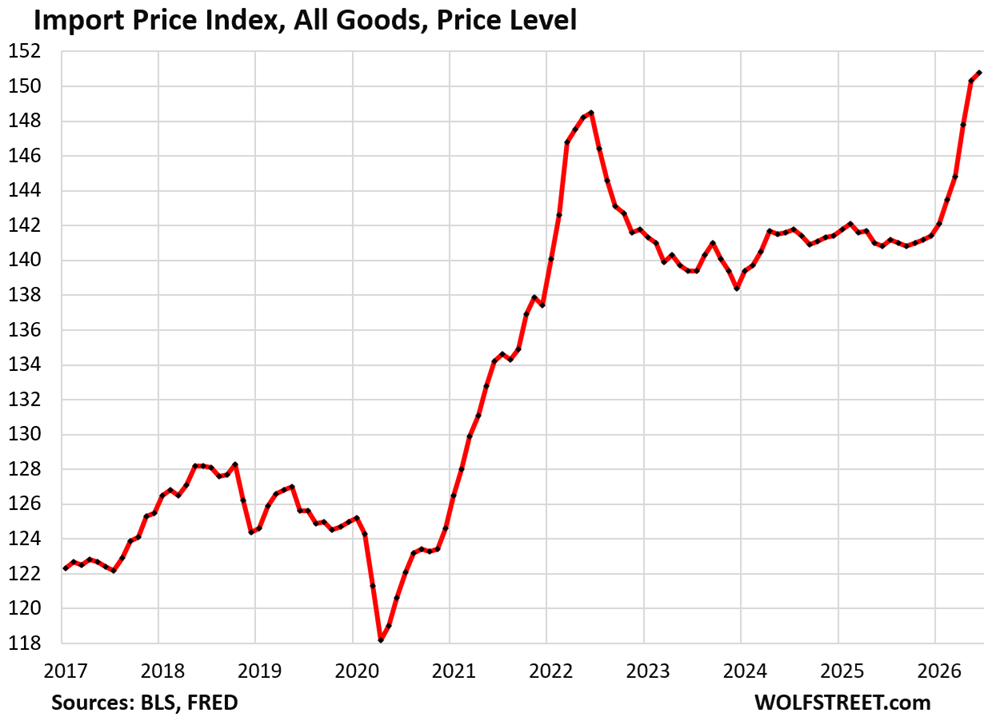
There are a lot of complexities that confuse the image. For example, prices of fuels shot up this year into May, then began plunging through June. But the US is the largest producer of crude oil, petroleum products, and natural gas in the world and runs big trade surpluses in energy products, exporting more than importing. And because prices of these exports by the US – primarily distillate (diesel), gasoline, jet fuel, pet coke, propane, ethane, butane, natural gasoline, and crude oil – have also shot up, the US economy overall (though not the consumer) benefits economically from higher prices of these products. This is not the 1970s anymore when high fuel prices just sucked the money out of the country.
Another complication is nonmonetary gold, whose price had spiked last year and into early this year, but has plunged since then. But nonmonetary gold has relatively little impact on the US economy and on inflation.
So we’re going to look at import prices of manufactured goods – and particularly of computer and electronic products, where the price action now is.
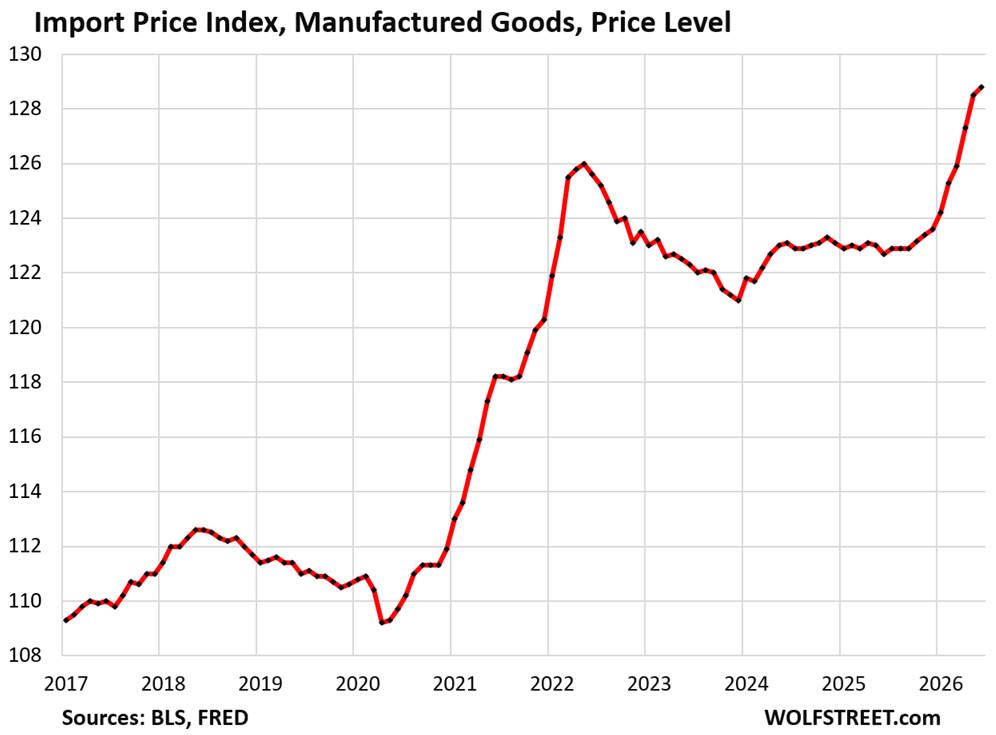
Import prices of manufactured goods have risen by 4.2% over the first six months this year, and by 5.0% year-over-year, according to the BLS today. The big driver was the surge in prices of imported computers and electronic products.
The US imported $2.9 trillion of manufactured goods over the past 12 months.
Import prices of computer and electronic products, a subgroup of manufactured goods, have shot up by 7.4% over the first six months this year, and by 8.0% year-over-year.
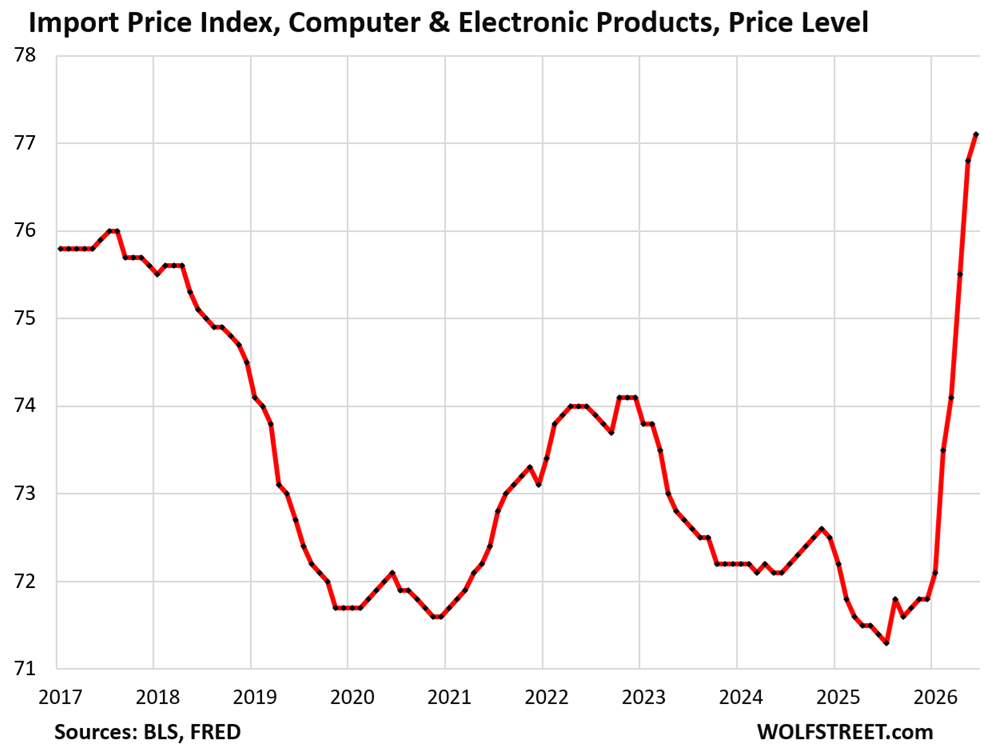
This is particularly interesting because prices of tech products have a long history of dropping as manufacturing processes have evolved and tech products have gotten immensely better over time. That $600 laptop we bought a couple of months ago has memory and computing power that would have required a big-box computer costing tens of thousands of dollars 30 years ago.
Between 2006 and 2019, the import price index for Computers and Electronic Products declined by nearly 30%. These products were a substantial deflationary factor in the inflation scenario through 2019.
The first shock to the long-term price declines came during the supply chain chaos in 2021 through 2022, when shortages of all kinds, including chip shortages, hit the industry, amid pumped-up demand from the shift to working at home and learning at home.
The second shock is now. And it’s huge, far bigger than the first shock. And this is one is caused by the AI investment boom that is sucking up semiconductors, servers, and all kinds of electronic components that are running into manufacturing capacity limits.
Giant companies with immense amounts of cash on their balance sheet, with immense funds raised from investors through equity and debt offerings, and startups of all kinds, are chasing after these products to build out their AI infrastructure, and in the desperate effort to get there first, they’re blowing money left and right, including for these products.
There are already reports of these import price increases migrating from corporate customers to services that consumers pay for, and to products that consumers buy, such as smartphones, laptops, all kinds of gadgets, appliances, etc.
Enjoy reading WOLF STREET and want to support it? You can donate. I appreciate it immensely. Click on the mug to find out how:


So AI fever spreads from electricity to electronics.
Basically at some point they had a brainstorm,
“How do we raise the price of XYZ?”
Bid it up!, They’ll pay.
Americans will buy in anticipation of inflation just like Latin Americans do. Then it becomes endemic. Cash and savings disappear for obvious reasons. I hope this does not happen!
Relevant measures since DXY hasn’t fallen. A big COLA won’t help interest rates.
“A 3.8% increase in benefits would raise the average Social Security check by about $74, from an estimated $1,938 to $2,011, the TSCL said”
Three Big Mac meals after taxes. So generous!
Where do you buy your BigMacs ?
COLAs are not designed to allow you to buy three extra Big Mac meals that you didn’t buy before. COLAs are designed so that you can continue to buy the same number Big Mac meals every month.
COLAs are not a “raise,” they’re a “Cost Of Living Adjustment” -they’re supposed to overcome the effect of inflation and no more.
We are in the digital age with more and more computer processing at lower costs. Yet something shifted dramatically with AI and the super computer companies that dominate the tech arena sometimes referred to the MAG7 +. Low capex margin dominated companies of global scale shifted from spending money on stock buybacks and job growth to CAPEX spending. From what I can tell this could lead to margin expansion for the end user as their marginal cost for software development drops considerably. My friend just had a quote on auto insurance that changed 20% in 20 days to a higher number. Which I attribute to AI changing the insurance quotes in real time to optimize revenues. I don’t think we will see many jobs displaced but rather a growth in different types of roles. But I do think compute requirements will increase causing higher costs for the higher end components.
It’s like they own all the toasters now.
We pay for a service that toasts our bread.
🍞
/s
Before, you could clear your cache and see the price drop. I expect AI will end that loophole on corporate gouging.
Sites like United and Amazon were robbing customers blind(and still are).
Last week I was quoted $337 one way Economy from Houston to Hawaii then it jumped to $1,200+ 3 days later. I cleared the cache and it went back down to $337. I booked 1st class for $880.
Forgot to include increasing crap customer service with AI phone and online contact hell to wade through for any dispute resolution. But hey, profits increased with no live reps to pay.
It is my understanding that the interest rate in Russia is 14.5%.
After Ukraine wins. Putin the Great will need a new job.
I suggest he be made head of the FED, since Volker is not available.
This would rather firmly deal with the hyperinflation of out times in the USA
On 5/1/25 a 1TB PNY CS900 SSD went for $54.99, today $159.99.
On 6/29/25 a 256GB PNY CS900 SSD went for $19.99, today $54.99.
Something of a shock after decades of falling prices for computer hardware.
It’s just a short term blip on the never ending declining cost curve of memory. I am old enough to have seen a 500 MB hard drive sell for $35,000 1980 dollars.
Didn’t Apple’s first hard-drive for the Mac (a separate box that you put the Mac on top of) have 10 MB and cost about $1,000 in 1985 dollars?
My first PC — two floppy drives, no hard drive, 640K (K!) of RAM, a black & green screen, plus a daisywheel printer and some basic software — cost $4,000 in 1985 dollars. I got a loan for that.
Holy cow, an IBM 8080 (or clone?).
My Dad had one of those!
I stayed up late into the night making desktop publishing crap, my own version of Mad Magazine and would pass it around the school. And then the Wordperfect function keys overlay, lol. Damn, were old!
DDR5 ram has gone up over 500% in the last 18 months. GPUs have doubled.
Like 24 hour grocery stores that never came back after COVID. The days of cheap personal computing are over.
Memory manufacturing is easy to scale up which is exactly what is happening to meet demand. This wave of AI investments is exactly that, a wave. What goes up, has got to come down.
“But what about in 5 years when the hardware in these dc’s becomes obsolete?” That’s when we’ll see two more waves. One wave of refreshes and new demand (which will have been anticipated by then), and one wave of bankruptcies for the ones that lost confidence and are left without investor money to splurge. Want to buy a dc anyone? Belonged to an old lady who only trained LLMs on it.
The RAM-aggedon affected consumer electronics early, initially hitting only businesses that needed to upgrade their computer memory and gaming computer builders/enthusiasts, with DDR5 prices increasing roughly 300% in the past year or so. That’s because these groups needed to buy the already expensive RAM directly, and had no older, cheap stock to fall back on.
Conversely, for a little while, many companies that sell ready-to-use / pre-built electronics which use RAM —
like a cellphone or your standard Asus or HP laptop— avoided shifting that cost to the consumer, even though they could have done that much earlier if they wanted to (despite having already bought their RAM stock at normal, pre-AI prices). That cushioned the blow for many consumers but said grace period is already ending.
Companies like Nintendo, Sony, Apple, cellphone makers, SSD storage makers, etc. have already started jacking up their pre-built product prices and there is no escape.
I rushed to buy new RAM sticks just as the prices were rising because I needed to upgrade my work/gaming PC, and luckily I had a lot of SSD storage already. But my partner bought a new laptop recently because her old one broke , and she paid 30% more than she would have for the same machine 8 months ago.
And even though I’m an avid gamer myself (and someone who often works on videogames too), I realize that the biggest issue with the AI/LLM bubble (the part of it that IS a bubble, anyway) is that all people, including your average consumer, businesses and self-employed people are getting shafted on more that mere entertainment. It’s getting harder to afford spractical everyday activities and productivity, and there are some voices saying that big corporations that have the means to sustain or rent huge cloud architectures will be taking advantage of the situation to offer everyday computer usage as a subscription service: you just needed a screen, keyboard, a cheap and super-basic CPU and a tiny storage device, a fast internet connection, and voila,. everything done via streaming: you can access all the graphics, computing power, software AND hardware you need for a small monthly sum that may (and will) be jacked up at any point. Also, your data will be used to train your provider’s LLM… And all that, without owning any of the hardware yourself.
I personally hope RAM makers increase capacity eventually, so we can avoid the most prolonged effects of all this.
Subscriptions: You will own nothing and be happy.
I wish AI would hurry up and benefit my life.
Doing business with companies on the phone and online is taking longer than ever. Asking my name and birthdate, etc a million times… reset my user and password 6 times and confirm 10 times.
And many financial transactions still work at snails pace. 7-10 business days etc… gotta let funds clear, settle…
Sent a wire the other day for a mortgage payment. Took a day to get there, a day to settle, 2 days to process, and 2 days after that to confirm the transaction.
It would be helpful if this Lightning data speed from these centers would stream line some of this… but it will be seen if that happens, or everything just becomes exponentially cumbersome with all this added data and processing.
And what about tariffs? Foreign exporters to the USA are not willing or able to take a haircut for long. So the tariffs have to land somewhere domestically. Even when manufacturing comes back, it will not lower costs. Hopefully it will raise incomes, somewhat. But somebody has to pay for that
along the chain.
Japanese and German automakers ate ALL the tariffs. See their earnings which plunged. Toyota’s CEO was ousted in February over that. Lots of foreign companies ate ALL the tariffs because they could not pass them on. Other foreign companies ate only a portion of the tariffs. Some foreign companies were able to not eat any of the tariffs and passed them on to US companies. Next stage in line were US companies that ate the tariffs. GM and Ford ate ALL the tariffs, couldn’t pass any of them on. See their earnings, which collapsed. Many other US companies passed some of the tariffs they had to take on to other US companies, thereby shuffling them around amongst each other. And most of the tariffs have remained there. This becomes clear in the PPI. Only a relatively small part of the tariffs was successfully passed on to consumers, such as in clothing and a few other things, which is documented by the inflation indices we have. Even the Fed concedes that the pass-through of tariffs to consumers was “minimal.”
Yes! The second wave of inflation is just getting started. It’s the summer of 73′ again Wolf, this time with almost 40 trillion in debt. no wonder the oligarchs and their bought-and-paid-for politicians want to take us to war. New world order, same old lies.
hedge accordingly
How do you see China eliminating the paper gold markets so that real price discovery happens? Conceptually I like the idea that ensuring a physical thing actually exists rather than paper which isn’t always clear everyone could hand in paper and ask for gold and get it. I get the importance of paper in other markets but feels like physical gold should exist for each piece of paper gold, whether it gets sent to you or not.
Cryptos aren’t even paper 🤣
Not sure how cryptos relates to my question but agree on the crypto front. I’m considering paying the truth social 100K to get him tweets a little early so I can strike it rich in the markets.
There is one crypto that is backed by PM and independently audited. The irony is that it was fonded by former people at the London bullion exchange who saw what was happening with paper contracts and decided to do something about it. Wish I bought more. It pays a dividend too.
“ That $600 laptop we bought a couple of months ago has memory and computing power that would have required a big-box computer costing tens of thousands of dollars 30 years ago.”
A $600 laptop today has the same computer power of a $15-50 million supercomputer 30 years ago.
It’s fun listening to the dudes on the All In Podcast whine about the general public pushing back on their precious data centers where so much of their PE is tied up.
Wolf,
I agree entirely that supply and demand factors in various product mkts are driving some of the inflation – especially the distribution of the inflation.
*But*
It seems very wrong to wholly omit the pandemic era money printing that empowered the Fed to drive interest rates close to zero and essentially financed the fever dream massive spending bills.
By dramatically altering the ratio of “money” to real existent physical assets, “inflation” is created by *definition* – where it goes is subject to supply/demand factors in each product mkt – but it *has to go **somewhere** (product inflation, interest rate flat-lining,…somewhere).
Leaving this out, is to ignore the biggest inflationary factor of all.
Absent Fed money printing, individual products can inflate in price…but aggregate price levels can’t. With money printing, the whole macro-economy will be inflated.
That is the biggest and most important point.
And every discussion of inflation should include it.
Read the article, not just the headlines. You’re talking about the first wave of inflation and money printing. But that’s OLD HAT. I discussed that for years here. And you slept through it all. Money printing stopped in early 2022 and turned into money un-printing ($2.4 trillion of QT). We’re now in mid-2026.
This here is the SECOND wave of inflation. So wake up. And this particular issue discussed in the article is fueled by the AI investment boom, and it has nothing to do with money printing.