
Federal government sheds more jobs, now down to 1966 levels. This labor market isn’t bad, just weird.
By Wolf Richter for WOLF STREET.
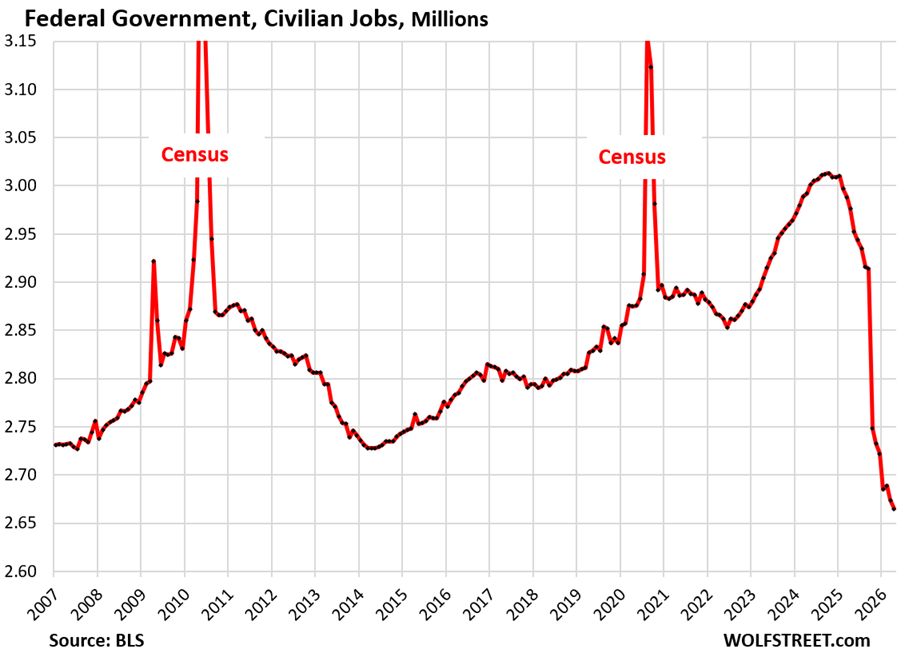
The drumbeat of job reductions at the federal government continued in April, with another 9,000 cuts in its civilian employment, including employees who’d departed earlier but whose severance packages ended in March.
Since January 2025, the federal government has shed 345,000 civilian employees, or nearly 12% of its staff. Federal government employment is now down to 2.66 million, the lowest since 1966, accounting for just 1.7% of total nonfarm payrolls, the lowest in the history of the Bureau of Labor Statistics data going back to 1939.
State government employment edged up in April from March, but is down by 53,000 since January 2025. Combined, federal and state governments have shed nearly 400,000 jobs since January 2025.
Local government employment – largely composed of educators, first responders, and healthcare workers – was unchanged in April, and up by 149,000 since January 2025.
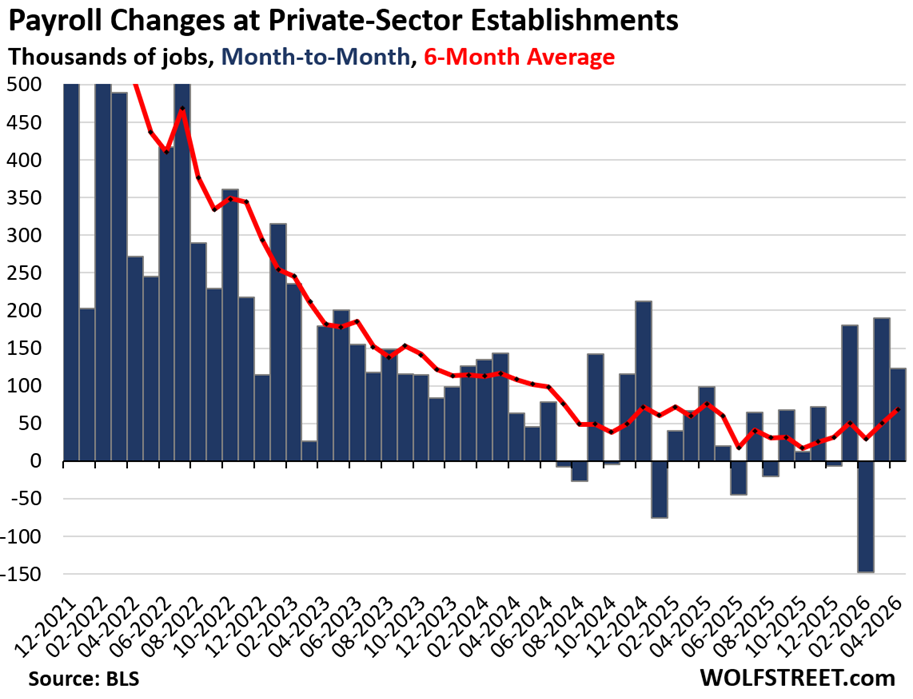
The private sector added 123,000 jobs in April, after an upwardly revised 190,000 additions in March. The month-to-month data yoyo has been quite strong. The huge private sector in the US doesn’t flipflop from month to month on a dime like this – it’s just that the data is yoyoing.
So the six-month average job gain, which flattens out the yoyo and shows the trend better, rose to 68,000 for April, the highest in a year (red in the chart).
Over the past 12 months, private-sector employers added 511,000 nonfarm jobs.
These job gains are low for the US under normal conditions. But now are not normal conditions as the labor force continued to shrink in April amid the crackdown on illegal immigration, tightening up of legal immigration, and the continued wave of boomer retirements.
But the federal government has shed about 12% of its headcount since January 2025, and is down to 2.66 million jobs, the lowest since 1966.
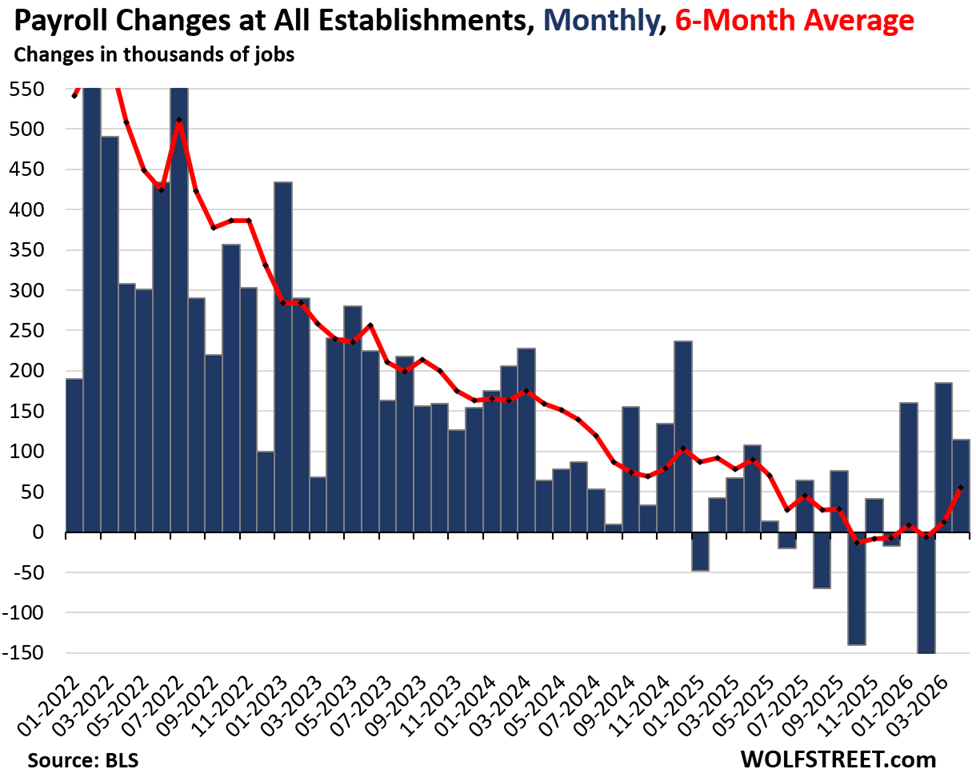
Total nonfarm payrolls, including government, rose by 115,000 in April, and by an upwardly revised 185,000 in March, to a record 158.7 million.
The six-month average rose to a gain of 55,000 in April, the highest in 11 months, despite the job losses at federal and state governments. The low point was in October last year.
Normally, such low job growth would cause the unemployment rate to rise sharply as the labor market would not be able to provide enough jobs for a growing labor force amid the influx of immigrants and young people moving into it at a faster rate than older workers retiring and dying.
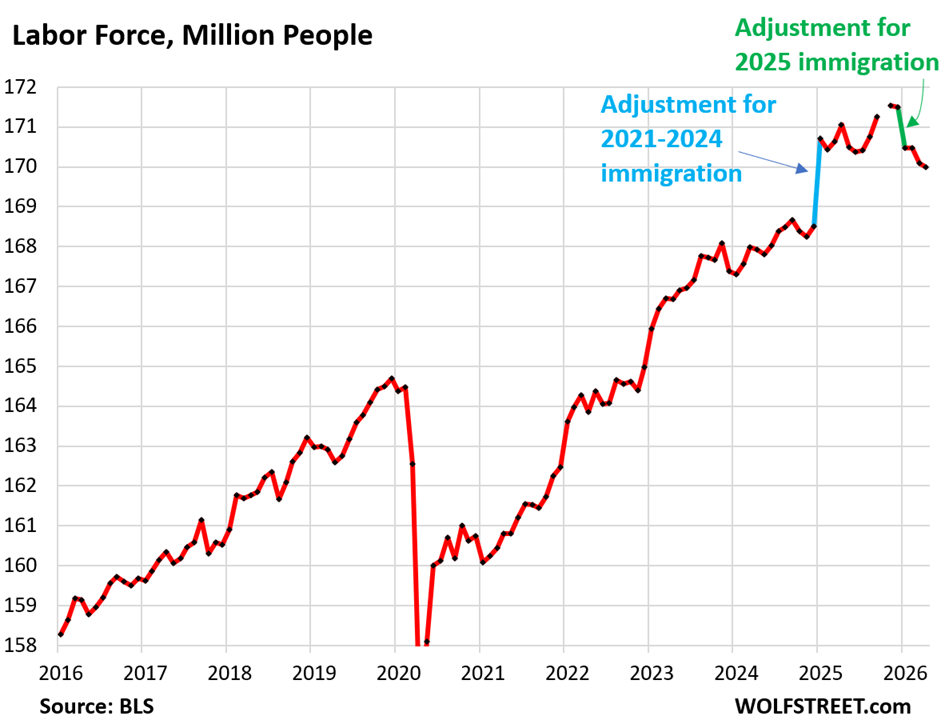
But that’s not happening anymore. The labor force has been dropping since last fall amid the crackdown on illegal immigration, a tightening up of some work-visa programs, and the wave of boomer retirements. In April, it dropped by another 92,000, to 169.99 million. Over the past six months, it has dropped by 1.45 million.
The labor force is the supply of labor, composed of people who are working or actively looking for work. And this supply of labor has shrunk by 1.45 million in six months!
The labor force data is based on household surveys that are adjusted annually at the beginning of the year to the Census Bureau’s revisions of the US population (blue and green segments in the chart).
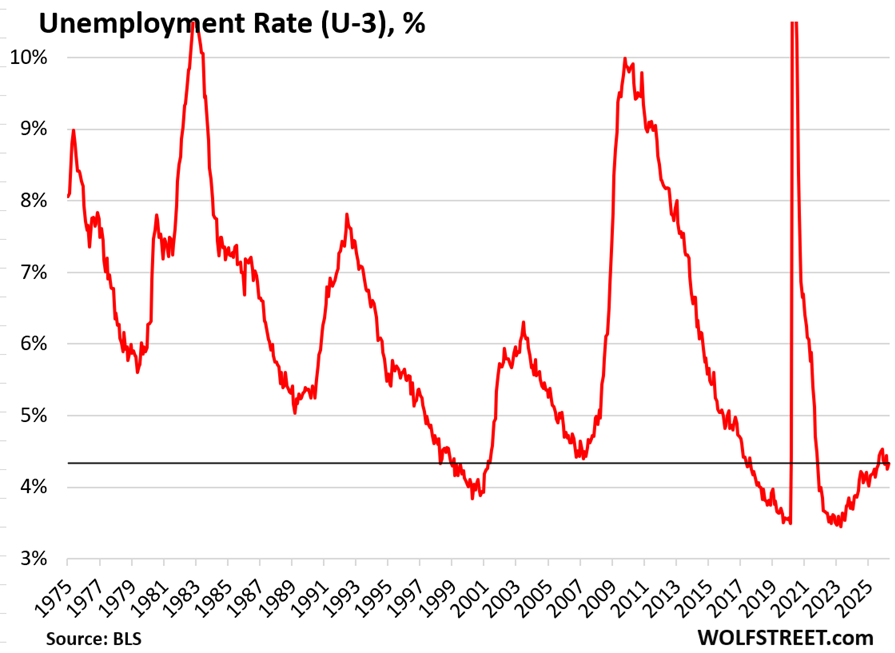
And so the unemployment rate has been roughly stable at a very low rate. In April, it was 4.3%, same as in March, down a hair from 4.5% last fall and up a hair from a year ago.
The unemployment rate reflects the number of unemployed people who are actively looking for a job (7.37 million) divided by the labor force (169.99 million).
From a long-term perspective, this is a tight labor market, but not because there is sharply growing demand for labor – there isn’t – but because of the declining supply of labor.
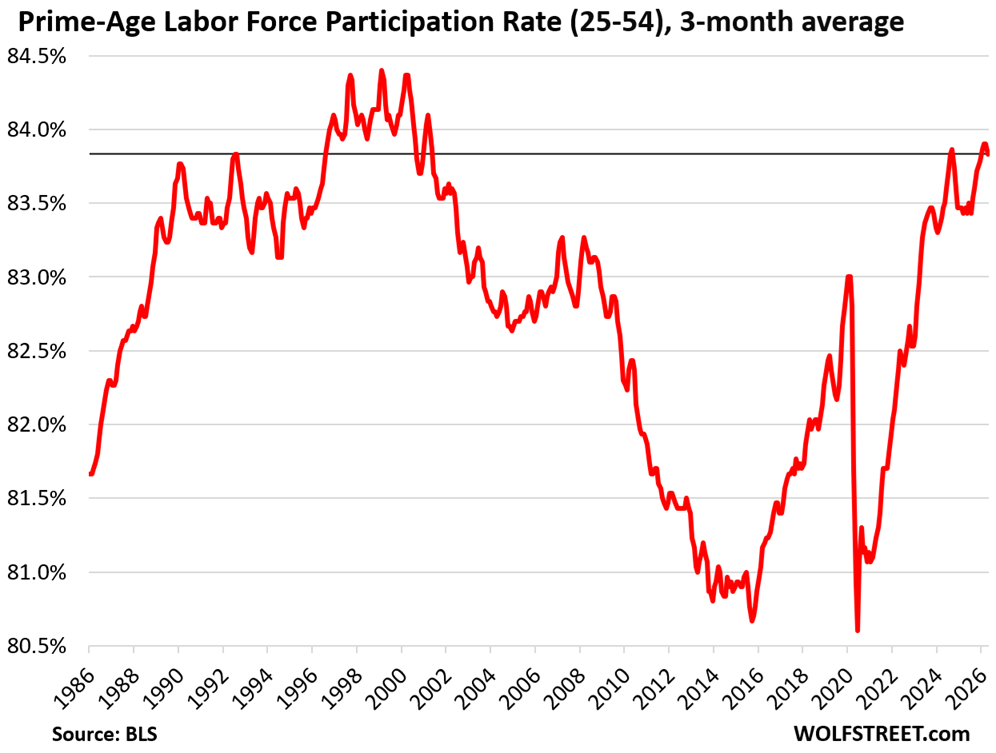
The prime-age labor force participation rate shows this tight labor market. The prime-age labor force consists of people between 25 and 54 years old. It eliminates the issue of the retiring boomers. When people retire and stop looking for a job, they’re no longer “participating” in the labor force but remain in the population until they die. It’s the surge of boomer retirements over the past 15 years that has pushed down the overall labor force participation rate.
In April, the prime-age labor force participation rate remained at 83.8%, and the three-month average was also 83.8%. This range has been the highest since the Dotcom Bubble in the 1990s.
It’s the result of more people getting pulled into the labor force by demand for labor as the supply of labor is constrained due to the crackdown on immigration and boomer retirements.
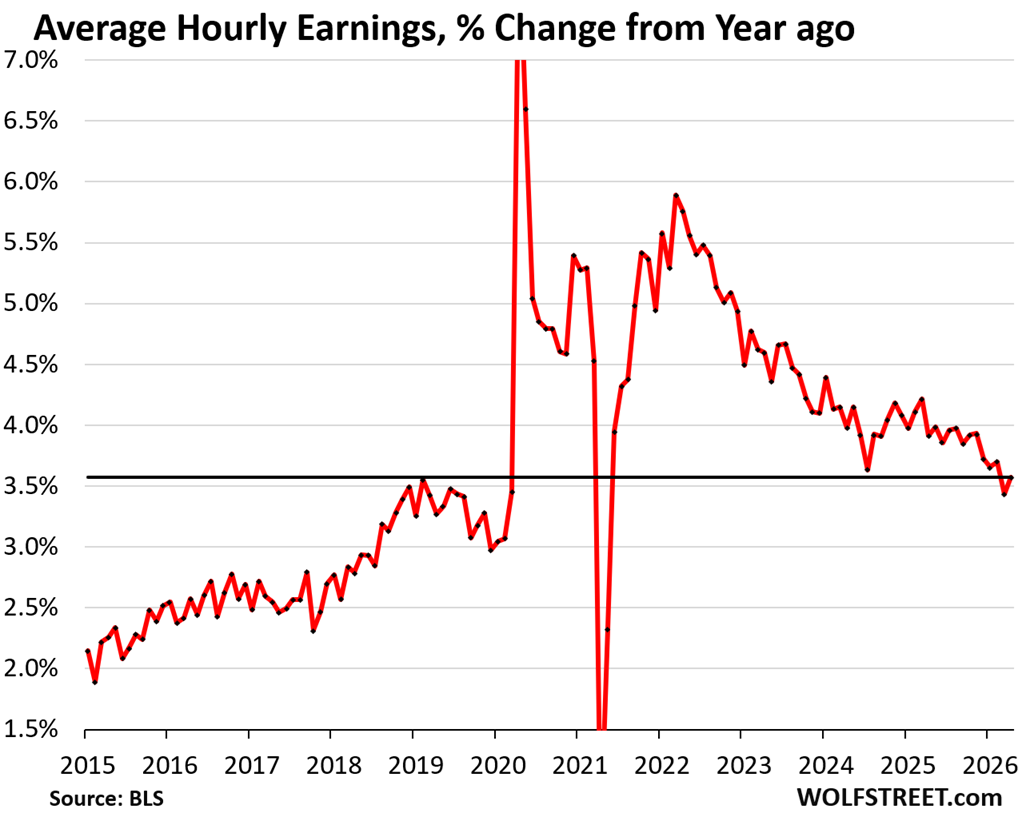
Average hourly earnings rose by 3.6% year-over-year in April.
Clearly, all these global layoff announcements by US companies since 2022, reported breathlessly in the media, and the actual layoffs that occurred in the US, despite continued but slow job growth and falling supply of labor, have the corporate-desired effect that workers have curtailed their demand for higher wages.
But now inflation is accelerating sharply and has about reached this rate of wage growth, putting wage growth at risk of falling below the rate of inflation.
Enjoy reading WOLF STREET and want to support it? You can donate. I appreciate it immensely. Click on the mug to find out how:


Employment to population ratio for 25-54 continues to be flat as a board: 81% of people in prime working years have jobs, also very similar to the dot com years and a close second for highest in US history.
Taylor rule continues to call for Fed Funds Rate about one quarter point higher than it currently is, though interestingly is dropping slightly.
It’s ironic that Trump wants lower interest rates, but he keeps doing things that lead to higher rates.
Tariffs, Iran, and the OBBBA are inflationary, and have kept the Fed from being able to lower rates.
His immigration policy tightens the labor market, reducing unemployment, and props up the other side of the Fed’s dual mandate. Again, no reason to cut.
Unless he actually wants higher rates, but is using some kind of reverse psychology when he screams for lower ones?
Howdy Beats Me. Trumpy Tweets are truly something. They seen to even have StockBOYS reading them. ” Making US Kings of Energy solves everything. ” . Pretty sure that is what he is thinking….That s what he always kept saying to Opra anyway.
So rate cuts? /sarcasm
Dependency ratio going to take a fun ride over the next 20 years.
Monetary policy isn’t the right solution. I’m sure we’ll hear about how young people need cheaper borrowing rates, what they really need is lower asset prices and better policy.
Wolf, at what point, if any, would the decreasing labor force become an issue from a tax revenue perspective? Treasury.gov has individual income taxes as 50.7% of tax revenue (FY2025). While 1.45 million out of 171.4 million (1.45 + 169.99) is a rather minor decrease (-0.85%) over the past six months, any sustained decrease in potential tax revenue when the deficit continues to balloon seems like it would be concerning.
We regularly see that healthcare is adding jobs. This is fitting given the aging population. However, I do wonder how sustainable this really is in the context of the giant US deficit and coming Medicaid cuts.
Oh it’s big bad. There will be a reckoning for sure. Employment is growing, and they have very effective collective bargaining/cartel status that allows them to set rate for an essential service.
It will be a massive GDP drag. The whole private/public debate doesn’t matter, it’s functionally an unproductive portion of the labor market regardless of where its housed.
The literature is clear on what happens when too much of a societies’ effort goes into a non-productive corners of the economy.