
10th liquefaction & export terminal shipped first cargo. List of LNG export terminals, operating and under construction, by in-service date.
By Wolf Richter for WOLF STREET.
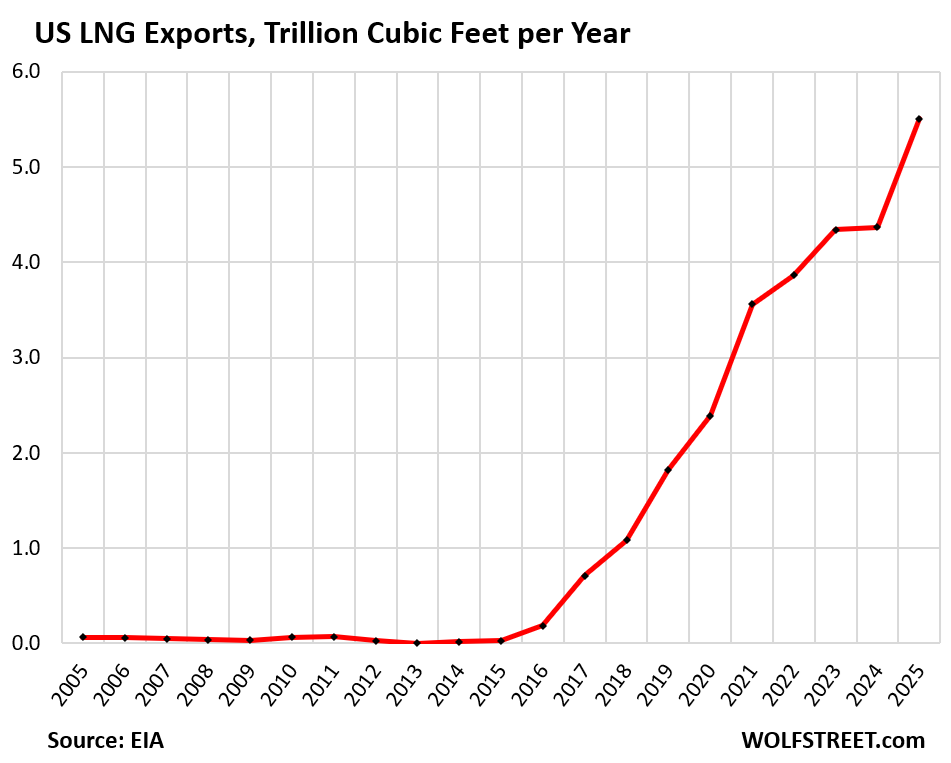
Exports of liquefied natural gas (LNG) took off when the first liquefaction train and export terminal in the lower 48 states, Cheniere Energy’s Sabine Pass in Louisiana, began operating in 2016.
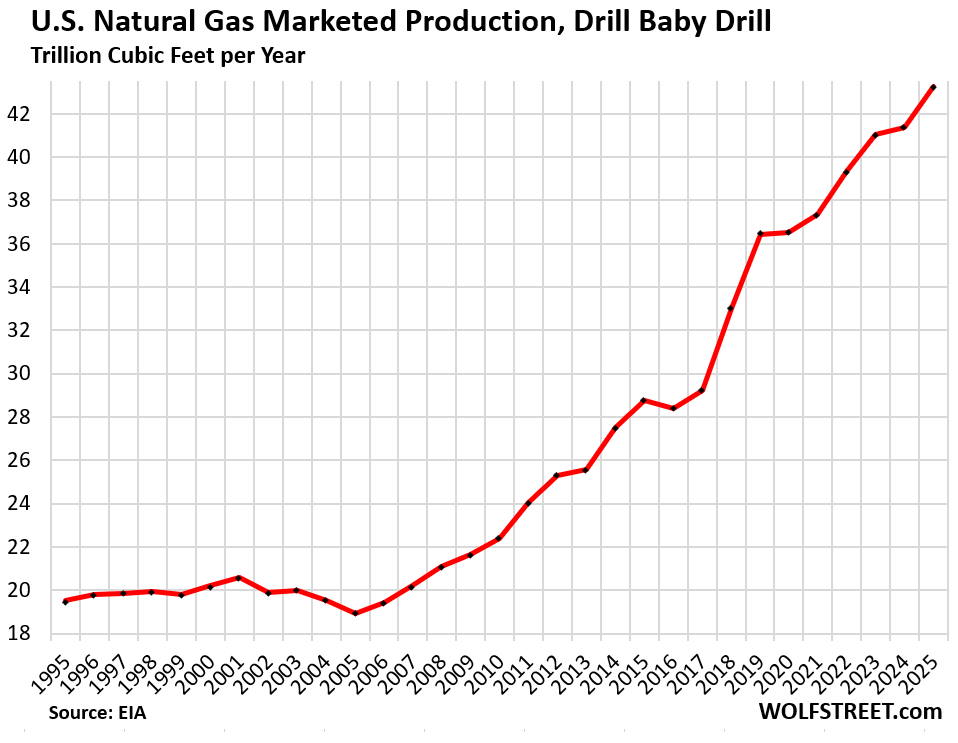
The ramp-up of fracking turned the US into the largest natural gas producer in the world by 2011, and generated a massive glut of natural gas in the US that no one knew how to throttle because a substantial portion of natural gas is a byproduct from fracked oil wells, and so with no exit for this production, other than by pipeline to Mexico, the price had collapsed, and hundreds of drillers went bankrupt in 2016.
LNG exports provided an outlet. LNG exports are limited only by the capacity of the export terminals, and this became a gigantic business, with new export terminals getting built for billions of dollars each in Louisiana, Texas, Georgia, and Maryland.
The newest and 10th LNG export terminal in the US, Golden Pass LNG in Texas, operated by Qatar Petroleum and ExxonMobil, shipped its first LNG cargo yesterday from liquefaction Train 1. Train 2 is scheduled to be completed later in 2026, and Train 3 in early 2027.
When all three trains are operational, they will have a combined nominal capacity of 16.6 million tonnes per annum (Mtpa) and a peak capacity of 18 Mtpa, according to EIA data. Export terminals normally run at over 100% of nominal capacity but less than peak capacity.
This brings the total operating capacity in the US to 121.8 Mtpa nominal and 147.8 Mtpa peak.
Numerous facilities are under construction, including Train 2 and Train 3 of Golden Pass, and they combined will add a nominal capacity of 100.9 Mtpa and a peak capacity of 118.6 Mtpa by 2031, over 40% of which is expected to start commercial operations in 2027. See table below.
It takes years to build a liquefaction and export facility. The investment decision for Golden Pass LNG was made in February 2019, and the first cargo was shipped in April 2026. But that project was delayed because the lead construction contractor, Zachry Holdings, filed for bankruptcy in 2024. This tangled the project up in court, and it took a while before a new lead contractor, Chiyoda International Corp, could take over.
When fully operational, Golden Pass (nominal capacity of 15.6 Mtpa) will be the third-largest facility in the US, behind Cheniere’s Sabine Pass (27.0 Mtpa) and Venture Global Inc.’s Plaquemines LNG (19.8 Mtpa).
The US became the largest LNG exporter in the world a few years ago, surpassing Qatar and Australia.
In 2023, no new export terminals came on line, and during the first 11 months of 2024, no export terminal came on line, which is why LNG exports in 2024 were flat.
But at the end of 2024, the huge Plaquemines LNG Phase 1 terminal (9.9 Mtpa) started operating, and in February 2025, the huge Corpus Christi Liquefaction Stage 3 (10 Mtpa) started operating, and exports of LNG shot up in 2025.
In terms of the Strait of Hormuz in billion cubic feet per day: The amount of LNG that was going through the Strait of Hormuz, but is now blocked, amounted to just over 10 Bcf/d, according to the EIA. Nominal US capacity has now reached 16.5 Bcf/d including the 0.68 Bcf/d from Train 1 of the Golden Pass terminal.
The US also exports large and growing amounts of natural gas via pipelines to Mexico; and it exports via pipeline to Canada, and imports from Canada (importing more than exporting), as a result of where producing and consuming regions, and pipeline connections, in both countries are.
Fracking has turned the US into such a prodigious natural gas producer in part because fracked oil wells produce a variety of liquid and gaseous hydrocarbons as byproducts, including natural gas. A substantial part of natural gas production being just a byproduct from oil wells changes the economic equation.
In the early days of fracking, those gases were flared because there was no takeaway infrastructure for gases. But pipelines caught up, and now there is massive production of natural gas whether anyone wants it or not (details here in my annual update on US natural gas production and exports).
| US Liquefaction Export Terminals, by in-service date | ||||||
| In-service date | Nominal capacity | Peak capacity | ||||
| Project name | Operator | Train | Mtpa | Mtpa | ||
| Sabine Pass | LA | Cheniere Energy | Train 1 | Feb/2016 | 4.5 | 5.8 |
| Sabine Pass | LA | Cheniere Energy | Train 2 | Aug/2016 | 4.5 | 5.8 |
| Sabine Pass | LA | Cheniere Energy | Train 3 | Jan/2017 | 4.5 | 5.8 |
| Sabine Pass | LA | Cheniere Energy | Train 4 | Aug/2017 | 4.5 | 5.8 |
| Cove Point | MD | Berkshire Hathaway BHE GT&S | Train 1 | Mar/2018 | 5.3 | 5.8 |
| Sabine Pass | LA | Cheniere Energy | Train 5 | Nov/2018 | 4.5 | 5.8 |
| Corpus Christi | TX | Cheniere Energy | Train 1 | Dec/2018 | 4.5 | 6.1 |
| Cameron | LA | Sempra LNG | Train 1 | May/2019 | 4.5 | 5.0 |
| Corpus Christi | TX | Cheniere Energy | Train 2 | Jul/2019 | 4.5 | 6.1 |
| Elba Island | GA | Kinder Morgan | Trains 1-5 | Sep/2019 | 1.3 | 1.4 |
| Freeport | TX | Freeport LNG Development | Train 1 | Sep/2019 | 5.0 | 6.0 |
| Cameron | LA | Sempra LNG | Train 2 | Dec/2019 | 4.5 | 5.0 |
| Freeport | TX | Freeport LNG Development | Train 2 | Dec/2019 | 5.0 | 6.0 |
| Freeport | TX | Freeport LNG Development | Train 3 | Mar/2020 | 5.0 | 6.0 |
| Elba Island | GA | Kinder Morgan | Trains 6-10 | May/2020 | 1.3 | 1.4 |
| Cameron | LA | Sempra LNG | Train 3 | Aug/2020 | 4.5 | 5.0 |
| Corpus Christi | TX | Cheniere Energy | Train 3 | Dec/2020 | 4.5 | 6.1 |
| Sabine Pass | LA | Cheniere Energy | Train 6 | Dec/2021 | 4.5 | 5.8 |
| Calcasieu Pass | LA | Venture Global LNG | Trains 1-9 | Mar/2022 | 5.0 | 6.0 |
| Calcasieu Pass | LA | Venture Global LNG | Trains 10-18 | Sep/2022 | 5.0 | 6.0 |
| Plaquemines LNG Phase 1 | LA | Venture Global LNG | Trains 1-18 | Dec/2024 | 9.9 | 12.0 |
| Corpus Christi Liquefaction Stage 3 | TX | Corpus Christi Liquefaction | Trains 1-7 | Feb/2025 | 10.0 | 11.5 |
| Plaquemines LNG Phase 2 | LA | Venture Global LNG | Trains 19-36 | Sep/2025 | 9.9 | 12.0 |
| Golden Pass | TX | Qatar Petroleum, ExxonMobil | Train 1 | Mar/2026 | 5.2 | 6.0 |
| Total operating | 122 | 148 | ||||
| Under construction: | ||||||
| Project name | Operator | Train | Mtpa | Mtpa | ||
| Golden Pass | TX | Qatar Petroleum, ExxonMobil | Train 3 | 2026 | 5.2 | 6.0 |
| Golden Pass | TX | Qatar Petroleum, ExxonMobil | Train 2D | 2027 | 5.2 | 6.0 |
| Port Arthur LNG Phase 1 | TX | Sempra Energy | Trains 1-2 | 2027 | 12.0 | 13.5 |
| Rio Grande LNG Phase 1 | TX | NextDecade Corporation | Train 1 | 2027 | 5.4 | 5.9 |
| Rio Grande LNG Phase 1 | TX | NextDecade Corporation | Train 2 | 2027 | 5.4 | 5.9 |
| Venture Global CP2 Phase 1 | LA | Venture Global LNG | Trains 1-26 | 2027 | 14.4 | 20.2 |
| Corpus Christi Liquefaction Midscale | TX | Corpus Christi Liquefaction | Trains 8-9 | 2028 | 3.0 | 3.6 |
| Rio Grande LNG Phase 1 | TX | NextDecade Corporation | Train 3 | 2028 | 5.4 | 5.9 |
| Woodside Louisiana LNG Phase 1 | LA | Woodside Energy | Trains 1-3 | 2029 | 16.6 | 17.7 |
| Venture Global CP2 Phase 2 | LA | Venture Global LNG | Trains 27-36 | 2029 | 5.6 | 8.8 |
| Rio Grande LNG Phase 2 | TX | NextDecade Corporation | Train 4 | 2030 | 5.4 | 5.9 |
| Port Arthur LNG Phase 2 | TX | Sempra Energy | Trains 3-4 | 2031 | 12.0 | 13.5 |
| Rio Grande LNG Phase 2 | TX | NextDecade Corporation | Train 5 | 2031 | 5.4 | 5.9 |
| Total under construction | 101 | 119 | ||||
Enjoy reading WOLF STREET and want to support it? You can donate. I appreciate it immensely. Click on the mug to find out how:


LMG + Nuclear should be our foundation on which to build renewable energy sources (dependent on Geography constraints).
Nuclear has had quite a jump-restart recently. Quite a few projects (AI/Data Center) are seeking to use reactors to power their infrastructure. While their use-case might not be savory, hopefully their safe usage will trickle down to grid operation in the future.
Wolf had an article about this not too long ago.
And yet somehow they can’t produce or store enough helium (natural gas impurity) to fix the critical shortage faced by scientists.
What are the plans for when it runs out and fracking operations become stranded assets?