
Foreign demand for the ballooning US Treasury debt is an increasingly important issue. But how much of that demand is actually “foreign?”
By Wolf Richter for WOLF STREET.
The US government’s $39 trillion in debt is held by all kinds of investors, including foreign investors. When investors lose their appetite for this debt, yields would rise until they’re high enough to attract new investors. Higher yields mean higher borrowing costs and even bigger deficits for the US government. All eyes have been on foreign investors to see if they start losing their appetite. And some have – especially China and Hong Kong – but others have piled into it.
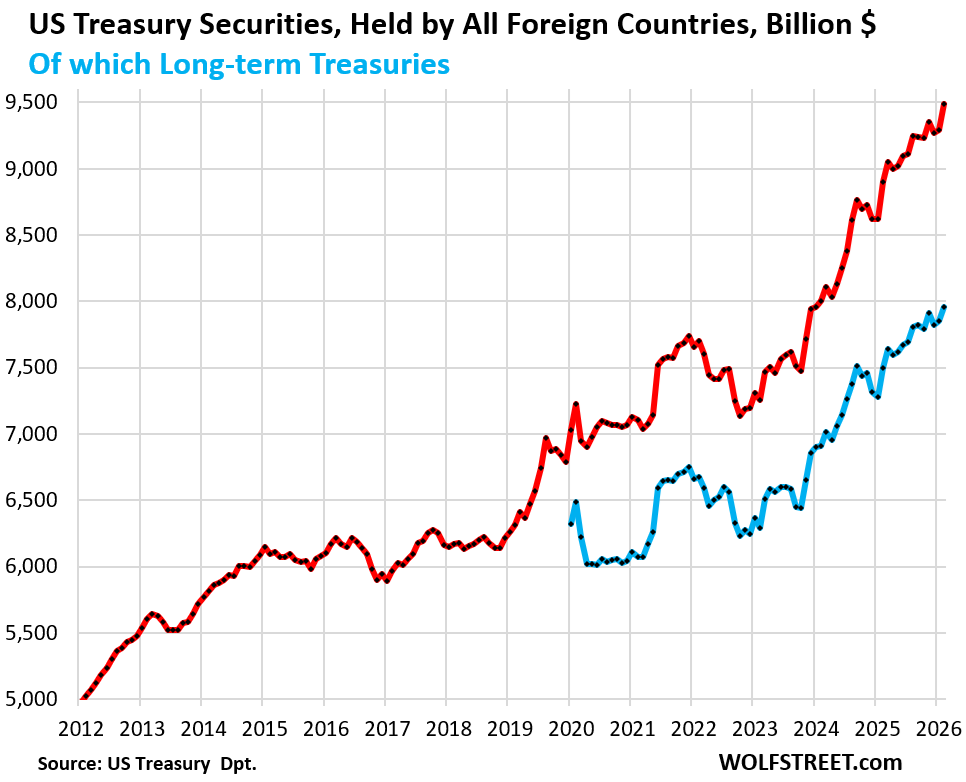
All foreign investors combined piled on another $198 billion of Treasury securities in February, and $587 billion over the past 12 months, bringing their total holdings to a record $9.49 trillion, according to Treasury Department data today (red line in the chart below).
Of that $9.49 trillion, $7.76 trillion (84%) were long-term Treasury securities (blue), and the rest were short-term Treasury bills.
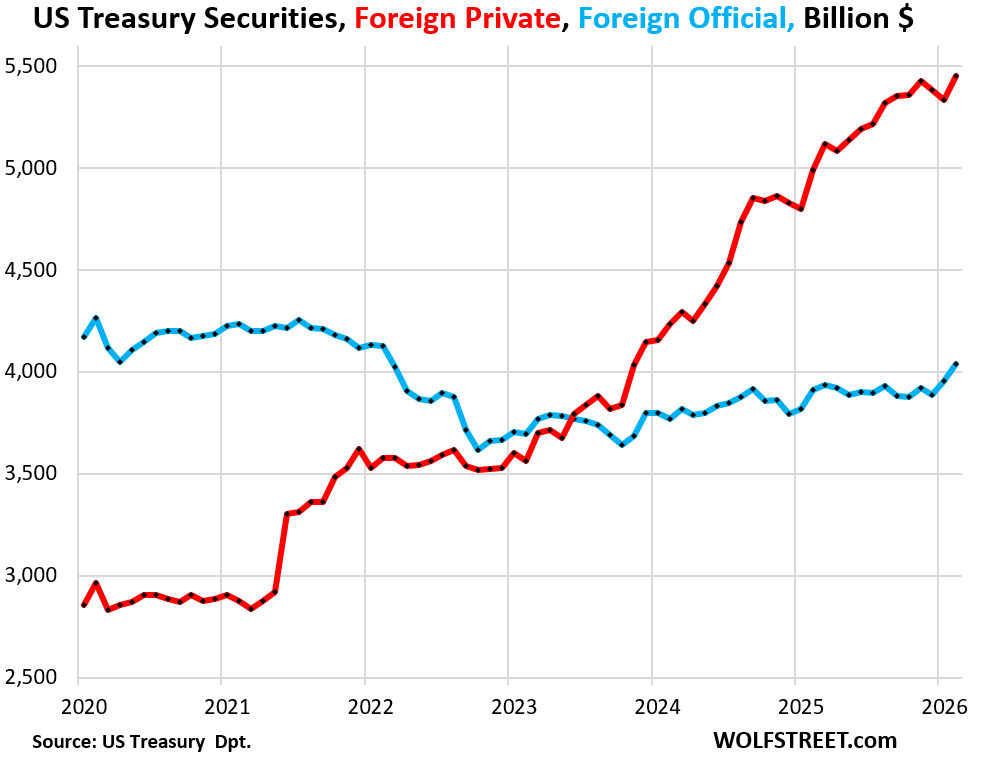
The driver behind the multi-year increase were “private foreign” holders: they increased their Treasury holdings by $117 billion in February, and by $461 billion over the 12-month period, to a record $5.45 trillion (red in the chart below).
These private foreign investors include financial firms in other countries, foreign bond funds, foreign companies, individuals in foreign countries, but also US hedge funds domiciled in the Cayman Islands, such as those engaged in the “Basis Trade,” and Corporate America with financial entities in Ireland, such as to legally dodge US taxes.
“Foreign official” holders, such as central banks and government entities increased their holdings by $81 billion in February and by $126 billion in the 12-month period, to $4.04 trillion – well below their holdings a few years ago (blue line).
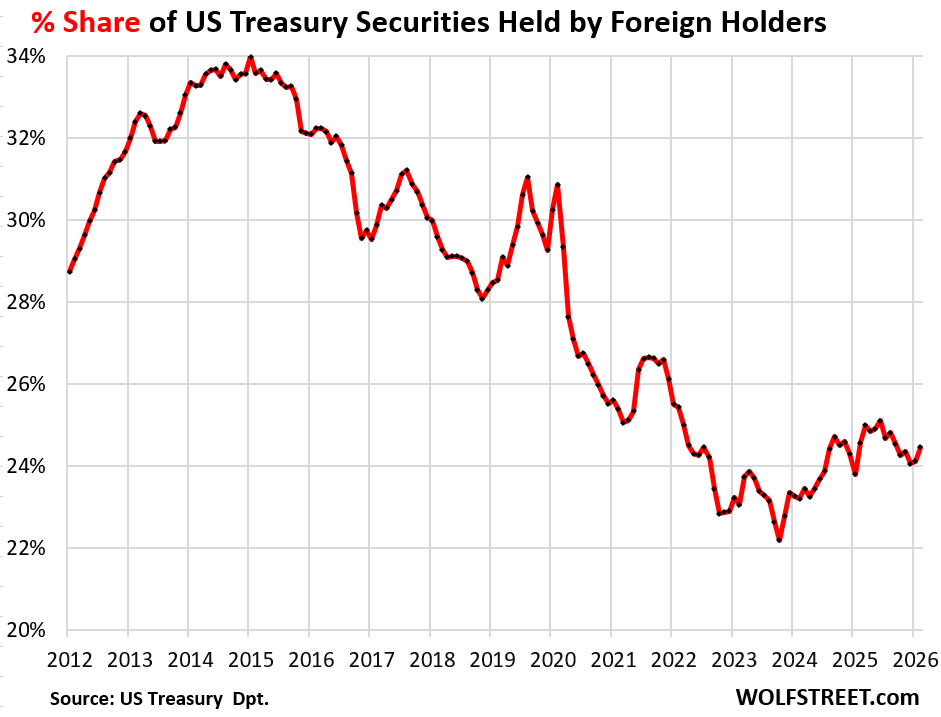
The share of total Treasury securities held by foreign entities had peaked at 34% in 2015, then fell to a low of 22% in October 2023, and has been marching higher since then.
However, during the Debt Ceiling period in January through June 2025, the US Treasury debt did not increase, while foreign holdings continued to rise along trend, and so their share rose. Starting in July 2025, the US issued large amounts of debt to refill its drained checking account, in addition to funding the ongoing deficits, while foreign holdings continued to increase along trend, and their share then eased.
In February, their share rose to 24.5%, the highest since September, after already increasing in January.
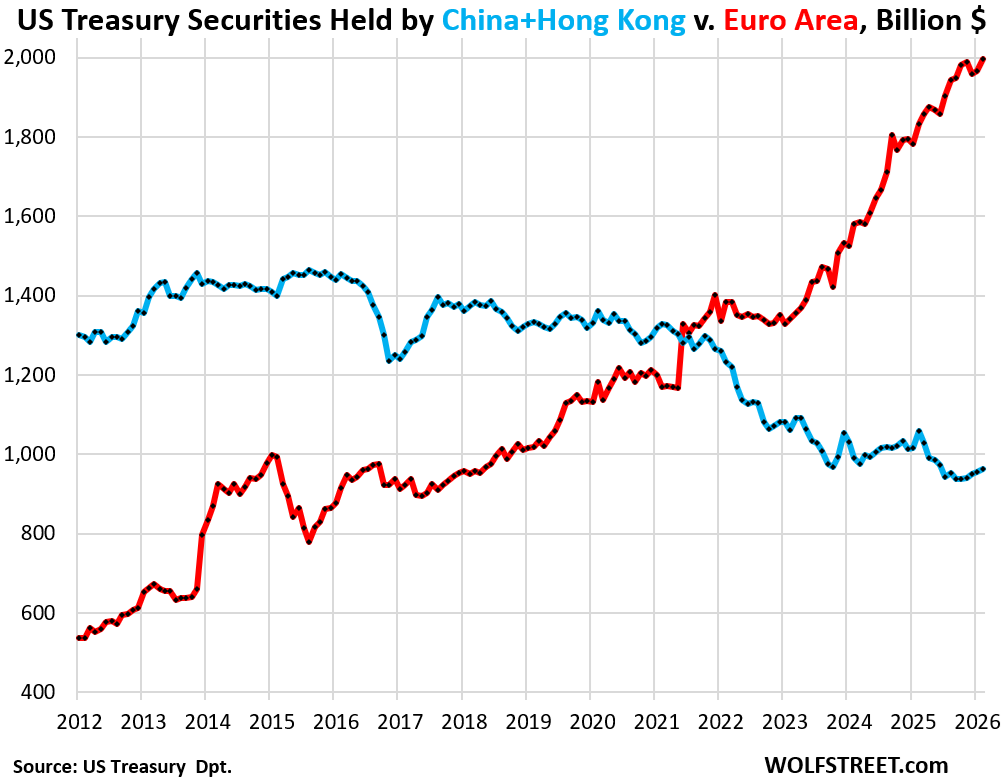
Big Shift: China & Hong Kong versus Euro Area.
China and Hong Kong combined added $8 billion in February, but over the 12-month period shed $96 billion, bringing their holdings to $962 billion. They have cut their holdings by more than one-third over the past 10 years (blue in the chart below).
The Euro Area has been loading up on Treasury securities hand over fist and in February added another $32 billion, to a record $2.0 trillion. Over the 12-month period, the Euro Area added $164 billion (red).
The biggest holders in the Euro Area are the financial centers (Luxembourg, Ireland, Belgium) and France, whose banking system also has functionalities of a global financial center. Their combined holdings accounted for 82% of the Euro Area’s total holdings. More in a moment. But Germany, a big exporter to the US and the largest economy in the Euro Area, only held $109 billion and doesn’t even make it to the Treasury Department’s list of top 20 “Major Holders.”
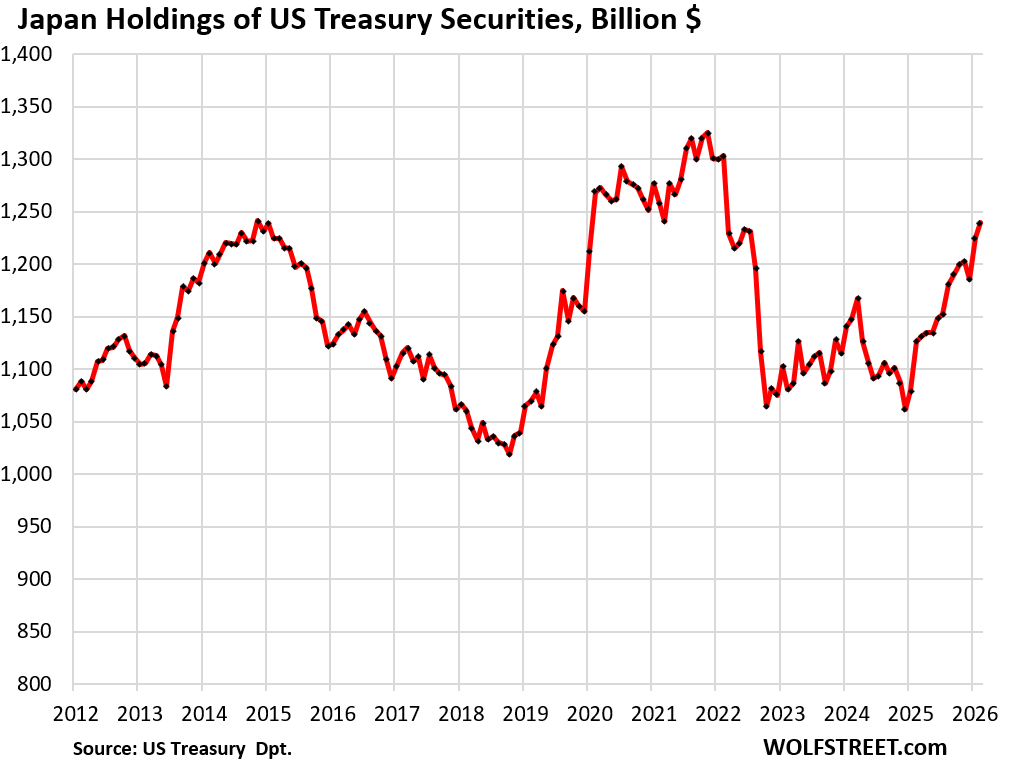
Japan’s holdings of Treasury securities rose by $14 billion in February, and by $113 billion over the 12-month period, to $1.24 trillion.
Japan’s holdings have remained in the range between $1.0 trillion 1.3 trillion for many years, despite the large fluctuations in between. Japan periodically sold large amounts of its USD holdings and purchased yen with the proceeds to the support the plunging yen.
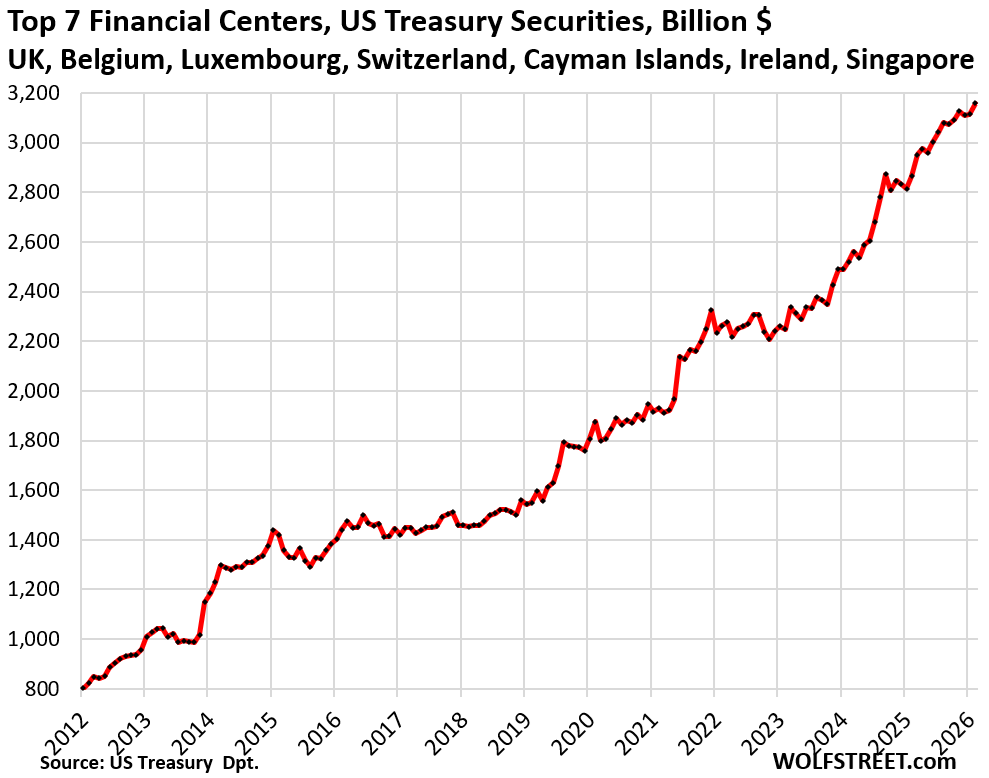
The seven largest financial centers piled on another $44 billion in February and $295 billion over the 12-month period, bringing their total holdings to a record $3.16 trillion. They more than doubled their Treasury holdings over the past 10 years.
Changes in February, and total Treasury holdings:
- United Kingdom: +$18 billion, to $897 billion
- Cayman Islands: +$10 billion to $443 billion (or closer to $2 trillion, according to the Federal Reserve’s analysis of the basis trade, see below)
- Belgium: $4 billion to $455 billion
- Luxembourg: -$0.3 billion, to $446 billion
- Ireland: +$9 billion to $351 billion
- Switzerland: -$2 billion to $287 billion
- Singapore: +$7 billion to $280 billion.
A big portion of Treasuries at these financial centers are held by US entities. These countries specialize in handling the financial holdings of global companies, hedge funds, individuals, and governments.
For example, Ireland is a favorite for US Big Pharma and Big Tech to store their profits. Belgium is home to Euroclear, which has $40 trillion in assets under custody for companies, governments, and wealthy individuals around the world.
And the Cayman Islands are where US hedge funds are domiciled, including those that are engaged in the huge “basis trade.” More on that situation in a moment
The “basis trade” and the Cayman Islands.
Many big US hedge funds are domiciled there, and their Treasury holdings would normally count as holdings in the Cayman Islands.
But the $443 billion in Treasury holdings currently attributed to the Cayman Islands massively undercounts the actual Treasury holdings by US hedge funds that are domiciled there.
The Federal Reserve Bord of Governors, in a report last October, showed that Treasury holdings by Cayman-domiciled US hedge funds were undercounted by $1.4 trillion at the end of 2024.
The report found that the Treasury International Capital (TIC) data, which these numbers here are based on, fails to capture a big part of the Cayman-domiciled US hedge funds’ Treasury positions and instead accounts for them as US domestic holdings. Other government data has a better handle on the Cayman-held Treasuries, according to the report.
These Cayman-domiciled US hedge funds engage in the basis trade. They’re highly leveraged in these positions. They’re long (they buy) Treasury securities and are short (they sell) Treasury cash-futures. It’s a massive business. In normal times, it provides liquidity to the Treasury market. During times of turmoil, such as in March 2020, those trades cause the Treasury market to seize – and the Fed ended up stepping into it to get it going again.
So the actual Treasury holdings in the Cayman Islands would be close to $2 trillion, not $443 billion – more than any other country.
And total “foreign” holdings would then be close to $11 trillion, not $9.49 trillion.
But these holdings by Cayman-domiciled US hedge funds are foreign holdings in name only. That’s the same issue with the other financial centers that hold Treasuries of US entities. That’s not really “foreign” demand for US Treasury securities.
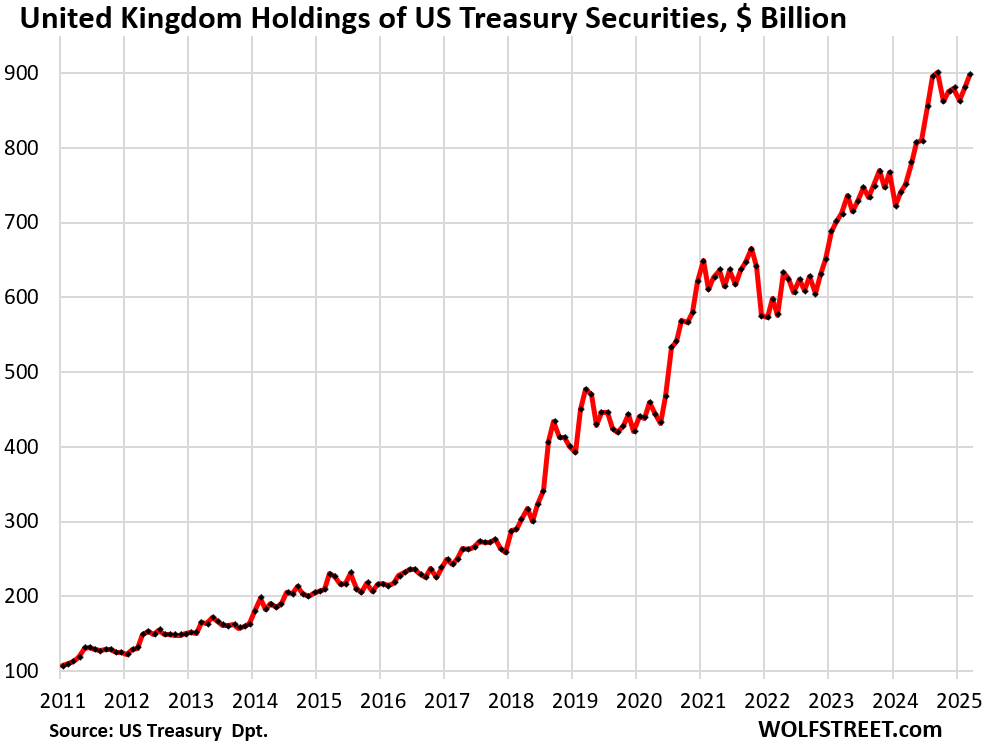
The United Kingdom is the “City of London” financial center. Its Treasury holdings rose by $18 billion in February and by $147 billion in the 12-month period, to $897 billion. The record was in August 2025 at $901 billion.
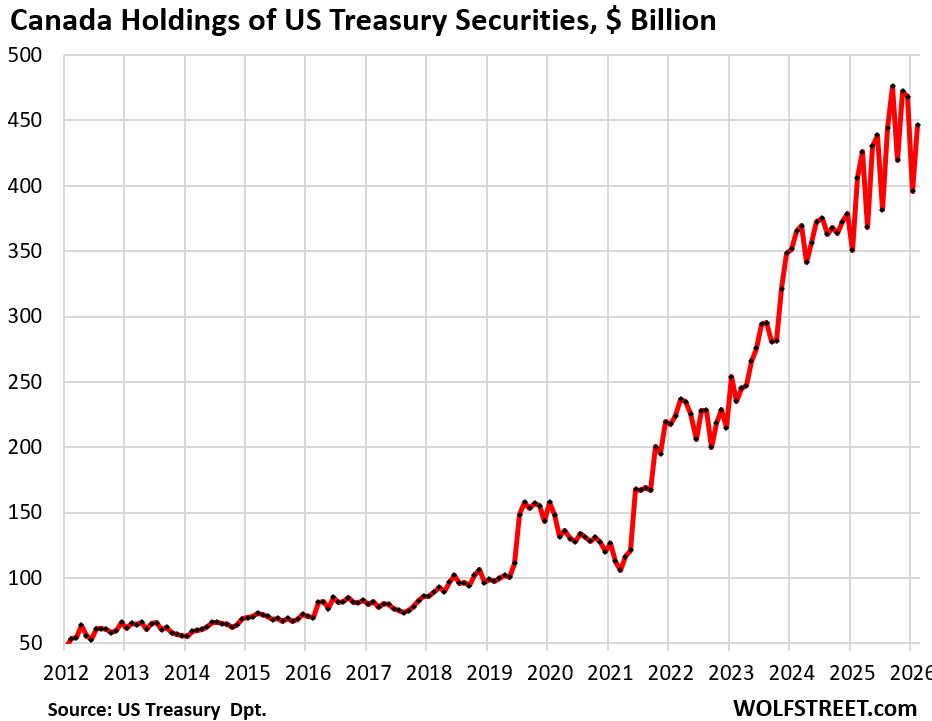
Canada’s holdings have been gyrating up and down in massive spikes and plunges in all of 2025, and that continued into 2026. In February, they jumped by $50 billion, after the plunge in the prior month, to $446 billion.
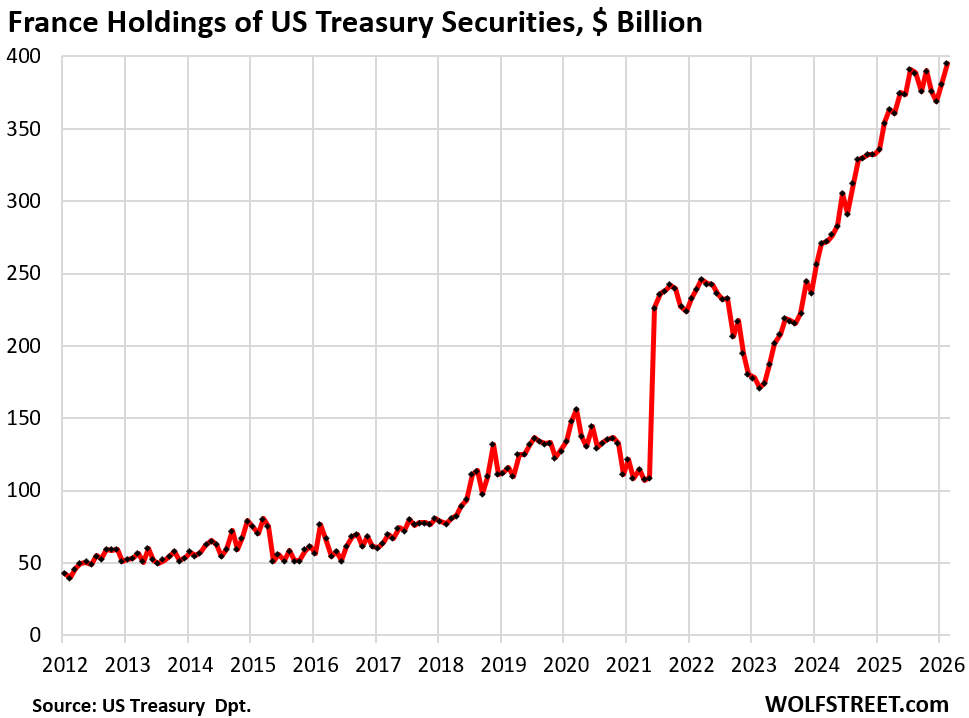
France’s holdings rose by $15 billion in February, and by $41 billion in the 12-month period, to a record $395 billion.
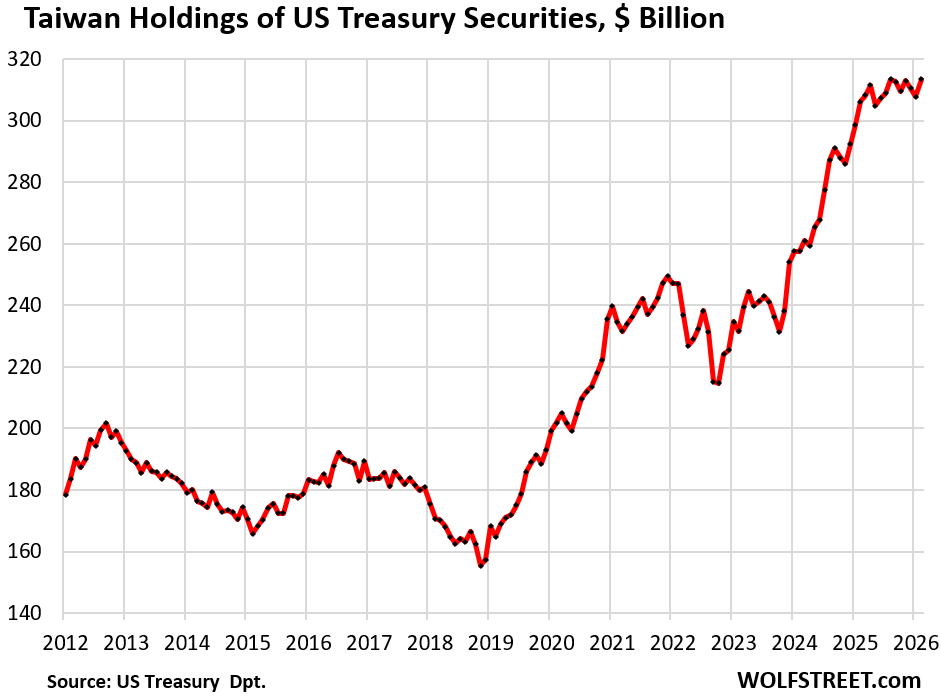
Taiwan’s holdings rose by $6 billion in February to $314 billion, and were up by $7 billion over the 12-month period:
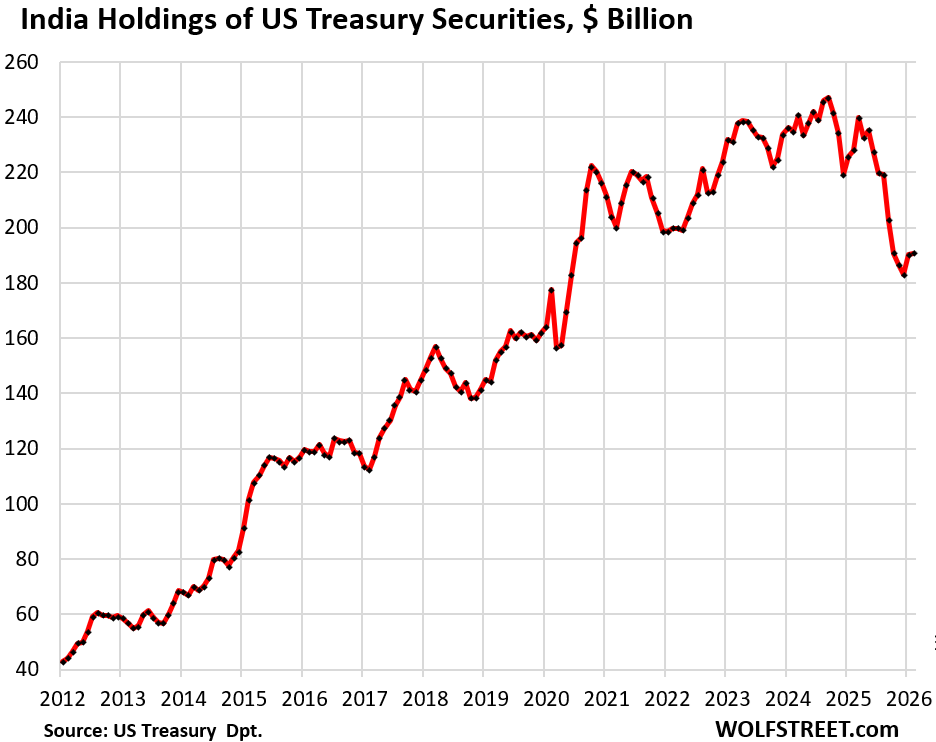
India’s holdings have risen over the past two months, to $191 billion, after dropping sharply from the peak in 2024 ($247 billion).
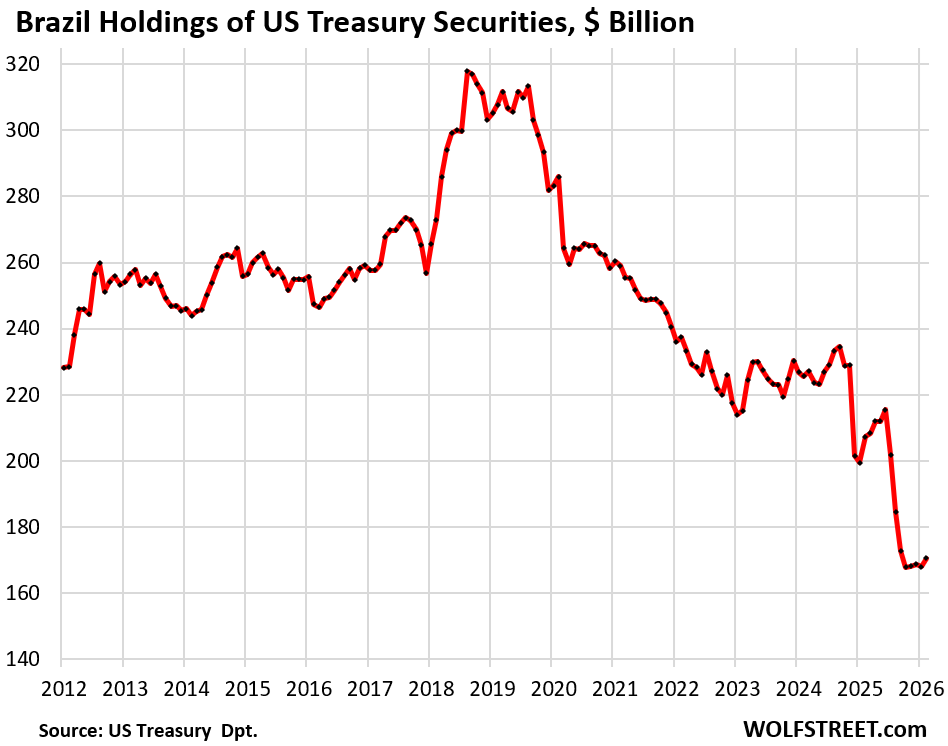
Brazil’s holdings have edged up over the past five months to $171 billion, after a 46% decline from the peak in 2018 ($318 billion).
In case you missed it: US Government Interest Payments, Tax Receipts, Average Interest Rate on the Debt, and Debt-to-GDP Ratio in Q4 2025
Enjoy reading WOLF STREET and want to support it? You can donate. I appreciate it immensely. Click on the mug to find out how:


These debt numbers are incomprehensible
We’re adding to it by around $2 Trillion a year
It’s unsustainable
If owners start to dump T’s the bond market could crater. The resulting high interest rates would kill the stock market as well.
Amazing to think how despite such large numbers, the Euro Zone is just one year’s worth of deficit, China 6 months, UK 5 months, India 1.5 months, etc.
“Foreign demand for the ballooning US Treasury debt is an increasingly important issue.”
If I were to write it, I would be tempted to say
“No one wants to touch that ***t with a 10 foot pole!”
“At those low yields.” It ALWAYS comes down to yields. If they’re high enough, there’s demand.
Some day well come to find out that these Cayman hedge funds are actually government programs run by the 3 letter agencies. What else could it be at this point?