
“These structural dynamics allow supply disruptions … to translate into rapid, outsized, and sustained price increases.”
By Wolf Richter for WOLF STREET.
Farm Action – “a nonpartisan agricultural watchdog organization led by farmers,” as it describes itself – has been lambasting the concentration in the agricultural system, an issue that is becoming even more urgent amid the current pressures in fertilizer pricing.
“Waves of mergers and acquisitions across food and agriculture have funneled power into the hands of a few dominant corporations. Their unchecked integration has hollowed out competition, giving them outsized control over how Americans farm, work, and eat,” it said on its website.
“This level of concentration means these corporations now reach into every link of the food supply chain—from inputs and equipment to processing, marketing, financing, and insurance,” it said. Economists generally warn that, when the combined market share of the four largest firms exceeds 40%, market abuses become more likely, it said (data collected in July 2024, U.S. market shares unless otherwise noted). Click on the chart to enlarge it:
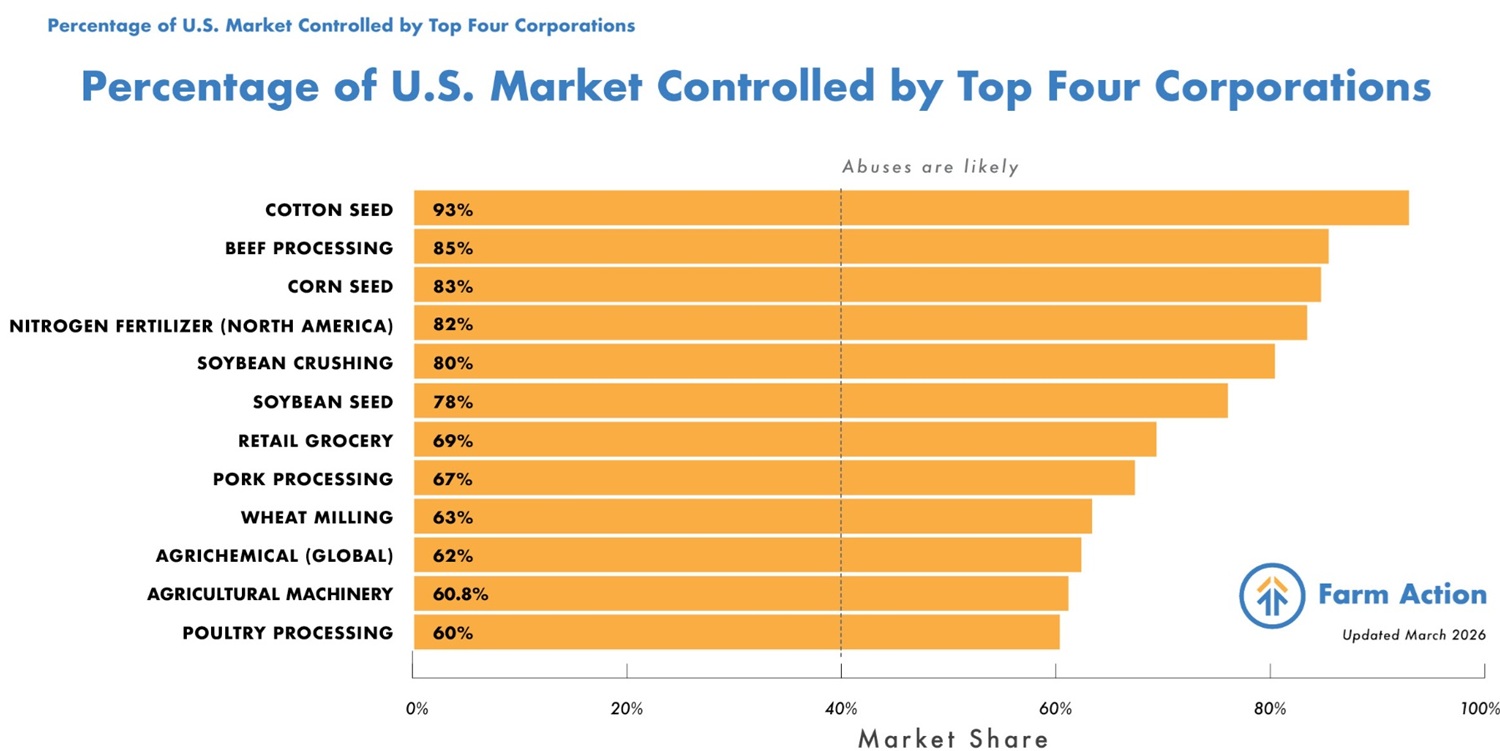
Note the #2 industry in the chart: Beef processing. The “Big Four” meatpackers – Tyson Foods, JBS, Cargill, and National Beef – that control 85% of the US beef market are under investigation by the Department of Justice for anticompetitive practices, including price-fixing and colluding to suppress cattle prices while inflating beef prices. But that scrutiny hasn’t hit the fertilizer industry yet.
Congress is currently considering new fertilizer policies to improve fertilizer supply and transparency. But the current proposals “don’t address the concentrated market forces that turn supply disruptions into severe price spikes for U.S. farmers – and rising costs for taxpayers and consumers,” Farm Action said in an emailed note about the letter it sent to Congress.
Here are excerpts from Farm Action’s letter to Congress:
“Over the past few years, farmers have experienced multiple fertilizer supply shocks, each resulting in sharp cost increases that strain already thin margins. Farmers operate within highly concentrated input and commodity markets, where they have little bargaining power over the prices they pay or receive. The result is a direct and immediate squeeze on farm profitability, compounding financial stress across the agricultural economy and increasingly triggering calls for federal assistance.
“Without structural reforms, this dynamic risks becoming cyclical, with taxpayer-funded relief flowing through farmers and ultimately into fertilizer and other highly concentrated input sectors.
“Fertilizer markets are highly concentrated at multiple points in the supply chain. A small number of firms control the production and manufacturing of the three critical macronutrients used by farmers….”
In a separate report, Farm Action provided specific data on who controls these three critical macronutrients:
- Nitrogen fertilizer production: 82% controlled by 4 firms: CF Industries, Nutrien, Koch Industries, Yara
- Phosphate fertilizer production: 90% controlled by 2 firms: Mosaic and Nutrien
- Potash fertilizer production: 75% controlled by the same 2 firms: Mosaic and Nutrien.
And the letter to Congress continues:
“These same firms control fertilizer inputs, distribution networks, and logistics channels—creating seemingly insurmountable barriers to entry for competitors.
“At the same time, limited transparency around pricing, production, and inventory levels makes it difficult for both farmers and policymakers to assess market conditions.
“These structural dynamics allow supply disruptions—whether driven by geopolitical events, trade constraints, or logistical challenges—to translate into rapid, outsized, and sustained price increases.
“Because fertilizer is a foundational input in crop production and a major driver of operating costs—often accounting for up to one-third to one-half of expenses for major commodities—the consequences of these market dynamics are particularly significant….”
“Recent history demonstrates how these structural dynamics play out in practice. During the 2021-2022 fertilizer price spike, wholesale fertilizer prices increased dramatically—rising more than 60% in 2021 and over 103% higher in 2022 compared to pre-spike levels. These increases significantly outpaced changes in underlying production costs. At the same time, major fertilizer manufacturers reported substantial margin expansion, with one leading firm increasing its gross manufacturing margin nearly seven-fold during this period despite far smaller increases in input costs.
“This pattern of rapid price escalation alongside rising margins in a concentrated market raises serious concerns about the extent to which supply disruptions are being amplified by market power.
“The result is a system in which global shocks are transmitted—and often intensified—at the farm level, contributing to recurring cycles of price spikes, financial stress, and calls for emergency assistance.
“Recent legislative proposals aimed at improving fertilizer transparency, strengthening domestic supply, and stabilizing prices reflect meaningful progress and a growing recognition that fertilizer price volatility has become a recurring threat to U.S. farm viability. These efforts are a necessary step forward—but on their own, they will not resolve the structural vulnerabilities that continue to expose farmers to repeated crises….
“To ensure that current legislative efforts address both immediate cost pressures and the underlying drivers of market instability, we recommend that Congress incorporate the following priorities:
- Pass a federal price-gouging law for agricultural inputs to establish clear authority to investigate and penalize excessive pricing during supply disruptions, particularly in highly concentrated markets where competitive checks are limited.
- Direct the Administration to designate key fertilizer inputs as critical materials under the Defense Production Act to strengthen federal authority to monitor supply, prevent hoarding, and stabilize markets during periods of disruption.
- Prevent further consolidation in the fertilizer sector, including by prohibiting mergers and acquisitions that would increase concentration in fertilizer production or distribution, and supporting robust antitrust enforcement against anti-competitive practices.
- Increase fertilizer market transparency by requiring comprehensive public reporting of prices, production levels, and inventories, and strengthening the U.S. Department of Agriculture’s capacity to monitor market conditions and identify abnormal price movements.
- Invest in domestic and regional fertilizer production capacity through targeted financing and infrastructure support, with a focus on independent, cooperative, and farmer-oriented models that expand supply while strengthening competition.
- Reform farm programs to reduce input vulnerability by modernizing crop insurance, expanding conservation and soil health programs, and investing in alternative nutrient systems that reduce long-term dependence on volatile synthetic inputs.
“Taken together, these actions will help ensure that current legislative efforts not only provide needed relief but also reduce the likelihood that farmers will face similar crises in the years ahead….”
Concentration through years of M&A activity, including buying up startups that might compete with the legacy firms, has been a huge issue in many industries, especially in Big Tech.
Enjoy reading WOLF STREET and want to support it? You can donate. I appreciate it immensely. Click on the mug to find out how:


So, we ALL got F’d over with this I -Ran situation for what??? Higher gasoline, higher fertilizer prices. We may be just in the first inning!
When I started in ag finance many years ago and was shocked at how capital intensive it was relative to commercial real estate and asked my co-workers how someone get into row crop agricultural.
The funny and sarcastic reply was, ‘Build a time machine and tell your grandfather to buy farmland.’
Hmm, I wonder if this is why Agency bond such as FED Farm CR BK 20 yr bond price is taking a beating lately. Even my 5.5% coupon notes have declined over 2% since I bought not long ago…Funny thing is even the latest yield is still not that much higher but maybe this kind of stuff have shaken some confidence off..
I’m sort of in awe of these people – farmers are possibly the most miserable market participants. They have no means of negotiating either input or product prices. If fertilizer & seed costs rise while wheat price stagnates or even falls you are ruined – regardless of how professional or efficient one is. There’s no way any sane person would want to be in such a risky position based on modern investment principles.
That said politics approach has been “throw more subsidy at the problem” in recent decades.
This is why we have socialized crop insurance and ag price floors, paid by taxpayers.
Throwing subsidies at ag doesn’t address anything other than softening the retirement landing. As for sanity, the population of farmers decreased little by little every year, the sane business people are not buying into ag. Only generational farmers continue farming, no one else will do it because it’s financially impossible to be an ag “start up”.
that’s a problem with probably all commodities not just farming.
Well if one thinks about the ramification for society if what you say about, perhaps the most organic of the everyday people that “farmers are possibly the most miserable market participants.”
Of course they are governed by the rules of a competitive equilibrium while the cost setting structure is closer to an oligopoly or an out rite monopoly both of which have been adjudicated as being pas se illegal
All commodity producers face the same challenge. Wolf mentions the problem in the last sentence . Taking out competition at the start up company level . Anti trust legislation was built on these principles. Elliot Spitzer took on Wall Street issues and illegal activities . Sub prime mortgages. Take a look at the grocery business and all of the consolidation ongoing there .
I don’t offer any solutions because when the government instituted some sort of Natural Gas industry legislation trying to increase supply the prices skyrocketed in the late 1970s to early 1980s. Deregulation of the NG markets lowered prices significantly and increased supply.
Barriers to entry on the fertilizer industry due to capital constraints is large. Where are the farm states in this picture as well ?
Thrilled the farmers are trying to have some influence on a government too big fixated on parading themselves in front of tv for “hearings”. Get some relief to the middle class.
Well it is likely to get worse as the unwinding of the QE era suggests,
The currency has just become a lot more risky
Thankfully the last thing that the Chinese want is the burden of being the reserve currency
All commodities are rigged in favor of the major players. It’s ridiculous that prices spike on fuel that’s already been refined.
While the physical oil takes nearly two months to arrive, retail gas prices in the U.S. often react much faster due to “market pass-through” where retailers adjust prices based on the replacement cost of future shipments rather than the cost of the oil currently in their tanks.
Why can’t prices simply rise in step with actual costs and not future costs? It’s totally price gouging and monopolistic shakedowns. That’s why energy stocks go up. Investors are willing to bet on the playground bully even though they will get hit as a bystander at the fuel pumps.
The hard and embarrassing truth is everyone is culpable.
Once again, the outcome of late stage capitalism where insiders, legislatures and dark money create oligarchies for all products and services. Government protects this system with subsidies and how the money and derivatives flow. This is not the capitalism that Adam Smith characterized. Despite what I’m sure many of you were thinking, Government does have a role in ensuring this doesn’t happen and break up theses oligarchs.
Because it is corporatism and mercantilism not capitalism.
It’s fitting that Smith was Scottish, as his almost invariably misconstrued theory of capitalism is the object of more “no true Scotsman” logical fallacies than you can throw a pin at.
“Waves of mergers and acquisitions across [insert favorite industry here] have funneled power into the hands of a few dominant corporations. Their unchecked integration has hollowed out competition, giving them outsized control over how Americans [consume the product of whatever industry you wrote above].”
Yep, seems to work for just about everything I can think of.
This kind of stuff went on around 100 years ago and why legislation was developed to enable rural communities to form co-ops to give themselves more market power. I’m guessing a lot of them sold out, the big ones I can think of are CHS and Land o Lakes that are still around.
Powell said the Fed will look past the energy spike……
he didnt use the word “transitory”, might as well have.
So the impact on fertilizer will be just a blip in the eyes of the Fed.
This why we need a Taylor Rule. We are in the midst of a blind Fed pretending what is going on…….isnt.
He also came up with something about the Fed acting in response to people’s inflation expectations. But isn’t that somewhat circular? Won’t people’s expectations be colored by government response?
One of the most important things Congress and government in general have to do is eliminating monopolies or oligopolies.
This, in order to allow free market capitalism to thrive.
I don’t think they are doing their duty and I suspect that Congressmen and women are being bought off by mega companies .
“free market capitalism” LMFAO!
CONgress’ response to the 2007/2008 great financial fraud should have made it clear to everyone that capitalism is long dead. How can anyone spout such nonsense with a straight face.
TARP was O flipping the middle finger at the electorate. Now you see fraud, now you don’t.
My avo fertilizer has gone from $20-50/lb to $88 and the public screams about paying $2 for a big fat avo
🤣 the Obama-did-it syndrome 🤣
Obama started in January 2009. TARP was passed in 2008 and signed into law by Baby Bush Republican.
You need a mental enema. Or maybe you’re suffering from internet brain rot, which is incurable. This is the second time in less than 24 hours that you blamed Obama for what Baby Bush Republican signed into law. If you do that a third time, I might kick you off the site for consistently committing all seven deadly sins of commenting.
If you hate what Baby Bush Republican did, fine with me. Take it like a man and cry into your pillow. But do NOT blame Obama for what Baby Bush Republican signed into law.
Keep voting for people that are starting wars that restrict LNG from getting out of the Middle East. Then look up the Haber Bosch process and realize where a lot of fertilizers are made from.
Entities that took bailout money……then were handing out big bonuses a few years later……is a very bad look.
Bail out money, if one believes in the concept, should be conditional on some level.
The Best Post of the Day!
You can thank Citizen’s United for that.
This mainly happened because the SCOTUS stole the 2000 election by stopping the Florida re-counts. Later re-counts showed that Gore won Florida, and the election.
Much of the corruption and big money influence on politics and society flows from that Citizens’ United decision, enabled by a SCOTUS that only became majority right wing because of who they installed at POTUS in 2000.
Elections have (huge) consequences. You’re living it again right now, on steroids.
There is a place for monopolies in an economy. It is in areas experiencing rapid technological innovation where one or two players can use their market power to increase prices and use the resulting income to invest in that innovation. However, farm inputs and outputs don’t fall within that arena. It would be nice if the federal government could pass laws that provide for effective capitalist competition in the US. And perhaps a 10 – 20 year grant of monopoly as a part of incorporation powers where needed. But our hopelessly corrupt elected officials will work for the highest bidder.
Spoiler alert: The entire US economy has been monopolized by a handful of big, greedy players. There is no meaningful competition anymore. As one example. Do you think Home Depot and Lowes attempt to provide lower prices/margins against one another? I didn’t think so.
There only exists an illusion of competition. The real goal is to kill any new market participants. Vanguard, Blackrock and State Street effectively control the board of every major public corporation as they retain the right to vote on behalf of the ETF you own.
Wow, that’s spooky. Less than an hour ago I had exactly the opposite experience.
TOMCAT Attractant Gel For Mice and Rats, size 1oz, model 0362210
Lowe’s price: $7.48
Home Depot’s price: $4.49
Both prices listed online for items in stock at their closest store.
As a soldier in the army battling inflation, naturally I made the stop at the Home Depot that was 1/2 mile from the Lowe’s knowing I was going to save $3.00.
Take THAT, Big Home Improvement.
Your first point might be reasonable in certain segments of the economy but your example is terrible.
Home Depot and Lowe’s don’t have dominant market share, and virtually no undue pricing power given Amazon, the internet and even regional building supply companies.
Other methods to support domestic farming other than handouts
New Zealand: In 1984, New Zealand took the drastic step of eliminating all farm subsidies. This move came after finding that subsidies led to overproduction, environmental degradation, and inefficient farm management. New Zealand farming subsequently prospered, demonstrating that trade liberalization is a viable alternative.
and:
Supply management
in Canada is not considered a direct government subsidy because it does not use taxpayer money to fund farmers. Instead, it is a regulatory system that stabilizes income through production quotas, price controls, and import tariffs. It allows farmers to receive a reasonable return directly from the market, rather than through government handouts.
Where I live there are dairy farms. But you cannot just get some cows and start producing milk. A dairy farm has to have a milk ‘quota’, and cannot produce more than their quota. Same for eggs, poultry, etc. Dairy farmers make a good living here.
US Dairy?
U.S. dairy subsidies are extensive, direct and indirect financial supports from the government, costing taxpayers over $4 billion annually. These subsidies, which include federal loans, insurance programs, and market price support, can constitute a massive portion of farmer income, with some reports suggesting they represented a high percentage of producer returns in certain years.
I guess the big players just want more from the taxpayers.
Agriculture subsidies in the US and the EU (and most other places) come from hunger post WWII.
They are market distorting and addicting. It is difficult to remove them. Going cold turkey like new Zealand might not be the worst idea. But the consequences are wide and food prices will probably rise short term.
In ancient China, as with all other East Asian areas, agriculture has been practiced for several thousands of years without fertilizers from natural gas. Human and animal excretions were the available fertilizers that allowed fields and terraces to continue to produce food for families and some exports for those thousands of years. Now we flush all that fertilizer into rivers and oceans! Incredibly wasteful! My own city does use waste sewage to extract phosphorus that is used by farmers, and many more places do much the same. Savings are to be had, and at this point, no corporations have a monopoly on human sh*t!!
DELETE THIS LAST SENTENCE BEFORE BEZOS READS IT I BEG YOU
Ah yes. The Peoples’ Night Soil Brigade, under Chairman Mao.
Might be a job of the future. Possibly a useful college major.
Lets see AI do that!
Not only China. Basically everywhere.
The disease potential is not insignificant.
There are other ways to use it:
Biogas via the wastewater plant. Cycle the remains through composting.
There is also the accumulation of heavy metals and so which are part of the modern waste.
A different route taken by some countries is recovery of the phosphate. Which is more limited then nitrogen.
Unintentionally, the letter is actually a spotlight on the broader economy in general. There are too many monopolies and regulatory capture has removed any teeth that the FTC had when it comes to pursuing anti-trust endeavors.
This was years in the making and only now is it rearing its ugly head in quite a few sectors.
Alex, What is Anti-Trust?
In May 2011, Cargill completed a major split-off and divestiture of its 64% stake in The Mosaic Company, a leading fertilizer producer. This transaction involved exchanging approximately 286 million shares with Cargill shareholders and debt holders, transitioning Mosaic into an independent, publicly traded company. The value of Cargill private stock today is about $100 per share and family awned since 1865. Most farmers and citizens of the USA can’t handle the truth or understand the concept of monopoly. Let alone being dominated 24/7 from having limited choices. The depth and breadth of the largest private corporation in the world is astounding. I’m glad I got the opportunity to work and learn 20 years and still retain my ESOP shares today.
Only enabled and made possible by the Federal Reserve ZIRP free money policy.
Folks if you can borrow money cheap, so can the big guys, and they use it to acquire everything under the sun.
The last thing we need is Congress to do anything.
We only need a Federal Reserve run by disciplined adults.
The shits really gonna hit the fan now
I totally agree that the ag sector, like many many sectors in the US economy, is over-concentrated. However increased margins for in response to foreign supply shocks would be expected, would they not? This is a sign of the market functioning, acting to incentivize increased domestic production.
Besides reducing industry concentration, perhaps avoiding foolish military adventures would help with prices. Just a thought.
The farm sector is a basic foundation of human survival. The mismanagement by the Ivies lays truth too the lie. DOGE