
“These structural dynamics allow supply disruptions … to translate into rapid, outsized, and sustained price increases.”
By Wolf Richter for WOLF STREET.
Farm Action – “a nonpartisan agricultural watchdog organization led by farmers,” as it describes itself – has been lambasting the concentration in the agricultural system, an issue that is becoming even more urgent amid the current pressures in fertilizer pricing.
“Waves of mergers and acquisitions across food and agriculture have funneled power into the hands of a few dominant corporations. Their unchecked integration has hollowed out competition, giving them outsized control over how Americans farm, work, and eat,” it said on its website.
“This level of concentration means these corporations now reach into every link of the food supply chain—from inputs and equipment to processing, marketing, financing, and insurance,” it said. Economists generally warn that, when the combined market share of the four largest firms exceeds 40%, market abuses become more likely, it said (data collected in July 2024, U.S. market shares unless otherwise noted). Click on the chart to enlarge it:
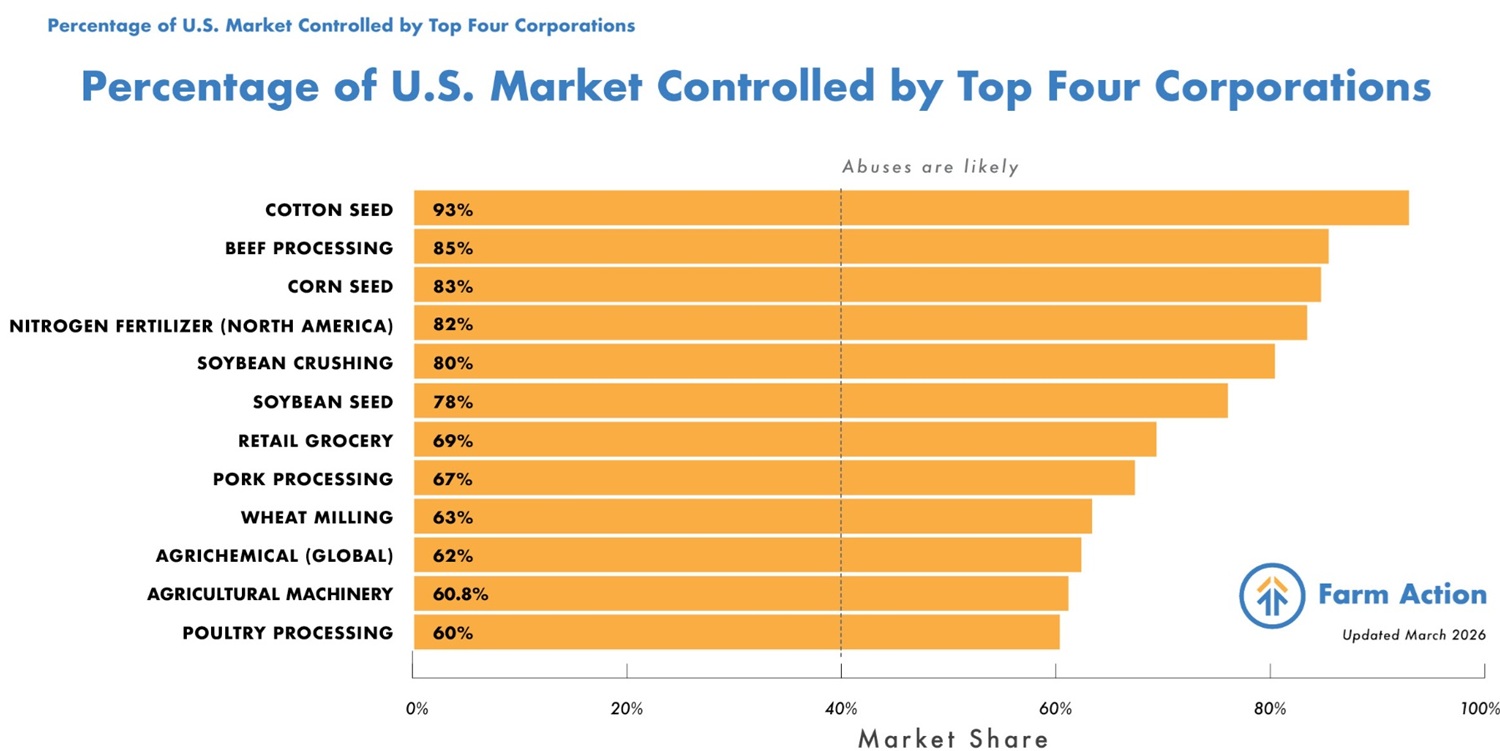
Note the #2 industry in the chart: Beef processing. The “Big Four” meatpackers – Tyson Foods, JBS, Cargill, and National Beef – that control 85% of the US beef market are under currently investigation by the Department of Justice for anticompetitive practices, including price-fixing and colluding to suppress cattle prices while inflating beef prices. But that scrutiny hasn’t hit the fertilizer industry yet.
Congress is currently considering new fertilizer policies to improve fertilizer supply and transparency. But the current proposals “don’t address the concentrated market forces that turn supply disruptions into severe price spikes for U.S. farmers – and rising costs for taxpayers and consumers,” Farm Action said in an emailed note about the letter it sent to Congress.
Here are excerpts from Farm Action’s letter to Congress:
“Over the past few years, farmers have experienced multiple fertilizer supply shocks, each resulting in sharp cost increases that strain already thin margins. Farmers operate within highly concentrated input and commodity markets, where they have little bargaining power over the prices they pay or receive. The result is a direct and immediate squeeze on farm profitability, compounding financial stress across the agricultural economy and increasingly triggering calls for federal assistance.
“Without structural reforms, this dynamic risks becoming cyclical, with taxpayer-funded relief flowing through farmers and ultimately into fertilizer and other highly concentrated input sectors.
“Fertilizer markets are highly concentrated at multiple points in the supply chain. A small number of firms control the production and manufacturing of the three critical macronutrients used by farmers….”
In a separate report, Farm Action provided specific data on who controls these three critical macronutrients:
- Nitrogen fertilizer production: 82% controlled by 4 firms: CF Industries, Nutrien, Koch Industries, Yara
- Phosphate fertilizer production: 90% controlled by 2 firms: Mosaic and Nutrien
- Potash fertilizer production: 75% controlled by the same 2 firms: Mosaic and Nutrien.
And the letter to Congress continues:
“These same firms control fertilizer inputs, distribution networks, and logistics channels—creating seemingly insurmountable barriers to entry for competitors.
“At the same time, limited transparency around pricing, production, and inventory levels makes it difficult for both farmers and policymakers to assess market conditions.
“These structural dynamics allow supply disruptions—whether driven by geopolitical events, trade constraints, or logistical challenges—to translate into rapid, outsized, and sustained price increases.
“Because fertilizer is a foundational input in crop production and a major driver of operating costs—often accounting for up to one-third to one-half of expenses for major commodities—the consequences of these market dynamics are particularly significant….”
“Recent history demonstrates how these structural dynamics play out in practice. During the 2021-2022 fertilizer price spike, wholesale fertilizer prices increased dramatically—rising more than 60% in 2021 and over 103% higher in 2022 compared to pre-spike levels. These increases significantly outpaced changes in underlying production costs. At the same time, major fertilizer manufacturers reported substantial margin expansion, with one leading firm increasing its gross manufacturing margin nearly seven-fold during this period despite far smaller increases in input costs.
“This pattern of rapid price escalation alongside rising margins in a concentrated market raises serious concerns about the extent to which supply disruptions are being amplified by market power.
“The result is a system in which global shocks are transmitted—and often intensified—at the farm level, contributing to recurring cycles of price spikes, financial stress, and calls for emergency assistance.
“Recent legislative proposals aimed at improving fertilizer transparency, strengthening domestic supply, and stabilizing prices reflect meaningful progress and a growing recognition that fertilizer price volatility has become a recurring threat to U.S. farm viability. These efforts are a necessary step forward—but on their own, they will not resolve the structural vulnerabilities that continue to expose farmers to repeated crises….
“To ensure that current legislative efforts address both immediate cost pressures and the underlying drivers of market instability, we recommend that Congress incorporate the following priorities:
- Pass a federal price-gouging law for agricultural inputs to establish clear authority to investigate and penalize excessive pricing during supply disruptions, particularly in highly concentrated markets where competitive checks are limited.
- Direct the Administration to designate key fertilizer inputs as critical materials under the Defense Production Act to strengthen federal authority to monitor supply, prevent hoarding, and stabilize markets during periods of disruption.
- Prevent further consolidation in the fertilizer sector, including by prohibiting mergers and acquisitions that would increase concentration in fertilizer production or distribution, and supporting robust antitrust enforcement against anti-competitive practices.
- Increase fertilizer market transparency by requiring comprehensive public reporting of prices, production levels, and inventories, and strengthening the U.S. Department of Agriculture’s capacity to monitor market conditions and identify abnormal price movements.
- Invest in domestic and regional fertilizer production capacity through targeted financing and infrastructure support, with a focus on independent, cooperative, and farmer-oriented models that expand supply while strengthening competition.
- Reform farm programs to reduce input vulnerability by modernizing crop insurance, expanding conservation and soil health programs, and investing in alternative nutrient systems that reduce long-term dependence on volatile synthetic inputs.
“Taken together, these actions will help ensure that current legislative efforts not only provide needed relief but also reduce the likelihood that farmers will face similar crises in the years ahead….”
Concentration through years of M&A activity, including buying up startups that might compete with the legacy firms, has been a huge issue in many industries, especially in Big Tech.
Enjoy reading WOLF STREET and want to support it? You can donate. I appreciate it immensely. Click on the mug to find out how:


Hmm, I wonder if this is why Agency bond such as FED Farm CR BK 20 yr bond price is taking a beating lately. Even my 5.5% coupon notes have declined over 2% since I bought not long ago…Funny thing is even the latest yield is still not that much higher but maybe this kind of stuff have shaken some confidence off..