
Beer brewers have long suffered as Americans switched to wine. But since Covid, even winemakers got hit, and 2025 was really bad.
By Wolf Richter for WOLF STREET.
Beer brewers and winemakers in the US are struggling with an existential crisis: A substantial decline in consumption. It hit beer first, because people switched to wines. And then it hit both after the pandemic, when alcohol consumption declined all around.
There are numerous stories about vineyards not being able to sell their grapes, and winemakers not being able to sell their wines, and a slew of them have gone out of business. I described the fate of Vintage Wine Estates, a publicly traded winemaker with 34 widely known brands which filed for bankruptcy in July 2024 and entered out pantheon of Imploded Stocks.
The decline in alcohol consumption isn’t because the tapped-out overindebted always-struggling or whatever American consumer can no longer afford to buy a beer or some wine.
But it’s because older people have become aware of the toxicity of alcohol and what it does to their bodies, and they have cut back, and by a lot, and younger people never really got started in the large numbers that the older generations did at that age. And for the industry, this has turned into a deadly mix.
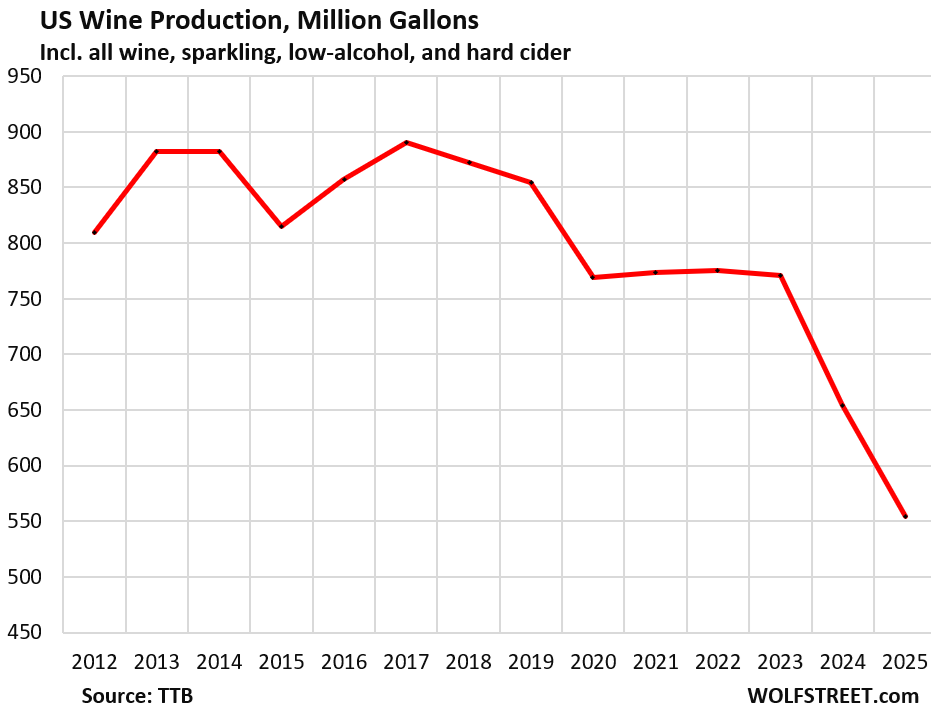
Wine production in the US plunged by 15.2% in 2025 from the prior year, and by 28% over the past two years, to 554 million gallons of all types of wines (including sparkling wine and hard cider). Since the peak in 2017, wine production has collapsed by 38%:
The data was released today by the Tax and Trade Bureau (TTB), based on the excise tax filings that winemakers have to file with the Treasury Department.
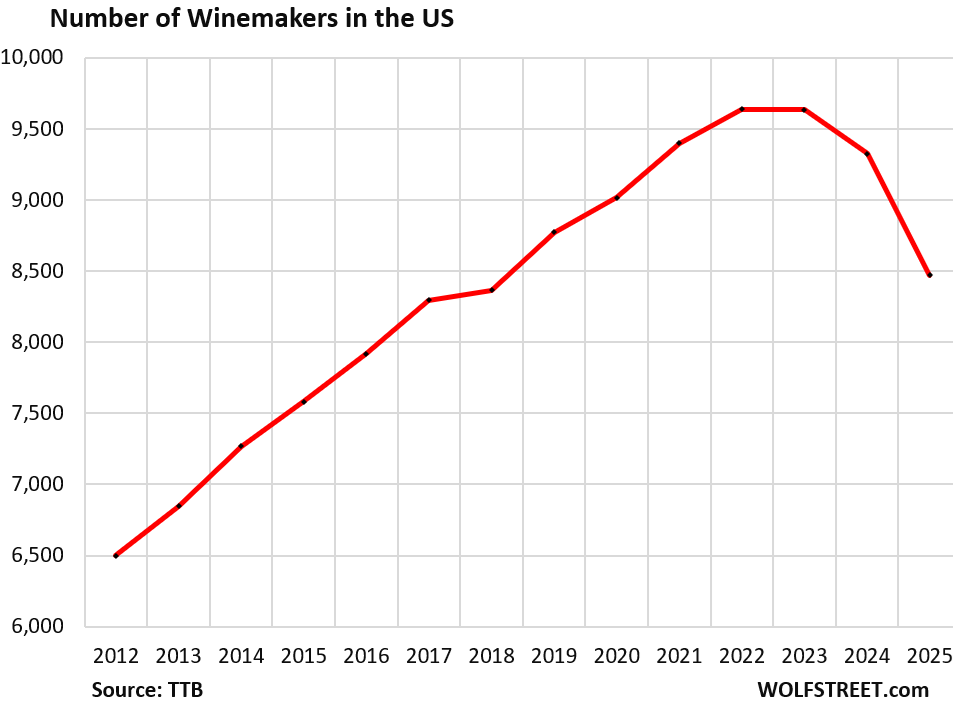
The number of winemakers in 2025 has dropped by 9% from the prior year, and by 12% from the peak in 2022. The year 2025 was a terrible year in terms of winemakers not being able to hang on any longer:
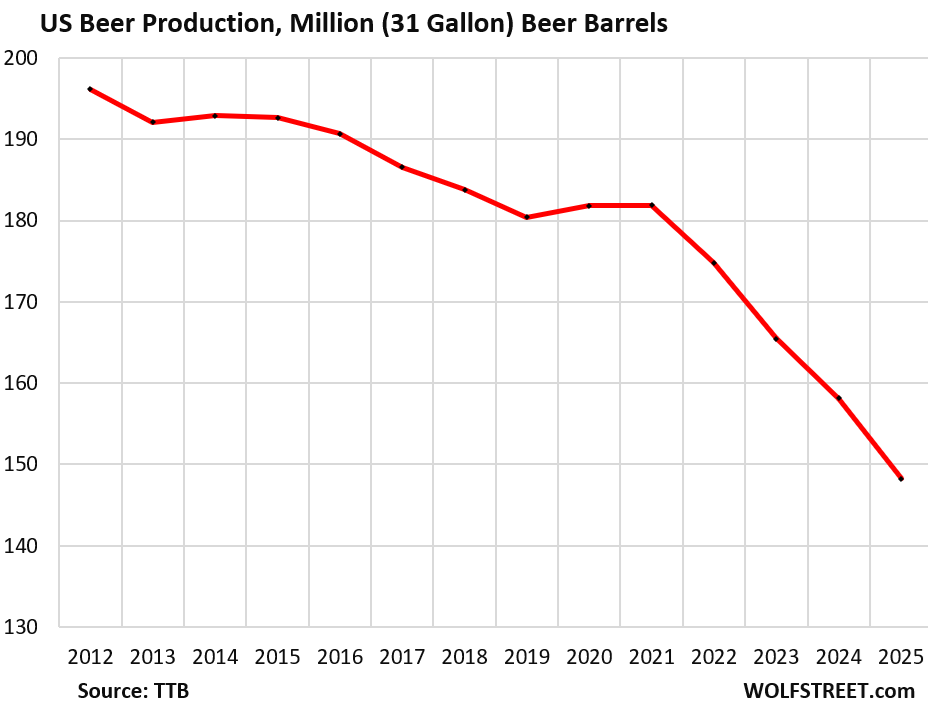
Beer production fell by 6.2% in 2025 from the prior year, and by 10.2% over the past two years, to 148 million barrels, the lowest in ages (for measuring beer production, 1 barrel = 31 gallons).
Since 2021, beer production has dropped by 18.5%. Since 2012, it has plunged by 24%, according to data from the TBB.
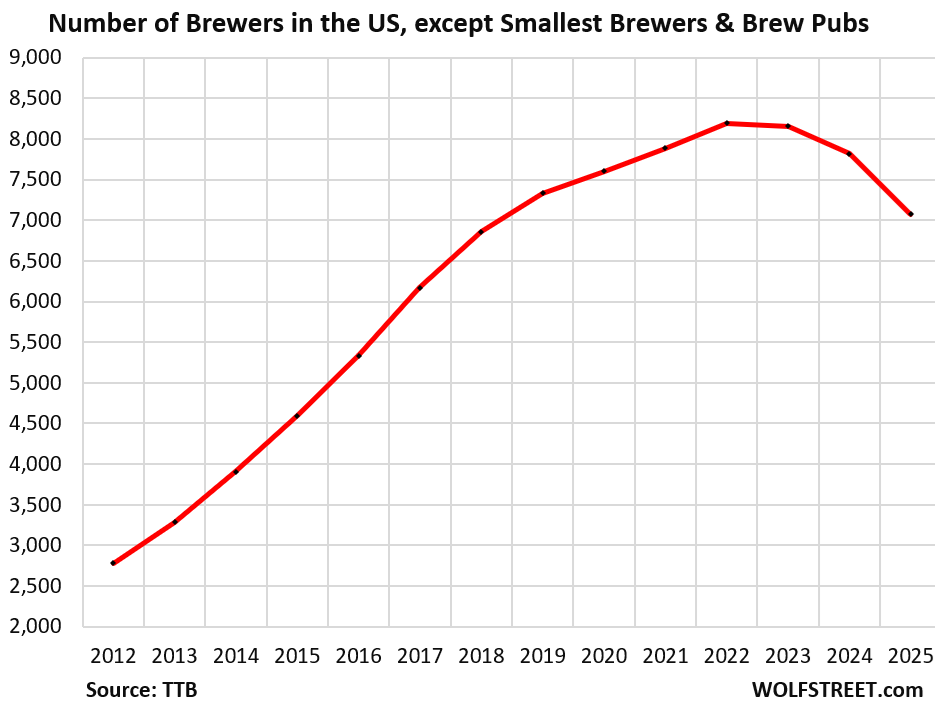
The number of beer brewers – not including the smallest brewers and brew pubs that don’t have to file the excise tax form – has dropped by 9.5% in 2025 to 7,024.
Since the peak in 2022, the number of brewers has dropped by 13.7%.
Very small brewers and brew pubs that are liable for less than $50,000 in excise taxes a year – they would produce less than 14,200 barrels of beer a year – do not have to file the excise tax form TTB F 5130.9, and are therefore not included in this count. There may be about 3,000 of them.
Beer production has long suffered from US consumers switching to wine. At the time, Big Beer was running the show, and Americans lost interest. That trend started decades ago when per-capita beer consumption began to decline.
Then small brewers started brewing delicious beers that caught people’s attention, and so began the craft brew boom that came out of the hide of Big Beer, which was losing market share. So Big Beer started buying many of the bigger craft brewers.
But new craft brewers kept springing up, and it was a dynamic industry, and sales of craft brews boomed, despite a continuous shakeout that wiped out many of the earlier brands that had brewed some great beers but in money-losing operations. By 2012, overall beer consumption started declining, and that decline accelerated since the pandemic, and craft brewers are getting hit too.
America makes some of the best beers and wines in the world, and exports some of them. But other countries too are cutting back on alcohol consumption. And governments encourage it with big sin taxes and with explanations of the health effects of alcohol. As older people are cutting back and younger people are not picking up the habit, the industry – similar to the tobacco industry – faces the prospects of a long decline.
I’m a huge fan of craft brewers and love many of their excellent IPAs. I want them to thrive. But I too have cut back by about 75%. Everyone I know has cut back. I’ve become a terrible customer. I’m down to just four beers a week in most weeks, half a beer per day plus a whole beer on Saturday night when we go out, and that’s where I’ll keep it. It’s enough to enjoy the awesome experience of that first mouthful, but maybe not enough to keep the brewers alive.
Enjoy reading WOLF STREET and want to support it? You can donate. I appreciate it immensely. Click on the mug to find out how:

The wine market looks an awful lot like the housing market — prices (of good stuff) haven’t budged. In fact, all the high-ish end and above Italian, French, and Napa are all up.
When these stories started circulating maybe 18 months ago, I hoped to get the things we like for maybe 2018 prices. Nope! At least not yet. Everything we like is probably already supply constrained, so unaffected so far.
I am actually pretty sure that alcohol consumption is dropping because the younger generations are more into drugs. In my country at least, I am quite shocked to meet so many young adults that are very much against any kind of alcohol because of health concerns –also tobacco– but have no problem with snorting unknown powders and think smoking weed is healthy.
I do think that the war against alcohol and tobacco was a very bad idea. But, you know, who could have predicted these kind of results?
Curious how much of the drop is due to less exports? Did countries stop buying US made alcohol to any significant degree?
Exports were never a big part of production. Wine exports accounted for only 3% of total wine production in the US in 2025 (in gallons). Wine exports peaked in 2015 and started dropping along with dropping global consumption of alcohol. In dollars, it might be a little different since I assume that the wines that get exported are mid- to higher end, and not mass-production wines, and in dollars, the share of exports might have been quite a bit bigger.
In Canada we’re losing lots of craft brewers, 2 near me in the past month. Their prices are going up because the price of aluminum beer cans has gone through the roof, partly because the US makes the cans and it’s tariffed when it comes across. In some cases tariffed twice. Also with pot now legal and mainstream, young people already have a buzz before they hit the bars where they don’t buy a lot of expensive beer. There’s a point with the price of craft beer where you just stop buying it. Cheers!
“Their prices are going up because the price of aluminum beer cans has gone through the roof…”
This is BS. The cost of the aluminum in a can is less than 2 cents. The costs go up because LABOR costs go up, and because the price of specialty hop and malt may have gone up, and because other operating expenses increased.
My wife and I are doing our part for the scotch and wine industries. Some sort of alcohol is usually consumed in our household daily.
However, you mention pricing and that Americans COULD pay, if they so wanted. I’m not so sure. Even crap bottles are up $3 from where they were 5-6 years ago. If you’re a lower-end consumer, that $7 Josh Cellars from 2019 now has a $10 psychological discretionary spend barrier. If budgets are tight, maybe you forgo that bottle or two… or three. Good, standard, everyday bottles that could be had for $14 before are $20+ now. More expensive bottles have just gone to straight-up price gouging. Caymus for instance is just flat-out ripping people off for what it is, even at Costco. I laugh everytime I see whatever price it has raised itself to when I walk by in the aisle. Unfortunately, my parents got duped into buying it a couple times because “for that price, it must be good”-mentality.
I digress, but the point is, I believe some “paper napkin math” psychological barriers have been touched on with current pricing. Plus, the quality that’s out there at approachable price levels for most consumers is utter trash right now. I personally believe that’s part of the reason proseccos, moscatos, and the like, along with rosés (barf!) and rieslings, etc., have become so popular lately is because they have so much residual sugar that they mask any nuances, especially at low price levels, and all taste like a Millennial midlife crisis. I’m 40, so I can judge freely.
None of the alcohol companies have given up any of the prices increases that they slapped on during COVID and subsequent inflation years, so I don’t have a lot of sympathy now that there is a supply glut but they’re — apparently — unwilling to move product by discounting bottles.
… And don’t even get me started on scotch pricing over the last 10 years. The little island of Islay has me bent over barrel, figuratively (and occasionally, literally).
you can get nice white wines for $6 a bottle, including Costco’s house brand Pino Grigio (Kirkland). Safeway has several good table wines in that range, after loyalty discount, sixpack discount, and the on-sale price. Lots of good deals to be had in the wine aisle in the $10-$20 range. You need to get out more often.
And Americans are loaded. the median income of married couples is $120,000 in the US, and much higher in places like California ($138,000). 65% of Americans own their own home, and those have soared, and 60% own some stocks, and they have soared, and others own cryptos and PMs. I’m sick and tired of this BS about American being poor and cannot afford basic things. 20% are in that category, and 15% are poor. So don’t pretend that everyone lives below poverty level. And even poor people drink a beer or a glass of wine every now and then, or more often.
Thanks, Wolf, but I get out plenty. Kirkland used to be good value. The latest vintages have been crap. The wife is the white wine drinker, mostly Chardonnay.
I am not saying the American consumer is poor. I am saying there may be inflation-induced psychological reasons why people are buying less alcohol, when taken in combination with GLP-1 drugs, competing recreational drug use, diet/healthy living lifestyles, what have you.
If you’re already on the fence about drinking due to other factors, and that $14 bottle you liked 6 years ago is $20, it’s a much easier decision to skip putting it in the basket.
I used to like going to the movie theater, and still do, but the pricing has gotten outrageous. It’s not that I can’t afford it as a consumer — the activity just doesn’t deliver the same value anymore. I just wonder if some similar is happening with alcohol, in addition to the other factors you listed in your article.
Keep fighting the good fight.
We’re drowning in wine in California. And there are deals everywhere. You live on the other side of the country and might not fully feel it. Wine Country here has a huge problem. They don’t know what to do with all this wine and the grapes. Some are ripping out their grapevines and replacing them with fruit trees.
“Lots of good deals to be had in the wine aisle in the $10-$20 range.” Good deals on ok-ish wine, yes. The mere fact you mentioned Pinot Grigio at all tells me you should stick to beer. :-)
Agreed, Kirkland *for the money* punches above its weight. They briefly had a Brunello, maybe $30, that competed with $60+. Their Barolo has about the same $ to quality, and their champagne, although not everyone’s style, certainly beats all others at $25.
I ❤️ wine snobs
And my wife is drinking wine, including the Pino Grigio. I’m drinking IPAs. Any decent IPA is multiple times better than the best wine ever. Wines just cannot measure up. They’re just an inferior product compared to an IPA. A good IPA starts out with a complex deep fruitiness amid gentle bubbles that then slowly dissolve into rich hoppy bitterness that lingers for a long time in your mouth. The first mouthful can leave you stunned with pleasure. But IPAs are an acquired taste.
Plastic bottle Canadian Mist or Seagrams VO is almost $20 now. There is a market for cheap alcohol. But I believe youre right in that the new generation is consuming less in terms of absolute volume.
A lot of it has to do with stigma.
The thing is, if you actually look at these studies, like the one in the Lancet
https://www.thelancet.com/article/S0140-6736(18)31310-2/fulltext
which concludes:
The level of alcohol consumption that minimised harm across health outcomes was zero (95% UI 0·0–0·8) standard drinks per week.
a couple things become apparent:
For men, of which I am most certainly one regardless of legal proclamation, one or two standard drink a day (in their super clinal description) slightly increases the risk of lip and oral cancer and tuberculosis and slightly decreases the risk of ischaemic heart disease and diabetes.
Maybe I’m crazy, but where I live in the very suburban USA, I don’t think I’ve ever heard of anyone contracting tuberculosis.
This doesn’t mean I disagree with good habits, like smoking anything is probably a bad idea, as is eating Hot Pockets or other things impossible to synthesize in the kitchen.
My point is the study may be accurate in context, but not necessarily 100% accurate for people in the USA.
A different problem is drunk guys driving into things, but that’s a different risk with a possible solution, e.g. FSD or cybercabs!
I swear these things are driven by the puritans (Somewhere, somebody is having fun, and we will have none of that!), or maybe Bill and Melinda :D (per the Lancet study!)
Forsake demon Rum and that Devil in disguise; Bacchus. Embrace the fruit of Weedus; the flower of cannabis.
Remember, wut booze you lose.
Spirits have been getting nailed as well. Diageo is a large alcohol conglomerate; their stock is down big (60%) and still dropping.
I drink straight spirits almost exclusively.
During the Pandemic, prices of good whiskey/scotch absolutely exploded and certain bottles were impossible to find. Not only can you now find stuff on shelves, but prices are starting to outright deflate. It’s been pretty remarkable to see the turnaround.
I’m a millennial and I find that a lot of my generation is just deciding to cut back or quit drinking. Grabbing a drink or two costs a similar amount to an entree at a restaurant these days. People are also just more socially isolated too (personally I think screens play a huge role). Rather spend my free time out running, hiking, yoga, etc. than drinking at a bar. I’d imagine this is even more prevalent in Gen Z.
I have no affiliation with them, but f you want killer deals on wine, try Grocery Warehouse.
California Sober –
Weed crazy America –
Legal weed killing the booze industry.
THC drinks hitting the shelves in bars.