
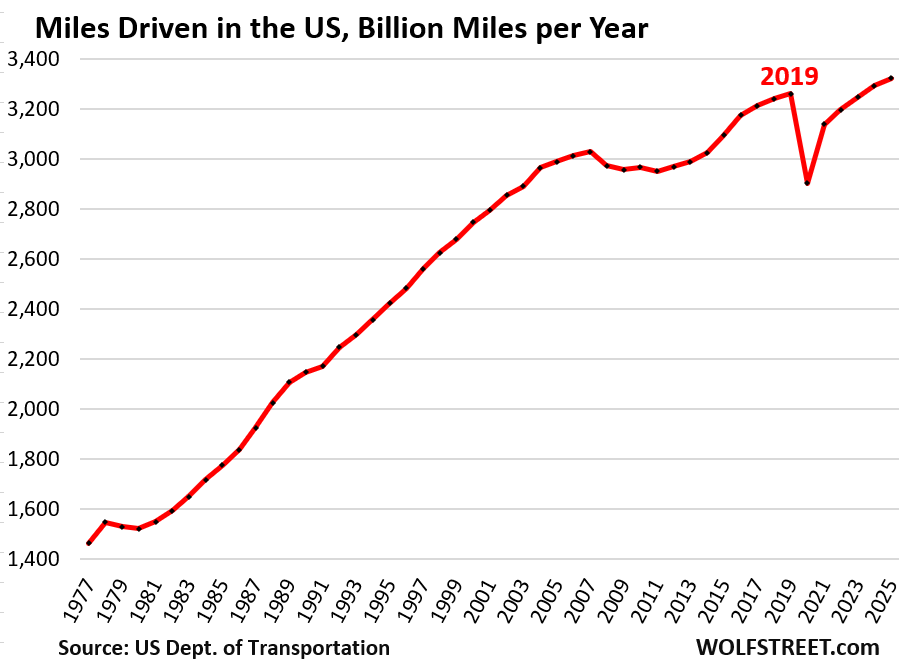
Since 2019, miles driven rose by 1.9%, the population by 3.6%, and miles driven per person fell.
By Wolf Richter for WOLF STREET.
Working from home has proven to be very difficult to squash. Despite three years of corporate efforts to cajole or force employees to return to the office five days a week, or at least three days a week, office attendance remains far below pre-pandemic levels.
But over the past six years, 2020 through 2025, the US population has grown by 12 million people, as per the Census Bureau’s population estimate last week, and so more people commute by car, and commuting routes have become as congested as ever, while mass transit ridership has remained far below pre-pandemic levels, which puts a greater traffic burden on the roads.
So the number of miles driven by highway-legal vehicles of all types – cars and light trucks, buses, motorcycles, delivery vans, medium-duty and heavy trucks – rose by 0.9% in 2025, to a new record of 3,324 billion miles, according to estimates by the Department of Transportation today.
Compared to the pre-pandemic record in 2019, miles driven in 2025 were up by 1.9%. Over the same period, the US population has grown by 3.6%.
The Department of Transportation bases its estimates of miles driven on traffic counts collected at about 5,000 continuous traffic counting locations across the US.
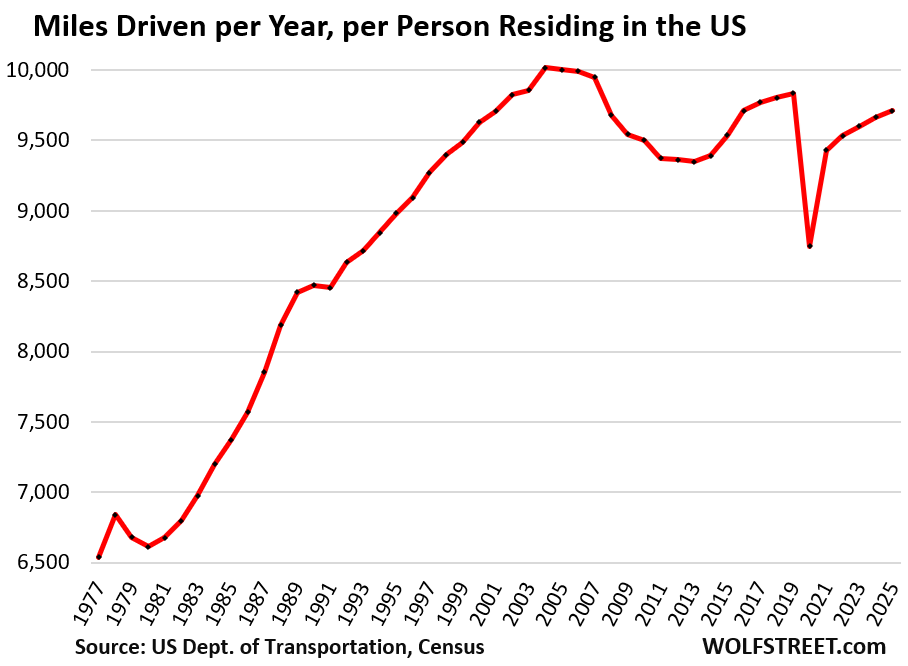
Miles driven per person of any age residing in the US rose to 9,710 miles per year in 2025.
This includes people who are too young or too old to drive, or who don’t drive because they don’t need to, such as many people in some big dense cities. But it shows the trend in terms of the overall population:
The peak miles driven per person was in 2004 at 10,016 miles per person. Even 2019 was higher at 9,837 miles per person.
The increase over the past three years would reflect increased commuting (including at the expense of mass transit) and other factors, such as increased commercial traffic and increased tourism.
Miles driven per person also show the ascent of the American commuting culture and urban sprawl through 2000. Note the effects of the Oil Shock in the 1970s, when the price of gasoline spiked amid shortages of gasoline.
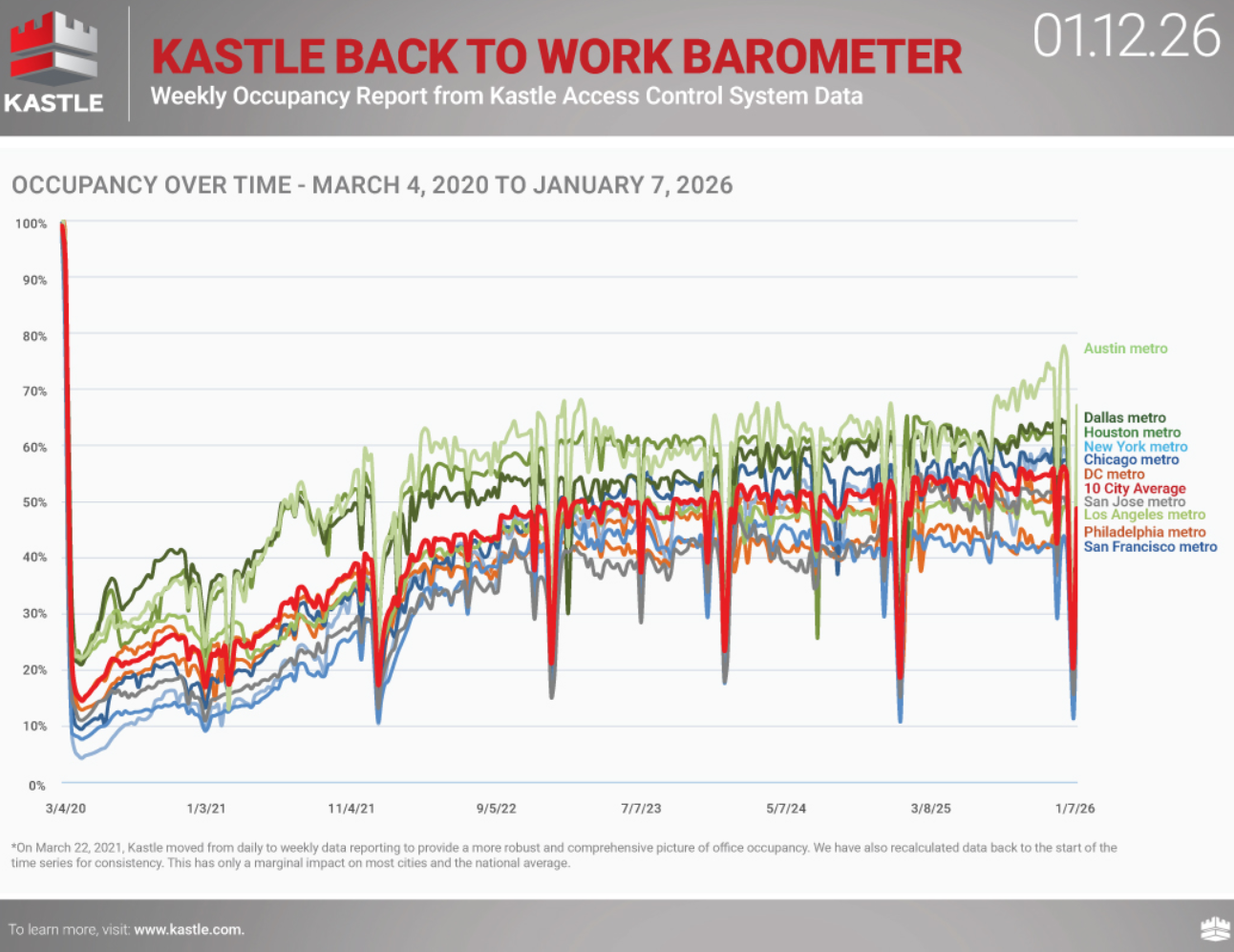
Office attendance – how many people actually show up at office buildings – has come up a lot from the pandemic lows but remains far below the pre-pandemic period and has improved only marginally over the past three years.
Office attendance remains at less than 60% of where it had been before the pandemic – Tuesday being the busiest – in the 10 cities where Kastle tracks office attendance at buildings where it provides access-control systems (click on the chart to enlarge).
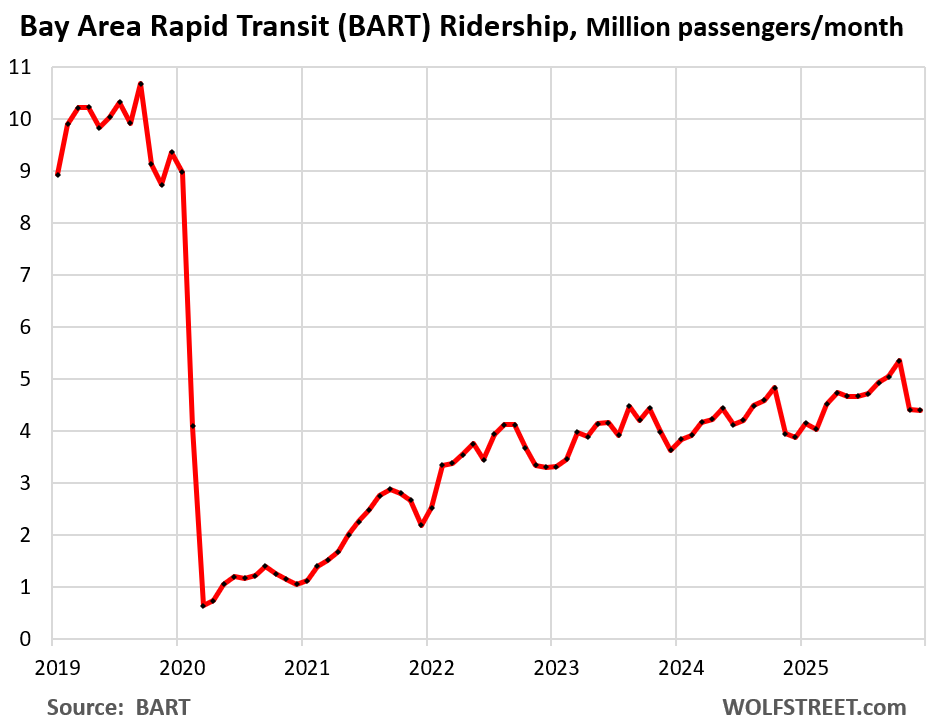
And mass-transit remains out of favor, even commuting routes have become as congested as ever. For example, ridership on the Bay Area Rapid Transit (BART) system, one of the largest commuter rail systems in the US — and sporting brand-spanking-new trains now – has been at about half the ridership it had in the respective months in 2019.
December ridership, at 4.40 million, was about 55% of what it had been in December 2019 (9.36 million). November was at 50% of November 2019. October was at 41%. September at 53%.
Enjoy reading WOLF STREET and want to support it? You can donate. I appreciate it immensely. Click on the mug to find out how:


If you’re signed up to receive a WOLF STREET email notification every time an article is published, you received a weird one Saturday night.
Sorry, that was my goof-up, not a hack.
When I was working on a technical issue for a potential client’s banner ad on the homepage late Saturday night (I know I shouldn’t do that), I was in the wrong place and clicked on the wrong thing, and my automatic email system jumped into action and instantly sent out an email with the title “Advertisement-Putt.Live” (the internal name of the potential ad), but there was nothing there, so when you clicked on the headline, WOLF STREET served you a 404 error page (page not found). I love my automatic email system, but I cannot ever make a mistake 🤣
Again my apologies to all of you 13,800 people who received this goof-up Saturday night.
I spent 14 years car free using a combination of public transit and bike commuting. Last year I broke down and bought a car. It’s just too hard to maintain: the US fails to invest in public transit (mostly because a large portion of the population has already built their lives around automobile culture and doesn’t want to be inconvenienced), and having a teenager in the house and shuttling them everywhere was too much (even though the teenager actually takes a lot of public transit).
It could be different, but somehow never is.
It was purposeful starting with Reagan who cut infrastructure projects. That was done along with auto and gas lobbies who wanted everyone to need a car. This resulted in how city planning is done. Nothing accidental at all about it.
I believe it dates all the way back to Eisenhower with the national highway system. We decided to make highways free about the same time that Japan started their high speed rail system of bullet trains. Now Japanese highways are fee-based and well-maintained, and you can get just about anywhere via train and bus.
I went without a car there for close to 15 years, including 6 years with a wife and kid in a 2nd tier city. A bike and a train pass was more than enough to get around town.
“I went without a car there for close to 15 years…”
Google Maps and pre-planning does make this somewhat viable in some places…much less so in others.
And that “miles driven per person” chart (and Wolf’s “commuter culture” comment) do highlight how various factors have driven arguably inefficient sprawl.
Basically, there is a big trade off between land/housing costs (frequently cheaper in the suburbs/outskirts) and transit distance/time – leaving a *lot* of potential infill development opportunities skipped over (presumably because they wanted too much for use/ownership of their land).
Japan is a small country with high population density, particularly between cities. The US is geographically large. Europe went mass transit many, many decades ago because the countries aren’t actually that large and the subways were often started before cars became numerous (Paris subway in 1900, London in 1863). France is a bit smaller than Texas, but even as Texas population has boomed, France still has more than double the population. Even in the US mass transit started in higher density areas before cars took over (Boston in 1897, NYC in 1904; the elevated L in Chicago began in 1892, subways in 1943). To compare with other countries, look to the Boston-DC area, where there are both significant subway and inter-city train systems, and where significant portions of the population have no vehicles. That isn’t going to work in most of the US.
It’s even earlier than that — there was a wave of elimination of city tram lines across the country which began in the mid-30s, at least 10% of which (and likely more than that) can be conclusively attributed to the General Motors conspiracy via its ownership of National City Lines.
Elevated systems and subways mostly survived, but street level systems all but disappeared by the early ‘60s.
The elephant in the room is safety and cleanliness. When I lived in Seattle they let homeless ride the buses and trains 24/7. No one with a job wants to deal with that, even if they consider themselves friendly to the homeless population
Here in Reno the RTC bus system has been a fraud for years. The Reno Planning Department has a utopian plan for the aera that will never happen. We are not New York or SF. The hoax is so evident that they wrap the busses with advertisements to hide the fact that most buses are empty. Just the cost of one tire could buy uber rides for the few riders that use the system. It is paid for with a huge gas tax of 60 cents a gallon in Washoe Co and more importantly the federal funds. Someone needs to DOGE this fraud.
The purpose of the ads on the sides of buses isn’t to hide anything, but to make money. These are big surfaces that lots of people see, even people who do not use mass-transit, such as you. There are also ads inside these buses. Advertising on mass-transit vehicles that run on city streets in one form or another has been around ever since mass-transit vehicles came along back in the 1800s and is universal around the world.
The safety thing is a myth. Drivers are more likely to be victims of violence, accidental death, and crime than public transit riders.
People’s concerns about safety are mostly about visceral reactions to having to deal with their own fears about interacting with a wider range of humanity than they are typically used to, not about actual documented outcomes.
In Europe and Asia, they do not tolerate drug use and public intoxication on public transit. There are major safety and quality of life issues with public transit in many areas in the US which are well documented. It is certainly safer on a per mile basis than driving on average, but to cite just one example, the Chicago Red Line will provide a constant smell of urine and pot, many sleeping vagrants and beggars, and occasional physical assault. You don’t get that while you drive. To pretend otherwise is to pretend. This isn’t about discomfort, it’s about tolerating openly hostile public behavior from drug users and beggars, and it is not tolerated on public transit in most of the developed world. Until our society and laws address this in a meaningful way, transit ridership will be less than in 2019.
For the lat 70 + years I have been dependent on the automobile. All the while feeling guilty about wasting the earths limited resources.
An affliction that I first became aware of in 1971
Nevermind all the public aircraft!
Cmon!
Hop aboard and go to any city.
/s
given high priced fuel(diesel) and lower mileages per vehicle
I drive for business and on weekends tend to stay off roads
in summer we go to mountains for weeks at time
many days we don’t travel far if at all
—-
lately the local govt(sanctuary city) has once again purposely neglected our roads – they have special election to fund roads via sales tax increase
so pot holes get bigger and nothing seems to change
only the UNION WORKERS will benefit when(already in bag) from new tax
with 2:1 democratic margin – nothing that makes sense every happens
and budget be damned
school didn’t get big $$ for the 25% fewer students(got keep all schools open)
so they had budget override this past fall – yeppir just $100 per $100k assessed
paupers soon to be here – we’ll call them 99%
So your city has needs that must be paid for, but you are not ok with them being paid for either by sales tax or property tax? What’s the other option?
A Fuel Tax would be good! oh, wait we already have one. Federal, State and County fuel tax. Don’t forget the tax on tires, Federal and State. The surcharges in your registration and insurance policy.
So there not hi enough. Increase them .
Great question. A documentary I watched said that the taxes paid by Walmart are far less than the local businesses they displaced.
Stranger facts define America. How is it possible that red neck America gets their marching orders from the ownership of FOX news
Ted Cruz proclaiming his fealty to a foreign country. Hardly the Texas mystique
” taxes paid by Walmart are far less than the local businesses they displaced. ” Is this real estate tax they pay? Or sales tax they collect from customers and pay? Or both?
Real estate tax, on a per -square foot/ per-acre basis.
See Strong Towns dot org for some analysis
California is planning a tax on miles driven to offset reduced gas take because of EVs.
Premature ejaculation.
1. The legislation that the Assembly advanced is just a proposal for a broader STUDY of charging drivers for use of the highways (for miles driven, rather than for burning fuel).
2. If such a usage law eventually comes into being, that mileage charge would replace the $0.61 per gallon gas tax.
3. That potential tax has been tested in small pilot programs since 2016.
Ok, yep. Just saw now its merely a study. Two days ago it was legislation to be forwarded..
Here in the UK, from April 2028 there will be a “pay-per-mile” road tax (known as eVED) for electric vehicles and plug-in hybrids.
The plan is for EV drivers to pay 3p (4 cents) per mile, while plug-in hybrids will pay 1.5p (2 cents) per mile.
This is on top of existing Vehicle Excise Duty (VED); which is a tax per vehicle, aka “Road Tax”, the amount of which is based roughly on vehicle emissions.
VED is paid annually, in advance, irrespective of miles driven.
Petrol (gas) and diesel are heavily taxed here.
This new tax is justified as ‘making EV drivers pay for road usage as petrol/diesel sales fall’.
I saw you said BART had new trains. Did they quiet those things down any ?
I remember a handful of years ago visiting my daughter. We hopped a BART and boy it was deafening inside. I was surprised. I am already a little hard of hearing, and the noise made a conversation with her impossible.
The BART screech has to do with the rails. The new trains may have quieted it down a little, but they still screech on sharp curves, esp inside tunnels.
Yeah noisy….
But sure was super convenient, especially with the insane traffic around the bay. She had a car but also had the public transportation around the bay wired.
That, and I always tried to visit on my motorcycle…would split gridlock traffic and it made parking a non issue.
The NYC subway is also very screechy. Contrast that to the train system in Tokyo, where I could barely hear anything.
I don’t know what they do differently, but it works!
The Paris Métro run on Michelin tires!
> Contrast that to the train system in Tokyo, where I could barely hear anything.
Not true in general. It depends on the line. (I live in Tokyo). As Wolf said, it depends on the tracks.
Montreal aussi, Suzie!
The problem with public transportation is the public.
The fewer miles one puts on classic BMWs the better the value of the cars. If you think you may be putting more than a few hundred or few thousand miles on those fine automobiles, then it is best to consider adding another classic BMW to the fleet to lower the average on each, which is exactly what I am considering doing at this moment with a classic 8-Series coupe.
Nobody in America wants to pay the same tax rates their parents and grandparents paid, so we can’t have nice things anymore(except weaponry). Where I live the governor is proposing making some of the major highways toll roads, because of decreasing federal and state money for roads. I hope that toll roads are not going to become the norm in America.
According to Google
Social Security payroll tax rates (for employees) increased significantly between 1950 and 1979, starting at 1.5% in 1950 and rising to 6.13% by 1979. During these decades, the tax, which is officially known as the Federal Insurance Contributions Act (FICA) tax, also saw the introduction of disability insurance (1957) and Medicare (1966).
Here is the breakdown of tax rates (employee rate, matched by employers) for each decade:
1950s: 1.5% to 2.5%
1950: 1.5%
1951–1953: 1.5%
1954–1956: 2.0%
1957–1958: 2.25% (Includes 0.25% for Disability Insurance)
1959: 2.5%
Maximum Taxable Earnings: Increased from $3,000 (1950) to $4,800 (1959).
1960s: 3.0% to 4.8%
1960–1961: 3.0%
1962: 3.125%
1963–1965: 3.625%
1966: 4.2% (Includes 0.35% for Medicare)
1967: 4.4%
1968: 4.4%
1969: 4.8%
Maximum Taxable Earnings: Increased from $4,800 (1960–1965) to $7,800 (1968–1969).
1970s: 4.8% to 6.13%
1970: 4.8%
1971–1972: 5.2%
1973: 5.85%
1974–1977: 5.85%
1978: 6.05%
1979: 6.13%
Maximum Taxable Earnings: Increased from $7,800 (1970) to $22,900 (1979).
Key Takeaways
Tax Base Expansion: The maximum amount of earnings subject to the tax (“tax max”) increased dramatically, from $3,000 in 1950 to $22,900 by 1979.
You are showing FICA taxes(SS,Medicare), which have crept up to 6-7% for the little guy attempting to keep those entities solvent. This is a regressive tax, as most people pay it on 100% of their income, while a billionaire only pays it on the first $184,000, and zero after that.
I was referring to income tax rates which have been cut repeatedly since Reagan, largely on corporations and the top 10% of earners. Highest marginal rate during the 1950’s and 60’s was 90% on the mega wealthy, and corporate taxes much higher as well. I only make the reference because there is a myth in some circles that we are being “taxed to death”, and certainly for the top 10% and corporate America that is not supported by the facts.
It’s not at all hard to find actual data about who pays taxes in the US.
in 2024, the top 1% of income earners paid 45.8% of all income taxes. The top 25% of income earners paid 89.2% of all taxes.
The cuttoff to be in the top 25% of income earners $94,440.
This is from taxfoundation.org. Maybe their data is cooked ?
you could argue that you favor having the government take a larger % of GDP – which I think historically runs in the channel 18%-22%, but don’t try to sell me the idea that I am undertaxed. Maybe France would be more to your liking where the government takes 40% of GDP (I think – maybe a bit more or less?). I like to visit France and maybe it’s very pleasant to live there. I might like it if US cities were more like European cities but I think it might be as much about the fact that Europe is geographically smallish and cities there got their start 800 years ago ?
While SS taxes are regressive in nature, the payout system is progressive in nature.
While the federal income tax rates in the 1950s were high, few people or corporations actually paid them at that level. According the to the Tax Foundation:
The data shows that, between 1950 and 1959, the top 1 percent of taxpayers paid an average of 42.0 percent of their income in federal, state, and local taxes. Since then, the average effective tax rate of the top 1 percent has declined slightly overall. In 2014, the top 1 percent of taxpayers paid an average tax rate of 36.4 percent.
That is for all taxes, not just federal, but clearly even the highest income people in the 1950s were not paying federal income taxes at the 90% level.
Yes, the rich never paid 90% effective tax rates. Estimates vary quite a bit though and more up to date data seems to indicate a bigger drop for the top 1% (from 45-50% pre-1960 to 35% today, which is significant).
Notably the highest effective tax rates on the rich were right after WW2, when debt to GDP ratios were quite similar today after having to pay for the war. Everyone agreed then that the rich should contribute heavily to reducing that debt quickly. Corporate income taxes we also a lot higher back then.
I would very gladly trade 1920 Federal tax rates if we also go back to 1920 level spending. There has been an absolute explosion of Federal spending in the last century and most of it has been for social programs and defense, not infrastructure.
They’ve been the norm in Oklahoma for many decades.
You must not live in the Northeast. Seems like you have to pay to even drive out of your driveway there.
No toll roads around me, so I don’t have a transponder on my car, and after a driving vacation to the east coast I received bills in the mail for several months. There were no toll booths, so I guess they just photo your plate and bill you, which is better than waiting in line at a toll booth I suppose.
My grandparents paid 2% sales tax. My parents paid 5% sales tax. I pay 11% sales tax. But you are correct that I don’t want to.
Okay, here’s the outlier to those statistics. From “Riotville” Oregon 🙈😂. Purchased new Hyundai ICE road canoe in late 2018. (Planned to break in and do a 66/99 joy circuit which never actually happened…too busy.) By February 2020, first service done at 10K, and Covid hit**.Next entire year added only 1K to that. Since then, second service at 20K. Another service recently. Now on the edge of 30K. So, below the 30 in 7 “full years” making around 4K per year. To counter balance that, the other guy pulling up that average must be racking up one hell of a lot of miles. (**If I would have known what was coming I would have just gone for an early ‘60’s Chevy P.U. and bailed on this whole charade.)
I am a post world war II baby boomer born in 1952. I was lucky to be born then. My father would have to drive every morning to Boeing, about 30 miles. Then I 5 opened up. He remembered when there were virtually no cars on I 5 when it opened, and what a huge improvement it was. Back then there was still a considerable amount of unity, discipline, and improvement in American life that carried itself forward from the sacrifice of World War II. My father, a World War II veteran, benefited greatly from the GI bill, and indirectly so did I, although at the time, being young, I did not appreciate it. Also, back then, there was not as much complaining, although by 1968, the Vietnam War and the Civil Rights movement changed things, and rightfully so I suppose. And as far as automobiles go, they may be expensive, but they are freedom. Young people may not be able to buy a house, but they can still own a car. But back then auto insurance was not required. A person could also drink and drive to some extent as long as you were not swerving around. I was lucky.
Including miles driven by Uber.
and Doordash.
This is why I’m in OILK. I bought near the bottom.
More driving, bigger vehicles, drying up oil fields, 90+% ICE vehicles, equals a higher oil price.
Global instability will also contribute.
Is there a price at which it makes sense to convert office buildings to residential?
On a semi related note: have you done any reports on Qualified Opportunity Zone funding?
Thank you for your blog.
Yes, and they’re doing it everywhere with high rents/condo prices, and high construction costs, and so they’re doing a lot of it in Manhattan.
Oh dear, I meant that comment for the CMBS article, if you are able to move it.
I cannot move it. But please repost it under the correct article, and I’ll delete the original.
“December ridership, at 4.40 million, was about 55% of what it had been in December 2019 (9.36 million). November was at 50% of November 2019. October was at 41%. September at 53%.”
By the look of the graph there’s something off with the first of these %%s.
The graph is not in percentages but in millions of passengers per month. I gave you some recent sampel percentages in the text to illustrate, but you can also calculate them roughly from the chart.