
Energy that Americans pay for directly: Gasoline, propane, fuel oil, other fuels, utility natural gas, and electricity.
By Wolf Richter for WOLF STREET.
The first wave of energy price spikes that Americans pay for directly washed over the Consumer Price Index for March. But the energy price spikes that Americans pay for indirectly after they filter into non-energy goods and services have not yet shown up broadly, and those waves are still to come.
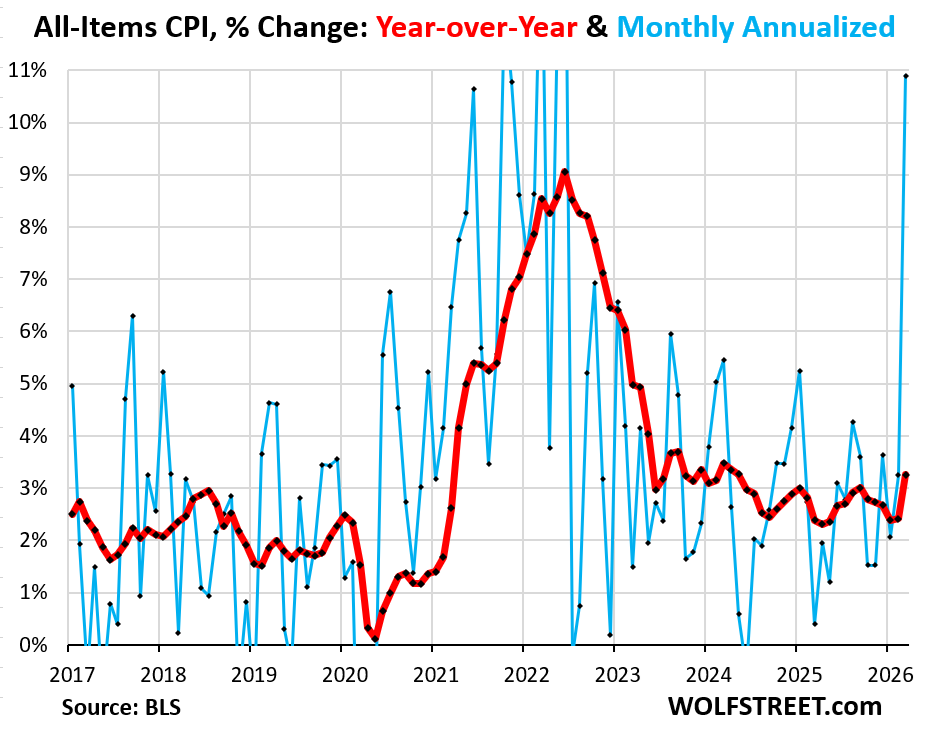
The all-items CPI, which includes food and energy, spiked by 0.87% in March from February, (+10.9% annualized), the biggest such spike since the peak of the prior waves of energy inflation in mid-2022 (blue line in the chart).
The month-to-month spike pushed the year-over-year increase of CPI to +3.26% (red in the chart).
The spike in energy prices that consumers pay for directly.
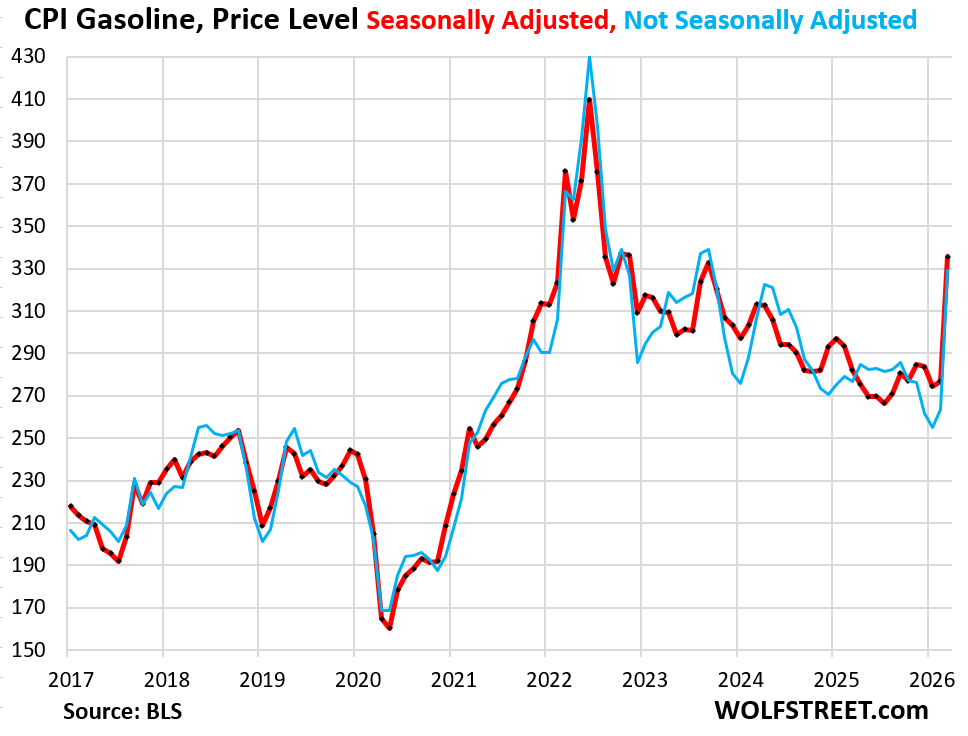
Gasoline prices bottomed out in mid-January after the multi-year decline from the peak in mid-2022. Gasoline prices started rising in late January. For February, the CPI for gasoline already jumped by 0.8% seasonally adjusted. In actual terms, not seasonally adjusted, it jumped by 3.3% in February from January.
Then came the war in Iran, and energy prices spiked in the US, though the US is the biggest energy producer in the world and has a big trade surplus in the energy trade, including in crude oil and petroleum products, and is a big exporter of gasoline, jet fuel, and diesel.
But energy speculation is global and instant, and so prices at the pump spiked even as the gasoline that was in those underground tanks had been refined and purchased well before the war began, and all that happened is that the profit margin of the gasoline retailer spiked.
In March, the CPI for gasoline spiked by another 21% seasonally adjusted and by 25% not seasonally adjusted from February.
Year-over-year, the CPI for gasoline spiked by 18.9%.
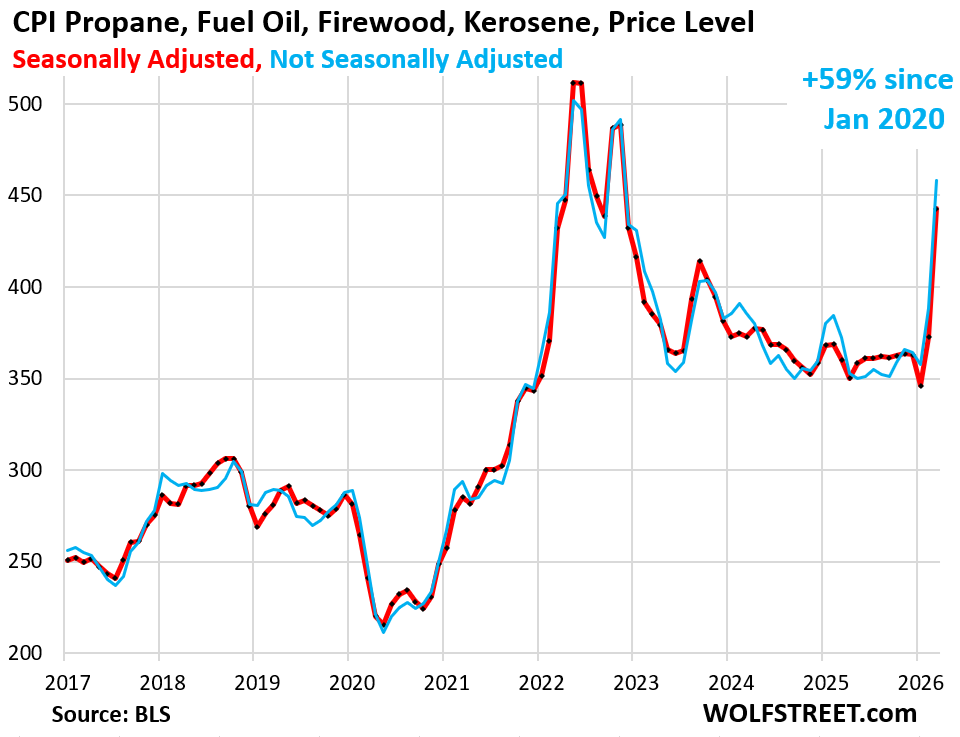
The chart shows the index for the price level (not the percentage change), seasonally adjusted price level in red, not seasonally adjusted price level in blue.
Propane, fuel oil, kerosene, and firewood: The CPI for “Other fuels” spiked by 18.8% in March from February, after having already jumped by 7.7% in February from January, seasonally adjusted. Over those two months combined, the index spike by 27.9%.
Year-over-year, the CPI for other fuels spiked by 22.9%.
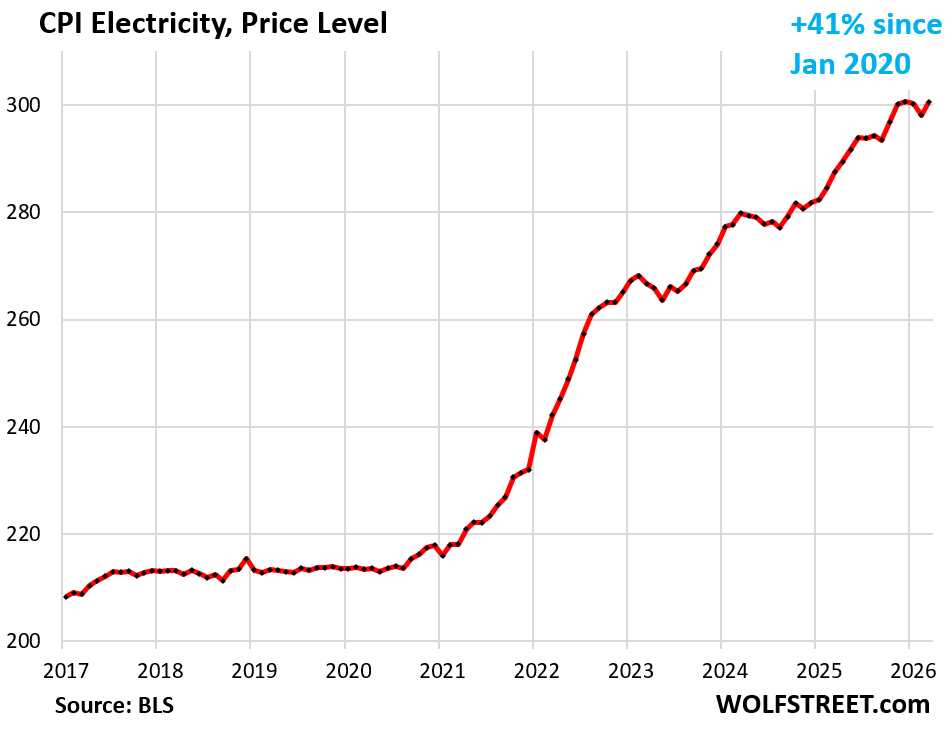
The CPI for electricity jumped by 0.82% in March from February, after two months of declines.
Year-over-year, it rose by 4.6%. Since January 2020, the index soared by 41%.
The price that households pay for electricity on their monthly bills – the fixed fees and charges and the price per kWh used – is largely set by utilities that are monopolies. Some of the utilities are owned by public entities, such as a municipality; some are owned by their ratepayers, such as co-ops; others are investor-owned regulated monopolies, and investors come first. The only competition these electric utilities face is rooftop and plug-in solar.
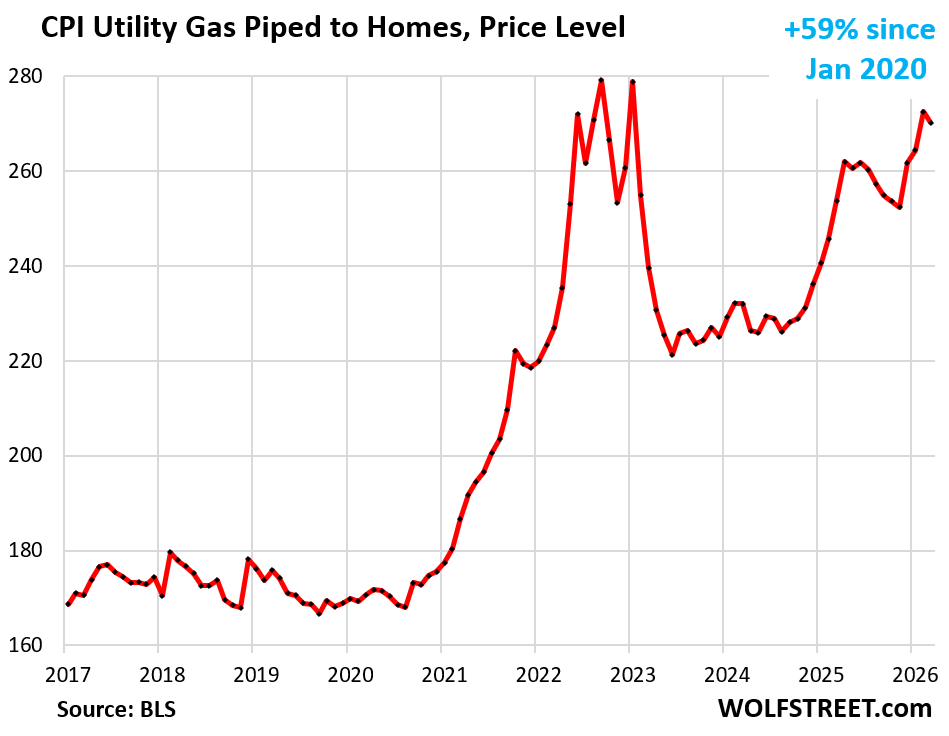
The CPI for utility natural gas (piped to the home) fell by 0.87% in March, after the 3.1% spike in February and the 1.0% jump in January, seasonally adjusted.
Year-over-year it was up by 6.4%. Since January 2020, it has surged by 59%.
The US is the largest producer of natural gas in the world, the largest exporter of LNG in the world, and a substantial exporter of pipeline natural gas. In the biggest oil-producing regions in the US, natural gas is a byproduct of fracking, and part of it used to be flared, and a small part is still being flared, when there is no takeaway infrastructure at the wells. But that’s not what households are experiencing.
The CPI for the energy costs combined that consumers pay for directly weighs 6.4% of the overall CPI. When it spikes like it did in March, it moves the needle.
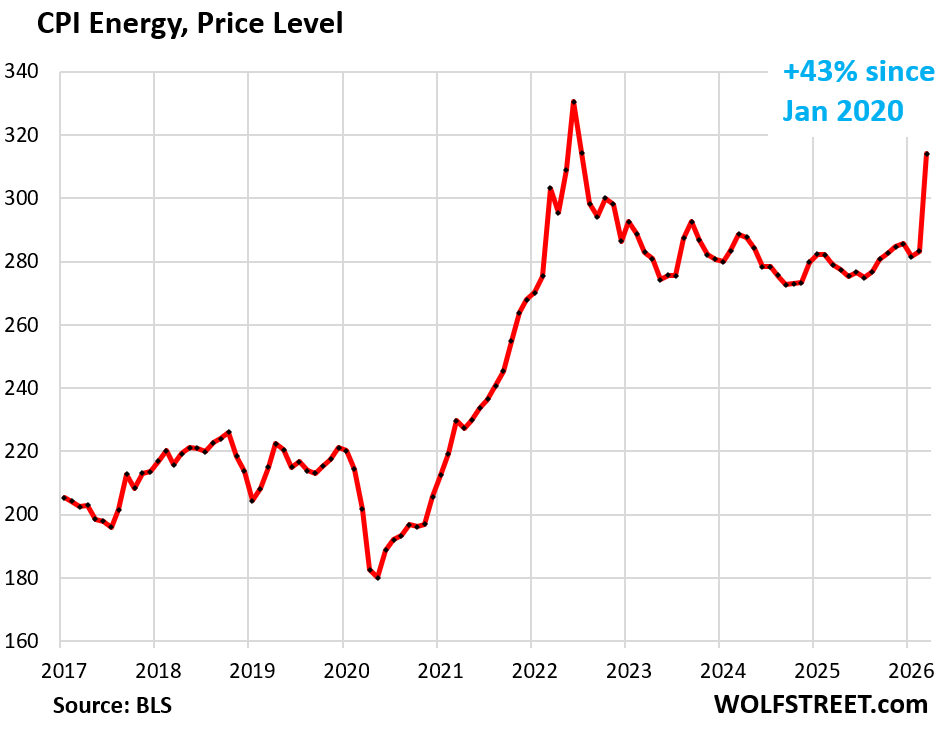
The overall energy CPI, which tracks the above categories, spiked by 10.9% in March from February, and by 12.5% year-over-year.
Since January 2020, it has increased by 43%.
Gasoline accounts for about half of the energy CPI.
Energy inflation, like food inflation, hits the lower income households the hardest, as they spend a substantial part of their budget on food and energy. The gasoline price spike hits lower-income households with long commutes particularly hard.
The decline in gasoline prices from mid-2022 through 2025 had been a substantial factor in the cooling of overall inflation. This factor has now brutally flipped into the other direction.
What is still to come to the inflation readings is the influx of energy price spikes into broader goods and services over time. It’s uncertain how much of that can be passed on when demand is not that strong, and how much of it gets absorbed by profit margins.
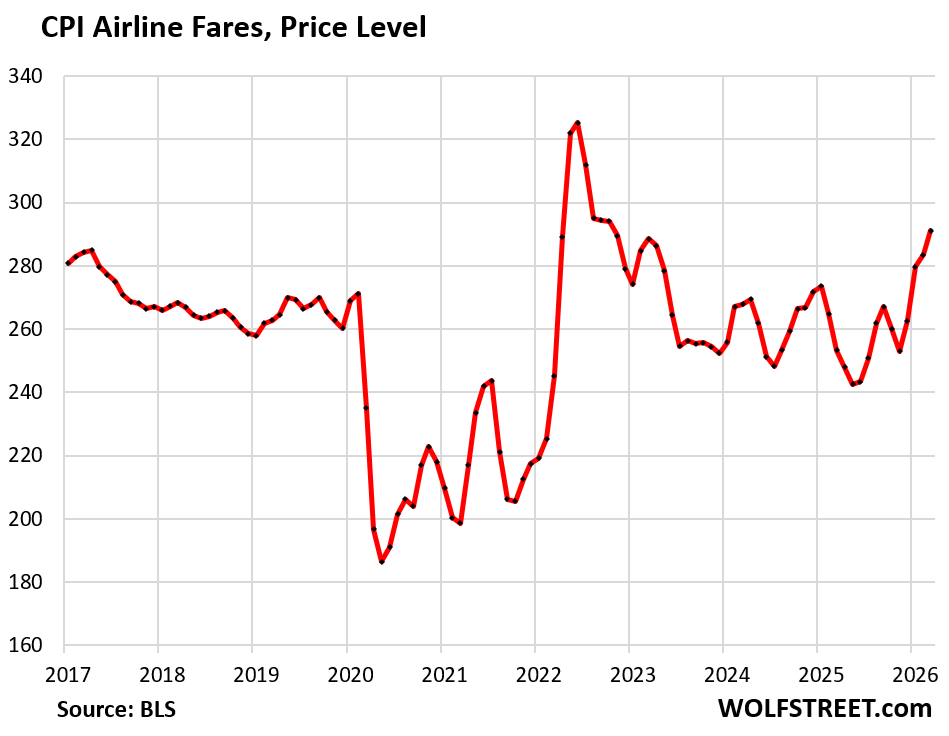
Airline fares is an example. When ticket prices rise, some consumers forgo air travel, and enough seats remain empty. But airlines have huge fixed costs and need to fill their seats, and so they run specials and cut prices to fill those seats. Airline profits can get crushed by rising fuel prices. Delta owns its own refinery. And airlines hedge some of their fuel consumption. So it’s not a straight line.
Airline fares jumped by 2.7% in March from February, but they’d already jumped much more in the prior months. In total, since November, airline fares spiked by 15%, most of that unrelated to fuel costs.
Airline CEOs have been out there trying to manipulate the American public into willingly paying higher prices by announcing that they would raise their prices in various ways to deal with the fuel costs. But consumers could just fly less and create enough empty seats that would force those CEOs to confess during earnings calls that their profits took a hit because they couldn’t raise prices enough without sacrificing revenue passenger miles.
Major non-energy components in CPI:
The CPI for durable goods, many of which are tariffed, was essentially unchanged month-to-month, after three months in a row of negative readings. Year-over-year, it was also roughly unchanged.
The CPI for food at home, after substantial increases in the prior three months, dipped in March from February. Year-over-year, it rose by 1.9%.
The CPI for core services rose by 0.23% (+2.7% annualized) in March from February. Year-over-year, it accelerated slightly to +3.05%. The six-month index accelerated for the second month in a row to +3.3% annualized.
In case you missed it yesterday: Even without the energy price spike, the Fed-favored PCE price index showed alarming trends, and the Fed needs to pay attention: Six-Month Core PCE Inflation (still before Iran War) Jumps by Most since June 2024
Enjoy reading WOLF STREET and want to support it? You can donate. I appreciate it immensely. Click on the mug to find out how:


“The CPI for durable goods, many of which are tariffed, was essentially unchanged month-to-month, after three months in a row of negative readings. Year-over-year, it was also roughly unchanged.”
Are you going to run an over/under on how many commenters blame tariffs? -g-
Interesting to note the spx has been doing the reverse of the tnx of late. Today the tnx was basically flat and tnx yield spiked up, breaking the recent trend.
Howdy Youngins. These are wonderful times for US Squirrels. The ZIRP tool is firmly locked away in the FED toolbox. Will Drill Baby Drill solve our inflation problems??? The guy in the Big House sure thinks so. Going to be a fun ride to November…..
Sober Sailor Saving Spending more everyday…..
Crazy how gas can spike like that. It’s not like everyone is driving more!
They say price is set at the margin. Kinda like when a dentist from Poughkeepsie pays 7 cents more for one Apple share and Apple’s market cap goes up $1 billion. My girlfriend paid north of $6/gallon in San Francisco, so here we go
I should have booked my summer vacation flights earlier. Sorry guys, Looks like I’ll have to contribute to the higher prices.