
Germany, France, Italy, Spain, Netherlands, Poland, Belgium, Sweden, Ireland, Austria, Norway, Denmark, Romania, Czech Republic, Finland, Portugal, Slovakia, Hungary, Bulgaria.
By Wolf Richter for WOLF STREET.
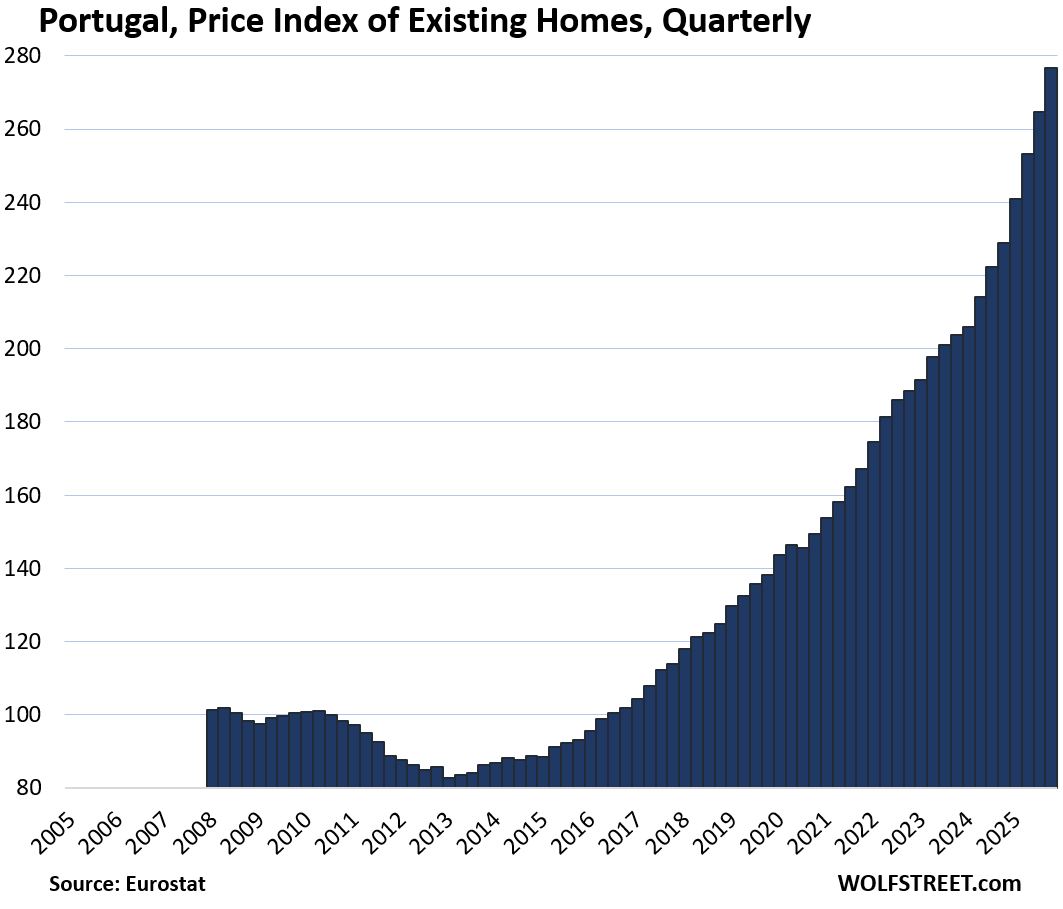
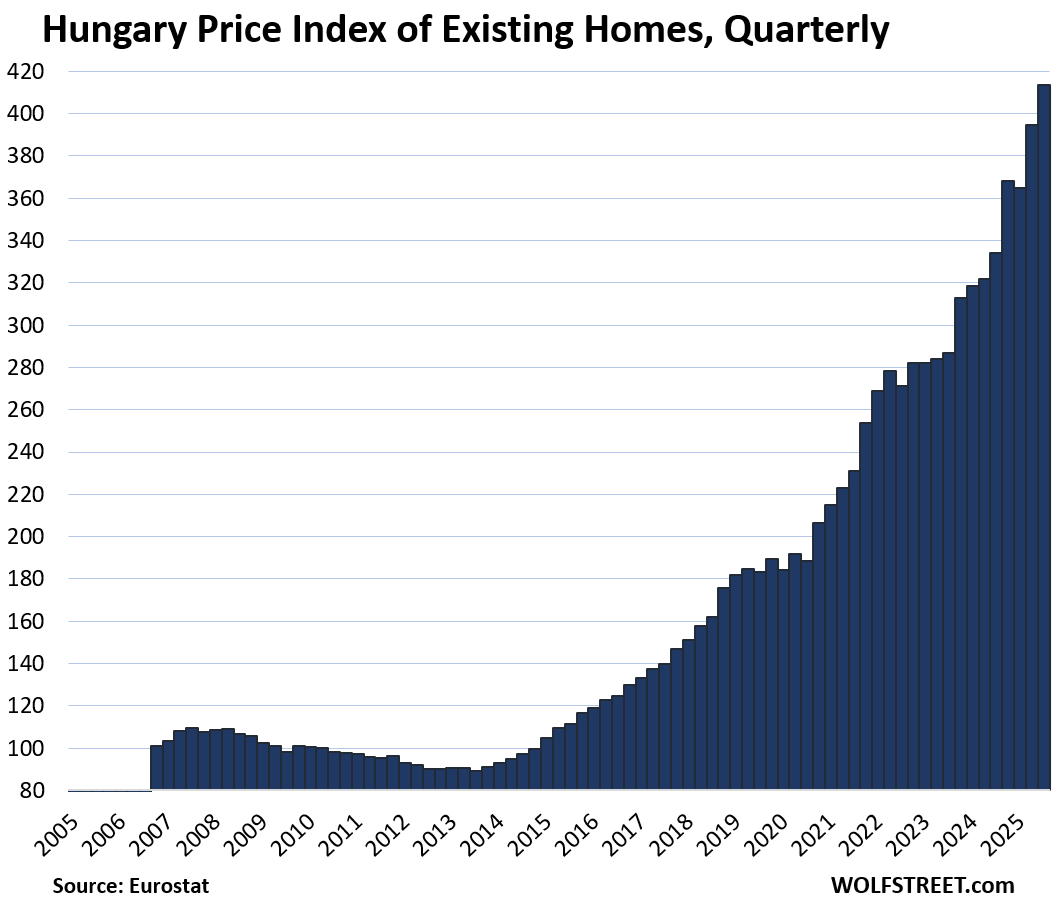
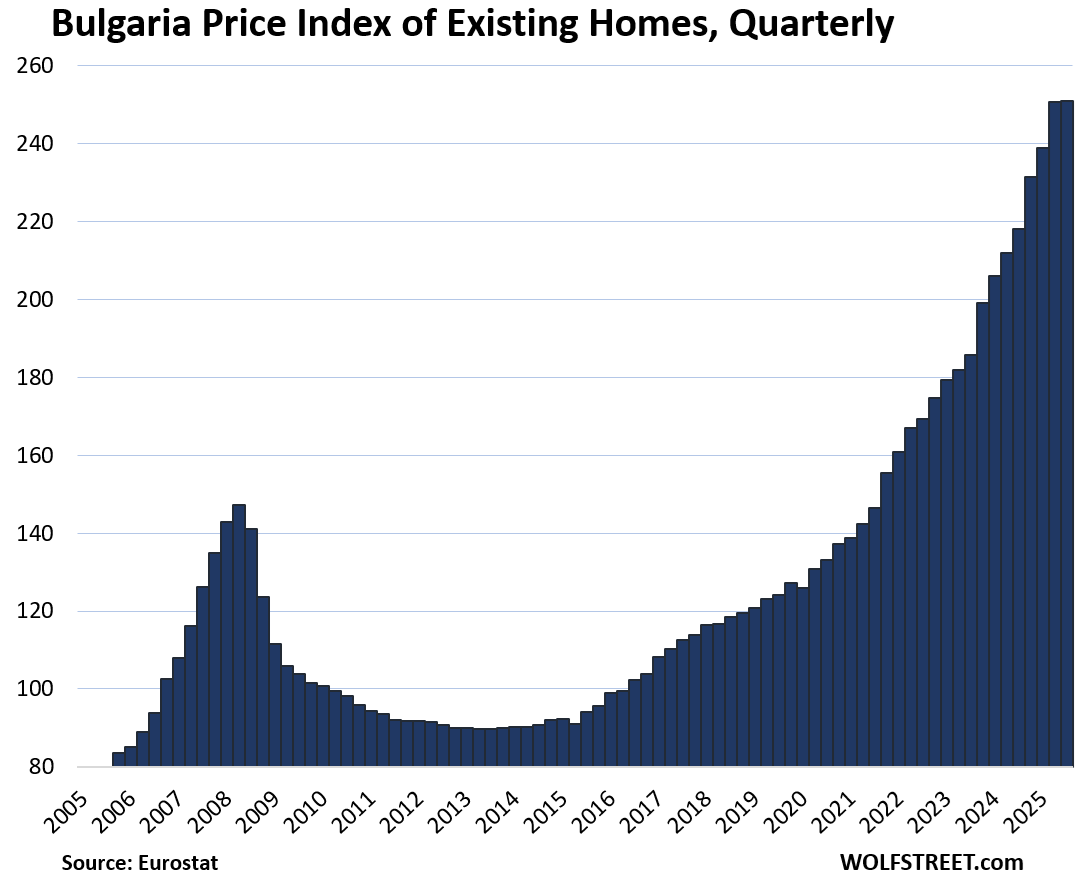
In some of the 19 largest countries by GDP in the European Union (EU) and in the European Economic Area (EEA), prices of existing homes of all types have skyrocketed to new highs, led by Hungry (+23.7% year-over-year), Portugal (+20.9% year-over-year), and Bulgaria (+15.0% year-over-year).
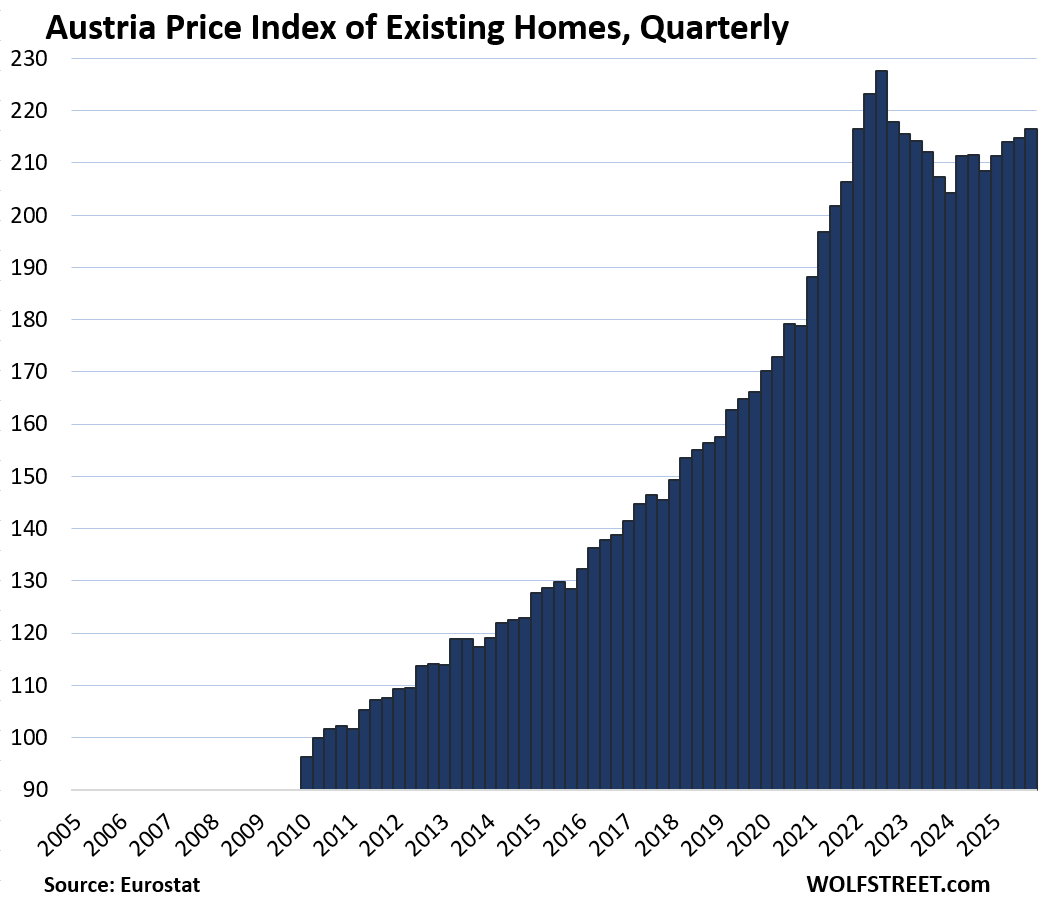
In other countries, prices of existing homes have wobbled along below their peaks in prior years, including Germany, France, and Austria.
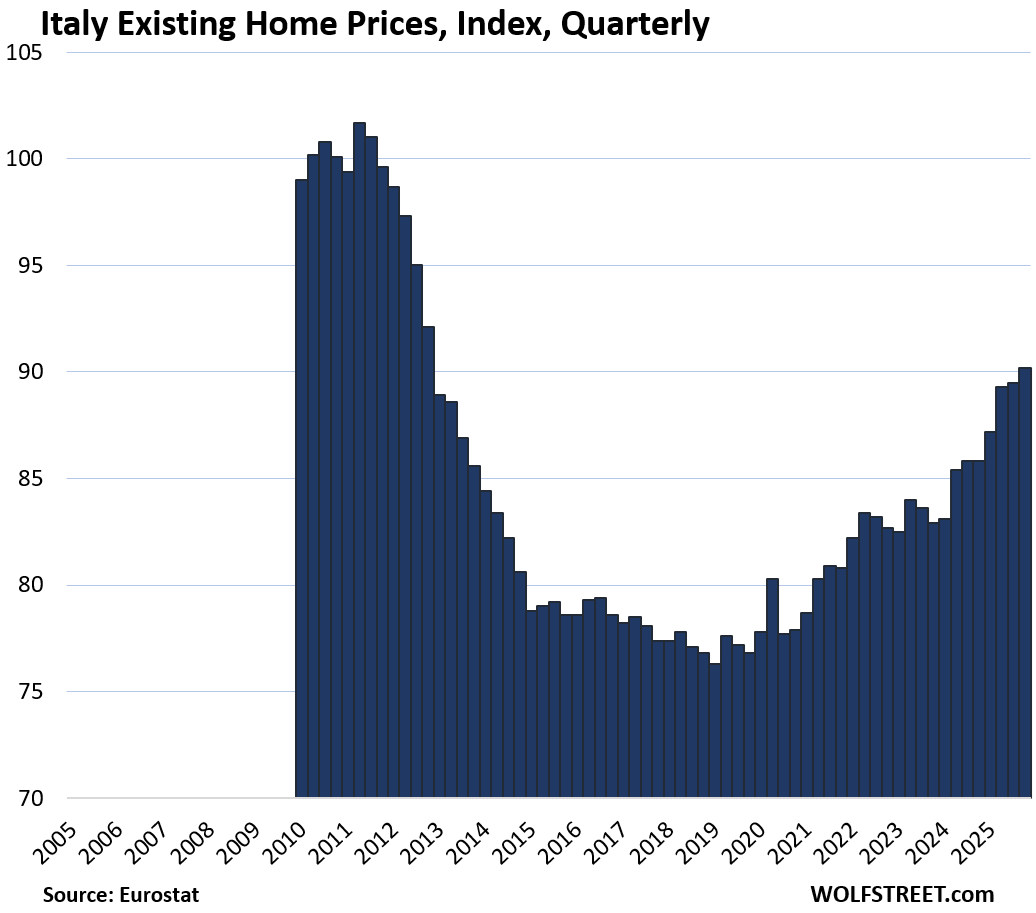
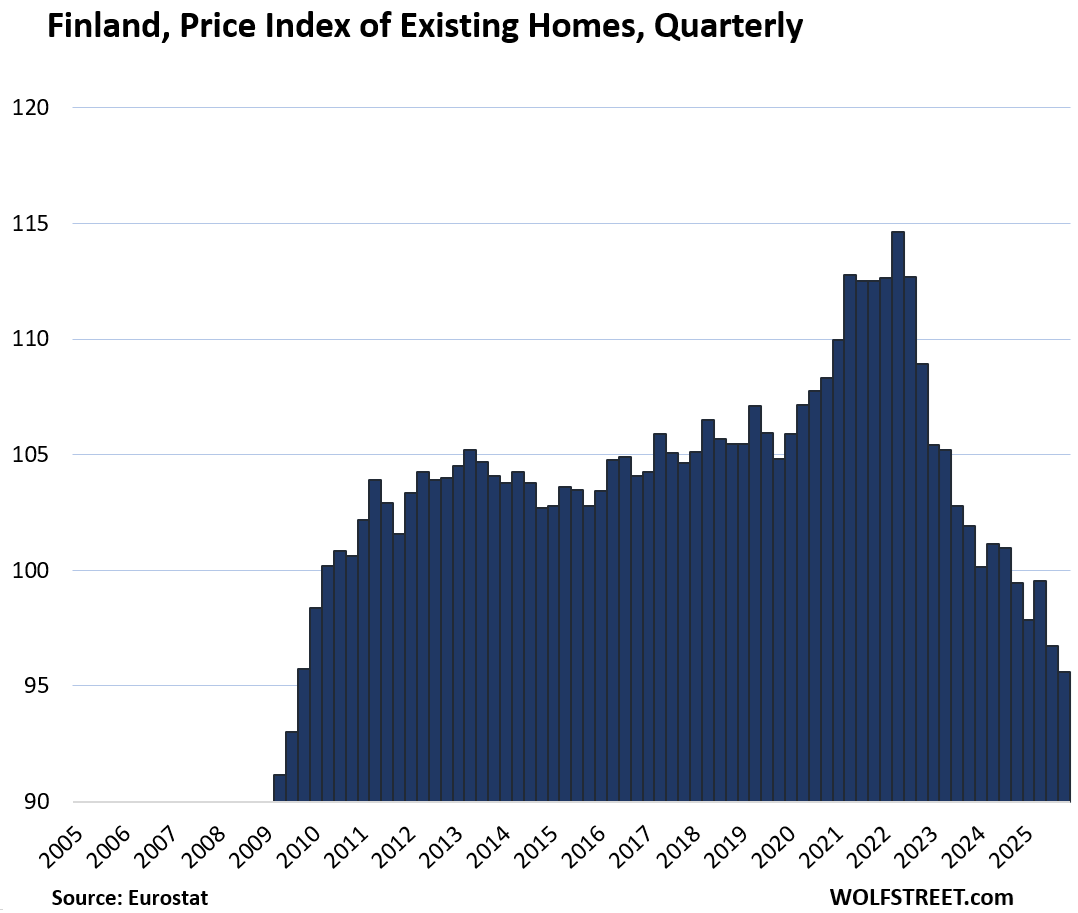
In Italy, prices of existing homes are still below where they’d been in 2011, the prior housing bubble that had imploded, despite substantial increases in recent years. And in Finland, prices have fallen by 16.6% from the peak in 2022 back to 2010 levels.
Here is our quarterly wild ride across these 19 housing markets in Europe, based on the new data from Eurostat through Q4 2025 for existing homes.
Countries where prices are below a peak in prior years (year of peak):
- Finland: -16.6% (Q2 2022), back to 2010 levels.
- Italy: -11.3% (Q2 2011)
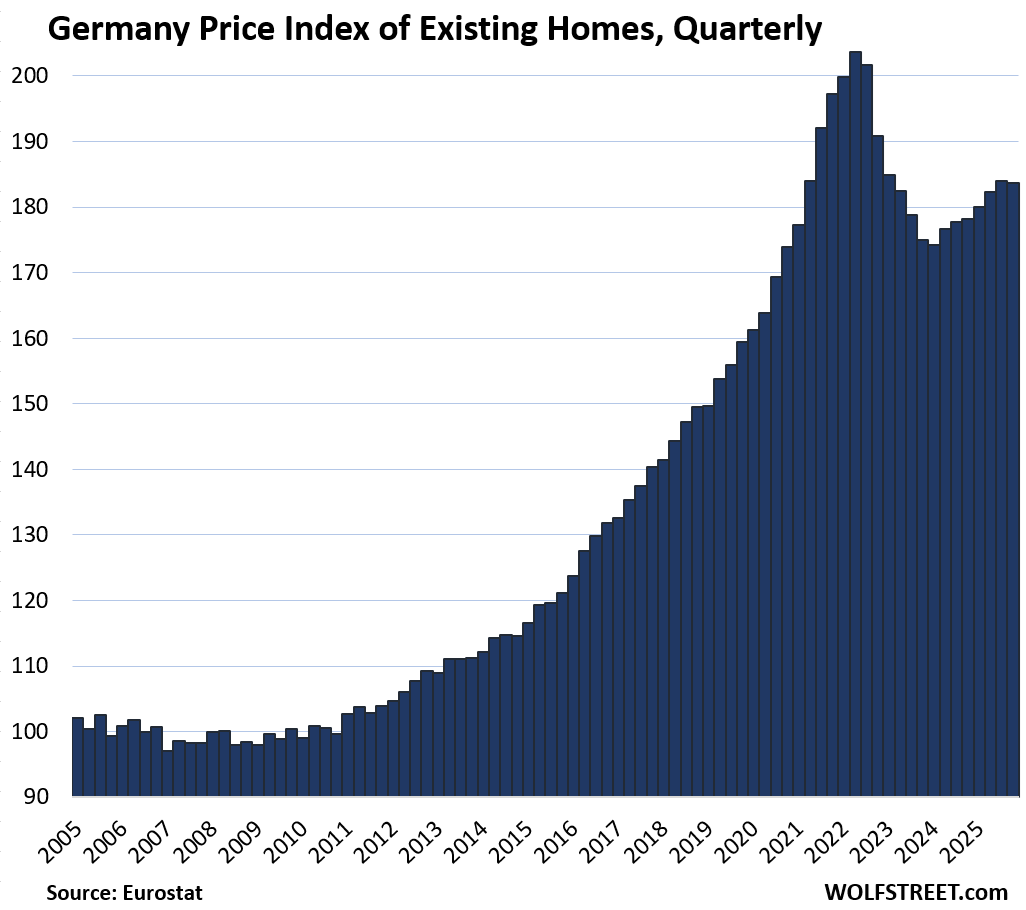
- Germany: -9.8% (Q2 2022)
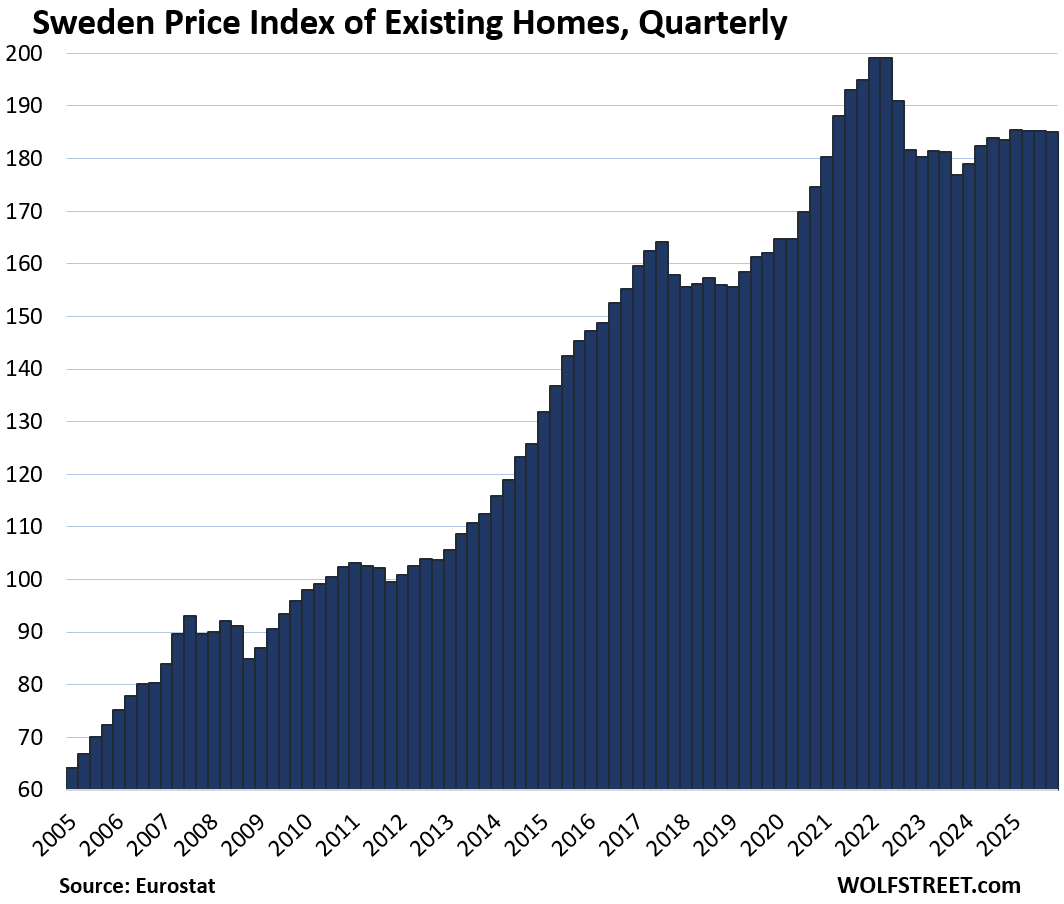
- Sweden: -7.1% (Q2 2022)
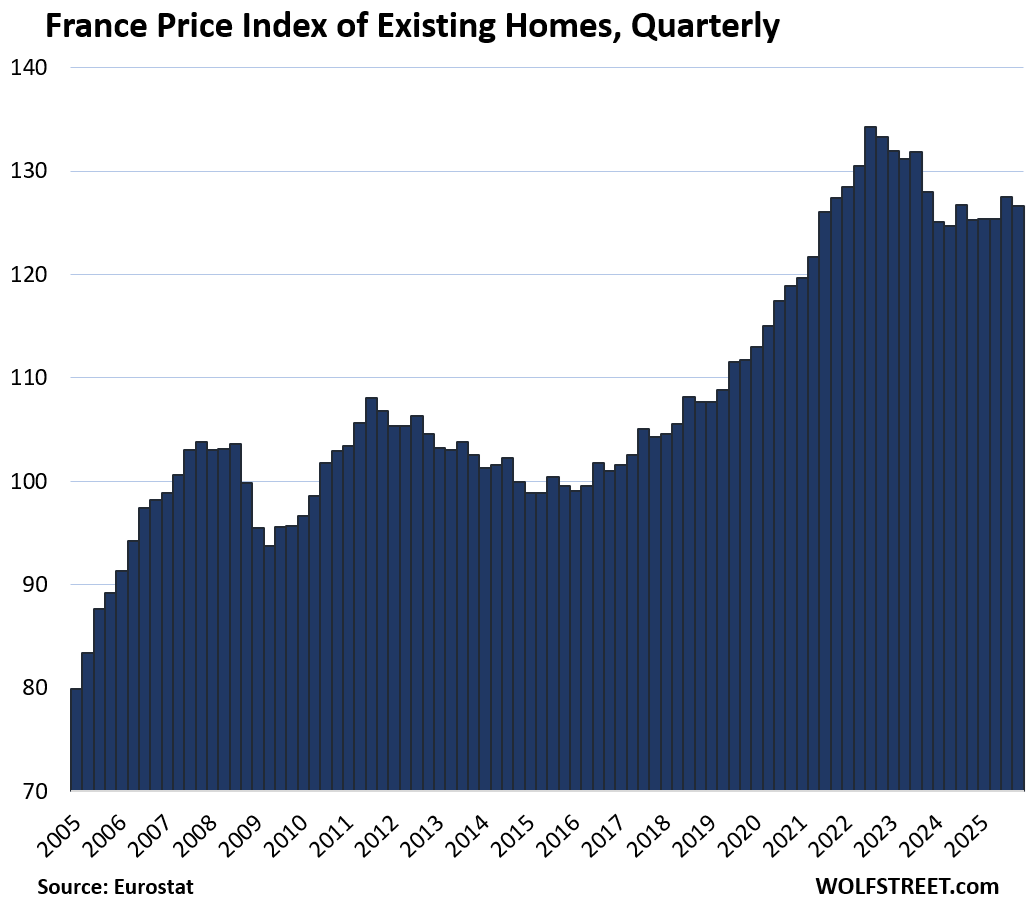
- France: -5.7% (Q3 2022)
- Austria: -4.8% (Q3 2022)
Biggest price gains since 2010:
- Hungary: 308%
- Portugal: 175%
- Czech Republic: 165%
- Bulgaria: 147%
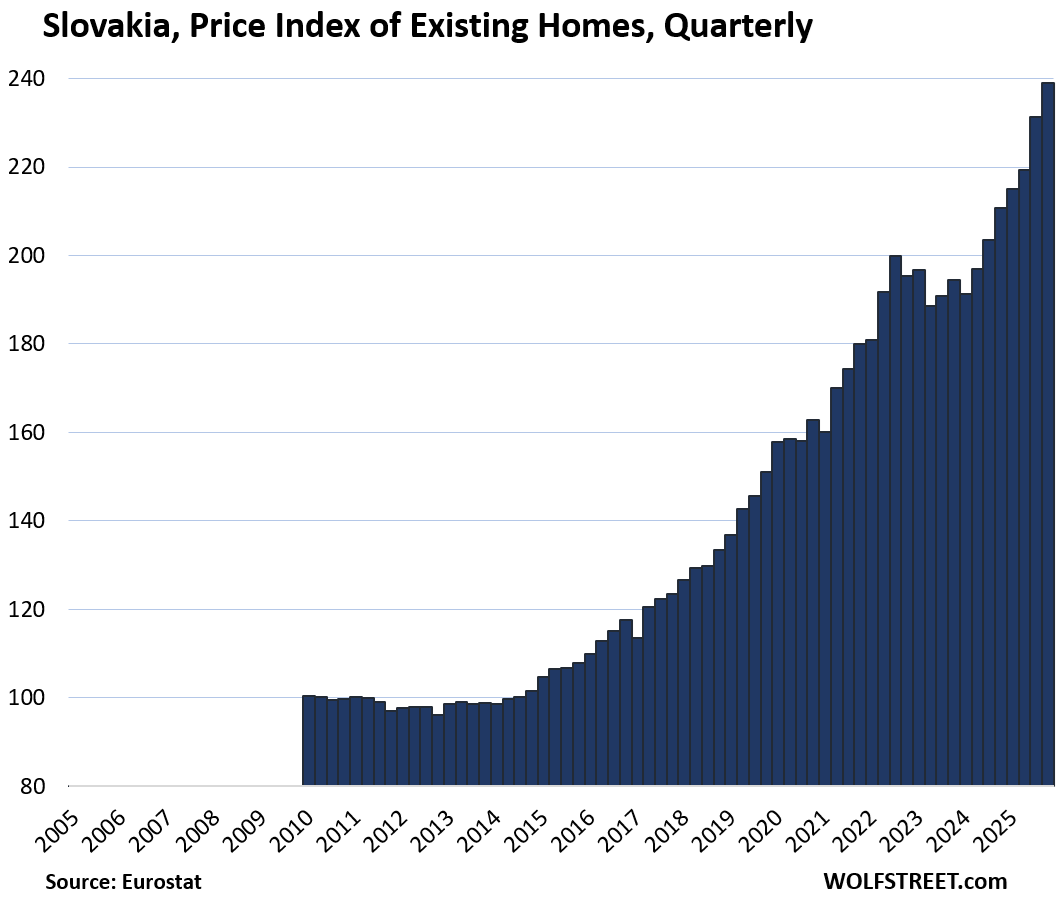
- Slovakia: 138%
- Austria: 125%
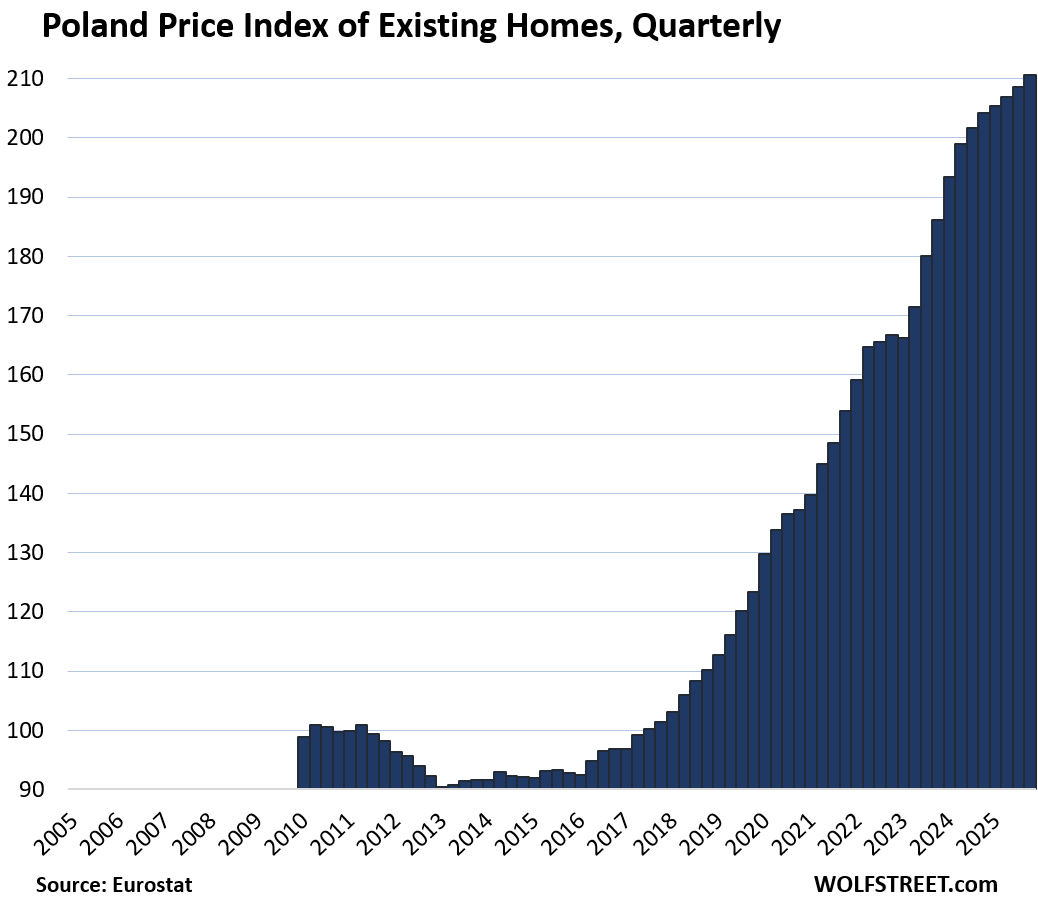
- Poland: 113%
- Norway: 111%
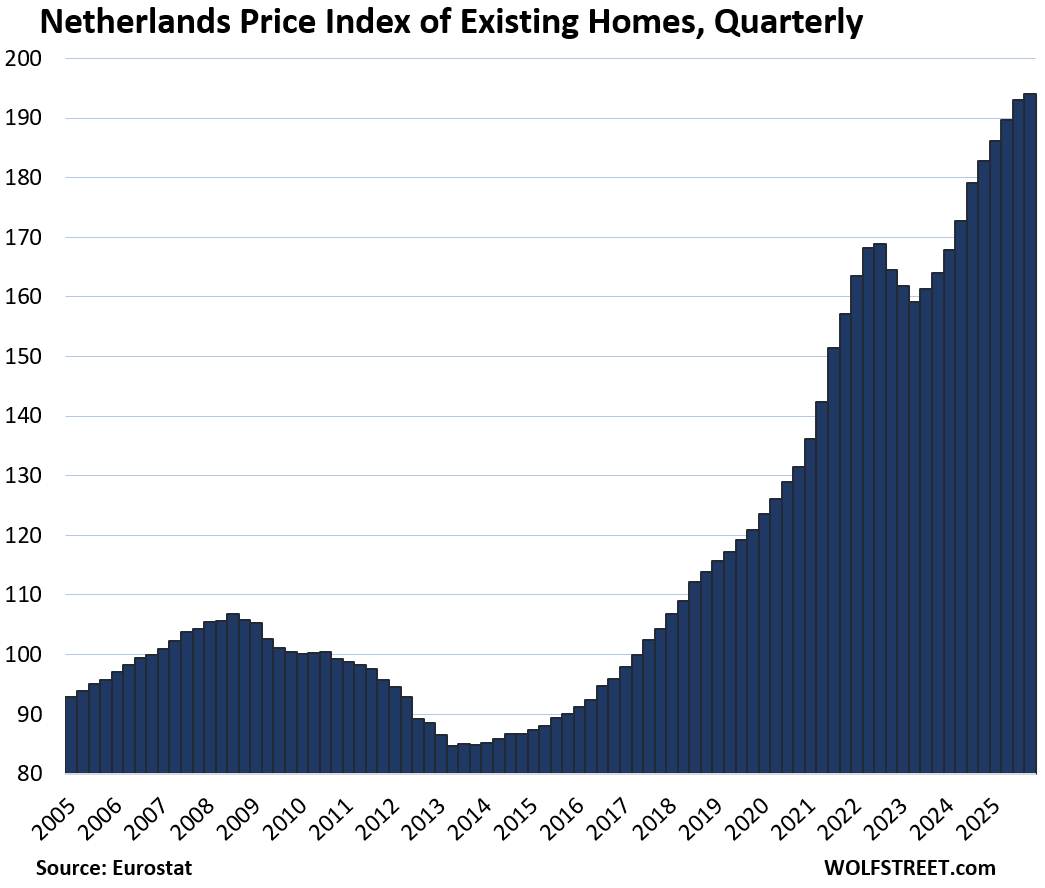
- Netherlands: 94%
- Sweden: 89%
- Ireland: 88%
- Germany: 85%
- Denmark: 75%.
Biggest year-over-year gains in Q4:
- Hungary: 23.7%
- Portugal: 20.9%
- Bulgaria: 15.0%
- Slovakia: +13.4%
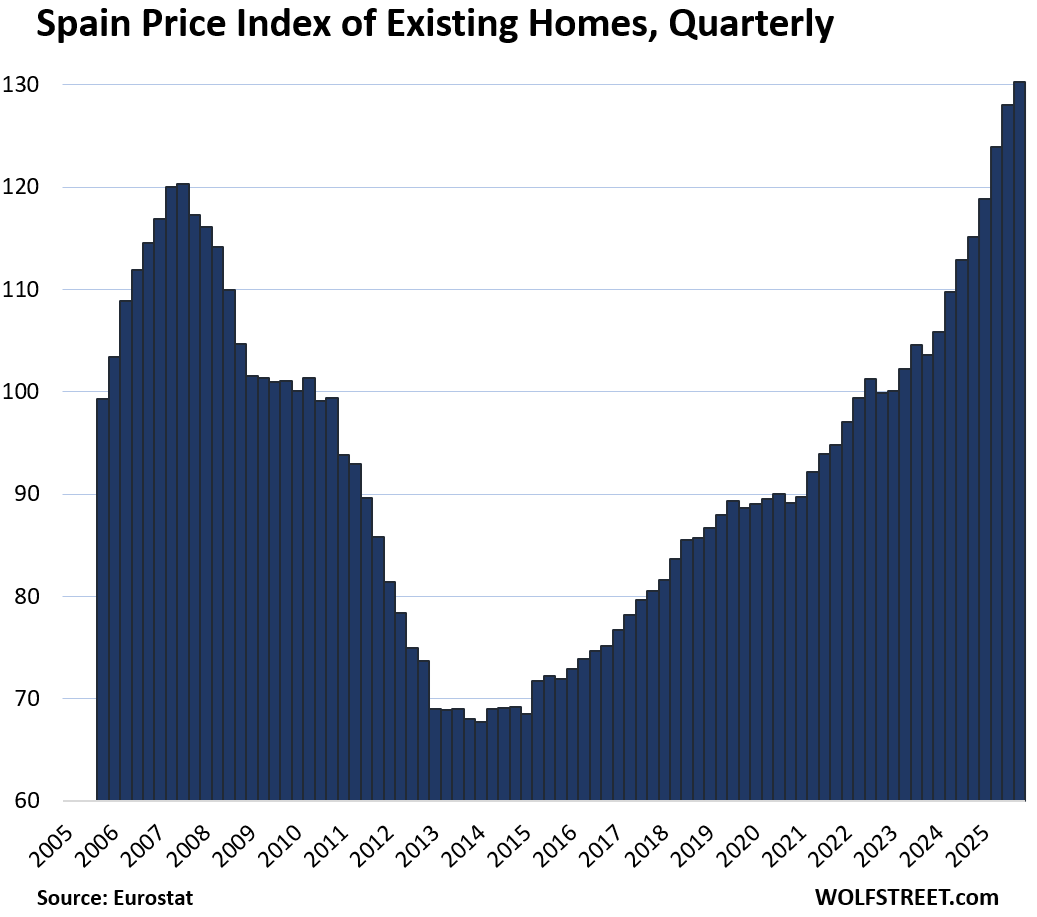
- Spain: 13.2%
- Czech Republic: 10.0%
- Denmark: 7.6%
- Ireland: 7.3%
- Romania: 7.1%
- Netherlands: 6.2%
- Italy: 5.1%
Biggest quarter-over-quarter gains in Q4:
- Hungary: 4.8%
- Portugal: 4.6%
- Slovakia: 3.3%
- Czech Republic: 2.4%
- Romania: 2.1%
- Ireland: 2.0%
- Spain: 1.8%
- Denmark: 1.4%
- Poland: 1.0%
The 5 countries with quarter-over-quarter declines in Q4:
- Finland: -1.2%
- Norway: -0.9%
- France: -0.7%
- Germany: -0.2%
- Sweden: -0.1%
Home price indices for the 19 largest EU/EEA countries:
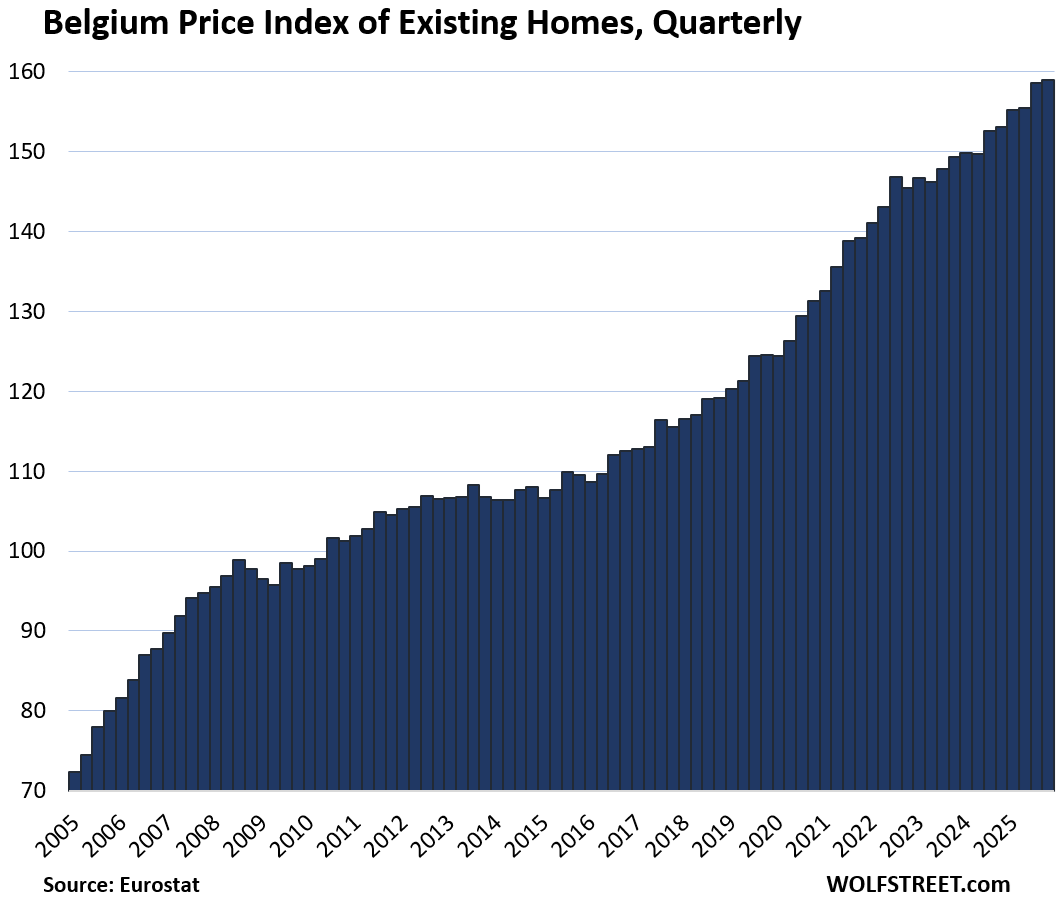
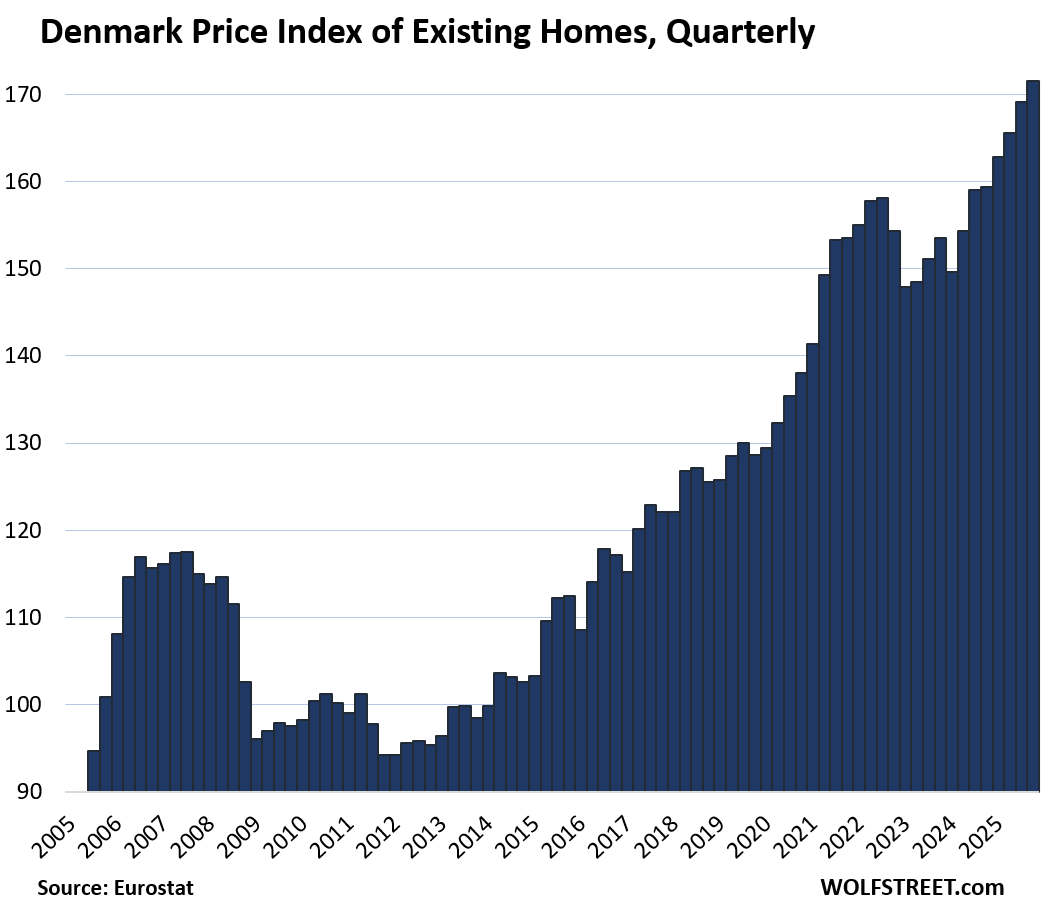
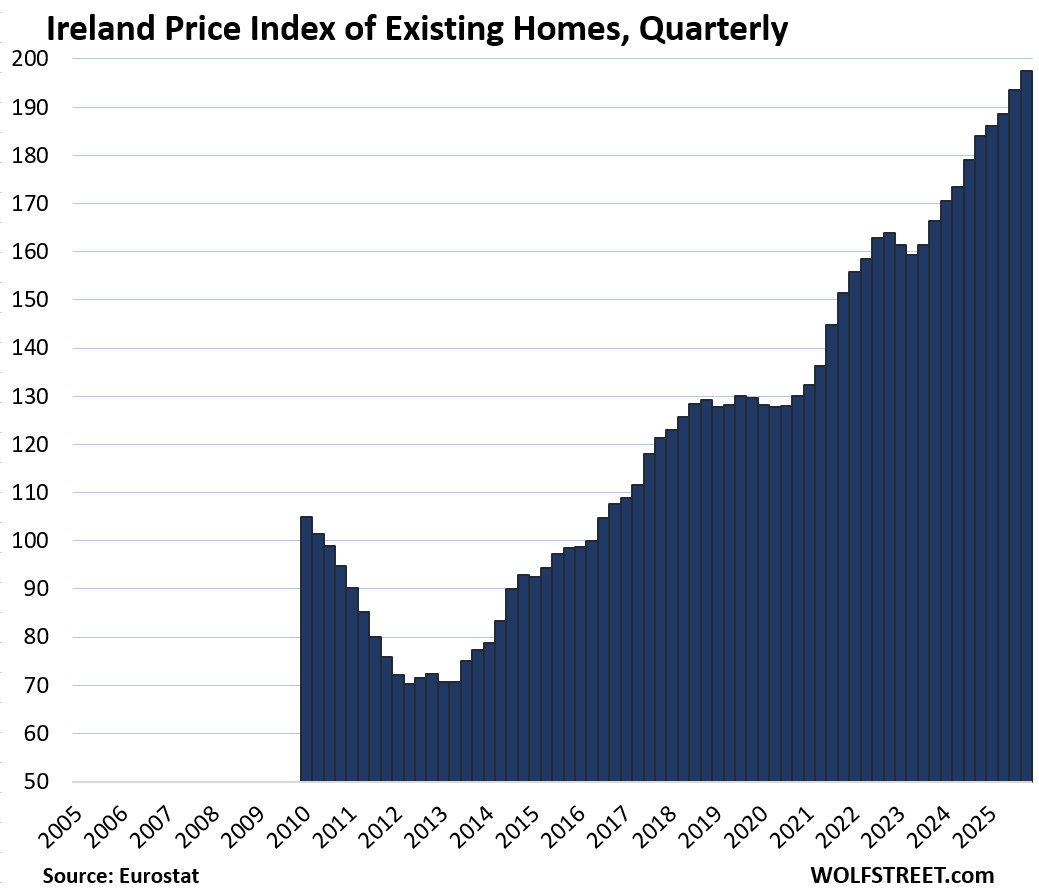
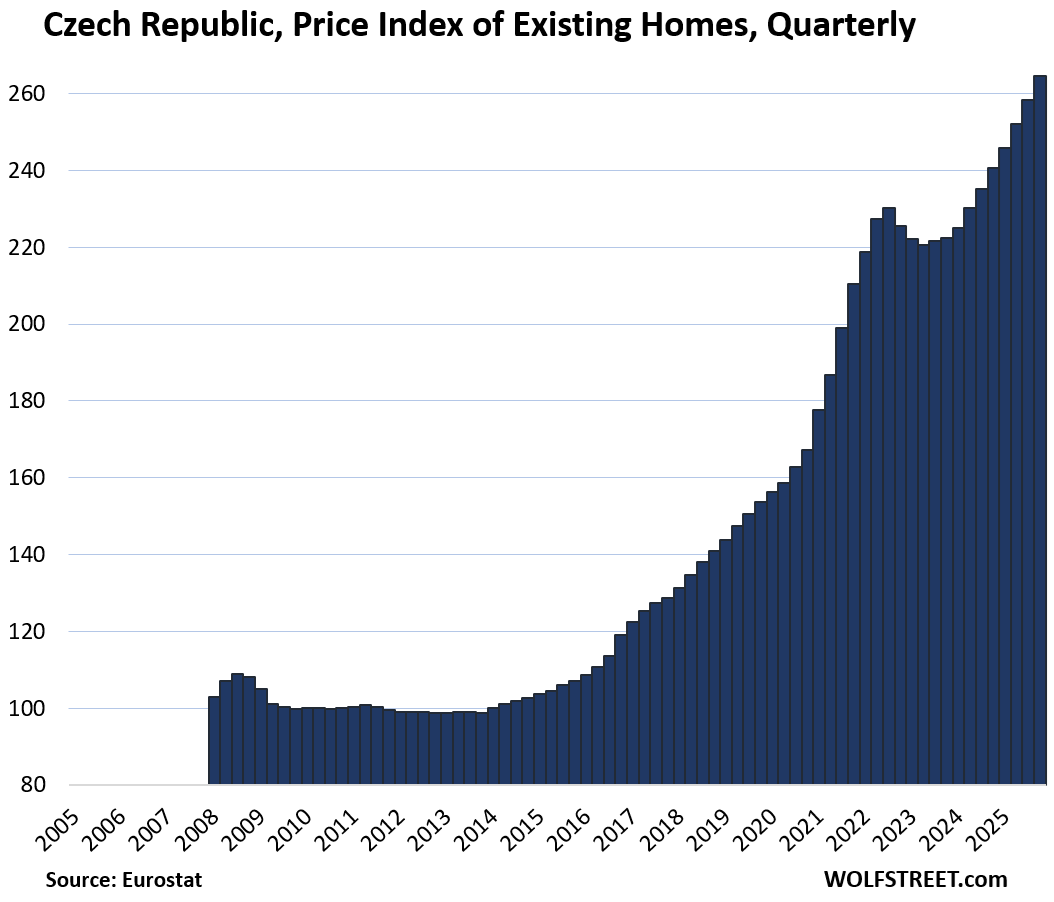
Eurostat’s data goes back to 2005 for some countries, but not as far for other countries; I put all of them on the same timeline going back to 2005 for easier comparison. Eurostat does not provide home price data for Greece, though in terms of GDP, Greece would fit into the line-up here.
The vertical axis shows index values (where the values for 2010 were set at 100), rather than prices in currency, so it’s not possible to compare the price levels across the markets.
The little tables show either three or four columns, from left to right: % change since 2010; quarter-over-quarter (QoQ) % change; year-over-year (YoY) % change; and % decline from the peak in prior years, for the six countries where that occurred. For five countries the prior peak was in 2022; for Italy, it was in 2011.
| Germany, Prices of Existing Homes | |||
| since 2010 | QoQ | YoY | From peak |
| 85% | -0.2% | 3.0% | -9.8% |
| France, Prices of Existing Homes | |||
| Since 2010 | QoQ | YoY | From peak |
| 31% | -0.7% | 1.1% | -5.7% |
| Italy, Prices of Existing Homes | |||
| Since 2010 | QoQ | YoY | From peak |
| -9% | 0.8% | 5.1% | -11.3% |
| Spain, Prices of Existing Homes | ||
| Since 2010 | QoQ | YoY |
| 30% | 1.8% | 13.2% |
| Netherlands, Prices of Existing Homes | ||
| Since 2010 | QoQ | YoY |
| 94% | 0.5% | 6.2% |
| Austria, Prices of Existing Homes | |||
| Since 2010 | QoQ | YoY | From peak |
| 125% | 0.8% | 3.8% | -4.8% |
| Poland, Prices of Existing Homes | ||
| Since 2010 | QoQ | YoY |
| 113% | 1.0% | 3.1% |
| Sweden, Prices of Existing Homes | |||
| Since 2010 | QoQ | YoY | From peak |
| 89% | -0.1% | 0.8% | -7.1% |
| Belgium, Prices of Existing Homes | ||
| Since 2010 | QoQ | YoY |
| 62% | 0.3% | 3.9% |
| Denmark, Prices of Existing Homes | ||
| Since 2010 | QoQ | YoY |
| 75% | 1.4% | 7.6% |
| Ireland, Prices of Existing Homes | ||
| Since 2010 | QoQ | YoY |
| 88% | 2.0% | 7.3% |
| Czech Republic, Prices of Existing Homes | ||
| Since 2010 | QoQ | YoY |
| 165% | 2.4% | 10.0% |
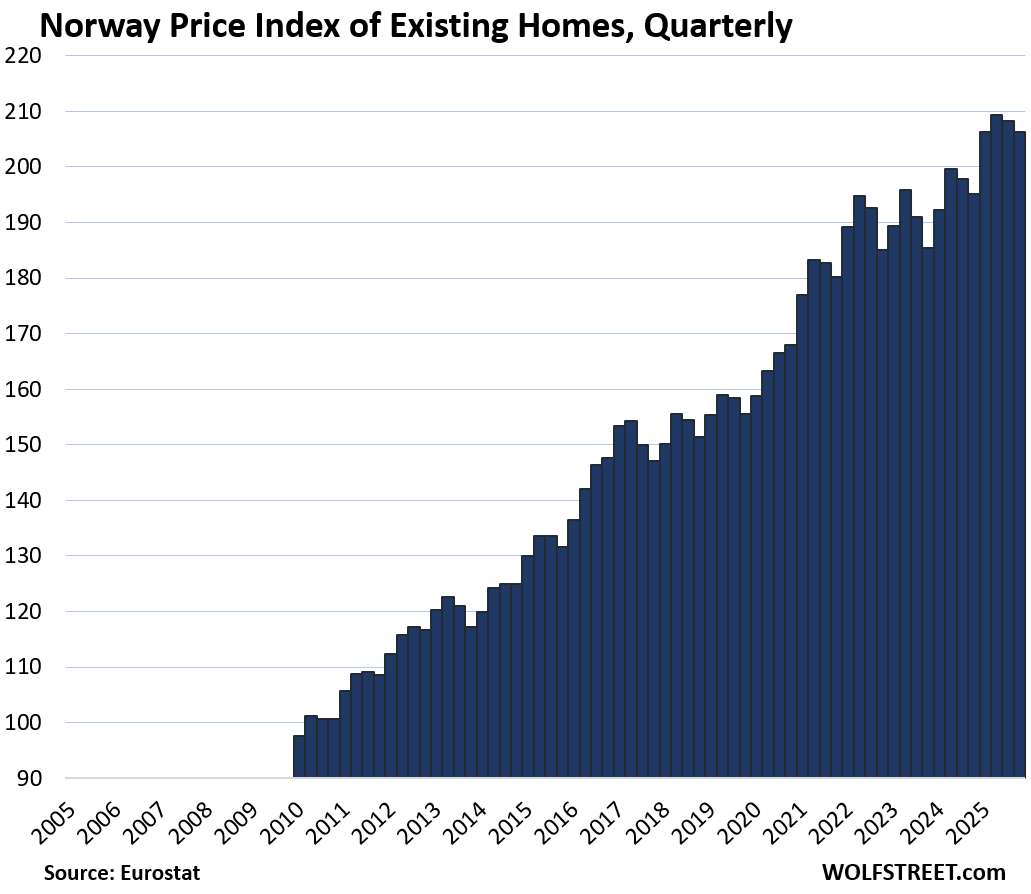
| Norway, Prices of Existing Homes | ||
| Since 2010 | QoQ | YoY |
| 111% | -0.9% | 5.7% |
| Finland, Prices of Existing Homes | |||
| Since 2010 | QoQ | YoY | From peak |
| -3% | -1.2% | -3.9% | -16.6% |
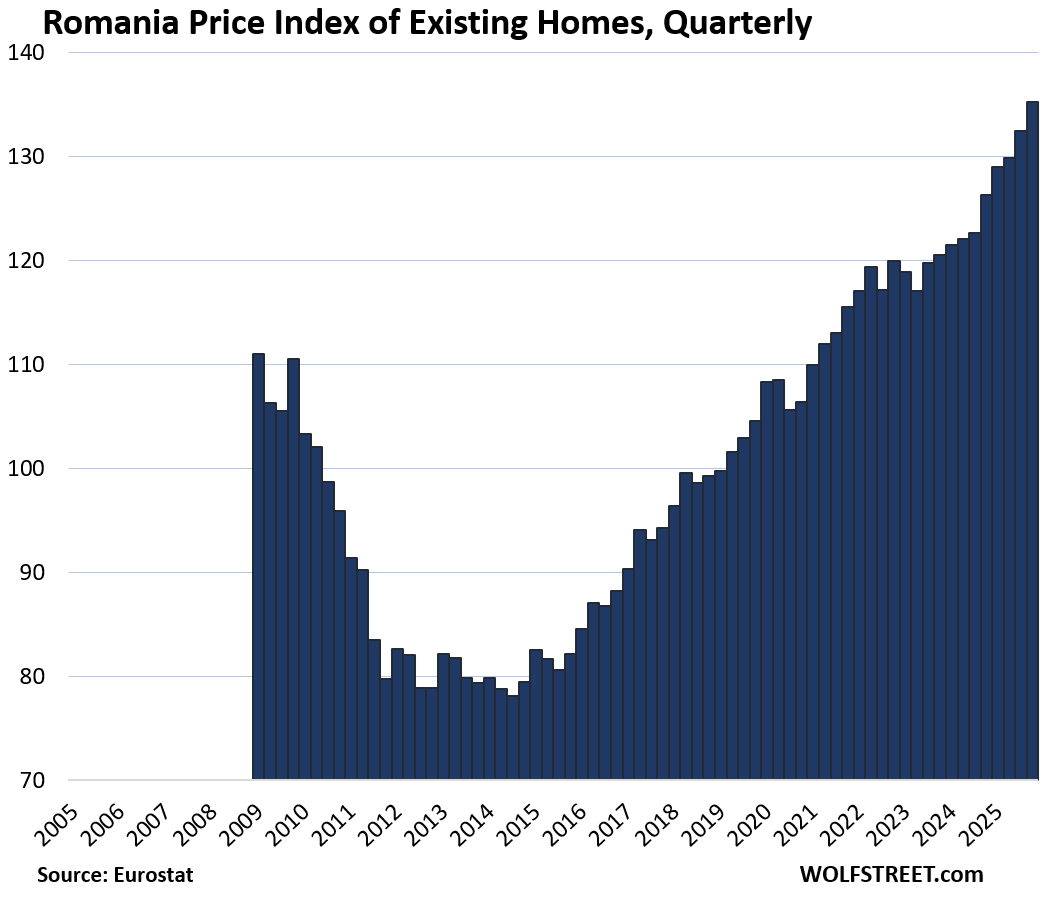
| Romania, Prices of Existing Homes | ||
| Since 2010 | QoQ | YoY |
| 31% | 2.1% | 7.1% |
| Portugal, Prices of Existing Homes | ||
| Since 2010 | QoQ | YoY |
| 175% | 4.6% | 20.9% |
| Hungary, Prices of Existing Homes | ||
| Since 2010 | QoQ | YoY |
| 308% | 4.8% | 23.7% |
| Slovakia, Prices of Existing Homes | ||
| Since 2010 | QoQ | YoY |
| 138% | 3.3% | 13.4% |
| Bulgaria, Prices of Existing Homes | ||
| Since 2010 | QoQ | YoY |
| 147% | 0.1% | 15.0% |
Enjoy reading WOLF STREET and want to support it? You can donate. I appreciate it immensely. Click on the mug to find out how:


What happened in Finland?
Rap music.
No wonder the Finnish youth rank happiest on earth. Affordable housing !
War in Ukraine happened. And Finland is probably next. Not the first time.
In Finland, ~93% of mortgages are variable-rate loans.
From the BoF:
“In Finland, a new housing loan usually has a maturity of 25 years and an interest rate and monthly loan-servicing costs that change once a year according to the 12-month Euribor.”
As a result, ECB rate increases post Covid have been felt by the majority of the market relatively quickly and have put significant downward pressure on property values.
Would I be safe in assuming the
countries highest price increases
have a younger population ?
Not sure about that. But most of them had much lower home prices 10 or 20 years ago than countries like Germany and other expensive places. So lots of people from those expensive countries, plus lots of Americans and Brits and others, went shopping there for second homes or to retire or as rental property or whatever. Some of the cities in those formerly cheaper countries are wonderful… such as Prague and Lisbon. They were relatively cheap back then, and now they’re a lot more expensive. Portugal is a big favorite for Americans and Brits. Eastern Europe has long been a favorite for Germans. Prague attracts buyers from everywhere. A flood of conversions to vacation rentals have turned into another big factor in the price spike. In all of those cities with ballooning home prices, homes have become unaffordable for local salaries – which is a huge problem.
conversations to vacation rentals
autocorrect fail
This is very much the situation in Poland (my old home country), the main cities attract a lot of central EU and some western capital, some of it is just ex immigrants returning but regardless it’s money from outside economies. This is leaving a lot of locals shut out of those markets. The interesting thing is that still today if you draw circles around those cities as you approach outer city limits you start to get pricing that’s more attainable for people who work locally (there’s a significant group of traveling workers, they’ll spend a few weeks abroad and come home for a couple or so, some of my friends do this). So the price difference between old square and outer limits is massive, then as you move into the smaller cities and countryside etc. you start to get very affordable pricing.
Anyway, this is very cool analysis, I enjoyed this article a lot!
Just window shopping around, I can see that Europeans really hate living in small towns or rural areas. There is a huge price difference, perhaps reflecting the high cost of car commuting. Yet I wonder if the small town life might be great for retirees, assuming they can get to doctor appointments and buy groceries.
In the US it’s the opposite. Everyone wants to bulldoze a little piece of forest 50 miles from a city and build their ugly snout house there and commute an hour to and from work each day for the rest of their lives. Don’t ask me to make sense of it. I only live here!
Thanks, lots of moving parts !
Just here for the rage and fed stroking. Thank you. Houses are good but what about beds.
Hmmmmmm…..,housing back to 2011 levels or so….,suddenly I am not on buyers strike!
It would be useful to see a chart of the most recent home prices by country (in euros or dollars) so I can compare them to what are found in the U.S.
Sure, as I pointed out in the article, but Eurostat doesn’t provide price data in currency.
“The vertical axis shows index values (where the values for 2010 were set at 100), rather than prices in currency, so it’s not possible to compare the price levels across the markets.”
I’m going to be “that guy”…. I know Italian real estate really well, and do not trust this data. OR, maybe it’s a super broad average that is dragged down by the growing number of infamous EUR1 homes getting counted in small villages that have been emptying out.
I can assure you that properties anywhere in any city you have heard of (and many towns you haven’t) are *well* above 2011 highs. Even Napoli and Palermo, places way off the expat map and historically stale, have risen bigly.
It’s hard to understand, because incomes haven’t risen much, and so homes are no more affordable there for the younger masses than in the US, probably worse.