
These new inflation pressures suddenly building up in the pipeline are concerning.
By Wolf Richter for WOLF STREET.
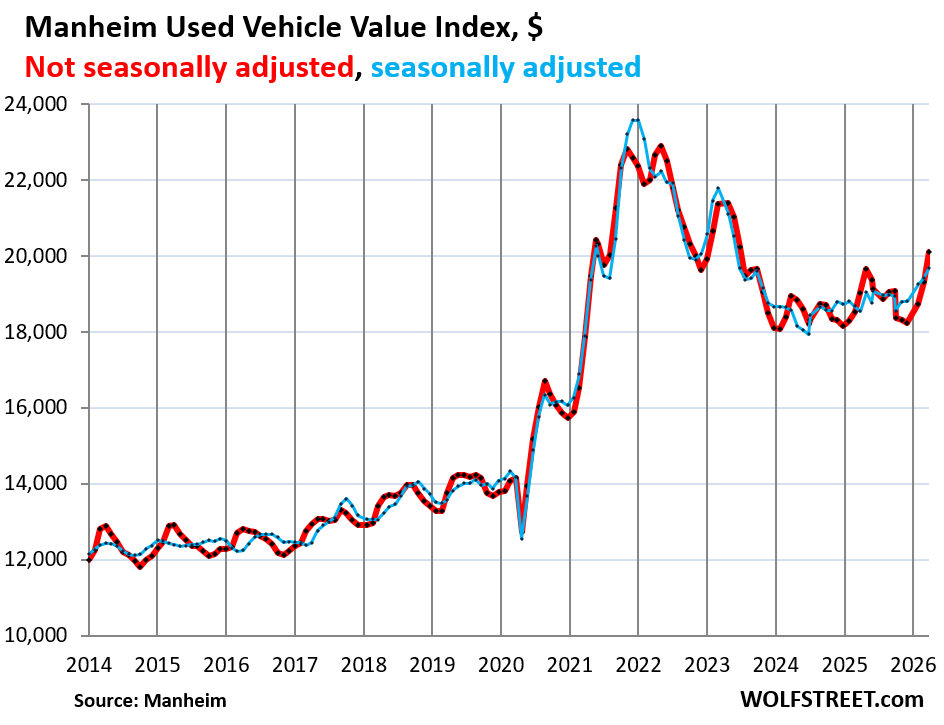
Prices of used vehicles sold at auctions where dealers buy to replenish their inventories spiked by 4.2% in March from February, not seasonally adjusted, to $20,102 (red in the chart). Year-over-year, prices jumped by 5.7%, the biggest increase since the price spike during the pandemic.
Seasonally adjusted, wholesale prices jumped by 1.4% in March from February, according to the Manheim Used Vehicle Value Index (MUVVI) today. Manheim, a division of Cox Automotive, is the largest auto auction house in the US.
Dealers, seeing what is happening on their lots, were emboldened to bid up prices at these auctions, confident that they can pass these higher costs, plus some, to their customers.
Supply at these auctions comes from rental fleets that sell vehicles they pulled out of service, from finance companies that sell their off-lease vehicles and repos, from corporate and government fleets, etc.
“Demand signals continue to be strong at Manheim, with sales conversion reaching 68.2% in the most recent measure. That result was 4.6 percentage points higher than the most recent three‑year average for March and higher by 5.5 percentage points from the revised-higher February rate (62.7%), pointing to strengthening buyer activity and continued competition for available inventory in the wholesale lanes,” Cox Automotive said.
Price action at the auctions came amid “relatively tight supply” and “healthy” demand fueled by big tax refunds to consumers, the report said.
Tax refunds make great down-payments for used vehicles. The total amount refunded through March 27 was up by 13.6% year-over-year, according to the latest filing statistics from the IRS. The average refund rose to $3,521, up by 11.1% year-over-year.
These big tax refunds were purposefully built into the “One, Big, Beautiful Bill Act” (OBBB), signed into law in July 2025, to boost the economy before the mid-term elections.
EV prices jumped by 3.7% in March from February, seasonally adjusted, and by 8.0% year-over-year, to $28,471.
ICE vehicle prices rose by 1.8% in March from February, seasonally adjusted, and by 4.2% year-over-year, to $19,874.
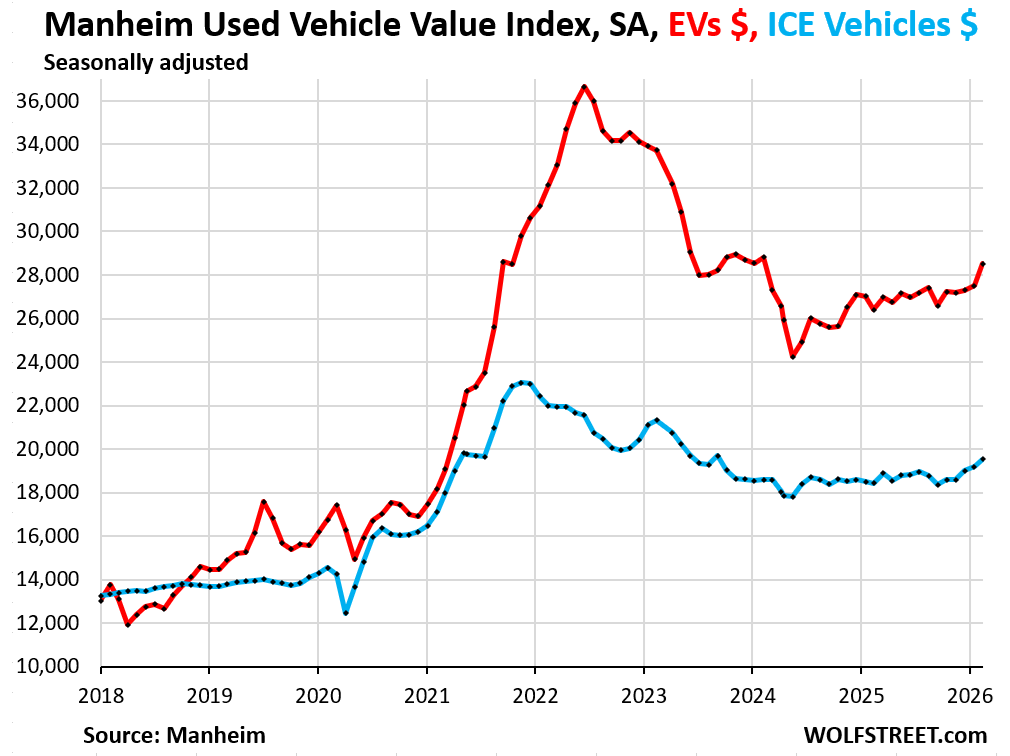
“EVs showed notable strength at Manheim during the first quarter, outperforming long‑term expectations and a sign of healthy demand for used EVs,” Cox Automotive said.
“Rising gas prices may have positively influenced demand last month, as dealers pursued potential opportunities with used EV, which are notably more affordable than new EVs,” it said.
“EV availability at Manheim improved in Q1 as well, as more off-lease EVs are moved into the auction lanes. In fact, the wholesale volume of EVs at Manheim set a record in Q1, with nearly 37,000 units sold,” it said.
“Initial retail sales estimates for used EVs were strong as well. Cox Automotive’s analysis suggests more than 100,000 used EVs were sold in Q1, the second-best result behind only Q3 2025, when buyers were hurrying to secure soon-to-expire government-backed sales incentives,” it said.
Used vehicle CPI inflation lags wholesale prices by a couple of months. These auction prices are an indicator of the price pressures coming to retail inflation rates. Affordability is an issue that might make it more difficult for dealers to pass on higher prices. But consumers are armed with their big tax refunds – they’re like big stimulus checks – and those kinds of down-payments reduce the monthly payments.
When those higher prices flow through to retail prices, they will push up CPI inflation for used vehicles.
From mid-2020 through mid-2022, the Manheim Used Vehicle Value Index had spiked by over 60%. Retail CPI inflation for used vehicles followed with a lag and spiked by 55%. Then, from mid-2022 to mid-2024, prices fell substantially, giving up a portion of that price spike. These falling used-vehicle prices had been a big factor in cooling core CPI inflation. But that process bottomed out in 2024, and prices started ticking up again. So these new inflation pressures suddenly building up in the pipeline are concerning.
Enjoy reading WOLF STREET and want to support it? You can donate. I appreciate it immensely. Click on the mug to find out how:


Carfax will show that these vehicles are rentals. Almost bought a used Toyota once, turns out was a rental car from texas in its previous life.
I noped right out of that deal and just went with new cars. At least you know what you have done to it from the start.
I buy 2-3 year-old rentals with less than 30k miles (hybrids). Never had a problem with them (well, one was totaled when it got hit from behind and shoved into the vehicle in front, but that’s not the fault of it having been a rental).
This is a HUGE market, 2-3 million vehicles per year are sold by rental fleets.
I’m glad you bought a new vehicle: boosted consumer spending by a lot, and increased state tax revenues by a lot. These are worthy goals to support. Thank you.
Ooooh salty tonight! Hehe
Just can’t beat the price difference between slightly used and new.
I will gladly pay thousands less to let someone else to be the first one to fart on the seat.
I just paid high blue book for 22 tacoma with 30k on it
so many had 100k miles and they still wanted in $20k+++
see a lot of high priced junk out there
Rather than only Core-Price-Inflation, that averages prices on many physical thiigs, energy, services, taxes… that will utilmatly effect used car-truck prices also…
A very large factor is the aging out of car-trucks owned nad leased by private owners and small business, that is coming to a boil.
New vechiles are not just too expensive.. they are mostly high risk, high-cost investment-maintenance things to own.
A large percentage are turbo-charged. Any vehicle buyer expecting more than 135k miles on a new turbo engine.. is hoping against logic.
At the top of this comment, i noted TAXES.. example, since the last 10 years, The Seattle-Metro (3 counties) area has instuted horendously inflated car-truck annual value tax to plate the vechile every year. Example, a 5 year old 60k (was its new price) BMW, paid 10.5 percent sales tax.. Now that BMW is Zero-actual-value.. because it needs a new engine and dual turbos.
But the Seattle-Meteo SoundTransit annaul plate tax still has $500 add-on.
Add on that WA state just passed another new law, to severly fine, and even jail persons try to tax evade the annual plate taxes..
Even idiots regarding vechile buy selection, are being momtly cost forced from: New-car ….
to No-car,
or to Old cars ,
that are actually repairable…
Thus more demand on old vechiles.. regardless of gasoline or EV.
I bought my Mitzibshi 2020 from a dealer in Maryland for $11,700. Vehicle was coming off a rental in Missouri . Had 62,000 miles on it and was in mint condition. Looked and felt like a brand new car. Why anyone would shell out $40,000 for some POS American car nowadays is beyond me.
My POS new American car drove me 3,000+ miles with me only having to touch the steering wheel three times. I think it’s worth $40,000.
I bought a 2025 Nissan Versa SV last Aug that was a Hertz rental. They only had it titled for 14 days, and it had 4,300 miles on it. It was involved in a minor accident with no air bag deployment. It looks mint, runs great & started out with 32K more mile on the warranty. It get’s 40 MPG combined driving, and I only paid $16K for it.
My 2025 tax return was about 12% more than the year before, so the used car dealers know this. I’m not surprised by the spike. As we all know, the spring is the most expensive time to buy cars, used or new.
Bought my first real car from Enterprise rental. Loved that Ford Explorer and put well over 100k on it before selling it to the neighbor kid. Don’t knock the rental car. I would have thought otherwise but in reality it served me and my family well.
The fastest car in the world is a rental.
I’m curious about the causes of seasonal adjustments. Is that related to the tax refunds increasing sales as mentioned? Or maybe because fleet vehicles get unloaded at a certain time of year?
Contrarian here. Tax season indeed props up demand for cheap cars – that increases demand and prices.
Fleets are the first part of supply, but less then usual: Uber and Lyft gained a lot of business from both taxis and rentals. This is an anecdote, but my wife stopped renting, period – she switched to Uber/Lyft cold turkey, and she is not alone. Fleet vehicles are definitely there, but I’d speculate that it’s less than what people predict. Less fleet supply means higher prices.
The second part of supply would be repos (not the ones that wolf informs us about, but cars repossessed due to delinquencies). Delinquencies and forbearances are way up (mostly subprime), but that’s enough to push repos to historic heights (these levels were never seen before). Many people grossly overpaid for cars during and after the pandemic, got deep underwater, and stopped paying for one reason or another. That’s the third leg pushing “average” used car prices up.
My hunch is that demand will be strong for the cheapest cars, which do not require much of a loan (unless we print more money and banks will start lending again). Higher-value items will sit on lots and prices will start dropping after tax season ends. Temporary gas price spike will push ICE vehicle prices further down, while EVs will enjoy short spike in demand. That will continue until electricity bill comes due and will drop EV prices down too.
Let’s circle back in 2 months to see what will _really_ have happened.
Cheesus Bogus Meesus
Despite your anecdotal stuff, based on a sample of 1, namely your wife, about the demise of rental cars, revenues of rental fleets are holding up just fine, unless they’re Hertz.
Here is by far the largest one, Enterprise Mobility, which owns Enterprise Rent a Car. It has 2.4 million vehicles in its fleet, which it cycles through every 2-3 years. Here are the revenues:
2022: $30 billion
2023: $35 billion
2024: $38 billion
2025: $39 billion
Rental cars supply 2-3 million used vehicles a year. In 2025, rental fleets sold 2.23 million vehicles to the used vehicle market. They sell them at auctions, such as the Manheim auctions discussed here; they return them to the factory under their programs, and the factory sells them at auctions; they sell them directly to consumers on their own car lots; and they sell them to big used-vehicle dealers, such as CarMax.
Lease returns (2-3 year olds) are another huge source of used vehicles for the wholesale market. In 2025, 2.3 million off-lease vehicles were sold to the used car market. This is less than normal due to the supply shortages of new vehicles three years earlier. I discussed this a lot, and this is one of the reasons that used-vehicle supply is still “tight.”
In terms of repos, there are no actual figures for 2025 yet, though there are a lot of bullshit figures floating around out there. But there are actual figures for 2024, from Cox Automotive and Experian: 1.7 million vehicles were repossessed.
A lot of the repos are older higher-mileage cars — the kind of cars that are sold to subprime-rated customers — that don’t compete with 2-3 year old lease returns and rental cars.
Your wife takes a ride-share 3-hours, one-way?
You must be able to dive into your money vault like Scrooge McDuck!
Andrew Giant
In the winter, the issue is the weather. January and February are the worst months of the year. they’re terrible. There is no demand for vehicles in bad weather, and prices drop.
Tax refund season starts in March and goes through June, which coincides with nice spring weather. Lots of demand, and higher prices. Exuberance. March madness…
Summer is hot (not fun buying a car when it’s 104 in the shade and there is no shade) and people are on vacation and demand tends to be lower than in the prior months, but pretty good. We had some very good summer months, and some not so good.
Labor Day is good, fall is OK, November sucks, December tends to see strong demand for various reasons.
Seasonality is sometimes hard to explain. Even my website traffic is seasonal. Seasonality is also unreliable. So seasonal adjustments are another layer of distortion that’s on the data. But they do help sometimes.
Excellent recap, fellow!
I just expericenced this winter effect.. just sold my year 2000-Jeep-XJ less than 1 week ago, for $7700 USD. 106,000 miles, 4WD, and zero rust, only needed new tires.
It took 2 months to sell it.. what a pain in the backside. And i spent appx 180 dollars advertising fees on facebook, offer-up, craigslist and Ebay. Facebook worked best. Im in WA state, and an Idaho buyer purchased it…
I should have sold it in June-July 2025. It mostly sat in my garage, eating up my office space, and consuming monthly insurance costs.
Waiting to sell, until cold-wet awful Seattle area weather of Feb-Mar-2026.. cost me at least $2500 sell price.
Luckily for me (the seller), XJ jeeps have a special following of buyers, and good condition ones are getting rare. Or the price for a 26 year old 4WD vechile with a 1984 engine design, would sell for markedly less.
Live and learn.. hehe.
Thanks so much!
Not surprising. New vehicle prices are up, mostly due to tariffs and new sales for Q1 2026 are down from Q1 2025 which drives demand on used vehicles. Also not surprising that new sales are down compared to Q1 2025 due to all the pre-tariff buying. Inflations is getting stickier.
New vehicle prices are NOT up. they’re still below where they’d been in 2023. Automakers have been eating the tariffs because there isn’t enough demand to push up prices further, after the price explosion in 2021-2022. Same as the housing market.
Tax refund season might push up prices, and we’ll see. But it hasn’t happened yet.
I love it when you point out the basic fact that Supply and Demand still hold weight in our markets despite their being highly regulated.
The fact that corporate profits have doubled in the past few years means that a lot of companies have found they have a lot more pricing power than they thought, meaning consumers refused to cut spending even in spite of higher prices.
It’ll take a recession to change that mentality, but the decreasing of price increases for cars is a welcome change. Too bad we can’t find that in the services too.
If I’m doing my math right from the Mannheim auction numbers, it would be very interesting to see a CPI *Used* Vehicles chart overlaying that CPI New Vehicles one…
(I *think* it looks like used car inflation was much worse during the pandemic relative to new car inflation, but a year by year comparison might be enlightening…).
And seeing a ratio of CPI Used/CPI New might really sharpen the point…
Used vehicles are a free market, and prices spiked (+55% CPI) a lot more than new vehicle prices, and then plunged. New vehicle prices are controlled by an oligopoly of big automakers. Prices rose more slowly (+25%) as automakers cracked down on addendum stickers, but then prices didn’t plunge, only tapered off a little and have been roughly flat for three years.
Still and all, it is an interesting relative dynamic and the ratio of used-to-new pricing presumably went up for a number of years (and then maybe eased off).
Again, just an interesting data point/change in the dynamics of mkts.
(It ain’t like new car prices are doing anybody any favors – but it is interesting that the advantages of going used deteriorated a noticeable bit for a while. Hopefully, those advantages will return.)
New vehicle prices are DOWN, not up. I’ve been test driving cars since January just to get a feel for what I would like to drive for the next 10 years, and every single time I have gotten between 5-10% off MSRP without playing the game. I tell them I’m not ready yet, but like every good salesmen, they insist.
On some other brands which I would not every buy, the prices are as low as 30% off MSRP with 0-1.9% APR. If you don’t care about what you drive, there are some absolutely crazy deals out there.
Purchased ~2-3 year old 1976 Olds Cutlass Supreme from Hertz , gave it to the local junk yard in 1996. The car never gave me any problems until it started getting up in years. They didn’t make cars back then like they do now. We own a 2006 Honda Pilot we purchased new. It looks like new and has been the most reliable car I have ever owned. Buying new is cost effective if you’re looking at keeping it long term. If you trade them in after a few years then used is the way to go. Someone did an analysis some years back on the savings realized if you were to keep your vehicles long term. It was quite surprising how much money you could save.
I have a Volvo SUV I bought used. It now has 225k miles on it and going strong. When I bought it it was cheaper and nicer than similar mileage Subarus and Toyotas. Also I have very cheap car insurance as a result. It still looks new enough because luxury cars are always a few years ahead. Most of these decisions are really more about what’s important to people…. I hope it makes it to 300k :)
I will say me 98 Olds Intrigue I bought last year for 5000 has so far treated me very well!I got it with 48000 miles,ran/runs great/nice interior/clean body.
Only work done so far is tire balance/front end alignment/rear discs and pads,I also know need a wiper blade(the horror!).I also have just given it it’s 4th oil change.
I now have 60000 on it and still runs excellent,I really lucked out on this one price and condition.
One has the time hit Fl. or other retirement areas,good older cars with low mileage still available at reasonable prices.
That’s amazing nice find
A 1998 Olds with just 48k miles on it for just 5K??!!
Was this the car that Hannibal Lecter kept in the storage unit before Clarice broke in?
I will say when first saw ad on CL(called right away!) I was wondering if a flood car or some such thing.A careful inspection of who car just showed me a good deal,have done the majority of work on me vehicles for decades and thus have a fair amount of knowledge of what to look for.
I waited over 4 months for this ride,was driving me 2 4×4 toys from the 80’s,a van and a pickup,both lifted/built to the hills etc.,thus,not unless needed a “daily driver”.As gas prices rise I still don’t care,will never give either up!
I am dead serious about looking in retirement areas,in the 80’s got a 71 Skylark with 40 thou miles and a 70 Cutlass with 65 thou.
miles,both got built a bit.
Deals can be found if not under the gun to get a car right away,best of luck to all car hunting whatever your cup of tea is!
I find it amusing that consumers take their refund and just splurge especially buying a car that depreciates once driven off the lot instead of just putting it in the bank.
A big down payment saves on interest. If your used-car loan interest rate is 8%, every dollar you put down earns you 8% guaranteed. If you put it in the bank, you might earn between 0% and 4%. Interest saved = money earned. You’re making this money, not the bank. And if you put down enough, you might get a lower-rate on your loan, such as 7%, and then the benefits of your down payment soar.
On a new vehicle, you might get subsidized financing, but if you don’t finance, you get the equivalent cash incentive.
We pay cash for all our cars for that reason without exception. I’ve never ever had a car loan. But when I was poor, I drove some shitty deathtraps, paid for in cash.
My comment is more about buying a car when it’s not necessary. If you need a newer vehicle, making the maximum down payment or paying all cash is the way to go. If you want to swap out vehicles just to drive something different, it is a waste. Then there are the people who swap out cars (even high end bikes) every couple of years so as to avoid repairs. It’s ridiculous.
Today the problem with the deathtrap/bone shaker option is the cost of repairs. In the day you could do the repair yourself or you might able to find a reasonable independent auto repair shop. Now days, private equity has gobbled up the independents and in many cases labor rates exceed those of the dealerships. Parts, OEM and otherwise…same deal. I was like you on the starter car but I can sympathize with the millennials who, in many cases, do not know how to turn a screwdriver and, almost certainly, do not have the auto electronic experience to pull off a repair. On the other hand, there is the Uber option.
I would not even attempt to fix a modern car. That technology is way beyond me. But the idea when you’re poor is to buy an old beater that you don’t have to fix, that runs right. And when it needs major repairs, or needs a new set of tires, you sell it and get another old beater with good tires.
But today, there are many reliable nice-looking 15-year-old cars out there. That wasn’t the case in the 1970s. A 15-year old car back then would likely be sitting in a salvage yard, unless it was a collector’s item. I had an 8-year-old 1968 Mustang, and it was already a piece of chunk with lots of problems.
I’ve only had a car loan once, for a day. I was buying a Bimmer for $10K below market. I refused financing, so the finance guy at the dealership split an $800 bonus from the financing company with me, so my total went down by $400. I paid it off the next day. People today think MSRP with a 6% loan is a deal.
Part of the reason people cry about higher gas prices:
Per AI: 💡 Interesting economic perspective:
Transportation is usually the second-largest household expense after housing in many countries.
Per AI and from the American Automobile Association’s “Your Driving Costs” report:
Lifetime car ownership cost (40 years)
Scenario
Avg yearly cost
40-year total
Low-cost ownership (older cars, paid off)
~$6,000 per year
~$240,000 lifetime
Average ownership
~$11,500 per year
~$460,000 lifetime
Higher-cost vehicles (SUVs, loans, high insurance)
~$15,000 per year
~$600,000 lifetime
Luxury vehicles
~$20,000+ per year
$800,000 – $1,000,000+ lifetime
I was a low cost ownership guy and did a lot of the upkeep and repairs myself. The difference in low cost and average ownership helped me save and retire very early.
I am getting a bicycle for SF. They built bike lanes everywhere, so car traffic is worse and parking is worse. Public transportation options here are good and cheap. Even Uber is cheaper and faster considering the time to find parking, parking fees, or a ticket. Also, many bicyclists are belligerent, like they own the road and the sidewalks—if you can’t beat them, join them.
I got some more reporting from the field, brought in the 2012 mdx for an oil change and inspection. Dealership failed our safety portion, and it was good he did. They now do videos and walk around and text it to you to show you what’s being identified and why. The addition cost for the needed repairs $3652. I was able to negotiate down to 3256 after the rep took hours to get back to me, in glorious delay fashion. Repairs were, rotors (two new, two resurfaced), all break pads, right front fork, and both front steering bushings/arms. I said put on all new rotors and let’s get it down to $3000 and you have a deal. They so oh no they won’t do that price. I said I would pick up the car and asked how long I had for re inspection, they said they thought thirty days. Took the car to a friend who is further away but doesn’t have the markup dealers have. $1650! From 3652. This dealership just renovated and always is busy in the mornings. No surprise but also kind of annoying they don’t just give a great price off the rip but who can blame them if people pay it!!
Never get any service done from dealership.
They have lot of overhead and thus prices are almost double than neighborhood shops.
Thank you. I generally take this advice but I get amazing service coupons from time to time, yes, even free oil changes so inuse those. I also do my fluid flushes at dealer. All major and routine repairs go to my friends shop. His advice as a mechanic was the above for me.
Looks like the parts were 650/652.
Just curious, how much was the oil change/inspection.
The oil change was $67, the inspection was 79$( they always confirm I mean emissions and safety which is like of course I mean both) they had a coupon deal that took $25 off, that total is after the $25 off. I also had to plug to tire pictures, they charged $16 each. It’s the Honda dealership so they are not so bad on fluids for mdx or Honda cares but I wouldn’t take my Toyota there because they jack up the price for both of those.
Wolf, the difference I see today compared to 2020/2021 is that there are tons of deals on new cars today. 0% APR, discounts, rebates, etc. For cars under the Stelantis brand and Nissan, the deals are absolutely mind boggling.
I’ll be watching the car market closely this year since I’ll be in the market for something in about 6-12 months. I expect more deals to show up on new cars in 2026 and 26-27 winter.
I’ve always bought used cars and kept them for 5-10 years depending on what was happening with life (babies, commutes, parking situation, etc) but I would consider a new car if it’s a small premium to the used.
I wrench my own vehicles mostly and targeted $2000 annual depreciation plus a few hundred in parts. Now 75 years old and can afford a Bugatti. But this summer I will take my 2012 Honda Accord out of storage and treat it to new sport tires for tearing around the mountains 😁. My favorite…a 1996 Buick Roadmaster I bought in 2006 (when gas prices were “high”) for $6K with19K miles on it. 185,000 miles later it was still going strong and looking good. I Never drove shitboxes!
Given 75 years is the Roadmaster your all time favorite?
I have had over 30 beaters,many good 4×4’s/71 drop top Vette/71 Olds 442-455/Goats/Camaros/Firebirds,the list is endless.
I would say between 85 Ford pickup and 81 Chevy van(both built 4×4)me van or me old FJ-40 me favorite.
I had those cars now would be worth a small fortune!
I am 63 and as I still refuse to grow up wonder what toys down the road I will own!
The delta in price between an off lease car and a demo car is getting smaller. Used car values up and slightly used new cars are way down. If you can stretch for a slightly high price, I think it’s a much better value to buy a demo car with only a few thousand miles.
My tax refund was $26 this year. Maybe I can put that down on a rusty pinto. I guess I should loan the gov more money so I can move up in this world. Haha.
Beautiful!
I was going to say LoL, what larger tax refund? We did end up with a small refund but had we filed jointly it would have been 0. Our tax prepper said in all her years she had never seen a 0 on a tax filing. I’m 40ish and just bought my first new car in 2024. A Volkswagen Taos but the interest rate was in the low 3% range. This was prior to the announcement of the tax break for American cars and we missed the tax break on our new air conditioner by like one percent of efficiency or some BS.
I am learning from reading this blog, there is a large difference between my personal anecdotal experiences and the rest of the jerks on this planet. Lol