
These new inflation pressures suddenly building up in the pipeline are concerning.
By Wolf Richter for WOLF STREET.
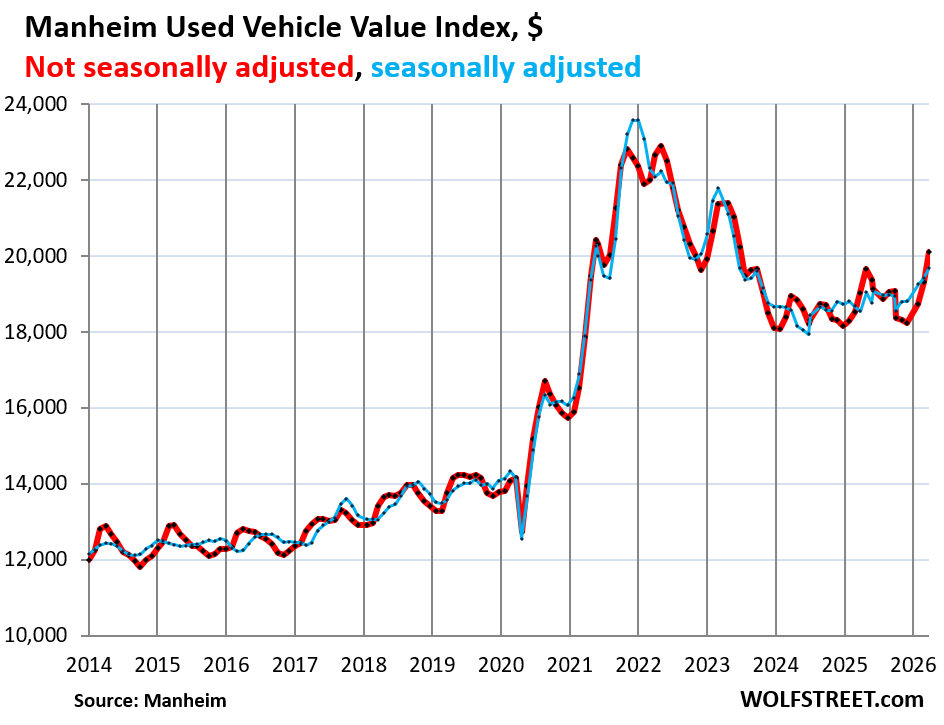
Prices of used vehicles sold at auctions where dealers buy to replenish their inventories spiked by 4.2% in March from February, not seasonally adjusted, to $20,102 (red in the chart). Year-over-year, prices jumped by 5.7%, the biggest increase since the price spike during the pandemic.
Seasonally adjusted, wholesale prices jumped by 1.4% in March from February, according to the Manheim Used Vehicle Value Index (MUVVI) today. Manheim, a division of Cox Automotive, is the largest auto auction house in the US.
Dealers, seeing what is happening on their lots, were emboldened to bid up prices at these auctions, confident that they can pass these higher costs, plus some, to their customers.
Supply at these auctions comes from rental fleets that sell vehicles they pulled out of service, from finance companies that sell their off-lease vehicles and repos, from corporate and government fleets, etc.
“Demand signals continue to be strong at Manheim, with sales conversion reaching 68.2% in the most recent measure. That result was 4.6 percentage points higher than the most recent three‑year average for March and higher by 5.5 percentage points from the revised-higher February rate (62.7%), pointing to strengthening buyer activity and continued competition for available inventory in the wholesale lanes,” Cox Automotive said.
Price action at the auctions came amid “relatively tight supply” and “healthy” demand fueled by big tax refunds to consumers, the report said.
Tax refunds make great down-payments for used vehicles. The total amount refunded through March 27 was up by 13.6% year-over-year, according to the latest filing statistics from the IRS. The average refund rose to $3,521, up by 11.1% year-over-year.
These big tax refunds were purposefully built into the “One, Big, Beautiful Bill Act” (OBBB), signed into law in July 2025, to boost the economy before the mid-term elections.
EV prices jumped by 3.7% in March from February, seasonally adjusted, and by 8.0% year-over-year, to $28,471.
ICE vehicle prices rose by 1.8% in March from February, seasonally adjusted, and by 4.2% year-over-year, to $19,874.
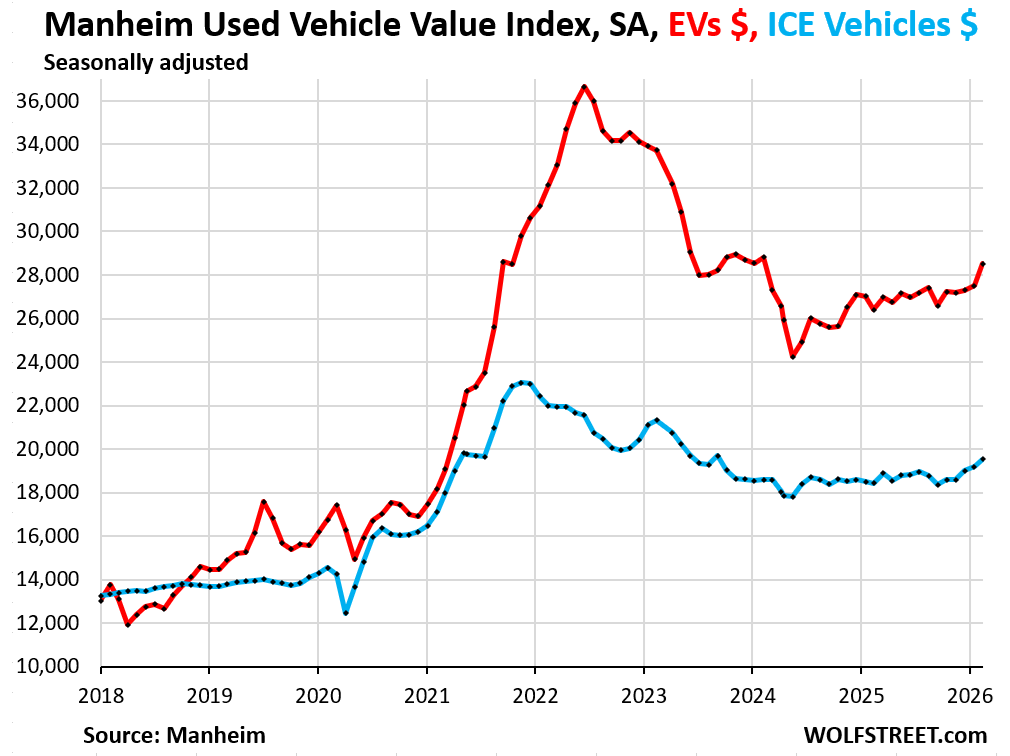
“EVs showed notable strength at Manheim during the first quarter, outperforming long‑term expectations and a sign of healthy demand for used EVs,” Cox Automotive said.
“Rising gas prices may have positively influenced demand last month, as dealers pursued potential opportunities with used EV, which are notably more affordable than new EVs,” it said.
“EV availability at Manheim improved in Q1 as well, as more off-lease EVs are moved into the auction lanes. In fact, the wholesale volume of EVs at Manheim set a record in Q1, with nearly 37,000 units sold,” it said.
“Initial retail sales estimates for used EVs were strong as well. Cox Automotive’s analysis suggests more than 100,000 used EVs were sold in Q1, the second-best result behind only Q3 2025, when buyers were hurrying to secure soon-to-expire government-backed sales incentives,” it said.
Used vehicle CPI inflation lags wholesale prices by a couple of months. These auction prices are an indicator of the price pressures coming to retail inflation rates. Affordability is an issue that might make it more difficult for dealers to pass on higher prices. But consumers are armed with their big tax refunds – they’re like big stimulus checks – and those kinds of down-payments reduce the monthly payments.
When those higher prices flow through to retail prices, they will push up CPI inflation for used vehicles.
From mid-2020 through mid-2022, the Manheim Used Vehicle Value Index had spiked by over 60%. Retail CPI inflation for used vehicles followed with a lag and spiked by 55%. Then, from mid-2022 to mid-2024, prices fell substantially, giving up a portion of that price spike. These falling used-vehicle prices had been a big factor in cooling core CPI inflation. But that process bottomed out in 2024, and prices started ticking up again. So these new inflation pressures suddenly building up in the pipeline are concerning.
Enjoy reading WOLF STREET and want to support it? You can donate. I appreciate it immensely. Click on the mug to find out how:


Carfax will show that these vehicles are rentals. Almost bought a used Toyota once, turns out was a rental car from texas in its previous life.
I noped right out of that deal and just went with new cars. At least you know what you have done to it from the start.
I buy 2-3 year-old rentals with less than 30k miles (hybrids). Never had a problem with them (well, one was totaled when it got hit from behind and shoved into the vehicle in front, but that’s not the fault of it having been a rental).
This is a HUGE market, 2-3 million vehicles per year are sold by rental fleets.
I’m glad you bought a new vehicle: boosted consumer spending by a lot, and increased state tax revenues by a lot. These are worthy goals to support. Thank you.
Ooooh salty tonight! Hehe
I’m curious about the causes of seasonal adjustments. Is that related to the tax refunds increasing sales as mentioned? Or maybe because fleet vehicles get unloaded at a certain time of year?
Contrarian here. Tax season indeed props up demand for cheap cars – that increases demand and prices.
Fleets are the first part of supply, but less then usual: Uber and Lyft gained a lot of business from both taxis and rentals. This is an anecdote, but my wife stopped renting, period – she switched to Uber/Lyft cold turkey, and she is not alone. Fleet vehicles are definitely there, but I’d speculate that it’s less than what people predict. Less fleet supply means higher prices.
The second part of supply would be repos (not the ones that wolf informs us about, but cars repossessed due to delinquencies). Delinquencies and forbearances are way up (mostly subprime), but that’s enough to push repos to historic heights (these levels were never seen before). Many people grossly overpaid for cars during and after the pandemic, got deep underwater, and stopped paying for one reason or another. That’s the third leg pushing “average” used car prices up.
My hunch is that demand will be strong for the cheapest cars, which do not require much of a loan (unless we print more money and banks will start lending again). Higher-value items will sit on lots and prices will start dropping after tax season ends. Temporary gas price spike will push ICE vehicle prices further down, while EVs will enjoy short spike in demand. That will continue until electricity bill comes due and will drop EV prices down too.
Let’s circle back in 2 months to see what will _really_ have happened.