
Weak demand for labor and job destruction at federal & state governments should push up unemployment. But the supply of labor has plunged.
By Wolf Richter for WOLF STREET.
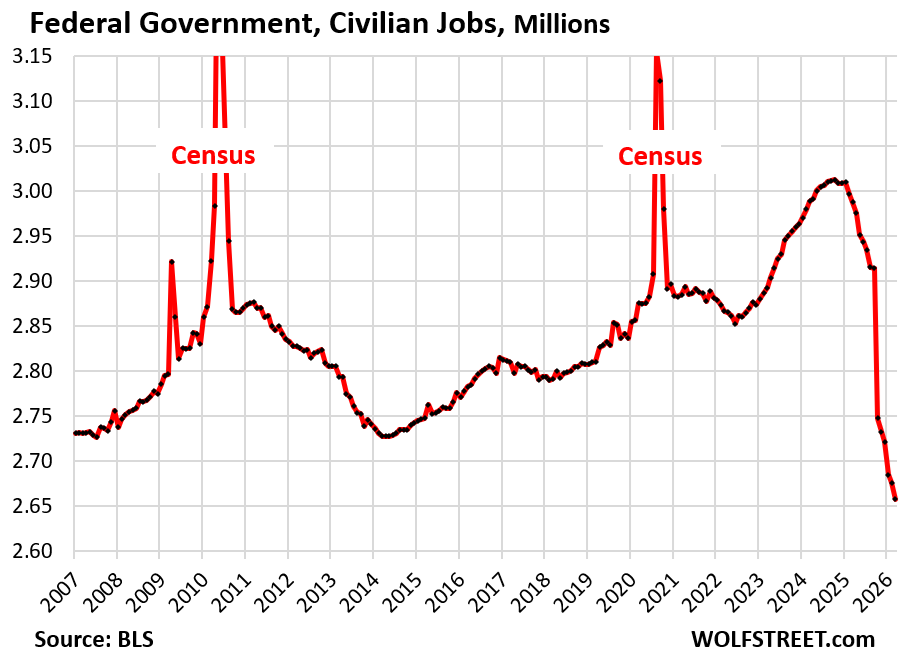
The federal government shed another 18,000 jobs from its payrolls in March, including employees who’d departed earlier but whose severance packages ended in February. Since January 2025, the federal government has shed 352,000 civilian employees, or nearly 12% of its staff. Federal government employment is now down to 2.66 million, the lowest since 1966, when LBJ was President.
State governments shed another 4,000 jobs in March, and since January 2025 have shed 49,000 jobs or about 1% of their payrolls, according to data from the Bureau of Labor Statistics today.
Local governments added 14,000 jobs in March. Local government employment is largely composed of educators, first responders, and healthcare workers. Since January 2025, local governments have added 161,000 workers to their payrolls.
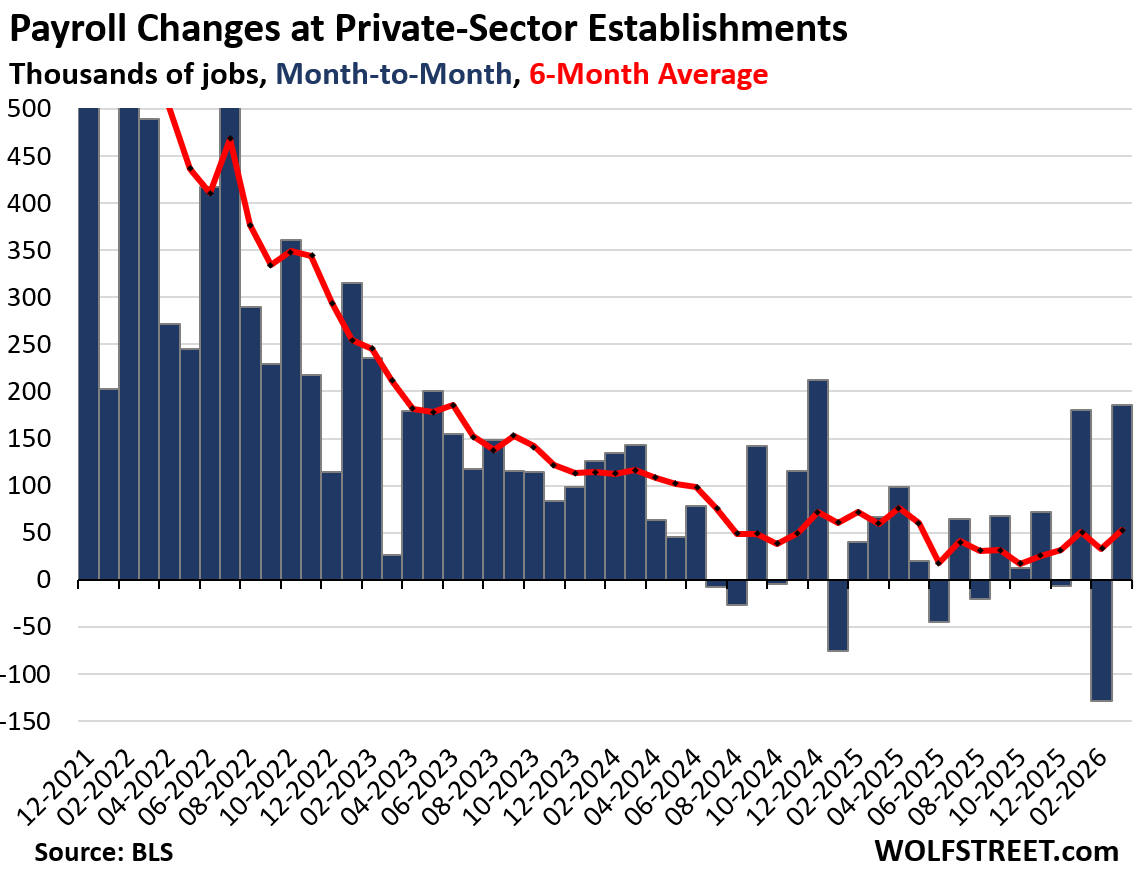
The private sector added 186,000 jobs in March. But the data has been yoyoing, made worse by big revisions in both directions. Today, January was revised up further, February was revised down further. And earlier this year, the BLS adjusted everything to its annual massive benchmark revisions.
So the six-month average, which irons out the silly month-to-month ups and downs – a labor market doesn’t turn on a dime every single month – shows the trend better: The private sector added 53,000 jobs on average per month over the past six months.
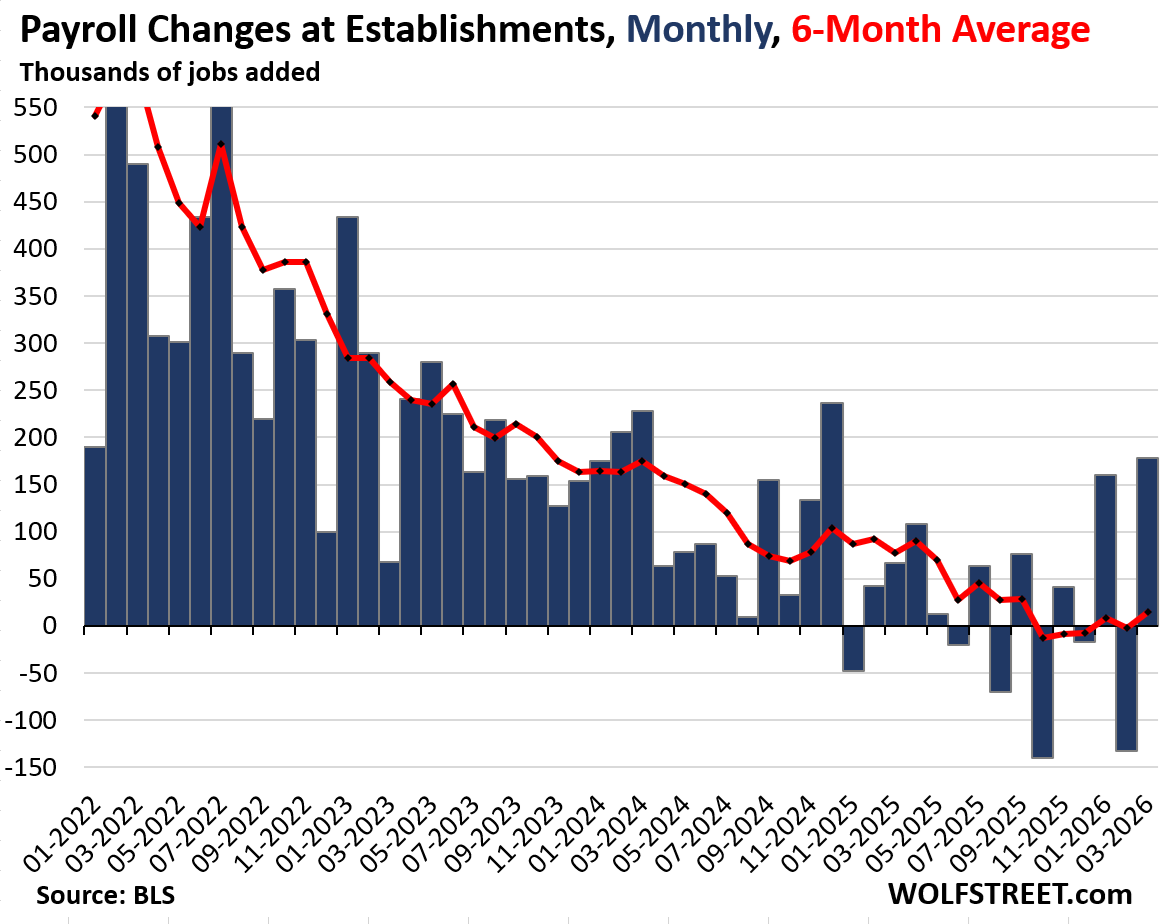
Total payrolls, including government, rose by 178,000 in March. But the six-month average inched up by only 15,000 after having been in the negative in four of the past five months, dragged down by job cuts at federal and state governments.
These kinds of dynamics – negative to low positive growth in nonfarm payrolls – would normally cause the unemployment rate to spike because normally, the US labor force would grow substantially through immigration, legal and illegal, and a slow-growth or no-growth labor market would no longer be able to provide jobs for the growing labor force.
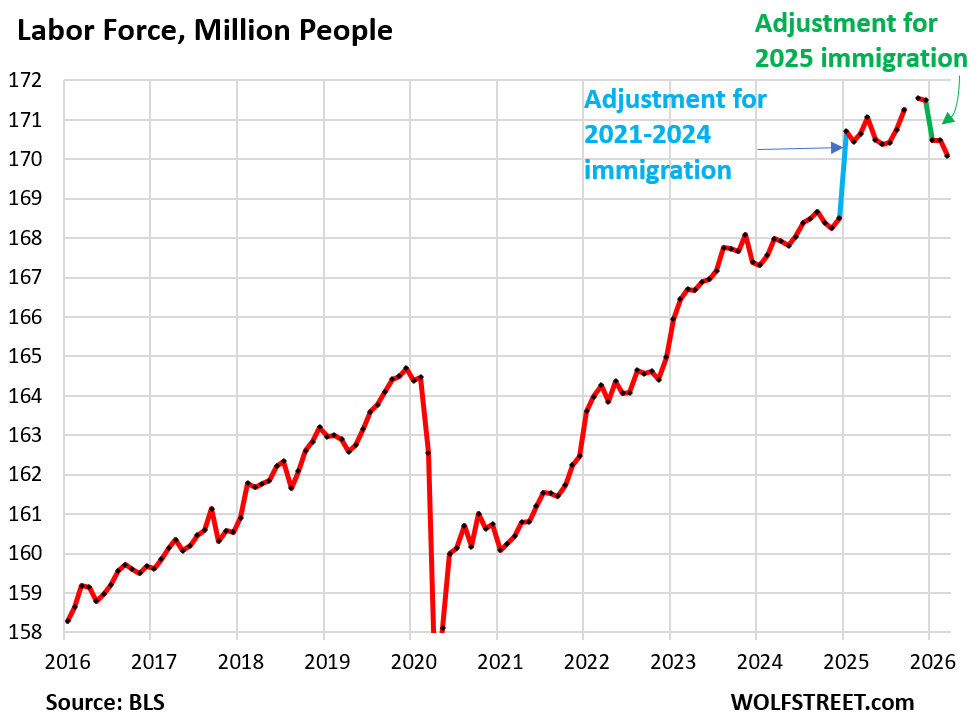
But the labor force continued to shrink in March amid the crackdown on illegal immigration and a tightening up of some work-visa programs. In March, the labor force fell by another 396,000 workers.
Over the past five months, the labor force has plunged by 1.45 million people (six-month data not available because October is missing due to the government shutdown). The labor force is the supply of labor, composed of people who are working or actively looking for work. And this supply of labor has shrunk by 1.45 million in five months! This is huge
As nonfarm payrolls have grown only very slowly over the past six months, while the labor force has been shrinking rapidly, the total number of unemployed people has plunged by 542,000 over the past five months.
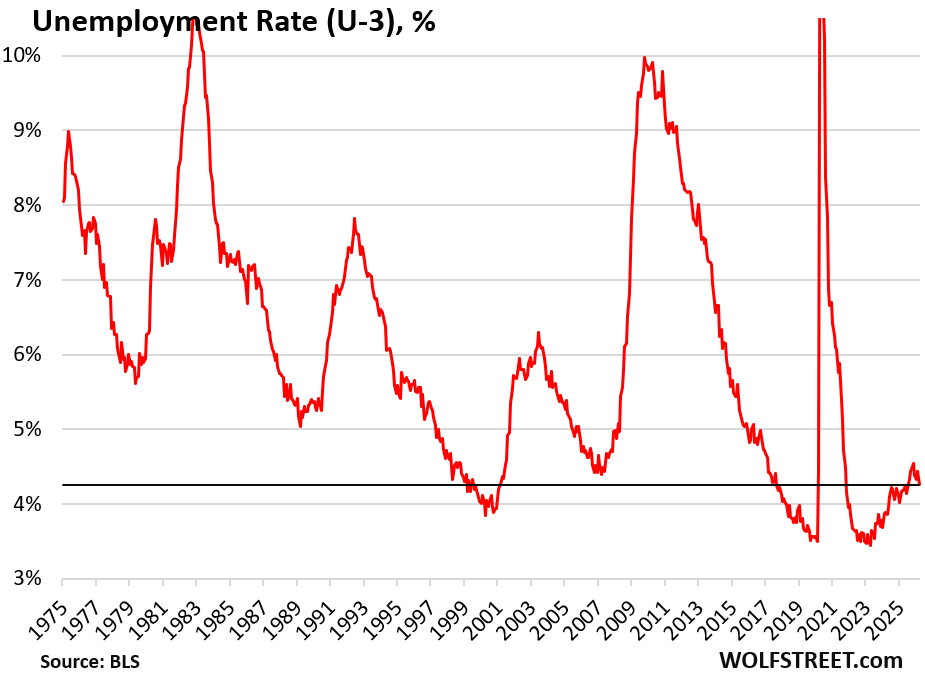
And so the unemployment rate ticked down to 4.26%, the lowest since June 2025 – from a historical perspective a tight labor market, but tight for the reason of a shrinking labor force (supply of labor), not strong job creation (demand for labor).
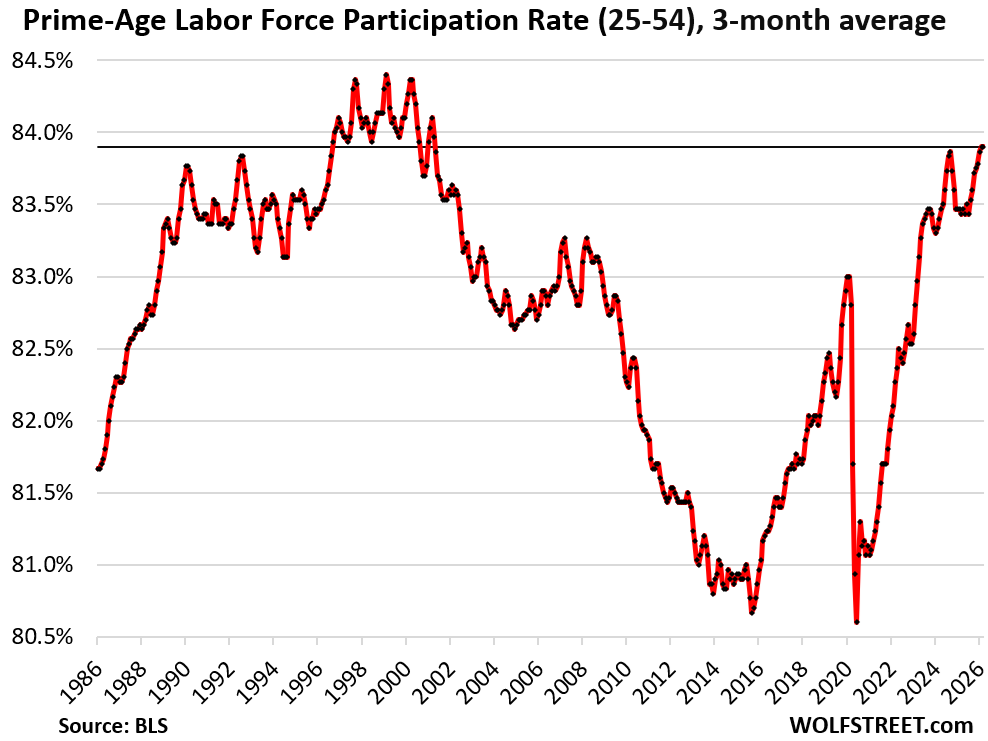
We can see this tight labor market in the prime-age labor force participation rate (25-to-54-year-olds), which has been at 25-year highs, below only the extraordinary period of the Dotcom Bubble. In March, it was 83.8%.
The prime-age labor force participation rate eliminates the issue of the retiring boomers. When people retire and stop looking for a job, they’re no longer “participating” in the labor force but remain in the population until they die. It’s the surge of boomer retirements over the past 15 years that has pushed down the overall labor force participation rate.
The high prime-age labor force participation rate amid glacial job creation further documents the reduced supply of labor due to the crackdown on illegal immigration.
This is the weirdest US labor market I have ever seen. But it isn’t bad. It’s just weird.
The charts…
The private sector added 186,000 jobs in March. Part of that yoyo was a strike in February at Kaiser Permanente in California that had taken over 35,000 healthcare workers off the payrolls in February. In March, after the strike was resolved, they were added back to the payrolls, producing a 70,000-worker month-to-month swing.
The six-month average irons most of that out. Six-month average jobs growth ticked up to 53,000 in March (red line). The low point of the six-month average was in October, with only 17,000 jobs added.
Over the past 12 months, private-sector employers added 502,000 nonfarm jobs, which is low for the US.
Total nonfarm payrolls, including all governments, rose by 178,000 in March. The six-month average job growth turned positive, inching up by 15,000 jobs added on average over the past six months.
Over the past 12 months, total nonfarm payrolls added only 260,000 jobs.
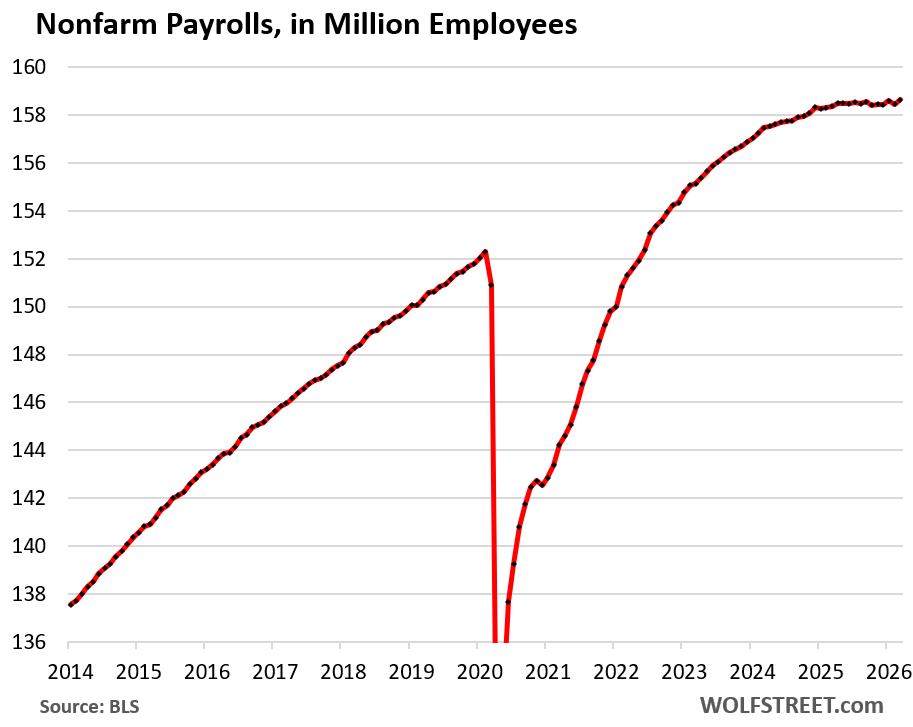
Total nonfarm payrolls ticked up to a record 158.64 million in March, they but that was just invisibly higher than a year earlier. They have essentially flattened out.
The federal government shed another 18,000 civilian jobs in March. Since the beginning of 2025, the federal government has shed 352,000 civilian employees, or nearly 12% of its staff.
Civilian employment at the federal government is now down to 2.66 million, the lowest since 1966, when Lyndon B. Johnson was President, and three years before Nixon took over.
The labor force declined by 396,000 in March to 170.1 million. This is very volatile data based on household surveys that are then adjusted annually at the beginning of the year to the Census Bureau’s revisions of the US population (blue and green segments in the chart below).
Over the past 5 months (no data for October), the labor force has plunged by 1.45 million people.
The labor force is the supply of labor. It consists of people who are either working or are unemployed and are actively looking for a job. People who are retired and not looking for a job are no longer in the labor force. Newly arrived immigrants, regardless of status, who are either working or looking for a job, are in the labor force.
This gives us a rough indication to what extent the supply of labor has shrunk:
The number of unemployment people looking for work fell by 332,000 in March to 7.24 million, the lowest since June – caveated similarly as the labor force data.
Over the past five months, the number of unemployed has plunged by 542,000 people.
The unemployment rate declined to 4.26% in March, the lowest since June last year.
The unemployment rate reflects the number of unemployed people who are actively looking for a job (7.24 million) divided by the labor force (170.1 million):
It shows a tight labor market, with the unemployment rate at the low end of the historical scale.
The prime-age labor force participation rate (25-to-54-year-olds), which eliminates the issue of the retiring boomers, has been at 25-year highs, below only the extraordinary period of the Dotcom Bubble. In March, it was 83.8%, the three-month average was 83.9%.
It shows that the reduced supply of labor due to the crackdown on illegal immigration is pulling more prime-age people into the labor force.
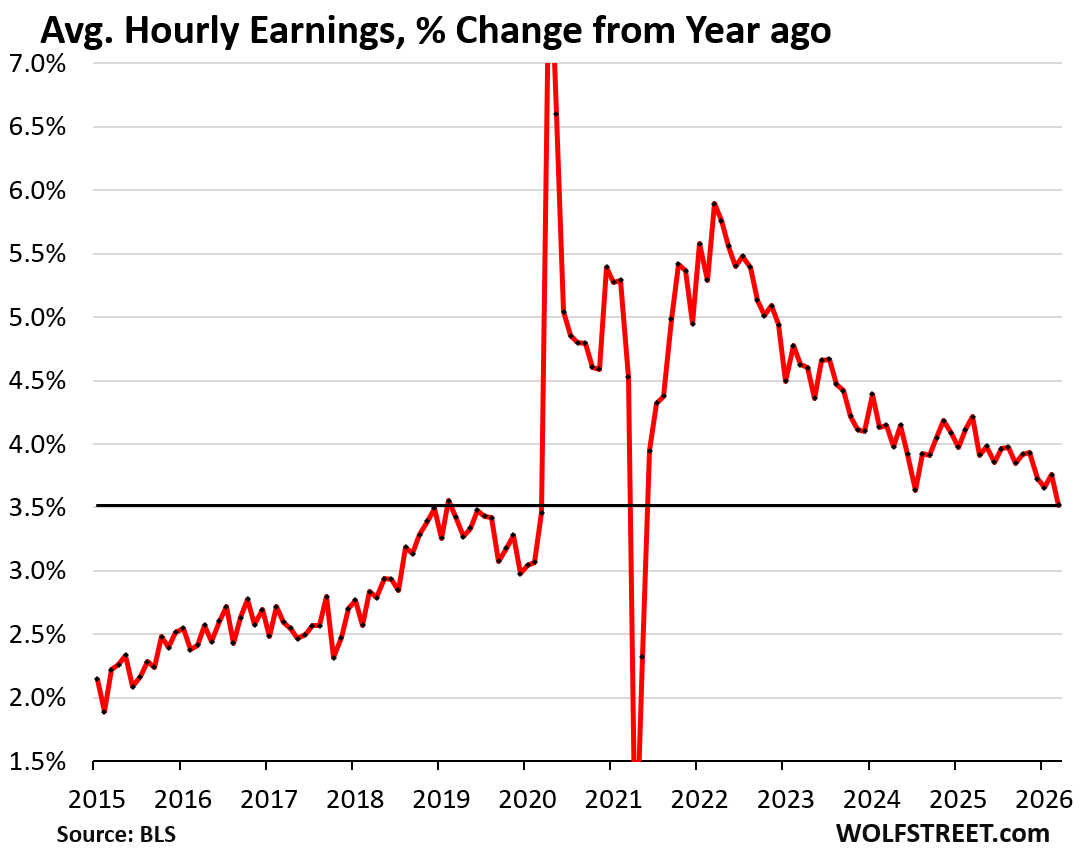
Average hourly earnings rose by 3.5% year-over-year in March, the slowest growth since the distortions of the pandemic. This would still be solid growth, and is at the peak before the pandemic, but inflation is rising, and there is now a risk that wage growth might slow further while inflation accelerates, and workers would then fall behind inflation.
This slowing but still solid wage growth shows the impact of both dynamics that pull in opposite directions: weak demand for labor and falling supply of labor.
And in case you missed it: Stasis in the US Labor Market: a Peculiar Situation
Enjoy reading WOLF STREET and want to support it? You can donate. I appreciate it immensely. Click on the mug to find out how:


Corporate profits are still floating at all time highs.. basically double the
Pre pandemic norm. I imagine the unemployment situation, as reported, wouldn’t move much unless something changes…
Wolf, Do you think labor force reduction is due to self deportation and deportation or is it due to retirement? Excellent article. Thanks again
Retirements are low as the majority of the boomers has by now retired, though there are obviously still some of us who are clinging by our fingernails to our jobs.
https://wolfstreet.com/2026/03/31/stasis-in-the-us-labor-market-a-peculiar-situation/
Thanks, Wolf! You are one of the few who takes the time to split out private (non-government) employment.
Have you ever looked at the state/local employment by state? It seems as though, over time, government employment is mostly shifting from federal, down to local levels. For example, I just saw a report, with graphs (but no notation as to sources of data), showing that over the last 10 years, California population grew 0.4%, the number of state employees grew 24.5% and the inflation adjusted state spending grew 48%.
(It would also be interesting, but maybe difficult to track, if NGO employment is going up, while government employment is going down, with $$ just allocated into a different employment category.)
State and local jobs are very different from federal government jobs. These jobs are NOT moving down from the federal level to the state level.
In addition, state governments also shed jobs. Read the article.
People are clueless about state and local government jobs.
State government jobs are dominated by jobs at state universities, which are huge employers. For example, the University of California system employs 267,000 faculty and staff (data via University of California), nearly half of the state government’s total employees of 551,000 (data via BLS).
University of California is a major exporter of services, as foreign students’ spending of foreign-sourced money in the US counts as exports and contributes to GDP as export of services. Universities attracting foreign students is a big important element in CA’s economy. It brings in lots of money and finances lots of economic activity — not just through tuition, but via all the other stuff that these students spend their foreign-sourced money on. And the industry – and that’s what it is – has become huge in CA.
Whoever provided you the manipulative discombobulated BS you cited is a clueless moron.
Slowing wage growth should help with inflation.
Not for working consumers
As a software contractor who has taken hundreds of client and recruiter calls, and done over a hundred interviews, I’ve noticed a shift in attitude from availability to quality. From 2017 to 2023 it was all about having capacity, clients just piled on. Now, for the first time I can remember, new clients are attempting to ask questions about work quality. The conversations are much more interesting.
Thanks for the article. The problem might be that once labor supply stabilizes, or even starts to increase again, will many employers need more new workers? Or will efficiencies be maintained and new entrants be unable to find work, increasing the unemployment rate that way.
Good question. This comes up at the Fed too. It can go both directions:
1. demand for labor increases, and then there are labor shortages in some areas – there already are labor shortages in the construction industry (electricians, other highly skilled workers), in health care, etc. And those labor shortages may spread to other areas as demand increases, which would push up wages, which would be a good thing for workers and the economy, but another factor in the inflation puzzle.
2. or demand declines, and then unemployment rises very quickly, and we’ll have our recession.
So we have increasing inflation and oil shocks galore and the labor market is fine…
One wonders how the FED can sit on its hands and NOT raise.
When in doubt, blame (or praise) AI.
Which may actually be a legitimate assertion.
Every day, in every way AI will get smarter and smarter.
Howdy Folks. Great article. What I keep thinking about after reading it is?
What were all these federal workers doing while at work? Maybe had another job somewhere and why some of the numbers don t make sense.
Howdy Bubba. At my agency we lost two groups of people. A bunch that were within 5 years of retirement, and a bunch within their first 5 years of service. The first group took the early retirement option, and are now having the time of their lives. The majority of people in the second group were our most promising up and coming employees. They weren’t working second jobs, but are now employed with various local, state, and private entities. We are leaning into our “partners” now to pick up the slack. However we’re just paying them a lot of money and doing most of the work in house with less. They have been cutting some red tape though, so that’s helped take some pressure off.
I always pay attention to average hourly wage. I think it’s big factor in future inflation. Speaking of future inflation; my most repetitive comment on wolf’s site. “The unemployment rate will invert below the inflation rate” creating a perfect storm for asset wealth destruction and bursting of the biggest bubble ever. It’s trending to become reality.
cheers
It would be interesting to get the change in the numbers of contractors and the related employees. My limited experience with medicare deals mostly with contractors.
And the consumer still remains strong which is a surprise to me . Apartment vacancies I think are rising Wolf supplied that data a few weeks ago . So eventually the consumer spend will start to have an impact on economic activity . I’m sure when that happens Wolf will know first
Anybody noticed any changes in the level of service they get from the federal government, even though they have shed all those workers?
I sure haven’t noticed a change.
In terms of me being the public, I have not noticed anything. My Social Security just started without any hiccup at all. Medicare has been rolling along on auto pilot, no problem. My tax returns got accepted, etc.
But from my point of view as an analyst, I now run into data that the government no longer produces. This was secondary stuff, so maybe I was the only one that looked at it and reported on it, but it was interesting and important, and it’s either gone or partially gone. This includes the data for the EPA’s annual Automotive Trends Report. They still posted the report, but not the data. “The data on this page has not yet been updated…” it says still today. This should have been done last fall. So I couldn’t do my annual article about it. Bummer.
But they’re still responding to my emails. So there’s someone left in there.
The whole thing does remind me of Twitter when it got gutted and over half of the workers and apparently most of the contractors were fired, and Twitter users didn’t really notice much difference. There were maybe some minor hiccups, but nothing existential, from the users’ point of view. Advertisers left, but that may have had other reasons.
It does make you wonder about these big overstaffed companies where apparently no one knows what all these people are doing, and if it even needs to get done. And when you fire half of them, the company is still OK. That points at really shitty management before.
In terms of government, the jury is still out. We don’t really know all the stuff that doesn’t get done anymore that might turn out to be crucial somewhere. I’m watching this with some sort of morbid amazement.
The Federal Government increasingly relies on contractors rather than “Feds” to do its work. The government isn’t smaller just because it has fewer direct employees.
Contracting increases the government’s flexibility – it’s really hard to fire Feds – but it also reduces transparency and enables corruption at all levels – all those lucrative contracts must be renegotiated.
This also means that a substantial fraction of “private” employment is actually “government contractor” employment, which really isn’t the same thing.
It seems a lot of the contracts and contractors got axed too.
“Professional and business services” – an industry where a lot of government contractors would be situated, has taken a big hit.
I’ll throw in the “AI Anecdote” to the conversation: we yanked three entry level ($50-$60k) positions from our recruiter in the last three months as we’ve slowly rolled out a number of AI solutions in our business.
1. Eliminated the need for an additional client account manager as the new tools allow our existing team to collect and chew on big data sets with a lot less manual labor. Net result is that our client account staff are able to handle about 30% more than before.
2. Eliminated two entry level help desk support positions. Similar to #1 above – we’ve rolled out a number of tools that have helped us to reduce noise, automate a lot of lower level work (user setup and user firings, as examples)
Moving forward, we think that a handful of new tools we’re working to rollout are going to add at least 30-50% overall efficiency to the technical delivery team.
We’re also holding off on another project manager as our new AI solutions for scoping, quoting, and project follow-up are eliminating a LOT of administrative overhead (and, greatly improving accuracy and reducing errors).
TL;DR – we’ve grown at a steady 20% average clip the last 6 years. If that trend stays this year, combined with our new efficiencies, the ~8 new hires we anticipated for this year will be 4 or less.
When will AI eliminate your position?
It is already AI. No human writes like this. You can tell by the blandness and lack of soul. Well, could be a Harvard business school graduate.
Good question actually.
They’re going to revise these jobs down by -200,000 in 3 months after the media has moved on.
They revised January up today.
It’s my understanding that Obama didn’t deport all that many undocumented aliens from the interior of the US during his 8 years. The vast majority of these deportations were from illegals crossing over, spending days in the in the US receiving aid of some sort before being deported.
Nowadays, between illegals self-deporting & actual hundreds of deportations, both of which from the interior, means we’ve never seen anything like this before.
Now, if we can get Trump to take a real stand against H1-B visas. I would love to see him go all out putting corporations on notice that this program will be sunsetting over a fairly short period of time.
I meant to say hundreds of thousands of deportations. My bad.