
The 6-month average trade deficit in goods fell to $80 billion, the least-bad since 2020.
By Wolf Richter for WOLF STREET.
The Census Bureau released the trade figures for February today, and they were another step in the right direction. The trade deficit in goods at $57 billion in February, was down by 52% from the trade deficit in February last year ($120 billion) and down by 58% from the tariff-frontrunning peak in March last year ($136 billion) just before the vast majority of tariffs kicked in. But monthly trade figures are very volatile. The 6-month average irons out those monthly ups and downs and shows the trend.
The 6-month average trade deficit in goods fell (improved) to $80 billion in February, the least-bad since September 2020, and down by 37% from the 6-month-average peak in March 2025. The tariffs are doing their job!
Since a trade deficit is a negative in the GDP calculation, it is shown here as negative figures, representing US cash flowing out of the US to other countries.
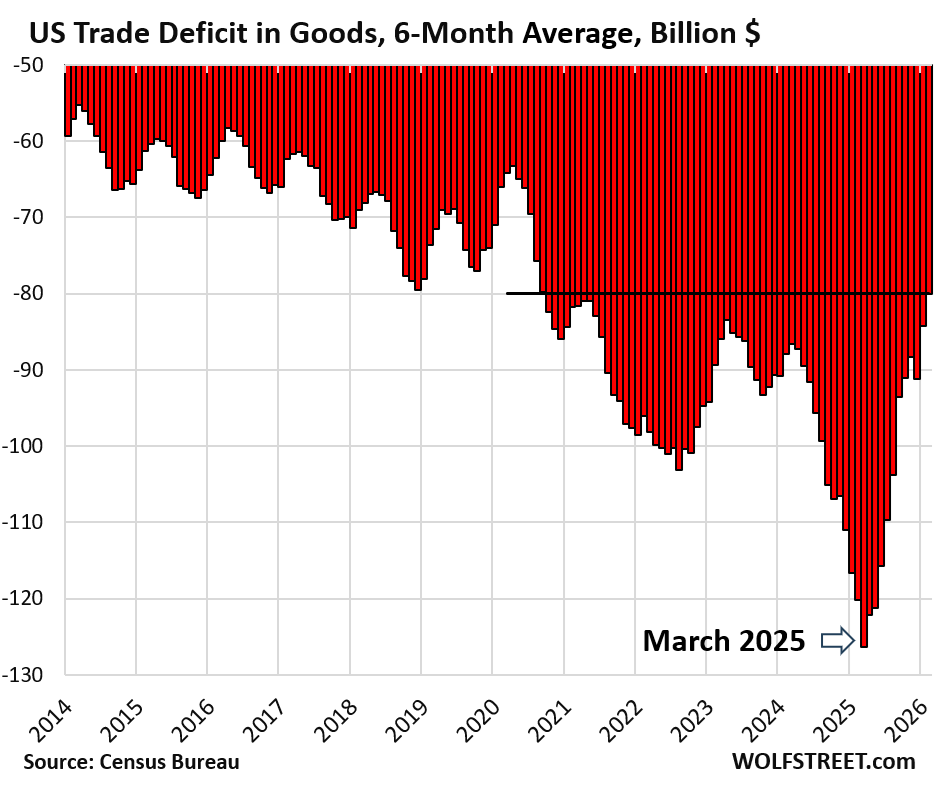
The tariffs are supposed to accomplish two goals: 1. Reduce the massive and unsustainable trade deficit in goods driven by the tsunami of imports; 2. Raise taxes from companies that continue to import anyway.
Here we’re looking at the first of those two goals: an improvement in the unsustainable trade deficit in goods. Tariffs are applied to goods, not to services. The future of the tariffs still hasn’t been etched into stone. But the effects so far are becoming clearer: a substantial reduction in imports of goods, and a big improvement in the massive and unsustainable trade deficit in goods.
Shifting supply chains and production to factories in the US is a slow process, especially when it involves building new factories or expanding existing factories. These projects take years from being first decided to actually starting mass-production. What has shown up over the first 10 months of the tariffs so far is the low-hanging fruit.
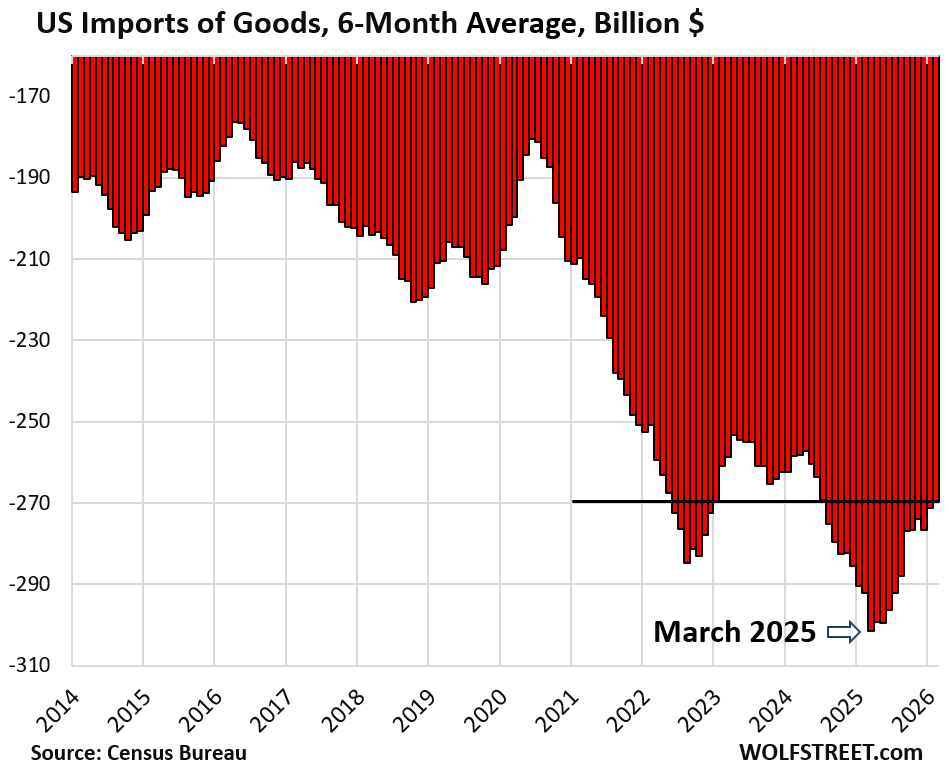
Imports of goods fell to $255 billion, the least-bad since December 2023.
The six-month average of imports improved to $270 billion, down by 11% from the peak of the six-month average in March 2025 ($302 billion), and a level first breached on the way up in mid-2022.
Imports are a negative in the GDP calculation and are expressed here in negative figures.
Exports of goods have been ticking higher, but they’re not nearly high enough to balance out the flood of imports. In dollar terms, the US is a big exporter of pharmaceutical products; energy products and petrochemicals; civilian aircraft, aircraft engines, and parts; machinery and industrial equipment; vehicles and parts; periodically nonmonetary gold; and many other products.
In February, exports rose to $196 billion, the second highest since October. The six-month average rose to a record $190 billion.
Exports are a positive factor in the GDP calculation and are expressed in positive figures here:
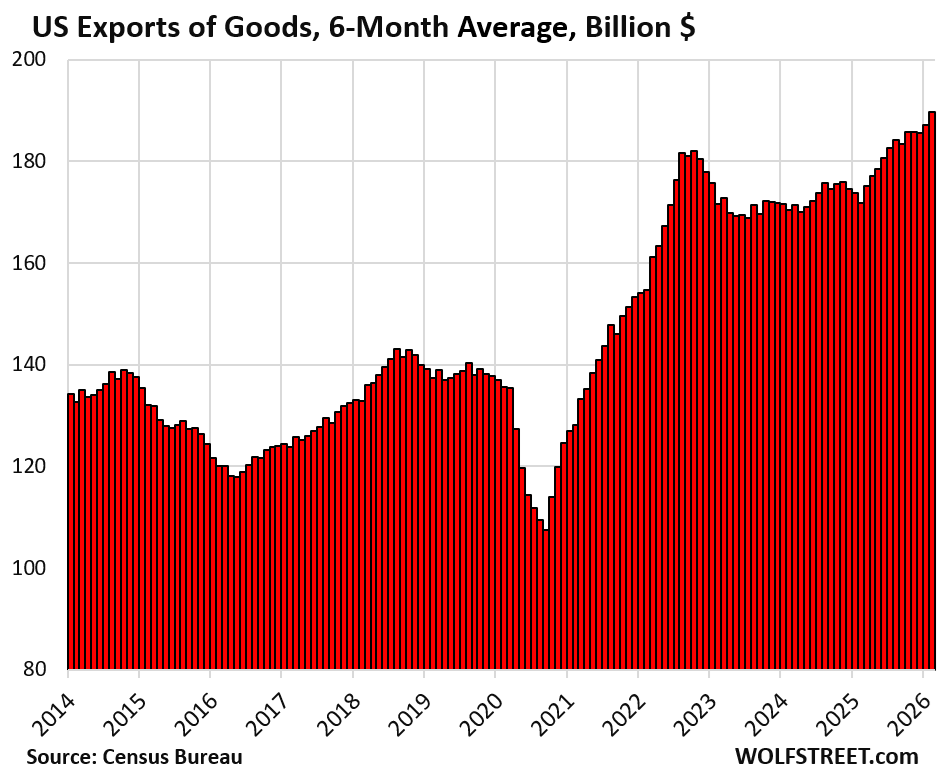
The combination of even slowly rising exports and rapidly falling imports produced the sharp improvement in the trade deficit in goods (first chart above).
And in case you missed it: Status of US Dollar as Global Reserve Currency: USD Share Drops to 31-Year Low as Central Banks Diversify into Other Currencies & Gold
Enjoy reading WOLF STREET and want to support it? You can donate. I appreciate it immensely. Click on the mug to find out how:


Any thoughts about the tariff refund issue?
Wait and see. But it has zero to do with these trade figures here. It has to do with the US budget and debt.
The US macroeconomic situation is so fundamentally poor – and the “money print/rate strangulation” “fix” is so played out (explicit, toxic inflation resulting from last go round…following 20 years of ZIRP Russian Roulette that barely managed to avoid *explicit* inflation until it…didn’t) that regardless of what the Courts determine/enforce/etc, DC is going to *have to* stick with some/any variation of the tariffs.
There is a reason why Biden never undid the first round of Trump tariffs – they were helping to undo the long-term macro threat (ie,
1-perpetual trade deficits financed with
2-perpetual fiscal deficits made possible by
3-frequent money printing,
4-eventually, inevitably resulting in inflation).
That death spiral has finally made itself felt and the US is out of lies it can tell itself (financing trade deficits with printed money, ultimately)
The same dynamic is going to apply here – some/any variation of the tariffs are going to be kept in place by Trump, his successor, or the Congress (if things are so desperate that Congress has to locate its balls after decades of avoiding adult decisionmaking).
I agree with that. I’m not as much of a doomer as some others, but I do think the “We’re a very rich country that can afford a stable middle-class lifestyle for everyone” jig is up.
Totally agree on that. The problem in a few years is that all the people who were implicitly promised a stable middle-class lifestyle if they just got a college degree and showed up are growing seriously restless with the inability to obtain said lifestyle.
They already threw the bums out in 2024, they will throw this set of bums out in 2028 when they fail to deliver. Eventually, the voters run out of bums to throw out. Does anyone really think that housing prices will correct, wages will rise, and inflation will be tamed by Nov 2028?
When did we have a middle class lifestyle for “everyone”?
Was it in the 1930’s when my grandmother was working 12 hour days as hospital maid? Was it in the 1950’s when my Dad was living with three other guys in a 2 bedroom apatment after High School or was it in the 1970’s when I was in college working part time as a property manager in the day and driving a limo part time at night?
I understand that much of the exports was gold shipped for refining or to pay for Chinese products like Rare Earths
You understand nada. Just spreading braindead internet manure here.
1. Nonmonetary gold exports jumped month to month by $8 billion, to $18 billion in February. Total exports jumped to $196 billion. Despite that month-to-month jump, gold exports in February accounted for just 9% of total exports.
2. Gold exports have zero to do with IMPORTS. Tariffs target imports, not exports.
3. Gold is not used for payments 🤣 but for investment.
By my math $8 billion in gold exports accounts for ~20% of the reduction in the trade deficit. Not insignificant.
All the charts are six-month averages as are most of the figures I gave you, RTGDFA, and in the six-month average, the February monetary gold exports barely register because it was a one-month blip. In addition, there were one-month blip imports in the six-month average too.
In late 2024 and early 2025, there where HUGE monetary gold IMPORTS, and I wrote about it here, and they broke the Atlanta Fed’s GDPNow. You can see that in the spike of imports through March 2025. Some of those monetary gold imports have been getting unwound. That’s all. People are going nuts over gold.
I’m not an expert on the triffin dilemma but this rebalancing had to happen, luckily it’s happening sooner by choice rather than later by the firm grip of the invisible hand.
Just a follow-up from a comment I made here about month ago about Noem and Bondi being inept. They have both been fired.
Don’t you know the DOW was at 50,000!!!
Bobber, it was amusing when she said that. Anybody that brags about the stock market being at a record high and taking credit for it is an idiot.
Love it! Who’s next??
Thank you, Wolf! Good to see President Trump exonerated on this topic. The woke crowd is too quick to dismiss him for everything he does. His speech last night was inspiring! Next, we need to get fully behind our president on the Middle East war. He needs us now more than ever!
Wait What? Something that the president stated would be a good thing actually is working? Where is the popular press reporting this???
Some stories are starting to grudgingly get published on that, for example today in the Financial Times even (behind paywall):
“The case for Trump’s tariffs looks strong a year on from ‘liberation day’“
This war doesn’t put America First.
There are many words that come to mind regarding Trump’s speech last night. “Inspiring” is not on my list.
Yep, they don’t make Lincolns anymore…I guess even if he had a great speech write (ala Kennedy) he won’t read from it.
What caused the runup in exports and imports $ from 2020-2023?
Is that just the inflation wave making the $ amount higher but not the actual amount of goods?
I didn’t see in the article if these are inflation-adjusted $ values or not.
In the quarterly GDP data, which is adjusted for inflation, the total trade deficit (including services) nearly doubled from mid-2020 to mid-2022, adjusted for inflation.
Today is April 2nd, not April 1st.
You just broke the internet with your epiphany.
Just to check this is all tariffs, not just economic slowing? If so than good news. Glad something is going well.
I wonder how much of the gap would be filled if the corporate tax rate was increased considering how low it is. Corpos have been on the gravy train for decades now with low taxes and outsourced labor and manufacturing.
Good news. It will be interesting to see how the war impacts all of this in the months to come.
I think you are too quick to dismiss the significance of non-monetary Gold exports. Granted it’s not clear what it means and people interpret it all different ways.
It would be great if Trump were more focused on these issues at home. His foreign adventures may undo all the good work at home and may leave us with President Newsom in 2028.
Trump has spooky good luck, so maybe he will come out of this mess in the Gulf ok. Impossible to predict for now.
In late 2024 and early 2025, there where HUGE monetary gold IMPORTS, and I wrote about it here, and they broke the Atlanta Fed’s GDPNow. You can see that in the spike of imports through March 2025. Some of those monetary gold imports have been getting unwound. That’s all.
Given the jump in oil prices, should we now expect the trade deficit to take a spike down, as US energy exports benefit from those higher prices?
We may see some of that in the March and April figures.
What about 3rd goal, bringing manufacturing back to the US? How’s that going?
Doing very well, as you can already see in the trade figures and in the construction of factories in the US.
Just don’t expect sweatshop manual labor. All modern factories are highly automated, with relatively little labor, and what labor there is, is highly qualified labor, including tech jobs. Nevertheless, there are currently 438,000 jobs that manufacturers are trying to fill.
Would love to see these charts without net petroleum products. Not even talking about the recent Iran price spike. The first three months had some price effect already.
Are American’s becoming better at not consuming junk? Or producing petroleum products?
This is trade data through February. Whatever happened in March will show up next month in the data.
Hope the tariffs and other things like security concerns continue to drive manufacturing back to US. We can’t have an adversary controlling entire supply chains. A good example of non tariff activity we can do which will also support building here is with internet routers- starting next year all have to be manufactured in the US, we will go from having no manufacturing of these to millions of them per year.
Yes, tariffs reduce the trade deficit. Clearly. Yes, that needs doing. Again, clearly. That said, the tariff regime by executive order we saw last year has and will continue to cost small businesses oceans more than big companies on a relative basis, and has and will put many, many small businesses right out of business. Actual nuts and bolts impementation of tariff policy at the ground level is highly complex and exacting in import procedural steps. Big companies have armies of lawyers and accountants to wade through the contracts and policy that determines what goods are subject, which are not, how much, and when. Small businesses cannot contend with the schizophrenic on/off/maybe nature of Trump’s demented policy, if you can call it that, and this has cost those small business owners a fortune. A fact that is perfectly fine with the likes of Amazon and the other mega corps. Call me woke, call me a snowflake, call me whatever you want. But I will die on this hill. Any benefit the US as a whole sees from his tariff regime is a happy accident. He is a sociopathic narcissist who cares about no one but himself. And, as usual, American mom and pops will suffer the consequences of politicians pandering to mega corporations.