
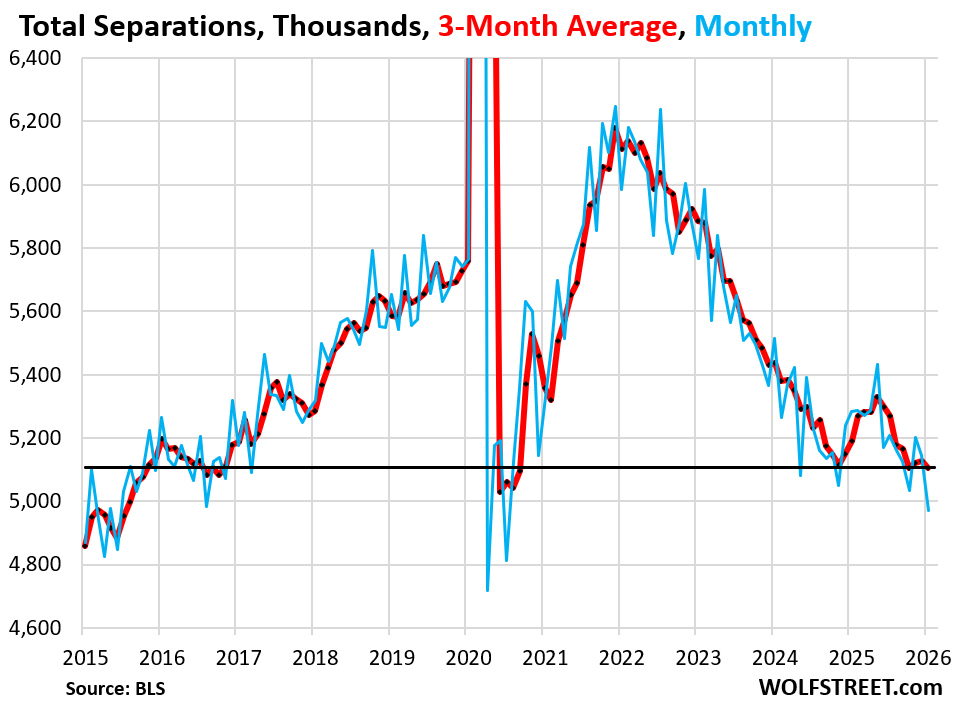
Total separations drop to the lowest since 2015 beyond the lockdown months.
By Wolf Richter for WOLF STREET.
The Job Openings and Labor Turnover Survey (JOLTS) of 21,000 business locations, released today by the Bureau of Labor Statistics, tracks labor market churn: How many people quit their jobs, how many were fired or laid off, how many retired, died, or separated for other reasons, how many job openings those people left behind, and how many people were hired to fill those job openings.
Voluntary quits are very low, layoffs and discharges are very low, retirements and other discharges are very low. So, total separations have plunged to the lowest since 2015, with the exception of the lockdown months. The low number of separations means fewer newly vacated jobs are left behind, so job openings are lower, and the number of hires to fill that lower number of job openings is lower.
The crackdown on illegal immigration and the tightening up work-visa-related immigration also plays into this as it shrank the supply of labor, making hiring more difficult.
All this makes for a peculiar labor market.
Total separations – voluntary and otherwise – plunged in February to 4.97 million, the lowest since the lockdown months, and before then the lowest since 2015 (blue in the chart).
The three-month average, which irons out the month-to-month squiggles, dropped to 5.11 million, also the lowest since the lockdown months, and before then since 2016 (red).
Total separations consist of voluntary quits (60% of total separations), layoffs and discharges (33% of total separations), and retirements and other separations (6% of total separations). More on them in a moment.
But during that decade, employment has risen substantially, and this low rate of separations shows that a form of stasis has spread over the labor market, an unusual equilibrium in the US labor market, which is efficient for employers. But it makes it hard for young workers to enter the job market.
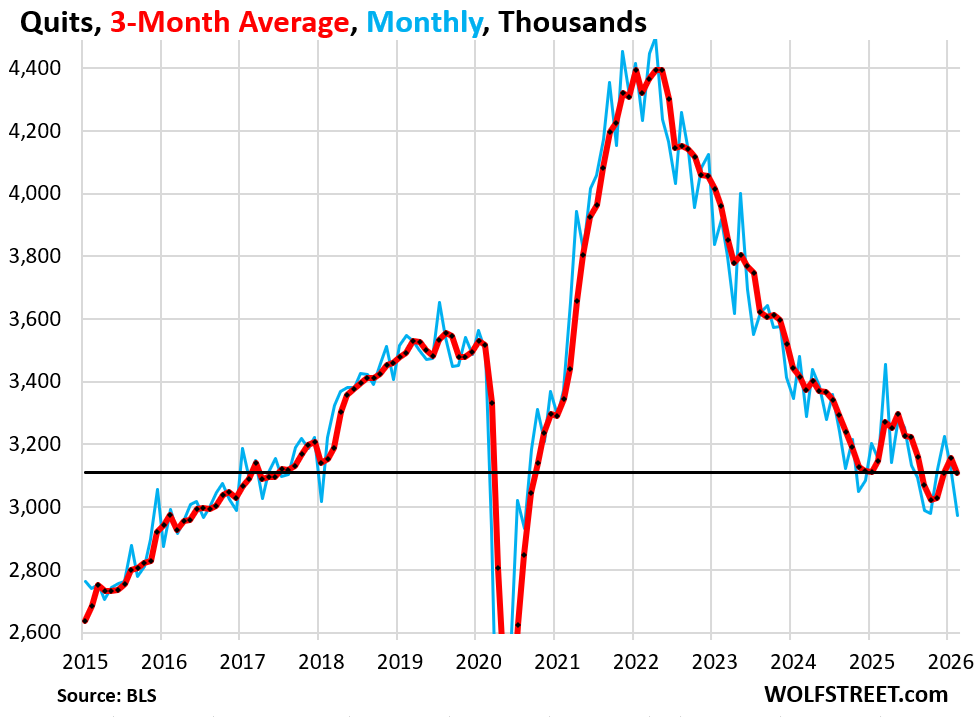
Voluntary quits plunged in February for the second month in a row, to 2.97 million, the lowest since the lockdown months, and before then the lowest since 2017-2018 (blue in the chart below).
These are people who quit their jobs voluntarily, such as to take a better job somewhere else, but do not include people who retired, died while employed, etc., who are tracked separately.
The three-month average dipped to 3.11 million (red).
Quits are the biggest source of the labor market churn and account for 60% of total separations.
Fewer quits means fewer open slots left behind that would turn into job openings and then into hires to fill those job openings.
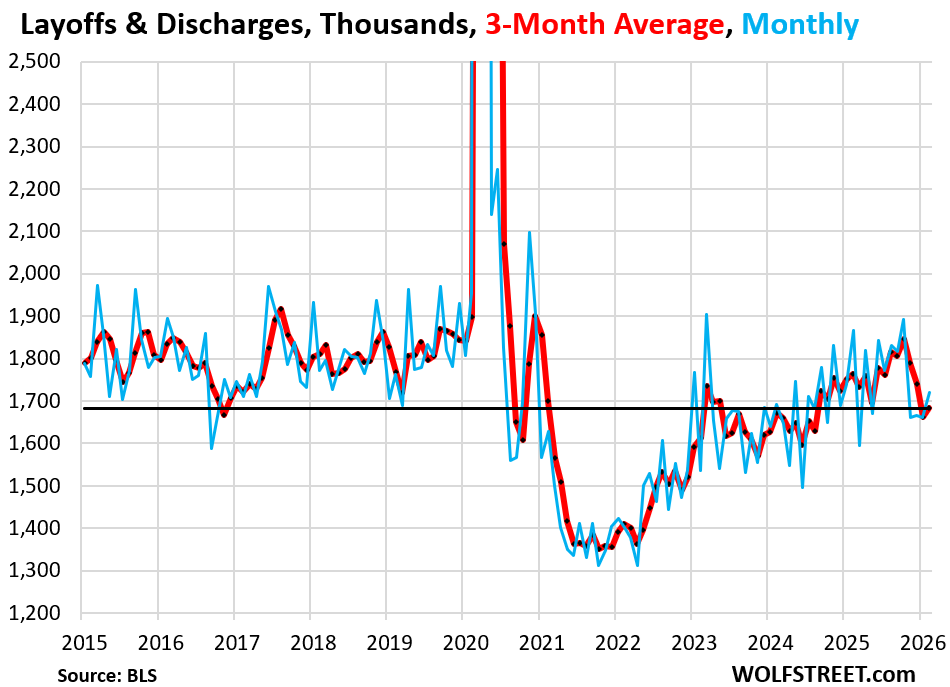
Layoffs & discharges ticked up to 1.71 million in February. The three-month average ticked up to 1.68 million, well below the prepandemic years, except for one month (Oct 2016). Only during the time of the labor shortages, and coming out of it, was the level consistently lower.
Getting fired for a variety of reasons, or for no reason, is a classic feature of the American labor market.
Layoffs and discharges accounted for 33% of all separations.
These low layoffs & discharges have been confirmed by other data, including very low unemployment insurance claims.
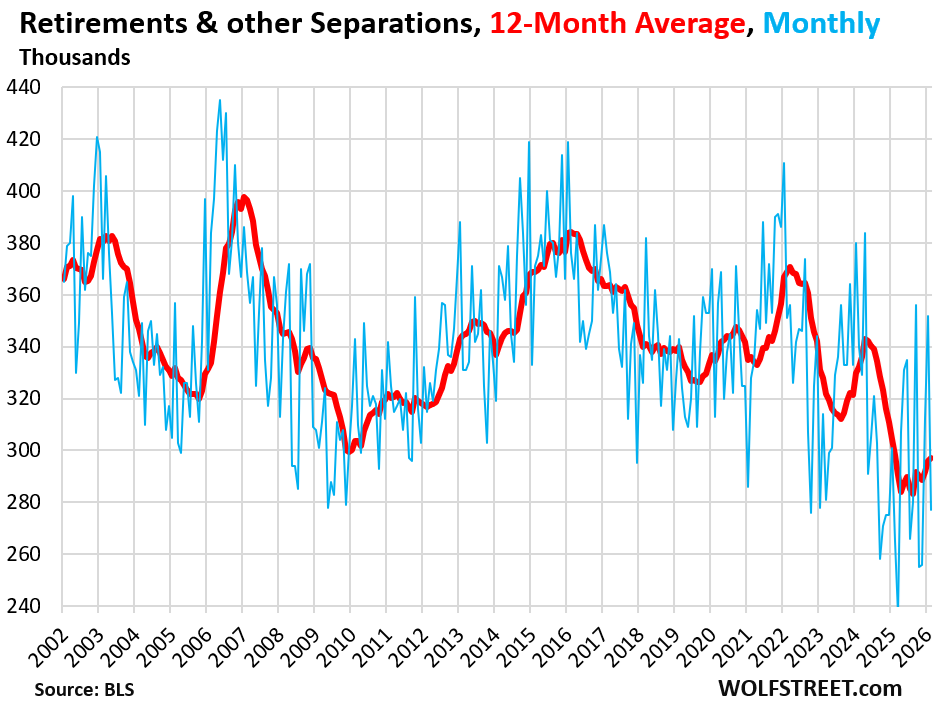
Retirements and other separations (including deaths while employed, etc.) fell to 277,000 in February.
The 12-month average, which irons out the huge month-to-month squiggles, edged up to 297,000. The last few months were the lowest in the data going back 25 years!
They account for about 6% of total separations.
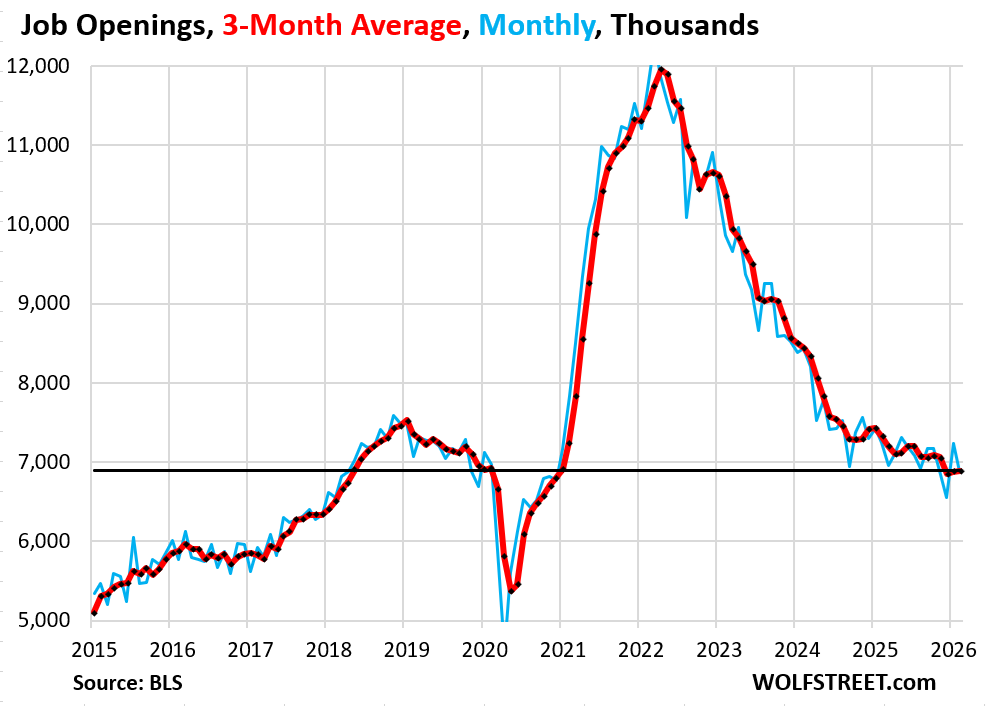
Job openings are a result of total separations that have dropped to a decade low. So job openings have sunk below where they’d been in 2018-2019. In February they fell, giving up part of the jump in January.
The three-month average, which irons that stuff out, was roughly unchanged for the third month in a row at 6.89 million openings.
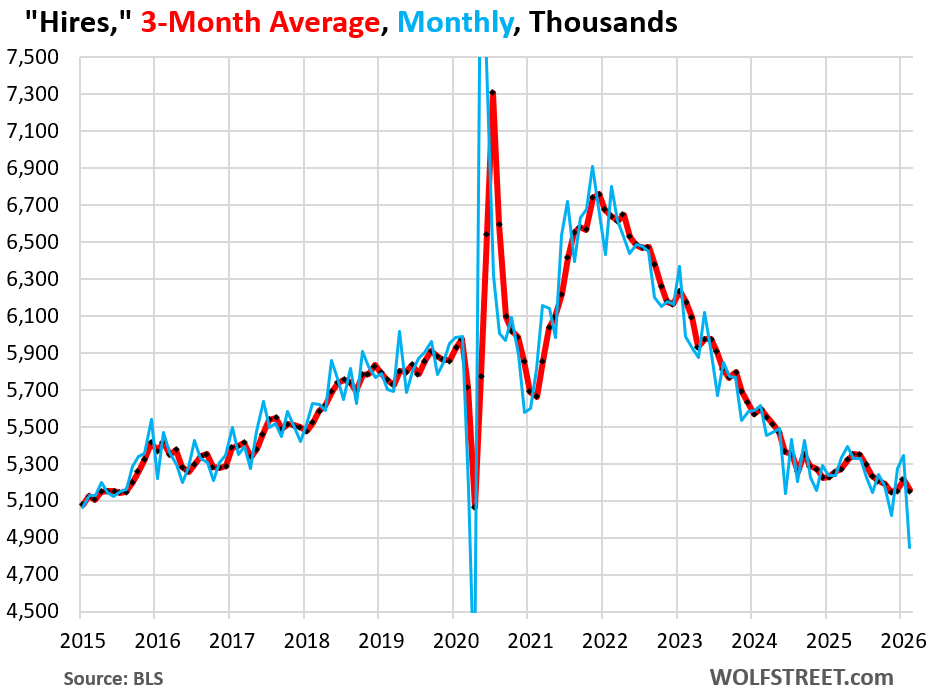
The number of hires dropped in February, after the jumps in December and January. The three-month average dipped to 5.16 million, right where it had been in December and above November. So roughly stable for the past four months.
Most of these hires replaced workers who’d separated from the company, leaving open slots behind. Only a tiny portion were hired to fill newly created jobs. But the JOLTS data doesn’t track that; the employment report to be released this Friday, attempts to track that.
These are low levels of hires, the lowest since before 2015 beyond the lockdown months. But with so few total separations – the lowest since 2015 – there are fewer job openings left behind, and less need to hire people to fill those openings.
Turnover in the labor force had exploded in 2021 and 2022 during the labor shortages. A lot of churn like that in the labor market is expensive and inefficient for employers. But it resulted in a reshuffling of the labor force, with more people switching to jobs and industries that were better fits for their aspirations, and who were better fits for their employers, which allowed for the churn to calm down in this peculiar way.
Enjoy reading WOLF STREET and want to support it? You can donate. I appreciate it immensely. Click on the mug to find out how:


Reminds me of the housing market.. nice and frozen