
Hoping for lower mortgage rates that may not come.
By Wolf Richter for WOLF STREET.
Homebuilders have been aggressively trying to build and sell homes because that’s their business; they cannot wait out this market and pray for lower mortgage rates that may not come. They’re fighting for market share, and they’re trying to show growth to their investors – in a housing market that is otherwise frozen.
So the inventory of completed single-family homes for sale – the “spec homes” – has reached the highest level since 2009, prices continue to zigzag lower, incentives and mortgage-rate buydowns are used to move the inventory. And sales, well, they’re not exactly spectacular, but they’re fairly decent, compared to existing homes.
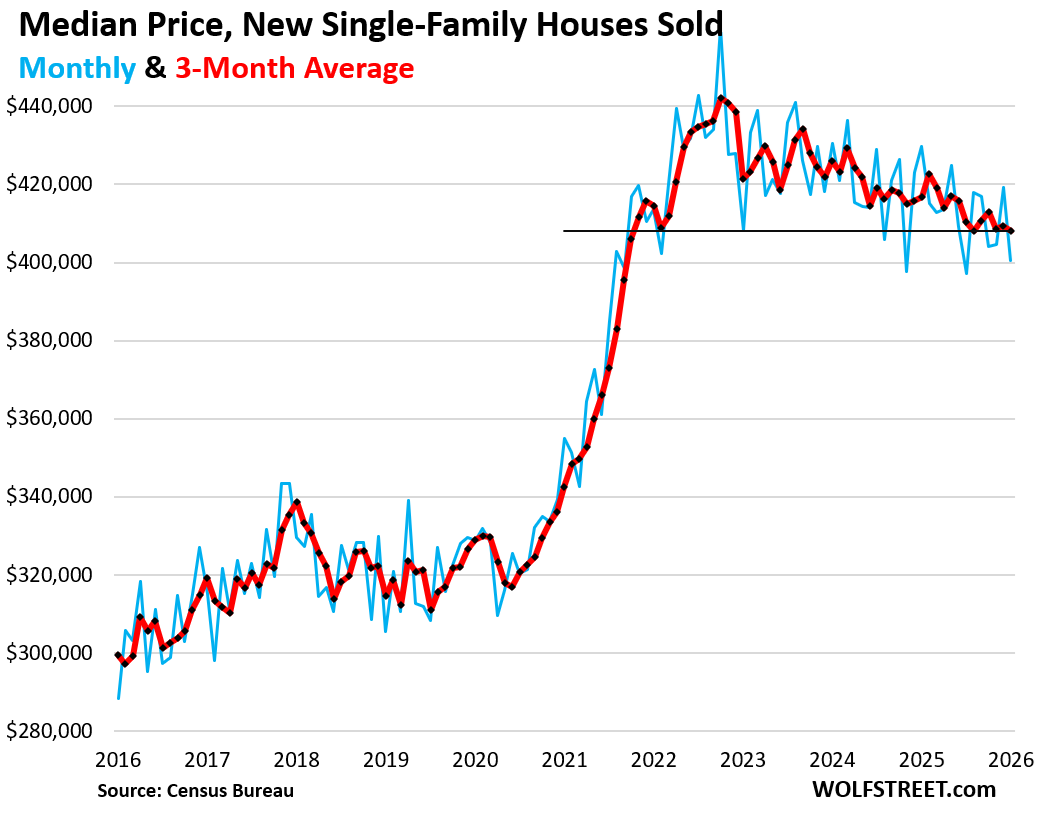
Contract prices fell, even with incentives not included.
The median contract price dropped by 6.8% year-over-year to $400,500 in January (blue in the chart below), according to data from the Census Bureau today.
The three-month average, which irons out some of the month-to-month squiggles, dropped to $410,533 (red), down by 2.1% year-over-year and by 7.7% from the peak in late 2022, and roughly back where it had been in October 2021.
But this median-price metric does not include the heavy incentives, such as mortgage-rate buydowns that builders use to move their inventory. The Census Bureau tracks prices written into purchase contracts that buyers signed. These contract prices do not include the costs of mortgage-rate buydowns and some other incentives.
With the costs of the buydowns and incentives included, home prices fell far further – we know that from builders’ financial reports. For example, Lennar spent 14% of the home sales revenues on incentives, in addition to selling at lower contract prices, and this pushed its average selling price down by 24% from the peak, to levels first seen in 2017 (more in a moment).
These contract prices overstate effective sales prices and understate the effective price drops. And still, they’ve been zigzagging lower.
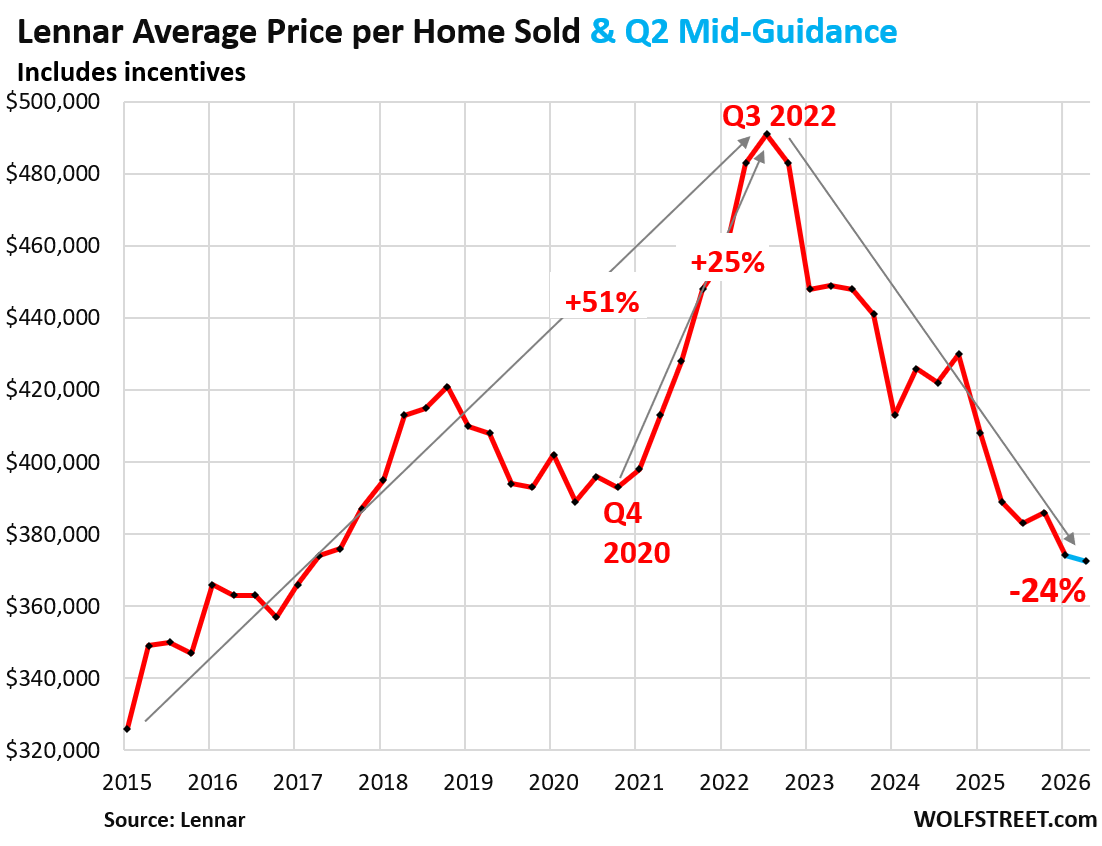
The price explosion in 2021 and 2022, when homebuyers were willing to pay whatever, had led to obscene profit margins at homebuilders. Those profit margins have been getting slashed since then, in Lennar’s case – which is gunning to be the #1 homebuilder in the US by volume – by nearly half.
Lennar’s gross margin on home sales got slashed to 15.2%, down from the obscene 26.9% in Q1 2022. Operating earnings from homebuilding plunged by 54% year-over-year, earnings before income taxes plunged by 57% year-over-year, net earnings plunged by 56% year-over-year, and its shares have plunged by 52% since the peak in September 2024.
Lennar cut the average price per home sold, including all incentives, by 24% from the peak in Q3 2022, to $374,000 (red in the chart), where it had first been in 2017. The mid-range guidance for Q2 dropped to $372,500 (blue).
In return, Lennar’s deliveries in Q1 have soared by 37% from Q1 2021, while sales of existing single-family homes have plunged by 32% over the same period, amid surging supply.
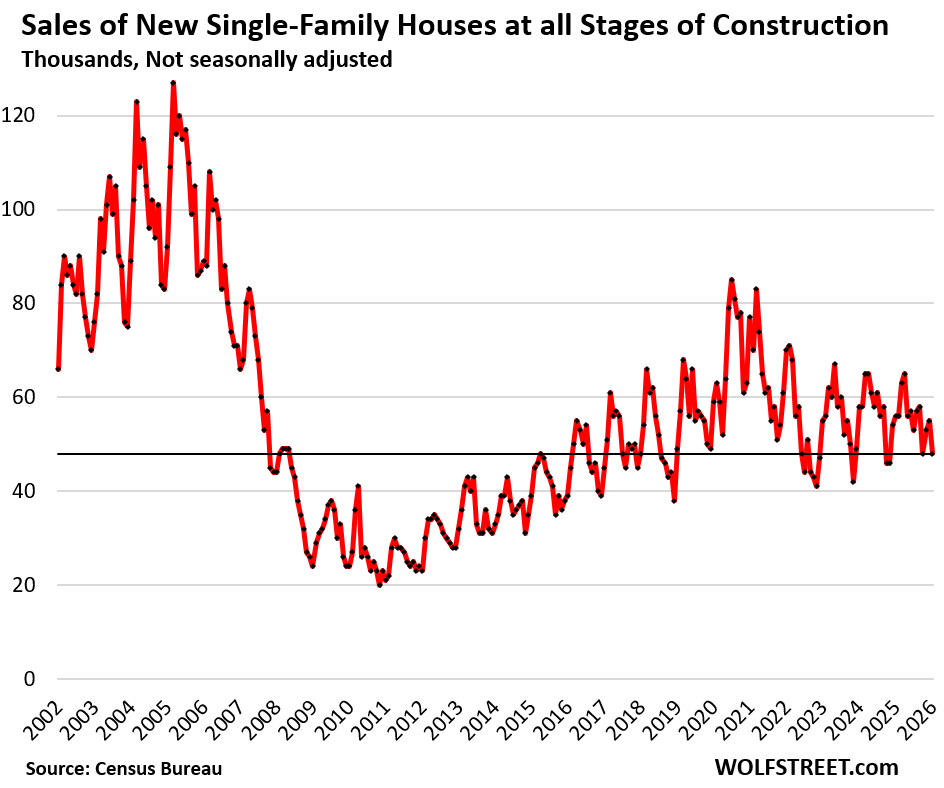
Overall sales of new homes have hung in there. In January, homebuilders sold 48,000 homes, down by 14% year-over-year, but just 2% below January 2019, roughly level with January 2018, and above January 2017.
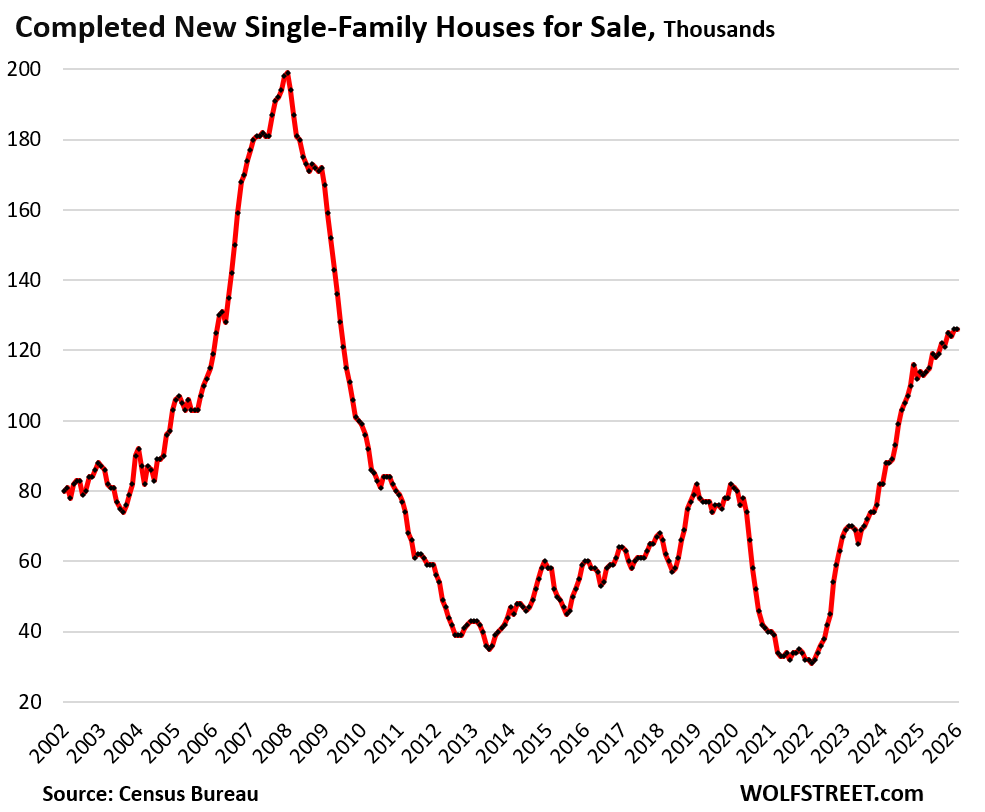
Completed single-family homes for sale, at 126,000 in January, were up by 11% year-over-year, and the highest since June 2009. These essentially move-in ready “spec homes” are waiting for the spring selling season and lower mortgage rates that may not come. Builders have tied up a lot of capital in them, and they will be highly motivated to sell them.
Inventory by region.
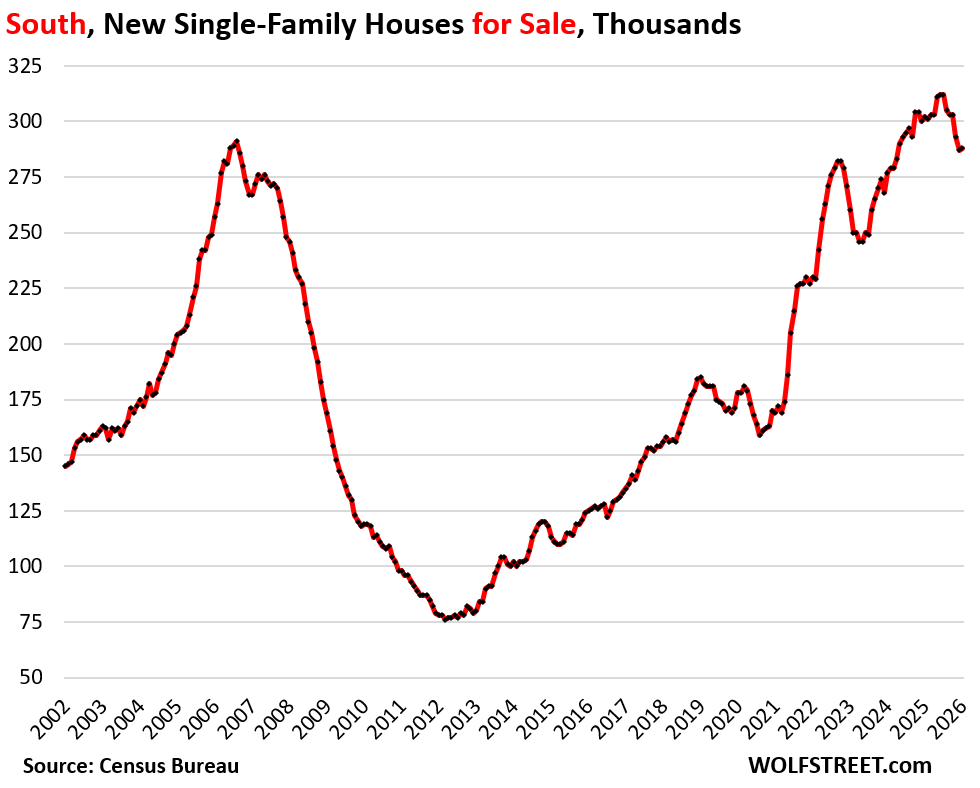
Inventory for sale at all stages of construction has been declining from the very high levels – from record levels in the South – as builders were focused on completing what they had started, and being somewhat prudent with starting new projects (a map of the four Census regions is below the article at the top of the comments).
In the South, inventories of new houses for sale at all stages of construction in January, at 288,000, were down 4.6% year-over-year, and down 7.7% from the record levels of 312,000 in June and July. But they remain very high, 55% higher than in January 2019.
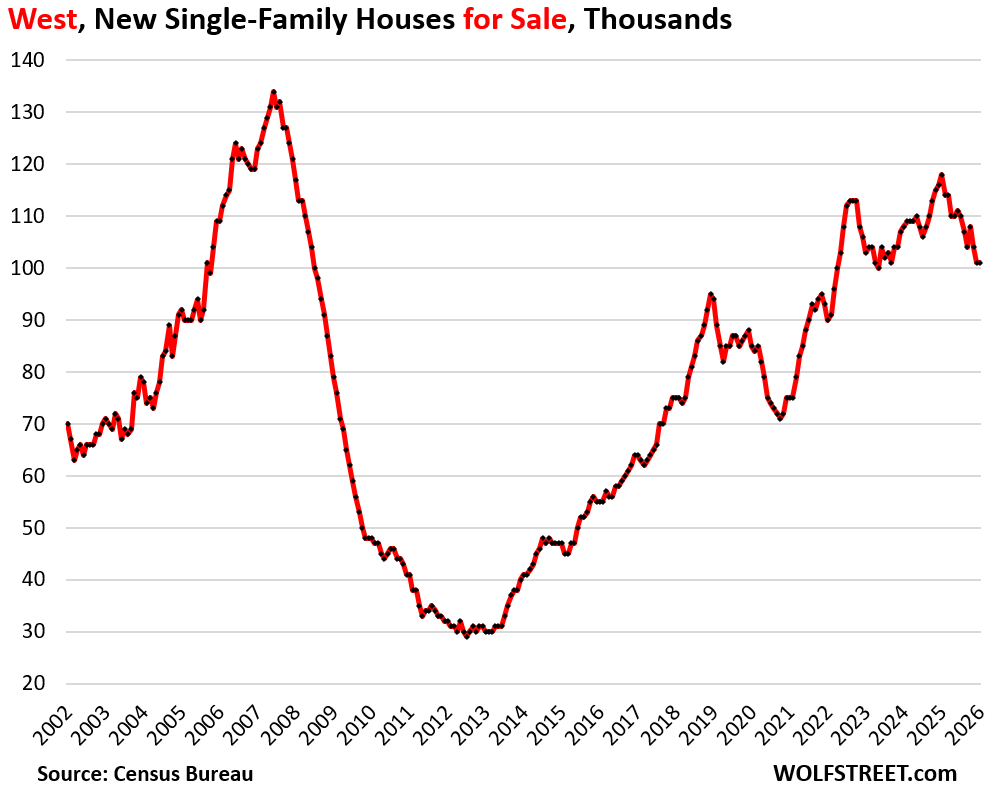
In the West, inventories of new homes for sale have been declining for a year, but remain very high. In January, inventories, at 101,000 homes for sale, were down by 14% from January 2025, which had been the peak.
The West accounted for 21% of the total US inventory.
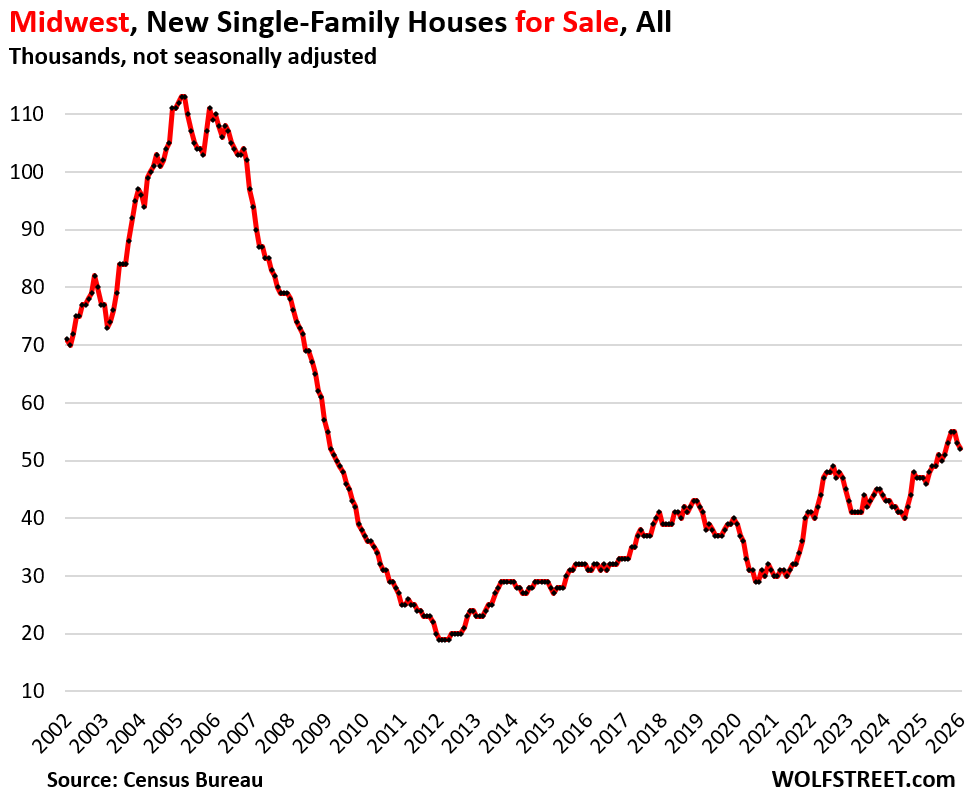
In the Midwest, inventories, at 52,000 homes, were up by 10.6% year-over-year and by 24% from January 2019:
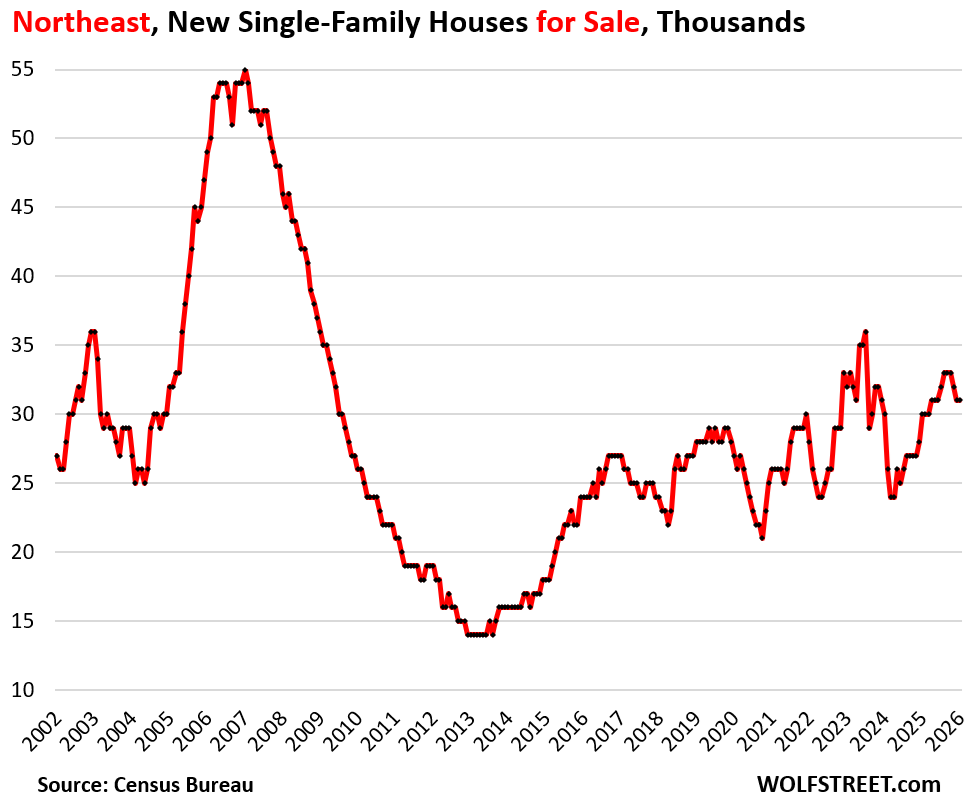
In the Northeast, inventories, at 31,000 new homes, were up by 3.3% year-over-year and by 11% from January 2019.
The Northeast is a relatively small area with huge densely populated cities where multifamily construction (condos and apartments) plays a very big role.
Enjoy reading WOLF STREET and want to support it? You can donate. I appreciate it immensely. Click on the mug to find out how:


Wolf, a couple of questions.
Does the count of new homes sold by builders include small guys who maybe build one or two houses at a time? Or is it just a survey of the large companies developing whole subdivisions? Just curious if lending conditions are hurting small mom and pop contractors more than the big companies, as I assume they rely more on debt while the latter rely more on equity, but I may be wrong.
Second, it’s been a couple of years of builders offering mortgage rate buydowns. Have they given any guidance to how their hedges have been holding? Did they actually buy protection for the life of the mortgage, or did they only hedge for a couple of years, banking on interest rates going down and buyers refinancing? Because if it’s the latter, that might be a ticking time bomb on their balance sheet if those mortgages last longer than the swaps that were bought for them.
Homes in Northern Nevada are not dropping at all! Especially carson Minden area.. Anything if you’re lucky enough to find it on a half acre or more, is seven fifty on up, unless it’s total junk! Inventory is very low. Must be people coming over the eastern sierras. From california.
Lune,can only speak for northeast as a carpenter/licensed builder have seen smaller spec outfits cutting back,that said,they can fall back on reno work/additions ect though feel that may slow as the world sees how the economy plays out with war.
I do drive by daily a smaller outfit that was doing 4 homes spec and so far 3 sold as soon as finished,they are on last one and am watching to see how it does when finished,pricing and profits i have no idea..
A friend who is the GC on apt buildings and the complexes is still very busy,these deals were in the works for years and so far no slow down but even he is starting to wonder how this will play out,again,in the northeast also.
1. yes, it includes all new residential construction. Census goes by permits, and field staff then visit some of the construction sites. It also started experimenting with satellite imagery and computer vision.
2. Small builders are getting hurt because they don’t have their own mortgage company, and cannot easily buy down mortgage rates, and hedge those risks.
3. DR Horton took a big write-off in early 2024 after its hedge blew up in late 2023. That was an interesting filing because they had to disclose some details that they would have kept as a trade secret otherwise, including that they were hedging those buydowns at all. I wrote about it at the time:
https://wolfstreet.com/2024/01/24/d-r-horton-sheds-some-light-on-the-massive-costs-of-mortgage-rate-buydowns-as-a-hedge-went-awry-stock-tanks/
4. The questions in your second paragraph are still considered trade secrets by homebuilders. But they have disclosed that they hedge with forward contracts. Maybe next time a hedge blows up, we’ll get more details.
I wonder, what is the correlation between homes for sale and intentional de listing? If de listings are impacting supply or not.
No correlation because you’re on the wrong topic. Delisting is a thing with existing (used) homes where homeowners delist it if it doesn’t sell quickly.
But these are new homes, sold by builders, and big builders have their own sales offices, and what they have for sale is for sale.
I buy house. I pay money.
You got the order wrong or holding out on what you pay money for?
This is NOT a critique just an observation – we can write a GAZILLION TIMES about price drops of a GAZILLIONTH of ONE PERCENT, but until there is some meaningful movement in price, we’re just spinning wheels.
I’m still fuming about the ordinary home for sale for a whopping $1.75 Million! Now I totally can relate to Weimar Germany.
Years of small drops, along with years of wage increases and inflation can bring the housing market back in line, but the slow way. For new homes, it’s already been three years.
This is how it’s going to happen this time. Probably 7-10 years worth.
I had the same thought, but it’s starting to look more like AI will cause wage decreases.
AI has been quite effective for me in 2026. It really is getting better.
Agreed. Investors have to consider the risk of another 2008 housing bubble suddenly bursting, at a time when stocks are at historically high valuations. Information that the bubble is slowly deflating is actionable, because it represents the steady reduction of that risk. Similarly, people who might be buying a home need to think about the falling odds of getting a better deal in the future.
“Hoping for lower mortgage rates that may not come.”-Wolf’s teaser
There is even less incentive for those with sub 4% mortgages to move. However, as during the Great Recession, prices can be determined by the margins. If rates continue to rise and the 30 year conventional mortgage hits 8%(as I believe it will), then prices will come down but buying will cost the same. Zero sum in the end. Lower price, higher interest, same payment.
Nah, remember this time is different right? Anything remotely like 2008 is not going to happen again…Judging by friends and people I know from work still comfortable taking out $1M mortgage on 6% in SoCal…..the optimisim that nothing like 2008 will ever happen again in this market and price will either stay flat or up slowly every year is pretty wild to see…
New house here in the saintly part of the TPA bay area sold for right at ONE MM, the recent avg/SF for all locally,,, after listing when finished for ONE.SIX MM…
Should be enough to inform anyone paying attention what has come,,, and most likely IS coming albeit slowly SK…
‘Hood is definitely ”gentrifying” with many new and much larger homes taking the places of ’50s 2&1s, but NO FLOODs, (X zone), good schools w/i walking, etc…
Not to dig on anybody’s high cost neighborhood, but I look at these lifestyles and wonder why anyone signs their life away to live that way.
Rene’ Girard’s theory of mimetic desire comes to mind. The people who agree to work a lifetime to dig out of a $1M hole that is costing interest have some idea in their head about this being the good life. They got this idea by watching other people do it. Additionally, they believe they will be happier for taking on that burden, because everyone else wants to carry it.
When I bought my first home…. It was generally considered that a buyer should not purchase a home with the hope of equity for at least 10-15 years.
I suppose that is now reversed. So it is a waiting game the other direction.
Possibly 10-15 years??
Patience and prudence is not desirable these days by many…..
but can be very helpful financially in the long run, which ever way you are going.
Just a thought.
I understand the problem…. and am not trying to downplay it ….
Just trying look at it in some what of a beneficial way.
In theory…
maybe ???
I am prepared to be destroyed by comments
It’s a slow motion trainwreck. Eventually the train will go off the rails and we are back to 2012 prices.
The question is how slow? Wage increases have been higher than the rate of home price increases since the top occurred a couple of years ago. So it could just be that high wage inflation and low RE appreciation slowly bring us back to 2012 prices a quarter century from now.
And an entire generation misses out on homeownership as a form of savings, as the value of their home declines in real terms.
Homeownership is good insofar as it provides stability for families and communities, but homeownership as a form of savings has always been a dumb idea from a policy standpoint.
It will be interesting to see how it plays out…
I think yes pending no recessions, no stock market down turn, and no increase in unemployment we’re in for a long slow decline.
IF we get any of the above though or if we get a ton of media about falling prices and housing crashes I think the decline speeds up.
The markets all seems to be much more psychologically driven than fundamentals driven these days. If people get scared sellers will be more willing to negotiate and there will be even less buyers…
Not to mention the whole Airbnb problem, which I have to wonder what happens if travel slows even more? Here in CO the mountain towns got hit hard by no snow, which will also probably reduce or delay bookings for next year
Airbnb is indeed a problem. People who operate a housing unit like a hotel need to have their operation regulated like a hotel, inspected like a hotel, and taxed like a hotel. This would tend to lower the plague of Airbnb units and add to the supply of homes available for sale.
hmm…..you are probably right on below but then again have normies not been paying attention to what happened starting in March and the mess that we are in now and we’re not even in 1st inning when it comes to economic impact medium/long term.
“I think yes pending no recessions, no stock market down turn, and no increase in unemployment we’re in for a long slow decline”
Then again not surprisly, I am sure a lot of normies think things will go back to normal in couple of weeks, Dow will be at 50k again…rinse and repeat. Let’s see but I think not being to TACO easily out of this one might provide a different perspective to how quick we can recover….time will tell but will need to buckle up for the wild ride. For retired boomers that soley rely on retirement withdraw and their balance tie to the market, I am sure the last couple of weeks is not a sign of encouragement. Question will be at what point, does it speed up their urgency to sell any extra properties to perserve capital, if that happens, I think the hubris of still asking for the moon on houses or not reading the room on what new homes are going for will flip the script very quick.
Interest rates are blowing out thurd. Lower home prices will help but it’s zero sum on the payment. Cash buyers will be winners.
For anyone who wants a better life, there will be many opportunities to negotiate with builders in TX, especially in DFW.
I think this is odd: In the “Lennar cut the average price per home sold” graph, it appears that the highest prices Lennar ever received for their homes was Mid-2021 thru late 2023. I believe those were the infamous Biden years often talked about. I also presume that all the other builder received the most $$$/home during that time also. Is that counter to the “internet assessment” of things ?? As a side Note, I also bought a new 2,850 sq ft home in mid-2020 for $650,000 and still kept my old one (same size) for the kids. So aside from me “not being the only one”… I don’t get that Biden period also being the most lucrative for the builders.
2021 and 2022 were the most lucrative years, the first 2 years of the Biden administration. Then 2023 and 2024 got a lot tougher, and margins declined.
Was that because the epidemic money handouts and work from home made people go crazy bidding up prices? We got a stimulus check, but it was no way large enough to go buy a bigger house. I don’t get it
2.8% 30-year mortgage rates when inflation was heading to 9% was better than free money. In addition, there were other stimulus moneys, such as the forgivable PPP loans. There were other factors too, including mass-psychology summarized often with “FOMO.”
Here is a map of the four Census regions of the US:
i stated this before, but i could buy a great one story 20 foot ceiling condo on waterfront in jack london, oakland area for less than i paid for it over thanksgiving week in 2015. i sold it in 2019 at a huge profit. great hood, wonderful weather. walk to ferry to get to SF in short order………..i love your r/e analysis. i’ve been an investor in r/e and small time restoration of old homes since the 1980s. i like to ride the waves and bail out when the indicators turn south……….watched my older brother do it in the late 60s and in 70s after his “tour” of viet nam. i love the term tour. like a holiday package you know you are coming home on a certain date. why fight hard?
Dear Leader’s Iranian war has increased the costs of energy across the globe and may increase the costs of the materials used to construct a new home adding more pressure on builders.
The increase in energy costs is the result of Iran using the war as an excuse to menace neutral shipping in an effort to extract tribute. See Barbary Pirates…
Damn it just goes to show how hyperlocal real estate can be.
I’m in Austin where SFH prices are trending down. I went to see a house last week that was the right size but dated and overpriced, on the market for 7 days at that point. There was a lot of traffic; 5 people in the short time I was there. Today it’s already under contract.
According to the realtor the house next door was renovated and sold for a cool $1M.
In the meantime my rent in this same neighborhood is under $2K and stayed flat from last year. But people are still overbidding shit and making things worse for the rest of us!