
Even as miles driven rose to a record.
By Wolf Richter for WOLF STREET.
Gasoline consumption in the US, in terms of product supplied to gas stations, declined by about 1% in 2025, to 8.91 million barrels per day, according to EIA data, below where consumption had first been in 2003, even though the US population increased by 52 million people, or by 18%, over the same period.
Compared to the peak in 2018, gasoline consumption in 2025 fell by 4.5%. Compared to the prior peak in 2007, gasoline consumption is down 4.1%.
Gasoline consumption is increased by miles driven – which inched up to a record – and is slowed by the improving efficiency of gasoline-powered vehicles and the growing share of EVs.
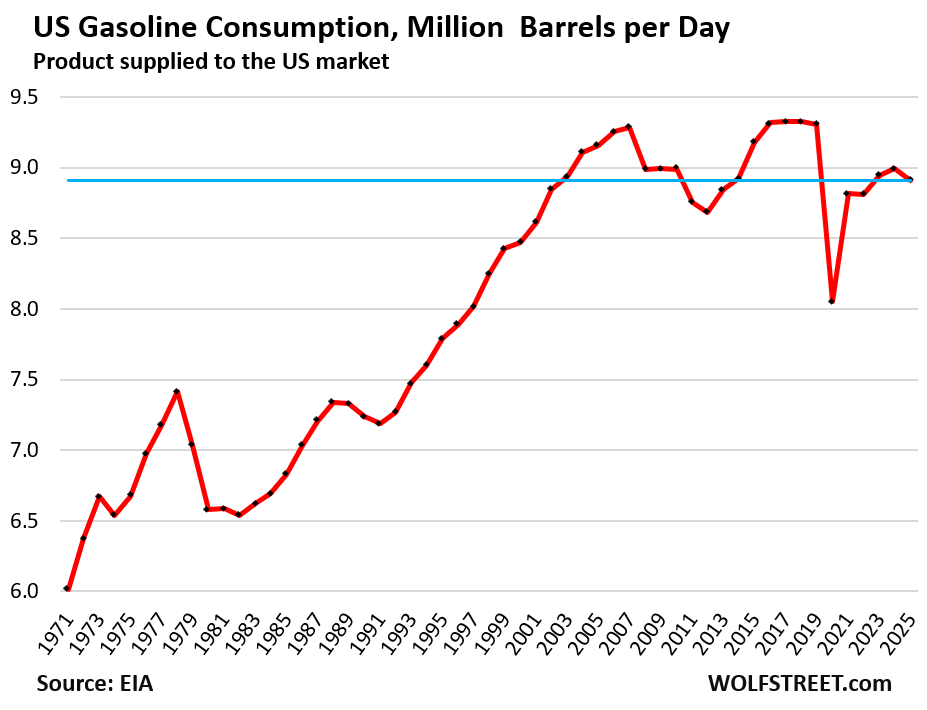
The effects of the two Oil Shocks in the 1970s on gasoline consumption was dramatic. High gasoline prices and a recession led to fewer miles driven, but it also unleashed efforts by US automakers to make and sell smaller, more fuel-efficient vehicles. And the small fuel-efficient Japanese models became immensely popular. This wave of smaller and more fuel-efficient vehicles held down gasoline consumption, and it didn’t surpass its 1978 high until 1993, though the population grew by 18% over those 16 years.
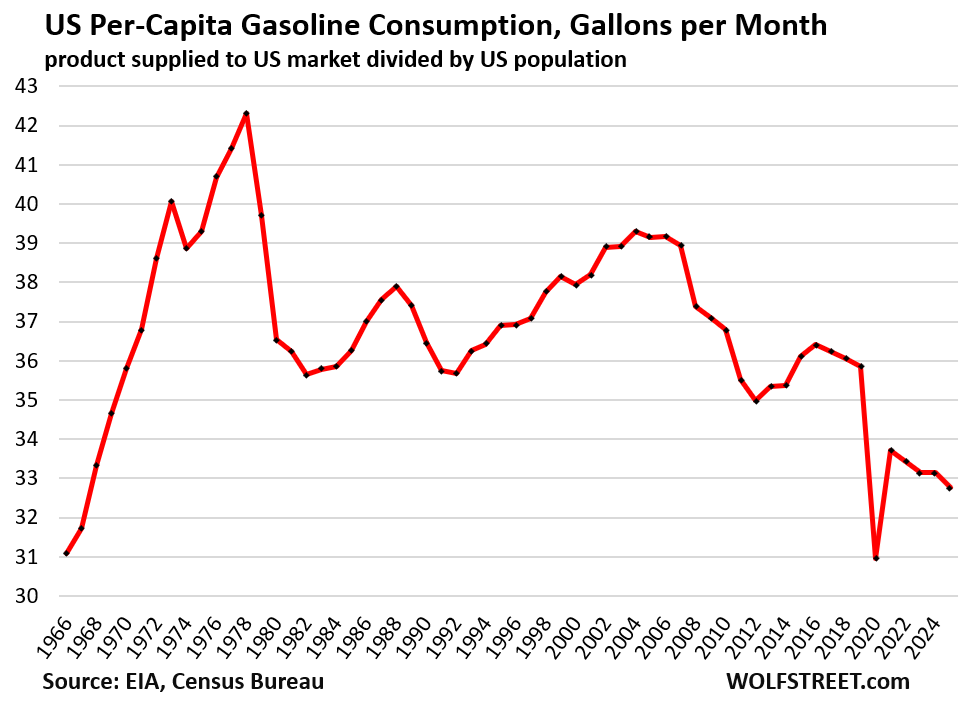
Per-capita gasoline consumption fell to 32.8 gallons per month in 2025, the lowest since 1967, except for the Covid year 2020, as a result of declining overall gasoline consumption amid a growing population.
This dynamic illustrates the structural decline in demand for gasoline.
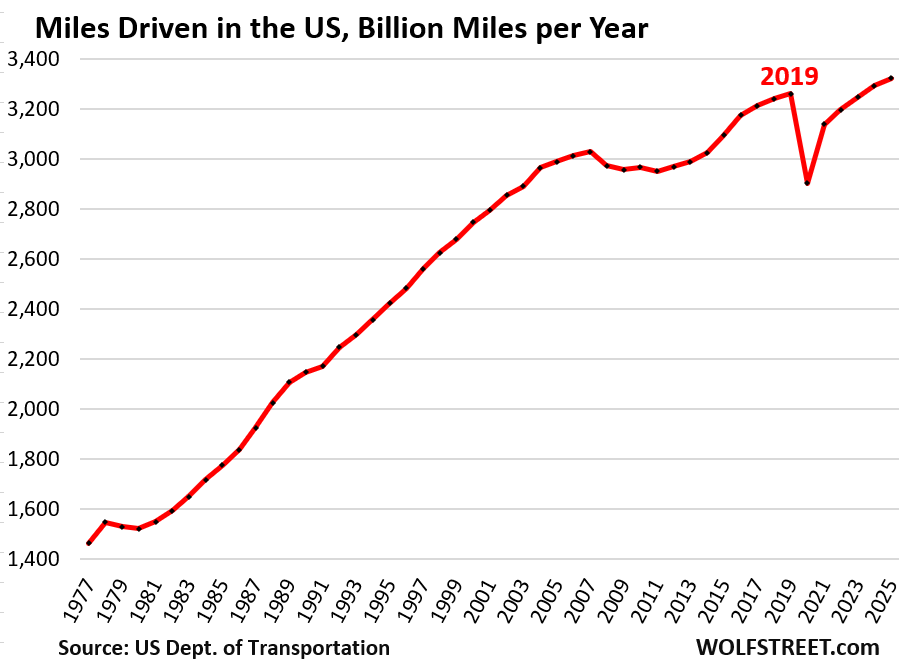
Miles driven edged up 0.9% in 2025, to a record of 3,324 billion miles, according to data from the Department of Transportation (includes miles driven by cars, light trucks, buses, motorcycles, delivery vans, and commercial trucks). But that’s only 9.7% higher than at the prior peak in 2007.
That gasoline consumption declines even as miles driven increases attests to the impact of more fuel-efficient ICE vehicles and more EVs in the vehicle mix.
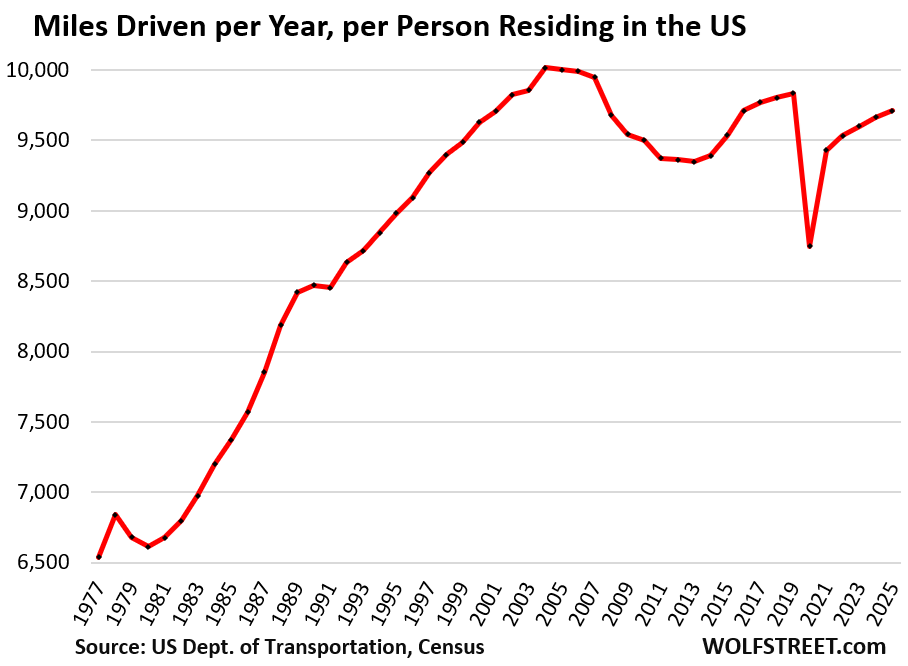
But people drive a little less: Miles driven per person residing in the US, at 9,710 miles in 2025, was 3.1% below the peak in 2004.
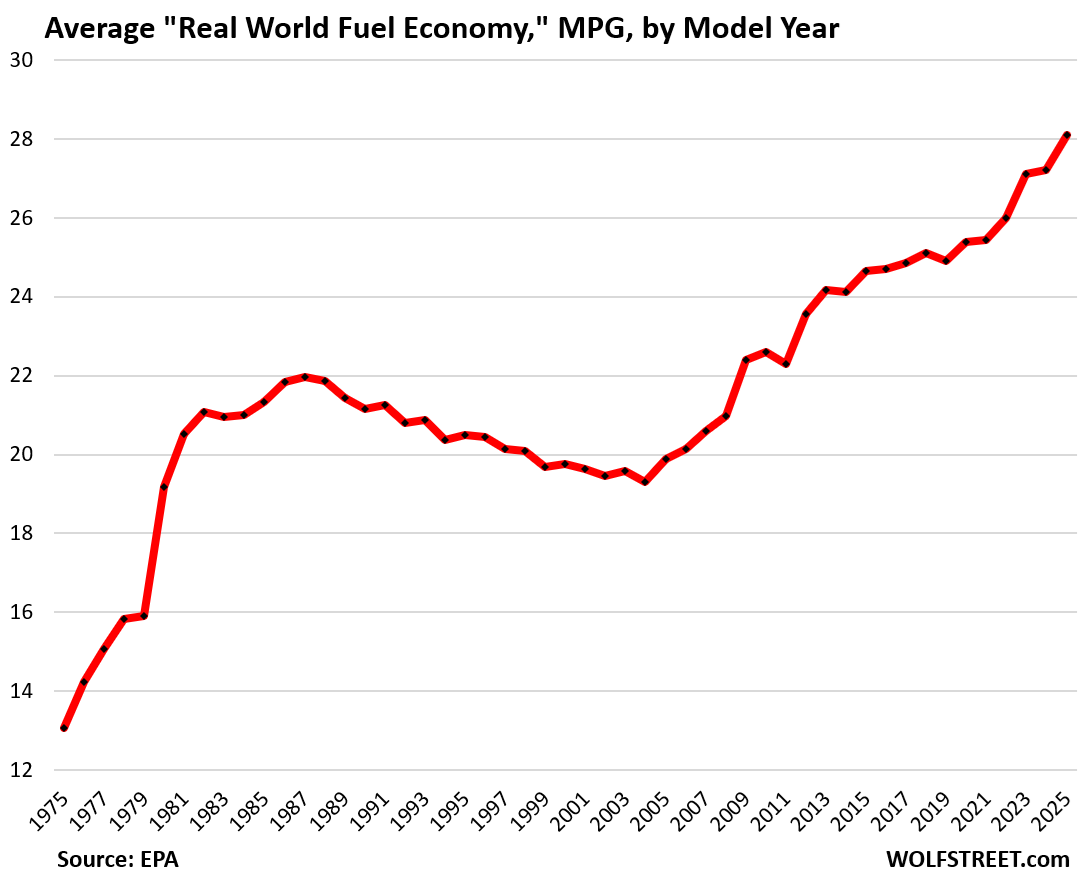
And average fuel economy keeps improving: that has been a big part of the long-term structural demand issue for gasoline.
Over the past 25 years, the average fuel economy of all passenger vehicles sold in the US rose by 43%, to a record of 28.1 “real world” MPG for the 2025 model year, according to preliminary data from the EPA last month.
Note the spike in average fuel economy coming out of the Oil Shocks, as compact Japanese vehicles made huge inroads, and as US automakers began offering smaller vehicles with better mileage.
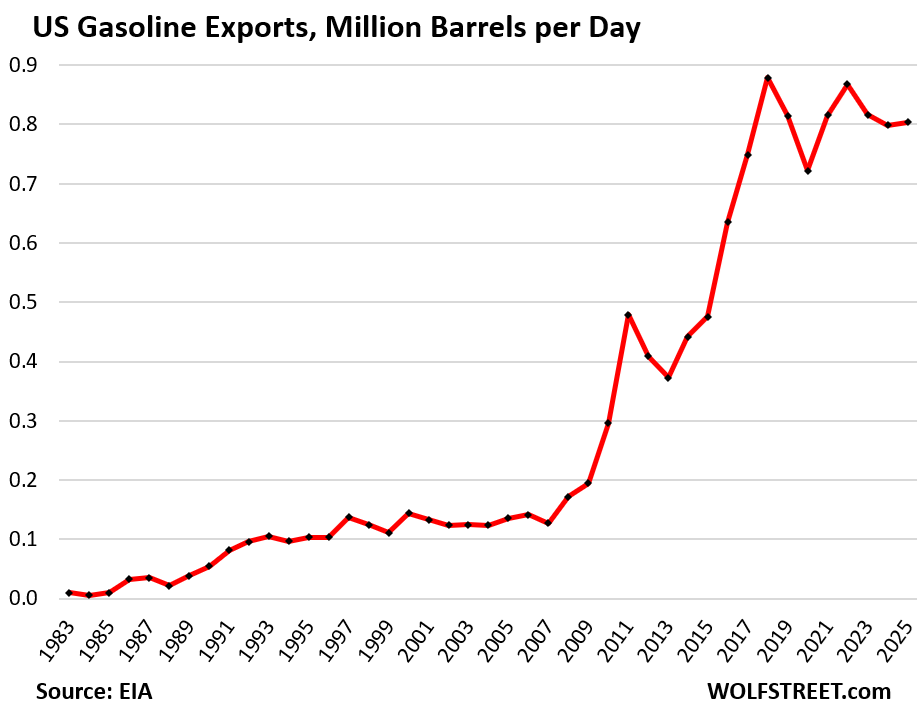
Exports of gasoline have become an outlet for refiners.
Crude oil production in the US has surged by 172% since 2008, to a record 13.6 million barrels per day (MMb/d) in 2025, according to EIA data. Over the years, exports of crude oil and petroleum products (diesel, gasoline, jet fuel, petroleum coke, and many others) have soared, and imports have fallen. In 2020, the US became a net exporter of crude oil and petroleum products, exporting more than importing. In 2025, net exports of crude oil and petroleum products rose to a record 2.8 MMb/d (detailed analysis and charts here).
Gasoline exports have become a big profitable trade for US refiners, and an outlet to replace falling demand at home. Many refiners import crude oil and export value-added products, such as gasoline, including refineries in California which face steeply dropping gasoline demand amid the rapidly growing prevalence of EVs and hybrids in the state.
For example, the US had a trade surplus of 590,000 barrels per day in crude oil and petroleum products with Mexico in 2025, importing 500,000 barrels a day of crude oil and exporting 1.1 MMb/d in value-added petroleum products, largely diesel and gasoline.
Gasoline exports started soaring in 2008, surpassed 700,000 barrels per day for the first time in 2017, hit 879,000 barrels per day in 2018, and have stayed in that range since then. In 2025, gasoline exports edged up to 804,000 barrels per day.
And in case you missed them:
Enjoy reading WOLF STREET and want to support it? You can donate. I appreciate it immensely. Click on the mug to find out how:


I live in Santa Clara, CA and Teslas are everywhere around here including in my garage.
We’re surrounded too, but not just by Teslas. There are lots of other EVs, but they’re harder to pick out than Teslas, and you have to look more closely, because they’re less distinctive looking and sort of blend in with the rest of the vehicles.
This is exactly why I went for the Blazer EV. It looks like an ICE Blazer unless you know the detail differences or parked side-by-side.
ICE is still too convienent for the great american road trip, but I love driving the EV for everyday use.
Interesting that the distribution of miles between Rural/Urban and Interstate/Arterial/Other has been pretty similar from 2017 through today. With office occupancy only in the ~54% range for the Top 10 markets, I would have guessed the distirubiton from commute to decrease but perhaps that is offset by ecommerce delivery.
as an ICE driver, living in a rural area, thank you to all of the urban dwellers (and some rural) who use EVs. I see a few here and there, but nothing like in CA.
less demand for gas should lead to less pressure on fuel prices. win – win – a great example of how the all-of-the-above energy strategy should work.
Absolute nonsense. The 20% weight difference is not enough to result in significant difference in road damage, especially not compared to trucks, which do the vast majority of damage.
Pure anti-EV fear mongering nonsense.
Ioniq 5 is becoming so incredibly dominant where I live. They are just cheaper than the ICE equivalent, which is the expected outcome.
(I have an Ioniq 6 and loooove it)
You guys should put out some poison traps or something.
Not good to have an infestation.
/s
What do you pay at home for electric power ($/kWh)? I’m in Menlo Park and I pay $0.40/kWh! That is high enough that it makes it as expensive to drive an EV (other costs ignored) as a 30 mpg vehicle with $4/gallon gas.
If I were in Palo Alto, it would be $0.17/kWh. Palo Alto built or bought their transmission lines.
That’s exactly the conclusion I reached as well when we were shopping for a second vehicle recently. With PGE charging over 43 cents a kWH it was actually more cost effective to get a hybrid
We have solar but not enough to offset an EV
at $0.40/kWh solar is a no brainer. Including the northfacing roof. A better return on an investment will be hard to find.
40 cents is insane. We pay 13 cents. National average is not much higher.
Howdy Folks. Its good to be KING. OPEC never should have had control over US….
They NEVER did.
Howdy SoCal. Jimmy Carter believed it and so did I while in line waiting for my rationed 6 gallons of gas.
DBF
You do realize that fifty year old memory is irrelevant and just a tiny bit stupid ?
6 gallons of gas wouldn’t get these new cars to a subway and back.
War in the Middle East just doesn’t hit the economy like it used to…
Especially since just about every country over there, muslim or not, hates Iran
Where do you get that erroneous notion?
Ah defining me as incorrect. Mister just post article headlines
You can literally just Google it.
Iran has been launching missiles into neighboring countries.
Iran has China and Russia who are like quasi allies.
Other gulf nations don’t like them. Their only allies are militant groups.
You don’t have to agree or disagree with the actions taken to understand that. I know that might be hard for you.
Ummm wait for it…
this thing is gonna rattle some stuff Real bad.
You all here complain about the debt, it’s gonna go INSANE!
so I don’t want to hear you complain anymore. Zip it.
Lol
Highly doubt it.
I wonder how much hybrid vehicles have helped that number. I get like 45 mpg in a Rav4 hybrid
A lot. in the sedan segment, which Toyota dominates (along with Tesla), MPG spiked over the past 2 years model years, pushed higher by the hybrid-only Camry. So we can see the effect. But hybrids are in all categories, and lots of people are shifting to them from regular ICE power trains.
My main problem with the EV push by governments was the ignoring of hybrids.
You could gain 40-50% MPG, not worry about charging, it eliminates range anxiety (real or not).
Going from ICE to EV is great, but for many hybrids are the best of both worlds, especially plug ins
Plug ins suck. So I’ll have to disagree with you there. They are the worst of both worlds
And the reason to go with an EV is it’s much more impressive horsepower / performance.
“but for many hybrids are the best of both worlds, especially plug ins.”
Agreed…hybrids delivered marked improvements in city MPG (perhaps 40%-50% improvements) and were in production by 199frigging9.
And yet they never remotely received the near religious frenzy that very slow to arrive full-plugins did (which started to trickle into production from maybe 2010-2012 on).
An earlier, similarly frenzied rapture about *hybrids* (including a jaundiced, realistic view of older SUV’s terrible MPG numbers) would have accelerated the current degree of US oil independence by perhaps 10-15 years.
An excellent example of the “perfect” (100% plug-ins) being the enemy of the good (hybrids).
FYI Toyota’s best stop start battery, just over $400 installed at the dealership.
Should last 3 years. lol
🤕
I’ve been living in Bali for 6 months and the array of Chinese EVs is definitely interesting. 15% of Indo sales are EVs BYD is the one that jumps out to me.. but just huge variety of brands, same as Chinese made TVs in American Best Buy. Not a lot charging stations that I notice, but somehow it works. EVs stand out silently in the roar of 90% scooter traffic’ … Indonesia’s workhorse. Cheap transport, a scooter is $2K USD, $1day for petrol, rideable year round in tropics, and can transport a family – and even the family dog ;) A few electric scooters here, but far more car EVs. You can swap your scooter battery easily at every mini mart which are everywhere. Indo is 280M population and a young country, .. cool to see how some of the developing world get around.
I’m a scooter fan (potentially) but how do groceries and other physical shopping get returned home in Indo?
Pretty tricky/dangerous balancing would seem to be required absent the huge uptake of mini-trailers (which I rarely if ever see in pictures of scooter-heavy nations).
Trying to get more than 1-2 bags of groceries home on a standard scooter would seem almost impossible. And even those 1-2 bags might end up causing a ton of accidents.
Mini-trailers would seem the obvious solution – but you almost never see those – even in heavy-scooter nations.
But…if the US ever did become much more scooter-receptive, the entire worldwide oil market would change dramatically.
And 90% of the required mechanical equipment (ie, scooters) have *long* been in massive production around the world.
Groceries go in backpacks and I feel like most of the world never buys more than 1-2 bags worth of groceries at a time. Small living and high energy costs keep the fridge and pantry smaller.
Corner stores and fresh foods dominate the food supply, vs. processed prepackaged bulk.
I’m guilty: an “American sized” fridge, usually packed, along with the freezer and a pantry that’s called “empty” when there’s only two weeks worth of food in it.
“and I feel like most of the world never buys more than 1-2 bags worth of groceries at a time”
I guess…but I live a fairly spartan single lifestyle but my once-a-week-grocery shopping generates 3-4 bags pretty consistently.
And 2-3-4 person families?
You are going to get multiples of my numbers – thus the scooter “roadblock” (absent mini-trailers…which again seems like a pretty obvious solution but rarely seen in scooter-nations)
Multiple trips are sorta possible – but cut into the gas savings and would be a large time suck too.
Anybody wanna invest in a scooter-trailer start-up? I mean, how complicated can the tech be?
(Although those scooter-heavy nations tend to be massive labs for small-scale entrepreneurism – so I suspect some pretty big hidden hiccup must lie in wait…I just can’t really picture what it might be…which is a bad place to be for a proposed start-up…)
Banning grocery stores where people live has turned American grocery shopping into a long range expedition taken at long intervals. Most of the world doesn’t have that problem.
The World’s Hottest Market Just Crashed. Here’s What It Means for Investors
Panic swept through one of the best-performing stock markets in the world as investors rushed for the exits. Major companies plunged in the biggest one-day selloff on record, raising new concerns about how geopolitical tensions could ripple through global markets.
South Korea’s stock market suffered one of the most dramatic crashes in its history this week as escalating geopolitical tensions in the Middle East triggered widespread panic selling. The benchmark Kospi Index plunged roughly 12% in a single session, marking the biggest one day drop on record and forcing authorities to briefly halt trading to prevent further market instability.
That 2-day 20% crash still rolled back the gains of only 1 (one) month 🤣
I see UBER and Lyft cutting gas use (espically in places where you have to pay to park). I also know many people who will take an UBER or Lyft to an event when they can get a ride home from another family member coming to the event from another direction. Every year the number of my tenants that own cars keeps dropping since cars keep getting more and more expensive and less and less couples have two cars and more and more people are “car free” using just public transportation and UBER and Lyft (and Waymo more and more as it expends from just SF).
I lived 14 years car free. The three key things that allowed me to do that were a) a reasonable public transit system, b) a widespread and convenient to use short term car rental service (Zipcar and car2go), and c) Lyft/Uber.
Of these, Uber was the least important and critical because in my city, it’s actually cheaper to buy a car than take an Uber. Uber generally costs $5-6 a mile in my city, whereas you can own a car including all car related expenses for closer to $1-2 per mile.
My EV costs under 5 cents a mile for fuel, though of course parking, insurance, and tolls are about the same as for other cars, and upfront costs are slightly larger. I’ll probably end up paying about the same over the card lifetime for the EV as for the regular car.
And imagine if Uber/Lyft/New Mkt Player ever became truly serious about *carpool*-oriented rideshare (exploiting tech ability to optimize routing of pick-ups/drop-offs).
Uber/Lyft have true shared-ride options (meaning *more* than just the driver and 1 passenger…) but they really don’t focus on them (presumably because the current status quo is more profitable).
But the tech has long been there and we are really only 1 serious new mkt player away from *true* “ride-share”.
(And imagine the impact on the *daily* *work commute* mkt – where a huge pct of people are going to the exact same company/building/2 block area *anyway* – 5 days a week).
I know someone really well ;-) who drove Uber as a side gig for a couple of years. At that time Uber had just rolled out Uber Pool, which was cheaper for the passenger, if they didn’t mind sharing the ride with a stranger. It was pretty unpopular with drivers, though lots of passengers would choose it for the cheaper price. It’s amazing how many riders would choose Pool even when in a hurry to get somewhere, then fret about the delays, giving the driver perhaps a bit of schadenfraude. Oh, you thought you’d get a cheaper ride for the same quality and speed of service?
Perhaps enough passengers got burned by taking forever to reach their destinations, or having to ride in close quarters with a weirdo, rendering the service unpopular?
Marvin G,
Maybe – people can be pretty irrational about trade-offs (time savings vs cost savings).
I tend to focus on the multiple passenger issue for 3 pretty big reasons –
1) *True* rideshare (if widely adopted) would have a profound impact upon auto demand (and hopefully apply effective pricing pressure against the manufacturers – who seem to have focused – for decades – on financial manipulation of the consumer rather than increased productive efficiency – and therefore cost savings. They have sorta been despoiling Ford’s grave (the positive economics of the Model T mass production are legendary).
2) Routing optimization for multiple passengers is the *essence* of what modern computer technology does best. By itself it likely would have a profound effect upon oil usage/demand – another industry that has sorta been getting away with sub-optimal murder for decades.
3) Certain, *central* uses of autos – *especially* the daily work commute (large numbers of people all going to the same damn place) is again a *key* potential market for true rideshare. And, again, a massive impact on auto and oil demand.
In some ways, current “rideshare” has sort of partially self-aborted – it is “rideshare” in name only.
90%+ of Uber/Lyft current business is simply displacing taxi demand (1 driver + 1 rider) – without truly altering the underlying physical demand/supply process of transport – which the rideshare technology could pretty easily do (shared route optimization).
I’m almost 40 and I’ve always been a bike commuter. It was on a road bike for a long time but I recently added an e-scooter and e-cargo bike to my fleet. Otherwise I walk everywhere, or take the bus or light rail if I’m going downtown. There’s no maintenance to worry about and it saves me a ton of money so I can actually save something. Apparently I’m the only one who does this though. My roommate just got her car repoed, so I tell her to take the bus and she actually thinks I’m joking. This country man.
How do you like the cargo bike?
Does it get the job done safely and effectively for weekly grocery shopping?
I definitely agree that there are a *lot* of non-car options out there that 90% of Americans have been bred to non-even *contemplate* – to their significant cost (auto expenses easily being the 2nd largest behind housing).
A little bit of research/pre-planning (the miracle of Google Maps) makes doing without a car a *lot* more feasible (although not in 100% of circumstances…80 years of car culture *has* altered the infrastructural landscape of housing location, etc.)
“ 80 years of car culture *has* altered the infrastructural landscape of housing location”
The suburbs I grew up in would not be considered walkable. Barely bikeable for practical purposes.
The newer trends of community development, including actual services in neighborhoods, is reversing some of this.
Old school small town culture is also becoming appealing again, for simplicity’s sake.
@cas127 I like it, just a higher weight limit on the rack and a higher torque motor. It’s a Surly, like $5,000 retail, so probably the most expensive bike I’m ever going to buy. I pretty much run fenders, rack and panniers on all my other bikes now as well. I even have a flatbed trailer that I use sometimes.
Honestly the main problem with doing errands on a bike is just finding a place to lock it up and having to worry about it. I use chain locks and I’ve never had anything stolen, but this kind of stuff is a lot easier when you have two people and someone can just watch the bikes. I have a couple friends who ride and that’s what we do when we can.
And yeah definitely for commuting I spend a lot of time on Google Maps just picking out some convoluted route through all the back roads to get places. I rarely use bike lanes and I try to avoid stroads whenever possible, and I’ll try to just string together a bunch of neighborhood roads. I only have a 3 mile commute right now and because of the traffic on the main road, riding the e-bike on the back roads is actually faster than driving.
“like $5,000 retail”
Yowza – I was picturing a human-powered Dutch bike with some giant box on the front or rear (they exist…).
Even $5k is a huge savings over a new full auto but I was picturing something closer to $1k (my Google Maps-fu usually can place me within 1-4 miles of shopping/housing/work. Close enough for a bike but 6-8 miles for groceries (with 3-4 miles including return shopping load) is kinda beyond my aging abilities when walking.
The most I’ve ever done comfortably walking is about 2 miles when carrying groceries walking on an ongoing bi-tri-weekly basis (so 4 mile round-trip…which takes over an hour).
I kinda see that as the outer-limit for a purely walking-based lifestyle (2 miles away from groceries and *maybe* the same for work commute).
A cargo bike might triple that outer range (to 6 miles away from groceries/work).
That increase in radius massively hikes the circular area possible for housing (pi-r-squared and all that…)
But there seems to be a huge market gap between full autos and bikes/tiny e-scooters. Traditional gas/electric scooters could fill that gap with only a smallish increase in load capacity.
That’s funny I feel like every family member I see has a car.
I have seen dads buy themselves 2 cars and have one each for their kids.
Also prob they have a company car as well.
The middle class just has a fascination with cars.
To be fair, there are a ton of places where it’s really a big sacrifice to be without a car.
i exchanged gasoline for electricity in 2004 when i started WFH.
I’m willing to bet the Average Real World Fuel Economy hit a brief nadir between 2003 and 2005 because of all the 10 MPG Hummers on the road, that all-American symbol of excess.
When was the last time you saw one of those on the road?
I’d love to know how many cybertruck owners had a hummer in the early 2000s.
LOL yeah similar egos for sure
One thing that was not stated in the article above is how much bigger vehicles have become since the 1980s. Double cab pick ups hardly even existed in 1980. SUVs are everywhere now. It is actually too bad in a way that there are not more smaller vehicles. Smaller cars are also an advantage with EVs due to less weight.
In 2024, world oil demand exceeded 103 million bbl/d for the first time. The global demand for crude oil in 2025 amounted to 105.13 million barrels per day.
True…but largely because of the huge surge in Chinese and Indian oil demand over the last 20-25 years.
Japan has had pretty darn flat *absolute* oil demand since about 2000 – beyond even the US’ *per capita* flatish-ness.
(Admittedly, a bunch of Japanese/US oil consumption levelling is attributable to a large degree of economic stagnation but there is definitely an improvement in oil utilization as well).
Can anyone tell me how to convert firewood to gasoline?
Asking for a friend.
😆 /s
Don’t know about firewood, but coal has been converted into gases (coal gas, which is toxic!) for a long time, and coal gas was used before natural gas became the standard gas. Here in San Francisco, there was a “gas house” where the Marina Safeway today is. It’s right by the water. Coal arrived by barge, and the factory converted it into gas for household use, starting in the 1800s. PG&E later bought the company. The cove where the barges arrived is still called “Gas House Cove.” And obviously, as the sediment there is horribly polluted, PG&E was supposed to clean that up, but that’s a whole nother story.
Converting coal into liquid fuels via the Fischer-Tropsch process has been used since the 1930s in Germany to replace gasoline. A substantial portion of gasoline used in Germany during WW2 was this synthetic gasoline. It worked pretty well apparently. Modern coal liquefaction these days works but is more expensive than oil-based fuels. It’s one of those things that is technically nailed down, but economically not feasible because oil-based fuels are so cheap.
Pretty cool stuff!
Germany at the moment is digging 3 miles down around some newer towns. It’s a Geothermal system where the hoses form an almost Rake like shape, then they send water down there to heat up. Then it is distributed to the town.
Something about it is Novel, maybe the heating of the water using the earth’s heat. Or the special shaft hose structure.
Geothermal heat pumps are one of the most efficient climate control options available. Installation is expensive though.
Liquids heat up when transported via pipe through the frictional forces between the fluid and pipe material. Piping fluid 3 miles below surface sounds not real, especially if that fluid is water. Do you know the temperatures and pressures down there?
If it’s 3 miles worth of pipe, that makes more sense. However, pumping costs need to be weighed against the cost of heating water locally through electricity or gas. There is no free lunch.
Gas Works Park in Seattle was also a coal gasification plant once IIRC.
“but economically not feasible because oil-based fuels are so cheap.”
Was also true for fracking at $20/barrel oil…but fracking became economically profitable/feasible once oil started its terrible rise post 2000.
Best guess is that today’s fracking still probably requires $40-$45/barrel prices to be economically feasible.
But…that said…and vis a vis coal-to-oil (hat tip for correct-but-largely-unknown-history you reported), contemplate the actual chemical structure of natural gas (CH4) and gasoline (mostly C8H18).
Those are both pretty structurally simple molecules, made up of identical, very common elements (ditto *water* as H20…a common source of H…).
You would think that NG-to-oil (gasoline) would have been solved a long time ago but presumably the historically intractable realities of C-H chemical bonds have foiled it.
Still…
https://en.wikipedia.org/wiki/Gas_to_liquids?wprov=sfla1
Processes to convert natural gas to methanol and gasoline exist. They are not economical, nor are they a good source of fuel because of the very low return on usable energy when all of the inputs of heat, electricity, water etc are considered.
Using that natural gas to make electricity to power an EV is far more efficient than the multi-step industrial processes required to make gasoline to burn in an inefficient ICE vehicle.
there are wood-gas powered cars in north korea.
Not converting wood to gasoline, but using it for an energy source: Pyrolysis.
Cleaner than simply burning (combustion), but as Wolf points out: the economics of the “fossil fuels complex” is simply hard to beat (especially when it is built into the infrastructure).
MW: Prices to charter large oil tankers soar as Strait of Hormuz traffic grinds to a halt
It’s hard to overstate just how much fuel efficiency has improved over the years. Take the best selling non-truck vehicle in America: the RAV4 as an example. Starting this model year it is available as hybrid only across all trims. Compared to the RAV4 from a generation ago, the 2026 model is much larger than the 2001 model and is much more powerful, yet at the same time consumes about half as much gas per mile driven. This kind of technological improvement has definitely had an effect on overall gasoline consumption… and as more and more hybrids and EVs get on the road, this effect will continue.
Agreed…but America’s apparent fixation on low-MPG trucks/SUVs (aided/cultivated by MPG rqmt exceptions for trucks/truck-based SUVs) has made the process much, much slower than it could have been.
The very fact that US manufacturers dropped almost all their *car* models circa 2016-2018 was/is disturbing in itself.
Many more SUVs today are on car bodies (with better MPG) but still…
Last chart has a typo. Barrels per Dday. Love the article.
The mileage driven going up should help maintain new sales.
I would be very interested in an article talking about average age and mileage at scrappage over time.
Oh well – here in well educated and prosperous Oakland County, cost of living is low, back yards are spacious, I have a V8 (Yukon), 2X V6s (Grand Cherokee & Enclave) and a fun V5 (S60 turbo) – shopping for another V8 – and really thankful to all EV adopters (keep my gas cost lower – and those stay on a “leash” of 300 miles range).
Used to see quite a few EVs trying to make the semiannual Midwest-to-Florida trip – not so much this year. Long distance trips in an EV is a bitch..
Anyways – cheers from the land of low taxes and reasonable cost of living.