
Amid a struggle to power AI data centers.
By Wolf Richter for WOLF STREET.
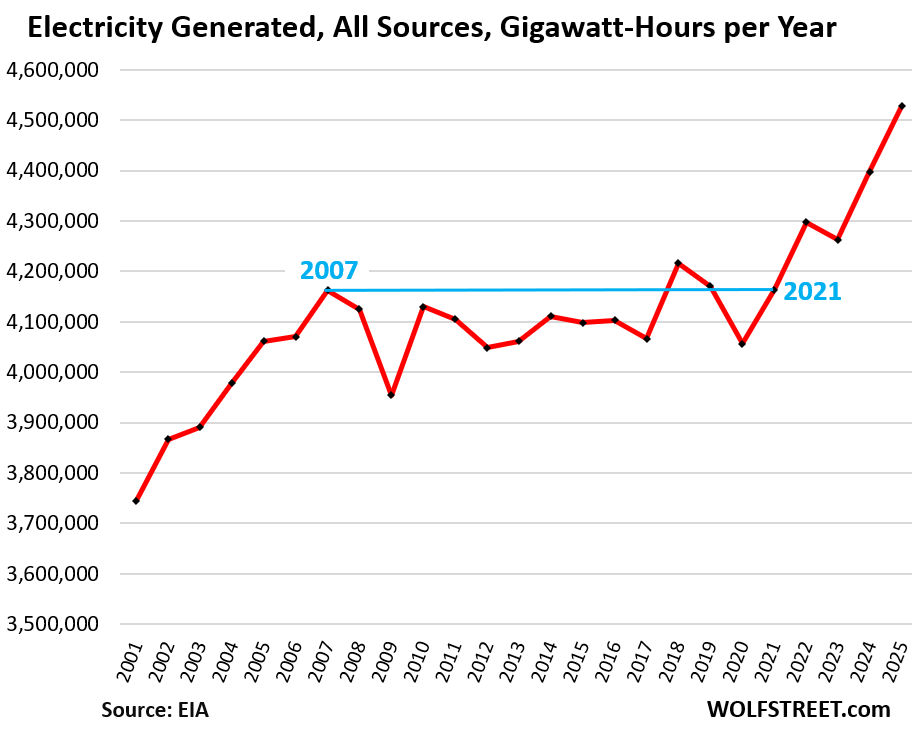
The quantity of electricity generated in the US by all sources, from natural gas to rooftop solar, rose by 3.0% in 2025 from 2024 to a record 4,527,969 gigawatt-hours (GWh), according to data from the EIA.
There had been 14 years of roughly no growth in power generation from 2007 through 2021, despite the growing economy and population, as electricity users cut their usage by investing in more efficient equipment – lights, appliances, electronic equipment, industrial equipment, heating and air-conditioning, etc. – and by investing in building insulation, shading, etc., with the hope of putting a lid on their rising power costs. During those years, many power generators and electric utilities were mired in a no-growth business where only rate increases could generate revenue growth.
But now there is a large-scale demand increase from data centers that are sprouting like mushrooms, on top of the demand from the rising share of EVs in the national vehicle fleet.
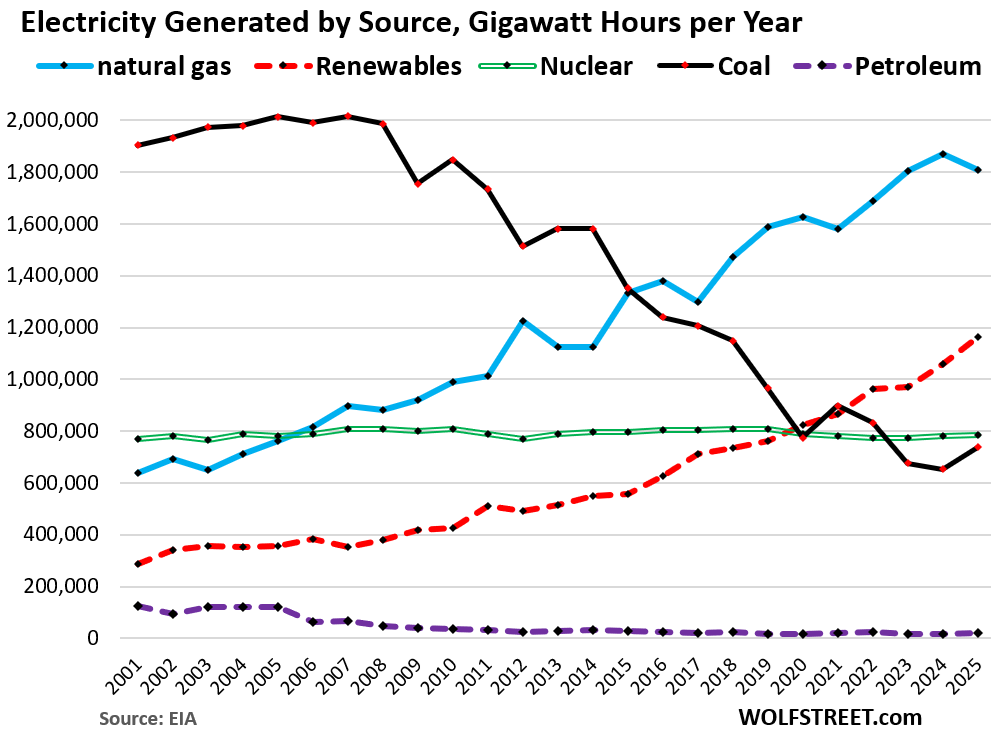
Electricity generated by source:
Natural gas dipped but still ruled. Electricity generated by natural-gas-fired power plants declined by 3.3% to 1,807,338 GWh in 2025, the second-highest after the record in the prior year (blue in the chart below).
The US became the world’s largest natural gas producer in 2014. This soaring production oversupplied the US market starting in 2009 and caused the price of natural gas to collapse. The low price of US natural gas and the high thermal efficiency of combined-cycle natural-gas-fired power plants – around 65%, nearly double that of older coal powerplants – made natural gas immensely attractive for power generators. Since 2007, power generation from natural gas has doubled.
Coal power generation jumped by 13% in 2025, from the record low in 2024, to 737,151 GWh (black in the chart below).
In terms of costs for power generation, coal cannot compete with the combination of cheap US natural gas and the efficiency of a combined-cycle gas turbine powerplant. Wind power has also become more cost-efficient than coal. With renewables, the “fuel” is free; and all methods of power generation require costly plants, equipment, and maintenance, there not being any free lunches when it comes to energy.
Generation from all renewables combined – wind, solar, hydro, geothermal, and biomass – rose by 9.6% to a record 1,162,090 GWh, driven by surging generation from solar (+28%). More on renewables in a moment (dotted red line).
Nuclear power generation inched up 0.4% to 784,781 GWh (double green line).
Generation from petroleum liquids & petroleum coke jumped by 26% to a minuscule 19,258 GWh (dotted purple):
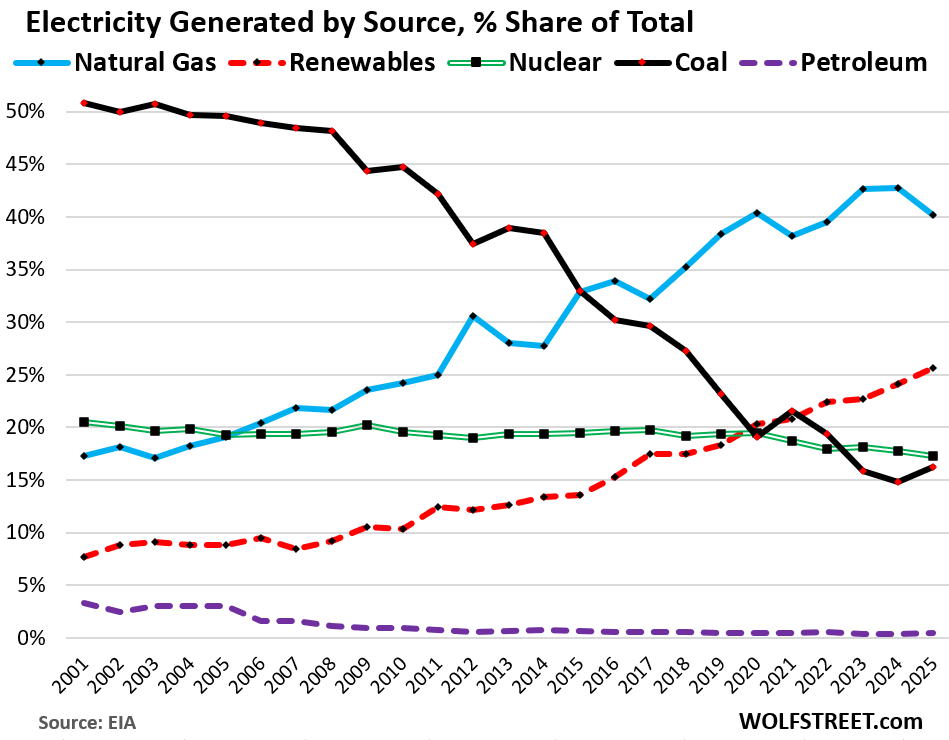
The % share of electricity generated by source:
The share of natural gas as source for power generation dipped to 40.2% of total power generation, from the record in the prior year, and about double its share in 2006. Natural gas had surpassed nuclear in 2006 and coal in 2016 (blue in the chart below).
Coal’s share rose to 16.3% of total power generation, from the record low share in the prior year (black).
The share of all renewables combined increased to a record 25.7% of total power generation (red). More on them in a moment.
The share of nuclear power generation edge down to 17.3%, continuing its long slide.
The share of petroleum and petroleum coke edged up to 0.4%, having nearly vanished as source of power generation (purple).
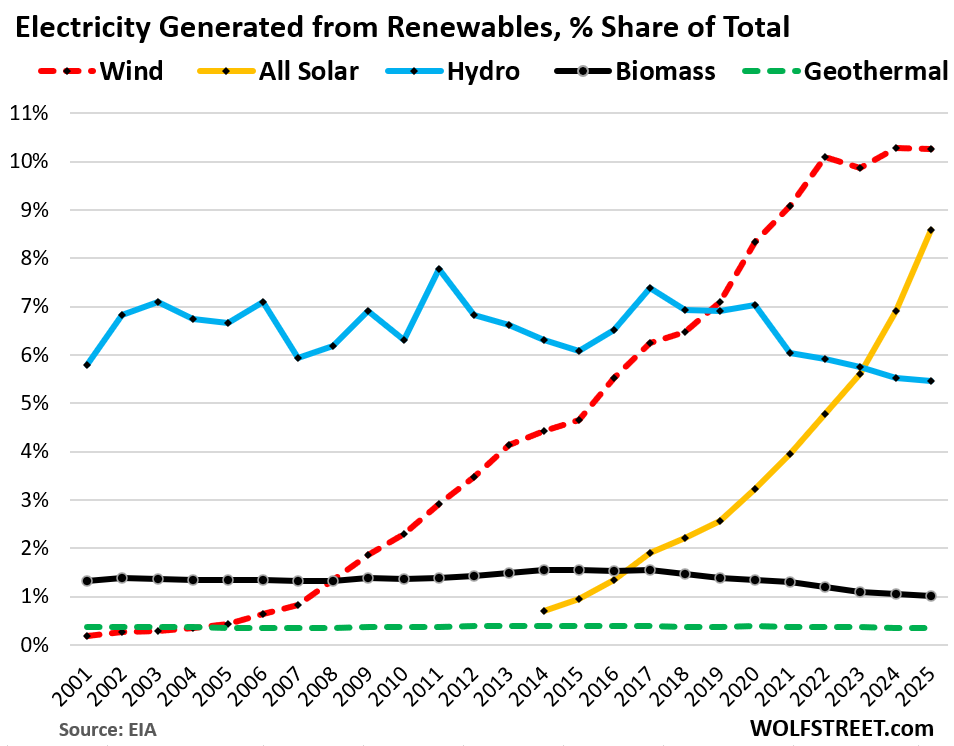
Power generation from renewables.
Wind power generation rose by 2.8% in 2025, to a record 464,391 GWh. Its share of total power generation remained at 10.3% (dotted red in the chart below).
The Big 5 states for utility-scale wind-power generation in 2024:
- Texas: 124,940 GWh
- Iowa: 44,310 GWh
- Oklahoma: 38,630 GWh
- Kansas: 30,320 GWh
- Illinois: 24,430 GWh
Solar power generation – utility scale and rooftop solar – surged 28.0% to 388,820 GWh. Its share of total power generation surged to 8.6% (yellow).
The share of wind and solar combined rose to 18.8% of total power production in the US.
Power generation from small-scale solar – such as rooftop systems on homes, retail stores, parking garages – jumped by 11.0% to 93,147 GWh, having more than doubled since 2020. The share of small-scale solar rose to 2.1% of total power generated.
The Big 5 states for utility-scale solar-power generation in 2024 (excludes rooftop solar):
- California: 79,544 GWh
- Texas: 44,506 GWh
- Florida: 23,302 GWh
- Arizona: 16,237 GWh
- Nevada: 14,524 GWh
Hydropower generation rose by 1.7% to 247,023 GWh. Its share remained at 5.5% of total power generation (blue).
Biomass power generation declined by 0.5% to 46,187 GWh, and its share declined to 1.0% of total power generated. Biomass includes wood and wood-derived fuels, landfill gas, and other waste biomass (black).
Geothermal power generation ticked up 1.7% to 15,669 GWh, for a minuscule share of 0.3% of total power generated. Most geothermal plants were built in the 1970s in California, but there are now renewed efforts underway to harness this power source, which provides reliable steady power generation (green).
All hands on deck! To deal with the sudden surge in demand.
Power plant retirements are put on hold. Due to the surge in demand for electricity, which is expected to ramp up further over the next few years, owners and operators have delayed planned retirements of power plants.
In 2025, owners and operators originally planned to retire 12.3 GW of capacity, of which 66% were coal-fired plants, 21% were natural-gas-fired plants, and 13% were petroleum-fired plants. But they ended up retiring only 4.6 GW of capacity in 2025, the least since 2008, under pressure from this sudden surge in demand and following emergency orders from the Department of Energy to extend the operations of several coal-fired plants. The EIA expects retirement delays to continue in 2026.
There were also major delays in retirements for 2025 that had been decided previously. For example, in 2022, the retirement of California’s last nuclear power plant, Diablo Canyon, scheduled for 2025, was moved to 2030, with potential operation extensions to 2045.
Power plant construction ramps up: In 2025, power plant developers and operators added 53 GW of new utility-scale power generating capacity to the grid, according to the EIA.
In 2026, they plan to add 86 GW of new utility-scale power generating capacity to the grid. If they actually succeed in getting these plants online, it would amount to a record addition. Solar power capacity accounts for over half of that addition.
Enjoy reading WOLF STREET and want to support it? You can donate. I appreciate it immensely. Click on the mug to find out how:


I have heard that AI data base are scheduled to build dedicated small nuclear plants. Where some this fit into the power production/consumption picture?
That’s not going to happen for many many years. It takes a very very long time to build a nuclear power plant, even a small one.
What is happening: natural-gas fired power generators are being installed at data centers. Several suppliers of them are now using retired jet engines as the base unit (after overhaul and some modifications). That’s much faster to ramp up. Big diesel generators are also being installed. Look at Caterpillar’s stock [CAT].
Those gas turbines have essentially doubled and tripled in price over the last few years. It is nuts
Lead times for new gas turbines have reached historic highs as of early 2026, typically ranging from five to seven years for large-frame units. This is a significant increase from 2021, when the average wait time was only about two years.
Richard Greene
You copied and pasted from AI verbatim. By now I can smell AI with my nose tied behind my back.
Here is the actual article. Lead times are 3-4 years, and including permitting, construction, and commissioning, it’s 6+ years to put a gas turbine generator into place.
https://www.infrastructureinvestor.com/the-gas-turbine-crunch-why-supply-wont-meet-demand/
Overhauling and modifying retired aircraft jet engines is turning out to be a much faster way, with much shorter lead times. And there are a lot of retired jets in the US. Several companies are into that now.
Wolf – I can’t read your link but there are two power gen turbines types.
Industrial and Aero derivative.
Aero derivative is an engine that uses some of the same primary components and design basis as an engine in a jet plane. However it’s generally not 100% the same as a commercial jet engine. They are smaller and lighter than industrial units and easier/cheaper to mfg.
Part of Catepillars stock rise is likely due to their Solar turbine line, which has a big industrial use base. Those turbines go into aircraft but fuel control, nozzle designs and temp controls will differ a bit. Not to mention what is likely a different stub shaft and bearing package to allow connection to the generator (which often runs on a completely separate turbine from the “jet engine” part)
Ultimately a moot point but I think many people think they are taking old jet engines, putting them on the ground and hooking up to a generator. To some degree this is true but it is also simplistic from a technical pov.
Just thought I’d share.
Gaston
“Ultimately a moot point but I think many people think they are taking old jet engines, putting them on the ground and hooking up to a generator.”
oversimplified, but yes, that’s exactly what FTAI Aviation and some others have started doing: rebuilding retired jet engines, modifying them in some key ways, including to run on NG, and turning them into generator sets. They won’t last 20 years, as a new aeroderivative will, but that’s not the issue with AI data centers waiting for grid hookup.
In Texas many data centers are co-locating with solar or wind farms, either existing or new.
which doesnt make sense as they are unreliable intermittent sources of power
Texas has consistent winds, especially the flat areas of the Panhandle and West Texas.
Dale, all you have to do is install batteries and bank the power.
Add a grid tie for rare top offs and you’re golden.
People against renewables are like people with a million dollars and you could make gold appear out of thin air to become even more rich. But your buddy and your family ethically just don’t want you to transmute gold from nothing. “It just ain’t right” they say. 😆
From what I have read some are already well into development and generate as little as 1 or 2 MW. The reactors These can be easily trailed to the site and would power only the datacenter. The affordability comes from an easily repeatable design ala’ an assembly line approach.
No, they don’t exist yet in the US and won’t for years (outside of some of the Navy’s ships and submarines).
“The first small modular nuclear reactor could be powering an industrial plant in Texas early in the next decade. And the state is pushing to become the leading site for testing and building the technology.”
https://www.texastribune.org/2026/02/17/texas-small-modular-nuclear-reactors-grid-energy/
“In Texas, a handful of projects are now moving beyond studies. Each uses a different technology and targets different uses. And this summer, several of them face tests that could shape the trajectory of the entire industry.”
Hilariously enough, Microsoft just announced that they are going to re-open Three Mile Island again.
The economics of opening this disaster seem to be more prudent than it’s old optics.
And Trump is giving them a $1 billion loan to do that. The subsidies nuclear gets are obscene. See my comment further below about subsidies to nuclear.
The Palisades nuclear plant in Michigan is being recommissioned as well. Unfortunately it was shut down with no intention to be restarted again and considerable corrosion occurred. This is making it more expensive and reducing its generation capacity to 60% of previous nameplate capacity.
What could go wrong…
“Wind power has also become more cost-efficient than coal. With renewables, the “fuel” is free”
Hard to believe — is that with subsidies?
It’s been true for years. Solar is cheaper too. Existing natural gas plants are still slightly cheaper, but the moment you need to build a new one or do extensive maintenance, wind and solar win.
But there’s lots of folks out there that want you to think otherwise for political or economic reasons….
You still have to have a baseload of carbon. You also need carbon for non windy or cloudy days.
Not to mention the room that wind and solar take up.
It is why so many are going to the natural gas trubines
Everything is subsidized. The most subsidized of all by far is nuclear power. Nothing comes even close.
Wolf,
My professional career was engineering and management of nuclear power plants. At my age, I’ve forgotten more than I want to admit, but wonder if you could explain in more detail about the implied huge subsidy of nuclear power. Are you referring to the intiial government help to define the industry?
They’re not “implied.” They’re direct and announced. Direct grants (plain handouts). Direct loans and loan guarantees. Billions of dollars per plant. New plants cannot even be financed without them.
Trump just announced subsidies to the uranium supply chain.
Trump’s “Office of Energy Financing” just announced that it closed a $26 billion loan to Southern Company, which owns the Vogtle nuclear power plant. The loan is to support Vogtle old units 1 & 2, plus, hydro, transmission, storage, and gas.
Obama already gave $8 billion in federal loan guarantees toward the construction cost of units 3 & 4 of Plant Vogtle.
The DOE handed out a $1.5 billion loan to repower and upgrade the Palisades nuclear power plant in Michigan.
Trump’s DOE is giving out a $1 billion loan to restart unit 1 of the 3-Mile Island nuclear power plant. Microsoft is behind that plan.
The government of California handed PG&E $1.4 billion to extend the life of the Diablo Canyon nuclear plant.
And on and on and on.
Then, when the power plant gets decommissioned (what do you do with these highly contaminated nuclear hulks?), ratepayers pay another bunch of billions for decades to do that, and governments chip in as well. I have been lied to by the nuclear industry my entire life.
Thanks for bringing this up.
To have a rational discussion, the true cost of any system input must be known.
Does anyone have a table of the true costs of energy inputs, including subsidies?
It is very difficult to get all the numbers, but the estimates that say wind and solar are cheaper than all other sources of power generation are attempting to provide unsubsidized estimates.
Also note that fossil fuel based power generation has long been and continues to be subsidized as well, so this comparison may not go the way you might be expecting.
In the UK our power costs are constantly rising as the share of ‘renewables’ rises, we are now listed as the most expensive in the world. They are not cheap and would not exist if they were not subsidised. We even compensate the power companies if the wind doesn’t blow. Taxpayer payments direct to shareholders. The graph of power generated by renewables does not tell you the installed capacity which will be around 5 times higher, the capital for these unnecessary installations, compared to say gas turbine, all has to be paid for. Not to mention the thousands of miles of wasted connection infrastructure to get the power from where the wind is to where the power is needed. The maintenance cost is also never discussed. Can you imagine changing a main bearing in a wind turbine 150m above the sea surface compared to a normal turbine house with an overhead gantry. To plan to have your grid based on this is nothing but folly, and of course an insider trade wealth transfer to the companies.
‘Not to mention the thousands of miles of wasted connection infrastructure to get the power from where the wind is to where the power is needed.’
If electric power could only be used near where it is generated we might still be using the DC power generated by Niagara Falls
when they were first harnessed by Con Ed around 1910.
When harnessing the Falls to produce electricity was first proposed, the gov was given two options: one was DC power from Consolidated Edison, the other was AC power by George Westinghouse, using the new- fangled ideas of Nicola Tesla. At the time the latter struck most folks as weird. Why should the electricity reverse direction many times a second?
The politicians could not decide so the contact was split and both versions were built. However DC can’t be transformed or ‘stepped up’ to higher voltage, so the power is quickly lost to resistance in the wires. Sixty miles is about the practical limit.
AC power can be stepped up, the higher the voltage the less resistance. All means of generation routinely send AC power many miles from generation to user. So will the very large wind project off the coast off New England that has just survived a bizarre attempt to block it by cancelling its off- shore leases, when it is months away from generating.
Thanks for clarifying that you mean nuclear moving forward. To my knowledge, past nuclear plants were not subsidized in any substantial way.
Mike R
They were always subsidized or outright government-owned (TVA owns three plants, the state of Washington owns 1 plant, and there are some city-owned plants). I just don’t remember all the deals off the top of my head from when I was a baby.
High voltage DC can be, and is, used for long distance transmission because modern electronics can handle high voltages. This wasn’t possible 100+ years ago, so AC and transformers were the way to go. HV DC is converted (inverted) to AC before it makes it onto the grid for distribution.
Full disclosure: not an EE. However, I suspect DC is more efficient as you only have resistance to contend with, not impedance like in an AC circuit. This would make the transmission losses less. There may be a cost penalty from the electronics needed for DC, but more voltage makes it from the source to whomever the user is.
‘the capital for these unnecessary installations, compared to say gas turbine, all has to be paid for’
Just noticed ‘gas turbine’. And where would the gas come from? The UK is not Texas. Some UK gas comes from declining North Sea, but largest (half) comes from Norway via undersea pipeline and it’s even necessary to buy some of the most expensive, LNG from US and others. The UK is a very good producer of gas turbines (RR) but not of gas.
Nuclear is also sort of subsidized through the disposal of the waste. Hasn’t quite happened yet, but nuclear will be reliant on the government to dispose of it.
You don’t hear if too many people looking to have it disposed in their backyard.
Global levelized costs of break even (subsidies don’t matter for this):
Coal: $88/MWh (2020 NEA)
Gas: $71/MWh (2020 NEA)
Onshore Wind: $41/MWh (2021 Bloomberg)
Offshore Wind: $79/MWh (2021 Bloomberg)
PV Utility fixed axis: $39/MWh (2021 Bloomberg)
Both PV and wind costs are still dropping steeply due to innovations & scale. Coal is very stable and will likely stay on this level for a couple more decades at current use. Gas is stable but will rise faster than coal due to increasing difficulty of opening new fields.
The above doesn’t account for investments in the net that will be required to offset the higher variance introduced by higher % of renewables. You either need more high-voltage lines accross the country or even accross borders, as the sun always shines somewhere, or you need storage (batteries) and those are costly at the moment although rapidly getting more affordable. But then again, you’d have needed those investments anyway due to the electrification and increased demand that Wolf highlighted.
Silver was the most expensive component in PVs for the 2021 costs. I would think with the 3x increase in silver prices that today’s PV prices for new ones will be more.
With all due respect, those figures are highly misleading. The key is, you have to meet the demand when it is on the system. Wind and solar don’t do that, so they have to have backup – either carbon-based or batteries. So, yes, when it is 2:00 pm in West Texas in early July, wind costs per kWh are low. When the recent Winter Storm Fern came in, wind and solar were relatively low in output, and the nukes, coal, and especially gas generators met the required demand. So the cost per kWh for wind and solar appear low, because they simply didn’t generate when needed the most. And the fact that the countries that have gone the most in on green energy – UK and Germany – have very high electric prices just proves that green energy is in fact not cheaper than natural gas.
To repeat: The UK has NO onshore natural gas. It gets some from declining North Sea, but largest portion is from Norway. It also brings in LNG from USA and others.
So….fans of UK gas turbines, where is the gas?
As for Germany, it was getting most of its from Russia.
“Hard to believe” – the anti wind/ renewable propaganda is insane.
Just look at prices:
The LCOE (Levelized cost of Energy including fuel, operations and maintance; on top of that is going transmission and taxes and so on until the electricity reaches your household but that is the same for all sources.)
US:
Onshore wind: $37-$86
Offshore wind: $100-$120
nat gas: $70-$90
PV: $38-$78
As with real eastate, location matters, especially for renewables. But much less then some might suspect. In many cases Solar + Batteries are cheaper than a (new) gas peaker plant.
A new wind farm is often cheaper than keeping a old coal or even an old natural gas power plant running.
LCOE is not the appropriate cost measure to utilize. Anyone who does utilize it is trying to make wind and solar look better than they are.
Also, transmission cost is NOT the same for different resources. For example, in Texas wind and solar are far removed from the demand centers. The utilities spent billions to build the required transmission lines, and will soon be spending even more. Gas plants can be more easily sited near demand centers, so the transmission to support their integration into the grid is far lower. While transmission costs are averaged for all electricity sold, certain resources involve higher transmission costs than others, but that effectively gets “hidden” via flat rate transmission pricing.
One almost has to put an asterisk on wind and solar as it needs storage and back-up.
Short term storage…batteries, pumped hydro, etc can work, long-term it’s a coal or NG back-up. Hopefully geothermal soon enough.
So it is low cost but it’s like buying a cheap unreliable car and touting how cheap it is only to ignore the expensive reliable 2nd car you had to buy.
And yes, it’s good while that 2nd car stays reliable. When that falters…well that is why some are screaming about a pending energy crises
https://ourworldindata.org/cheap-renewables-growth
This article does a good breakdown of why wind and solar are becoming the cheapest sources of new electric power.
What’s mainly important is that they are new technologies that are still subject to learning curves that allow manufacturing, installation and generation from them to become cheaper over time as more is installed. The wind turbines become larger so they can reach higher wind speeds higher above the ground, the materials get cheaper, the construction improves, installation becomes streamlined etc.
Solar photovoltaic power behaves in a similar manner to Moore’s Law for computer chips(which shouldn’t he surprising because the technologies are adjacent to each other). As more solar panels are made, manufacturing becomes more efficient, the panels themselves are more efficient at converting sunlight into electricity(an average modern solar panel is about 25 times more efficient at capturing the suns energy than photosynthesis), installation and siting improves, batteries allow some capturing of excess energy during the day to be sold later at night when the energy is more valuable.
While renewables have been getting cheaper, coal and nuclear have not, and natural gas has only gotten a little cheaper as natural gas prices collapsed due to improvement in fracking and the development of ever more efficient combined cycle power plants.
A large part of the reason for fossil fueled power not getting substantially cheaper like renewable energy is that, below a certain price point, fossil energy producers cannot make a profit and so they cut back new investment until production falls, prices rise and it becomes profitable again. There is a hard floor under fossil fueled electric power prices because of this price floor below which it doesnt make economic sense to mine coal or gas.
Time will tell when people come to their senses.
Shockley–Queisser limit
real science not moore’s law
Richard Greene,
https://en.wikipedia.org/wiki/Carnot%27s_theorem_%28thermodynamics%29?wprov=sfla1
Carnot’s Theorem applies a maximum efficiency to all heat engines that is rapidly being approached by combined cycle natural gas power plants as well.
A limit to the maximum efficiency of a solar panel is not the same as a limit to the minimum price of solar power. Other factors apply, as they do for the price of electric power from natural gas and all sources.
Rolls Royce are working away at it, modifying their nuclear submarine and warship units. Close to success, in partnership with Amazon I think.
Great charts wolf,
Is there a way to understand power demand by source? Splitting EVs from data centers would be interesting.
EV electric usage is still very small, less than 1% of total electricity usage nationwide.
i wondered the same thing… did some digging.
Wolf references EIA. Same site includes estimates of electrical consumption for EV’s. Most recent: 2024.
Ref: https://www.eia.gov/electricity/monthly/epm_table_grapher.php?t=table_d_3
EIA estimates 2024 US EV consumption of 11,740,439 MWh (11,740GWh) or about .27% of total 2024 US generation (4,400,000 GWh)
From other sources… the number of EV’s on the road increased from 4.2 to 5.7 million in 2024…or about 2% of the US fleet. Same source projects 80 million EVs on the road by 2035… 16x increase… Doing the multiplication, that suggests EV’s will use190,000 GWh in 2035… a 4.3% increase from 2024 electrical generation..
ref: https://www.eei.org/en/news/news/all/eei-projects-78-million-evs-will-be-on-us-roads-in-2035
Conclude: US fleet electrification is a small part of total growth in electrical consumption. If utilities can support 3% per year growth to support data centers, they should be able to support 4.3% total growth over 10 years to support EV adoption…
Its amazing that something actually useful like EVs only consume about 1/10th the amount of electricity wasted on crypto currency nonsense. Fucked up priorities in the US.
Also consider duty cycle…
Data centers run 24/7 … 100% duty cycle.
EVs… a 300 mile range EV driven 15,000 miles per year with a 60KWH battery charged at home on at 6KW is only drawing power 10 hours a week… 6% of the time…
Wirh a bidirectional charger that EV could charge during low demand / cheap hours and feed the grid at high drmand / expensive hours.
EVs are not data centers.
Yep. When people compare industrial reliability to their cars…100k miles is about 2,800 hrs run-time. A year base load is 8,760 hrs. Industrial equipment runs for years between maintenance cycles.
FYI: Here’s a link to Holtec’s restart of the Palisades Nuke plant. We live avoit ten miles south of Covert, MI.
https://www.enr.com/articles/62386-tasks-delay-restart-of-palisades-nuclear-site-until-possibly-late-march
I’m curious about the future impact the sunset (haha..) of the residential solar tax credit. Residential solar was a much larger percentage of this power generation than I expected.
I do know there are ways around it to capitalize on the commercial credit still existing, and also think the credit expiration may be a good way to apply pressure/trim the fat in current solar installation costs. Even with that, the credit expiration will have an impact. As a homeowner with a pretty chunky south facing roof, I am keeping an eye on this topic. Oh how I wish solar tiles took off, they look so much better than those brackets!
The credit is still around. They’ll just call them “leases” instead.
Rooftop solar took off in California when it was heavily subsidized. And then crashed when the subsidies were removed. In 2023, residential rooftop solar added 1,944 MW of capacity. In 2024, it dropped to 1,029 MW, and in 2025, despite predictions it would go up, it dropped a little bit more to 1,003 MW. Yes, there are work-arounds, but absent increased subsidies, 1,000 MW a year of additional residential roof-top solar capacity per year seems about right for the next couple of years.
Utility-scale solar in Texas will show the largest growth.
The reason solar installations crashed in California in 2024 had nothing to do with subsidies. It had everything to do with the way the state (Sacramento democrats) have decided that solar rooftop owners are now white, rich, and evil in that they, astonishingly per these leftocrats, drive up electricity prices for the “marginal”. They conviently ignore the massive individual investments that were made to help ensure the grid keeps up with demand pretty much every moment the sun is shining. The poster child of politcal bait and switch.
I would say it has more to do with protecting utilities companies and their profits, and protecting the business model they require to both provide a public good and still make a profit.
Net metering does in fact face a hard choice when rooftop solar adoption gets big enough. You can either allow it, promoting rooftop solar, but those who don’t have it will face rising prices because the utilities will have fewer customers to pay for upgrades and maintenance. Or you can stop it, and then the incentive to let homeowners provide more power to the grid goes away. This is a perfect example of where the state should step in to make sure incentives align with desired outcomes.
Pity to can’t get cheap Chinese solar panels and inverters. 6.6kw system installed for under $3000USD here in Australia. Batteries are still expensive but getting cheaper.
The net metering scheme California had was in effect a subsidy to rooftop solar. Rooftop solar owners were being “paid” much more for their energy than the market price for electricity at the time of day it was being produced. If the utilities were paying 20 cents per kWh for solar power, when the market was 10 cents per kWh at the time it was being produced (say, 1:00pm), then the rooftop solar owners were being subsidized as compared to every other type of generator.
Legal Economist:
– are there studies that document the energy generated per square foot of land (i.e., energy density) used for respective solar/renewable vice fossil fuel technologies?
– how would land requirements increase as renewables percentage of total electricity consumption increased to say 25, 50 or 60% of total consumption?
– it is my understanding that SETO has funded multiple efforts aimed at managing the retirement of the hundreds of millions of solar panels already in use when those come due at the end of the panel life cycle as a million or more tons of photovoltaic waste (similarly for wind props); recycling and capture of rare earth metals is presently uneconomic so this is being pushed off as a problem “when we get to it” starting in the 2030s. Are externalities like these accounted for in cost assessments?
– beyond subsidies, are price comparisons meaningful in a context where government regulation, law suits, environmental “violence”, taxes at the pump, strategic reserve manipulation, cartels, law suits, regulatory commissions have a visceral impact on the final price? Are they meaningful in a context where CAPEX to expand fossil fuel supply and production capacity experienced pronounced decline since 2013 for political and ideological reasons?
– I have a relative who manages a large regional grid in the Southern US. He routinely laments the difficulties of managing the renewable segment of that grid. We’re all aware of renewable volatility and storage at scale issues. Are there others?
– Are rooftop solar panels an install and forget technology or are there costs associated with maintenance, cleaning panels (to include the impacts of natural impurities like pollen as well as pollution) that require professional support? Does connection to the grid require an inverter? This is what I have been told by several owners – but it is not my area of technical acumen.
Numbers,
That is interesting. So now instead of the poor blaming rooftop Solar, they can blame AI for the companies pressing upgrade costs on them.
Sufferin….
I might chime in that the envisioned trade-offs contain a flashing red light: “This is a perfect example of where the state should step in to make sure incentives align with desired outcomes.”
Sic…who gets to decide the “desired” outcomes?
GEV batteries, Bloom Energy(BE) and the Dow Transport are all up.
The silence from the environmentalists is deafening.
Shouldnt they be “all in” on fighting this explosion in power generation from sources which they do not approve?
Perhaps they are “all in” on AI and are in a cognitive dissonance chamber.
And for a nation bent on energy independence, why are we exporting LNG? It seems so critical to energy use from maintaining a house to running a data center.
I don’t know of any overlap between environmentalists and AI evangelists. There are some tech bros who are trying to say that AI will tell us how to solve climate change or whatever but of course they’re going to say that. The *how* has never really been the problem. I would probably say that the reaction from environmentalists is that, like everything else going on right now, this whole thing is unbelievably stupid and the sooner the bubble pops the better. It’s like the situation with the national debt: the longer this goes on with everyone doing their best to ignore it, the more screwed we’re all going to be when it catches up to us.
Environmentalism was the religion of yesterday.
The New Religion is AI!
Next? Aliens and robots.
Environmentalism has become an ideology with irrational consequences (e.g., damaging priceless art). Religion suggests faith – but you are likely close to home psychologically in that regard. From an epidemiological pov the reality is that environmentalism as a science has its positive contributions. It’s the politicization of it that has been damaging.
AI is a technology. It follows predictable trajectories.
Business investment decisions suffer no lack of examples of firms making gross miscalculations.
Market bubbles, as Wolf points out, come and go.
I think there are a lot of
folks against the explosion in power generation for AI, and not just environmentalists, but they’re not reporting it in mainstream media on either side of the aisle. There’ve been lots of locals fighting data center builds in their towns, due to the exorbitant increases in utility bills, not to mention what it does to the water supply (like brown water coming out of the tap).
The cost of extra energy/water consumption will fall on the consumer at the end of the day no matter how politicians spin it. If companies pick up the tab, they will just charge more for their services. There’s no free lunch.
In a truly free market all those consumable calories would find much more productive applications. I was informed by a tech expert that the majority of data center demand is actually from cyber security/surveillance and online gaming… both being mediate by “AI”.
Yeah, who needs real innovation or food (things that also require a lot of energy). AI will be the single greatest mis-allocation of resources that mankind has ever known.
Hedge accordingly.
Data center demand is heavily driven by AI and the compute requirements to create new LLMs, and to lesser extend the continued push from on-prem to cloud. Cyber security is not a big slice of the pie, neither in compute nor in storage, and cloud gaming is insignificant atm although there’s a lot of room for growth.
Agreed on the misallocation though.
According to the NSA’s own documents those LLMs are going through all our metadata already. Apparently the only way to save the republic is to destroy the republic and become communist… hat tip to George Bush junior.
Hmmm. Seems to be a value judgment by me on how much is “enough” or “rational”.
I spent 30+ plus years working cybersecurity for military, gov’t, intelligence: enterprise requirements definition, R&D, acquisition, T&E, etc.
There is billions being invested into cybersecurity. There are enterprise-wide strategies, policies, regulations, for cybersecurity policies.
The system-of-systems relationships in cyber make cybersecurity a very complex problem space. The shere volume of cyber presence and legacy code make cybersecurity exceedingly difficult. The inherent stack of generalized language statements down to binary machine code is fraught with all sorts of exploitable architectural flaws and code bugs. As the rhetoric goes: attackers only need one zero day, defenders have to address all zero days.
My gripe, from a big picture/historical pov, has been the six/seven year or so cycle for the cybersecurity “paradigm of the day”. At some point, that can be viewed as a really sweet deal for all the corporate feeders advising gov’t (and bidness) on where to invest its billions of cybersecurity dollars. Heck, I know retired cybersecurity types who have become millionaires building businesses that simply hire folks to post articles intended to advise gov’ts/businesses on the next great path to follow in the “ecosystem”.
A study was done on the capital costs for gas transmission vs. electric transmission. The comparison was 1) generating electricity at the gas source and running electric lines 200 miles vs. 2) running a gas line 200 miles and generating electricity where it was needed. Option 2 was half the capex.
Very interesting – can you remember where you saw the study?
I assume Freeland is referring to this paper:
Daniel DeSantis, Brian D. James, Cassidy Houchins, Genevieve Saur, Maxim Lyubovsky (2021). Cost of long-distance energy transmission by different carriers, iScience, Volume 24, Issue 12, 2021,
https://doi.org/10.1016/j.isci.2021.103495.
(https://www.sciencedirect.com/science/article/pii/S2589004221014668)
Thanks
“Option 2 was half the capex.”
Even less I would guess if liquefied and driven to your home.
A joke?
Cite that study, please.
Iowa, for example, generated over 60-65% of total power from wind each year from 2022-2024. Among all states, Iowa has one of the most reliable grids and some of the cheapest electricity rates . Another portion of Iowa electricity comes from solar and hydro.
The LCOE for wind and solar, as another poster mentioned, is half or less of fossil fuel generation sources and a fraction of nuclear. Power generation is a business, and the low cost of these sources makes the best case for profit.
Modern onshore wind installations are generally accepted to have a capacity factor of 40-45%. These figures are several years old and are heavily dependent on the location and turbine design, which is still evolving. 50% CF has been mentioned by several reputable places. On the other hand natural gas CF is around 65%. Intentional curtailment happens in both wind and natural gas. Producers must match output with grid demand.
When the LCOE of natural gas is more than twice that of wind, it’s easy to see why utilities choose wind: profit.
On-shore wind turbines are usually 35-40% CF at best. And, since the best spots were taken early, later locations aren’t as good. Of course, technological improvements can offset some, if not all, of the loss that results from being in less than best locations.
All states need to approve plug in solar to help alleviate the power crunch.
If Arkachi loses his subsidy NVDA can lose $1T.
Thanks Wolf. Again, great, easy to understand info that most are not privy too. Thanks
China is still cranking out new coal plants, with more in the pipeline.
Need power to keep up with the cheap EV & solar panel demand.
And just how long, with permitting & lawsuits, will it take to build 1 nuke plant in the US?
China has built and continues to build by far the largest solar-power capacity and wind power capacity of any country in the world, and it’s building nuclear power plants more than any other nation. China is building natural gas plants and is producing its own natural gas and is importing lots of natural gas to fuel them. Building coal power plants has become a sideshow. These huge efforts are in part why the air has gotten cleaner, along with other efforts, including emission controls, shutting down certain factories, planting lots of trees to keep the dust storms at bay, etc. China has invested a huge amount to clean up its air, and continues to do so.
The chart shows how the share of coal in the power generation mix has dropped from mostly coal in 2010 to about 60% coal today. And it shows how power generation from coal has now flatlined and will begin to decline over the next few years, given the massive capacity additions recently and currently of wind, solar, gass and nuclear
Chart from S&P Global. Click on the chart to enlarge:
Tom – “And just how long, with permitting & lawsuits, will it take to build 1 nuke plant in the US?”
A better question is…just how long will it take you, Tom, to approve a nuclear power plant in your neighborhood, in your backyard, next to your BBQ grill…
I have no zoning were I live.
No approvals necessary.
Approvals for nuclear fuel etc fall WELL outside the authority of local zoning regs.
No argument Wolf.
Just noting what you call a sideshow.
Imagine the hand wringing by Western Media
if it were here…not China or India.
Clean coal or not.
I heard an interesting joke that is sort of applicable here.
Poorly paraphrase, it was how about all of these AI data centers require huge buildings, to s of expensive computers, and ridiculous amounts of power.
All humans need is a pile of cocaine, a pack or Marlboros, and some snacks and they will run a week straight.
Obviously funnier when he said it, but the point is that right now, AI is so ridiculously resource intensive that the future of AI isn’t going to be who can come up with the smartest model. It will be who can come up with the most efficient model.
Efficiency will eventually matter.
Industry reporting suggests though there’s a spike now, future baseload commercial and AI demand will be lower. Restrictions reduced immigration by 80% greatly accelerating rate of population decline. Labor shortages in turn accelerated AI adoption and led to inelastic capex spend. the labor shortages also substantially lengthened times and cost for new AI center project grid connection. At the same time, tariffs greatly magnified cost of imported specialty steel used in transformers. The combination of increased wait times and tariff induced price increases and shortages led to data center going to behind the meter power solutions. Rising utility rates are accelerating move. Over next 5 years close to 20% of data center usage will already be behind the meter, Estimates suggest that about 10% of residential might be too along with about 14% of industrial/manufacturing. It’s suggested as this catalyzed migration continues, residential ratepayers will likely bear an increasingly magnified burden in sustaining grid maintenance costs and in front of the meter costs will continue to climb.
I feel dumb for even reading the comments under this post.
People solar panels are a mechanical instrument. Stop turning them into assigning them anthropomorphic labels thinking they are “blue‑hair wokies” .
Utility‑scale solar paired with LFP and soon sodium‑ion is comically cheap.
No subsidies needed, because China already did the hard work of subsidizing and figuring out how to manufacture them for pennies.
We literally live in a time where everyone can have a theoretical oil rig of energy on their own property, and somehow people still fight it..
Most BESS are for designed for 4 hours, not 4 day winter storms. If you don’t want rolling blackouts, then the grid has to have the necessary backup via nukes or fossil fuel plants. Sure, you can make a killing with a BESS doing price arbitrage between noon and 6 pm pricing (and that is why Texas is seeing so much BESS installation), but that doesn’t work for long-term cloudy, windless days (as Germany is increasingly finding out during its dunkelflaute periods, which can last for over a week. And that is why Germany’s current natural gas storage levels are around 20%.
Late reading through the comments, but I do appreciate the informed and reasonable discussion. Thanks to all.
One thing I notice is that all the discussion of costs are about the short term and immediate. Have we decided that carbon dioxide in the atmosphere is not contributing to warming up the planet? And that we don’t need to add to the fossil fuels the marginal additional costs of increased air conditioning, fire fighting, coastal flooding, etc. to the all-in cost equation? Just curious.