
It might not make much difference now, but it would during a housing crash.
By Wolf Richter for WOLF STREET.
Trump is pushing Congress to pass legislation that would block landlords with 100 or more single-family rental homes from buying additional existing single-family homes. The idea is to prevent a surge of concentrated buying in a handful of markets that would distort prices further.
These landlords could still build their own single-family rentals, or buy build-to-rent developments from builders – thereby adding to the housing stock. But they could no longer buy existing homes.
Even if Congress passes legislation to that effect, it won’t have a big impact on the market currently because:
- The very biggest SFR landlords have turned into net-sellers of existing homes they’d bought in 2012 and afterwards, and they’re now building their own, or are buying build-to-rent developments from builders.
- As a group, by far the biggest SFR landlords are mom-and-pop landlords, and always have been, and they would not be impacted by the ban.
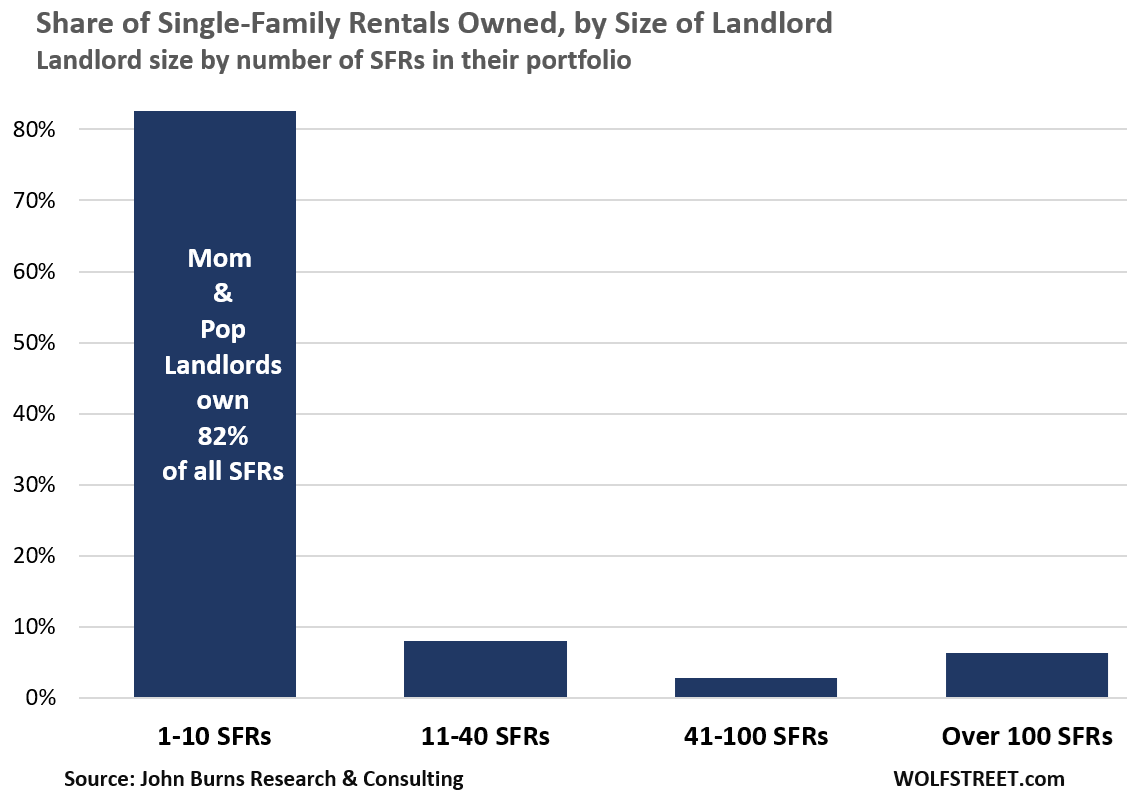
Only about 6.3% of the SFRs are owned by landlords with 100 or more SFRs, according to John Burns Research and Consulting. Only those landlords would be affected if the ban becomes law.
But mom-and-pop landlords with 1 to 10 SFRs own 82.6% of single-family rental properties. That’s the force to be reckoned with – and always has been (data via John Burns):
Owning rental properties has always been a classic investment choice for retail investors. They have been buyers of single-family rentals through thick and thin. Many homeowners became landlords when they bought another home, moved into it, and rented out their prior home, instead of putting it on the for-sale market, and then repeating it multiple times over the years.
But unlike big institutional investors, mom-and-pop landlords are largely invisible, though they represent a mass of buyers that quietly swarm all over the place looking for their next property, and driving up prices in the process.
Huge institutional landlords are relatively new in the single-family rental market, a product of the Federal Reserve’s efforts in 2011 and 2012 to get firms to borrow vast amounts of money at very low rates and buy thousands of homes out of foreclosure to create demand and pump up prices – and thereby provide relief for the banks.
This created a handful of gigantic single-family landlords and a bunch of smaller institutional landlords with heavy concentrations of SFRs in a few markets. When they went on their concentrated buying binge in 2012 and on, it did pump up prices.
But in 2022, the biggest SFR landlords started selling some of their scattered-site properties at huge profits after prices had spiked. And they’re not buying existing scattered-site homes anymore; they’re too expensive at current prices that don’t pencil out, and they’re too costly to manage.
They’re adding to their SFR portfolios by building entire build-to-rent developments, or by buying purpose-built SFR developments from builders.
Build to rent has been the hottest trend in home construction for the past four years. Most of these developments have common amenities, and often a leasing and maintenance office, and are less costly to operate than thousands of older maintenance-hungry homes scattered all over the place.
The largest single-family rental landlords.
There are about 11.3 million single-family rental properties. The six biggest landlords own about 430,000 of them.
#1, Progress Residential: “Nearly 100,000” SFRs, according to PE firm Pretium Partners which owns the landlord. Its portfolio of SFRs is concentrated in some markets, with over 12,000 SFRs in the Atlanta-Sandy Springs-Alpharetta metro.
In the years after the financial crisis when prices were low, it bought 65,000 single-family homes “one-by-one.” It later bought portfolios of SFRs from other landlords and Section 8 SFR properties. As prices rose and became too high for rentals, it began to pull back from purchasing homes one-by-one, and since 2022 has essentially ended those purchases.
Since then, it has been purchasing entire build-to-rent developments of SFRs, acquiring 78 build-to-rent developments, totaling over 10,000 SFRs, according to Pretium Partners.
#2, Invitation Homes [INVH]: 97,036 SFRs as of Q4 2025 (86,139 wholly owned plus 7,897 joint-venture owned), according to the publicly traded REIT’s SEC filings.
INVH was founded by PE firm Blackstone during the Housing Bust in 2012 and spun off to the public via an IPO in 2017. Blackstone sold its last shares of INVH in 2019.
Since about 2022, INVH has been selling scattered-site SFRs that it had purchased at very low prices starting in 2012. And it has been purchasing build-to-rent homes from builders.
In 2025:
- It sold 1,356 scattered-site homes for $534 million (average $393,800 per home)
- It purchased 2,410 homes, “almost all” of which from homebuilders in SFR developments, for $812 million (average $336,923 per home). In Q4, all of the SFRs it purchased were built-to-rent.
#3, Blackstone: 62,000 SFR in the US, according to data from Parcl Labs. Blackstone, after it spun off Invitation Homes, got back into single-family rentals by acquiring two landlords: Home Partners of America with 17,000 SFRs in 2021; and Tricon Residential in 2024, with about 38,000 SFRs in the US. Tricon is also a developer of build-to-rent SFRs.
#4, American Homes 4 Rent [AMH]: 60,337 SFRs as of Q4 2025, according to the publicly traded REIT’s SEC filing. AMH, founded in 2012 by Public Storage founder B. Wayne Hughes, was spun off via IPO into a publicly traded REIT in 2013 and in 2016 merged with American Residential Properties.
AMH started its own homebuilding division in 2017, when it pulled back from scattered-site acquisitions. In July 2024, the company announced that its homebuilding division, AMH Development, had completed its 10,000th home in new build-to-rent developments.
In 2025, AMH Development delivered 2,322 newly constructed build-to-rent homes. For 2026, it expects to deliver another 1,700 to 2,100.
In Q4, it sold 646 of its scattered-site properties and held another 1,142 properties for sale.
For 2025, the company booked a net gain of $231 million on the sale of single-family properties.
#5, The Amherst Group: 59,400 SFRs. The privately-owned company is engaged in build-to-rent, bought portfolios of SFRs from other big investors, and bought individual homes and renovated them. It sells renovated homes directly to consumers on its own platform.
#6, FirstKey Homes: Over 52,000 SFRs, according to the company. It was founded in 2015 by Cerberus when it took on the 4,200 SFRs that Cerberus had previously bought from Building and Land Technology (BLT). FirstKey Homes has also become a seller of its scattered-site properties.
But a ban could make a difference during a housing crash.
If home prices plunge far enough, the ban could make a difference in that it would prevent large firms from swooping in and buying up thousands of homes from distressed sellers or out of foreclosure in those markets. Institutional investors have an advantage: they already have the cash, and they have the expertise, they can act fast, and they can load up on properties. And that’s what happened last time. A ban could prevent that.
In cased you missed it: Single-Family & Multifamily Construction: Bring on the Supply just as Population Growth Slows to a Crawl
Enjoy reading WOLF STREET and want to support it? You can donate. I appreciate it immensely. Click on the mug to find out how:


I think this problem could be solved in far more simple ways. First, on a local level, states and municipalities can ensure higher property taxes on investment properties.
Two, on a federal level, the 30-year-fixed mortgage, guaranteed by taxpayers, doesn’t need to extend to investment properties. I recognize that it’s hard to qualify at the same lower rates when purchasing for investment, but if you purchased to live in it and then rent it out, you keep your government-supported low rate. Congress could implement some kind of mechanism that causes rates to increase if a previously lived in property is now being used as a rental property.
I’ve always said more or less the same.
For every house or property you own- you pay a higher property tax. Progressively increase the tax with every property and no one will want to own their 8th house with 35% property tax.
This would never happen because too easy to circumvent: separate LLC for each property, already pretty common.
They will go by the ownership of the LLCs. That is already done, as you pointed out. Each property is in its own LLC normally.
local govts can’t do that without damaging their own finances
here they have to go up 15% annually for EVERYONE
but what about values going down
no problem – govt will raise mil rate to compensate
the grift is on
and property taxes like income taxes ought to be illegal
not to worry – 99% soon to be renters
@Troy Whould you also want to increase the registration fees for anyone with more than one car?
This is a false equivalency. And a dumb one at that. Cars depreciate in value and the difference between registration costs on a 20 year old car is nothing near what taxes on a 20 year old house cost
just EV owners
Your ideas do not seem “simpler” than a straight ban.
It’s also arguable whether it’s a “problem” for a company to own 101 rental properties instead of only 100 rental properties.
A lot of social media users repeat the complaint about about large corporations buying properties, but are vague about why it would be ok if small & medium corporations were buying those same properties for those same prices.
our PENSION plan is rental income
so you’re advocating stealing from our pension
maybe we ought to say anyone who owns STOCKS ought to have special taxes
at least OUR assets are REAL and not paper/computer generated
Or the government could just stay out of it and stop social engineering through tax policy…dare to dream.
You say it as if the real estate market has not been “socially engineered” for decades on both federal and local levels.
What I intended was that the whole situation is a mess because of the social engineering that has been occurring for a long time and the solution to the problem is NOT more social engineering.
I’d love to be able to tap the $1 billion loan programs these guys get
and they use OPM
what a racket to make 1% hoover even more 99%
I agree.
I don’t understand why people like to demonize landlords, and seek to punish them in some way for trying to make a profit.
If there are no landlords, then there will be no homes for people to rent.
I know several people who use a rental home or two as their retirement income stream. Rental homes are their investment instead of IRA, 401K, or employer based retirement.
I would argue, why should they pay higher taxes than others because they worked, saved, and managed their money prudently.
I would argue why someone should pay higher costs to live because they weren’t lucky enough to acquire a lot of assets before the government intentionally drove them into the stratosphere?
Why should residential real estate be allowed to be depreciated on a 27.5 year period? Why should 1031s be allowed for this asset class, and nothing else?
Why should REITs and REMICs be allowed?
The tax code already gives far too much in preferences to real estate.
Amen to that.. I sacrificed for years to build a portfolio of ten…
At 73 it beats the heck out of SS…and allows me to be generous with, family, Church and private schools…btw,, some of us never retire,, still doing 60 hrs weeks.. Love it…
I therefore advocate that we continually raise our rents for those who FAILED to live within their means
How’s this a social engineering problem?
The problem is that investors are getting more rich & have the ability & monies to adapt their strategies to acquire more homes to boost profits. There’s nothing social about this. Wolf’s point about the SFRs selling homes the bought from 2009 – 2012 & then transitioning to buying or building entire developments clearly illustrates this.
How about we also place limits on build to own & see what happens? This trend is no different that all sorts of examples of concentration of wealth. That’s the real problem, beyond the constant meddling by the Fed that protects banks & big investors.
The longer we go on with a recession which also gives us a chance to see how Warsh et al responds means the wealth gap is only going to continue to widen.
” states and municipalities can ensure higher property taxes on investment properties.” Mostly they already do, since they offer various tax breaks to owner-occupants. Certainly they could increase these.
Yep, but not enough to discourage investment. Taxing them like commercial properties (like a retail shopping center would be) much do the job.
Sorry, Sir, but spoken like a person who has never owned a rental property.
–Geezer
NJGeezer, I’ve helped manage commercial properties. In many places, they are taxed 50-100% more than residential properties of the same assessed value.
Yeah, that would make running more affordable!
I assume you mean “renting?”
Rental rates are set by the market, not by the landlords’ input costs.
you say
rental rates are set by market not landlords
however if rental rate does NOT make profit
we pull, sell and move $$ elsewhere
and do you think those who FAIL to live within their means
are buyers – I think NOT
or we just distribute to our kids on cheap
joedidee
And the buyer of your rental property then needs to keep the unit occupied with paying tenants. And they’re subject to the law of the market. You personally can walk away by selling the place, but the rental property, regardless who owns it, is subject to the market forces.
Nice try with the tax scam. If you had any understanding of how this actually works, you would know that the landlord doesn’t pay the tax, it is simply passed through to the tenant.
Huge fundamental misconception. The landlord always charges the maximum rent that allows them to fill the unit and keep it occupied. The landlord’s costs don’t change anything except the landlord’s profits. This is now a huge issue spread all over CRE, with lots of landlords defaulting, losing their properties to lenders, and collapsing, and lenders taking huge losses, because costs rose much faster than they could hike rents and keep the units occupied — including in multifamily CRE. This site is full of articles on this topic. And the stocks of the big SFR landlords have plunged because of this issue… they can no longer pass on their rising costs to potential tenants because potential tenants don’t go for it and won’t sign the lease. There is a little more leeway on lease renewals on good properties because of the costs and hassles that tenants face when moving. So they might go for a 4% rent increase instead of moving. But there are limits too, and the next rent increase might make them move, and then unit is vacant for some time with zero revenues, and to fill it, the landlord may have to cut rent some. All the big SFR landlords are complaining about the inability to pass on rising costs.
It’s amazing. It’s the same stupid argument that people use with tariffs, that they’re “all paid by the consumer.”
I always ask “If providers of goods and services can always pass their costs through to consumers, why would they not raise their prices every day?”
They then usually respond with “Well, eventually the price will be too high.”
So I say “Okay, so we’re acknowledging that there is a limit to what people can and will pay. Now why does that limit apply when it’s based on profits, but not when it’s based on inputs?”
Never get an answer.
My guess at an answer there would be that tariffs raise the floor across the whole sector so there’s no cheaper competitor for people to go to. They’re forced to either pay the price that’s higher than they want to pay, or not buy the product at all. Domestic alternatives don’t have the tariff but those prices seem to usually be higher than even the tariff-adjusted price (I try to buy US or at least EU-made stuff but I’m generally paying double whatever the Chinese/Amazon version is).
Matt B
“They’re forced to either pay the price that’s higher than they want to pay, or not buy the product at all.”
That “not buy the product at all” happens all the time. It’s very common. We stopped buying beef over a year ago, for example. Not worth it. The alternative to an expensive steak is a cheaper steak or ground beef. The other alternative to steak is fish, pork, chicken, etc. There are nearly always other alternatives, though maybe not direct alternatives. And in terms of imported goods, there is the issue that all durable goods have: you can just keep what you have and don’t buy anything new. People do that all the time — see motor vehicle sales. Automakers have not been able to raise prices at all amid weak demand.
Not trying to contradict you but I have a question about that. In the short term the landlord can’t pass on the cost if the market won’t bear it, but in the long term won’t supply be constrained until it is once again profitable to be a landlord, but at a higher price point, reflecting the higher input costs?
In the long term, landlords can lose money and do lose money and lenders take over the properties.
Rents generally depend on local wages and salaries.
@Wolf It is important to remember that “all” landlords are not pushing hard for maximum rent for every unit and at every lease renewal.
As a landlord that has always rented “below market rent” (not because I’m some kind of saint, but because I want a large selection of tenants so I can pick the “best” tenant since good tenants are not as hard on the units and stay longer). I’ve found that “most” small Mom & Pop landlords follow a similar strategy .
It is also important to note that if costs rise for ALL landlords in a market it will tend to increase rents since most landlords will try and increase rents to cover the increased costs. Increasing costs are often a pattern interrupt that causes the Mom & Pop landlords like myself to increase below market rents.
ApartmentInvestor
You never got around to reading the complete sentence:
“The landlord always charges the maximum rent that allows them to fill the unit and keep it occupied.”
I agree with that last comment. While there may be some landlords out there that charge a little less than market because they feel badly for a particular tenant, most are keeping rate increases reasonable not out of the goodness of their hearts, but because they realize keeping a good, stable tenant is a better long-term play.
and yet investors like us who own our assets F&C
have difficulty making decent living in retirement
soon enough the FED will bankrupt the 99%
and 1% will hoover up remains
In SW FL, our luxury apartment is lowering our rent from $2100 to $1700 for our renewal. And this apartment was $2700 a few years ago.
There is massive and growing supply and dwindling demand (old folks dying, less illegals, northerns fleeing after hurricanes, etc).
I know, n=1. But things are changing here.
A ban would reduce options for distressed sellers. This gives rise to another debate between individual freedom and societal benefit. When such things are eventually resolved they do not seem to work in favor of taxpayers.
1% waiting
The issue is why are housing prices so high while at the same time the sales volume plumbing new lows.
I think of it as an incongruity in the logical assumptions that color my point of view.
1. There’s no shortage, folks that need a home can easily rent
2. Sticky prices are real, why take a loss of 20k compared to my neighbour who sold their house last year?
3. Current rates are 6%, for anyone that bought their first house since 2008, these are the highest rates in their lives. Their friends locked in a mortgage at 3% a couple of years ago. The president is saying the rates will come down. They would be crazy to switch mortgages now.
4. Investors are flush with cash, even if they have some vacancy costs, who cares? They sold one or two properties recently for gargantuous gains, holding on to the others doesn’t hurt them. Besides their stock portfolio is also doing great. All is well.
The prices are skewed up because the high end of the market is still financially stable. The average prices sold are elevated since nothing at the bottom is selling because the entry level of the market can’t even afford to rent.
It causes realtors to keep the prices up, hoping to catch a bigger fish since everyone else is a minnow.
1:04 PM 2/23/2026
Dow 48,804.06 -821.91 -1.66%
S&P 500 6,837.75 -71.76 -1.04%
Nasdaq 22,627.27 -258.80 -1.13%
VIX 21.01 +1.92 10.06%
Gold 5,187.70 -37.90 -0.73%
Oil 66.59 +0.28 0.42%
“If the American people ever allow private banks to control the issue of their currency, first by inflation, then by deflation, the banks and corporations that will grow up around them will deprive the people of all property until their children wake up homeless on the continent their Fathers conquered.”
– Thomas Jefferson
Thomas Jefferson never made any such quote at all and this was clearly and completely debunked on the Monticello web site many years ago. The word ‘inflation’ wasn’t even used at all until around 1937. By the way, Thomas Jefferson was one of the most profligate people in the US back in his day and passed away owing creditors massive sums on money.
Thanks you
I always liked the quote:
“Don’t brlieve eveything you read on the internet”
-Abe Lincoln
Years ago, while I was traveling around the country on my bicycle, a thunderstorm forced me to take refuge at Patrick Henry’s estate, Scotchtown.
The docent was a direct descendant of Patrick Henry, and she was very proud of her ancestor. Among other things, she was proud of the fact that, while Thomas Jefferson died broke, Patrick Henry died as a very wealthy man.
“Over 80% of the quotes on the internet are fake” – George Washington
Curious to see the number of houses for sale during/after the next recession. The Depression caused many forced sales due to county RE tax. I hope I’ve enough cash flow to survive .
Not counting on an IRA as those assets will also be down!
Can anyone explain the possible ramifications from a ban during a crash. It makes sense there would be a difference but I have trouble understanding what the effect would be. Would it possibly be that the housing prices would fall further since there would be less demand due to no large investors?
Yes, it takes away, or at least reduces, a price floor based on ROI.
Thanks for the response.
Start the countdown clock until someone says “Blackrock”…
Anyway, I doubt this will matter. If there’s enough juice in the deals, a manager like Blackstone can create separate entities with 100 each.
At least half of those big ones listed are a PE-owned entity. Make of that what you want.
Personally, I think of the dirt bag that somehow made millions off of slinging failed Sears properties, all the while screwing investors and municipal taxpayers and crashing the remnants of the retail operations.
The issue isn’t whether a PE firm or company can own / build housing, etc.- they can, no doubt. The issue is the seemingly advantageous financing, sketchy political ties, dubious taxing issues and money hoarding nature of PE entities.
Name one PE firm where you saw an improvement in the bought-out company. I don’t mean the metrics (profit / loss), but actual improvement for the company… i.e. their service got better, bringing more customers, or quality manufacturing, etc.
If you’re cool with that, no big deal. Rent from them. Just don’t be surprised when you move out if you’re not dinged on your deposit for bath tub caulking, appliance lights not working, spider webs on the porch, etc… and every other fee that can be contrived.
The real solution to the housing problem is to end single family zoning of lots California statewide like in Oregon. Oregon does have another law to prevent sprawl into forests that significantly added to the bottleneck without ending single family zoning.
Coming from someone who probably does not live nor appreciate the quality of life in sfr neighborhoods. Cramming more rats (people) into ever smaller spaces does not improve quality of life. Incentivizing companies to expand into the wide open spaces outside of urban and suburban sprawl would be a better social solution.
Not everyone subscribes to your personal ideal of what “quality of life” looks like. Which is why 1 bedroom apartments in urban areas can sell for 10x as much as 3 bedroom houses in the middle of nowhere.
In Las Vegas, investors own 26.29% (about 172,000) of single family homes. Of those, about 6% (10,445) are owned by institutional investors. That’s 1.6% of all single-family homes.
In Reno, investors own 23.17% of all single-family homes (about 43,000). Institutional investors own about 265 homes in the area, or just 0.6% of investor-owned homes, and 0.14% of all single-family homes.
Wolfs chart looks pretty accurate.
Nevada Current
Now do Sparks
Why 100? Why not 10?
I realise that Mr Trump’s vices are the price you pay for his virtues but I still find it hard to fathom that a businessman could survive to his age with such a feeble understanding of Economics.
He seems to espouse what I call man-in-the-pub Economics. That is not intended as praise. I suppose it might be better than man-at-Harvard Economics but there are other, better varieties available.
Well said dearie!
Is it possible that Trump is saying what he thinks will get him votes, regardless of whatever he may or may not know about real eatate economics?
Or is could that never possibly be one of his “vices”
Mom & Pop landlords should be eliminated along with the corporate ones. People should allowed only one home other than the one they live in. Eliminate depreciation for the homes more than 2 per taxpayer. That will get rid of the housing shortage and price spikes.
And result in evictions for current tenants…
There is no ‘housing shortage’ and there are many more houses on the market than there are potential buyers. Government attempting to control what folks can and cannot buy is utterly absurd in any scenario.
If mom+pop and corporate landlords are all eliminated, who will own all the houses that people are renting ?
The Government ?
This isn’t the root of all real estate evil. That would be the Fed buying MBS and ZIRP. Take that factor away, 2008 bubble doesn’t happen, 2021 inflation doesn’t happen.
I’ve been hearing about increasing financial stress amongst small landlords (especially newer ones) who own 2-3 homes or more, often using the additional properties as airbnb’s and such – with a decline in demand for airbnbs adding some complications.
As I expect the next downturn soon, most likely this year but possibly stretching to start into next year, those conditions combined are what the analyst who reported this expectation was speculating would lead to more housing price decline issues due to foreclosures and loss of properties by smaller landlords. Time will tell.
These “promises” never materialize
Like IOUs of dust
So basically the proposal is a “solution” to a non-problem that will create conditions that will make a future problem worse…
@Wolf are you taking a break from the monthly US housing bubble articles?
It’s just “transitory,” as they would call it at the Fed when they knew it would be roaring on.
Readers would like to see a 2% objective for US housing bubble articles, and those expectations are “well-anchored.”
Thank you again, Wolf, for your excellent analysis!
The obvious conclusion for conditions today is that banning institutional investors is like closing the stable doors after all of the horses escaped. Sorry for the quaint old-timer phrase.
It may have helped back in 2016 when house prices had mostly recovered and the housing market was becoming frothy again. It may have also helped to slap a huge short term capital gains tax on house flippers.
Back in 2010-2012 when extreme irrational fear dominated any potential buyers from buying even when mortgage costs were less than renting, these institutional buyers set a hard floor on the crashing market and started a housing turnaround. Primary home buyers and mom and pop landlords lost their irrational fear and started buying again. They called this time The Great Recession for a reason and it wasn’t a good reason.
Today, the irrational greed and FOMO has been removed from the housing market. People are seeing that renting is much less than buying and the FOMO to buy a house has been lessened. Anecdotally, my son is paying half in rent than if he had purchased his neighbors house with the same floor plan last year.
I still believe that purchasing a house now is a great choice if you are planning to live there for 12-15 years.
Wage inflation and younger people being promoted with salary increases will make life easier over time.
That was true for me 40 years ago in S CA and I believe it is true now.
If you can afford it. I also believe that everyone has a right to affordable housing but nobody has the right to buy a house. Rents should track wage inflation.
Government shouldn’t set policies that will crash housing prices. 2008-2014 was a great time to buy a house since the prices were on par with renting but it wreaked havoc on the entire economy. We don’t want another 2008 crash. Inflation will whittle away the house prices over the next 10 years as long as speculation and FOMO don’t reappear.
Today’s market has more sellers than buyers. That means prices should flatten or drift down as wage inflation enables more buyers. There are currently less buyers, but they are able to pay the current prices. The rest should save money and rent until they can afford their forever(10-15 years) home just like it has been for most of the last 40 years. Including myself.
While it may be too late for the existing run-up in prices, RE is always cyclical. So, put the law in place now, in anticipation of when prices go down and large SFR firms may be enticed back into the market. If the ROI for those firms somehow never gets high enough to where they want to buy more SFRs, then the law basically has no impact.
Biggest problem with this proposal may be the large PE entities who simply create lots of separate entities each holding 99 SFRs. The devil will be in the details.
Legal Economist,
I see your point and if houses crash again like in 2008, laws can be changed to allow it. Hopefully while not allowing it to drive the next run up. In retrospect, I think this law may have had a beneficial effect if it was enacted in 2016 when the current bubble started to appear. Now we all have learned and know better. /sarcasm
I could compare this law to Dodd Frank in 2010 enacted to prevent another crash. Time shows the loopholes and weaknesses in any law. Another closing of the stable doors after the horses escaped.
Constantly changing the laws with the goal to massage a “free” market into a smooth gentle endless upwards curve?
Sounds like a flawless plan. I wonder why no one tried it before.
“If home prices plunge far enough, the ban could make a difference in that it would prevent large firms from swooping in and buying up thousands of homes from distressed sellers or out of foreclosure in those markets.”
Almost every real estate professional has said that the equity situation now vs 2006 is like night and day. With the huge cushion in home equity, how likely is it that there would mass distress and foeclosure like last time?
Ok, here’s a thought – prohibit hedge funds and other institutional investors from buying homes, thereby facilitating the normalization of home prices. When homes over-correct (which needs to happen!), change the rules allowing institutional investors back into the market
in order to ‘save the market’, and watch them scoop up millions of homes at pennies on the dollar.
Every American citizen should be allowed one homestead not subject to ANY property tax up to a certain amount so we could actually realize the American dream if owning a home and your land under it. Every home owned after that should be subject to progressively higher more painful taxes as to discourage investing in SFHs. Housing shouldn’t be a lucrative investment. If you want to invest in real estate, it should be multi-family apartments or commercial.
Housing isn’t the investment it’s the land under it.
Stop these silly thoughts please. Painful taxes don’t affect us we just move around income to avoid them.
Start by removing simple rules, policies that force prices upward or reward tax incentives for asset storage.
How do you “move around income” to avoid property tax? I’m suggesting higher property taxes based usage type and number of homes owned.
@Idontneedmuch would your plan allow someone to own a ski cabin or beach house?
Sure. First vacation home gets taxed, the second a little more, so on and so forth. Eventually it stops making sense to own so many homes. Then you can rent a hotel room with all the money you are saving!
It should be illegal to own SFR for rental purposes in the USA.
@Ty Webb
When I graduated from college (after working doing apartment maintenance and driving a limo to pay for tuition, rent and food for 5 years) I rented a home with a roommate (since we both wanted a garage). Do you think we should have been forced to rent an apartment until we could save up to “buy” a SFR? After I did save up to “buy” my first SFR I had a different roommate, whould that have been allowed under your no SFR rental plan (can anyone rent a “room” in their SFR or are all “renters” forced to live on the other side of the tracks in the “apartment area”)?
The problem is that they contract with builders to build the rental homes in neighborhoods with starter homes. The legislation doesn’t cover the build-to-rent activity.
There are private equity firms like Pretium who have bought land
Build to rent adds new supply to the housing stock and supplies new corporate-financed houses to the housing stock. Adding new supply to the housing stock is a good thing. Families are going to move in and take pressure off the for-sale market. What are you bitching about? That home prices might fall?
In addition, they’re not building these developments in existing neighborhoods as you claim (they’d have to buy and tear down a bunch of houses which would raise the costs of the project). They’re building them out in open undeveloped space obviously because the developments are big, just like any new single-family development.
“There are about 11.3 million single-family rental properties. The six biggest landlords own about 430,000 of them.”
Thank you for putting that in perspective.
430k units / 50 top markets = 8,600 units per market…..are 8,600 units really what drive that local market? Probably not. Concentrated in 10 markets? Maybe. It would put localized pressure on what would be Rents and Rental stock / 1st time buyer property values that could filter up to other local properties – but Regionally? 430k units as impacting price nationally? The media tells some stories doesn’t it?
I disagree
With what?