
New-vehicle sales in 2025 rise barely above 1986: Four decades of structural stagnation, plunges, and partial recoveries.
By Wolf Richter for WOLF STREET.
Total new-vehicle sales, as measured by deliveries to end users, rose by 2.4% in 2025 to 16.2 million vehicles, the highest since 2019, and just a hair above where sales had been in 1986 – four decades of structural stagnation, plunges, and partial recoveries. The two best years were 2000 and 2016, with 17.4 million and 17.5 million vehicles sold. In 2025, sales were 6.4% below the year 2000. Over those 25 years, the US population has increased by 21%!
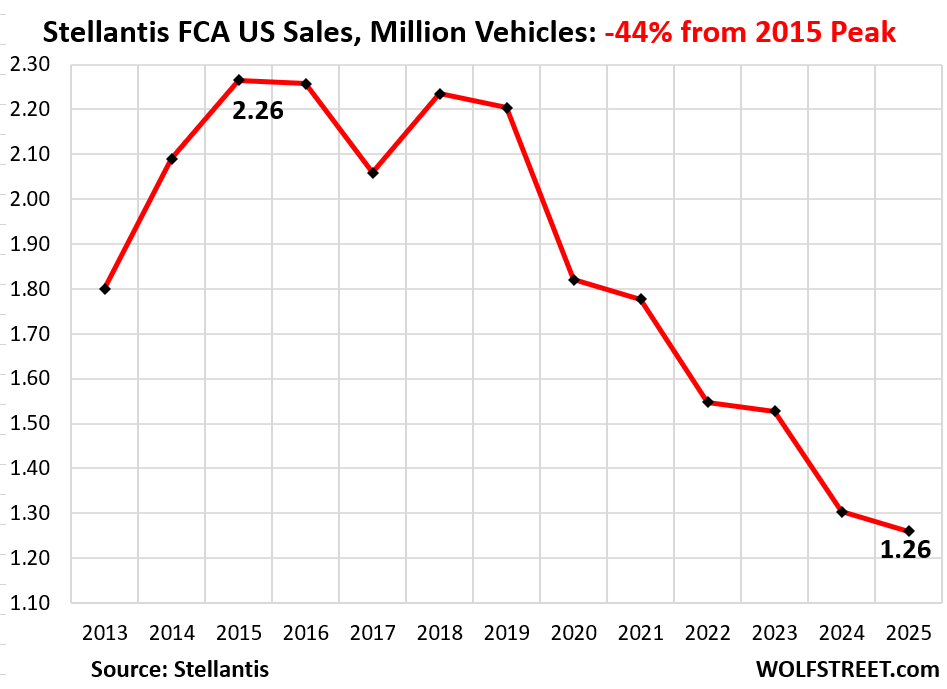
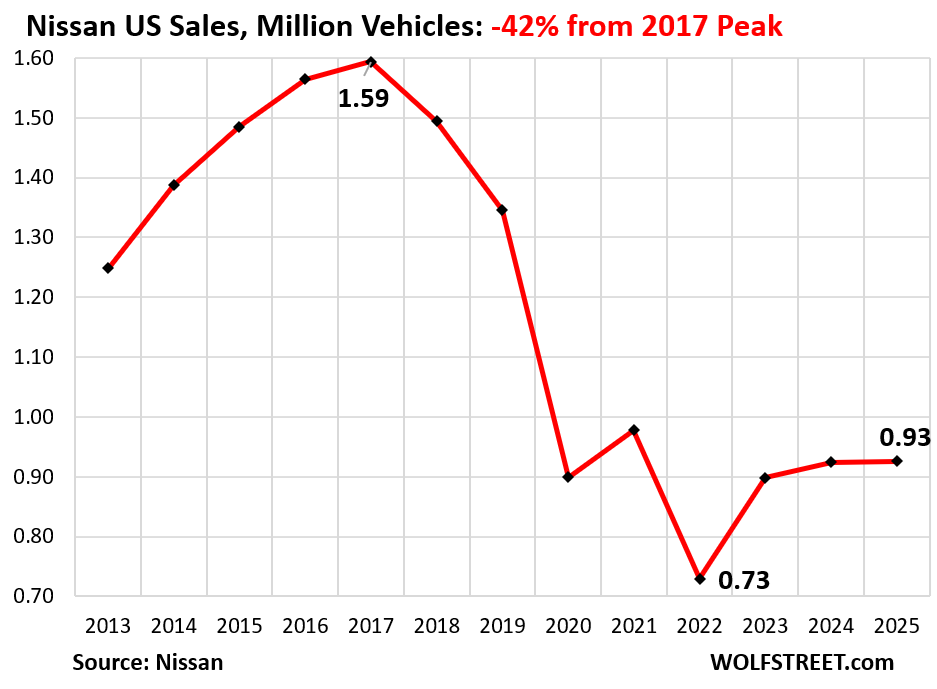
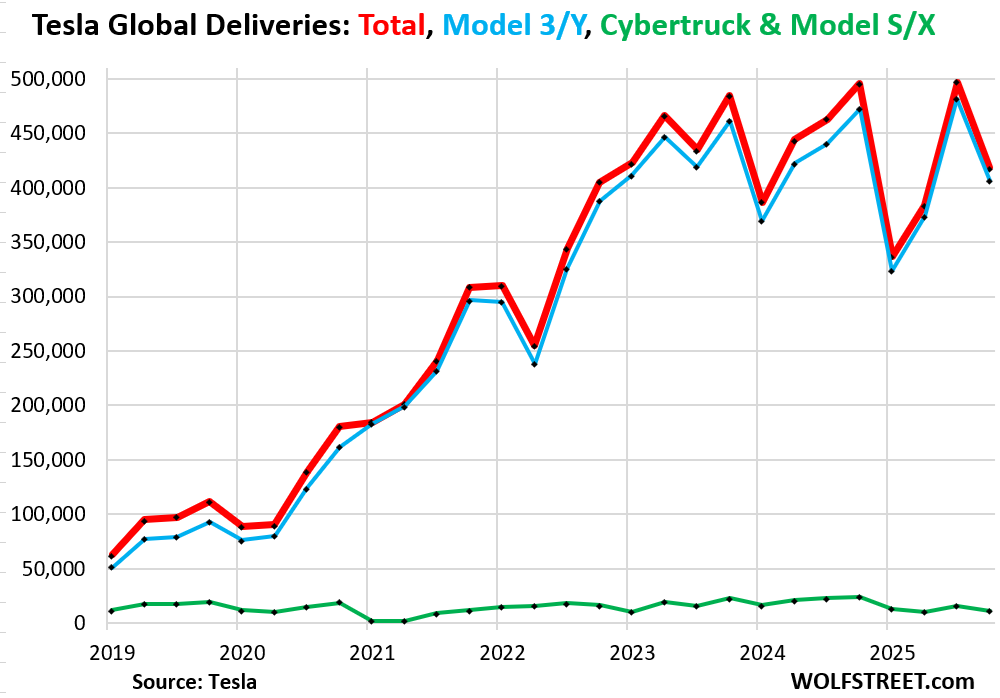
Stellantis continued its death spiral, with sales dropping further in 2025, down by 44% from the high in 2015; Nissan may have paused its death spiral, with sales roughly flat year-over-year, and down 42% from the 2017 high. GM’s and Ford’s sales have come up, but are still well below their 2015 levels. Honda also eked out a gain for the year, but sales were still down 13% from the peak in 2017. Toyota’s sales jumped and surpassed its 2015 record by a hair. Hyundai-Kia sales continued to surge from record to record. And Tesla doesn’t report US sales publicly – it only reports global sales publicly, which dropped for the second year in a row (overall new-vehicle sales data via Bureau of Economic Analysis):
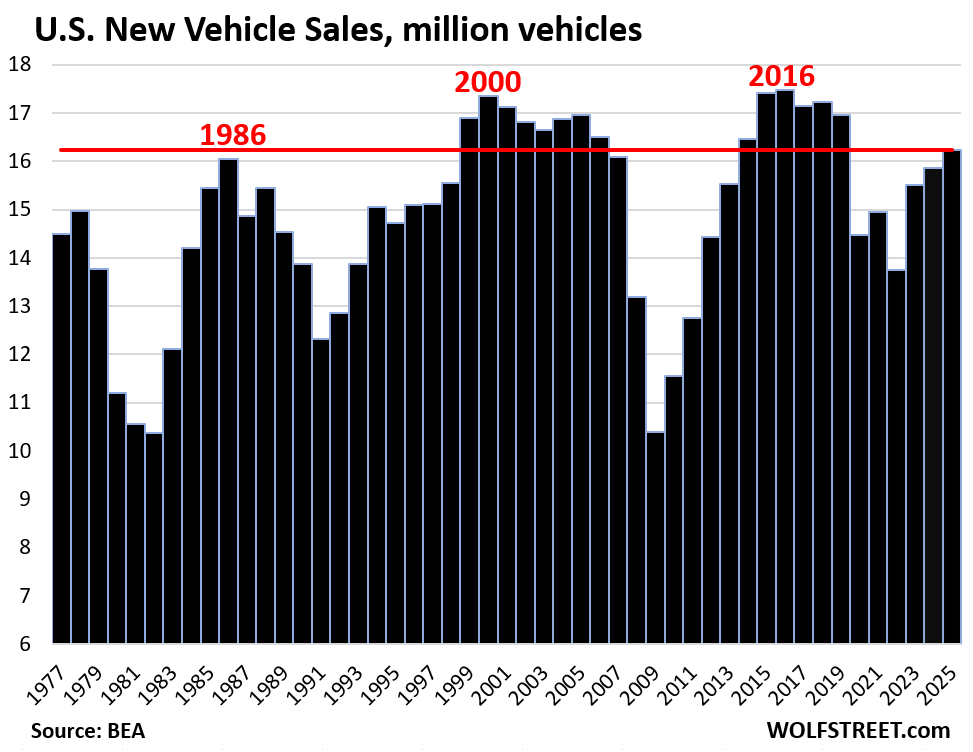
Full-year sales by all automakers combined rose on the strength of Q3 when EV sales surged due to frontrunning the end of the federal incentives; and on the strength of March and April due to frontrunning the tariffs.
Each frontrunning stampede was followed by a hangover. In Q4, sales dropped by 4.2% year-over-year, as some of the big automakers reported substantial drops.
The top foreign automakers assemble a big portion of their US-sold vehicles in the US, and many of their vehicles have more US content than those of GM, Ford, and Stellantis. Most US-sold Tesla models are at the top or near the top with their percentage of US content.
Prices exploded in 2020-2022 and hit a ceiling.
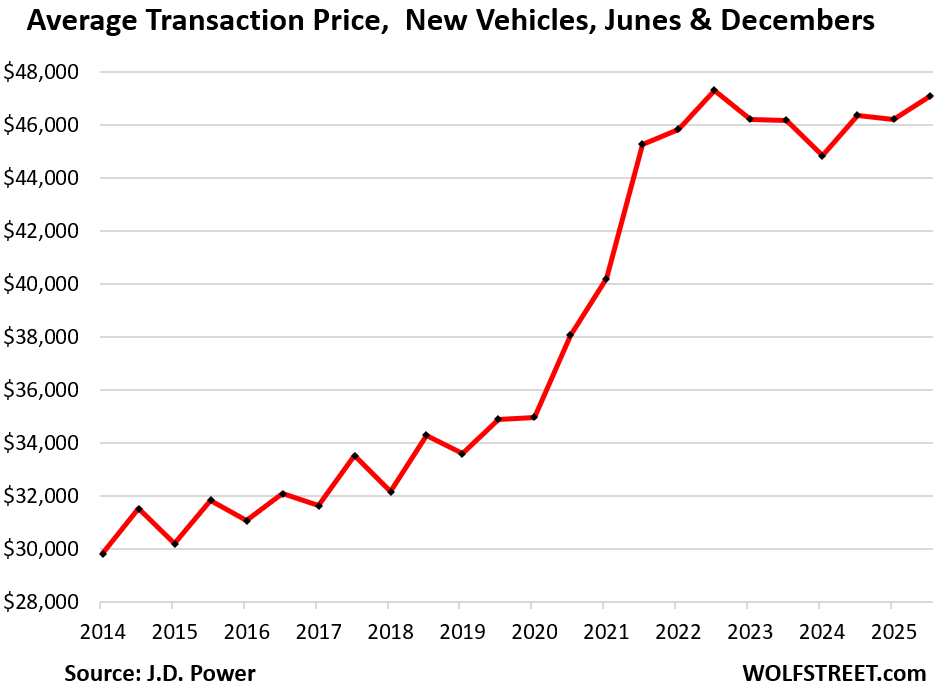
In 2020-2022, automakers and dealers went crazy with their price spikes. Over the three years from the beginning of 2020 through the end of 2022, the average retail transaction price had exploded by 36%. After the price explosion that led to obscene profit margins at automakers and dealers, price increases ran into a consumer revolt, which is why the tariffs couldn’t be passed on without losing sales.
Automakers have always tried to go upscale, coming out with fancier, bigger, and more expensive models, which is how they boosted their revenues in a market that has been structurally stagnating in terms of unit sales for four decades.
In addition, they raised prices across the board with annual increases in the MSRPs, and adjusting actual prices throughout the year with various incentives and discounts.
The result is that new vehicles are now too expensive. The average retail transaction price peaked at the end of 2022 at $47,329 and has remained roughly at that level since then. At the end of 2025, the average transaction price was $47,104, up by 1.5% from a year ago, and down by 0.5% from three years ago, according to JD Power estimates. The average retail transaction price includes all incentives and discounts.
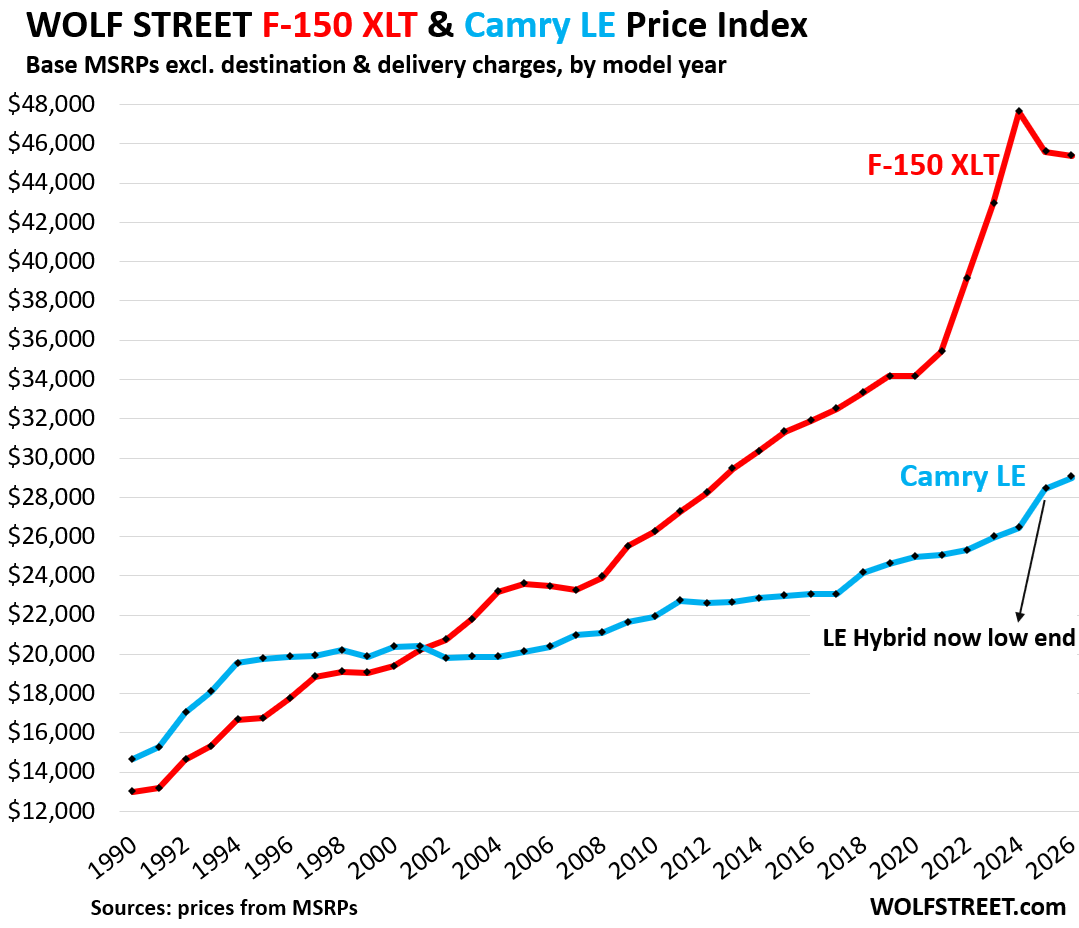
The WOLF STREET F-150 XLT & Camry Price Index tracks the MSRPs of the base versions of the Ford F-150 pickup truck and the Toyota Camry LE going back to 1989. Over the three model years 2022, 2023, and 2024, the MSRP of the F-150 spiked by 34.5%, but then hit that ceiling.
Toyota did the classic trick of upscaling the base Camry LE by making the hybrid drive standard in the 2025 model year, which had been a $2,400 option in the 2024 model year, and then raising the MSRP by about $2,000 to reflect that (details in my discussion here):
Sales of the biggest automakers in the US.
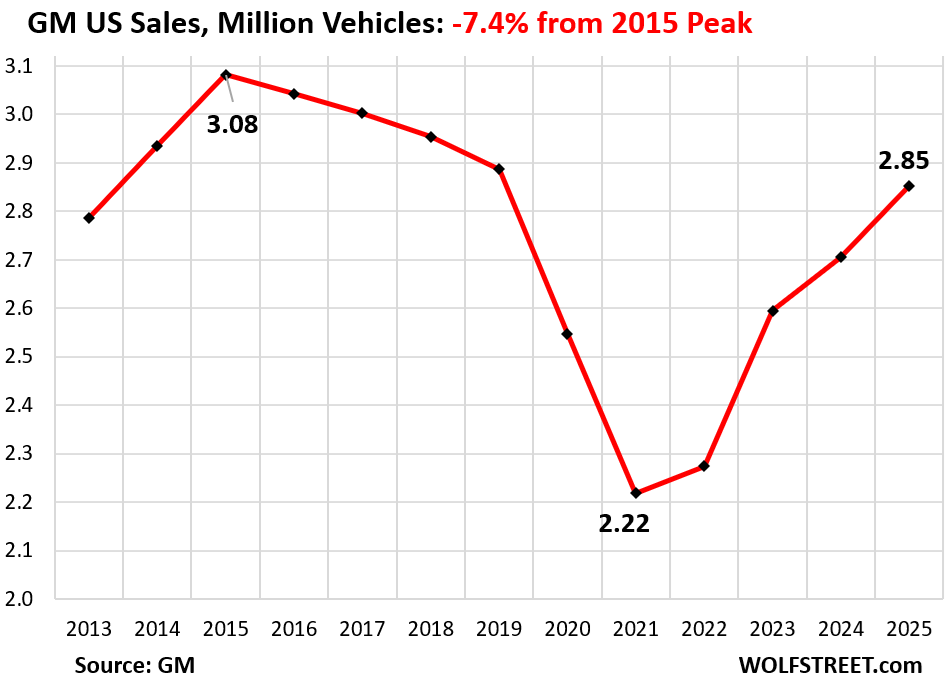
#1, General Motors: In Q4 sales fell by 6.9% year-over-year to 703,001 units. For the whole year 2025, sales rose by 5.5%, to 2.85 million vehicles, on the strength of frontrunning in Q1 and Q3.
It sold 940,000 full-size pickup trucks across all its truck brands combined, more than any other automaker, including Ford, which sold 829,000 full-size pickup trucks.
But the year total was still down by 7.5% from the 2015 peak.
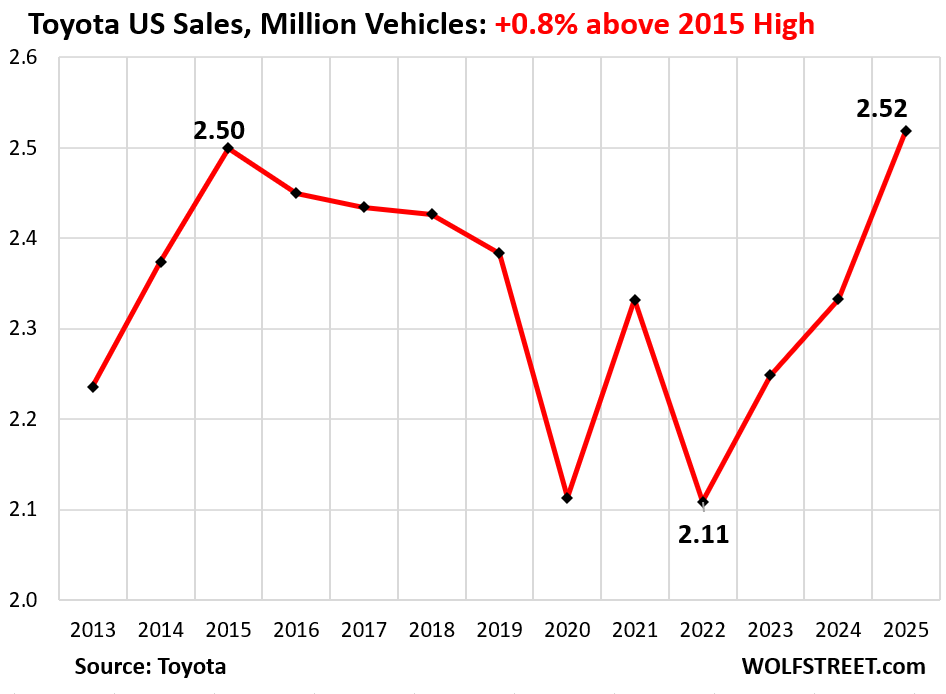
#2, Toyota: Sales of Toyota and Lexus brands combined jumped in Q4 by 8.1% year-over-year, to 652,195 vehicles.
Sales for the whole year jumped by 8.0%, to 2.52 million vehicles, squeaking by the peak in 2015 by 0.8%.
It sold 248,088 Corollas (+6.5% YoY), 316,185 Camrys (+2.0% YoY), and 56,488 Priuses, the subcompact liftback sedan (+26% YoY). That’s 620,000 sedans, about a quarter of Toyota’s total sales, not including the niche cars that Toyota also sells.
This is the kind of market that Ford, GM, and Stellantis, in their infinite wisdom of always kowtowing to Wall Street, abandoned years ago. Sedans have tighter profit margins than the big iron, and Wall Street hated that. So, under pressure to show higher profit margins, the automakers just handed most of the sedan business to foreign brands and Tesla.
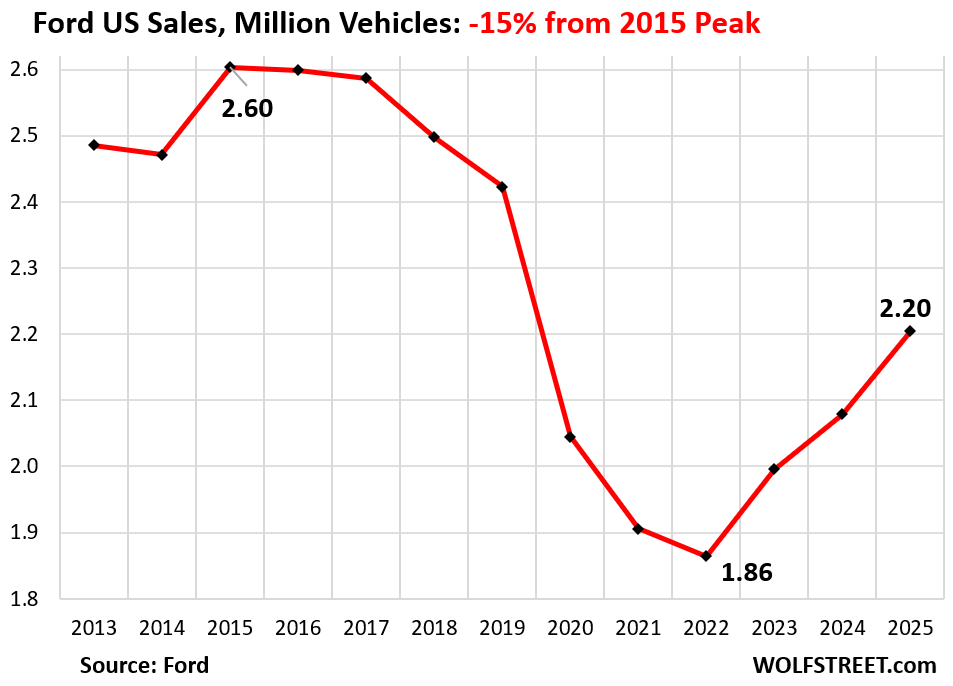
#3, Ford: Sales by Ford and Lincoln brands combined in Q4 rose by 2.7% year-over-year.
For the whole year, sales rose by 6.0% to 2.20 million vehicles, but that was still down by 15% from the recent peak in 2015!
The only car that Ford still sells in the US is the Mustang. That sedan business that Ford sacrificed on the altar of Wall Street sure is missing now.
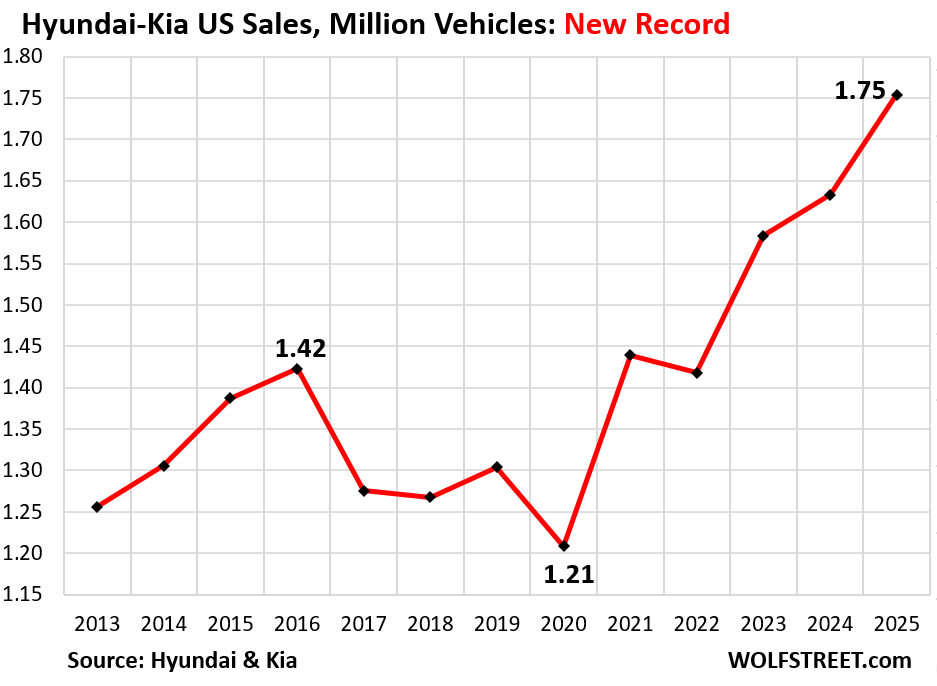
#4, Hyundai-Kia: Combined sales jumped by 7.4% in 2025, to a record 1.63 million vehicles, up by 26% from the 2015 high. Hyundai sales were up 7.8%, Kia sales 7.0%. But Q4 sales were barely up from a year ago.
Hyundai is the parent company of Kia, with Hyundai holding a 33.9% stake in Kia, and Kia holding stakes in Hyundai subsidiaries, and they share vehicle platforms. For our purposes here, the duo counts as one automaker with different brands.
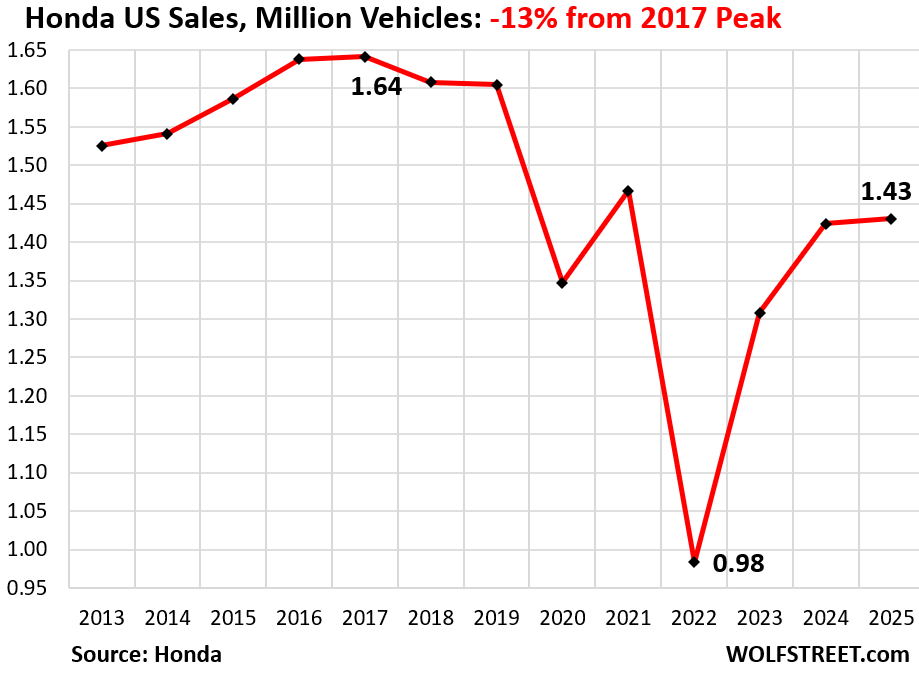
#5, Honda: Quarterly sales plunged by 9.5% year-over-year to 332,578 vehicles, with December down 12.5% year-over-year, but…
Thanks to Q1 and Q3, full-year sales inched up by 0.5% to 1.43 million vehicles. Honda sold 417,269 sedans, about 41% of its total sales.
2025 was the second year that Honda was the #5 automaker in the US. In 2024, it had moved past Stellantis, whose sales had collapsed.
But sales in 2025 were still down by 13% from the 2017 peak.
#6, FCA US (Stellantis): The death spiral continued in 2025. FCA US sales all brands combined – Jeep, Ram, Chrysler, Dodge, Fiat, and Alfa Romeo – dropped another 3% in 2025, to 1.26 million vehicles. From the recent peak in 2015, sales have collapsed by 44%.
- Jeep: 593,401 (+1%)
- Ram: 431,670 (-2%)
- Chrysler: 126,373 (+1%)
- Dodge: 101,927 (-27%)
It sold only minuscule numbers of Fiats (-14%) and Alfa Romeos (-36%) in 2025.
The shares of Stellantis [STLA], which are traded on the NYSE, have collapsed by 62% from their high in March 2024.
This is an ultra-ugly chart of an existential crisis. But there’s always hope: Q4 sales were up 4% year-over-year:
#7, Nissan: Sales of Nissan and Infiniti combined were roughly flat year-over-year in 2025 at 926,153 vehicles, with Nissan Division sales edging up 0.9% and Infiniti sales plunging 9.0%.
Q4 sales dropped by 3.7% year-over-year to 214,250 vehicles.
From the recent peak in 2017, sales have plunged by 42%. Another ultra-ugly chart of an existential crisis, not far behind Stellantis.
Tesla doesn’t publicly disclose US sales. It only publicly discloses global sales. Tesla’s global sales in Q4 plunged by 15.6% from a year ago. For the whole year, global sales dropped by 8.6%, the second year in a row of declines (full discussion here). Preliminary estimates indicate that the drop in the US was steeper still.
Enjoy reading WOLF STREET and want to support it? You can donate. I appreciate it immensely. Click on the mug to find out how:


2025 stock gains crushed it – GM up 55% and Ford up 34%
#NoBubbles
(Nothing to see here)
Total new-vehicle sales, as measured by deliveries to end users, rose by 2.4% in 2025 to 16.2 million vehicles, the highest since 2019, and just a hair above where sales had been in 1986 – four decades of structural stagnation, plunges, and partial recoveries.
A very elegant description of the status of a bell weather indicator of the affordability quotient.
Kinda make sense. Toyota US/NA is losing $400M+ per quarter even with record sales. Something has to given with that division as they can’t bleed forever and let the world subsidize it.
While I am emphatic to your point of view, understanding the point is quite another point of view.
I am in Western Canada, in September we went to the Honda dealer to buy new 2025 Honda Pilot. The showroom was half empty, hybrids and a few CRVs only. All sales people busy and fully booked, nobody had any interest to sell us a new vehicle. No new Pilots to even look at or kick the tires. During the next day appointment we’ve signed a cash deal for a new Pilot Touring without seeing one. We had to wait 2.5 months to have our new Pilot to arrive at the dealership in mid December. During the chit chat with a manager , he disclosed that most potential customers can’t get financing and commissions have been reduced. In summary I don’t like the price – way too high, I like the vehicle, I had to install myself a new hitch assembly + wiring harness and new running boards. Seems like our Fed gov in Ottawa is forcing ICE vehicles out of the market. Weird experience.
Excuse me but what does this have to do with the Federal government liking or disliking ICE? Honda dealerships are arrogant pricks because demand beats supply and they don’t give a damn and aren’t hungry. You bought an overpriced Pilot, keep deluding yourself Ottawa is screwing you over.
Unfortunately for Honda they are severely supply-constrained because of a chip shortage due to the China vs. Netherlands Nexperia kerfuffle.
The Pilot, IMHO, is one of the best vehicles on the planet. I’d buy one tomorrow, if they cut the price by $10k.
I have a dumb blonde question to whomever: how much does that $47,000 car actually cost in terms of labor, materials, etc.? I get supply and demand, yada yada, but really? Maybe that’s why the stock does so well?
We drove the Honda Pilot and the Hyundai Palisade. The Palisade was a very pleasant surprise and experience. We chose the Hyundai. It was a more quiet drive over the Honda and it felt and sounded more solid. For example, when opening and closing the rear passenger doors, the Palisade sounded and felt structurally sound to the Honda.
The Honda sales rep was extremely arrogant when we told him we decided to go with the Hyundai and said we had wasted his time.
The real difference between the Honda and the Hyundai is the quality of the engineering. If you maintain the Honda, you can drive it until you die. But if, like most folks, you’ll get bored with a car after x number of years, go with whichever makes you happiest.
The price for the Pilot is that high because you refused to walk out when they didn’t have what you wanted. All Honda buyers keep the prices up because of this, the sale is guaranteed. Simple supply and demand.
lol and you bought the car anyways, thanks for the hilarious story!
OK, thank you for that. Venting has its place but it is only love that can heal the psychological wounds that we all have
Cars are too expensive for getting from point A to point B. AI and autonomous cars will kill ownership certainly in cities/suburbs, in afew decades. Don’t get me wrong ppl will still own but growth will be toast.
Agree. I walk to work myself.
I agree: car sharing/ ride services will increase, “alternative” EVs will also (I have a walkable commute, but I love my electric bike!), vehicle longevity is also a factor.
My dad grew up in Detroit, his family worked for Ford in various capacities (dad and two brothers). The MO used to be: get rid of the car at 50k miles! It’s just gonna “nickel and dime you” and die at 100k after that.
It was his mid-90s Honda Accord that was the first car he owned and drove past 100k miles (he leased for many years as a traveling salesman). He has only owned Hondas since.
I love my 2013 Tacoma, at a mere 175k miles and plan on my daughter(s) driving it, and generally running it for 250-350k or whatever.
I remember going onto the Ford lot with my buddy in 1981. He wanted a new truck. After browsing the lot he picked one out and the salesman gave us the keys to test drive it. It wouldn’t stat and it wouldn’t shift gears(standard tranny). The salesman thought we were idiots, jumped in the truck and had the same two issues. I bought one used Ford since then and it was a turkey compared to all of the Tacomas, Tundras and T-100’s I’ve owned since then. I would only drive a Toyota or Lexus.
I’m working with a Ford engineer as a client right now. He’s in year 30 at Ford. He calls Ford a truck company and laughs about the EV trucks.
Never enter a Ford sales lot as a way to pass the time
I have owned Ford’s continuously beginning with my 71 T-Bird, the 74 396 pickup that consumed fuel at the rate of 6 miles per gallon, the 1986 Bronco 4X4, the F-150, to today finds me driving an F-150 decked out too haul a 40 foot trailer;.
I only ever owned two Fords — a 1981 Fairmont and a 2000 Lincoln LS.
They were both dire in the snow.
Car ownership is a luxury for most of the world’s citizens,
IMO, America’s greatness is derived from its social democracy tradition
In advance apologies for the coming rant:
Stellantis going down is no surprise. Quality is horrible. The shop is run like it was done at Boeing. Cutting here and there on quality to scrape some more profit. Not to mention the bad decisions on the engine lay-outs and the wet-belt debacle (also used by ford).
In general the auto industry is making cars disposable objects.Like phones that have to be replaced after five years,
Which engineer thought is was a good idea to build valve covers and water-pump housings out of plastic? Only accountants can come up with such ideas. These plastics (conveniently) disintegrate just after the warranty period.
On top of all the bad engineering decision comes the regulatory electronic crap that is pushed onto the customer. Driving a modern car is like being controlled by a micro managing nanny. And if nanny has an headage, it is costing lots of ‘doekoe’ to get her up and running again, because it can’t be fixed by the owner. On some cars it needs taking of a fender to change a lightbulb. It’s maddening.
People found out they were getting a bad deal and voted with their wallets. And rightly so.
The Jeep Wagoneer is a huge POS that they try to market as an upscale vehicle
I rented one. It drove nice and had lots of space. I went and looked at the price and laughed my ass off. $100K for a Jeep?
The engineers do that to conform to the CAFE standards, which is based on avg mpg per fleet. As per usual it’s the government who is screwing us.
Another issue though is there’s no true volume brand anymore. That used to be Dodge but after they removed Ram, killed the Caravan and decided to only sell gas-guzzling muscle cars it’s no wonder Stellantis is struggling and Dodge may not see 2030.
Make Dodge what it once was and get serious about quality and maybe Stellantis North America survives.
It’s somewhat weird to compare sales vs 40 years ago.
Most, if not all cars are so much more reliable than anything (other than perhaps Mercedes) compared to 40 years ago, so there is not much incentive to buy a new car every 3-4 years.
This seems to be true but the “vibes” is that cars are unreliable because people turn any mechanical issue into a social media post.
Right. Most check-engine lights are cheap repairs and nothing that will leave you stranded. Get a code reader, or an auto parts store will read your code for free. The internet will tell you the most common repair for the code, and how to perform the repair. And even if you want a mechanic to do the repair, that knowledge is power.
It certainly wont leave u stranded because it’s not about yr engine, it’s about pollution controls. If the lite said ‘check pollution control’, most people would ignore it. My current drive has had it on and off for a year, my former drive had it always on for two years…but I’ll bet a Honda 1.7 litre with zero controls still puts out less than the trucks with 5.7 proudly announced on their sides.
1. Look at more than just the first chart. Also read the text.
2. Year-by-year comparisons going back more than just a few years are not “weird” at all. They show what the industry is struggling with: NO GROWTH in unit sales – structural stagnation for automakers despite population growth and economic growth. In this industry, growth is a zero-sum game. If one automaker has sales gains, it comes out of the hide of other automakers. If a new automaker enters the scene, such as Tesla, those sales come out of the hide of other automakers. The industry as a whole hasn’t grown at all. And as I pointed out, the result is that automakers use upscaling and price increases to grow revenues, which results in prices being too high for a large part of potential buyers and crimps sales further, sort of a vicious cycle. It’s a very tough industry to be in.
3. “so there is not much incentive to buy a new car every 3-4 years.”
Lots of people get a new car every 2 or 3 or 4 years, including most people who lease, which is hugely popular. But those vehicles then become nice used vehicles for sale, and people buy them, instead of new vehicles. And those vehicles last longer than vehicles did 40 years ago, and so they still show up on the used vehicle market 15 years later, looking nice, and running well, and people buy them and drive them. That’s part of the structural stagnation that automakers face.
Wolf, I am curious: is this a global phenomenon?
I imagine it being the same in Europe, probably Japan.
I just have no idea about the potentially emerging markets of China (can anyone know?), South America, Africa etc.
I also assume a lot of Asia/ India not growing a ton in cars: bikes are huge for transportation (and, feet).
I partially answered my own question: China is just shy of 23 million vehicles, vs. about 3.75 million in 2005.
The rest of the world doesn’t seem so interested in buying cars looking at the numbers (source good car/ bad car).
It’s a phenomenon in Europe and in Japan. But not in China (not yet) and India, and other countries with growing new-vehicle markets.
China is the largest market in terms of new-vehicle sales in the world and continues to grow.
I am not sure that today’s new cars are “much more reliable” than those on the market 40 years ago. I will be selling my 2021 CR-V next year, looking for something new because I don’t want the risk of a major vehicle electronics related expense.
We had a 1997 Toyota Corolla, and it was indestructible. Plus, you could even work on it yourself (plugs, wires, brakes, etc.) when necessary. If it hadn’t been stolen in 2014, I’m sure we’d still be driving it today.
Car manufacturers have fallen in love with giant screen flat panel displays for their instrument panels. Where I live, annual temperatures can vary between 100 f in the summer down to -30 f in the winter. Is that a good environment for electronic devices like your new car?
We are driving two cars. They are both more than 20 years old. One is a 2001 Toyota Highlander and the other is a 2004 Acura TL. Since we have been retired for more than 6 years, the mileage has changed little since then. The biggest impediment for them lasting another 10 years is that they are parked outside in the California sunshine. I thought about a new car about a year ago. The clear coat flaked off the hood and roof of the Toyota. We decided that it was worth getting it repainted. I was also able to install new headlamps myself. They had hazed up on the interior surface. I’ve even had inquiries as to whether I’d like to sell the car. Both have suffered failures of the CD changer, but otherwise are pretty bullet proof. I’m not interested in new cars with all the data reporting and mediocre software. Beside, I don’t need a car to impress anyone.
With you EXactly FB:
After selling my ’19 Ram because I was offered what I had paid for it in ’22,,, I used that cash, eventually, to buy a ’01 F-150 that continues to impress me with it’s clear and continuing service to the point of me now considering TOTL new tires and going to siblings who do not travel…
Spouse loves her ’09 Cobalt, in spite of me telling that it is a car designed to be cheap and only last 100K miles…
Both have been re-painted after sitting in FL sun…
My guess is, if automakers manage sales of 16 million annually again, they’ll call it a banner year even though sales in past decades were higher. Most of US auto exports come from transplants [BMW, Benz, and Honda], If, in the future, US has to rely on domestic market only they’ll probably need to reduce manufacturing capacity by at least 20% and probably introduce further automation and AI to bring price down. China’s auto manufacturing sector is about 3X US. China overtook Japan as largest car exporter in the past year or two. So the trend is not friendly.
This is the best analysis I’ve seen on the USA new car market. Sad state of affairs that the historical big 3 have all but abandoned selling normal sized and priced cars to average folks. Hyundai / kia and the Japanese companies can do it. It’s not easy to do it and make money. The big 3 have just gotten fat and lazy. Just replaced our 10 year old reliable Buick verano with a Subaru crosstrek.
They been fat a lazy. toyota honda mazda nissan better cars in that order. Same as it ever was.
Whatever one-time factors that still allowed Tesla to post somewhat stable sales figures will all be gone in 2026 and I shudder to think what annual sales will look like when the year is over. A 30% drop or more IMO is not out of the realm of possibility.
Not to worry though as I’m sure the investor cult around the stock will ensure the stock price will reach new heights thanks to some thing or another just over the rainbow.
Given the zero sum point of Wolf’s article, it’s amazing that this industry contains a competitor with a 3 figure PE ratio and falling sales.
Stellantis is a lost cause. Poor product mix and even poorer quality vehicles at high prices.
At least Nissan has managed to somewhat arrest the freefall. I hope they survive. They still make some nice vehicles. The new Leaf is particularly nice and reasonably priced for an EV.
What’s crazy is people think re-hiring Tim Kuniskis is the answer. I’d argue his desire to make Dodge a gas-guzzler muscle car brand is where a lot of the trouble began. Dodge had double- digit market share not that long ago but now has around 1-2%.
And it wont have a CVT. I suspect it was Nissan’s CVT woes that doomed a hook up with Honda. Over 5 % were failing inside the warranty period. Nissan also supplies them to some other auto cos. The write ups say stuff like ‘need regular fluid changes, don’t treat roughly etc. PASS.
Is the flat new car sales all that shocking with the increases in reliability and more older vehicles on the road? And toss in the rise of ride share apps. I believe most population growth is in cities, where ive heard the smart folks walk everywhere
Subaru built it last sedan (Legacy) for U.S. in spring 2025. There are still many Malibus where I live. Will there ever be a sedan revival?
Harder to sleep in a sedan. At least a hatchback can double as affordable housing.
Good stuff thanks wolf
I wonder if fewer of the middle class are able to afford these $20000+ Corollas with features galore.
Population is up but car sales are down. Cars are lasting longer, and even cheap cars are expensive these days.
People with money or who need cars to work, love huge trucks and suvs with hybrid drive, automatic tailgates and self folding mirrors. But what percentage of the population going forward has that kind of discretionary cash?
We have to pay $10-$20 to park for an afternoon just about anywhere in our city now. Availability of parking spots for new construction is getting tighter in our city. Lots of young people I know are delaying even getting a driver’s license. No wonder people young people take Ubers.
More shopping is online now. And most of my groceries come by truck. Our city is giving away transit, especially to seniors.
I wonder if we had $10,000 Chinese cars, if it would change things much? Toyota would lose some Corolla sales, but barring $10,000 Chinese cars (and we have), it’s hard to see anything but a declining number of unit sales.
Add rising insurance costs to the list of reasons not to buy a car. My brother’s State Farm car insurance doubled a year or so back and we dropped them within 48 hours of getting the new bill.
Love the F150/Camray analysis.
Probably even more stark if you compare to Corolla. People will say not apples and apples since the truck offers different utility. Yes and no. I would hazard a guess that at least 50% of F150 sales may be for nothing but commute (e.g., little or no truck use). They simply became the next extension from the massive gas guzzling SUV’s, of which we see very few anymore in my neck of the woods. Plus these SUV owners were mainly Boomers with a few kids and their needs have clearly changed.
Americans have always loved their big/flashy/trendy vehicles. It is coming to an end I believe. American manufacturing (and certainly auto) has too high a cost structure to be viable in the next decade.
Toyota Corolla. This is where cars will be heading
Most trucks are masculinity support vehicles, the owners would have a heart attack if you actually put something in the bed for fear of scratching the paint. You can spot an actual working truck right away.
Not surprised with Nissan losing sales,they used to make great products,loved me 2 door SE Pathfinder,a z engine in a baby blazer basically!
I have two friends(contractors)who have their newer vans and the quality compared to their older vehicles just sucks,have worked on them and a buds newer Nissan coupe,piece of junk again compared the solder stuff.
I have not worked on the newer Fords/Chevy’s,hope friends who bought have good luck with them but if they break,well…..,guess who they will call!
Look up the break up between Allison Transmission and GMC. GMC and Ford partnered up for the last 5 years to make a 10 speed to replace the reliable Allison. It has not been going well based on consumer reports.
Why does one need a 10 speed auto in a pickup….?
Especially when i want a 5 speed manual(anti theft device!)but would live with a 3 on the tree!
I have a auto at least want a C-6/Turbo 400/ect.
New engines, most with twin turbos are very efficient at specific RPMs (call it 2300 RPM).
The closer you can keep that engine to 2300 RPM the better. More gears allows that to happen due to the tighter ratios.
Horsepower and displacement have been steadily rising over the years. The tricks to keep miles per gallon reasonable include turbos, CVTs, or conventional transmissions with >6 speeds. The engineering tradeoff is higher costs and lower durability. Those tradeoffs are acceptable because they both boost profits.
I’d love for a direct to consumer model as well from car manufacturers. Dealers add like 2-3K for doing nothing.
Tesla has a direct to consumer model. It’s one (of many) ways they have higher margins than traditional car manufacturers. Go to a Tesla showroom for a test drive, and you don’t even have to talk to a human. Schedule the drive on your phone, scan your driver license, and they send you a code to unlock the car and drive it away. I bought my Tesla online – didn’t have to sign a single document until the day I picked it up and drove it home.
Hey now, those dealers have spent decades bribing politicians up and down their states to keep direct to consumer from becoming a thing. That money has to come from somewhere. /s
Most vehicles requiring 7 year loans to make the payments easier to swallow while the vehicles start to break down in 5 years is just a bad business model. 20 years ago was peak reliability, modern cars no longer have the same reliability with all of the turbo’s and hybrid systems. They are “nice to have” but they are not reliable.
Hybrids are very reliable, what are you smoking? Look up some of the service history of Toyota Hybrids, they are legendary.
P.S. Ford licensed the system, the old Fusion Hybrid was essentially the same hybrid system that Toyota uses.
Ford turbo chargers? – yes. All kinds of issues with those things and easy to find via a google search. Hybrids? Most hybrid systems are incredibly reliable – especially Toyota and others that license the Toyota hybrid system.
Hybrid systems add a lot of additional components. This means mean-time-between-failure will reduce accordingly. This is just math not opinion.
Now, some manufacturers have more hybrid experience (Toyota) which can result in decent reliability despite increased complexity. Jeep/Stellantis are still learning. See ongoing 4xe recalls and sales stop.
A Rav4 hybrid does not make financial sense unless you pile on the miles and plan on keeping it for life. It’s a $5,000 premium over the base model. Assuming the average 15k miles per year driven, it would take almost 10 years to recoup that through the fuel savings. The ICE is a better buy.
Your opinion reflects a common misconception. Toyota’s hybrids are arguably simpler vehicles than comparable traditional ICE vehicles.
Toyota’s hybrids remove a bunch of failure-prone components from today’s typical powertrain, such as a transmission (replaced by a super-simple “power split” device), clutches, starter, alternator, and turbo. They also expose the ICE engine and the brakes to significantly less wear.
I urge anyone interested to learn more about how Toyota’s “Hybrid Synergy Drive” works. It is northing short of an ingenious engineering marvel.
I would 100% prefer to have a Toyota-style hybrid transmission over a CVT.
Fewer parts, friction plates only used at high speeds, no torque converter – just less to go bad.
And that’s why hybrid transmissions routinely last 250k miles and CVTs routinely fail around 140k.
When you factor in an eventual $5k replacement for the CVT, and multiple $1,000 fluid changes, the hybrid option is always cheaper and will support the resale value.
Hardigatti
We’re on our second hybrid – the first was totaled – and have had zero mechanical problems over the six years we had them. Bought both used, the first was a rental car, the second was an off-lease vehicle. When I drive, I get close 50 mpg, sometimes over… Ford Fusion full-size sedan, used as daily road warrior in stop-and-go traffic chaos.
A hybrid drive is not that complicated, as some things are simpler, while other things are more complicated. The system is integrated into the motor. And instead of a heavy highly complex failure-prone 8-speed automatic transmission that must take a lot of abuse, hybrids have electric motor(s) that take a big part of the stress instead of the transmission. So the transmission can be a CVT since the electric motor takes a lot of the beating. In their hybrids, Toyota, Ford, and others pair CVTs with electric motors. CVTs are a much smaller and simpler electrical device with fewer moving parts than an 8-speed automatic.
CVTs are beautifully smooth since they don’t shift gears, and often don’t even change the rpms of the motor since the electric motor supplies the shorter busts of power, such as on the highway to get up a hill, instead of revving up the ICE.
@Wolf Toyota hybrids don’t have what most people think of (and frequently despise) when referring to the term “CVT”. Toyota vehicles have an eCVT which is a completely different animal than a “regular” CVT. Toyota’s eCVT is also known as a “power split device” (PSD) and it is an order of magnitude simpler contraption than a traditional CVT – and is far more reliable.
Ford uses a very similar type of CVT.
Depth Charge, Toyota doesn’t make the Rav4 non-hybrid anymore. But last time when I bought one a few years ago, the differential was not $5k, it was about $2k.
Hybrid Toyota?
For my 2013 Lexus RX450h that has 78k miles, I have done two brake pad & rotor replacements. And every three years I replace the small “starter” battery that’s positioned in the rear deck next to the spare tire. Otherwise, she’s been damn near perfect in terms of maintenance and reliability.
One thing that this machine does very well is winter driving. With a brand new set of Blizzaks on it for this season, good ground clearance, and the quick AWD torque she has, my 13-year old mid-sized SUV is perfect for getting around town this time of year.
This spring, I’ll get a fresh set of 3-season tires and put on new front and rear struts. $2k invested in my ride is a lot cheaper than $80k for a new SUV, I reckon. Not to mention the savings from avoiding the 9% new vehicle’s sales tax, higher insurance costs and the outrageous license plate fees every year in Minnesota on a newer vehicle . . .
Wolf, wow the 2020 ford fusion hybrid must be a lot better than the ~2013 model I once test-drove. I sort of liked the car, but I didn’t get nearly as good mileage as you (~50mpg), especially perhaps because it was a cold start. I like the fusion in theory, but apart from the mileage I got, I was also not pleased with the super-wide door jambs (at the bottom) that made entry /exit quite laborious, and made the backseat footwells quite narrow.
Agree that getting in and out of a low-slung Fusion isn’t as easy as getting in and out of an SUV.
in order to maximize the mpg, you need to adjust your driving style to optimally use the electrical system. There are gauges in the dashboard that help you do that. This includes braking (softly and well in advance so that the motor/generator can capture the maximum amount of energy), accelerating from traffic lights (softly so that the ICE doesn’t need to kick in until later), and keeping the system on “Eco” setting. On the highway, it’s kind of fun to play with the variables as you drive, gives you something to think about.
Stellantis did this to themselves. They alienated their customer base.
I had a few Dodge vehicles and they weren’t bad for what they were which is to say they were affordable forms of transportation. I paid 50% of what a comparable Toyota or Honda would cost when I bought a used Dodge truck. I was ok with doing some repairs along the way since I knew going in that the reliability wasn’t as good as other brands.
But now? Stellantis decided a decently equipped Ram should cost $65K. And a Jeep Wagoneer is $70K. And these come with high output twin turbo motors. Who wants to risk owning a TT motor from Stellantis?
Not sure how they fix their downfall at this point
Prairie,keep an eye on the timing belt,getting close for a change.
You blow the timing belt will eat the head on these newer motors.
Older vehicles the timing CHAIN went you just lined the cam/crank tdc,replace and your off and running again.
James 1911,
Thank you. Yes, I had planed on getting a new belt put on as I got closer to 90,000 miles, which is the recommended mileage for replacement.
But, you’re right, James. I’ll add it to the list when I get the struts and tires done this April. It’s better to be on the safe side.
Cheers.
Wolf!! Why is new car sales hardly increased since 1986 despite so much population increase? Is it due to low incomes? High prices? What is the reason?
High prices and the much longer life of those vehicles. They stick around and drive well, and populate the used-vehicle market, and people buy them used and then trade them again years later for another used vehicle. A 10-year old car today can look and drive very nicely. So the number of vehicles in operation has risen, and the average age had risen, and the used-vehicle market has gotten very big.
Wolf, among the many problems that the auto industry faces, the one that is the most annoying to the consumer is the dealership model. They extract money without adding value and with EV’s they don’t have a future revenue source with maintenance. Do you see any signs that this may be changing? Obviously, the pure EV manufacturers (Tesla, Rivian) are direct to consumer, but it seems to me the legacy companies cannot survive without this model changing.
Obi66,
In Texas, car manufacturers are prohibited by law from selling direct to consumers. They must use franchised dealers.
Car dealers are prominent business people in just about every legislative district in the state. While this is changing as Texas becomes more urban and dealerships consolidate, I would not expect any changes to the franchise laws any time soon.
Note that Tesla gets around this by handling the transactions as out-of-state sales, where the buyer technically completes the sale out of Texas and then brings the car into Texas.
You need to lobby your state legislature to abolish the State Franchise Laws that FORCE automakers to use dealers. Tesla got around it in many but not all states by getting an exemption in those states early on when it was a nothing and no one thought it would ever be anything, and there were no Tesla dealers or vehicles.
Automakers have tried many times to sell directly to consumers, but they get sued by the states and dealers and have to back off.
When I first noticed the engine stopping and starting in my friend’s F-150 when the vehicle was at rest and then again going say at a stop light, it freaked me out.
Does it really do any good in the long run?
Doesn’t waste gas idling.
Cooks your starter faster for minimal gas savings,truck can be tricked(some)by having trailer harness and wiring plug so the computer thinks your pulling a trailer.
May over heat in bumper to bumper traffic as me friends did till he did the wiring trick.
Start/Stop will let ya know when your battery is getting weak. Nice when it’s new, sucks when the car is used.
Been around for decades.
Ya, I know it has been around for decades. That’s how I know it adds a failure point to a vehicle. Plenty of people where I live(cold climate this time of year) have had issues at stop lights. The start stop feature shuts down the vehicle if it doesn’t have enough cold cranking amps to fire immediately.
Oddly there’s been no race to the bottom among the OEMs with regard to incentives. Roughly flat year over year and still well below the 10%+ that was the pre-pandemic normal. Nobody is looking to make it up on volume it seems.
Even stellantis seems resigned to their fate and Toyota is just killing it (in this zero sum game) with industry low supply and incentives.
Nobody wants to give up those fat margins. GREED.
10%+ was a pre-pandemic high (2019) not normal. Dealers had inventory coming out of their ears in 2019, with 90 days supply, and it was time to do something about it.
With all due respect Wolf – and you know I love you – but incentives as a % of ATP ran above 10% from 2016-2020 (excluding 2 or 3 months in early 2019).
And you know we’re sitting at 90 days supply right now…
Again – all due respect
supporting links:
https://www.coxautoinc.com/insights-hub/nov-2025-atp-report/
https://www.coxautoinc.com/insights-hub/nov-2025-new-vehicle-inventory/
Your first link agrees with what I said — that 10% was the high, not the norm. It existed off and on from late 2016 to 2019. But not before late 2016 – see left side of the chart. This was the period when I started my Carmageddon series.
Note that the Average Transaction Price (2nd chart in my article) kept increasing in 2017-2019 despite the 10% of MSRP incentives. But over the last 3 years, the ATP has not increased at all, despite lower % incentives.
Back to sales figures of 40 years ago, eh? No mystery, price. Is what it is.
For my business, I raise price whenever I can and if I get away with it, great, if I don’t then we reduce them before we’re damaged. Reason being I’m not actually in the widget business (we sell widgets), my business is actually to make money. Widgets happens to be how I do it but the actual business is to make money. Same for every other business on this earth.
So I don’t blame Detroit, et al. for raising prices because they should if they can get away with it. At present it looks like they’re discovering these won’t stick and will be forced to retreat. If I owned shares, which are way up this year, then I’d judge this to be time to sell, but I don’t dispense market advice to anybody.
Interesting times. Thanks for the article, Wolf!
John,have always wanted a widget,please get in touch!
I may not NEED a widget but…..,feel my life would be more complete with said widget.
Based on GM and Toyota 4th quarter sales being almost exactly 1/4 of annual sales numbers, it would seem the tariffs didn’t have as much of an impact as I would have thought, and the front running must have been fairly minor?
For the overall industry:
Tariff frontrunning was big in March (17.9 million SAAR) and in April (17.1 million SAAR), both big outlier figures. But March is in Q1 and April is in Q2. So it didn’t fit neatly into quarters.
In terms of Q4… the frontrunning that took place in Q3 was about EVs, whose sales exploded, pulling up overall sales figures in Q3 even as ICE vehicle sales were weak. Then in Q4 EV sales plunged, and ICE vehicle sales improved.
Thanks, that adds some clarity
These figures show that the US can purchase fewer trucks and cars while still maintaining a high standard of living and a robust economy.
Some can argue that more efficient cars and fewer flashy trucks on our roads are un-American, but I do not agree.
“Tesla doesn’t publicly disclose US sales. It only publicly discloses global sales. Tesla’s global sales in Q4 plunged by 15.6% from a year ago.”
Why the hocus pocus by Tesla? What are they hiding?
And I know that you have said previously that one model (model Y?) is “the best-selling car in America”. How would you know this if they don’t report U.S. sales numbers?
Personally, I’m glad to see Tesla sales declining, and I would be thrilled if they went right off a cliff.
We know from the new-vehicle registrations how the Model Y is selling. But they’re not timely. We got Q3 US registrations in late November, we’ll get Q4 US registrations in late February. We’ll get California registration for Q4 in late January (I always report on that in detail).
It seems like no corporation completely goes out of business anymore. Penny’s is bankrupt but is still open where I live. You walk in and it smells like the Goodwill. And then there are always new businesses squeezing their way in. But why not? Why does the world need another car maker like Tesla? It is because so many others make poor products and don’t seem to care. But they still continue to go on and on and on. Four decades ago I bought a Toyota because it had a better reputation than American cars. It is truly amazing that things have not changed. The American consumer is also to blame I suppose. A lot of consumers love a shinny penny while waving the red, white and blue. And the corporate insiders know it. I have a 2001 Corolla that I had a new engine put in etc. The problem is that if I forget where I parked, I can’t see it due to all the SUVs and trucks parked around it…lol. Bigger is better and as the article states, Wall Street has had it’s way.
“Penny’s is bankrupt but is still open where I live.”
Yes, Chapter 11 bankruptcy — a “debt restructuring” where stockholders generally lose everything, some creditors get paid in full, other creditors get what’s left of the company.
JC Penney was bought out of bankruptcy court by the two biggest mall landlords, and they did it to keep JC Penney as anchor stores at their malls and keep their malls alive:
https://wolfstreet.com/2020/11/11/why-simon-property-group-brookfield-property-1-2-mall-landlords-bought-jcpenney-other-collapsed-retailers-out-of-bankruptcy/
They should have picked a better store, if their goal was to use it as an anchor. Failing anchor to attract people to failing malls. Does not seem like an intelligent business model.
But I am wrong all the time, so there is that. Haha.
The brick and mortar businesses of all department stores — the few that have survived so far — are spiraling down, some faster than others, and they’re closing stores left and right. So if a J.C. Penney anchor store shuts down, maybe the landlord can put a botanical garden or something into that space?
Fords best selling cars in 2020 were the Fiesta and Focus. They then decided to nix them to make wind up toys. Stupidity like that deserves bankruptcy.