
The US has become a large exporter of value-added petroleum products, including diesel and gasoline.
By Wolf Richter for WOLF STREET.
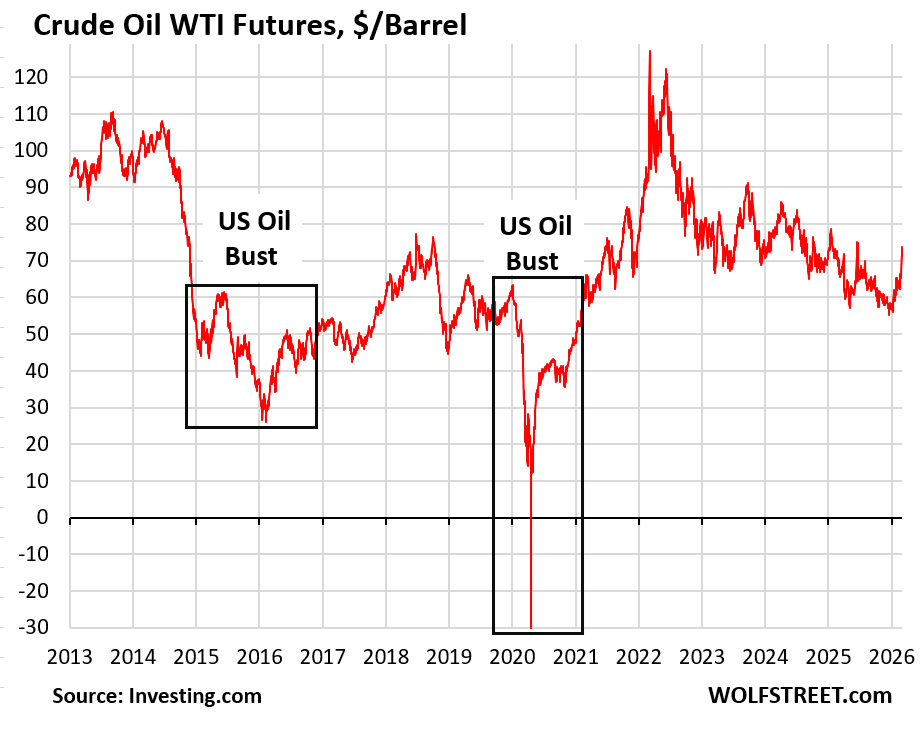
The price of the crude-oil grade West Texas Intermediate (WTI) spiked to $75 per barrel over the weekend following the beginning of the Iran war, and to nearly $78 earlier today, and currently trades just below $73. The last time WTI experienced a spike like that was in June 2025, after the US bombed Iran’s nuclear facilities, before prices replunged.
The #1 worry for US oil and gas drillers is overproduction. Frackers can ramp up production far faster than demand can increase, as has been learned painfully twice since fracking took off. Overproduction by US frackers started pulling the rug out from under prices in mid-2014; WTI crashed from over $100 a barrel to below $30 a barrel by early 2016. During that Oil Bust, many dozens of oil & gas drillers filed for bankruptcy. Then in 2020, it started all over again; overproduction caused the price to collapse, and dozens of oil and gas companies filed for bankruptcy that year. Drill Baby Drill, but not too fast.
“Discipline” in production has since then been the guiding principle of the industry in order to keep the price from collapsing once again. At today’s prices, drillers are now aggressively hedging their future production, according to Bloomberg. This locks in that price, at which fracking is very profitable. And this hedging activity by US producers is also a force that is keeping a lid on the price.
This isn’t the 1970s anymore.
Back in the 1970s, during the two Oil Shocks, the US was dependent on oil imports from OPEC, and OPEC ran the show. Now the US is the largest oil producer in the world and has become a major exporter of crude oil and petroleum products (gasoline, diesel, jet fuel, pet coke, propane, ethane, etc.), exporting substantially more than it imports.
Imports dropped further in 2025, and 57% of those imports came from Canada, and they also dropped. Only 14% came from OPEC.
A big part of the oil trade is to import crude oil, refine it, and export the value-added products, such as gasoline and diesel, a big trade even for California refineries, which are not connected via pipelines to the producing regions east of the Rockies and struggle with declining demand for gasoline in the state. They get California’s production plus import crude oil, and then export diesel, gasoline, and jet fuel, and other petroleum products to Latin America.
Oil & gas is a huge thriving industry in the US, with massive global trade. As a large net exporter of petroleum and petroleum products – exporting more than it imports – it will benefit from those higher energy prices rippling out from the Middle East.
The US is also the largest natural gas producer in the world, and a huge exporter of natural gas, including via pipeline to Mexico and Canada, and has become the largest exporter of LNG in the world. The biggest customer of US LNG in 2025 was by far Europe.
And the US and Canadian energy markets are joined at the hip. The electricity grids are connected, allowing the US to fill in gaps in Canada by selling more electricity to Canada than it imported from Canada as needed recently due to BC Hydro’s issues, and vice versa. The US imports more natural gas from Canada than it exports to Canada, a function of where producing areas, pipelines, and population centers in both countries are. In terms of petroleum imports by the US, Canada is its largest source, providing 57% of total US imports. But the US also exports petroleum products to Canada. So this isn’t the 1970s anymore.
Production hit record, despite efforts to not overproduce.
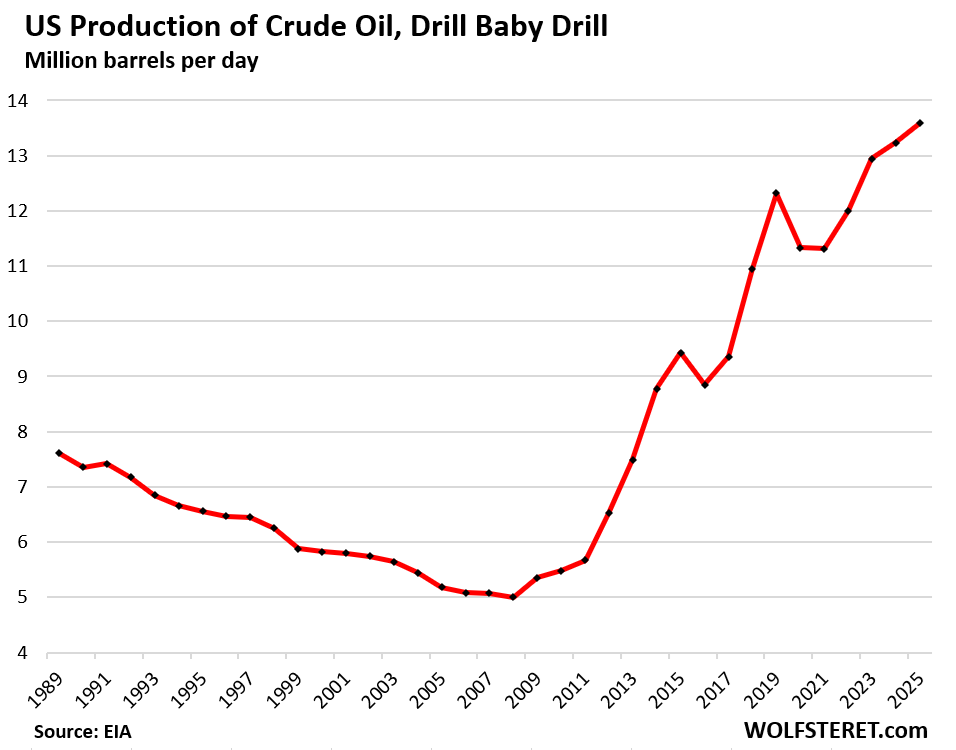
Crude oil production in the US rose by 2.7% in 2025, and by 172% since 2008, to a record 13.6 million barrels per day (MMb/d), according to EIA data.
US oil production rejiggered the global energy dynamics. And for the US economy, it created the advantages of relatively cheap and reliable energy for transportation and commercial uses, and as feedstock for the vast US petrochemical industry.
The two kinks in the chart in 2016 and then again in 2020-2021 were the results of Oil Bust 1 and Oil Bust 2 when overproduction caused the price of US crude oil to collapse. Oil-and-gas drillers filed for bankruptcy in two big waves, which reduced production, which allowed the price to rise again into a survivable range.
Net exports (exports minus imports) surge.
Exports of crude oil and petroleum products were roughly stable in 2025 at 10.7 MMb/d and up by 495% from 2008 (red line in the chart below).
Imports declined to 7.9 MMb/d, far below the levels in the prior decades, which had peaked at nearly 13.7 MMb/d in 2005 (blue line).
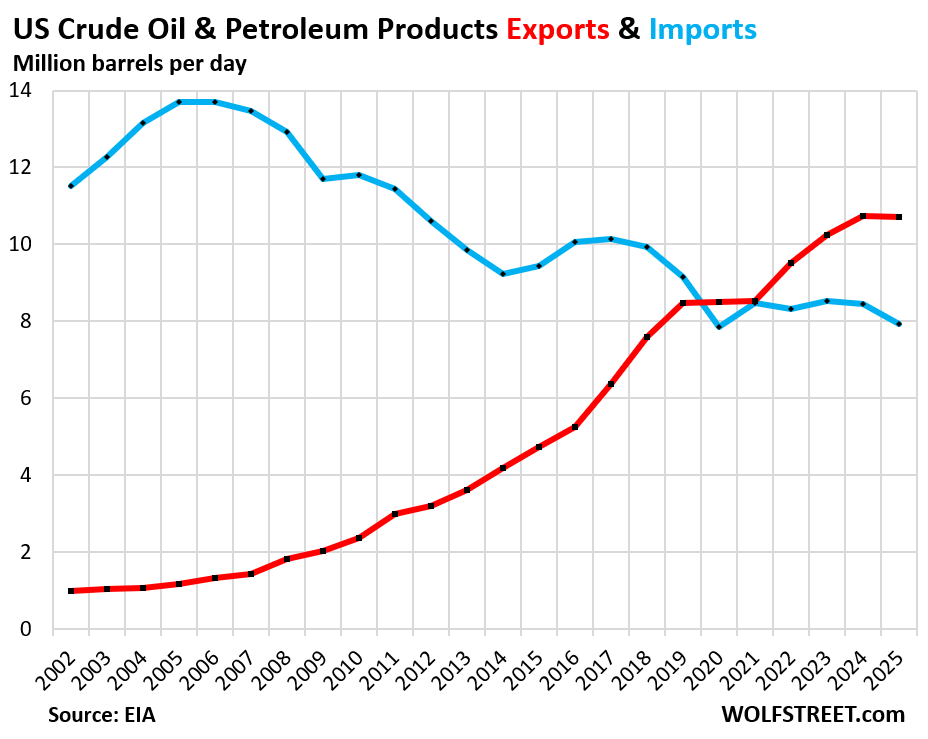
In 2020, when the red line in the chart above surpassed the blue line for the first time, the US became a net exporter of crude oil and petroleum products, exporting more than importing.

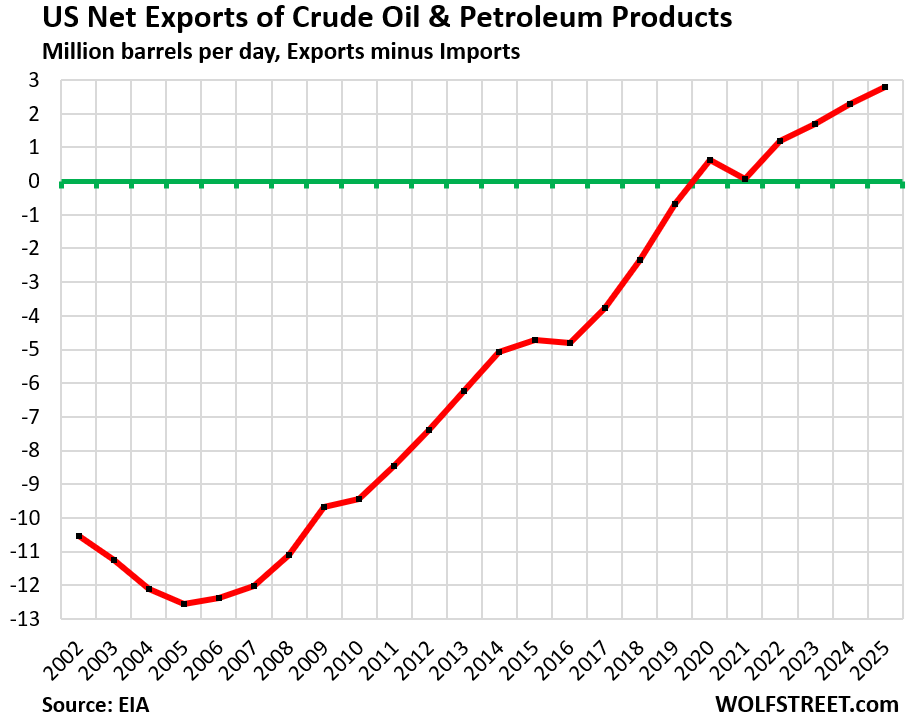
In 2025, net exports of crude oil and petroleum products rose to a record 2.8 MMb/d. In 2005, before fracking took off, the US had a deficit in net exports of 12.6 MMb/d. This is how US oil production rejiggered the global energy dynamics.
Exports of petroleum products.
Exports of petroleum products rose by 1.4% to 6.73 MMb/d, accounting for 63% of total exports. This includes 2.8 MMb/d of finished motor gasoline, distillate (such as diesel), and jet fuel.
Exports of crude oil declined by 2.9% in 2025, to 3.99 MMb/d, accounting for 37% of exports.
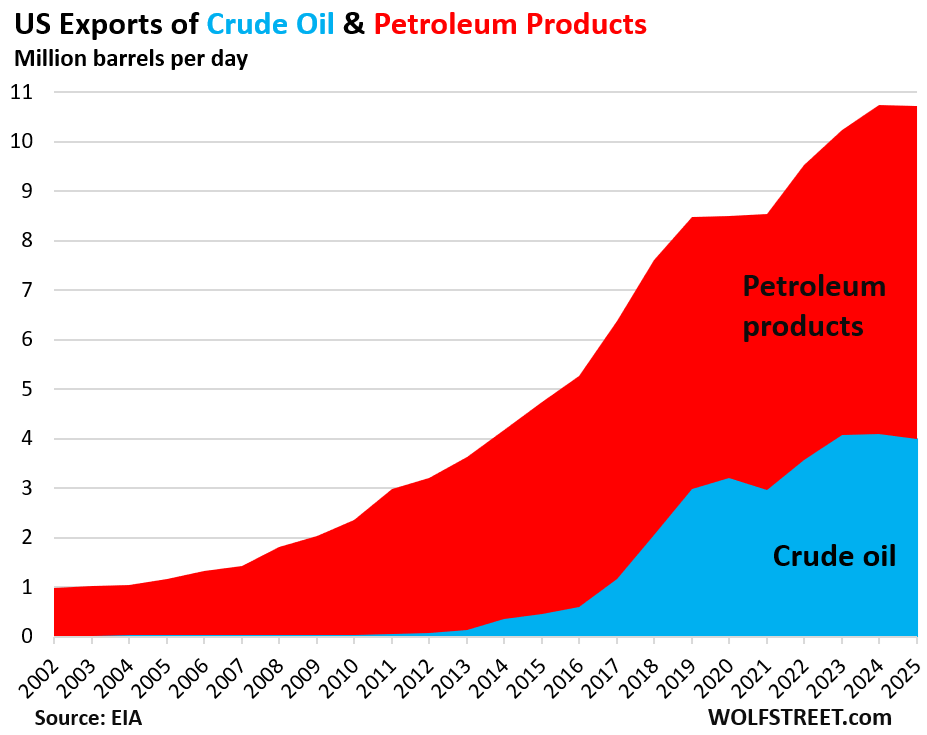
Even refineries in “oil island” California are in on the deal. They’re not connected via pipelines to US producing regions. California produces some of its own crude oil, and imports crude oil from Alaska and foreign countries. Some crude oil arrives by oil train across the Rockies. But it’s also a large exporter of gasoline, distillate, and jet fuel, mostly to Latin America. West Coast (PADD 5) refiners exported 0.41 MMb/d to other countries in 2025.
Importing crude oil, refining it, and exporting the value-added product is a huge profitable business for refiners in the US, which explains in part why the US imports crude oil: Refiners sell the refined products to foreign customers.
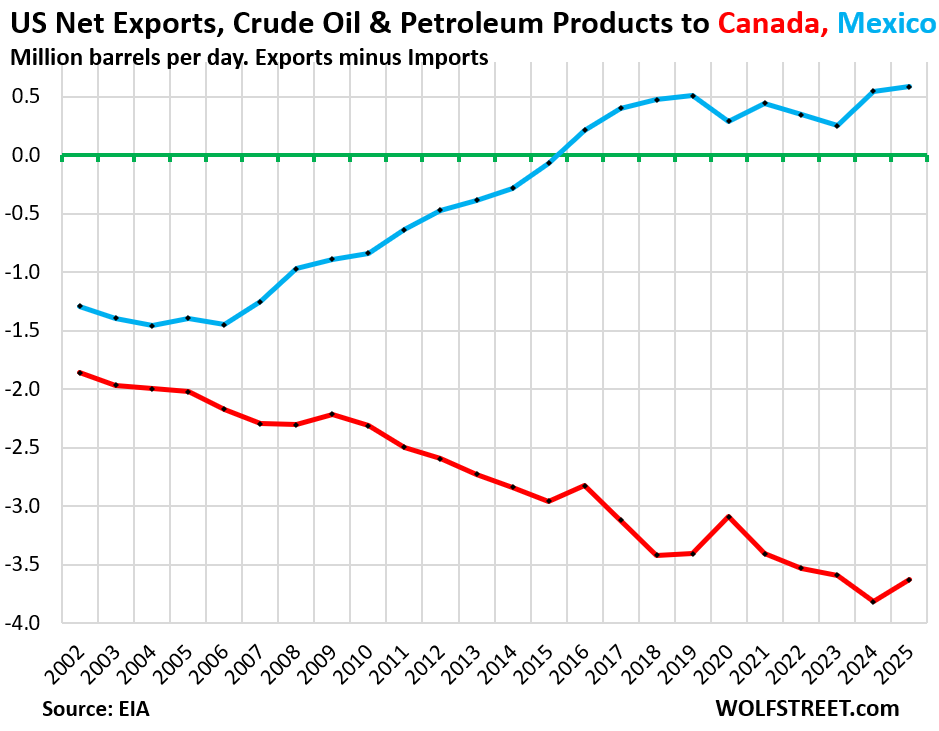
For example, the US imported 0.50 MMb/d of crude oil from Mexico in 2025 and exported 1.1 MMb/d of petroleum products (largely gasoline and diesel) to Mexico. And net exports (exports minus imports) to Mexico rose to a record 0.59 MMb/d.
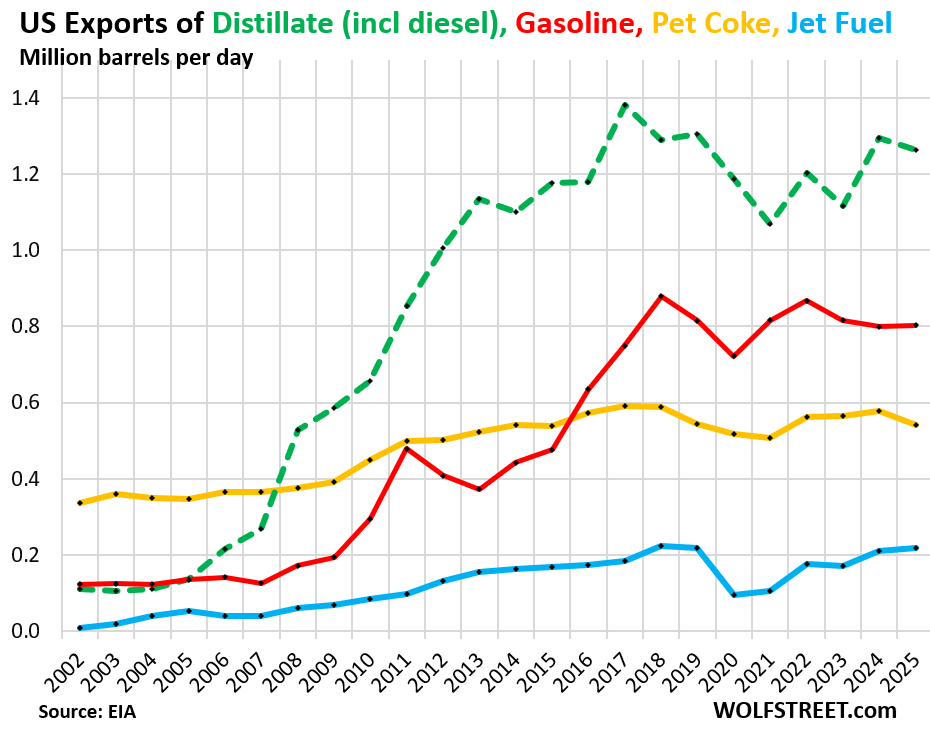
Among the many petroleum products that the US exports are finished petroleum products, the largest categories of which are by export volume:
- Distillate: 1.26 MMb/d
- Gasoline: 0.80 MMb/d
- Petroleum coke: 0.54 MMb/d
- Jet fuel: 0.22 MMb/d
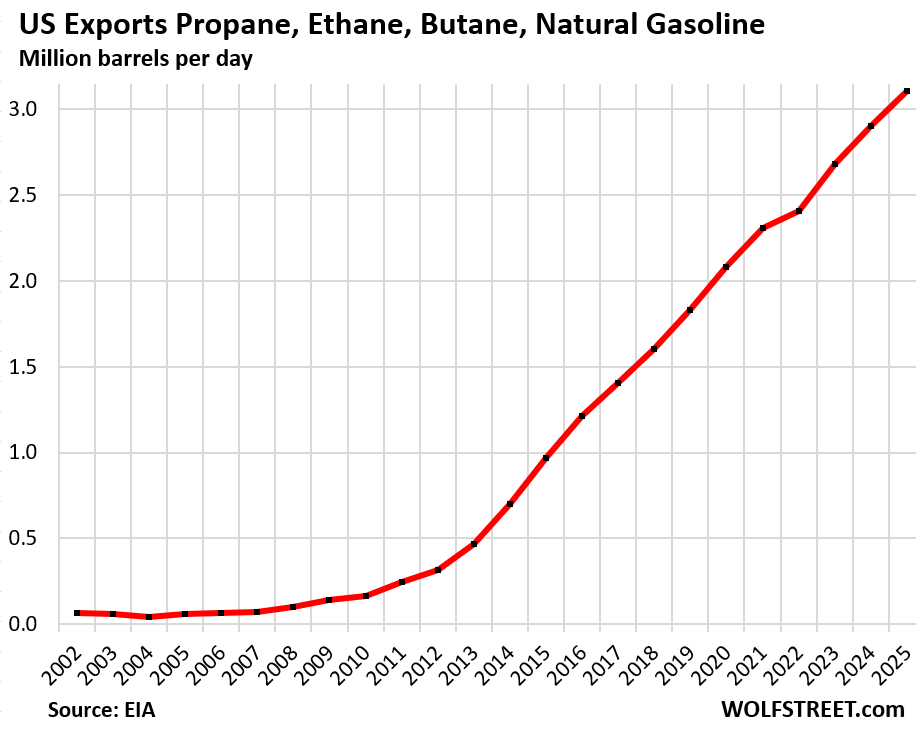
Exports of propane, ethane, butane, and natural gasoline soared by 7.0% to 3.1 MMb/d in 2025, up from near zero in 2008, an astounding export boom:
Net exports to Canada and Mexico.
Net exports to Canada were negative, but less so: US exports to Canada rose to 0.87 MMb/d in 2025. Imports from Canada fell to 4.49 MMb/d. And net exports to Canada were negative, but that deficit became smaller in 2025, 3.63 MMb/d (red line in the chart below)
Net exports to Mexico rose to record 0.59 MMb/d, as imports from Mexico fell to 0.50 MMb/d, the lowest since 1979, and exports to Mexico dipped to 1.09 MMb/d (blue).
In other words, the US has surplus with Mexico and a deficit with Canada.
Imports from Others.
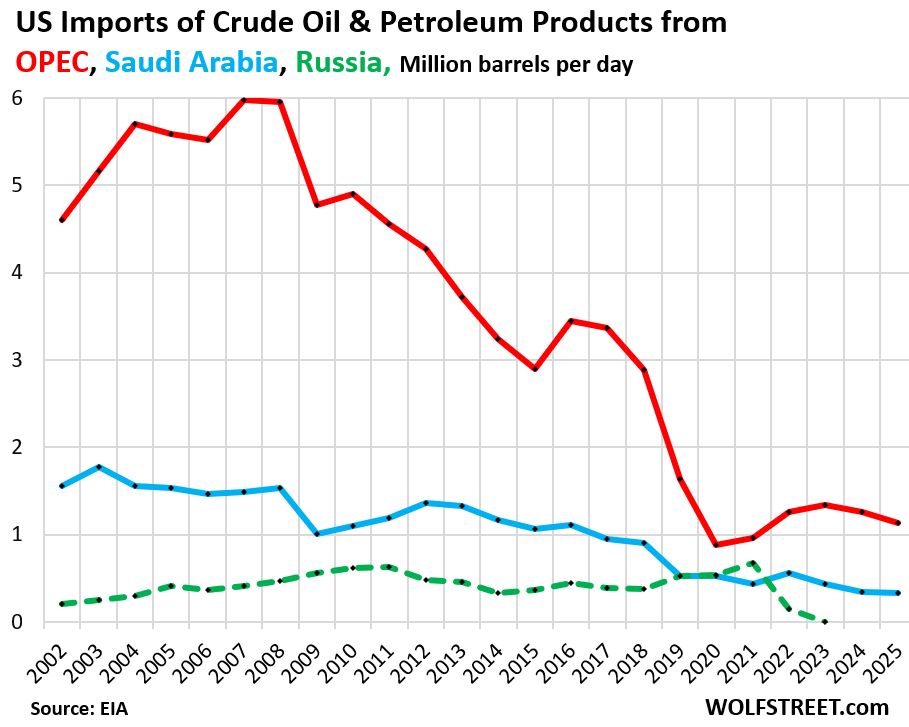
Imports from Saudi Arabia declined to just 0.33 MMb/d in 2025, down from the 1.5 MMb/d range before fracking took off on a large scale (blue in the chart below).
Imports from OPEC overall fell to 1.1 MMb/d, down from the 5-6 MMb/d range in the years before fracking took off (red).
Imports from Russia dropped to zero in mid-2022 and stayed there (dotted green).
In case you missed it:
U.S. Gasoline Demand Fell Further amid Long-Term Structural Shift: Plunging Per-Capita Consumption
Enjoy reading WOLF STREET and want to support it? You can donate. I appreciate it immensely. Click on the mug to find out how:


“Exports of propane, ethane, butane, and natural gasoline” Should that be natural gas?
No. Natural gasoline is a liquid hydrocarbon mixture of pentanes and heavier compounds. Among other uses, it’s blended with gasoline to change the octane rating and vapor pressure rating.
LNG is mostly methane.
America is basically food and energy independent.
Same with Russia.
China…not so much. China is also Iran’s largest trading partner. China will exert enormous pressure to end this conflict.
I think Israel is fairly immune to Chinese pressure.
China could sell weapons to Israel’s neighbors in retaliation.
The US exports light crude and commodity crops like soy beans, but needs to import heavy crude and high value crops like fruits and vegetables.
China imports many raw materials, energy and foodstuff, and exports manufactured goods such as REEs, APIs, PCBAs, PPEs, … graphite.
The fact is the world is interconnected that no nation can survive on its own, including the US and China.
I’m really sick and tired of reading this ignorant BS — “The US exports light crude … but needs to import heavy crude”:
Why don’t you RTGDFA before you open your mouth and stick your foot into it???
I told you exactly what the US exports in the article with charts: diesel, gasoline, jet fuel, petroleum coke, butane, propane, ethane, natural gasoline… that’s the majority of what it exports. It also exports various grades of crude oil.
It imports crude, a big part of it on the West Coast because there is no frigging oil pipeline across the Rockies, you moron! The West Cost ALWAYS has to import crude oil, no matter how much crude oil Texas produces. And so the West Coast refiners import crude oil, refine it, and export diesel, gasoline, and jet fuel to Mexico and other Latin American countries.
I told you all this in the article with charts.
And your fruit comment was just as ignorant.
Another issue is that the oil that the US exports (light sweet) is not the same kind that it imports (heavy sour). Different prices and uses.
That’s only an issue for old refineries that haven’t invested in updating their equipment to take advantage of the supply they can get.
Then there are refineries that aren’t even connected to the producing regions east of the Rockies, and much of their supply has to come from imports. This is the West Coast! Build a pipeline across the Rockies! Canada could do it, lol
Well-run refineries invest to maximize their profits. And they have been doing that.
Gasoline consumption in the US is declining. The biggest customers in the US is the petrochemical industry, and it doesn’t need diesel and gasoline. It needs all the other stuff.
People (and the media) have been spouting off the same goofball stuff for 15 years.
the oil supply glut narrative is finally following the climate change narrative to the grave. the iranian invasion is, again, reminding leaders that without 100MM bbls/d and 150Bcf/d the modern world doesn’t function. wish it did but doesn’t. if you have to try to measure the water line on tankers off china to prove a glut, you just have to look in IEA SPR’s to see that “glut” disappear. the taco bet will end in tears
typo: 150mBcf/d
I worked on the upstream side of the oil industry for 15 years and the refining and chemicals side typically has very slim profit margins. The money is made upstream. Occasionally the margins surge and the downstream makes money hand over fist, but it is rare. I spent my career listening to refiners complain about how low their margins were, and I saw it in their compensation and the penny-pinching on their project side.
“The money is made upstream.”
100% correct.
Saudi extraction costs have historically been *extremely* low – we’re basically talkin’ Jed-Clampett-Huntin-for-some-food-via-shotgun-up-came-bubblin-crude-type-low…like under $2 per barrel (worked for Aramco in the 90’s).
Profitability at varying price levels is absolutely key to the oil story worldwide.
Fracking absolutely saved America’s ass post-China-demand explosion that turned 2000’s $20 oil into 2008’s $100 oil.
Fracking tech was around for a long time…but the initial versions of it were only profitable at prices way above $20.
So the China-demand/price-surge summoned into existence the US fracking supply surge…but only at prices 3x-4x ye Olde $20.
So America is a lot more “energy independent” but only because we’re paying $70 rather than $20…so not an unalloyed “win” for the US.
No, it sure as hell isn’t the 70’s anymore, and quite frankly, I do view turning America into the typical oil-producing country as a good thing. Regardless, all of this is distracting us from the real issues and serious structural problems that still have not been addressed. How’s that trade deficit looking? How are we going to address all the domestic problems and infrastructure updates with all of our resources being diverted to war? Apparently congress is no longer necessary, Clown world Wolf.
Well your words actually annunciate some of the social issues that are a challenge for our society. I remember 71 waiting for my draft number too be selected as a US envoy to Vietnam.
Winning hearts and minds is the appropriate protocol until the illusion fades and all that is left is the damage. Which is of course where the glue of it all sustains us. That glue IMO is love.
I consider myself lucky because I had one grandfather that lead a business through a great depression and world war. I had another grandfather that survived genocide in Italy and fought in the pacific for his citizenship. More importantly, I had the opportunity to get to know both of them and listen to their advice before they passed. The average American is an idiot now. They are not prepared for what is coming. I worked for my grandfather in the 80’s and we did business in Russia. I saw what American polices, coupled with Russian blunders in Afghanistan, did to that country first hand. You had to grease the local oligarch to get things done. Tough bunch of people. America is heading to the same endpoint unless congress can reign this administration in ASAP. But boy old Chucky Schumer got real quite didn’t he? Looks like Massie and Paul are the only statesmen left.
Hedge accordingly.
Just filled up at my very convenient location that saves about 4 minutes out of my life. Soon however may have to do the Costco thing with all the other Costco people.
Not looking forward to that. 1st world problems
These charts make my heart warm!
Upstream retired engineer with 45 years experience. Hz oil production been around for many decades in conventional higher perm reservoirs. So many rules of thumbs existed in my engineering background that limited our knowledge and understanding of the source rock capabilities. Sustained prices above 30-40 usd and economic hz gas production under 2 usd allowed even more innovation and growth.
Praise the lord for USA oil. Wolf started his career I think in Tulsa Ok during the oil boom . Tulsa was oil capital of world in the 1920s. Now the permian basin should be but is not
Hmm, are the oil prices global? Driving gas prices, transportation etc, inflation everywhere? And this is the topic.
The topic is supply of oil, gasoline, other fuels. That’s what is driving prices in the US and globally. That’s what is at risk with Iran. That’s what the US can produce in prodigious amounts. The article discusses supply by the US. US drillers can put a lot of supply on the market, very fast. They can do that until the price collapses and they go bankrupt, as they have shown twice already.
In the long run they might do. If the war continues, the whole reset of global energy trade (using more US oil) would take some time; might miss the mid-terms :|
Drilled uncompleted wells (DUCs) were falling going into 2025 but had increased by about 25% at the end of 2025. That accessible inventory provides a cushion against the current turmoil.
Another retired engineer of the opinion that between the USA and Russia production the world will continue too be supplied by all grades of petroleum products that the American consumer has become accustomed over the past 70 years
Now Trump has given the green light to spraying the food we eat with round up.
Now I want to watch the Shaft movie from the 1970s
I remember my Dad pulling the fuse on the family wagon’s gas gauge, so the needle didn’t move, and he could go to multiple gas stations that were rationing to just a few gallons per car if the tank was low, and fill up before our vacation road trip. This sure ain’t the 70’s, when the boomers had it so “easy”!
So, your dad taught you that lying and cheating was good?
Screwing over his neighbors so he can go on vacation.
What a douche.
Experience in life 85 tells me prices will be down in
imo biggest *potential* price shocks are in the LNG market, it affects fertilizer pricing and availability and there is a limited number of LNG carriers.
In other news, Iran is still loading oil tankers and those tankers have to use the strait of hormus like everyone else.
It’s not the 70’s anymore,damn shame!
Great cars and great music,seeing classic cars from 60’s&50’s common,sure gas lines and troubles in S.E. Asia but as a kid and then a teen remember good times for most parts,of course,too young for the gas line joys!
Geopolitically it feels like the 70s all over again!
Opposite. In the 70s, OPEC had the US by the balls — and was squeezing them. Now it’s the other way around.
Maybe you were too young in the 70s to remember?
I was speaking more broadly geopolitically as in comparing the attack of Iran after their revolution to get rid of the Shah, which was of course installed by getting rid of the democratically elected leader in the 1953 CIA coup.
Difference now it isn’t about the same things but of course it isn’t about the things they saw either. Iran has no desire to have nukes nor have they proactively attacked anyone in the region. Admittedly their position may change now since they know any agreement they make can instantly be ripped up and war started.
Basically the Middle East is not strategic for the same reasons but we choose to get pulled in.
Progressive lawmakers Bernie Sanders, Ro Khanna unveil $4.4T wealth tax targeting billionaires. Iran new leader will be eldest son of former regime dictator. Not much changing in power structure. Cheap energy in a growing US economy in which raising a family and driving across country on vacation has been abandoned. Irans largest trading partner China sits on sidelines patiently waiting an outcome. The most pivotal midterm elections in a century lie ahead this fall.
Isn’t it interesting how the quality of US democracy has declined along with the switch from being an oil importer to being an oil exporter.
Perhaps the oil curse is universal.
Nixon???
Chris B,
Or perhaps our democracy has not changed but the world has and not us with it.
This aged like milk. Brent oil now $91, up 35% in a week.
You missed everything. RTGDFA. You quote sheer speculation. I told you what the actual supply situation in the US is. The US gets almost no oil (if any at all) and zero LNG through the Straight of Hormuz. There is no supply impact on the US. That’s what the article told you. That’s what is different from the 1970s, when the US ran short on supply.