
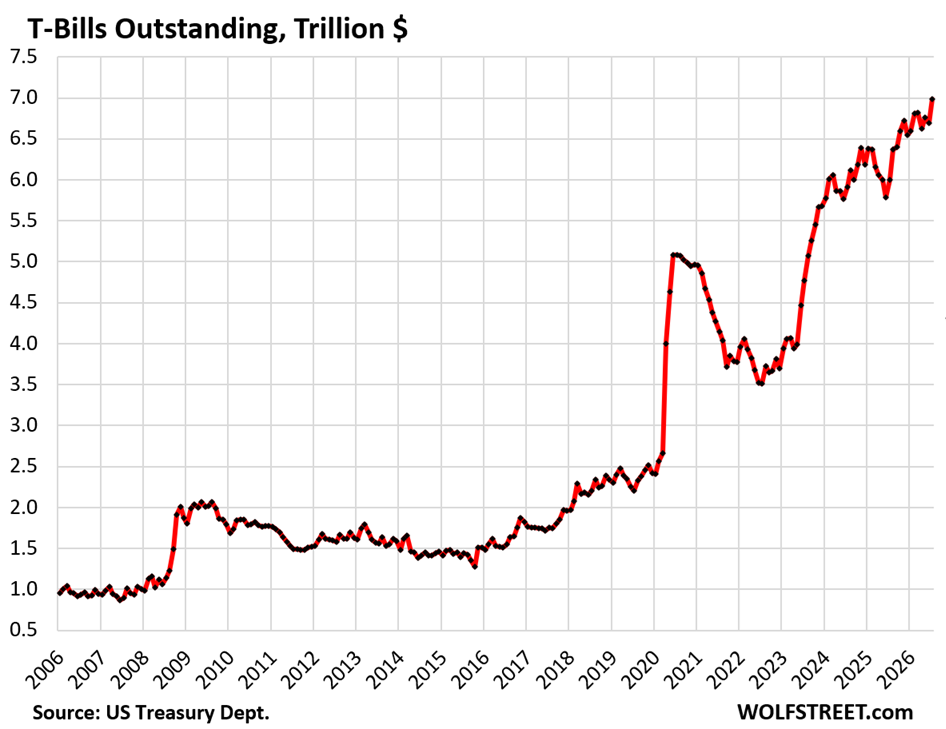
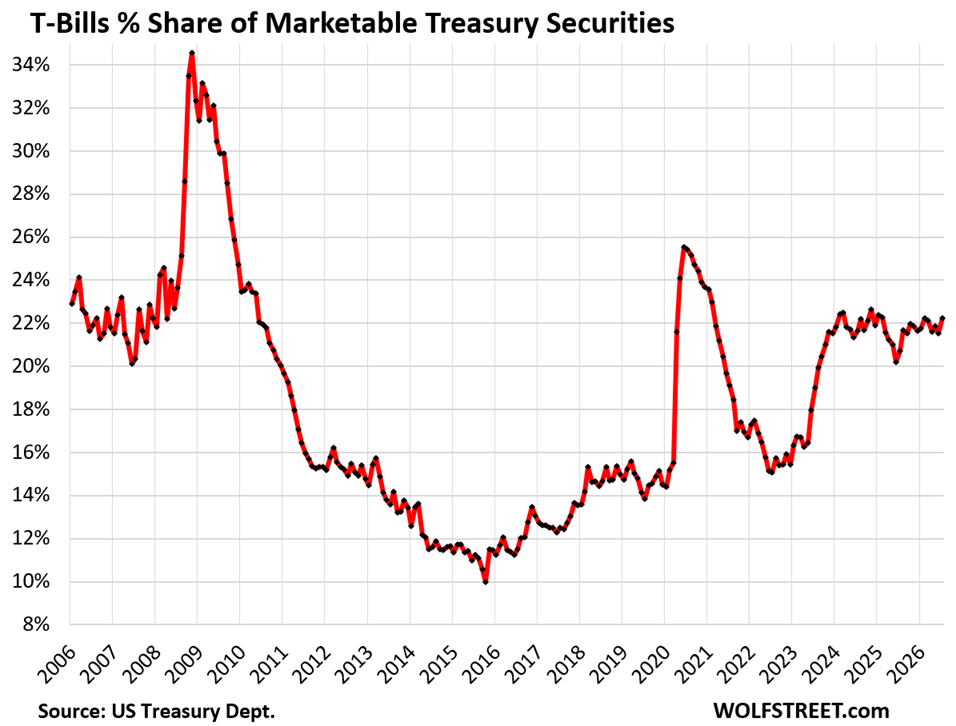
Treasury bills outstanding ballooned by $1 trillion year-over-year, to $7 trillion. But total marketable Treasury securities ballooned by $2.5 trillion. So…
By Wolf Richter for WOLF STREET.
The US government sold $638 billion of Treasury bills during the week, with maturities of 1 month to 1 year, spread over seven auctions, most of them to replace maturing T-bills. At three of those auctions, the government sold more than $100 billion each. At a fourth auction, it sold $99 billion. Those are big-fat auctions.
This was also the week when no auctions for Treasury notes (2-year to 10-year) and Treasury bonds (20-year and 30-year) were scheduled.
| Treasury bill auctions this week: | ||||
| Type | Auction date | Billion $ | High Rate | Investment Rate |
| Bills 4-week | Aug-06 | 115 | 3.640% | 3.701% |
| Bills 6-week | Aug-04 | 103 | 3.640% | 3.706% |
| Bills 8-week | Aug-06 | 105 | 3.710% | 3.783% |
| Bills 13-week | Aug-03 | 99 | 3.750% | 3.838% |
| Bills 17-week | Aug-05 | 75 | 3.785% | 3.886% |
| Bills 26-week | Aug-03 | 85 | 3.855% | 3.986% |
| Bills 52-week | Aug-04 | 56 | 3.880% | 4.050% |
| Total T-bills | 638 | |||
Short-term Treasury yields edged down this week after the FOMC’s no-rate-hike meeting at the end of July, when the bond market had already priced in a rate hike either at that meeting or at the September meeting.
Long-term Treasury yields declined after the US-Japanese intervention in the currency markets, when the US sold euros and bought yen to push up the yen’s exchange rate, along with Japan’s yen-buying. This was the big kahuna of currency interventions, and the yen soared. The Treasury Department did this to put a lid on longer-term Treasury yields, out of fear that Japan’s selling of US Treasuries to obtain the USD to buy yen with could further drive up long-term Treasury yields.
The Treasury Secretary is the top bond salesman or saleswoman in the world, and it’s their job to keep yields as low as possible to keep the government’s interest expense down. Bessent has got his hands full.
T-bill yields unwound the rate-hike expectation for the July FMOC meeting, and the expectations for a rate hike shifted to the FOMC meeting in September.
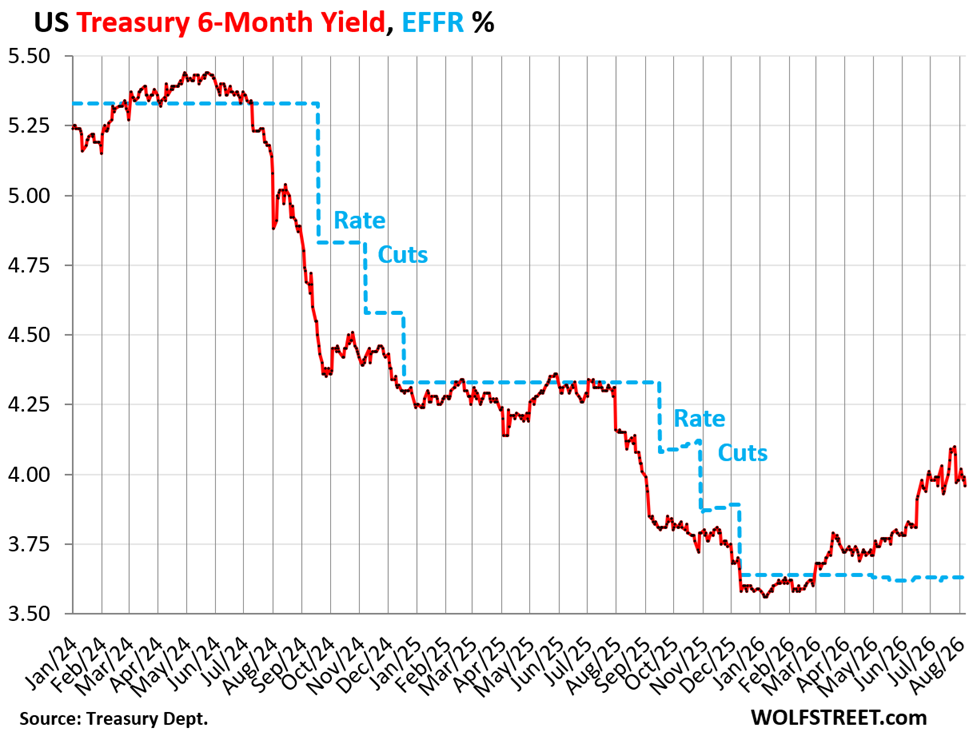
The 6-month T-bills sold at auction on Monday at a “high yield” of 3.855% or at an “investment rate” of 3.986%. That was down by about 10 basis points from the auction just before the FOMC meeting when 6-month T-bills had sold at an investment rate of 4.08%.
In the secondary market last week, the 6-month Treasury yield edged down about 2 basis points to 3.96% by late afternoon Friday, according to Treasury Department calculations (which are close to the “investment rate” at the auctions).
Note the mini-spike just ahead of the July FOMC meeting to reflect the expectation of a rate hike, and the drop-back since then.
The 6-month yield is now 33 basis points above the Effective Federal Funds Rate (EFFR, blue, 3.63%), which the Fed targets with its policy rates. So the expectations of a rate hike have remained intact, but shifted back to September.
The surge in T-bill issuance has pushed the amount of T-bills outstanding to $7.0 trillion by the end of July, up by $1 trillion from a year ago, according to the Treasury Department, which releases this data monthly. The big-fat T-bill auctions this week are not yet included in the data.

But but but… issuance of Treasury notes and bonds, oh-la-la, has also surged, so that the total amount of marketable securities outstanding has ballooned by $2.5 trillion year-over-year to $31.4 trillion at the end of July, and the share of T-bills has remained at around 22% of total marketable Treasury securities outstanding for nearly three years. In July, T-bills’ share rose to 22.2%.
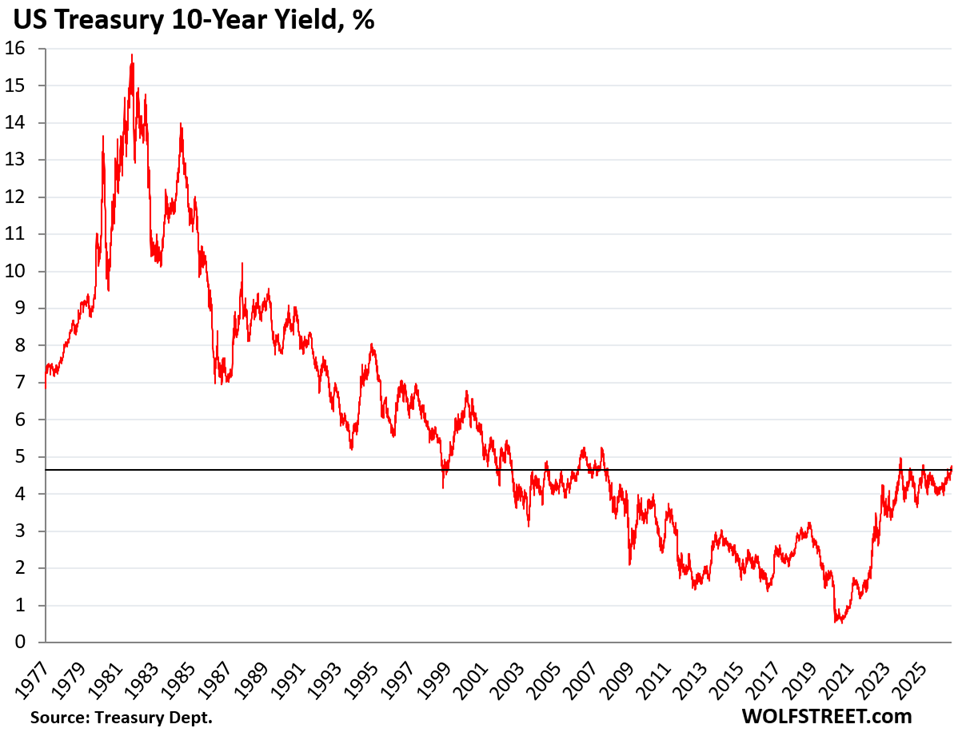
The 10-year Treasury yield declined by 10 basis points during the week to 4.65%, following the big-kahuna intervention in the currency markets that at least temporarily removed the threat from the bond market that Japan’s authorities would sell some of their Treasury securities to raise the dollars needed to buy yen to keep the yen from collapsing further.
But the inflation threat remains intact. Higher yields allow the bond market to live with higher inflation as the higher yields would more than compensate bondholders for the expected loss of purchasing power of the securities over the term of the securities. How much inflation buyers and sellers in the bond market expect over the next 10 years goes into this calculus. And these expectations differ, which is what makes a market.
This guy here is not a buyer of 10-year maturities at this yield, not anywhere near, because inflation has been hot for over five years, and the Fed has cut rates in 2024 and again in 2025, with the last three rate cuts occurring while inflation was re-accelerating.
That’s not a good sign, but a sign of a lax Fed that has chosen to let the economy run hot, with more nominal economic growth and more inflation, as a way to manage the growth of the gargantuan Treasury debt.
Supporting this theory was the fact that Warsh had made a huge effort multiple times over and over again during the FOMC press conference to dispel that theory with words – rather than with a rate hike and the announcement of more balance sheet reduction. Whatever his thinking may be – he’s a lifelong inflation hawk – but words won’t suffice, and a robust majority on the FOMC’s voting members are in the camp of letting the economy run hot.
Letting the economy run “hot” is a logical way of managing the debt, as Congress and various administrations have made zero effort to get the deficit down to where it would be sustainable without running the economy “hot.” We get that. But it makes long-term Treasury maturities unattractive at these yields.
The long view of the 10-year Treasury yield shows that in the big picture, the dip this week was practically nada; and that the 10-year yield can go a lot higher when inflation takes off, which is what the world’s top bond salesman is worried about.
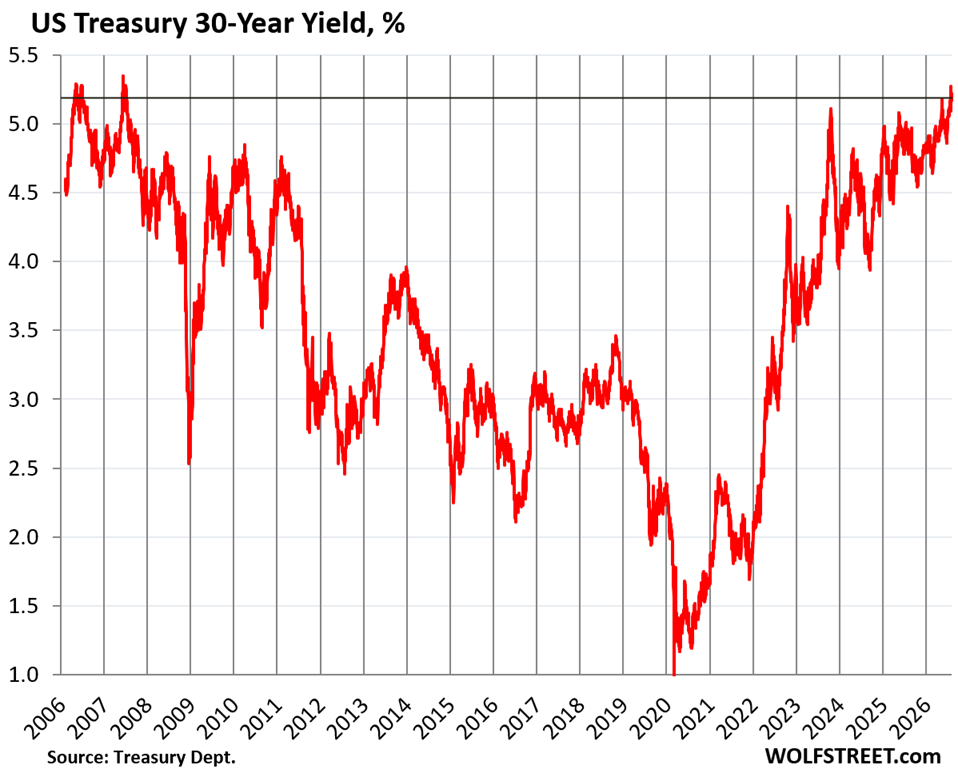
The 30-year Treasury yield declined by 8 basis points this week, from the two-decade high a week ago, to 5.19% on Friday.
The 30-year yield is less of a concern to our top bond salesman since issuance is relatively small, roughly half that of 10-year notes, and it doesn’t have the benchmark characteristic of the 10-year yield.
Markets use the 10-year Treasury yield for pricing of other yields, such as mortgage rates and corporate bonds. A surge of the 10-year yield drives up long-term borrowing costs across the private-sector economy. The 30-year yield doesn’t serve that function, and there were many years when the US didn’t even issue 30-year bonds. So the 10-year yield really matters, and when it goes over the red line of 5% at an auction, Bessent is going to have conniptions. But he’s probably not going to lose a lot of sleep over the 30-year yield.
In case you missed it: One Thing Is Clear about the AI Boom: It’s Burning Huge Amounts of Cash, and Alphabet Needs More
Enjoy reading WOLF STREET and want to support it? You can donate. I appreciate it immensely. Click on the mug to find out how:


The Fed has some competition. I just bought 1 mo. CD with 3.9% yield.
1. Wolf, take rest. World, US, treasuries can take care of themselves.
2. It seems, SGOV is the best foot forward at least for the next three months.
3. US, US Stock market is older than US itself. More than 250 years indeed. JP Morgan, Corenelius Vanderbuilt, Edison, Ford and Peter Lynch.
4. Bond market is larger than stock market. Smarter people (not necessarily rich) are in bonds not stocks.
5. Governments all over the world sacrificed bonds in favor of stocks for al most 20+ years (I stopped counting with my toes)
6. Please unblock Mr. Engles. We need to know if we are the only ones tripping.