
Which raises a question: How many more Fed rate cuts would it take in this inflationary era to drive the 30-year Treasury yield to 6%?
By Wolf Richter for WOLF STREET.
Treasury yields from 2 years to 30 years spiked today – along with crude oil prices and inflation fears – after Iranian attacks on oil facilities in the United Arab Emirates, commercial ships, and US Navy ships. Treasury yields are like a loaded spring amid escalating inflation fears. Rising yields means falling prices for existing bondholders.
The 30-year Treasury yield jumped by 6 basis points at the moment to 5.03%, the highest since May 2025, and is now 139 basis points above the Federal Funds Rate of 3.64% (EFFR, blue line), which the Fed targets with its policy rates, as the bond market is now pricing in significantly higher inflation rates over the life of the bond than the Fed’s 2% target.
A dovish Fed – a Fed that threatens to “look through” surging inflation because it’s just an energy price spike or whatever – spooks the long end of the bond market. The more the Fed cuts, the higher the 30-year yield? Which raises the question: how many rate cuts would it take in this environment to drive the 30-year yield to 6%?
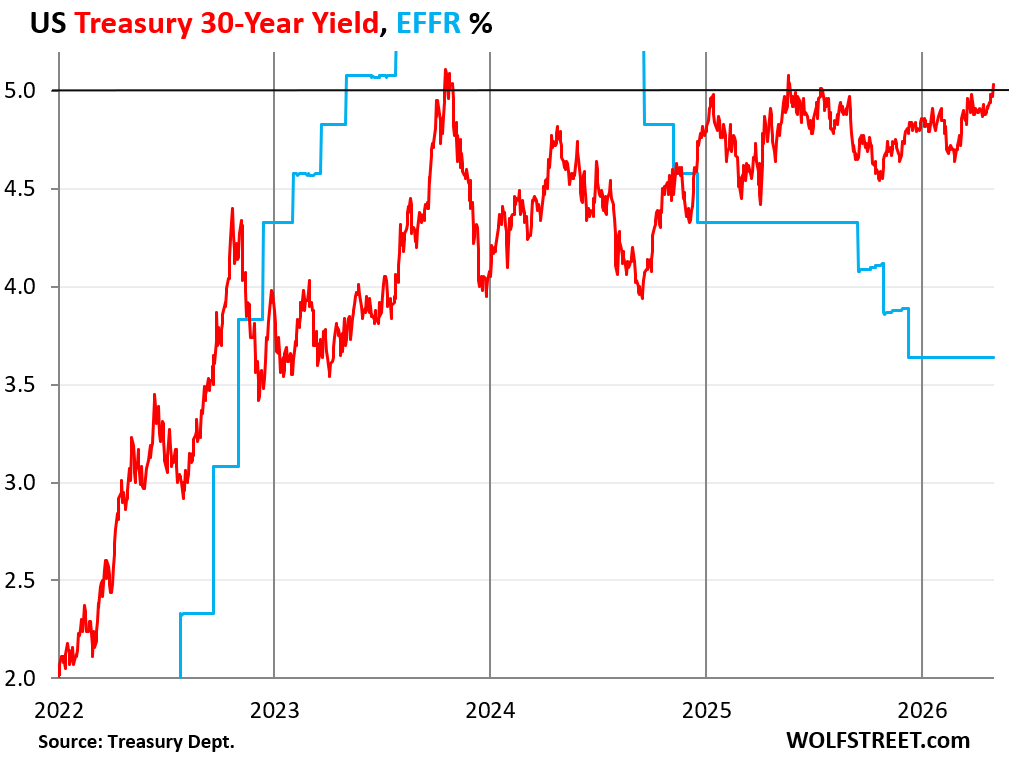
But historically, 5% is not a high 30-year yield: between October 1979 and October 1985, the 30-year Treasury yield was over 10% and topped out at just over 15% in September 1981. It didn’t drop consistently below 5% until the Financial Crisis in late 2007.
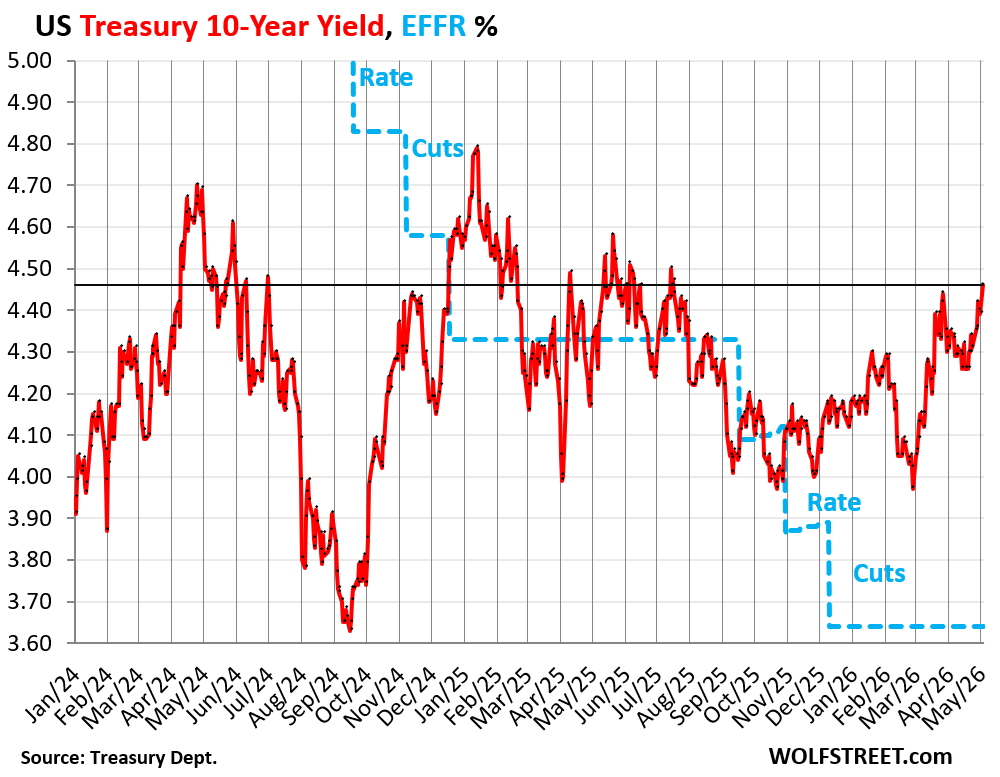
The 10-year Treasury yield spiked by 7 basis points at the moment, to 4.45%, the highest since the top of the spike in July last year.
Since end of February, the 10-year yield has surged by 50 basis points. It is now 82 basis points above the EFFR.
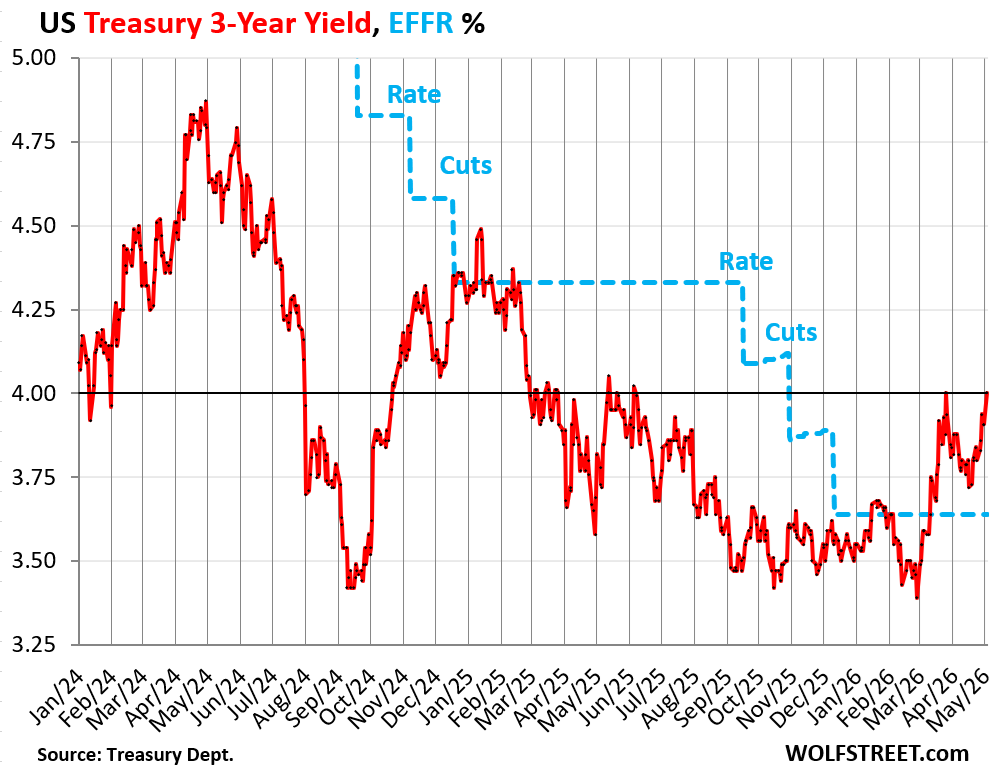
The 3-year Treasury yield spiked by 9 basis points to 4.0%, same as the top of the spike at the end of March, and both the highest since June 2025, and both 36 basis points above the EFFR, a strong signal that the bond market is expecting rate hikes over the next couple of years, not rate cuts.
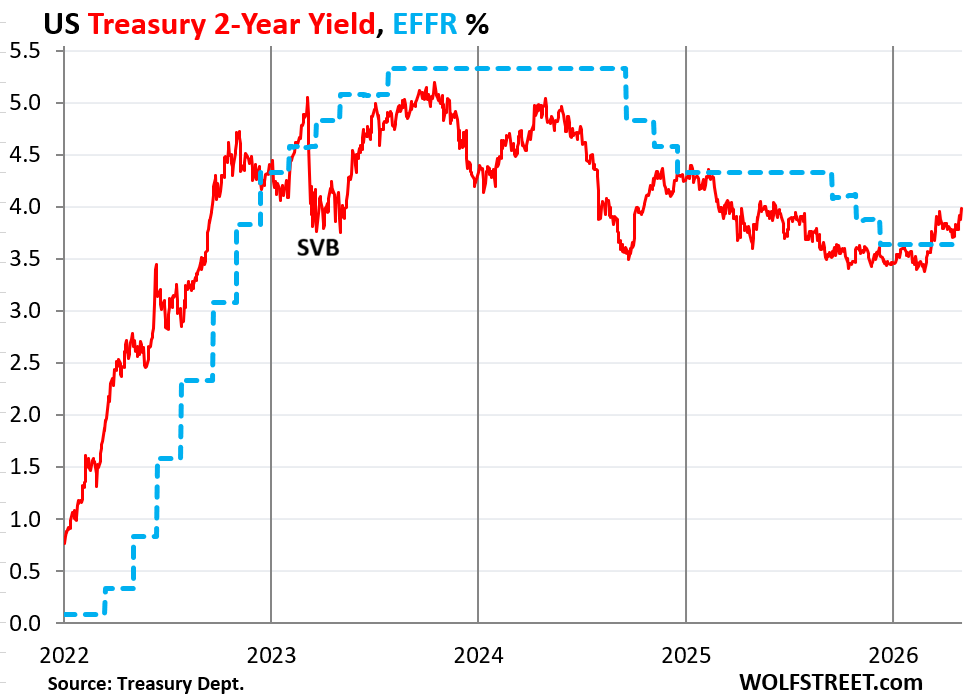
The 2-year Treasury yield spiked by 8 basis points at the moment to 3.98%, the highest since June last year.
It is now 34 basis points above the EFFR of 3.64%, the most since early 2023 just before the SVB collapse, after having been below the EFFR for nearly the entire time since the SVB collapse on rate cut expectations. This recent surge above the EFFR is a sign that this part of the bond market is now pricing in rate hikes, instead of rate cuts. And this expectation of rate hikes is also why the 30-year yield hasn’t yet surged toward 6%.
Overall inflation rates already spiked in March due to the energy price spike. It remains up for debate to what extent exactly the energy price spike will also fuel, sorry, even higher “core” inflation, which excludes energy and food products that consumers pay for directly.
The Fed favored “core” PCE price index has been rising for months and in March reached 3.2% year-over-year, with the 6-month average at 3.7% annualized. But even this core measure will trend higher as higher energy prices start filtering non-energy goods and services – part of which has already started with airline fares.
The longer end of the bond market is on edge about this inflation scenario and the risk that it could spread over many years as the Fed remains unwilling to really crack down on inflation and keeps looking for excuses – such as “looking through” the energy price spike, and perhaps under the Warsh-Fed, expecting that efficiency gains from AI will somehow solve the inflation problem.
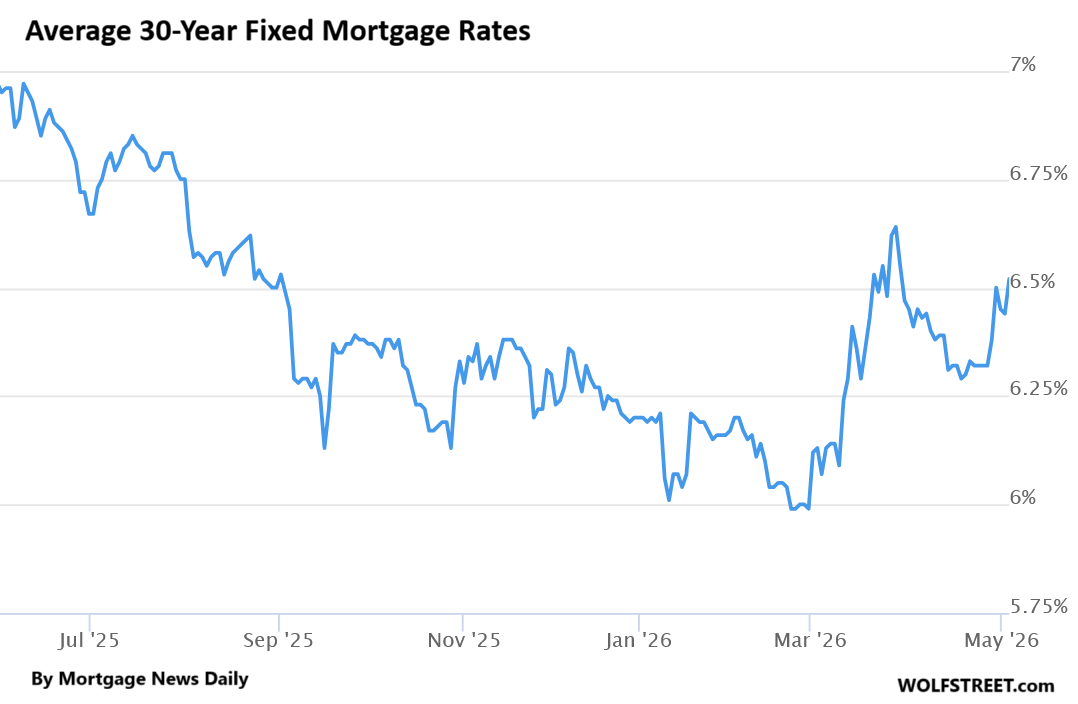
And the average 30-year fixed mortgage rate, which roughly tracks the 10-year Treasury yield but is higher, jumped by 8 basis points this morning, to 6.52%, according to the daily measure by Mortgage News Daily.
In case you missed it: The US Government sold $723 billion of Treasury Securities this Week. Inflation Jumped and Met T-bill Yields
Enjoy reading WOLF STREET and want to support it? You can donate. I appreciate it immensely. Click on the mug to find out how:


Thanks wolf
It’s starting to get real… When idealism meets physics.
Yup
The spring is loaded and there appears to be no way out except higher rates. 4.75 on the 10 year will see 7%+ for a 30 year mortgage. That should tip housing over for a nice dip. I’ve been watching Texas prices and it isn’t just Austin. Way overbuilt north of Dallas. Looked at a really nice house w/guest house in McKinney and it’s almost back to2017 price. Nothing like leaving 25% profit on the table and now trying to just break even.
Everything is fine. It’s like this… we’re on a party bus, drinking up the tax cut money, going down the mountain having a blast, with no brakes and an orangutang at the wheel.
The visuals are outstanding!
[1M] DXY might flip if “Project Freedom” produces casus belly for the US or UAE.
Howdy Youngins. YOU were not around for the Greenspan era. Maestro, as some folks called him, would raise, lower, go sideways even, and was even considered a genius. Will the FED pull the Greenspan tool out of the FED toolbox???? I sure hope so… It is truly a sight to be hold….
Diffrent times
The 30-Year Treasury has flirted with 5% several times in the past 3 years.
A technical analyst would say this is “not a breakout yet” – not until the 30-year closes above the 2023 high of 5.103% and the 2025 high of 5.09%, and stays there.
This time may not be any different – Wolf used to say that rates above 5% will get peoples’ attention and attract fresh buyers. But since the 30-year has been above 4.5% for a year now, perhaps “6% is the new 5%” to make Treasuries attractive again?
IMHO issuing debt to replace MBS rollover was the signal to us all that the Fed intended to “run it hot”.
Tidal waves of liquidity. 6% rates and $6 gas by 8/1.
It’s gonna be GREAT!
Historically rates are not terribly high, but in the post 2008 crisis where rates were kept low and most thought it was the new normal. Now lots of debt needs to be rolled over in the next 3 or so years, at much higher rates, and I suspect that it will have a major impact on everything.
Wolf
Your guidelines state:
8. Comments that are in bad faith, badger other commenters, or attack other commenters ad hominem may go into the shredder. If you criticize, please target the comment, not the person.
9. Comments that insult our authors or other commenters are shredded. This includes terms of endearment, such as “libtard” or “fascist.”
In your previous post I was called a “MORON” by commentator WB for no apparent reason. I find this very offensive. All I said was that the Dems would spend even more if they won the midterms. I agree that the Reps have not done a good job of controlling spending.
That comment should have been shredded for violating you commenting guidelines.
The 150 year average 10 year yield is 4.5%, almost exactly what it is today. Except for the oil shock in the early 80s, the two previous peaks of 5.6% during the panic of 1873 and 5.0% in the post WW1 panic in 1920 were the previous highs.
It’ll be interesting to see what the high will be during the current rebound from historical lows in 2020.
The Fed’s brake and gas pedals sigh,
Worried as markets edge high.
To slow or to speed,
They ponder with need—
Balancing growth ‘fore a crash nigh.
The Fed’s brake and gas pedals fret,
Should they tighten or loosen the net?
If rates jump too steep,
Growth might take a deep sleep—
But slow raises cause inflation to sweat!