
30-year Treasury yield looks like it’s setting up to break out past 5%. A rate cut while inflation is heating up could do it.
By Wolf Richter for WOLF STREET.
The US government sold $723 billion of Treasury securities this week, spread over 10 auctions. Of these auction sales, $483 billion were Treasury bills, with maturities from 4 weeks to 26 weeks, most or all of them to replace maturing T-bills.
The massive flow of cash into the government’s checking account – Treasury General Account or TGA – from estimated quarterly taxes, capital gains taxes, and underpaid income taxes from businesses and individuals began on April 10 and continued past Tax Day, with the TGA balance maxing out at $1.038 trillion on April 20, the highest in five years. Since then, the TGA balance has started to decline and on April 30 fell to $969 billion, still well above the Treasury Department’s “desired level” of $900 billion.
In response to this flood of tax receipts, the Treasury Department has reduced the auction sizes of the shortest-term T-bills by $65 billion combined (4-week, 6-week, and 8-week T-bills), compared to the same week in January. But it increased the 26-week T-bill auction and all four note auctions (2-year to 7-year) this week by $30 billion compared to the same week in January, in line with its longer-term needs to raise more money.
| Type | Auction date | Billion $ | High Rate | Investment Rate |
| Bills 4-week | Apr-30 | 82 | 3.60% | 3.66% |
| Bills 6-week | Apr-28 | 75 | 3.59% | 3.66% |
| Bills 8-week | Apr-30 | 77 | 3.62% | 3.69% |
| Bills 13-week | Apr-27 | 95 | 3.59% | 3.67% |
| Bills 17-week | Apr-29 | 71 | 3.62% | 3.72% |
| Bills 26-week | Apr-27 | 82 | 3.59% | 3.71% |
| Total Bills | 483 |
Inflation rose to T-bill yields. The auctions that took place early in the week came with lower yields than the week before. But that changed on April 29 and April 30 when yields rose.
April 29 brought the Fed meeting that resulted in hawkish dissents by three voting members, and Powell’s subsequent press conference. Ending the FOMC’s statement’s “easing bias” in face of rising inflation, and replacing it with a neutral bias in the future was the topic, where the next move could then be a hike instead of a cut.
April 30 brought two disconcerting inflation releases. One was the Fed-favored PCE price index which, after already accelerating for months, jumped by 3.5%; the Fed’s target is 2%; and T-bills went through the auction earlier in the week at 3.59%.
The other was the index that tracks inflation in the overall economy, not only for consumers but also for businesses and governments. This “GDP Deflator” jumped by an annual rate of 3.6% in Q1, after having already jumped by 3.7% each in Q3 and Q4.
T-bill auctions will ramp up again when the TGA balance falls below the “desired level” of $900 billion. And that’s in the process of happening.
The influx from the tariffs has slowed after the Supreme Court invalidated part of the tariffs, and replacing them with new tariffs will take some time. In addition, the government will start paying out the refunds of the invalidated tariffs, possibly $160 billion. So the ramp-up of T-bill issuance could be significant.
Treasury note auctions increased by $27 billion compared to the same week in January, to $240 billion this week, including 2-year Floating Rate Notes (FRNs).
The 2-year FRNs were sold at a “spread” of 0.103%, up from the last sale at 0.099%. Investors who bought them get an interest rate that resets every week, based on the yield at which the most recent 13-week T-bills were sold at auction. Plus investors get this 0.103% “spread” (discount margin). So if the auction yields of the 13-week T-bills rise over those two years, the yield of the FRNs will rise with them but will be 0.103% higher, unlike the regular 2-year Treasury notes that the government also sold this week, with a fixed yield of 3.812%.
| Notes & Bonds | Auction date | Billion $ | Auction yield | Spread |
| Notes FRN 2-year | Apr-28 | 34 | 0.103% | |
| Notes 2-year | Apr-27 | 78 | 3.812% | |
| Notes 5-year | Apr-27 | 79 | 3.955% | |
| Notes 7-year | Apr-28 | 50 | 4.175% | |
| Total | 240 |
All combined, the government sold $723 billion in T-bills and Treasury notes, still $35 billion lower than in the same week in January ($766 billion).
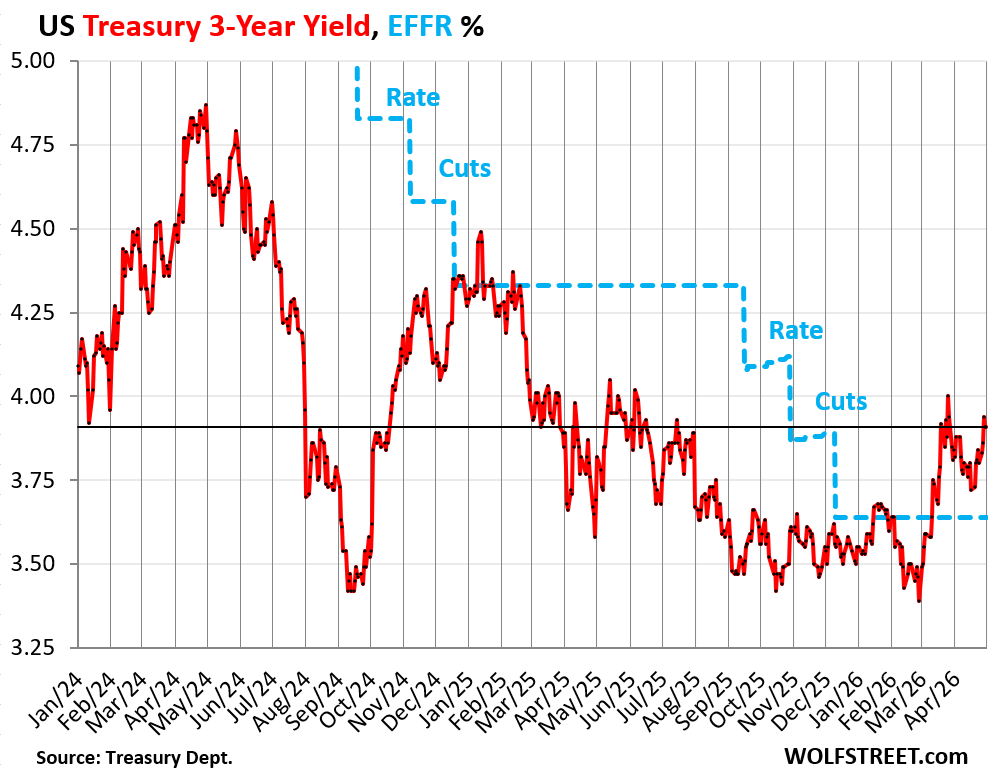
The 3-year Treasury yield was well ahead of the rate cuts and overshot substantially, falling as low as 3.42% in early September 2024, before the rate cuts even started, anticipating lots of deep cuts. At the end of February, it was down to 3.39% anticipating further rate cuts despite inflation that had been rising for months before the energy price spike. In March, the 3-year yield began to shoot higher.
But at 3.91% on Friday, it’s still only 20 basis points higher than inflation in the overall economy was in Q1, and does not look appealing at all amid these inflation dynamics.
The Effective Federal Funds Rate (EFFR), which the Fed targets with its policy rates, has remained at 3.64% since the December rate cut.
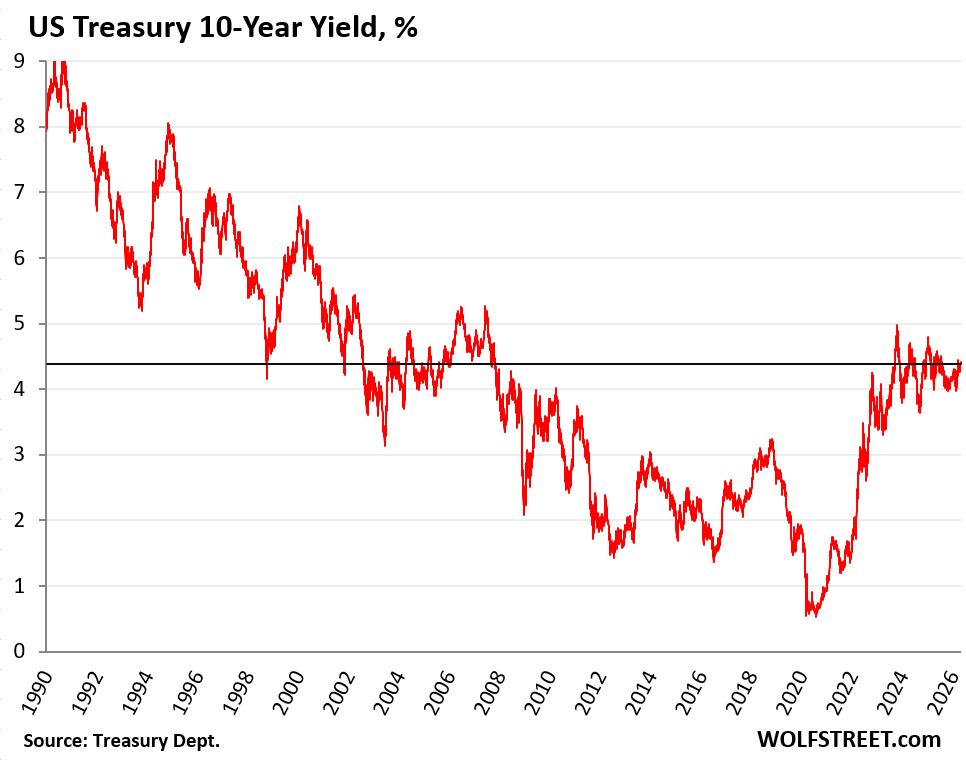
The 10-year Treasury yield rose 8 basis points during the week and ended Friday at 4.39%, after having jumped to 4.42% on Wednesday, following the FOMC meeting and press conference.
For long-term debt, inflation can be devastating if the yield is too low and doesn’t compensate the holder for the loss of purchasing power plus some.
This is the view of the 10-year Treasury yield back to 1990. From a historical perspective, the 10-year yield is not high.
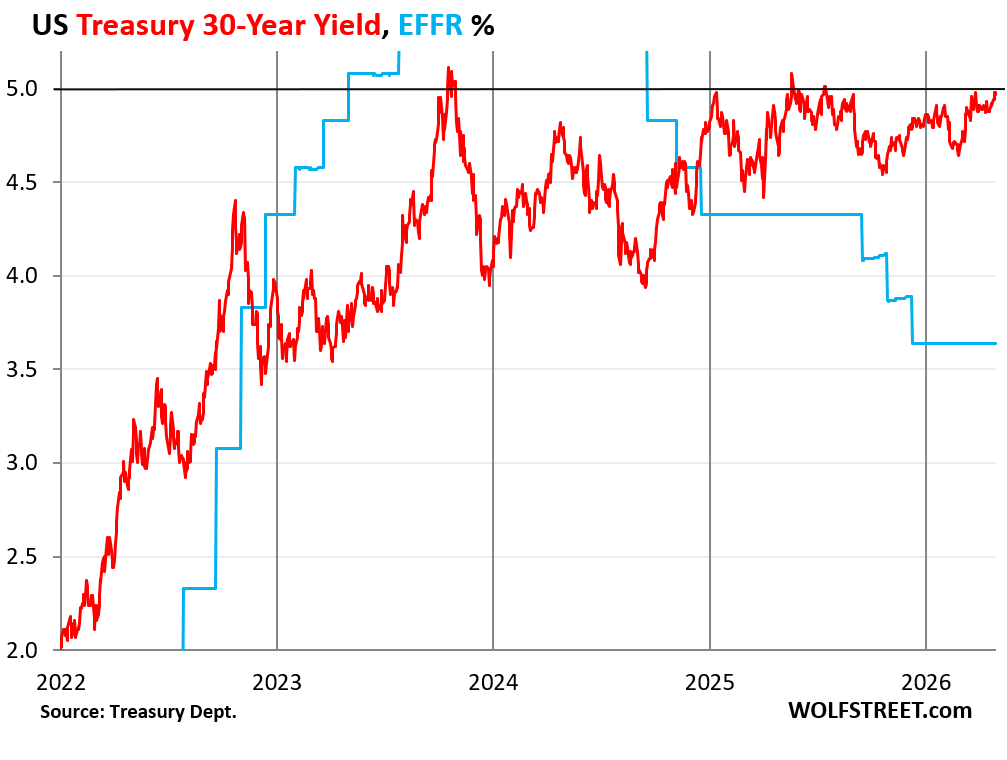
The 30-year Treasury yield had gone over 5% briefly on Thursday morning following the inflation data and on Friday settled at 4.97%. It has gone over 5% several times briefly since October 2023. And the fluctuations back down have been getting smaller and smaller.
It looks like the yield wants to break out to the upside past the 5% line. A rate cut while inflation is heating up all over the place could do it. If the bond market thinks that the next Fed, under chair Warsh, will “look through” inflation and let inflation ride, on the hopes that future efficiencies from AI or whatever will knock it back down someday, it could light a fire under long-term yields.
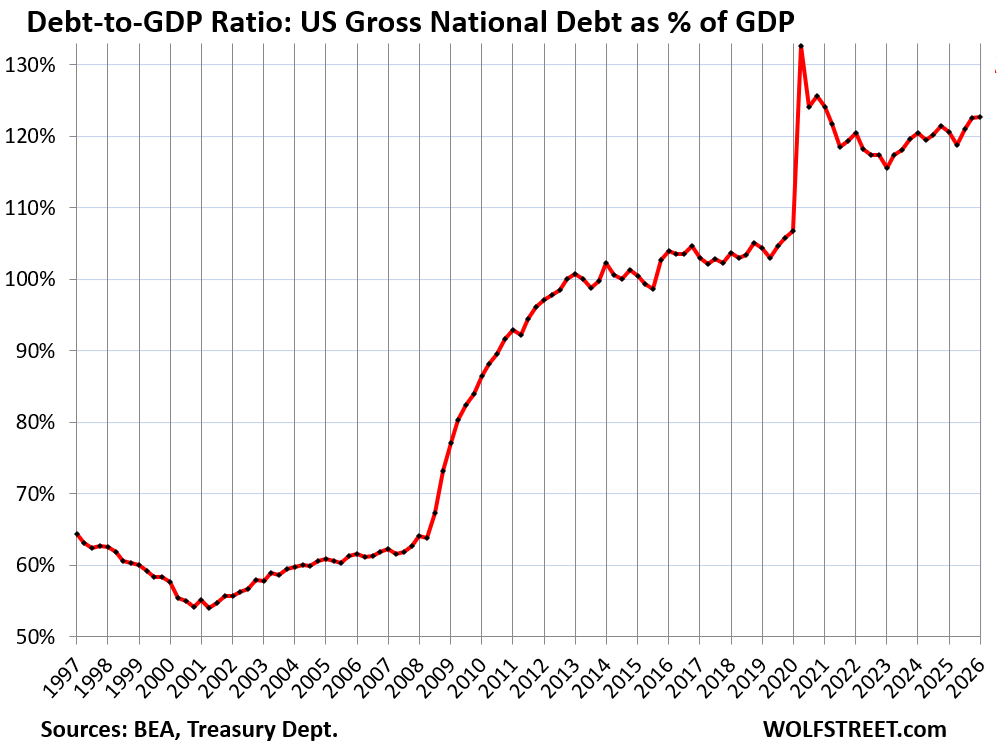
Fiscal recklessness – and the resulting surge of Treasury securities that need to be issued to fund it, and that the market has to absorb by attracting more investors possibly with higher yields – is another aspect of what bondholders have to worry about. But they’re not worrying about it much just yet. One of the metrics that tracks this fiscal recklessness is the Government’s Debt-to-GDP ratio, which ticked up to 122.6% in Q1.
Enjoy reading WOLF STREET and want to support it? You can donate. I appreciate it immensely. Click on the mug to find out how:


The USA is now in the top 10 of Debt/GDP. Only 5 of the others in the top 10 owe a larger fraction of their debt to foreign interests: Sudan, Venezuela, Greece, Lebanon and Eritrea. Bad company.
You for got Japan at 250 percent of GDP.
Yes, Japan is in the bunch, but it peaked at 258% in 2020 and has since then declined to about 230%. But half of that debt is held by the BOJ, which is now shedding it because inflation is high.
let’s not forget our brothers in Japan(300%), Italy, France(just 114%), Spain(104%),Singapore(173%)
gotta throw in EU as they are just adding to debt crisis
Idk but US’s 120% looks bigger than most of these countries
Wolf…
Do you have any insight into the demand for Treasuries and their use for the backing of Stablecoins?
Is there a connection?
The thing I’m waiting for is another run on a stablecoin. The last run on a stablecoin caused the stablecoin to collapse and everyone in it lost everything. If there is a run on a stablecoin that is backed with Treasuries, it will have to dump its Treasuries very quickly, at fire-sale prices as the stablecoin unravels. I might go shopping for Treasuries during the fire sale.
The market cap of USDT is < $200 billion. USDC is < $80 billion.
Even if a "run" forced a treasury-backed stable coin to sell Every. Single. Treasury., that's still less than what the US Gov't sells in a single day or 2.
Seems vanishingly unlikely that such a small amount of activity would crash the treasury market.
What was the increase in interest rates during the last run? Also for those of us with cash in Money Market waiting for opportunities, how long did the increase last? It takes a day for funds to settle.
What would a run on stablecoin look like? How would one track the stablecoin quantity issued?
I have no idea what that would look like if it happens on a large scale in the US. In 2025, the Fed included stablecoins in its list of “significant risks to financial stability” because they can experience runs that would cause them to dump their assets at fire-sale prices and lose the peg to the dollar, which would exacerbate the run. And since there is so much interconnectivity among cryptos, it turn into a wildfire of contagion in the crypto world.
Stablecoins seem to be DC’s answer to the need to find buyers for our debt. We all better hope it works.
Stablecoins would be fine if backed by gold. Otherwise they are just so much paper.
The whole point of “stablecoins” is they are pegged to a fiat currency. The “so much paper” aspect is literally why they exist.
If you want a crypto “backed” by gold, that’s fine, but then it’s no longer a “stable” coin because gold prices are not stable when measured in fiat.
Oh boy, am I supposed to learn what stablecoin is? I only just learned bitcoin fixes all that.
What is there to learn?
Stablecoin is just a cryptocurrency pegged to a fiat currency. 1 stablecoin = $1 USD.
I must have missed something.
Why not just use dollars?
Where does the crypto add anything?
@grimp:
Stablecoins add leverage. They’re literally printing money on the blockchain and acting like they’re new dollars. So they add something, but nothing good
Stablecoin is what you can use to bet on horse races!
Ever smell a stable and think about what causes that smell. That’s my definition of stablecoin.
The “drunken sailors” continue their binge in the halls of congress.
Mr. Trump wants 1 per cent rates as the inflation tax pounds away at 3 per cent.
The big hangover lies ahead.
B
WSJ: After Months of Debating Rate Cuts, Fed Shifts Toward Mapping Out HIKES…
If Trump doesn’t figure out soon what the Iran exit strategy is, then I would definitely agree there could be a lot of rate hike talk by mid-summer. Inflation always follows the price of oil.
INFLATION IS EVERYWHERE. For example, I’ve been waiting for my egg substitute at ALDI to drop some to follow the path eggs have made over the last 15 months. Nope! They just raised the price $0.10. Granted, that’s not a lot but something seems very out of whack.
Warning: this could be controversial, but it is worth speaking about.
I did a ChatGPT inquiry about ways the US subsidizes the world. You can do this query as well, so I won’t copy and paste info in this post, but the results do explain a great deal of why the US spends so much money.
The obvious part of the answer is that the US, for better or worse, is still the world’s policeman.
The US also backstops the world economy in times of crisis, funds many of the world’s institutions, subsidizes much health care in the world via higher US prices and investments, and has freer markets for imports that have changed the US workforce …
On the plus side, besides our huge national debt, America is allowed to export inflation, control much of the world’s culture and economic direction, dictate other nations’ foreign policy …
Just something to think about.
The private sector didn’t run a trade deficit until 1976. The dollar became inconvertible into gold because of the Pentagons far flung exploits.
What’s controversial is your use of AI, manipulated with a leading question, to generate comments. AI can land you on my blacklist.
I didn’t post any of AI’s responses it just confirmed what most folks already knew but will not say for fear of being seen as too nationalist.
The US role in the world is large part of our deficit.
Totally agree on leaving AI alone. Perhaps an update to your ‘rules’ under commenting would help? Or did I miss something reading the rules? Certainly possible.
Good idea, I should update the guidelines to include the issue of AI comments.
Yes blacklist AI. I have not used the tool but would think the tool is completely biased.
Look up sycophantic AI and never ask it to validate your opinion again
Good one George!
I looked it up and that is yet another reason why I don’t trust that AI gobbledygook!
And here I just thought I was brilliant, given the gushing AI does when I ask questions.
As for those thinking rate hikes after oil-based inflation….why? Price hikes wouldn’t be from ripping demand, so raising rates isn’t necessarily going to help, unless the economy really is overheating.
Respectfully, AI will replace many things we currently do today. It isn’t going away.
I know Wolf is a car guy so I am sure he knows what companies like BMW and Tesla have in their road maps for future features. I have seen some info and what they plan will blow your mind.
You mean like “kick boxing, sport of the future” ?
Let’s all remember what the “A” in “AI” stands for
WARNING! This is even more controversial-
I asked real intelligence why the US spends so much money and it told me because Americans live so big, consume so much and spend so much keeping the ship afloat to live this way. For better or for worse. It ain’t sustainable.
Any thoughts on Japan’s currency intervention?
Another one. Same old same old.
BOJ needs to raise rates and accelerate QT to protect the yen. It has been way too slow with both of them. Currency intervention is only a short-term Band-Aid.
Thanks. Let’s see what happens in June.
Call me crazy, but putting money in 30YT right now seems like a big gamble. Even putting money in the 10YT seems risky from a price standpoint. Granted, you really should only invest money in these longer maturities what you know you won’t need to touch. When we get to the next recession, it will be interesting to see how bonds playout. Will the Fed jump in and do yield control past 10Y notes or will they just let the bond market figure things out? My bet is the former now that we seem to be in a QE dominated regime. Looking forward to see what Warsh does.
My understanding is most who buy 30 year are institutional investors and foreign governments. As an individual investor I might consider a ten year at 5% given current inflation but any lower and I can be 100% liquid with 4.15%.
Who can see 30 years down the road?
Think you break even after 20. To tie up money that long. Phew, dunno
One might as well gamble with 100-year Argentinian bond at 62 cents on the dollar.
“The next recession”
When is that going to be? Considering the U.S. can’t afford a recession without raising that Debt To GDP ratio ever higher – our benevolent central planners have done everything under the sun for years to avoid the dreaded R word.
Thanks grim1 for your comment, ”our benevolent central planners”…
Until and clearly at least until the PTB, ALL of the PTB, come to understand how the so called Federal Reserve Bank is doing now and has NEVER done absolutely NOTHING of what is needed to at least help the folx who actually and continuingly MAKE USA ”Great and Greater than the other ”dirty shirts”,,, WE, in this case WE the folx who actually DO ALL the stuff to provide food and shelter for USA will continue to get ”hosed” or ”screwed” or whatever YOU want to call it by those folx, greedy far damn shore, doing all the vast and continuing manipulations to deteriorate the actual value of our hard earned US dollars…
Really DOES NOT MATTER how USD does against ANY other currency,,, only matters how our hard earned dollars do with regard to our local foods$$ and fuels$$$,,, etc., etc…$$$$
I’m happy to get a 20 year high in the 30 year bond entering retirement. US debt can not be ‘called’ like investment grade so I lock in rates. Although an abject failure as an institution, I think the Fed will keep inflation under 5% so I’ll maintain purchasing power. Got to put the money somewhere and stawks are nosebleed expensive. Rates going much higher will cause a recession, which will lead to rate cuts. US can’t afford interest rate on debt much higher so there will be some BS QE, as always. Long 30 year. Not to mention, reinvesting that nice yield at slightly higher rates if it does drift higher. Plus I got a lot of long term TVA which are not callable either.
I was in a local paint store yesterday, and taped to the back of the point of sale monitor was a piece of paper that said, “With several economic factors placing pressure on raw material, production, and logistics costs, we have decided to implement a pricing action.”
“Pricing action” – euphemism at its finest.
The employee said truckers are complaining about fuel costs (understandably) and they have to raise prices due to increased transportation costs.
I can already predict the future. Democrats will have a successful midterm, and will quickly have the light shined on them for any current economy woes. Then, the Republicans will point their fingers at the Dems and say they’re responsible for it. So tired of playground politics (from all sides).
How do we ever get out of this toilet bowl quagmire?
All federal elections should be every four years. No mid-terms. No six year terms. States can do whatever they want with state elections.
Don’t worry they are begging for a deal.
I’m salivating over those rates in the 90’s.
Even with the inflation of those days, I just do not buy much “stuff”
If the Dems take control of both houses of Congress this fall, look for spending to go out of control along with inflation which is already out out of control, followed by a bond market crash the likes of which we have never seen. It will make 1981 look like the good old days.
Unlike the present administration house and senate all republican ……2 trillion debt estimate 2026. And your already blaming the dems hilarious. You must be outraged.
Exactly. Swamp creature is a moron. Please don’t feed the trolls.
Agree with the change in Power.
The stock market might take on a much different tone if the House and Senate change hands.
It seems all strings being pulled to keep it elevated for the midterms. Once it becomes clear the power shift is imminent, mood change.
Now, add in the likely impeachments, etc. and the political games and turmoil.
Biden proposed 4 trillion additional spending which was never approved fortunately. I think my observations about Dems being bigger spenders than Reps are valid. I agree that the Reps are also spending too much.
Wolf should have deleted the comment by WB which violates the guidelines which he set to not attack anyone on this site personally. Calling someone a moron is a personal attack.
If this continues and is allowed I will be removing myself from this Website.
Swamp Creature,
I should have deleted your comment above that started it all. YOU started it with your political partisan comment, and then someone called you a moron, which is precisely why I generally don’t allow political comments like that. YOUR comment blatantly violated commenting guideline #3, and everything else is the result of your comment. This is guideline #3:
3. When commenting, we check our political views at the door. WOLF STREET is a business, finance, and economics site, not a political site. Readers from across the political spectrum are invited and should feel comfortable. It’s OK to mention politicians and policy issues. It’s not OK to descend into partisan bickering.
https://wolfstreet.com/2022/08/27/updated-guidelines-for-commenting-on-wolf-street/
LOL! Goodbye!
Simply making an observation. As far as I can tell the intelligent individual recognizes that the red team/blue team scam is indeed a scam. The “elites” on both sides went to the same schools, belong to the same fraternities, serve on many of the same corporate boards, etc. etc. This isn’t hyperbole, it’s fact. Divide and conquer continues, as it has for centuries.
Trump is spending like he always did. He is spending other people’s money. Borrow it, get rich, then maybe pay it back or go bankrupt.
tyx hit 5 today, so so did the 20
something has to give either way
I’m guessing China telling Trump to stuff his sanctions was the most likely culprit
US stocks fall after explosion on South Korean ship in Strait of Hormuz
Trump foreign policy is just him pulling the covers off US foreign policy pretensions of past decades.
To paraphrase:
A double minded Nation is unstable in all its ways.
Treasuries are responding accordingly.