
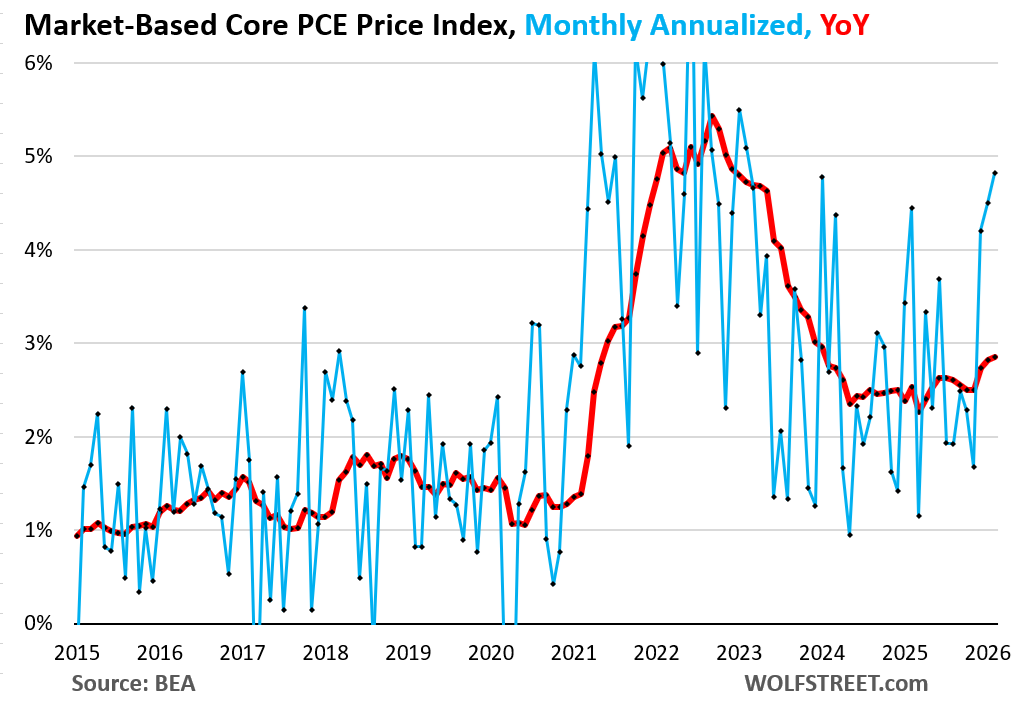
“Market-Based Core PCE price index,” which excludes the imputed housing components, spiked by the most since February 2023.
By Wolf Richter for WOLF STREET.
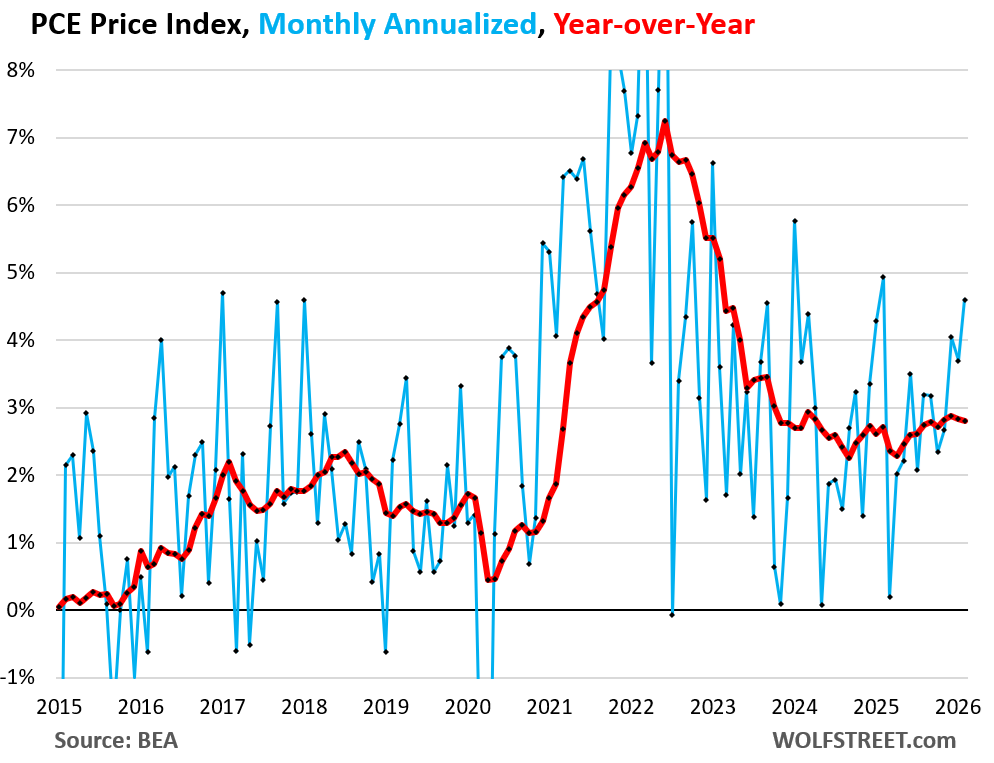
The Fed-favored inflation measure, the PCE price index, which includes food and energy, jumped by 0.38% in February from January (+4.6% annualized), the biggest jump in a year, though the energy price spikes from the Iran war hadn’t started yet (blue line).
Year-over-year, the PCE price index rose by 2.8%, roughly the same increase as in the prior three months, and all of them were the biggest increases since the spring of 2024 (red line).
The Fed’s target for the year-over-year measure is 2.0%.
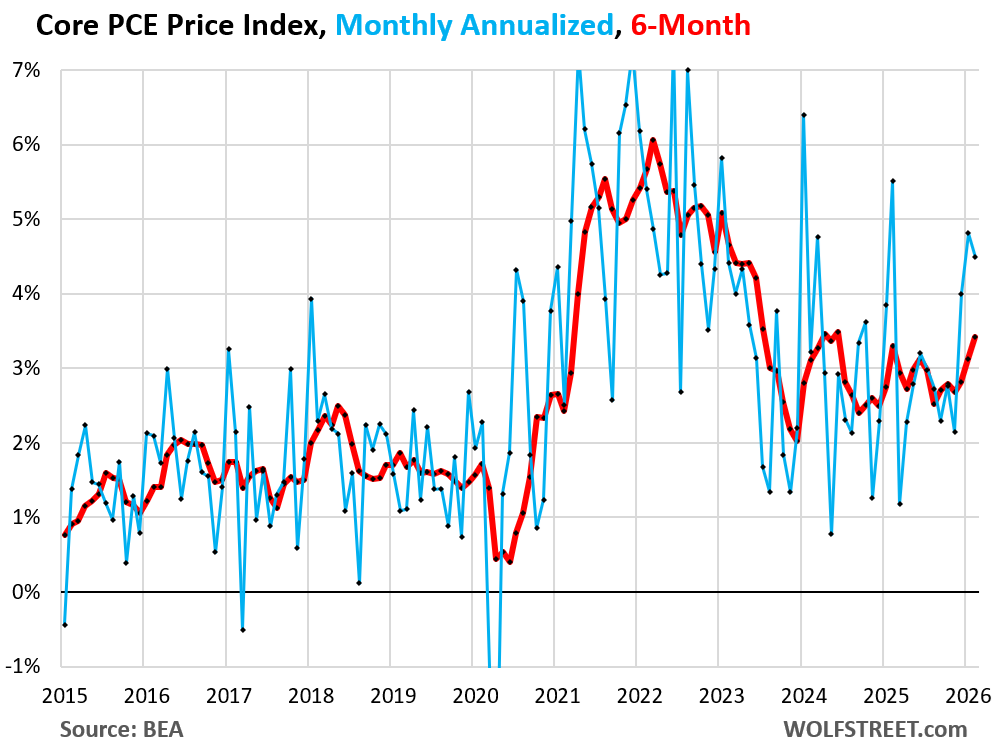
The core PCE price index jumped by 0.37% in February from January, or +4.5% annualized, the third month in a row in the 4%+ annualized range.
This pushed up the 6-month core PCE price index to +3.4% annualized, the worst since June 2024. The six-month index shows the recent trend, and that trend has been going in the wrong direction (red line):
The year-over-year core PCE price index (not shown in the chart) rose by 3.0%, a slight deceleration of the prior month (+3.1%). The Fed’s target for this measure is 2.0%.
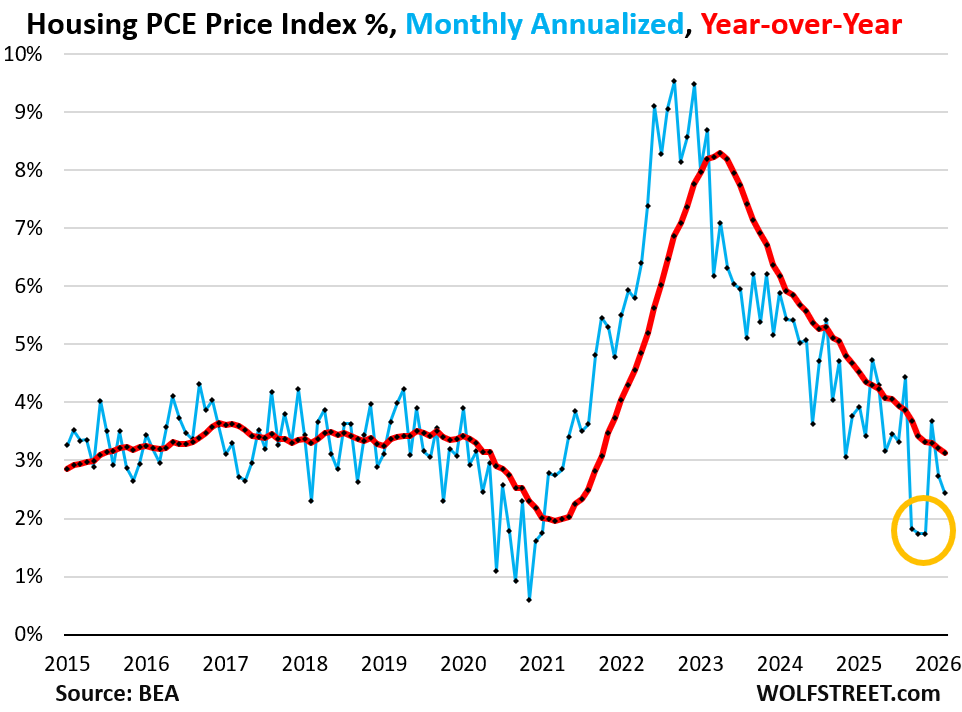
The housing index, including the imputed housing components, continue to hold down the overall PCE price index, the core PCE price index, and the core services PCE price index.
In February, the housing PCE price index rose by only 0.20% (+2.45% annualized, blue in the chart below). Year-over-year, it rose by 3.1% (red).
A major component in the index is “imputed,” so not based on price data but on what homeowners think their homes would rent for.
The declining imputed components take the place of actual inflation that homeowners face with surging homeowner’s insurance, property taxes, HOA fees, and repairs and maintenance.
The imputed data is from the BLS, what in CPI is called “Owner’s equivalent of rent,” which was heavily doctored last fall (explained in detail here), and is visible in the chart below in the outlier three months circled in yellow.
Those three months will continue to push down the year-over-year comparisons until they begin to fall out of the 12-month time frame in September.
But the “Market-based core PCE price index,” which excludes all imputed components, spiked by the most since February 2023, by 0.39% (+4.8% annualized).
Year-over-year, it rose by 2.9%, the worst since January 2024:
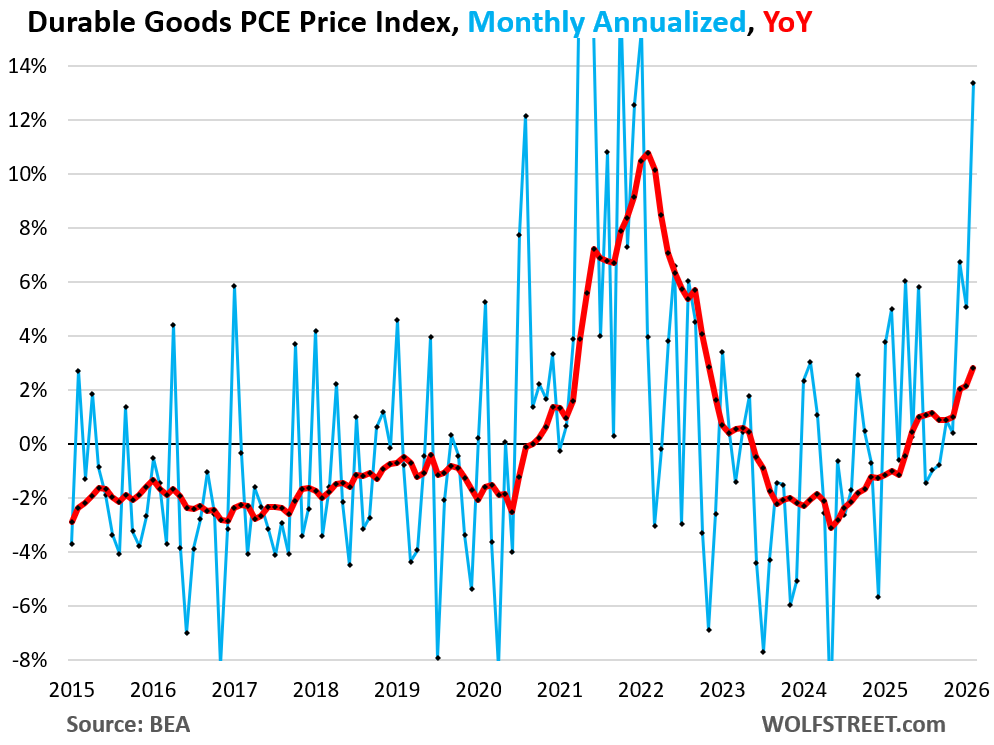
Durable goods prices spiked month to month by 1.0% (+13.4% annualized), but not because of motor vehicles, the biggest component, where prices where unchanged month-to-month and nearly unchanged year-over-year; but because of huge massive month-to-month spikes related to gold, guns & ammo, and computer software (and I’ll explain how computer software ends up in durable goods):
- “Jewelry”: +7.0% month to month (+125% annualized), +10.8% year-over-year, as part of the surge of gold prices through January that made it into jewelry retail prices with a lag;
- “Sporting equipment, supplies, guns, and ammunition”: +1.7% month-to-month (+22% annualized), second big month-to-month spike in a row, which flipped the year-over-year decline through December to an increase of +3.7% year-over-year. This category does not include bicycles, etc., which are in a different category, “sports and recreational vehicles,” where prices dipped in February.
- “Computer software and accessories”: +6.5% month-to-month (+113% annualized), third big month-to-month increase in a row; +8.0% year-over-year. Software is not tariffed. It’s under durable goods because it’s part of “information processing equipment,” which includes “personal computers & tablets,” which are tariffed, but were unchanged month-to-month (+0%) and barely up year-over-year (+0.9%).
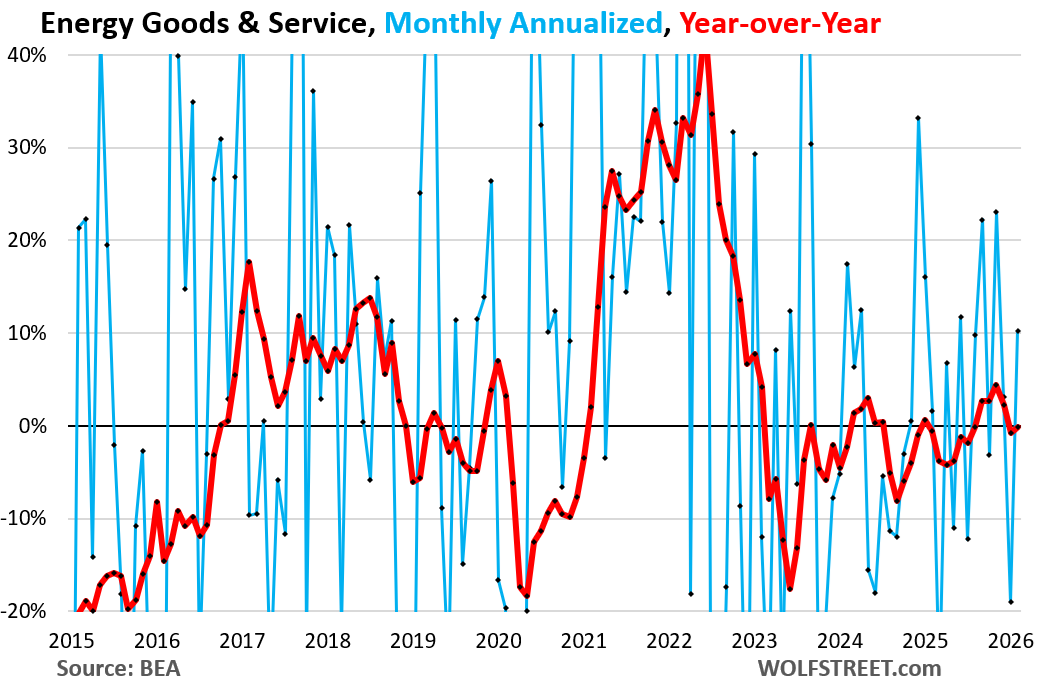
Energy prices jumped in February, before the Iran war, by 0.81% from January (+10.2% annualized), but were still unchanged from a year ago.
The energy price spike in March will add to the inflation data for March.
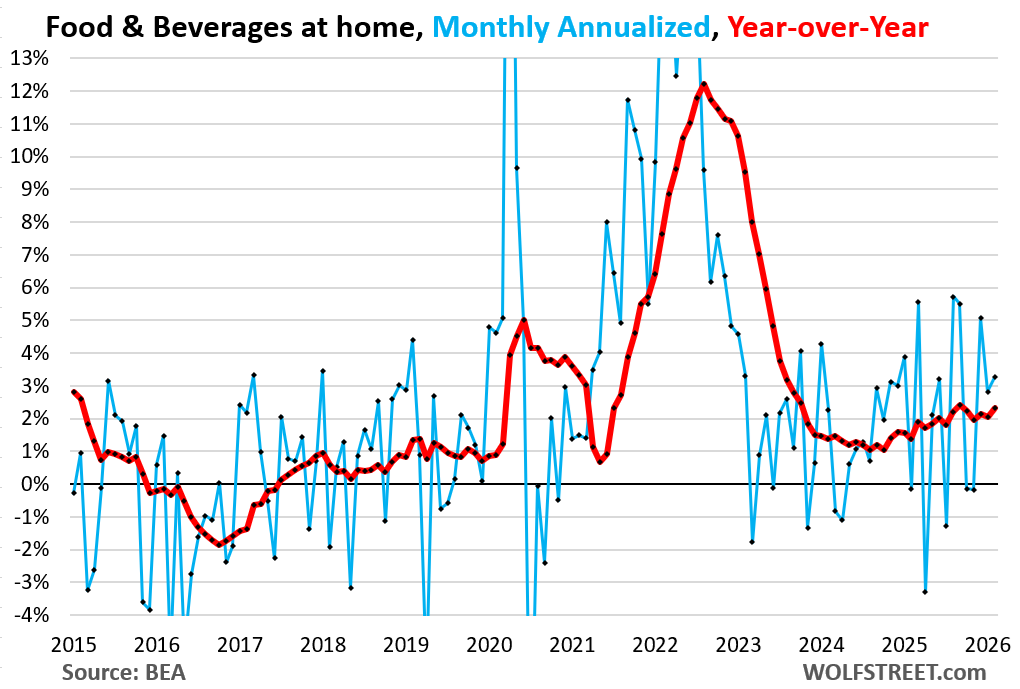
Food prices rose by 0.27% in February from January (+3.3% annualized, blue line). Year-over-year, they rose by 2.3%. The trend has been accelerating since mid-2024.
Part of it has been driven by the four-year-long huge price increases of beef and veal (+14% over the latest 12 months) and coffee (+12% over the latest 12 months). Some other food prices, such as eggs, have fallen from their prior spikes but remain much higher than before.
Inflation isn’t going away, on the contrary. There is a lot of stimulus in the economy: Government deficit spending, tax cuts for companies and individuals, bigger tax refunds to consumers starting in March, massive corporate investments in anything related to AI, too-low interest rates, and still too narrow spreads. Inflation feeds on these conditions.
The housing index and especially the declining imputed measures that replace the soaring actual inflation homeowners face are covering up the extent of the inflationary pressures in the economy.
The Fed needs to pay attention to inflation, and it has been to some extent, and it keeps mentioning it as a risk to the upside, and it has put rate cuts on hold because of it.
And in case you missed it: New inflation pressures suddenly building up in the pipeline are concerning – Used Vehicle Wholesale Prices Jumped. That’s How it Started in 2020 when Broad Inflation Took Off
Enjoy reading WOLF STREET and want to support it? You can donate. I appreciate it immensely. Click on the mug to find out how:


Hey tarriffs I am looking at you…….
You goofball troll who cannot even read. So do the impossible and try to read the article. It tells you where this came from, including this section here, quoted verbatim from the article:
Durable goods prices spiked month to month by 1.0% (+13.4% annualized), but not because of motor vehicles, the biggest component, where prices where unchanged month-to-month and nearly unchanged year-over-year; but because of huge massive month-to-month spikes related to gold, guns & ammo, and computer software (and I’ll explain how computer software ends up in durable goods):
The FED needs to step back and let the bond market take the lead. If it does not step up, then the FED needs to react.
Could the software inflation be due to an annual increase in “per seat” license costs by Mag 7 players (MS, Google, Amazon) and the longer term trend of basically renting software (AWS, MS 365, etc.) among corporations rather than owning it.
If that is the case, perhaps the spike would be a once-a-year event (every January, the Mag 7 sticks it to you for/from the Cloud) and therefore not appropriate to annualize.
On a much, much (much) smaller scale, I know I was recently irritated by MS hiking its annual subscription fees for its individual cloud services (I was somewhat, but so far insufficiently, motivated to buy increasingly rare physical versions of MS Office to avoid just this sort of auto-inflation.