
But debt doesn’t exist in a vacuum: The Debt-to-GDP and Deficit-to-GDP ratios provide (ugly) context.
By Wolf Richter for WOLF STREET.
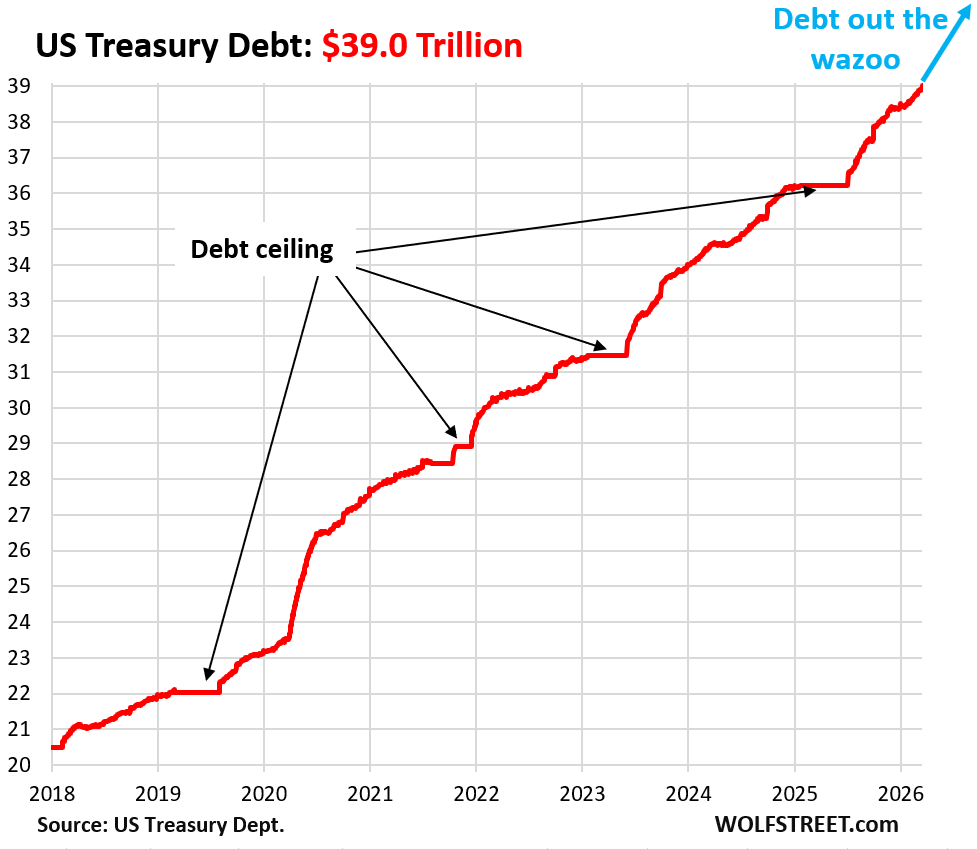
The US Treasury debt – all Treasury securities outstanding – jumped by another $1 trillion in five months, and by $2 trillion in 7.5 months to $39 trillion now, just a few months away from the glorious $40 trillion milestone, as tax cuts, spending increases, and now the war in Iran are speeding up the process.
Since the debt ceiling in early July, the debt has exploded by $2.8 trillion, with those trillions flying out the window at huge auctions every week so fast they’re hard to see. The illusory flat spots occur during the debt ceiling.
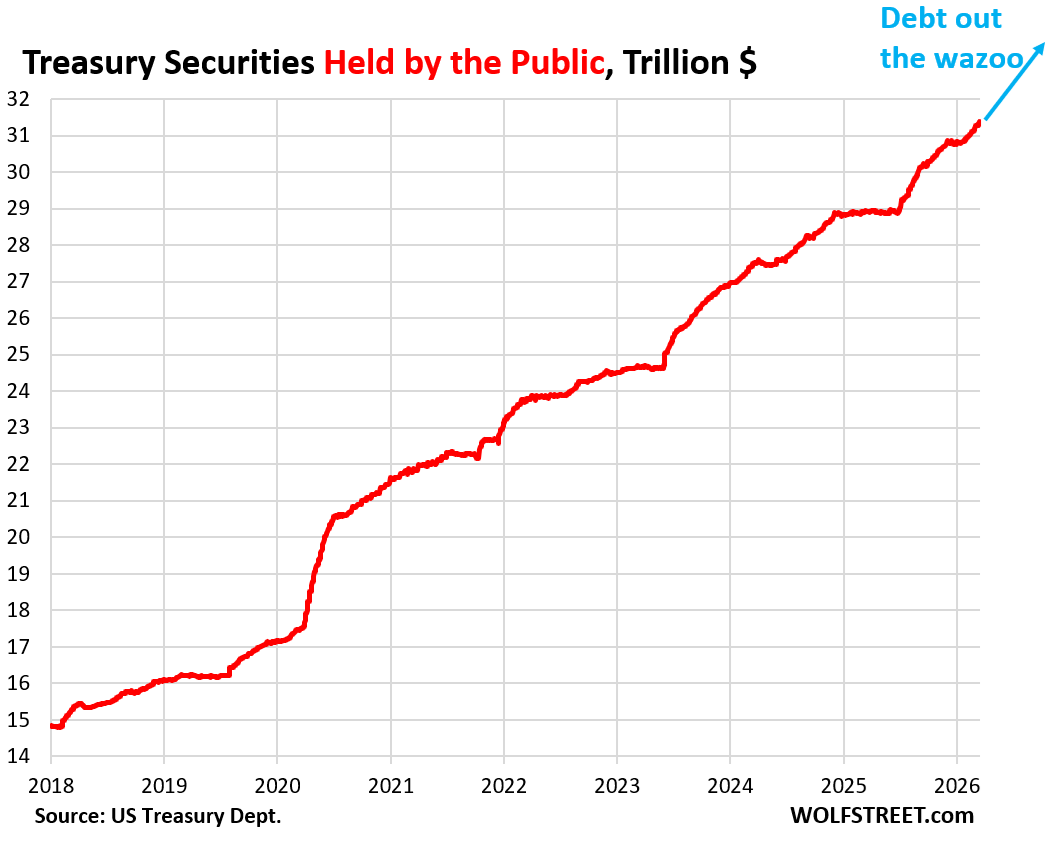
Of that $39 trillion in Treasury securities, $31.4 trillion are “held by the public” – up by $940 billion in five months. They’re the publicly traded Treasury securities held in accounts in the US and around the world, in brokerage accounts, by banks, by insurance companies, at financial centers, by central banks, by the Fed, etc.
That $940 billion increase is the additional supply that bond-market investors had to absorb over those five months.
The remaining $7.6 trillion of the debt is held in federal government pension funds, Social Security Trust Funds, and other “internal” government accounts, and they’re not traded.
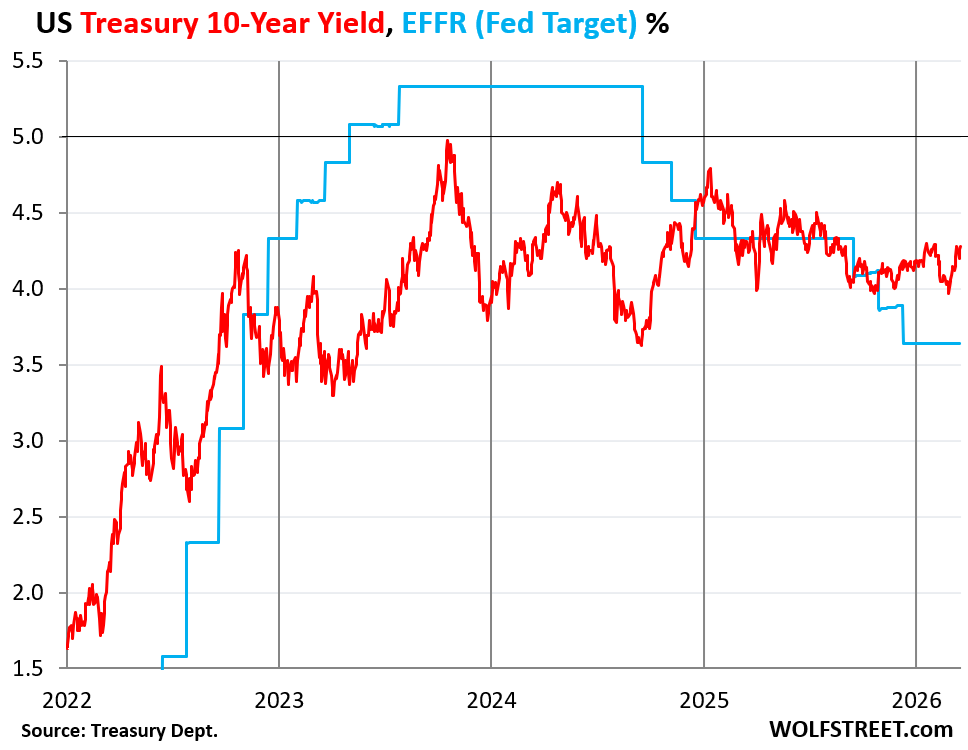
There is always enough demand, but at what yield?
Yields rise until there is sufficient demand for the sales to take place. Higher yields create demand. And so there will always be demand for Treasury securities, but the yield might be higher, and those higher yields (= higher interest expense) would then add to the fiscal problems of the government.
But given the current fiscal situation and the prospects for higher inflation for years to come, yields on longer-term securities are still relatively low:
The 10-year Treasury yield at 4.29% currently is only 1.5 percentage points above the PCE inflation rate (consumer-facing inflation) of 2.8% that is going to soar in coming months on the energy price spike, and 0.5 percentage points above the domestic Q4 GDP inflation rate of 3.8% (overall inflation generated domestically in the economy, excluding imports) that is also going to soar on the energy price spike.
There is a lot of uncertainty about inflation now and how it will develop in future years, with the White House leaning heavily on the Fed to cut rates despite inflation and let inflation do its thing.
All this indicates that there is still ravenous demand for Treasuries, despite all these issues, or else yields would be higher. Over the past few years, any time the 10-year yield approached 5%, demand just exploded and brought yields back down.
That 5% line is the sound barrier that the 10-year yield hasn’t been able to break and stay above for more than a few days since 2000. But in the 35 years before 2000, 5% was the low end of the range.
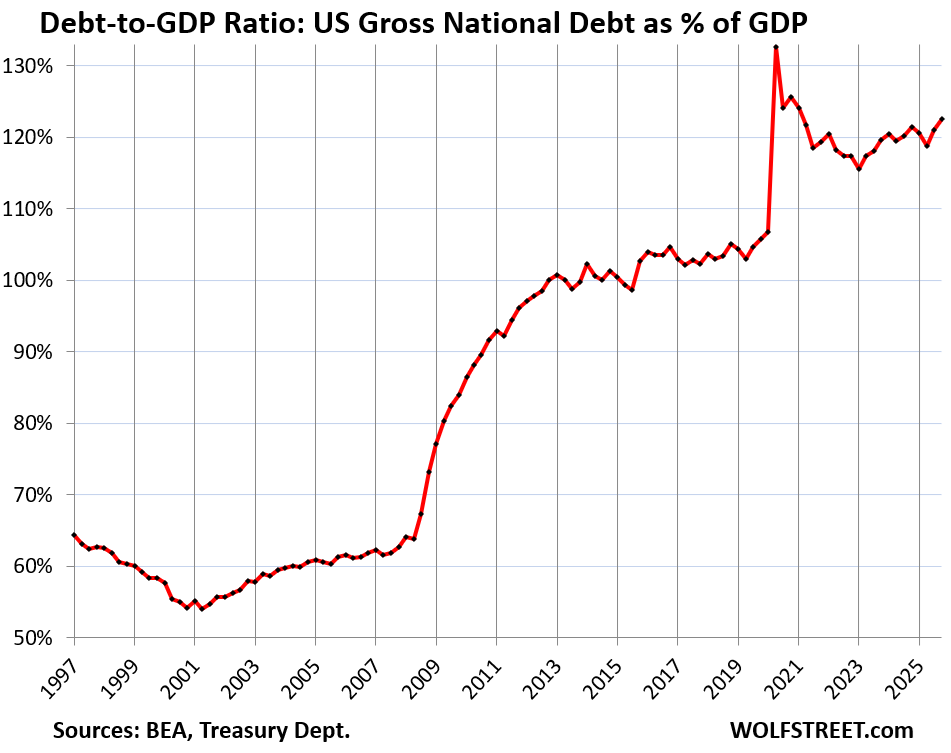
But debt doesn’t exist in a vacuum.
The debt exists within the economy, so it’s useful to look at the relationship of the Treasury debt to GDP, and at the relationship of the federal deficits to GDP (Treasury debt = cumulative federal deficits funded through issuance of Treasury securities; deficits are the annual flow; debt is what accumulates and remains).
The Debt-to-GDP ratio rose to 122.5% at the end of Q4. So that was Q4 nominal GDP and the debt at the end of Q4. But since the end of Q4, the debt has grown by another $500 billion.
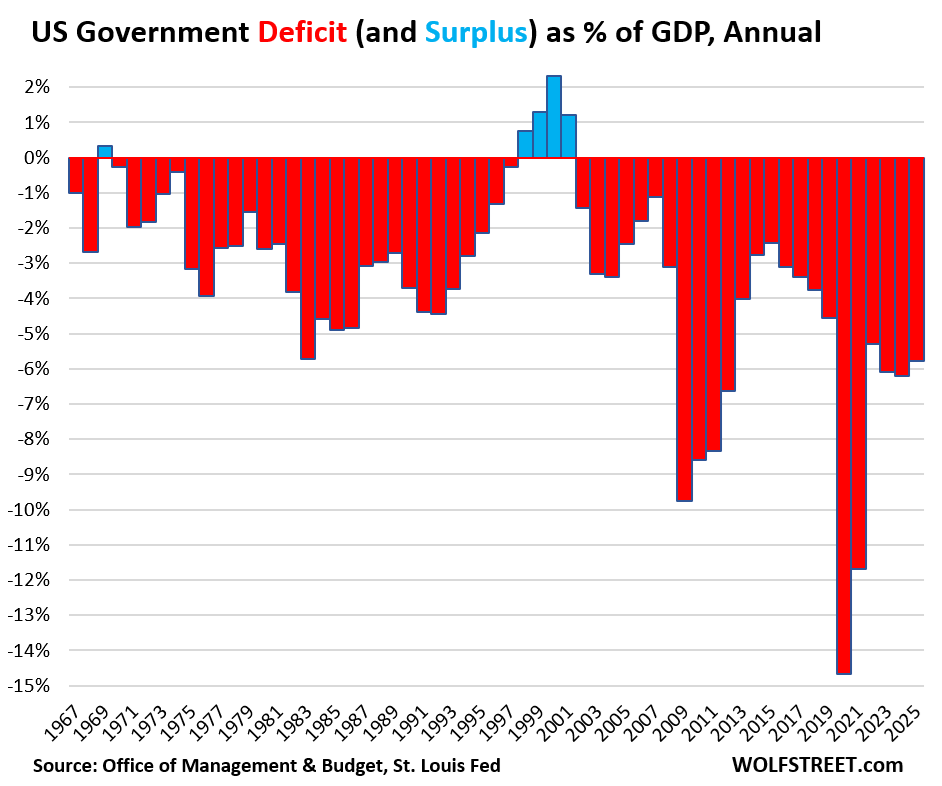
The deficit-to-GDP ratio at the end of 2025 was 5.8%. A slightly smaller deficit and a faster growing economy would improve the situation over time. But a “slightly smaller deficit” seems to not be in the cards any time soon:
Enjoy reading WOLF STREET and want to support it? You can donate. I appreciate it immensely. Click on the mug to find out how:


Stop pussy footing sround, Raise rates and crash prices.
The market will force the Fed’s hand. America is no longer a creditor on the world stage. The dollar “milkshake” isn’t going away immediately but the math is what it is and I see no evidence that congress will suddenly become fiscally responsible. In fact, I suspect that our owners will have their political puppets institute all kinds of communistic policies (price controls etc.) in order to “save capitalism”. Remember George Bush’s “I had to abandon free market principles in order to save the free market system.” comment after the great financial fraud?
LOL! New world order, same old lies/criminals.
Wb,
I am all for the dictatorship of the proletariat but none of that will happen here. Billionaires will own their massive compounds in Idaho, Montana, Colorado and other places and the bulk will be forced to turn them into trillionaires. Our system doesn’t need saving but replacing and that can be achieved with a dialectical approach focused on the working class. Not rocket science just no way to overthrow the power structures that enforce the current status quo.
America turned from a creditor nation to a net debtor nation in 1985.
Thanks wolf
Te party is over. The drunkards just don’t know it yet.
And Hegseth just asked for an extra $200B for the DoW. I though the number I was hearing a week ago was $50B.
Yikes!
The real kick in the teeth was when Pete said the war was “on behalf of the American people”.
This is complete bullshit Pete, CONgress (the voice of the American people) has NOT weighed in on this war.
What an idiot, but why in the hell aren’t any journalists calling this stuff out?
Those four blue surplus lines in the last chart kind of look like a big middle finger.
Isn’t saying always like saying never? Will there really always be investor demand for treasuries? Or is there likely a point down the road where investors lose confidence in the treasuries / dollar such that the treasury can’t afford to sell debt to the public? In other words, the yields will rise so high (whatever that number is) that Fed will have to step in & start buying the vast majority of treasuries?
I’m not suggesting this is just around the corner, but the chart of our total treasury debt doesn’t appear to be far from the rate of change having a very steep slope.
2030’ish, the year I plan to retire seems like fair a bet when there will be a major economic problem.
You have to look at the debt to GDP chart. That’s what matters. It’s bad, at 122%, but not that bad yet. Japan was at 250%.
Whenever I think that a bond crash may be coming, I start wondering where would all those dollars, proceeds of bond sales, go?
No one can sell a bond without someone else buying that bond for the exact amount that the seller gets. So all those dollars that the sellers would get during a “bond crash” come from the buyers, and no dollars go anywhere else.
Ah, the mysterious ways of financial markets… Thank you for bringing common sense back to my mind!
What would it take to get something like a “failed auction”, where the dollars go to some other asset besides US debt, regardless of yield? Would that require hyperinflation? Our leaders seem to be betting the farm on TINA.
That’s not going to happen here because the primary dealers are required to buy the remaining securities at auction that other buyers didn’t buy. Then they sell those securities to their clients and in the market over time.
in Germany, when an auction “fails,” the Bundesbank buys the remaining securities at auction and then sells them to investors fairly quickly. Every country has its own system to where even a “failed auction” still gets all the debt sold.
If this scenario continues unabated, then the Fed will become the buyer of last resort. No one knows when that will be but there are trends in place to make it sooner than any of us wants.
The 60/40 portfolio again will not work. Longer term bonds “only” worked magically for our parents/grand parents. That setup of 90, 2000-ties will not be repeated anytime soon. QE is not coming for the rescue.
Short TLT.
Buying at the rates on offer over time, surely has been a bad bet, looking back?
The bet now is, will rates really get cut when it’ll fire up inflation? And will Gov get their numbers making more sense any time soon?
The rock and hard place took 15 years to arrive but it’s here and people still gleefully buy the inflation trade AND debt at what feel like cheap rates of return given what’s happening.
Everyone can’t be right.
Right. People buying 10 year treasuries at 4.3% believe the Fed will get inflation mostly under control. People buying stocks at moronic P/Es believe that inflation will continue unabated and real assets will serve as a hedge, and worst case, the Fed will print its way out of trouble.
They both can’t be right. My personal opinion is that the Fed will throw the stock market under the bus to protect the bond market. And printing will destroy the bond market, so they won’t be able to do that.
I am trying to confirm that the tariff refund liability has not yet been added to the Treasury’s balance sheet.
The monthly treasury balance sheet that I found online did not include footnotes/disclosures. Has this already been added as a liability or are they considering this currently an off balance sheet contingent liability. I am trying to figure the mechanisms for this to flow-through into the data. (possible restatements vs recognizing the liability when timing and amounts become more certain.)
1. Your point about the liability on the balance sheet is fundamentally wrong. The government uses “cash accounting,” not “accrual accounting,” and it will show the tariff refunds as part of its deficit when it makes the actual cash payments and as part of its debt when it borrows the money. The liability the government has is the total outstanding pile of Treasury securities and agency securities. It’s cash accounting, not accrual accounting.
2. This debt here is the sum of all actual Treasury securities outstanding. When the government starts borrowing the money by selling more Treasury securities at auction to get the cash to pay the refunds, then these newly issued Treasury securities will be part of this pile here of total Treasury securities outstanding, and we’ll se that pile jump.
With Iran, we could have a future where we stop drilling our expensive oil and import Iranian oil paid for by Treasuries. Perhaps we could expand that to other countries where these Persian Gulf states (USA lake) get paid by other nations and we exchange that for Treasuries to hand these oil producers, greatly leveraging our financial control of the region and improving our financial situation.
“…just a few months away from the glorious $40 trillion millstone” – fixed that for you.
Great work, as always Wolf!
1:04 PM 3/19/2026
Dow 46,021.43 -203.72 -0.44%
S&P 500 6,606.49 -18.21 -0.27%
Nasdaq 22,090.69 -61.73 -0.28%
VIX 24.15 -0.94 -3.75%
Gold 4,656.60 -239.60 -4.89%
Oil 95.02 -1.30 -1.35%
“We’re going to need a new chart!”
I think Wolf is just messing with us. If you flip the debt charts upside down, it matches his Imploded Stocks ™ chart darn near perfectly.
🤣❤️
After few years when we’ have debt a $100 Trillion, we’d have similar conversation going on.
The US Gov can print ad infinitum and debasing the currency is the only way out.
Am I nervous….hell yeah and sometimes I think I am the only one that is. Seemingly all the experts and talking heads rarely consider bringing up this topic each time politicians promise voters new and shiny programs.