
Much lower margins, lower revenues per square foot, and lower construction costs. “We are adapting to market conditions as they are and not waiting for the market to bounce back”: CEO.
By Wolf Richter for WOLF STREET.
In its earnings report yesterday evening and in its conference call this morning, Lennar [LEN], one of the largest homebuilders in the US, laid out a laundry list of problems in the housing market that it dealt with in its own way: Revenues in Q1 plunged by 13% year-over-year. Operating earnings from homebuilding plunged by 54%, earnings before income taxes plunged by 57%, net earnings plunged by 56%, and its shares have plunged by 52% since the peak in September 2024.
The average price per home sold plunged by 8.3% year-over-year, and by 24%, or by $118,500, from the peak in Q3 2022, to $374,000 (red in the chart), where it had first been in 2017. The mid-range guidance for Q2 dropped to $372,500 (blue).
Lower prices are what it takes in this frozen overpriced market. Lennar’s deliveries have soared since 2021 and 2022: In Q1 2026, it delivered 16,863 homes, up by 37% from Q1 2021 (12,314), and up by 35% from Q1 2022 (12,538), in a market where sales of existing single-family homes have plunged by 32% from 2021, for the third year in a row, amid surging supply.
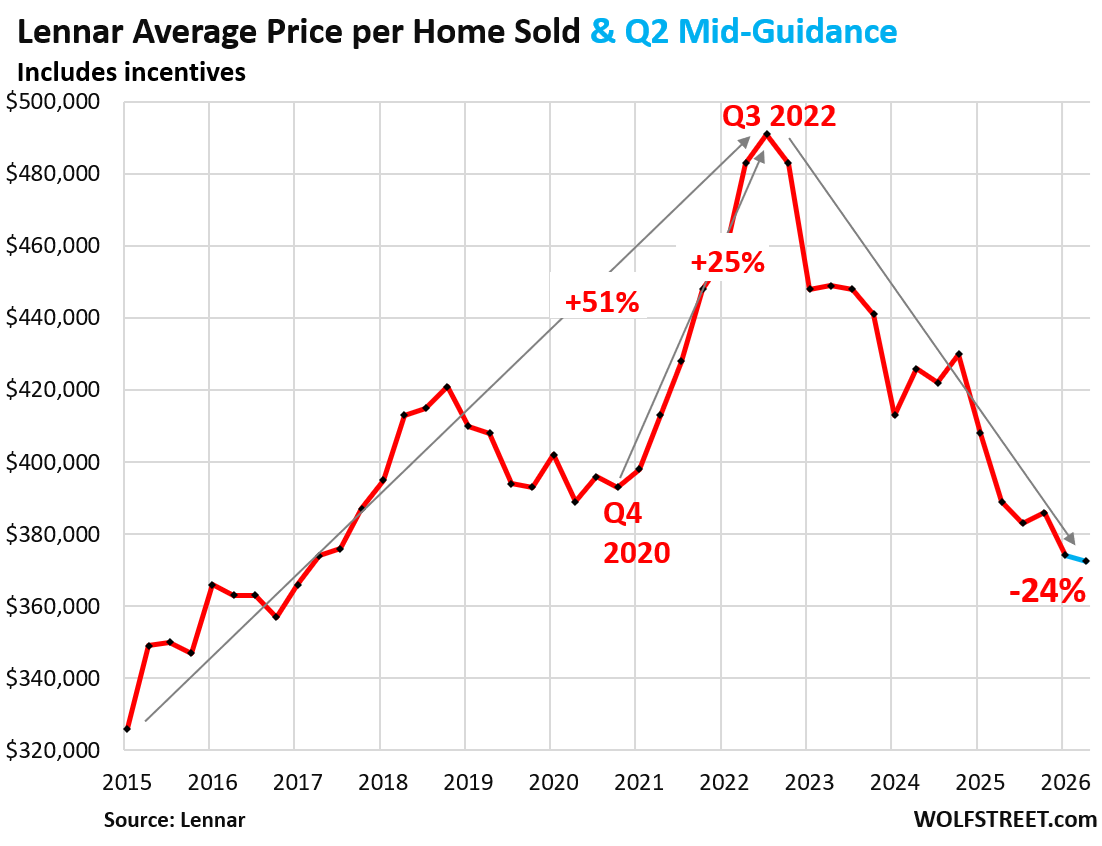
Part of it came out of profit margins: The average selling price was brought down by lower price points and by big incentives, including mortgage-rate buydowns. Incentives alone amounted to 14% of the average sales price.
Those incentives and lower prices slashed its gross margin on home sales to 15.2%, down from the obscene 26.9% in Q1 2022 when FOMO-besotted buyers were still willing to pay whatever during the final gasp of the golden days for homebuilders, and Lennar let them and cleaned them out, as did all homebuilders and sellers of existing homes.
Lennar targets the mass market. It doesn’t target the high end. It targets average families that want to buy a home. Its homes are mass-market products, designed and built to be more easily affordable – meaning lower priced. Lower-priced homes are exactly what this price-ravaged market needs.
What Lennar said:
“The decrease in average sales price [in Q1 year-over-year] was primarily due to continued weakness in the market and an increased use of sales incentives offered to homebuyers,” Lennar said.
“Gross margins decreased primarily due to lower revenue per square foot and higher land costs year over year, which were partially offset by a decrease in construction costs, reflecting the Company’s continued focus on cost-saving initiatives,” Lennar said.
“Our strategy has been to actively design around the affordability challenge rather than waiting it out,” Lennar said.
“We have focused on prioritizing volume to create durable scale advantages, delivering that volume at lower prices, and ultimately improving margins,” Lennar said.
“Additionally, our construction costs improved just over 2.5% in the first quarter and have decreased 12% over the last two years, even as labor remains constrained and materials face constant pricing pressure,” it said.
“We are, in fact, actually adapting to market conditions as they are and not waiting for the market to bounce back,” CEO Stuart Miller said during the conference call.
“Mortgage interest rates, which showed some early signs of easing towards the end of last year, have remained stubbornly over 6%, hovering around 6.2%-6.4% through most of our first quarter. With home prices plus interest rates at these levels, affordability remains the central challenge facing our buyers,” Miller said.
“The war in the Middle East is a wild card. It might end quickly and the world is a better and safer place, or it might trigger higher gas prices, higher inflation, and higher interest rates, and we’ll just have to wait and see,” he said.
“New leadership is taking a fresh look at efficiencies as well, together with new technologies. SG&A [selling, general, and administrative expenses] will continue to shrink, and the bottom line is that our overhead costs are coming down meaningfully throughout 2026,” he said.
In case you missed it: Supply of Existing Single-Family Homes Surges to Highest for February in 9 Years, Demand Stuck in the Deepfreeze.
Enjoy reading WOLF STREET and want to support it? You can donate. I appreciate it immensely. Click on the mug to find out how:


Right the price has dropped, but a buyer is probably getting 30-40% less of a house. Lennar’s lot and infrastructure costs cannot be reduced since their lot inventory is probably years old.
” designed and built to be more easily affordable – meaning lower priced” translate-cheap.
And what is the average size and price per ft.?
Need a bit more detail on this story.
Tariffs have caused huge price increases on their inputs for dimensional lumber, concrete, paint, fixtures and finishes.
there is a huge affordability crisis in this country, and you bitch about the homes being “cheap.” I’m so sick of this BS. you have no idea how tone-deaf this crap is.
You’re also ignorant about construction cost. RTGDFA and study what Lennar does. Note the word “manufacturing” in its description. This is modern methods of mass-production getting introduced to putting these products on the market for a lower price. That’s what ALL manufacturers do all the time. It’s a matter of survival.
I cannot believe that the first comment I get, posted within moments after the article got published, is this nonsense again. I get them on every article that deals with lower-priced homes offered by homebuilders to deal with this affordability crisis by introducing modern methods of building homes. But usually people at least wait a little while before posting this nonsense.
It’s like an automaker coming out with a nice well-performing has-everything-but-isn’t-gold-plated midsize car for $25,000, undercutting everyone in the market, and sales take off, and you goofballs diss it as “cheap” because it doesn’t have a V-8 with a carburetor (younger people might not even know what that is, lol).
Tell it, Wolf!
Just waiting for used homes to come down in price too.
Years ago I came up with a similar analogy that, coincidentally, aligns with the topic of this article.
I’ve actually used it against myself, the first time was with a coworker, and then a handful of times with my wife’s ideas. Oops.
Anyways, it goes a little something like this…
Basically, they go through the trouble of designing a whole house, all sorts of bells and whistles, get the layout just right, and then I come along and focus my commentary on the fact that I’m not a huge fan of the curtains. 😂
Anyways, thanks for these articles, really appreciate the insights.
A way to cut the cost of house construction without reducing liveability, is to use simpler shapes without all of the crazy angles, that also reduces heating and cooling costs as well for the same square footage.
I run a Habitat operation in the northeast. We are building good quality, net-zero starter homes that cost and sell under the monthly cost of a one-bedroom rental in our market. We are the only ones who can do this. And yet, there are still those who turn their nose up at these, and try to prevent us from building them.
simple comment
what is price per SF
when I bought my house I paid $45
now quoting around $200
Now Wolf, which is easier to sway, MMT or this nonsense?
Al B,
I only wish that Habitat would make its detailed home plans/take-off lists (which make accurate estimation possible for a given home plan) more publicly available.
Historically, it has been pretty hard to get this data – except for when some local H4H affiliate accidentally posts it to the internet.
Given H4H’s charitable status and stated goals – it is a bit hard to see why H4H really makes very little effort to publicize the practical details/data that would make low cost homebuilding much more widely possible – without H4H having to be directly involved in every build.
Wolfman, we don’t want you to blow a gasket! Calm, Deep breath. 😮💨
The housing affordability crisis is a really depressing topic. We all know this – if the government would buzz off (get out of the way), homes would be MUCH cheaper.
Almost had a coronary event the other day – I went to a small California town –
saw a decent size house for sale – built in 1970. Nothing special, but a very decent neighborhood. Price? $1.75 Million!!!! Who the F can afford that?
Something’s gotta give.
Cheer up, Wolf. Have a martini, or a bourbon.
When joedidee wrote:
He paid $45/sf fir his home that is now worth ~$200/sf
I looked at the first home I bought (on the SF Peninsula in 1994)
I paid $189/sf and Zillow says it is worth $1,222/sf
Also to add Wolf that average house has increases in size by like 1000 feet since the 70s. It has started to drop which is good.
Also remember that the average household size is getting smaller as well. So we basically have huge homes with fewer individuals in them.
It is a huge part of the affordability crisis.
Until there is some national policy helping families with children this won’t change. I see the M mansions selling to multi family generational buyers…. Here in Ca largely immigrants.
America’s decadent super sized cultural-glutonoous affinity…… I learned how to live within means while living abroad.;-)
and my little 2700 SF for me and wife seems to small
last kid about to leave
would love to down size, but homes we’re looking at come in at same price level and we can’t walk our 3.35% loan(10 years left)
so stay put in our tiny home
Eric86 said:
average house has increases in size by like 1000 feet since the 70s.
Joidedee said:
and my little 2700 SF for me and wife seems to small
That’s the exact reason!
I am currently raising my daughters in just under 1000sf! It’s tight, but I am looking at a remodel to squeeze in a second bathroom (and probably update the kitchen).
It reminds me of my niece and hubby when they had their first baby, in a 3/2 2300sf. Place complaining that it’s too small.
At the time, near Co. Spgs. A land of newer 4000-6000 sf. Developments. The trend is alive, as down the road still has my FIL who lives alone in about 4000sf, and his wife, who has a similar sized house less than a mile away.
American excess at its finest! Compare to articles I have seen about 85sf. Manhattan “apartments” that are no more than a raised bed and a hot plate, with a closet rod. I watch tiny house shows: 50-100sf per person IS TINY!
The older suburban housing “manufacturing” techniques appear in the song: “Little Boxes” by Malvina Reynolds, 1962. This song was covered by Pete Seeger in 1963. Written after seeing the tract houses of Daly City, California in that time period. Reference: Financial Times, Jan 17, 2022. Available for Audiovisual viewing on YouTube.
…and described as “The most sanctimonious song ever written”.
BradK – 100% agree.
The real “ticky-tackiness” was in the smug left-wing superiority that rather see the mass of people in poorer quality housing rather than offend the aesthetic sensibilities of gentry liberals.
If she had been around in the 1920’s, she would have bitched about how the Model T was less tasteful than walking.
I listened to her sing it at the Toronto Island Music Festival. I’m on her side. Working people always lived in more modest houses, but they weren’t ticky tacky until the 60s and 70s.
As a kid I watched the “little boxes” being built driving on 280 to visit my grandparents in the SF Sunset District (in a home my grandfather bought for $3,000 (less than I paid for my mountain bike).
I always thought it was a Joan Baez song (Google told me “Joan Baez Connection: Joan Baez is among the many artists who have covered the song, including a version recorded for the television series Weeds.”
@cas127 like most of my liberal friends (that want to ban the building if tacky little hones) Joan Baez lives in a multi-million dollar home on the SF Peninsula (In Woodside across the street from the Woodside Polo Club property)…
Still too damn high.
and fixers are debt traps waiting
material prices obscene today
and $5 gas gonna make it even worse
Crises are a normal part of the economic cycle. From memory, 1983, 1991, 2000, 2008. Let’s not forget 1929 and WWII. Trend lines get broken and the rules get rewritten. It feels like we’re overdue.
A excellent take on the affordability. Oh darned, I MENT, not to get political! Thanks
It’s true that land deals are made far in advance of actually developing homes but most savvy developers have some clawback clauses in case things get hairy. But land costs are crazy high.
Smaller homes- thank the good lord for this. I always gravitate towards smaller homes, how much space do people need? Homes were too large and if the design is good, a smaller plan can be just as nice.
Cheap[er]? I would need more details, but most of the homes that were being built over the past decade- and cost a lot of money- were already simplified and had engineered products. I don’t know how much further that could have gone.
Good for Lennar to deal with reality.
Realize this is just what I’ve seen in my neck of the woods over the last decade, but land prices hit the roof because of developers and builders coming in and offering way over market to farmers to get large tracts (300ac+). Land was cheap back in 2015: 4-6k an acre on average. Now even garbage land with horrid topo, floodplains and poor soil is going for 25-30k on average.
Can’t blame the owners. If you see your neighbor making bank why wouldn’t you expect the same?
I like to Zillow shop for land. I saw an ok parcel at (what I thought was) a decent price/ac. Compared to other listings.
A small amount of digging revealed that the current owner had bought a larger parcel, taken the larger/ nicer part AND all the water rights, and was selling the smaller portion (30 vs 37 acres) for basically the whole land cost of the 67 acres!
The realtor stated “they just bought it for $250k” and what’s listed is $165k… yeah $250k for over 2X acreage and $95k of water rights.
BUT: it’s still free to shop!
“a buyer is probably getting 30-40% less of a house.”
I’ll guarantee you that the trebling/quadrupling of home prices since 2000 didn’t get godd*mn anybody 3 or 4 times the house they could have got in 2000.
All 20 years of ZIRP reallly accomplished was a staggering increase in homebuilder profitability and an illusory, doomed “wealth effect” in the absence of real increases in macroeconomic wealth (translation – China has beat the sh*t out of the US economy for 20 years and somehow the US is supposedly 3 to 4 times wealthier, justifying the home price explosion?).
Where are you getting this 40% smaller rubbish? Avg sq ft sold is down 5-10% from 2022 peak.
Lennar & SW FL tells us what is needed if you want sales to return to normal levels – very important for GDP. We need prices to fall 20-25%
Exactly! Its nothing durable about Lennar homes! I regret purchasing a new build. My driveway cracked 6months after I moved in and they refused to replace it. My garage door opener needed to be replaced but this is suppose to be a new house. The floor peels and my crown molding comes undone in all my bathrooms. I can see all my nails in my rooms upstairs. Cheaply made and they have a nerve to charge all this money for a home. They forced us to pay a front foot fee for pipes that lead to our house for water and gas. Ridiculous!!!!!!!
I should’ve bought an older home with good bones. At least my expectations would’ve been met!
Wait until you buy an older home. The cost of the older home = the price you pay + 30 years of deferred maintenance and repairs. Those get expensive! Older homes are constant money-sucks.
And in terms of your garage door opener: complain to China about it.
During our recent home search, we found a 1960’s home we really liked, long DOM (200+). But the sellers overpaid in 2021, had put about $50k in structural remediation (hinging foundation wall due to expansive clays–common in NC that required steel beam reinforcement and the usual helical piers for stabilizing an addition’s crawlspace foundation).
The sellers were not motivated in the slightest despite the bleeding. While negotiating, I explained I look at the 7 year total cost of ownership when pricing houses. Yes, the foundation was shored up, but the roof was 20 years old, the sewer lateral was original, the HVAC and HWH both approaching replacement age. We were looking at over $500k in total cost of ownership. It just didn’t make sense at that price.
Meanwhile, we found a 2010’s built home, smaller lot, HOA, worse location. But the total cost of ownership will be well under $400k with very motivated sellers with an excellent cost basis.
We wanted an old house, but deferring maintenance is the rule, not the exception. They are quite literally “value maintenance” projects. Without them, your value evaporates. With them, you’re just like every other home. So people drive their money into vanity projects (with a positive ROI), instead. With existing home prices where they are, it just doesn’t make financial sense. A good cost basis cures all ills.
Lot sizes have definitely shrunk, any drive through any post-2020 development confirms that. But clearly if that was something that stopped people from buying houses, they wouldn’t sell!
Regarding the “less of a house” bit, I’ve strung together some measures on this via FRED. The $/sq ft of new homes has gone down in aggregate. So it’s not just building tiny homes that has driven costs down. You can recreate easily enough searching for aggregates stats about new construction size and prices and making an inference.
Fair to say this average price drop is driven by the ~40,000 drop in average price for the “Central” region?
Other region new order average price didn’t move much from 2025 Q1, and in some cases increased (West and East).
Unfortunately their definition of “Central” makes it a bit hard to understand where exactly the price drops are occuring.
Central includes theses states: Alabama, Georgia, Illinois, Indiana, Maryland, Minnesota, North Carolina, South Carolina and Tennessee.
In terms of new orders, it looks like the one region with strong year-on-year sales growth is “East”, with other regions static or declining (West).
East is Florida, New Jersey and Pennsylvania, so guessing most of those new order increases are in Florida?
Average price of new homes in South Central is $232,000!
Guessing that is driven by Texas? South Central is Arkansas, Kansas, Oklahoma and Texas.
“this average price drop is driven by the ~40,000 drop in average price for the “Central” region? Other region new order average price didn’t move much from 2025 Q1, and in some cases increased (West and East).”
That’s a lie. Average price dropped substantially in ALL four regions in Q1 yoy. The only place where it didn’t drop was in “other” where Lennar sold “5” (five) homes, so that doesn’t matter at all.
East: -5,000
Central: -33,000
South Central: -15,000
West: -41,000
Total: -34,000
I should have specified I was looking at the New Orders table.
The numbers you quoted are from the Deliveries table. As you say, average price of delivered homes did fall in all four regions.
OK. And yes, they pretty much reached the end of their price cutting, they said. They’re going to try to hold the line there. But they’re going after volume and efficiencies (mass production), and if mortgage rates head higher and slow things down, they might get even more aggressive on pricing.
It’s wonderful to see builders strive to make more affordable product and benefit from manufacturing and material advances. There are a lot of good ideas out there for cutting costs with little to no quality impact, and it’s great to see some big builders push in that direction.
“It’s wonderful to see builders strive to make more affordable product”
Yep, after having trebled prices since 2000, it is heartwarming to see our overlords stage a modest (forced) retreat from peak pricing (-tugs forelock-).
After all, contemplate the charity inherent in the hospital’s discounting of the $100 aspirin all the way down to $80.
Correct me if I’m wrong, but you’ve always stated incentives do not reduce the sales price. So 14% of $374K is $52K.
No wonder home sales are in the tank. That’s a lot of greasing of palms to get people to by your average home.
My dad lives in Cedartown, GA about 1.5 NW of Atlanta. A building is charging $245K for a 2 bedroom townhome that sits across the street from a county dump / recycling center & right next to train tracks. There’s probably 40 townhomes on what looks to be like 5 acres.
It’s ridiculous.
They don’t, in terms of the official sales price recorded by the town, used for the mortgage, etc.
But Lennar here (I believe) is reporting their internal accounting of their net sales price taking into account incentives, as part of their financial reporting to shareholders.
Ridiculous is the word BenW. Wolf correctly said “Lower prices are what it takes in this frozen overpriced market.” The home builders know that and adjust their pricing and sales tactics accordingly.
I just wish the sellers of existing homes would get the message. New existing home listings here in flyover southwest Ohio continue to be overpriced, some substantially so.
But maybe this area is just behind the times again. I’d bet in some other US metros the existing home sellers are becoming more realistic in their initial asking price.
As Mark Twain (supposedly) said, “If the world came to an end, I’d go to Cincinnati and live for another eight years.”
“New leadership is taking a fresh look at efficiencies as well, together with new technologies. SG&A [selling, general, and administrative expenses] will continue to shrink…”
There must be sales people with years of experience of judging just the right incentives to make a sale. Now AI is coming for their jobs.
“There must be sales people with years of experience of judging just the right incentives to make a sale.”
Welp, that’s one way to describe profit-maximizing price discrimination using psychological techniques.
The 30-year fixed-rate mortgage averaged 6.11% as of March 12, 2026, up from last week when it averaged 6.00%. A year ago at this time, the 30-year FRM averaged 6.65%. I can’t wait to see the results of the spring selling season here in Denver Metro.
It’s amazing to see builders starting new single family home developments as though the demand is still 2020-2022 on steroids. I bought my Lennar Home new in 2014 for $335K now valued at $600K. 2400sq/ft. I really admired and appreciated their products and programs to help the buyer along with selling a great product. Compared to Richmond and DH Horton builders foundations walls cracks and shifting to poor follow up on warranty repairs.
people get mad about “affordable” housing like it’s actually trash but many of us have owned or lived in hundred year old kit homes. The 1900-1930s bungalows, many of them were “cheap” kit homes back in the day and I think they’re beautiful. Even with the modernization I had to put in (asbestos gravity furnace anyone?). Who knows how domicile character will evolve over the years.
Meer, your appreciation of old simple homes reminds me of the distinctive ‘prefab’ houses erected here in the UK to tackle a post-WW2 housing shortage.
Some of those still stand, and many people admire and enjoy them.
There’s a post about those prefabs on The Historic England Blog. I found it interesting.
As for future trends?
I did read recently that kitchens are becoming less important, as more and more food is bought ready-to-eat, delivered, or eaten in cafes/bars/restaurants.
Wolf’s articles and charts on consumer spending give a good breakdown of these trends, showing how behaviour is changing over time.
Meer: You are absolutely on the right track with your comment!!::
We live in a house built in 1950 along with every other house with the same SF and plan on our street; most, including ours have been modified, but the basic plan was a 2b.r.& 1ba with total gross SF 720.
That was enough then for a young family OR an older couple, and still is for us elderly folx who want a small and simple to clean, maintain, etc., place, etc., etc.
This ”hood” , flood free, is now ”gentrifying” rapidly, and in spite of the overall decline of the market in FL, we continue to get offers in the snail mail every week…
Good Luck and God Bless all the young folx willing and wanting to secure a home/nest to reproduce;;; we continue to help our kin doing exactly that.
Can only recommend to any and all boomers or war babies to do the best they can for their ”family” youngsters of any and every extant, COUSINS EVEN!
I looked at these Lennar homes in Portland a while back. They really are fairly nice. I do prefer older homes with larger lots but they do have lovely interiors. Glad to see they are getting smaller. As an environmentalist I hate to see houses much over 2500 sq ft. They are building a lot of townhomes here for about $300 to $400k, but also single family for around $500 to $650k which is right around the same as “used houses” in less desirable neighborhoods closer in. These new houses are mostly in former farm areas of course on the edge of the greater metro. I actually invested in this company for about a year recently but got out before it sank luckily.
I believe a lot of the kit houses a 100 years back were actually good quality materials including a lot of heart wood that has more strength and rot resistance/galvanized nails back then looked as if dipped in a lave mix/just in many ways better quality along with some lead and asbestos issues at times.
I guess this is good news for some folks looking for a home but not my cup of tea personally,will take many acres and a tiny home for me.
On a side note found Wolf’s 3 post rant epic!
For over a year I have concluded existing home prices will decline slowly around 3-5% a year but if you add inflation @ 5% per year that is around10% a year. By 2027 things may be moving again for existing home sales even if pricing is down only 15%. It all depends on wage growth and inflation.
But in many once hot markets nominal prices have come down by 20 percent or more from peaks.
If you bring in inflation then it’s a lot more
I see prices going down and wahes not increasing meaning ful.
Wages in the lower spectrum would increase little bit but at the higher end it’d stay same .
The main problem is affordability and something has to give in
In my city median price is 1 mill and median household wage is 100k.
Home turnover seems about the same/slow pace here in upper ne Philadelphia, I’d say prices seem strong. I notice some of the much bigger Mac mansions sitting or coming off market due to no buyers but buying a 2m home in an area where average is 500k doesn’t make sense. You get can an amazing house on acres just outside of ne Philly for 1m. Recently, my in-laws renovating their main family bathroom to a walk in shower from tub, there aging mom and dad live in the home and we worried about a slip. It was also due for a rehab but made it work for a very long time. The contractor did is three bathrooms for family so everyone has evaluated his work over the years and appreciates his craft. There home was built early seventies. Has that awesome field stone front which is just awesome and not really done on the value builds today anymore. We keep hunkering down in our brick row home built 1950 renovated 2014. We put money toward the kids education and saving/investing. The other areas and car maintain costs and home costs. Hope/think to one day have a little bit more space just outside the city but the costs are prohibitive at current income level and options are not that great so more supply coming to market would be great.
Rates need to go up to force sellers down.
Loan rates can be refinanced, The overpriced home You bought cannot.
Have a fantastic weekend ! 🍻
I think the artificially low rates caused this affordability crisis. Everyone seems to be looking for rates to go down. Historically 6% is not abnormal or high. Unless the government monkey’s with the housing mortgage market I don’t see it going down much at all. Inflation, wages more or less keeping up with it will in time return housing to a reasonable equilibrium. Maybe another couple or three years.
For the most part lower rates on mortgages don’t save the buyer anything. House pricing goes up and you end up with about the same monthly payment. But with a higher principal balance you are on the hook for.
I think some of the affordability problem with with the codes required to build a home. A lot more has to go into a modern house than a house built in the 30s. Everything from galvanized materials to coated deck screws, fireblocking, draftstopping, plumbing needing x vents in stacks, rooms requiring afci breakers, engineered trusses, lvl beams, etc. All of these not only make for considerably more expensive materials, but also require more skilled craftsman/tradespeople to know about and often more time to get it right.
Now please be aware I’m not advocating for reduced code or anything like that – many of these are written in blood (fireblocking, draftstopping, afci, stair/deck rails at 4″, etc etc) – I’m simply pointing it out that some of the cost of non-affordable housing can be attributed to this, because many of these didn’t start to show up until the 90s or later.
Obviously there are other problem areas such as the underlying real estate being more expensive, or that houses are bigger than they used to be, etc.
In our market the average home price is around $300k. There is a lot of easy money buying tax forfeit and other very run down homes for $20k or less, putting $20-30k into them and tossing them back out at $100k. They are still quite bad, but the demand is crazy. Seen some young guys doing this and flipping a house every 2 months. They don’t last a week on the market.
Where do you live, Pike? Don’t need to know town, just region.
Upper Midwest. Small town USA.
I thought modular would lower costs, and I have been a red seal carpenter for 45 years. But what I have found is that the modular kits around here are just as pricey because buyers ask for premium furnishings. If Lennar can do this and make a buck, awesome news.
My grandparents were happy to have one bathroom…5 kids too.
15 years ago my daughter was buying her first home. I suggested a new mobile on a 2 acre parcel. Instead, they bought an old mine worker house from the 50s and fixed it up, well……I did a lot of fixing. But now she is 46 and her home is paid for and all nicely renovated. The last reno was done by a family friend of theirs. very nice….no debt.
I had a Lennar built first floor condo. 72 units, 4 stories where I could hear the 2nd floor people above walking, moving chairs, closing doors. I could hear their MBR toilet flush which was just above mine. I also could hear the shower of the neighbor next to me (1st floor).
Plywood between floors and required carpet on bedroom floors to alleged reduce noise (didn’t work).
Very poor quality in the units and the common areas….. elevators usually broken, sliding door not working, decorative water fountain not usually working correctly.
The noise stuff is normal for multifamily buildings. You will hear your neighbors. Period. That’s just part of it. Living on the top floor is my recommendation, especially for buildings with kids. Looking for buildings with older people can be a good option for noise abatement. A building with a lot of young partiers can be fun but loud. If you cannot handle hearing other people, don’t live in a multifamily building. The good thing about the US is that people can choose, multifamily or single-family, city center or suburbs or rural… Something for everyone.
EXACTLY. i’ve lived in all those different places. ocean front to rural mountains……..to burbs to biggest city in usa………spent the past 40 years restoring mostly craftsman bungalows and older places and renting out or living in…….i think this old one we are in, now is our 16th structure. 1858 built in hudson valley. you could park a mac truck on the second floor, the floor joists are like tree trunks. lived all regions in north america, too. my favorite was bay area, where i think you are located. jack london hood. old plumbing warehouse converted to condos. all one floors. 20 foot ceilings and windows. my unit had submarine features as the first owner built subs for a living…….
I lived in a 23 story multiunit condo in Tokyo. It was made of concrete so zero/no noise from any neighbors vs my Lennar plywood condo construction.
Hahaha, the Japanese! They’re very quiet and well-behaved. Don’t blame Lennar for the behavior of the Japaense.
I lived in a 1,800 sf condo in Tulsa, on the 23rd floor, concrete building (Liberty Towers) with huge sunset views, and I heard my neighbor fucking.
You should look at the construction method of a concrete building under construction. Only the structural parts are concrete. The interior walls, including those that separate the units, are steel studs and drywall in the US. I think in Japan they use some kind of prefab material for the interior walls.
No, I live in a townhouse build in the 90s in Germany on the 3rd floor. There is a family with kids on the 4rth directly above us.
I don’t hear anything. I heard a little bit when they were using impact drills when they were moving in. And I mean a little. (And vice versa, when I put in a new (20 year old second hand I renovated) kitchen and used some loud saws).
I pay less than 1000€/month (for 3bd/1 living room/ 1 bath+ 1 sep. toilet) including heating and electricity!
It just depends how something is build. And especially for multifamily its worth it to build more massive and well insulated. Germany has a problem with very high standards that make building quite expensive but the bigger problem is very few available plots.
I think there should be a middle way between the incredible shoddy way american houses are build and the >10-15in of insulation the German housing standard is demanding.
It doesn’t even need to be concrete. (Though the house I live in is reinforced concrete). It is possible to have a house made out of timber with good noise insulation. Just do it right.
I was raised in Germany in an apartment on the third floor, old building with thick stone walls and high ceilings, with two floors above us, and when they flushed the toilet, we could hear it. When they slammed the door shut, we could hear it, and when we kids made noise, our downstairs neighbors would bang on their ceiling with a broom handle. And those buildings would collapse during a major earthquake (wood is a great material for earthquakes, right behind steel; brick and stone are shitty materials for earthquakes). Shoddy German construction and workmanship.
I’m just not that sensitive to noise. I lived in many apartment buildings earlier in my life, from ones built in the 1800s to ones that were brand new, at the time.
After a few days, I tune all of that noise out.
A Les Paul custom and a Marshall Stack(tube,of course!)can really help here!
I lived in an apartment for a few years back in the day.
I also tuned out most of the noise, though the neighbor above me preferred to vacuum every morning at 2 am. When vacuuming he seemed to pay extra special attention his transition from carpet to tile causing banging sounds to resonate through my room for 5-10 minutes. I suspected his cleaning habits may have been chemically induced…haha.
I guess there are worse things in life. I live out in the cuts now. More my style.
Freddie Mac estimates the affordable starter-home shortfall for first-time home buyers at about 3.7 million units.
That being said, homeowners associations (HOAs) can also be a deal-breaker for first-time buyers. The average HOA fee is about $135 per month, with regional averages ranging from $150–$200 in the North, $200–$300 in the South, $200–$400 in the East, and $300–$500 in the West.
Another obstacle for homeowners is home insurance. Since 2020, insurance premiums have risen by a staggering 42%, compared with wage growth of only 18% during the same period.
Possible policy solutions could include limiting HOAs to gated communities, building 3 million starter homes in the 1,100–1,500 square-foot range, and providing tax incentives that can be fully applied to deductions. In addition, policymakers could consider a one-time waiver of capital gains taxes up to $1 million for retirees who sell their primary residence in order to downsize.
The potential benefits to the economy could be significant.
Slim checking in from Tucson.
On my daily walk around the neighborhood, I go by a house that’s been for sale since late last year. It’s a cute little place but it’s surrounded by a yard that’s infested with weeks.
I mean, some of these weeds are almost as tall as Arizona Slim.
It’s obvious that the owners and their agent couldn’t care less about this place. They just want to get their lofty wishing price.
But, until something gets done in the yard, that house is going to keep sitting there.
Me again.
Huge typo up above. My apologies.
I meant to say “infested with weeds.”
I think the affordability crisis goes beyond the price of the house. Insurance rates have skyrocketed across the country, and that’s pricing everyone out, even current homeowners.
People focus on purchase price- I focus on cost of ownership.
My family is Italian, and we own property abroad and in US. There is no property tax or insurance. We only experience this in America, it is theft in my opinion.