
The bond market flipped from haven trade to inflation trade.
By Wolf Richter for WOLF STREET.
The Treasury market is caught between three dynamics: The haven trade, where worries about stocks and the geopolitical situation sent investors scurrying into safe assets; renewed fears of inflation, with oil prices taking off, on top of six months of already accelerating inflation; and fears of an onslaught of new supply as deficit spending and borrowing are likely to get a lot worse.
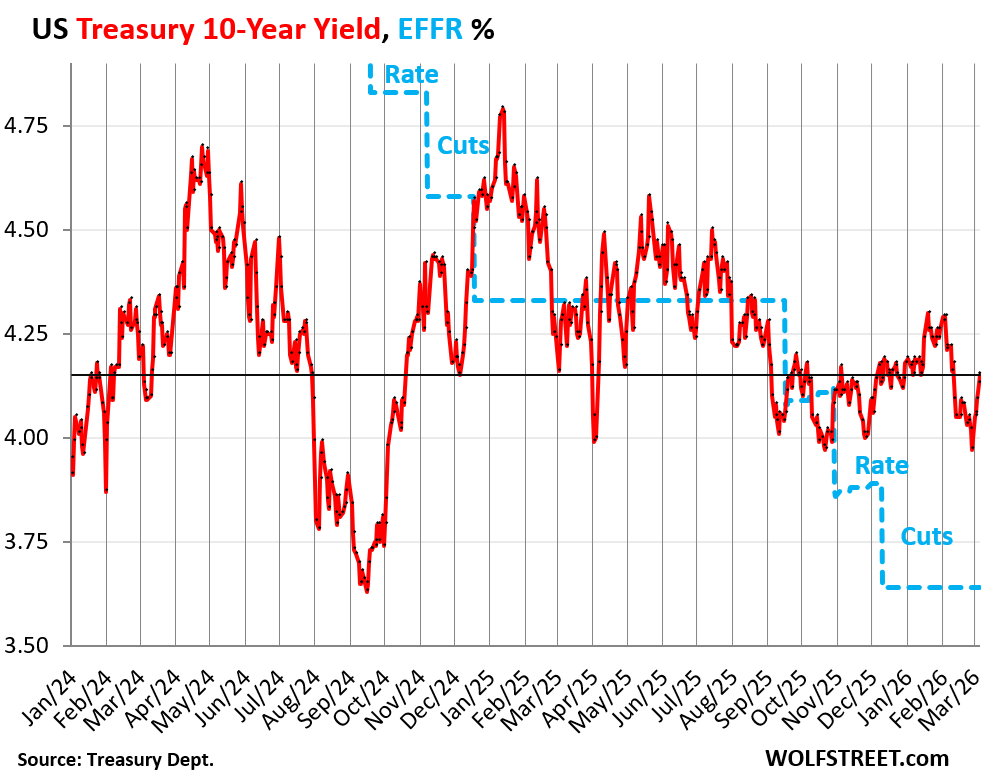
The haven trade pushes up bond prices and thereby pushes down yields. This was happening into last weekend. The 10-year Treasury yield had been dropping for days, and on Friday February 27 dropped to 3.95% despite the hot PPI reading, and fell below 3.93% in overnight trading on Sunday. But then as the US began bombing Iran, it flipped into fears about inflation and supply.
Monday morning (March 2), the 10-year Treasury yield shot up by 14 basis point on from the Sunday low, to 4.07%. And it rose further throughout the week, and on Friday March 6 closed at 4.15%, up by 22 basis points from the Sunday overnight low. The Effective Federal Funds Rate (EFFR, blue line), which the Fed targets with its policy rates, shows the rate cuts that the 10-year yield has been blowing off.
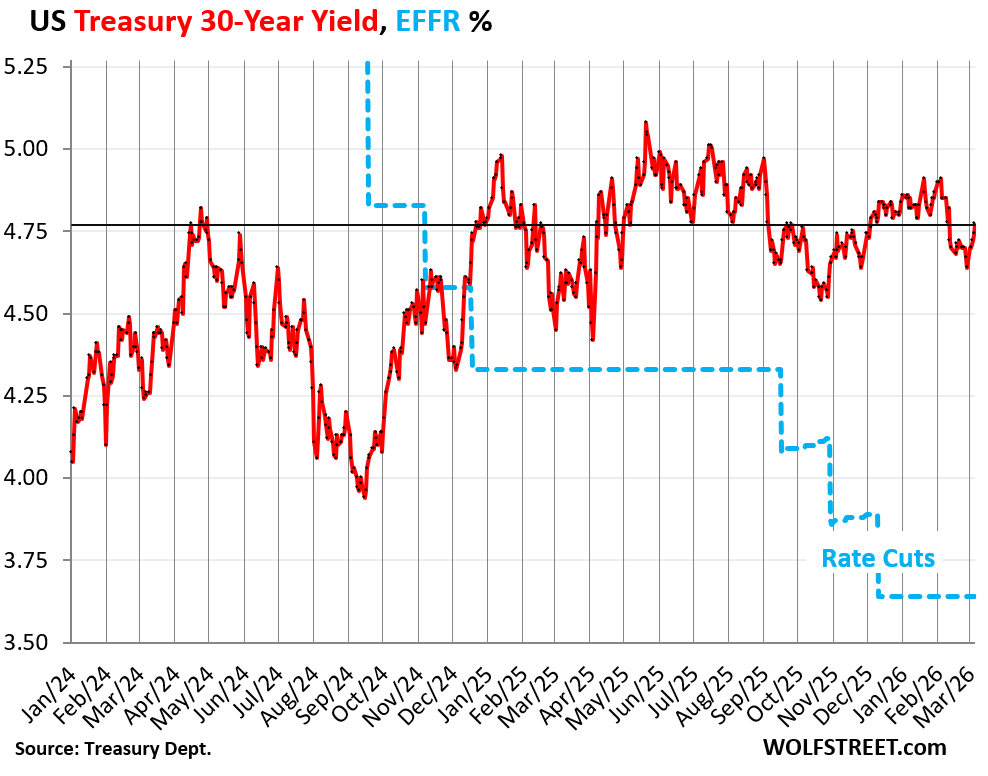
The 30-year Treasury yield rose to 4.77% on Friday, back where it had been in April 2024, before any of the Fed’s rate cuts, which started in September 2024.
The 30-year yield reacts to bond-market issues, such as expectations of future inflation and expectations of supply of new bonds that have to be absorbed; and it is not particularly influenced by the Fed’s short-term policy rates. But 30 years is a long time for inflation to go off the rails and for an onslaught of new supply.
These are big risks – and investors in 30-year paper seem too sanguine about them, or else they would ask for higher yields.
Inflation saps the purchasing power of long-term bonds; and the yield has to be high enough to compensate investors for this loss of purchasing power, and for the other risks investors are taking.
Cutting interest rates tends to spook the bond market in this inflationary environment and with so much government debt hanging out there, and more coming down the pipeline that the market has to absorb.
The bond market wants to be confident the Fed will take inflation seriously over the life of the bond. But that confidence is under pressure by Trump’s marching orders – what confidence is left over after the Fed let inflation get totally out of hand by blowing it off for a year, starting in early 2021.
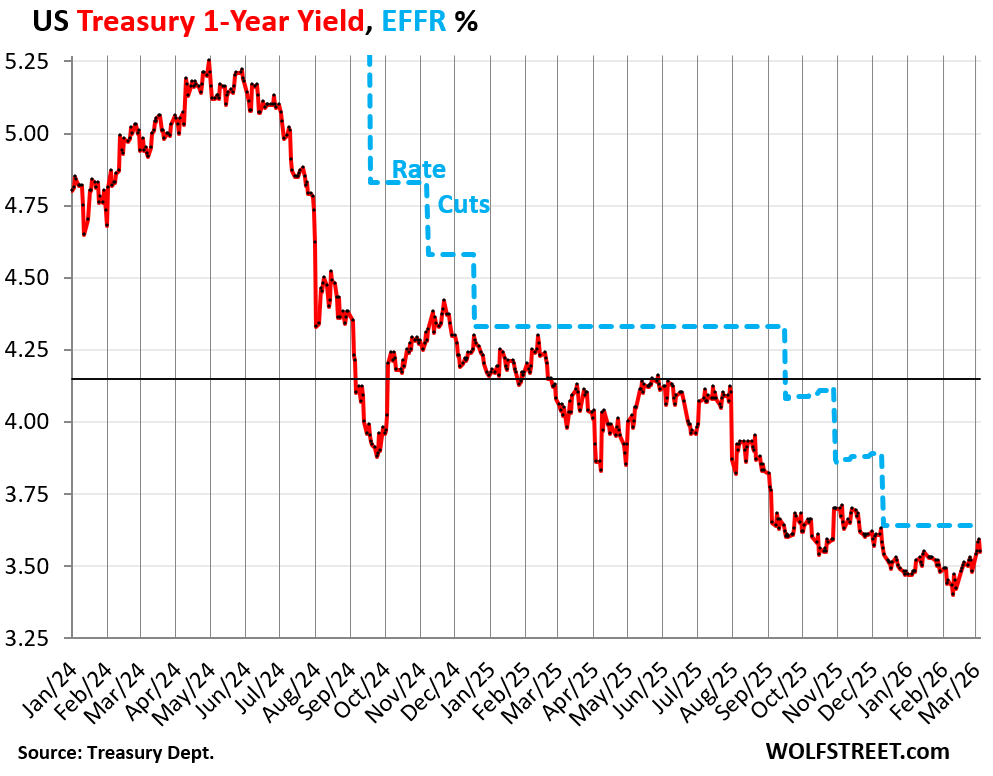
Short-term Treasury yields (1 month to 1 year) react to the Fed’s current policy rates and to expected future policy rates within the window before they mature.
And those short-term yields up to six months have edged higher this year and are now right around the EFFR, indicating that the market no longer sees rate cuts within their maturity window.
The one-year Treasury yield made the biggest move amid the short-term yields. By February 10, it had dropped to 3.40%, the lowest since August 2022, pricing in at least one rate cut this year. On Thursday, it hit 3.61%, taking that rate cut off the table. On Friday, after the weak jobs report, it backed off and closed at 3.54%.
This upward move of the 1-year yield from the low in February caused the dimple in the middle of the yield curve to flatten out, as we’ll see in a moment.
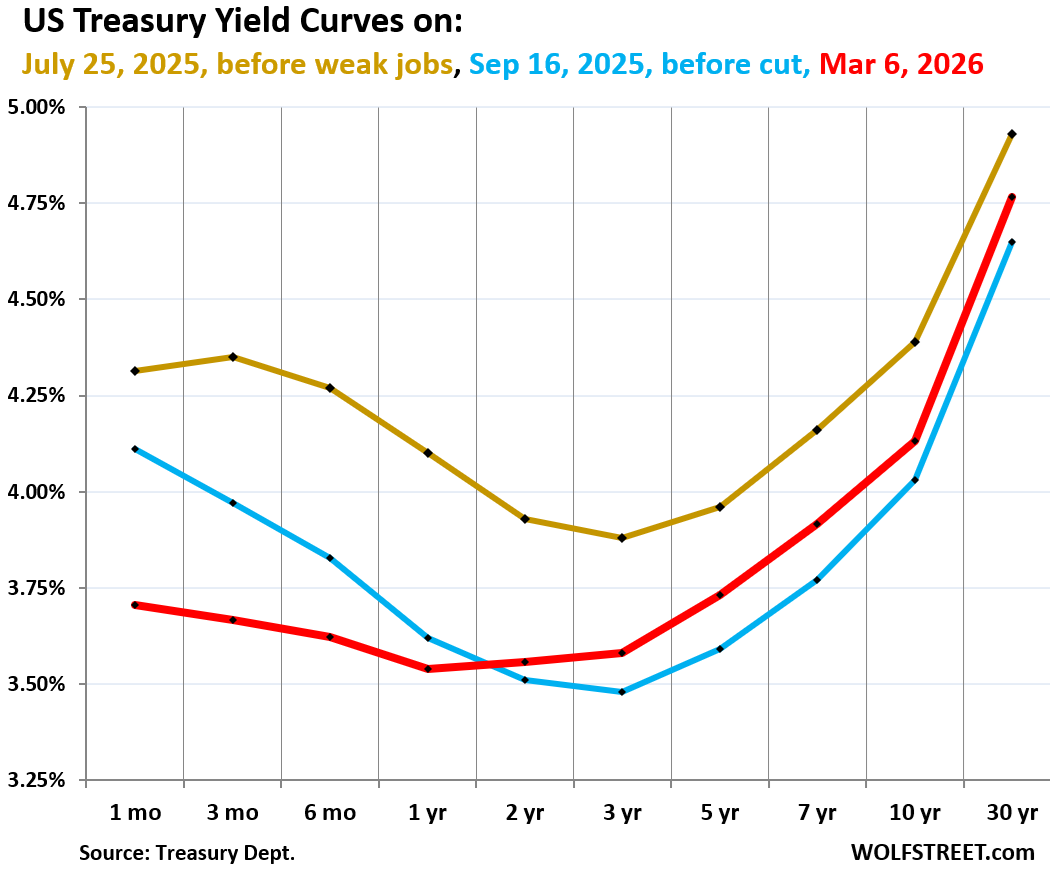
The yield curve has steepened since September 16, 2025, just before the Fed’s latest series of three rate cuts last year, with short-term yields falling due to the rate cuts, and long-term yields rising due to market conditions and fears.
And the sag in the middle is almost gone, with the 1-year yield now forming the lowest point on the yield curve, but barely, as the 2-year and 3-year yields, which had been the low points, have risen.
The chart below shows the yield curve of Treasury yields across the maturity spectrum, from 1 month to 30 years, on three key dates in 2025 and 2026:
- Red: Friday, March 6, 2026.
- Blue: September 16, 2025, just before the Fed’s first rate cut in 2025.
- Gold: July 25, 2025, before the labor market data turned sour.
Every yield from the 2-year yield and longer has risen since that September rate cut, despite hopes and predictions that long-term rates would decline when the Fed cuts its policy rates:
But the 1-month yield (3.71% on Friday) is bracketed by the Fed’s policy rates (3.50%-3.75 % since the December rate cut) and closely tracks the EFFR (3.64%). It was pushed down by the three rate cuts totaling 75 basis points since mid-September.
The 3-month through 1-year yields were also pushed down by the rate cuts, but less so.
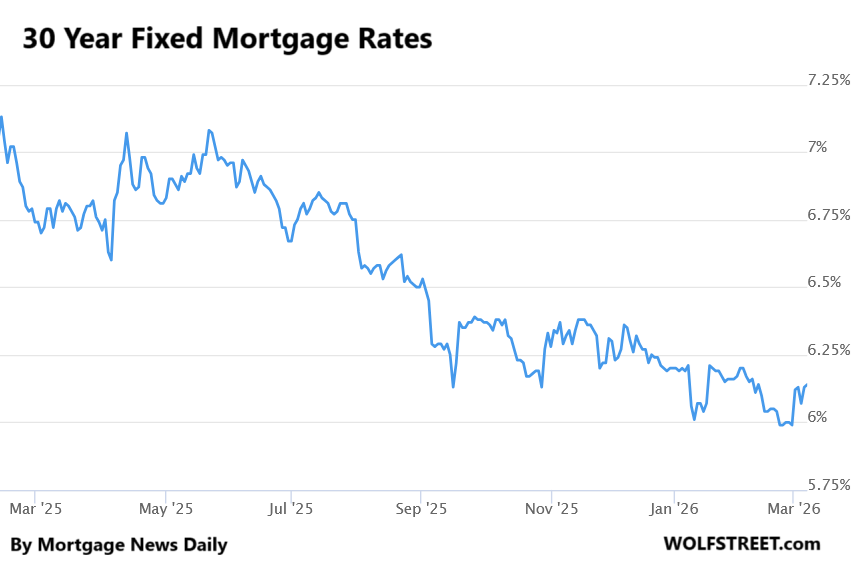
And mortgage rates jumped. The daily measure of the average 30-year fixed mortgage rate by Mortgage News Daily jumped by 14 basis points this week, from 5.99% on Friday February 27, to 6.14% on Friday, March 6. The stay below the 6% line was brief and shallow
A 6%-plus average 30-year mortgage is not high compared to pre-QE decades; it’s at the low end.
Enjoy reading WOLF STREET and want to support it? You can donate. I appreciate it immensely. Click on the mug to find out how:


Finally cancelled my wsj subscription. Bunch of fucking slop.
Libraries have the E version free. It’s formatted odd though. Still, same articles.
Good move. Personally have stopped watching CNBC. Except for Andrew and maybe Becky, they have morphed into a non-objective FOX News MAGA mimic. They cannot seem to keep the politics off the air, especially the folks they pull in for discussion. Not a bit of what they report is actionable and always about the large cap techs. If you don’t here it first, it ain’t news.
Sticking with Bloomberg for facts, not politics.
Hi Wolf – that overlay with “rate cuts” really helps understanding the situation. Thanks !
I would have to pay so much $ to get any cable channel.
It’s just too much hassle.
If they were smart they would offer $5 to get your fav channel a month.
Just got offered Paramount + no commercials for .99 a month , just because I updated the app. Sweet 99 cents!
Then you find out there is only 1 show you want to watch. lol. But still only a Buck. Now that’s the America I remember from the 90s. 👍
You can stream Bloomberg for free thru a lot of platforms (Samsung+) and I believe straight from Bloomberg.com
Live your life in a way so that you don’t have to trade some of your financial freedom for relief from boredom.
It has been trending downward ever since those Australians bought it in the 2000s. I mostly stopped reading their “serious” content by the mid-2010s, but I still read the book reviews and such.
Those Australians, lol.
More like THOSE… Australians.
A whole HBO series made to dunk on them. Haha
Wolf Street Journal?
Same here. Long time WSJ subscriber but I couldn’t take it any longer. WS is a much better source of unbiased information.
Journalism (not 🐺) is in the dumpster imho. I’ve never seen it this bad – gross speculation, profit primary motives, AI generated trash everywhere and a complete lack of integrity in favor of appealing and comforting biases to the subscription base.
Hell I’ve never seen this many grammar and spelling errors before have you noticed they are everywhere?
And every finance article reads like a political opinion rag it’s awful!
Agreed. Truly a sad state. I only trust European sources for news like FT now. Turns my stomach to see how far NYT and WaPo have fallen…10-12 years ago they were stellar
What we are witnessing is the devaluation of the US dollar as the gold standard of business transactions. Why ? If I had to guess it may be the impossible cost of American corruption.
The long overdue audit of the Pentagon’s one trillion dollar indicates that American military pissed away more money than they knew what to do with.
The problem with that is the production contract continues long after the technology is obsolete
America has been living on it’s credit card since at least the turn of the century.
Actually I once read that inflation is the trust people have in the currency.
Like a 1% is a lot of trust. A 10% inflation rate is not much trust.
If I recall correctly
Applying the Rule of 72 is one way of how long it takes for your money to double based upon 72/interest rate of 12 then it takes 6 YRS FOR YOUR CAPITAL TO DOUBLE. The opposite occurs w/the length of time debt doubles @ interest rates of borrowed money. It is is just an example of compounding interest rates in either direction does to calculate an est of receipt of compounding interest in either direction.
one has to think of it as
GOVT THEFT
of YOUR HARD EARNED fiat $dollars
Well it’s the distrust in the government or country as a whole.
Like the fed should get inflation to zero. If the people demanded it, like an iron fist, they would.
But the people are at each other’s throats, so the fed just dithers. Like all 3 or more term politicians, they blame their opponent and get re-elected. Really they are to blame.
How about the $200 million ad campaign for Noem? Or the $200 million for planes? Or $$ for armored limousines? The swamp is thicker than ever. Plus the weekly trips from Washington to Mar-a-Lago. It all adds up.
Pademe: but Anakin we’re not paying the bill right?
Anakin: stares back at her.
Padme: right? *concerned look*
Anakin: still staring
I don’t think the bulk of it is due to American corruption. It’s because we refuse to live within our means.
That’s not to say the rest of the developed world is doing a great job with that either, but at least they recognize that if they want a social democracy with an expansive welfare state, they have to pay taxes for that.
Americans want those same services but don’t want to pay European style taxes to pay for it. So instead, the money gets borrowed by the federal government and the American people have a greater standard of living than their counterparts in other developed countries. My theory is that the rest of the world is wising up to it.
Recent reports have shown that European GDP, even in Germany, per capita, is lower than even Alabama and Mississippi.
Depending how you want to adjust GDP for overvalued USD, the GDP difference maybe can be explained, but from what I understand, the USD is overvalued by about 16%, which does not explain the larger differences in GDP. So that means that European productivity is less than the U.S, per capita. That productivity difference might also explain why Americans are less happy than Europeans.
So, if you want more things, move to the U.S. If you want to be more happy, move to Europe.
The Europe that fought WWII is long gone, the people who came up with great technological innovation and engineering (e.g. Germans and English both invented the jet engine) have lost their ambition, and I think, their self-respect too.
Nope. It’s corruption. That’s why those in gov’t become so wealthy so quickly. They facilitate the corporatocracy. MIC gets it’s turn at the trough, then Big Pharma, them Big Oil, then Insurance, then HMO’s then Big Tech, etc. Wash rinse and repeat ad infinitum. Wall St. is the Wizard of Oz controlling the illusion.
While you might be right long term, we definitely will not see a collapse in the dollar during this oil crisis. Most of oil purchases are done with the dollar, if you are a country buying oil you likely need to buy the dollar and sell your own currency to buy oil. This will certainly hold the dollar where it is, and possibly drive it up. While I’m skeptical of it, whether or not this was a 4d-chess move by the admin to buy a little time keeping the dollar alive remains as an exercise for the keyboard jockeys.
The rise in oil prices was certainly helpful to Mr. Putin, the puppetmaster.
Did you see the US granted India a 30 day exemption from sanction to buy all the Russian oil they can buy?
Absolute corruption. But Americans just vote for whatever message they hear most often from the internet, which can be bought.
Mr. Wolf: “Inflation fears move to the top.” 1970s here, the inflation fears have stayed at the top since then. The dismissive “transient” inflation and feet dragging inflation fight corrects Benjamin Franklin’s: “nothing is certain but death and taxes” to add “Inflation.”
So it looks like the inverted yield curve has almost completely righted itself. Isn’t that supposed to be the indicator for when the recession actually begins?
Yield Curve “uninverted” in late 2024 to no such recession. It was thought to be a reliable metric, much like the Sahm rule, but they both failed as indicators in 2024.
Both misses have been excused as “due to the unique circumstances of the post-COVID economy” so don’t doubt this will raise hackles when it happens again.
Previously reliable indicators that have failed this cycle:
-10/2 yield curve
-10/3 yield curve
-NFCI uptick
-Sahm rule
-Residential construction rule
-Leading Economic Indicators
-Consumer Sentiment
-Business Sentiment
-Coincident Economic Indicators
-Low Personal Savings Rate
-Falling Labor Force Participation
Turns out, if you can spray a firehose of money at the economy 24/7, you can prevent even the worst crises from turning into a recession.
Deficit spending = stimulus. By that measure, we’re simply cranking up the stimulus higher and higher.
Dalio was right. It’s time to flee the US dollar. We won’t have a recession, but we’ll eventually wish we had accepted the business cycle instead of printing our way out of it.
– There were people who sounded the alam about rising yields (“Bond market crash”). To be frank, when I look at the bondmarkets and multiple rates in the US T-bond then I don’t see any crash at all.
– A crash in the (near) future is quite possible but not for the time being.
I think that all yields will continue to fall and yield curve to steepen (more) in the coming weeks and months.
There is zero argument for the yields going down on the long or medium end. There are plenty of arguments for it climbing. For the short end, the fed more influence but since the administration has been issuing more and more at the short end and seems to be continuing, we are going to have sooooo much supply of the short end that I honestly don’t see it moving too much.
Ok so those mortgage rates going back up really sucks.
“Sellers dig in even deeper!”
Poor sellers and their massive piles of equity.
Dude these houses near me, they are so outdated and spackled with grey paint.
How does no one buy quality fixtures for their house? Update the bathroom and kitchen a little?
Like it’s the original everything and these sellers want Full price.
I’m gonna have to pay to replace All of it, why would I give you full price? I want the drywall and plumbing. Maybe I’ll keep a light fixture or 2. Most appliances and fixtures have to go.
And this LVP flooring, wth?!
LVP stands for Low Value Plastic, right?
Suffer,many times no matter how nice a new bathroom/kitchen have found as a carpenter new folks just want their own vision,at least on higher end/higher mid level homes.
I have been told by many customers who ask what to do to sell their homes is just have it clean/neat home/yard and as a seller figure out what the locality will allow for additions ect.
I will say any who need to put in a new septic before sale the few bucks spent on adding say one or two bedrooms is short money in big picture and a great selling point.
I also say address any basement water issues as many folks really seem to like finished basements,just make sure local egress laws allow this.
I will also add fresh paint ect. does not hurt but trust me,it will be a different color in a year,at least interior.
Chris B,
You know what a genius vinyl siding guy did? He installed it on the floor too!
🤣
Thanks James! I watch a lot of This Old House reruns and follow some DIY guys on YouTube. It’s pretty fun to mess around fixing houses. I may not be very talented, but the price is right!
The Treasury needs to look closely at the mortgage rate. Banks have a minimum requirement to make money on a loan, the bond market wants the same. I’m not loaning the USA gov’t money (by buying bonds) when there’s no return. Bonds should run 3-4% above the rate of inflation, minimum.
It should be like that. But look at the market.
So many buyers for 10yr at 4.25%. That’s like 1.25-1.5% REAL rate including TERM premium.
So when most of the people in market think what you say, we will have 6-8% 10yr yield.
NYT: A Crypto Coin Is Gobbling Up U.S. Treasuries
Cryptocurrencies were designed to be a hedge against the U.S. dollar, which crypto creators viewed as an unreliable currency. Yet one of the fastest-growing crypto coins has risen in popularity precisely because it’s pegged to the greenback.
Stablecoins, as they are known, are also backed by U.S. government debt, known as Treasuries. And with President Trump’s blessing, they are poised to rework key parts of finance, presenting potential systemic risks and business opportunities in equal measure.
After meeting privately with a crypto industry leader on Tuesday, Mr. Trump criticized banks in a social media post, saying they were trying to meddle with a law he signed last year that widened legal avenues for adopting stablecoin in traditional finance.
“The Genius Act was the U.S.A.’s first big step to make the United States the Crypto Capital of the World,” he wrote, adding that banks “should not be trying to undercut” the legislation and “need to make a good deal with the Crypto Industry.”
Engineered to consistently trade at $1, like a cash equivalent, stablecoins have become a key asset in the crypto market by allowing traders to reduce the overall risk of their portfolios. They can trade out of wild price swings in the coins they bet on and into stablecoins, all while staying within the crypto blockchain.
As a result, stablecoins have grown to $300 billion in market value from roughly $20 billion in 2020. The Federal Reserve estimates they could be worth $3 trillion in five years.
Because stablecoins use Treasuries as the primary collateral to create this cashlike safety, cryptocurrencies have effectively flooded into the Treasury market, the central artery of the U.S.-led global financial network. Stablecoin-issuing companies, like Circle and Tether, now hold more Treasury debt than major U.S. government creditors like Saudi Arabia and South Korea.
Some experts fear that the next crypto crash could cascade into major losses for the highly sensitive short-term U.S. debt markets in which Treasuries predominate. The open question for regulators, bankers and the Trump administration is whether the growing centrality of the coins carries more upside or downside risks.
NY Times is so funny. Why did it take them several years to catch on?
And this is typical NY Times BS: “Circle and Tether, now hold more Treasury debt than major U.S. government creditors like Saudi Arabia and South Korea”
“Major…” So, here we go: Saudi Arabia holds only $149 billion and South Korea $140 billion, compared to Japan (1.19 trillion), China & Hong Kong ($951 billion), the UK ($866 billion), Belgium ($477 billion), Canada ($468 billion), Luxembourg ($435 billion), Cayman Islands ($421 billion), France ($369 billion), Ireland ($341 billion), Taiwan ($311 billion), Switzerland $295 billion), plus 5 others. Saudi and Korean holdings are smaller than Brazil’s and India’s.
If you get your economic info from the NY Times, you’re going to get goofballed.
NYT sadly has like 1 guy who is good at investments.
He loves the 60/40.
They have 32 28 year olds to lookup mediocre recipes. “A broth to die for” first boil 2 chickens all day, second discard chickens.
What? Discard 2 chickens ? Wth!?
It seems to me that StableCoins is simply a scheme to further increase the moneyness of Treasury Debt. For all the talk of the growth of SC, I also read that most of it’s use is relegated to settlement in the larger crypto space. True or not, I have no idea. I just know that I’ve never used SC to settle any kind of transaction.
SC also provides a means for Treasury to increase the money supply without supervision by the FED. If I take 1 USD and buy a SC. The SC issuer, gives that USD to Treasury to Spend and buys a dollars worth of Treasury Debt. Simultaneously, I can spend my SC as if it were money – so my 1 USD has become 2 USD in terms of of the economy.
The US has the best Financial Engineers in the world.
The US has the dumbest investors in the world. Hey, why not buy my shillcoin because I claim it’s somehow contractually tied to the US dollar, which is itself a currency in the midst of a full collapse.
And dipwads think it’ll go up 1,000x so why not hand over their money to some anonymous username on the internet.
We should have gotten rid of those lead pipes a generation ago.
I’m waiting for the 14 % ten year Treas… and also have one foot in the grave!! All the blather about inflation seems to suggest that everybody is doing fine in America. Everybody has some money to p – away.
14% treasury is a great retirement plan baby.
Outpace the market for 30 years by 6%, with zero risk.
Just daily go down to a Schwab corner store and laugh at them. That’s just your routine as a retiree, stop at Schwab and laugh at them. Haha
Interest on the Federal debt is the single fastest growing component of the deficit.
Imagine running a household this way.
🤔 these still look like Goldilocks yields to me. Next time the 10 pushes 4.75 I’m buying … the jump? The reverse dip? Buy the spike?
There is definitely a correct Van Halen song for that process.
Too bad there wasn’t a Richter scale for inflation!
“As Inflation Fears Move to the Top”
There may be millions and millions of drunken sailors lining up at the soup kitchens, or worse homeless if this inflation monster continues unabated.
So much concern about inflation and no mention of the (closed) Straits of Hormuz. BTW: California imports 58% of its oil from foreign sources and of that about 50% comes through the Straits.
1. Only minuscule amounts of crude oil that the US (including California, you dufus) bought over the past few years went through the Strait of Hormuz, accounting for only 2% of US petroleum liquids consumption in 2024, EIA data. US refiners can switch this small amount to anywhere. That chokepoint is not a US problem but a problem for Asia and Europe.
2. Saudi Arabia and the UAE have big pipeline capacity to bypass the Strait of Hormuz.
3. US (including California) imports from ALL of OPEC combined accounted for only 10% of total US imports of crude.
4. California refineries (and refineries in other states) import crude oil to EXPORT diesel, gasoline, jet fuel to Mexico and other Latin American countries. Gasoline consumption in California has been declining for many years (EVs and more efficient ICE vehicles), so refiners need to export to stay in business.
I’m sick of this ignorant manipulative BS about the US energy business from frustrated Canadians. Your government officially and on-the-record riled you up to reach out to US media and social media to spread bullshit and lies because they hate the tariffs and Trump. You’ve become a tool of your government’s propaganda machine.
You used to be a nice guy until Trump moved into the White House, and then you started abusing my site to spread BS and lies. Take Trump like a man and cry into your pillow.
And RTGDFA even if it destroys your BS narrative:
https://wolfstreet.com/2026/03/03/oil-jumps-but-its-not-the-1970s-anymore-us-crude-oil-production-hits-record-net-exports-soar-imports-decline-further/
‘US (including California) imports from ALL of OPEC combined accounted for only 10% of total US imports of crude.’
True! However, according to Oil Price (THE site for oil info) California is an oil ‘island’. It is not connected by pipeline to the oil producers like Texas etc. So it brings all the crude not produced IN California by tanker, including roughly 25% from the Middle East which was going through the Straits.
You still didn’t read my fucking article that I linked. I explained “oil island”, verbatim:
“Even refineries in “oil island” California are in on the deal. They’re not connected via pipelines to US producing regions. California produces some of its own crude oil, and imports crude oil from Alaska and foreign countries. Some crude oil arrives by oil train across the Rockies. But it’s also a large exporter of gasoline, distillate, and jet fuel, mostly to Latin America. West Coast (PADD 5) refiners exported 0.41 MMb/d to other countries in 2025.
Importing crude oil, refining it, and exporting the value-added product is a huge profitable business for refiners in the US, which explains in part why the US imports crude oil: Refiners sell the refined products to foreign customers.”
Your manipulative BS is an exasperating waste of my time. Adios.
Fyi. This is why I love this site.
DO NOT BE SURPRISED to see a 8% motgage rate by 2028 maybe even a 9%
I’m not certain you understand but the right wants 0% interest rate level.
I dunno if it’s to keep their assets permanently high so they have no competition from the millieniels. I dunno, there’s some strategy there.
If somehow the head of the fed made rates over 10%, they would run him out on a pine rail.
And if that happens, do not be surprised to watch another real estate crash occur.
Don’t threaten us with a return to sane home prices! :)
It seems the FED is actually fighting the bond market. Is the 5 & 10 year not saying the market thinks the neutral rate is ~3.85-4.2?
The disruption to the world economy due to ME could end up being massively deflationary in the short term.
There is no such thing as a neutral rate of interest. If anything, the neutral rate will inadvertently be revised lower through associated benchmark rates because of the denigration of the Phillips Curve.
Nice leveraged buyout of the US government you’ve got there. Would be a shame if something happened to it.
chat gpt : The Fed watches real rates of interest to judge whether policy is actually restrictive or stimulative, even if the nominal federal funds rate hasn’t changed.
ChatGPT is such a goofball. No one can watch the “neutral rate” because it doesn’t exist. It’s just a theory, and guesses where it is are all over the pace.
The Bond market is open and yields are green all the way.
I sold a short spread on TLT last week. All it has to do is not go up, which it won’t unless we get a major TACO. Luckily, Tangerine and Co. have already committed to a 4 week war to boost oil prices for their donors.
Ride the crazy or get bulldozed by it.
All you folks driving V8’s around might need to reconsider your life choices before we hit $5 per gallon.
Nope,might drive the two 4×4 toys a little less but not by much,love me classic vehicles and WILL NOT give them up,have the monies to feed the gallon per mile beasts(OK,not quite that bad)!
I am though could afford a lot of excess in all other ways while not cheap am frugal,so,will have me one fun.
The only other excess is may soon if playing keeps improving is get a Les PauL custom,not a inexpensive guitar.
Nope,the 85 built to the hills 4×4 truck and 1980 4×4 van are staying!
Or speculate poorly and lose a wheelbarrow full of money. You may be right or you may be wrong. But speculation is what drives most asset prices notwithstanding the underlying dynamics. If your analysis truly involves believing this is all about Trump providing money to donors, good luck because that is about all the leg that thesis has to stand on.
Next question… when does the market irreparably fracture vs exhibiting plasticity? PS The housing market has already reached plasticity.
Agree, still a member of the 1000 hp club, two cars, 700+hp, boat 500hp. Not rich, just enjoying life