
The annual adjustments of the labor force to the new population estimates are in, and they’re revealing.
By Wolf Richter for WOLF STREET.
We’ve been watching a big structural change happening in the labor market. And it’s starting to show up in the data.
Once a year, the Bureau of Labor Statistics adjusts its Household Survey data – total employment, labor force, unemployment, unemployment rate, etc. – to the new population estimates from the Census Bureau. The entire adjustments for that year are taken to the data for the month of January, and not carried back to the prior 12 months. And today was that day when it adjusted its January data (belatedly due to the government shutdown), and the new February data were layered on top of it.
The Census Bureau latest population estimates, released in January, showed a dramatic drop in “net migration” (immigration minus emigration) in 2025 as a result of the crackdown on illegal immigration, and the Census Bureau indicated that net migration could turn negative next year at current trends.
The supply of labor fell in 2025.
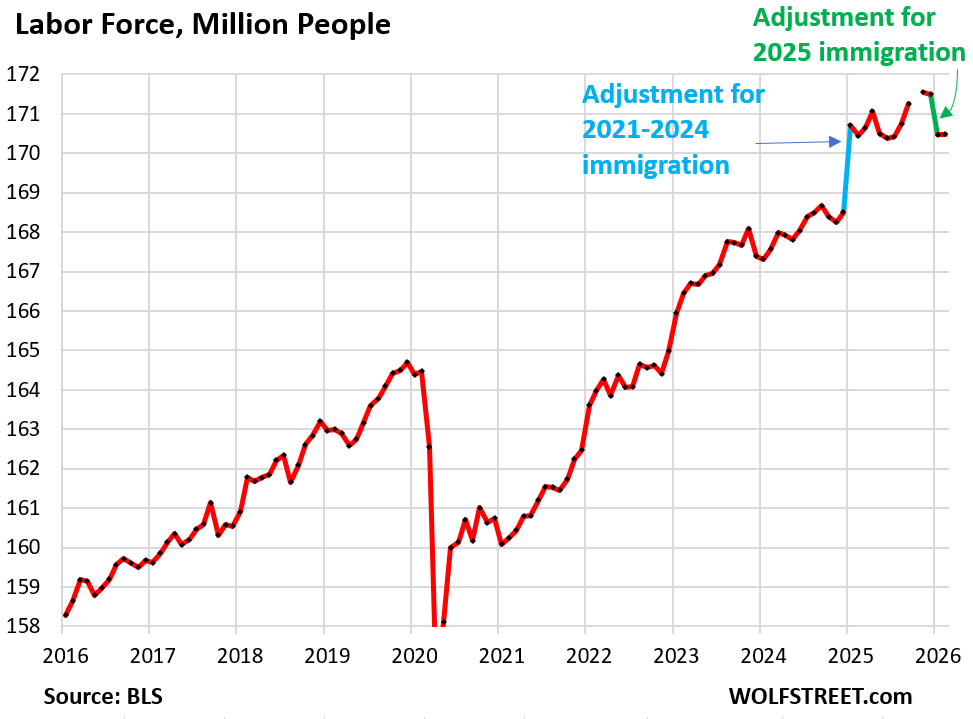
The labor force was adjusted down by 1.03 million people today for January (green segment in the chart below). And for February, the labor force grew by 18,000 people, to 170.48 million.
Last year at this time, the upward adjustment was gigantic because that was after the Census Bureau had finally figured out how to get a better handle on the huge influx of immigrants in the 2022-2024 period, and it caused the Census Bureau to dramatically raise its population data for that 2022-2024 period all in one data release. The BLS then made the massive upward adjustments to the January 2025 data (blue segment).
The labor force consists of people who are either working or are unemployed and are actively looking for a job. People who are retired and not looking for a job are no longer in the labor force. Newly arrived immigrants, regardless of status, who are either working or looking for a job, are in the labor force.
The labor force in January was 231,000 people below where it had been in January a year ago, indicating that the supply of labor declined, after soaring in prior years. This is a huge structural change for the US labor market.
At the same time, in 2025 and continuing, there was weak growth in nonfarm payrolls amid pressures from AI, automation, and in the tech world from “overhiring” in 2021-2023, as tech CEOs have been calling it, where they’re now cleaning house.
Unemployment in February, at 7.57 million, was roughly stable over the past six months, below September and November (no data for October) and above January and December.
The three-month average in February dipped a hair to 7.48 million.
The unemployment rate inched up to 4.4% in February from 4.3% in January, but was lower than in November (4.5%) and same as in September.
The unemployment rate reflects the number of unemployed people who are actively looking for a job (7.57 million) divided by the labor force (170.48 million):
This kind of unemployment rate is at the low end of the historical scale.
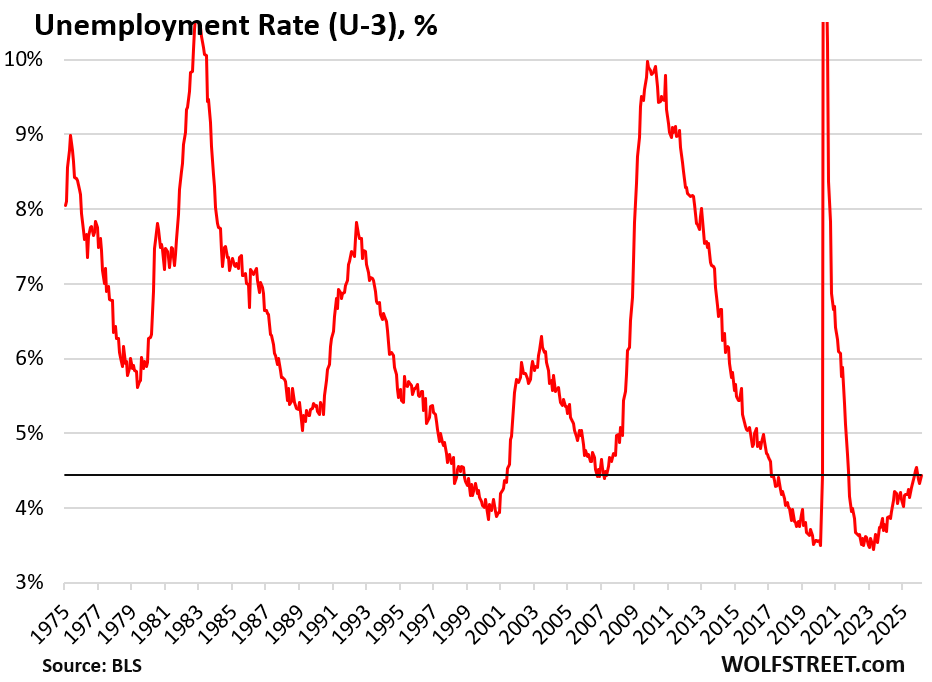
Immigration crackdown: Low unemployment rate despite stalled job creation.
Job creation has slowed to a trickle over the past six months. If the labor force would have continued to grow as in prior years, that kind of stalled employment growth would have fueled a much higher unemployment rate.
Job growth over the past six months by industry:
- Construction: +70,000
- Healthcare & social assistances: +287,000
- Leisure and hospitality: +52,000
- Professional and business services: +10,000
- Other services: +51,000
- Utilities: +5,000
- Wholesale trade: +8,000.
Job declines over the past six months by industry:
- Government: -256,000
- Information: -48,000
- Financial activities: -19,000
- Transportation & warehousing: -126,000
- Retail trade: -14,000
- Manufacturing: -42,000 automation being pushed to the next level
- Mining & logging, which includes oil & gas extraction: -7,000.
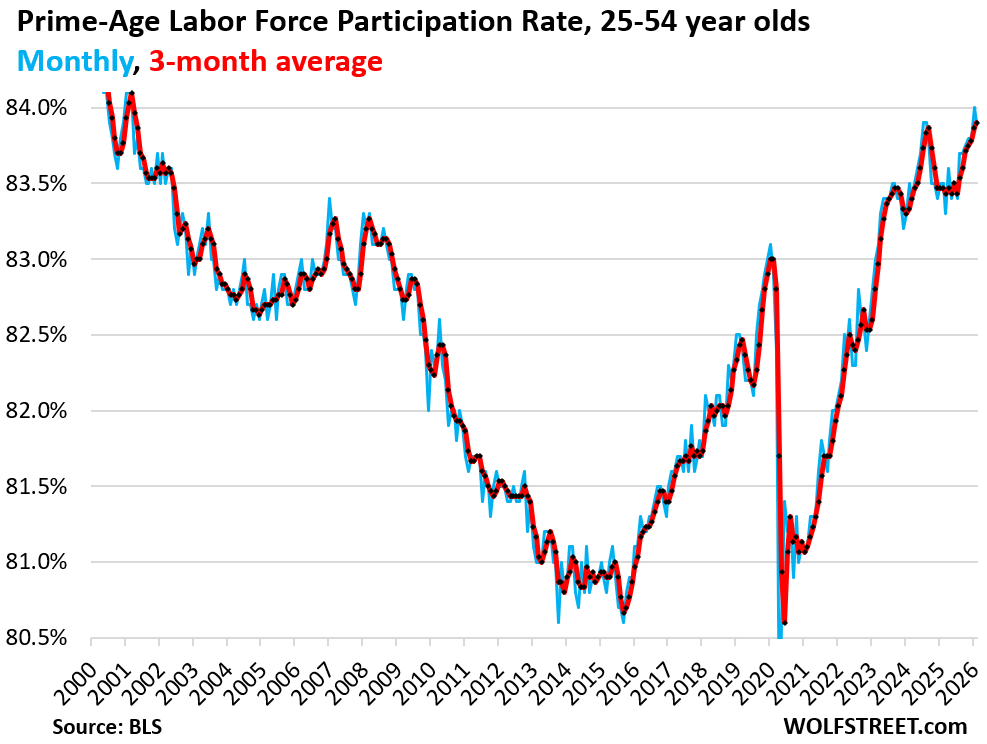
We can see this in the prime-age labor force participation rate (25-to-54-year-olds), which has been running at 25-year highs, lower only than during the extraordinary period of the Dotcom Bubble. In February, it dipped to 83.9%, from the 25-year record in January (blue in the chart below).
The three-month average rose to 83.9%, a 25-year record (red).
The prime-age labor force participation rate eliminates the issue of the retiring boomers. The overall labor force participation rate shows the percentage of the population that either has a job or is looking for a job. When people retire and stop looking for a job, they’re no longer “participating” in the labor force but remain in the population until they die. The surge of boomer retirements, which started about 15 years ago, has pushed down the overall labor force participation rate, as these retired boomers are still in the population but no longer “participating” in the labor force.
The high prime-age labor force participation rate speaks of the lower supply of labor in 2025 due to the crackdown on illegal immigration and its impact on overall population size, and of some strength in the labor market.
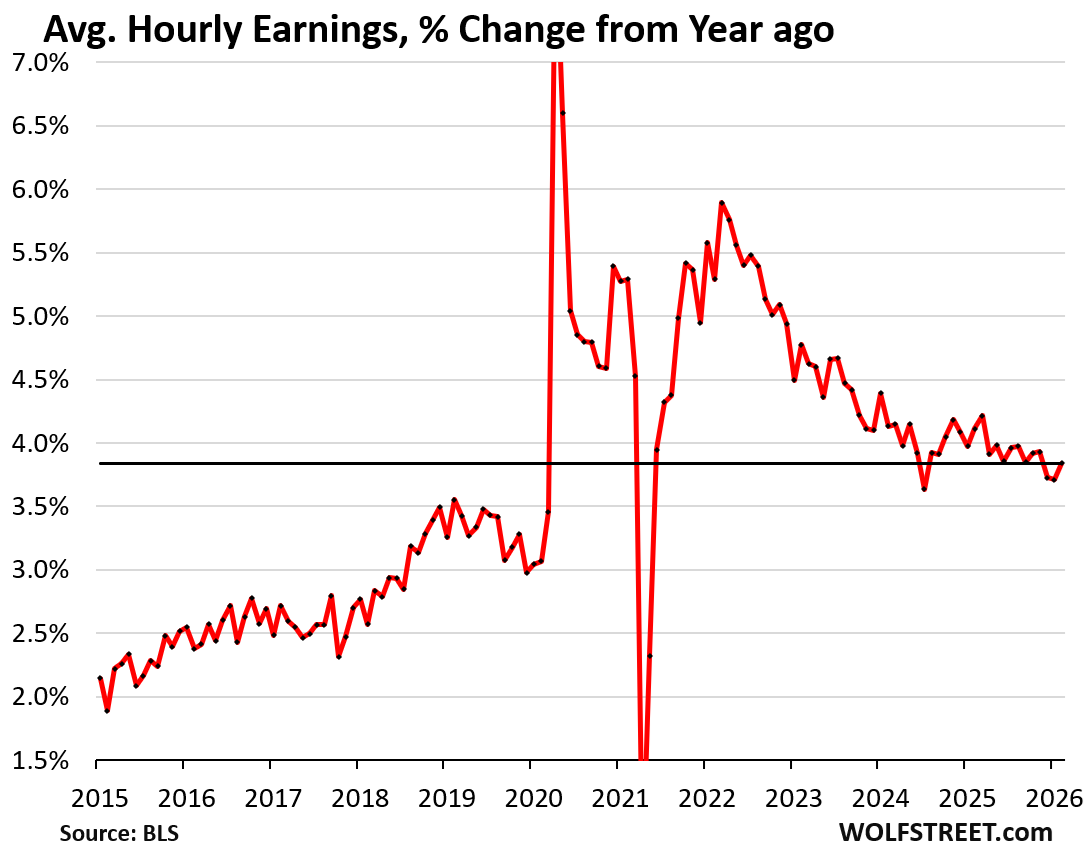
We can also see this in the solid growth of average hourly earnings. In the past, when job growth stalled, it did so as the labor force (supply of labor) continued to increase, thereby pushing up the unemployment rate, and pressuring down wage growth.
Now the growth in the supply of labor has stalled. And growth in demand for labor (job growth) is slow, so the unemployment rate remains low, and wages continue to grow at a solid rate.
Average hourly earnings in February rose by 0.40% from January (5.0% annualized) and have been in this 5.0%-annualized range for five of the past seven months.
Year-over-year, wage growth accelerated to 3.8%.
Despite weak job creation in the private sector and job cuts at the federal government.
The federal government shed another 10,000 civilian jobs in February. Since the beginning of 2025, the federal government has shed 327,000 civilian employees, seasonally adjusted, or 10.9% of its staff.
Companies and private research institutions that lost government contracts, or whose contracts were reduced or paused, also laid off people. But those were private-sector jobs; they’re not included here; they’re included in private-sector employment below.
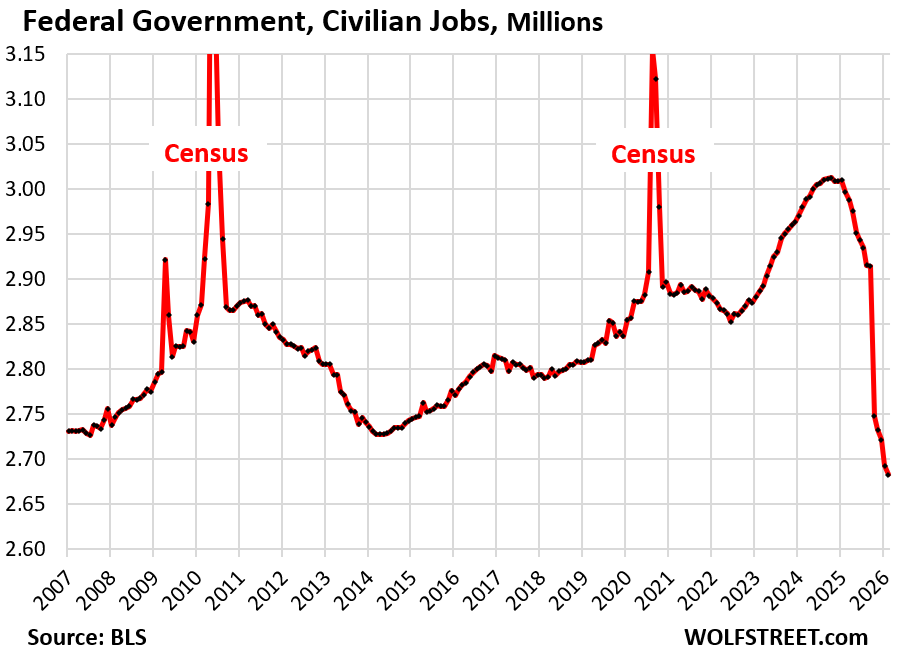
State governments added 5,000 employees in February, after having shed 50,000 jobs last year. Local governments shed 1,000 jobs in February but had added 123,000 over the past 12 months.
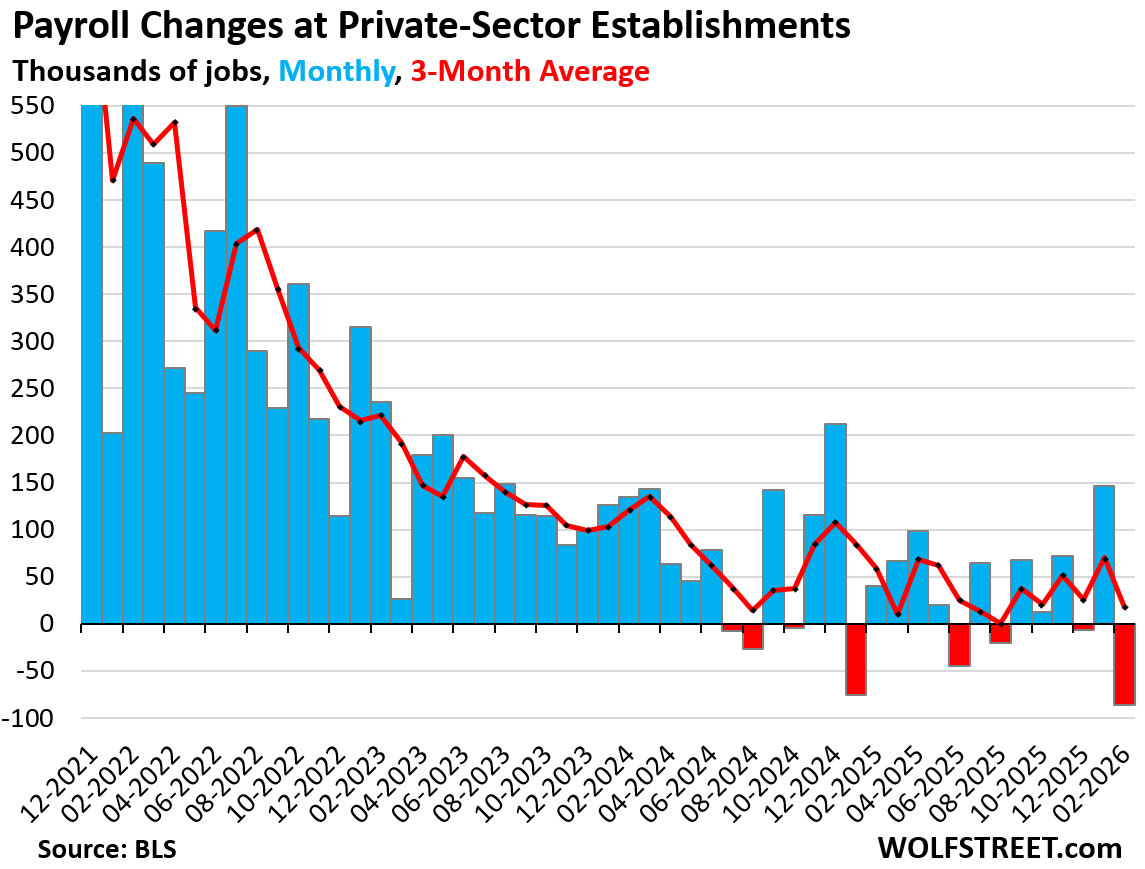
The private sector shed 86,000 jobs in February, undoing part of January’s gain of 146,000 (red and blue columns in the chart below).
The three-month average job growth, which irons out the month-to-month squiggles, declined to 18,000 jobs created on average per month over the December-February period. The low point of the three-month average was in August at zero jobs added (red line).
Over the past 12 months, private-sector employers added 392,000 jobs.
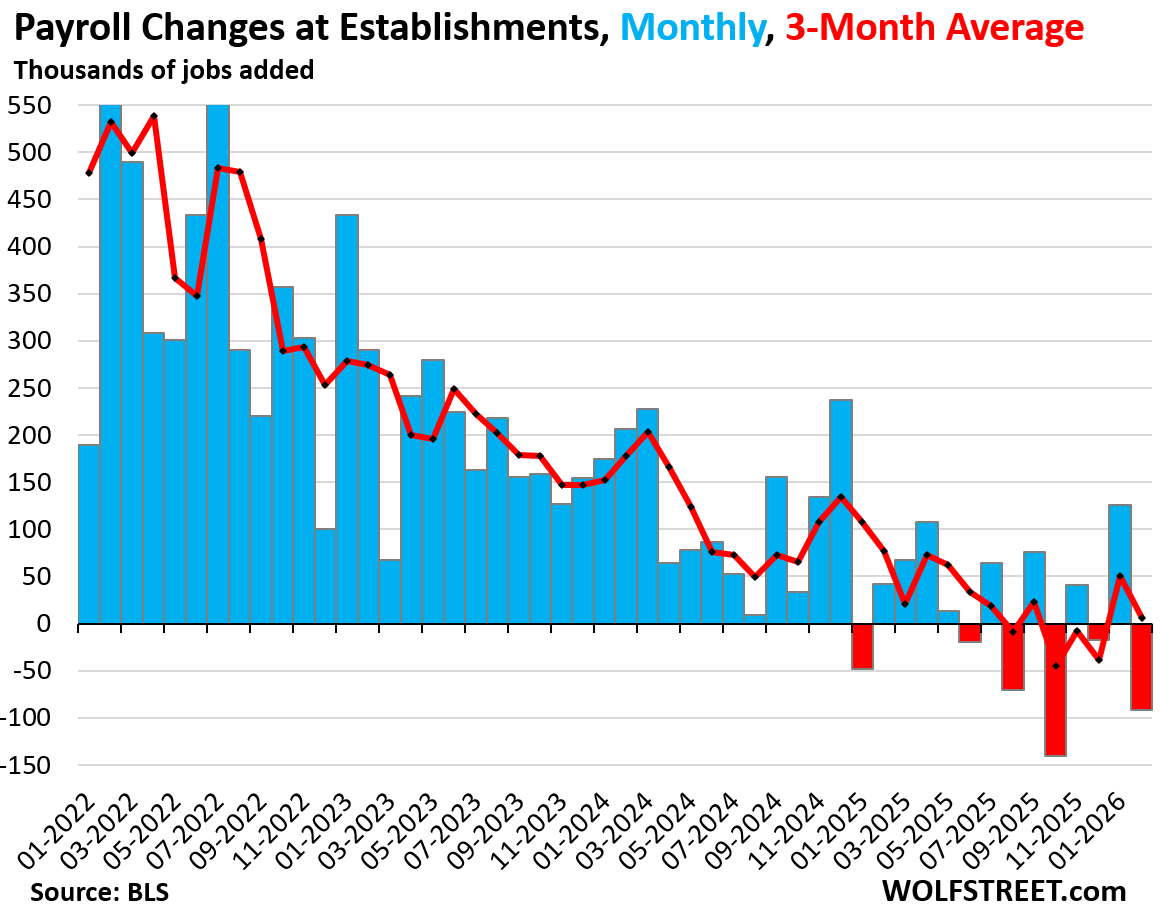
Total nonfarm payrolls, including governments, fell by 92,000 in February, after the 126,000 gain in January, seasonally adjusted.
The three-month average job growth declined to 6,000 jobs created on average in the December-February period.
Over the past 12 months, private-sector and government employers added only 156,000 jobs.
Enjoy reading WOLF STREET and want to support it? You can donate. I appreciate it immensely. Click on the mug to find out how:


We need to fine employers who hire illegals. Also, require E-Verify for all new hires. That would eliminate all this BLS data being distorted by the deportation of illegal workers.
Amen!
Yes, in accordance with U.S. law. Sick and tired of Americans being passed over for everything in favor of foreigners.
Did you see the article where the middle-easterner who is head of the Texas medical Board announced that foreigners are being fast-tracked for licensing ahead of Americans ?
Try as you might to attribute this to a “middle-easterner”, it’s a program that’s been implemented in 17 states so far to address doctor shortages.
From the Texas Tribune: “Texas joins 17 other states that are making it easier for foreign medical graduates to work as doctors here. About a quarter of the state’s licensed doctors were trained outside the U.S. “
There are doctor shortages because the medical boards will fully hold back the number of doctors
Eric is correct. Doctor shortages are artificially created by doctors to keep pay high.
The number of Americans being passed over for jobs is very low, unless you count the jobs Americans don’t want to do or jobs with pay that is so low Americans won’t take them.
There are MD shortages because people don’t want the medical debt, to deal with CMS, the awful work life balance, and the 1997 funding cap imposed by the government that limits MD residents.
Yea, I don’t understand why programs require a neurosurgeon to suck out a few hundred blood clots before they are allowed to do neurosurgery in the wild.
If all those medical training programs could just hire paid intercranial hemorrhage actors so more neurosurgeons could be trained, then the number of doctors would not be artificially held back.
Here in nc
They fill shortages by using PAs, NPs and bringing over foreign doctors under H1Bs.
American doctors educated and trained here, as in MDs are prob only 20% maybe. So 4 out of 5 encounters will be a PA, a NP or a foreign educated and trained doc. The foreign docs may have done their residency in the US. That does make them more Americanized with better communication and Better bedside manner.
The PAs and NPs have a real hole in their deduction ability because their education and training compared to an MD is very poor. They miss a Ton.
Regarding E-Verify only around 22 states that require it; and it’s a mix of Republican and Democratic leaning states that don’t require it. A program launched in 1996 and it’s still not being used correctly.
Hey Congress!! Make it a national law
But most mid to large Companies use e verify in every State regardless.
I hire WORKERS
don’t care color or otherwise
but I find I fire most mils of every color
they work then slack off after hiring, finally have to give them notice and fire them
the work needs to get done
best workers are in 50’s
I have always wondered about the methods of enforcement.
The strategy is to go after individuals, except in select cases of “egregious” violations (the occasional factory headline).
If labor laws were actually enforced, it would probably put upward pressure on wages and even create jobs (since we all want more regulators in our industries?).
what’s tyson, smithfield to do
MERICANS don’t like that work
requires effort and common sense
If they upped the pay, I bet Americans would love the work.
Have you seen the labor in a meat processing plant? Its highly repetitive and stress inducing on the body. It has NOTHING to do with common sense.
Swamp Creature,
Businesses don’t want that so politicians don’t want it. This has been the case since Reagan and of course McCarthy defeated it in the latest round.
It’s the tariffs. It takes time for things to flow through the economy. This was the prediction. Companies can’t pass the tariffs on, so they are not hiring and laying off. Less immigration and a smaller labor force would drive unemployment down, not up.
JFMcNamara
The companies that are laying off are the tech companies that overhired in 2021-2022. Jobs in Information have plunged, after spiking. They don’t sell tariffed products. And the biggest job losses come from the federal government (-327,000 since the beginning of 2025), unrelated to tariffs, but to government policy decisions.
Who will pick the vegetables? I understand this with regard to H1B work for engineers and high value employees, but the country literally runs on the labor of immigrants in construction, agriculture, and the back end of restaurant and hospitality work. And please don’t tell me US citizens will pick grapes in 100 F heat, farmers know that this argument is crap.
If you pay Americans correctly, and offer them decent working conditions, they will work. The problem is that employers don’t want that. they’re looking for cheap labor.
In terms of construction: A good friend of mine, after he took over his father’s construction company in about 1990, hired a Mexican foreman for one of the construction crews. The guy brought in his cousins and friends from his town in Mexico, put them up in a house, gave them an old van to drive to the job sites with, and paid them cash. They did decent enough work, and were a lot cheaper than the white and black tradesman they’d replaced. And over a relatively short time, all his crews were that way, and all the white and black tradesmen were gone.
It’s not that Americans didn’t want those jobs, it’s that illegal immigrants were encouraged to come and take those jobs because they were a lot cheaper and allowed the company to fatten its profit margins. And that’s how it happened everywhere.
Is there data or studies that show this effect in terms of job transition to a foreign national without authorization? There must be studies that support this argument of job replacements. Politicians talk about it, but no one has ever put a number on it.
This is one example of the dynamic in the workforce , really over the last 3 decades, which has led to the data showing how the Middle Class, especially Blue collar, suffering a sharp decline in relative income and wealth.
And IMHO has probably been the biggest reason our politics have been so difficult now.
Yes, and your friend would tell you that he likes them also because they’re happy. They don’t bitch and moan.
Cheaper: They don’t demand holidays, sick pay, health insurance, workman’s comp? Overtime pay and will work 6 days a week, no problema.
Year after year the politicians say they want to fix the immigration problem but that’s bullsit. Forget what they say. Look what they do. Nothing in Congress. Because their business constituents like illegal workers.
Trump has done something. (Many times inhumanly and illegally) We’ll see how it plays out.
I disagree. Labor is the only ‘big’ expense a company can control. The tax man, the banker, and the insurance company will not compromise. When those expenses increase, labor must decrease…. or prices increase. The “will work for better pay” argument makes it sound like a business is acting deceptively or worse immorally. A better generalization would be “Americans do not want to pay more $ for their stuff” and “stock market loves fat margins”. Consumers are happy to turn a blind eye to unfair labor practices as long stuff is cheap (see Temu). Investors are happy to turn a blind eye if the business has big profits. To pretend that the business has a choice if it wants to survive is foolish. Sorry for the rant, I have been involved in this world for most of my working life and get tired of the ‘greedy’ employer argument. If you could see the folks that apply for our jobs, low skill, high school educated or less, exclusively American workers, you would be shocked at how poor they are. The reality is not only is foreign labor cheaper, they are more skilled, more likely to show up, and much less entitled. Isn’t better and cheaper the American way? Now I will go back and RTGDFA one more time and hope I did not type something stupid….
Nepotism is a real corruption driver in America.
If people looked at the big picture and kept our system stronger without corruption. Things would be so much better.
But people are greedy.
Wolf:
They also sell the product for way less. Many of the local tradesman are lazy with low productivity and high wages. This will surely equal higher prices.
1. I strongly disagree with your “lazy with low productivity” in : “Many of the local tradesman are lazy with low productivity and high wages.” if you think that, you’ve fallen for some stupid BS.
2. “This will surely equal higher prices.”
Not higher prices but lower profit margins. The story of my friend – replacing US tradesmen with illegal immigrants from Mexico was done to cut the cost of labor and increase profit margins. He did NOT cut prices because of his Mexican laborers brought his cost of labor down LOL
The search for cheap labor is all about higher profit margins by bringing labor costs down, not lower selling prices.
During the Great Depression the poorer WASPs did……but that is what happens when a nation’s wealth inequality gets so extreme.
We are approaching that fast, if not already there.
When I moved into my house the roof was leaking and in a panic I hired a company that used some illegals who put a new roof on for a cheap price. They did such a crappy job I had to fire them and hire a new crew to come in and re-do the whole job. Example, when tearing off the old roof the illegals threw all the 30 year old roofing debris onto my neighbor’s lot instead of the dumpster that was provided.
And make laws retroactive and loaded up with clawback ability for the last 50 years……nobody should be living excessive lifestyles, anyway.
Laws with teeth. Whatever gov’t dept does it will EASILY pay for itself, just like the largely dissolved high end cheats IRS dept did.
Hell, make IRS full fledged branch of Military……Coast Guard chases down fake Gucci handbags, etc, etc, etc……..cheating rule of law (especially under our system) is cheating rule of law and destabilizing……..
Also need Constitutional max individual or household net worth.
Just fantasy….sorry……
I’m not sure we want the government this deeply involved in our lives in this way. I understand the impulse, but it just seems like another step down in the surrender of our liberties. This is why it’s so important that illegal entry into the country be prevented at the border.
100% !
1:04 PM 3/6/2026
Dow 47,501.55 -453.19 -0.95%
S&P 500 6,740.02 -90.69 -1.33%
Nasdaq 22,387.68 -361.31 -1.59%
VIX 28.71 +4.96 20.88%
Gold 5,162.50 +83.80 1.65%
Oil 90.43 +9.42 11.63%
MW: Surging oil prices spark Treasury market’s worst weekly rout since ‘liberation day’ chaos
This is anecdotal, but I will throw it out there. Most of the residents in my large apartment complex in Orange County, California are immigrants from all over the world. Lots of Mexicans and Muslims, but also people from Brazil, Poland, Asia, you name it. I mentioned in a post yesterday that I’ve seen an increasing number of empty apartments over the last six months, and they’ve been staying empty longer. I would not be surprised if this is related to net migration numbers just starting to show up in my local economy. Six months ago, and for several years before that, all the units were always full, and turnovers for rentals were being completed in either or two weeks. There are eight units visibly empty just on the walk from the street to my apartment, and a few of them have been empty for a little over a month. We haven’t got our annual rent increase notice this month, like usual, and my wife is beginning to wonder if we ever will this year.
However you look at those charts there is essentially no jobs created from Jan 2025-now.
New grads good luck!
#isitgreatyet
No, that’s not what the charts say, and that’s not what the text says: from January 2025, 356,000 private sector jobs were created, but 323,000 federal government jobs and 50,000 state government were destroyed.
Overall (private sector plus all governments), 150,000 jobs were created.
That’s not a lot, but it’s not “no jobs.”
Come on Wolf i said essentially no jobs…150k/13 months-11500 jobs a month is essentially and historically no jobs… Could be worse with more revisions
Predicting the Fed starts cutting again in May… in the face of still high inflation and we’ll see a brief rally in bonds before to force them to cut… the nail in the coffin of the US Treasury market. 🍿🍿🍿
Will 2027 or 2028 be the year of the return of the 10% mortgage we’ll see!
Any thoughts on when we’ll see a decreased supply of labor show up as services inflation… or is it already there?
Poor STEM education doesn’t help the supply of doctors and scientists.
Fix American education.
let’s make it free – you qualify you are in and not how deep the pockets are?
That will not help solve everything.
There also needs to be standards so that not everyone goes to college or completes their programs. Even our elite institutions have lowered standards such that a liberal publication, The Atlantic, speaks about how basic reading and math skills suffer at places like Harvard.
THIS, is absolutely the foundational root of the challenges USA faces today!!!
Back in the 1950s, when I was in public schools, many of my classmates dropped out as soon as they turned 16…
For many, that was 8th grade, as there was NO,,, “”SOCIAL advancement””,,,, if a kid didn’t care enough to do the work to ”PASS” any grade, and many didn’t.
Some of those dropouts just went to work in the fields and groves owned by their family, and, due to the crazy development of RE in FL, became wealthy..
Others went into the military and have had good lives following the training received there…
Time and Enough to bring back MANY AVENUES for ALL to pursue, and,,,
Time and Enough to STOP ALL, repeat, ALL forms of non merit based ”grades” or advancements…
The system is fine, the rewards aren’t. Go look at the median salaries for a lot of STEM jobs.
Clinical Med Tech (A 4+1 program): 62k
https://www.bls.gov/ooh/healthcare/clinical-laboratory-technologists-and-technicians.htm
Biological Tech (4 years): 53k
https://www.bls.gov/ooh/life-physical-and-social-science/biological-technicians.htm
Chemists and Material scientists (Masters and PhD usually): 86K
https://www.bls.gov/ooh/life-physical-and-social-science/chemists-and-materials-scientists.htm
The developed countries of the world are facing a future of negative population growth. People just aren’t having babies, and without adequate immigration, that means the aging of the population. And fewer workers supporting more seniors financially. I doubt the older people are going to pick the crops. Places like South Korea have been there for a while and it’s not a pretty picture. Be careful what you wish for.
Wolf – I share your interest in the 25-54 cohort. What are your thoughts on the following data points?
Between Feb 25 and Feb 26 (seasonally adjusted) for 25-54 age cohort:
– Population fell by 737,000
– Civilian Labor Force fell by 95,000
– Labor Force Participation grew by .4% (83.5 to 83.9)
– Unemployed grew by 375,000
– Unemployment Rate grew by .4% (3.5% to 3.9%)
– Not in Labor Force dropped by 642,000
In particular, I am interested in your thoughts on why unemployment grew in this cohort.
When does Census and/or BLS issue data on immigration status (or foreign birth as a proxy) that will inform your hypothesis that changes in immigration are changing 24-54 labor force participation rates.
Do we have any data now that look at natural change in the 25-54 age cohort in the past 12 months or so?
4.4% unemployment hardly a concern
Agree. I’d take it a step further – there is no evidence whatsoever that the U.S. economy can or could ever sustain a 4.4% unemployment.
The history clearly shows “full employment” exists north of that number, which means the reality is that companies are still holding on to workers in excess and shedding them would be optimal (this is why company share prices go up during layoffs, even if to the workers laid off it feels like an economic downturn).
The mainstream perspective is unemployment should go back down to the over hiring of the Biden years to be healthy and AI threatens that with mass layoffs.
My hot take: a healthy economy would shed low producing, quiet quitters and irresponsible workers (only 5% of the working population if you believe that) in favor of a finer-tuned, high-quality workforce BUT if we CAN hold this historically low unemployment it would be BECAUSE of AI, not in spite of it…
Something to think about. I could be wrong, but at least it’s a different way of thinking about it 🤷♂️
“Over the past 12 months, private-sector employers added 392,000 jobs.”
R
most recent bureau of labor statistics data
Feb 2025 134,969 private sector jobs
Feb 2026 134,812
= loss of 157,000 jobs
loss of 157,000 jobs or added 392,000 jobs?
Both can’t be right
your numbers are bogus? Total private sector nonfarm jobs:
Feb 2025: 134.751 million
Feb 2026: 135.143 million
Diff: +392,000
You can download the actual nonfarm jobs numbers here (click on “show table”):
https://www.bls.gov/charts/employment-situation/employment-levels-by-industry.htm