
It undid more than the entire haven trade that had started on Thursday and blew through the hot PPI inflation on Friday.
By Wolf Richter for WOLF STREET.
The 10-year US Treasury yield spiked by 14 basis points to 4.066% at the moment, from 3.925% in overnight trading amid massive volatility.
It thereby backtracked on more than the entire plunge from 4.05% early Thursday, to 3.95% at the close on Friday, despite a hot PPI reading Friday morning, to below 3.93% in overnight trading on Sunday, amid massive but short-lived demand, after the US and Israel had started bombing Iran over the weekend (hourly chart via Investing.com).
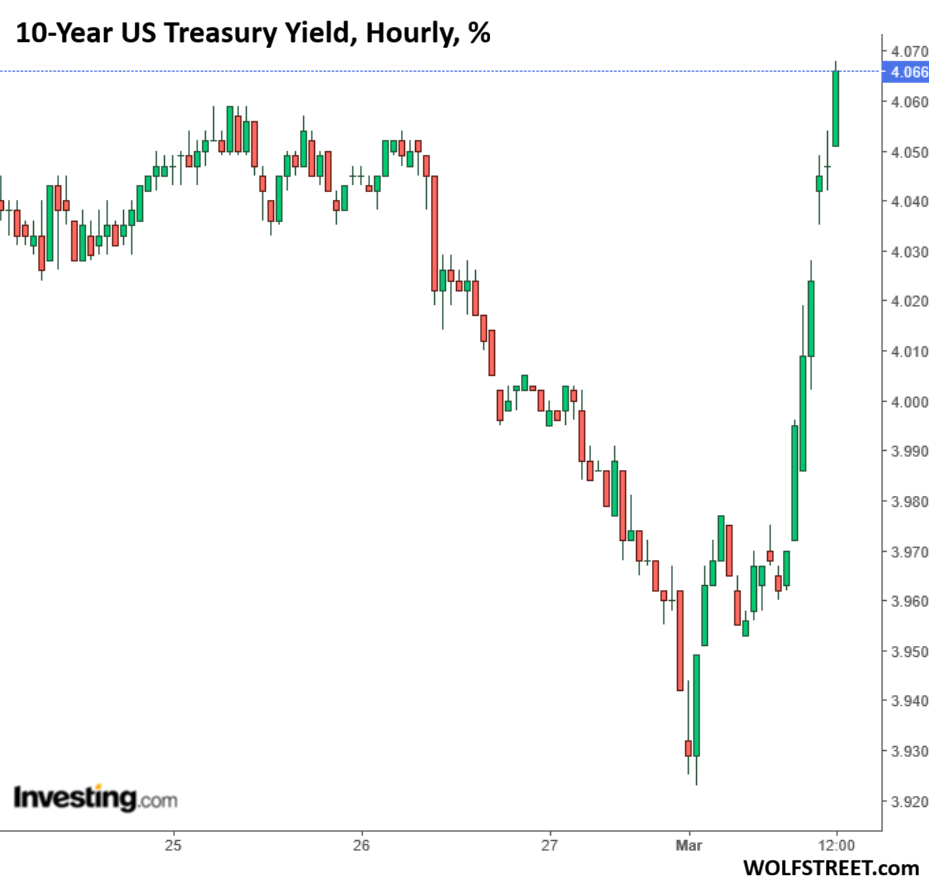
Market memes flipflopped vigorously from searching for a haven, as stocks were getting rattled, and damn the inflation torpedoes that the hot services PPI on Friday warned about, and searching for more haven after the Iran bombing had started, to suddenly worrying about these damned inflation torpedoes all over again that could be made worse by the consequences of the Iran war on energy prices?
Rising yields means falling bond prices; falling yields means rising bond prices. That may not be a big deal for regular bond holders, especially those intending to hold to maturity, when they get paid face value.
But much of the Treasury market is tangled up in highly leveraged complex trades, and those sudden moves make substantial ripples.
Markets do what they do because they do it. Why exactly they ignored the hot PPI inflation reading on Friday, and went all in on the haven trade, then flipflopped like this today on the haven trade and refocused on inflation, or whatever, remains subject of speculation.
One thing is for sure: at these below 4% 10-year Treasury yields, demand vanished, and yields are having to move higher today to find buyers. And they could of course re-flipflop for whatever reason. But these still very low yields – amid rising inflation and massive supply issues facing the Treasury market – are mightily unappetizing to this bond investor.
And look what that did to mortgage rates today: The average 30-year fixed mortgage rate spiked by 13 basis points this morning from Friday, to 6.12%, according to Mortgage News Daily.
Enjoy reading WOLF STREET and want to support it? You can donate. I appreciate it immensely. Click on the mug to find out how:


War is the fastest way to destroy a fiat currency that I know of.
Iran’s currency has been getting destroyed for many years day after day. The Iranian rial has collapsed by 98% or so against the USD in just the last 10 years.
But the dollar jumped today. And the DXY dollar index is back where it had been 50 years ago.
This is just a reminder that in a global crisis, the dollar often remains the “cleanest shirt in the dirty laundry pile,” even when war is the catalyst.
and yet in last 10 years our fiat $dollar has lost only 31.1% of value
$1 now needs $1.45 – in just past 10 years
based on official US inflation rate chart
Wise man say, “Dollar milkshake theory”
Or maybe Brett Johnson said that.
Regardless… I couldn’t resist saying that .
I will go back to shutting up now.
MW: Bonds head for biggest selloff in 9 months as Iran conflict sparks unusual Treasury moves
Is there anything that isn’t inversely related to interest rates?
Palantir, Lockheed and other defense stocks are rising on heels of Iran conflict
A currency exchange.
The income of buy-and-hold bond investors is NOT inversely related to rates. Ditto for the financial pain of borrowers who need to refinance!
P.S. There are many investments with near-zero correlation to interest rates.
I smell a crash coming, says former GOLDMAN boss…
Socaldude,
I smell it too.
Thank God I have $385 billion in T-bills to buy at the fire sale.
Sincerely,
Oracle of Petaluma.
The market has no interest in being chill, and honestly, the whole thing is de-bond-able. Why are yields even allowed to move? If we just glued the numbers to the screen at 3%, everyone would be happy. It’s simple architecture. Plus, if the 10-year bond is too volatile, we should just use ten 1-year bonds instead; they’re smaller, so they’re probably easier to manage.
I can’t tell if this is a serious comment or not… yields need to be able to move to account for inflation and risk. Freezing or “glueing” the numbers would destroy the economy and no rational person would buy. While this “simple architecture” phrase is witty I recommend you head back to elementary school to learn about the most basic parts of the economy before leaving a comment like this again; and don’t even get me started on ten 1 year bonds. That fudging absurd.
It was sarcasm, that’s how I read it. I thought it was obvious. But then I missed a lot of sarcasm too.
I think they actually did lock interest rates at around 2-3% after WW2 for a few years. Surprised none of the debt addicted politicians hasn’t suggested bringing it back.
The Fed did the same thing essentially during the pandemic QE, though it didn’t announce a long-term rate that it wanted. And it triggered the worst inflation in 40 years.
XXXTentacion,
1. He was being facetious.
2. In this economy, you’re going to have to learn to laugh, or you will be crying.
3. No crying allowed. Wolf is an economist, not a therapist.
If we know Treasury yields always go up when people get scared about inflation, why don’t we just stop telling the investors what the inflation numbers are so they stay calm and keep the rates low?
“Clark that treasury Auction gonna be Gooooo-oooooooddddddd” -Cousin Eddie
“Real Nice”
Pretty fireworks and a big boost to GDP from military spending which will reduce the debt to GDP ratio keeping bond buyers in a happy mood? I know bonds had a bad day but perhaps some of this is part of the long term play?
Re: safe havens
Gold rose to 5,338.51 USD/t.oz on March 2, 2026, up 1.15% from the previous day. Over the past month, Gold’s price has risen 7.93%, and is up 84.68% …
It’s a volatile risky instrument that plunged 20% just a few days a month ago, and 50% after the 2012 peak. It has massive historic plunges that can last years, and then it soars again and goes into periodic manias. Risk is defined that way.
Yet everyone prices gold in dollars. If you really want to see how gold “stores” it’s “value”, check out the charts of how many Big Macs an ounce of gold will buy you.
Hint: it dropped from 500 to 150 between 1980 and 1995. Shoulda just hoarded Big Macs!
I don’t see any reason why the 10-year would stay below (or even as low as) 4%.
The momentary “plunge” is technical noise. It seems like there’s a bit of repositioning about.
A flurry of demand, before a holdout for yield?