
This is precisely what this overpriced and frozen housing market needs.
By Wolf Richter for WOLF STREET.
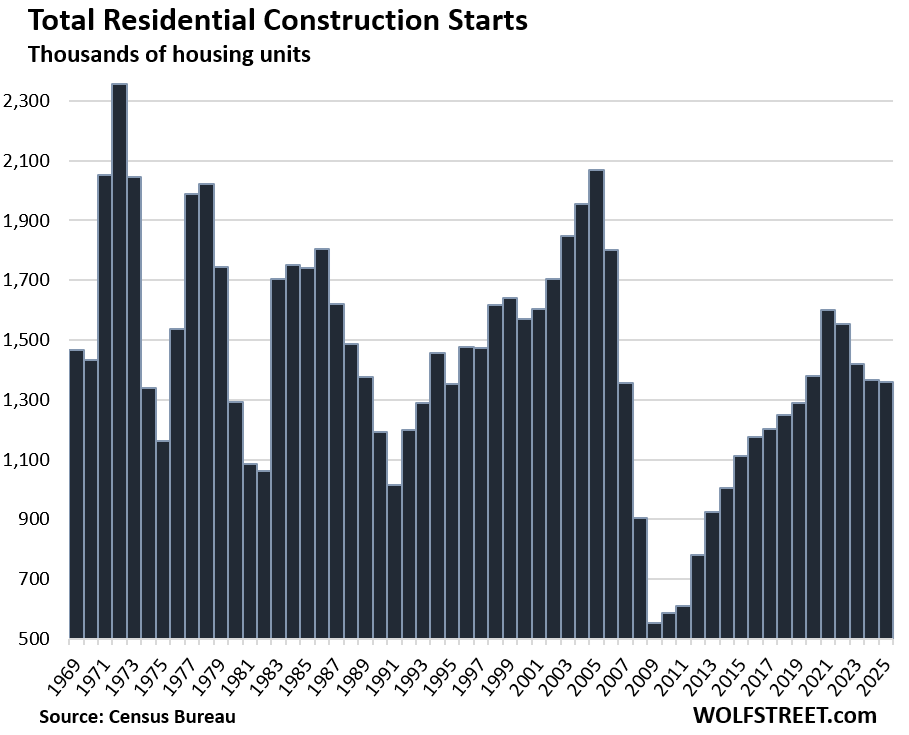
In 2025, construction was started on 1.36 million privately owned housing units, down just a hair from a year ago: 943,000 single-family housing units and 416,000 multifamily housing units (condos and rental apartments), according to Census Bureau data today.
About 2.3 people occupy a housing unit on average. So the 1.36 million housing units that were started in 2025 would provide a home, when completed, for 3.1 million additional people. But the US population increased by only 1.78 million people in the 12 months through mid-2025; and for the 12 month through mid-2026, it is projected to grow by only 756,000 people; and growth might further decline in the following years, according to the Census Bureau’s estimates.
In the years before 2009, the US population grew by 2.5-2.8 million people per year. In the 12 months through mid-2025, population growth was half that. For the 12 months through mid-2026, population growth will be between one-third to one-quarter of that. This continued flood of new housing supply amid dramatically slowing population growth is precisely what this overpriced and frozen housing market needs.
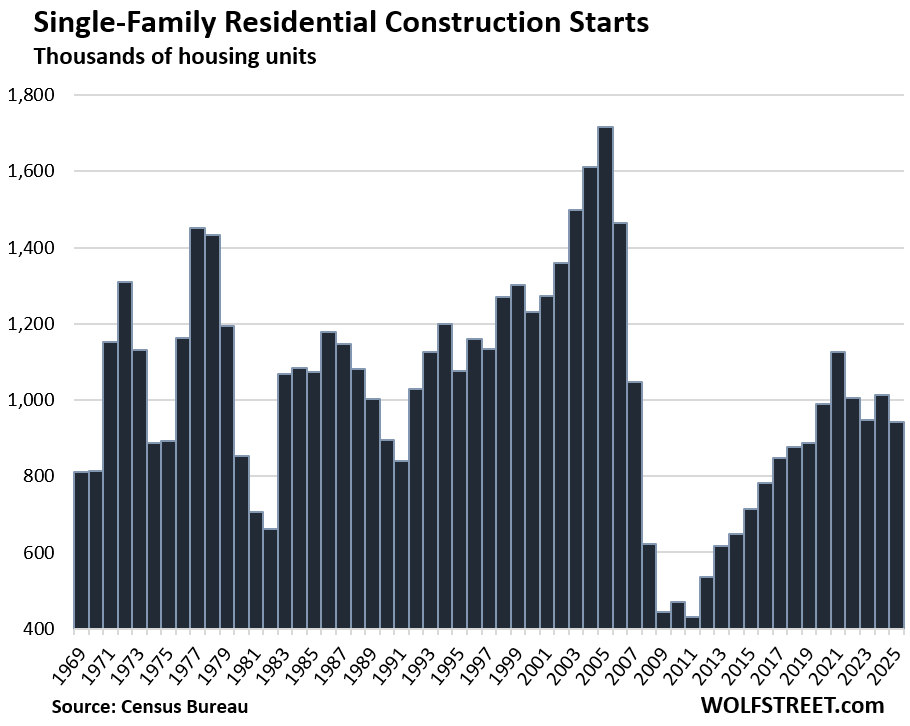
Single-family housing units.
Construction starts of privately owned single-family housing units, at 943,000 in 2025, were down by 6.9% from 2024 but roughly on the same pace as in 2023, as homebuilders pulled back amid very high inventories of new homes for sale and falling prices.
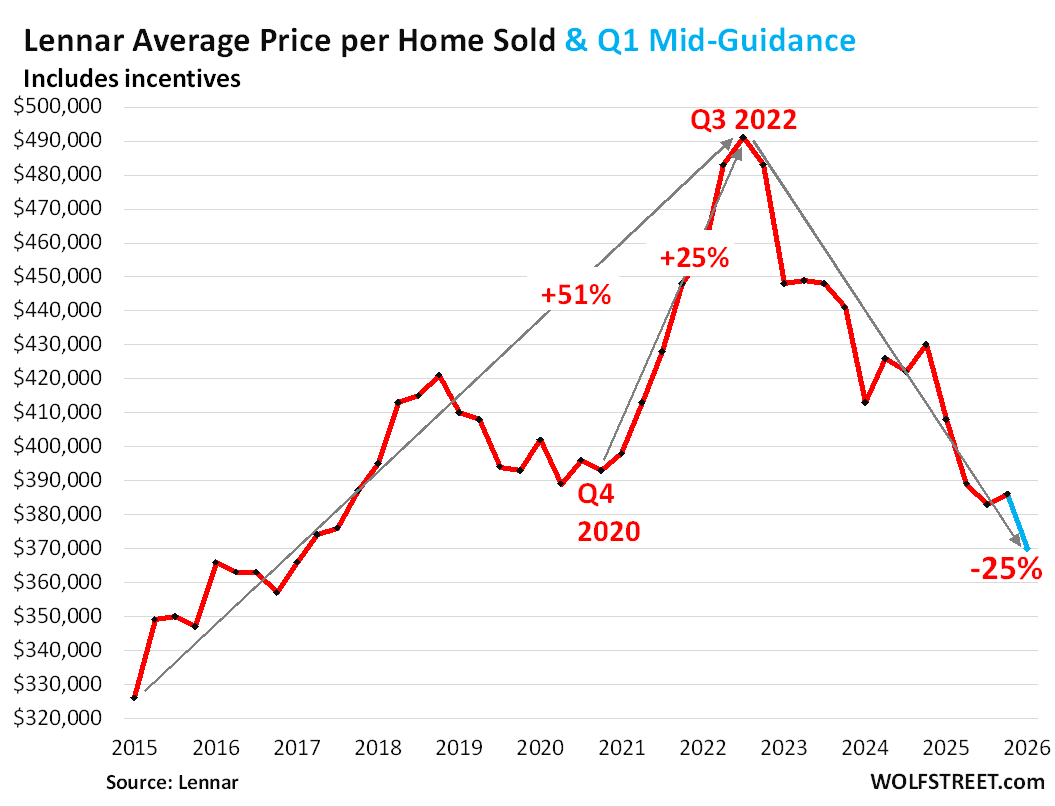
Falling prices of new single-family homes: For example, Lennar, one of the largest homebuilders in the US, has been trying to maintain its sales volume by piling on incentives, cutting prices, giving up a substantial part of its big-fat pandemic-era profit margins, and building at lower costs.
As a result, the average price of the homes that it sold has plunged; and for Q1 2026, it guided the average price down further, to a range of $365,000 to $375,000 net of incentives. The mid-point ($370,000 blue in the chart) would be the lowest sales price since Q1 2017, and down by 25% from the peak in Q3 2022 ($491,000).
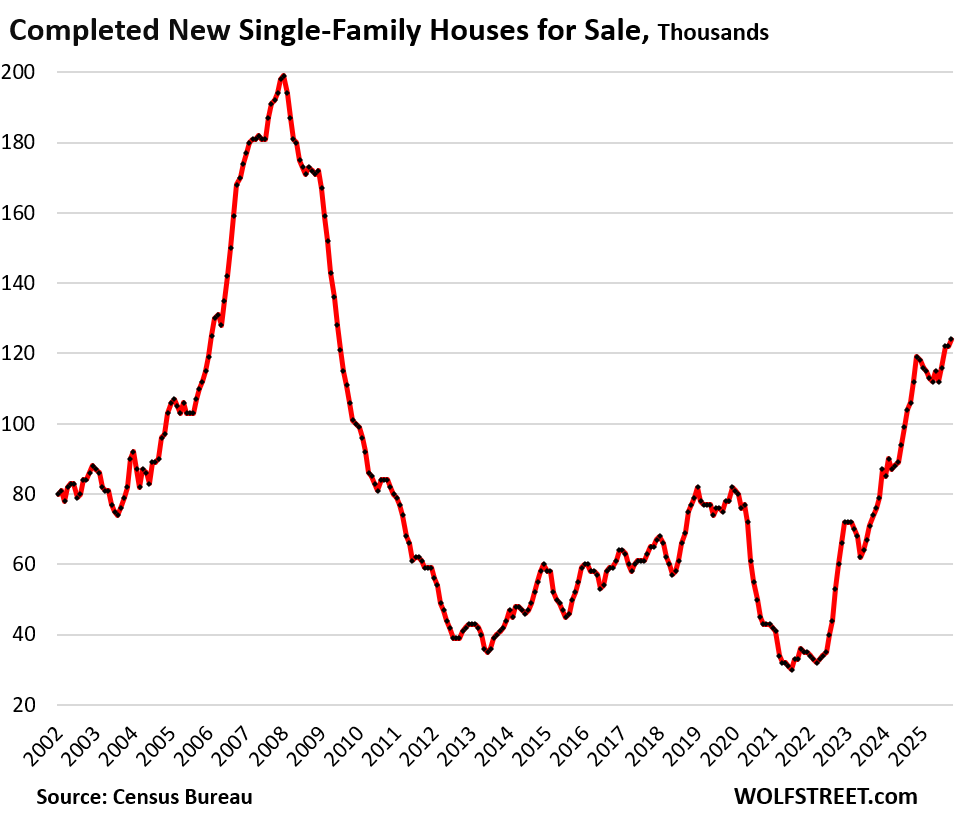
Soaring inventories of new single-family homes: Inventories of completed single-family homes for sale by homebuilders have piled up to the highest level since 2009, to 124,000, per the Census Bureau’s latest data available through October. And homebuilders are responding to it with lower average selling prices. Bring on the supply!
Multifamily housing units.
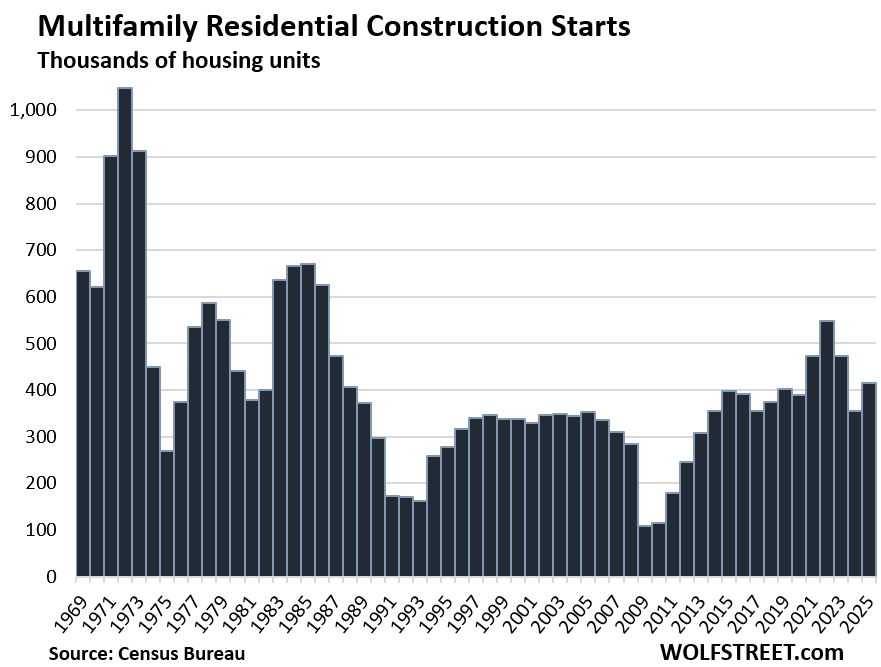
Construction starts of privately owned multifamily housing units (rentals and condos in buildings of 2 or more units) rose by 17.4% to 416,000 units in 2025.
Outside of the years 2021-2023, the 2025 pace was the highest since 1986. Bring on the supply!
In many markets, there has been a flood of higher end rental apartments and condos coming on the market. The bigger projects take years to plan and build. Vacancies have been rising as these units came on the market. Many projects that had been planned but not started became stalled due to lack of financing as the CRE depression spread around. Asking rents have been edging down in some of those markets (but rising in others). There have already been a number of large multifamily defaults, and the multifamily CMBS delinquency rate has surged to over 7%, from 1% in 2024.
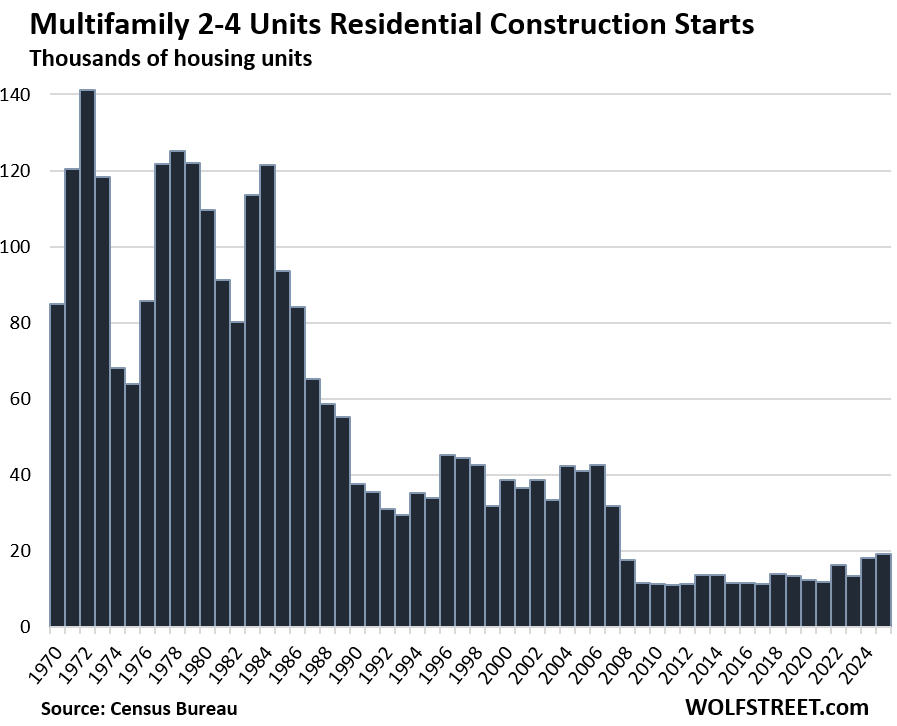
About 95% of these multifamily housing units were in buildings with 5 or more units. Only about 5% were in small buildings with 2-4 units.
Construction starts of housing units in small multifamily buildings with 2-4 units accounted for just 5% of all multifamily construction starts, at 19,100 starts in 2025.
But the pace has accelerated by 66% since 2015 (11,500 starts), sort of a rising-from-the-ashes moment, after that segment had nearly vanished in 2008. This is a playground that is accessible to mom-and-pop developers and landlords.
In densely populated urban cores, higher-end multifamily housing units (condos and apartments) are about the only type of housing that is getting built.
With higher-end apartments, builders are targeting “renters of choice” – people who could afford to buy a house out in the suburbs, but want to live in a modern high-rise in a central location with all the amenities and conveniences, a short commute, possibly an easy social life, and the feeling of being the middle of things, topped off by the flexibility that rentals provide.
Developers cannot target lower-income tenants or buyers because the construction costs just don’t pencil out, unless the buildings are subsidized, and there is that too.
Renters with less stellar incomes generally have to make do with renting apartments or condos in older buildings in less desirable areas, sometimes in run-down buildings with five decades of deferred maintenance.
Single-family construction has been spreading further out from urban cores – the urban sprawl that is everywhere. This includes “build to rent” single-family developments, designed and built specifically as rentals mostly for “renters of choice” by large single-family landlords or by builders that then fill the developments with tenants and sell the income-producing project to large landlords, pension funds, and other funds.
These build-to-rent developments have common amenities, a leasing and maintenance office, and are more efficient to manage for the landlord than individual houses scattered across their market, and they’ve been selling those scatter units here and there at sky-high profits for the past two years. Read… The Biggest Single-Family Rental Landlords and Multifamily Landlords in the US: Big Shifts Underway
Enjoy reading WOLF STREET and want to support it? You can donate. I appreciate it immensely. Click on the mug to find out how:


Wolf what’s your take on this post GFC underbuilding / housing shortage narrative in general? It seems convincing on its face but I am skeptical… lots of speculators out there.
It has been the most cited real-estate industry propaganda whose sole purpose is to manipulate up home prices by rationalizing them.
And after manipulating up home prices for years, they’re too high, and there IS a shortage of reasonably priced homes, thanks to all these efforts to manipulate up prices.
But if you have enough money, you can buy 100 homes a day, which proves that there is no housing shortage, but prices are too high.
Lots of new supply for years to come with slow population growth is exactly what the real estate industry needs. Bring on the new supply! Construction is a big contributor to the economy.
There were 15 million vacant housing units in Q4, 11.6 million were vacant year-round, according to the Census Bureau.
How do you see this playing out amid a weakening dollar and low FFR but relatively high long rates?
You fail to mention that going back to the year 2000, on average 700,000 to 1,400,000 residential units are demolished or destroyed each year. Thats an important component to realize. When taking this into account – pace of new construction appears to be on par leading to further housing shortage.
good lordy. those figures are totally nuts. The number of housing units removed is a minuscule percentage. Where do you come up with this stuff? Who’s circulating this stuff?
In 2025, 1.471 million net housing units were added : new construction minus removals. This includes privately owned housing units — the type I discussed in this article — plus public housing units. Chart #1 below
In 2024, 1.411 million housing units were added, see Chart #1 below. The recent peak was 2022, when 1.605 million units were added.
At the end of 2025, there were 148.7 million total housing units, up by 1.471 million year-over-year obviously. Chart #2
Over the past 10 years, the total housing stock on net rose by 13.2 million housing units (new construction minus removals).
All data from the Census Bureau’s quarterly “Housing Vacancies and Homeownership.” All you have to do is look it up. It’s not a secret. Or you could just ask me, and I will tell you 🤣
The greater Boston area needs at least a quarter million housing units over the next decade to keep up with demand. However most of these homes will be multi family since the area is already too densely populated to accommodate that many new single family homes.
The longstanding restrictions on multi family housing are mostly to blame for the area’s current crisis of too little housing at prices few people can afford. The problem was (and continues to be) so severe, the state legislature had to step in and force cities and towns across the region to build more multi family housing. Too little, too late unfortunately.
It’s a problem that crosses the political lines and few are willing or interested in solving.