
Seasonal Adjustments Gone Awry? They whacked $82 billion off December sales, by far the most ever.
By Wolf Richter for WOLF STREET.
Not seasonally adjusted, retail sales spiked by $80 billion in December from November, by far the biggest-ever November-to-December increase, to $817 billion, the most ever, and for the first time ever exceeding $800 billion (blue line in the chart).
It was driven in part by the $24 billion spike in ecommerce sales, the biggest month-to-month spike ever, to $166 billion, the most ecommerce sales ever by far, accounting for over 20% of total retail sales for the first time ever.
But oh no, the tapped-out consumer! In the headlines today: Retail sales were flat in December on “disappointing holiday season” or whatever. That was due to massive seasonal adjustments. And they seem to have gone awry just a little this December, thereby skewing the seasonally adjusted results (red line):
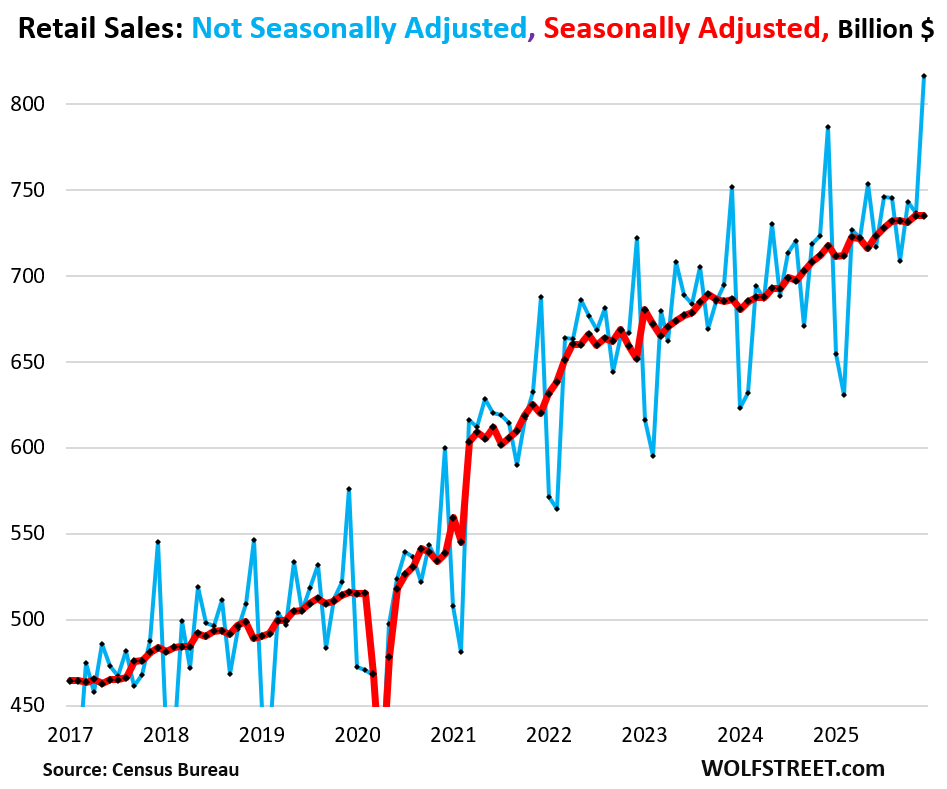
Year-over-year, so compared to the strong December last year, retail sales not seasonally adjusted, increased by 3.8%, the biggest year-over-year increase in three months, and slightly higher than the year-over-year increase of annual retail sales in 2025 (+3.7%).
Huge seasonal adjustment factors are used to reduce December sales and to increase January and February sales, with the purpose of leveling them out. Within a 12-month time frame, seasonal adjustments sum up to zero.
And in December, the seasonal adjustments were huge, whacking $82 billion off the not-seasonally-adjusted sales ($817 billion), by far the biggest whack-down ever, to get the seasonally adjusted sales down to $735 billion.
The December whack-down of not-seasonally adjusted sales to seasonally adjusted sales:
- December 2025: -$82 billion
- December 2024: -$69 billion
- December 2023: -$65 billion
- December 2022: -$71 billion
- December 2021: -$68 billion
- December 2020: -$61 billion
- December 2019: -$60 billion
- December 2018: -$57 billion
- December 2017: -$61 billion
The seasonal adjustment factor is supposed to account for seasonal variations, caused by things such as weather, holiday gift buying, and other factors, and importantly, differences in the number of “trading days,” which exclude weekends and holidays.
But the “trading days” have become less and less meaningful as ecommerce operates 24/7. Ecommerce was the biggest category in December by far, accounting for 20.2% of total retail sales, the most ever. And in many states, even brick-and-mortar retailers are open seven days a week, though in some states or counties, blue laws restrict some retailers on Sundays, such as alcohol retailers or motor vehicle dealers.
The Census Bureau’s X-13 ARIMA-SEATS software program calculates these seasonal adjustment factors, based on numerous historical data points. And in months with huge seasonal adjustment factors, such as December, even small misses skew the seasonally adjusted results enough to move the needle.
The Big Four categories, 60% of total retail sales.
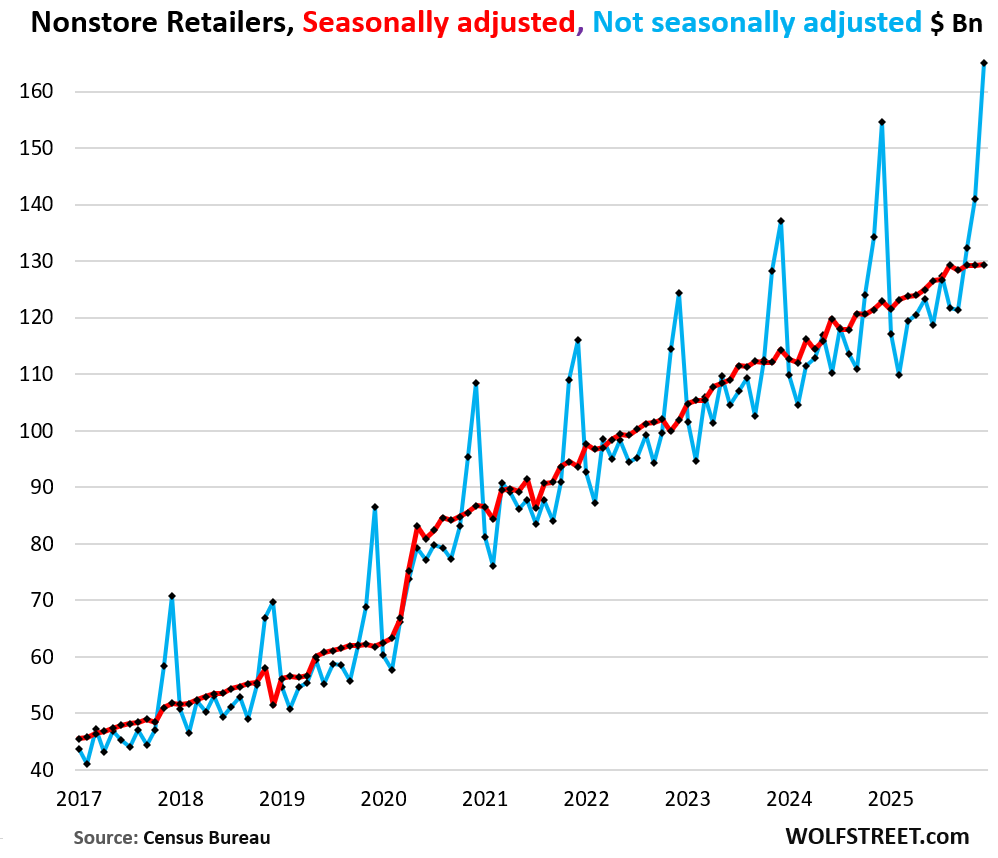
Nonstore retailers (mostly ecommerce) accounted for 20.2% of total retail sales in December, the biggest share ever.
Not seasonally adjusted, sales spiked by $24 billion, the biggest November-December spike ever, to $166 billion, the most ever (blue line).
Seasonally adjusted, sales barely ticked up (+0.05%) to $129 billion.
The seasonal adjustment factor whacked $35.7 billion off actual sales in December, the most ever. That was 12.6% more than in December 2024, when it had whacked off $31.7 billion. Clearly, something went awry in that seasonal adjustment factor.
Year-over-year, not seasonally adjusted, nonstore retailer sales jumped by 6.7% in December.
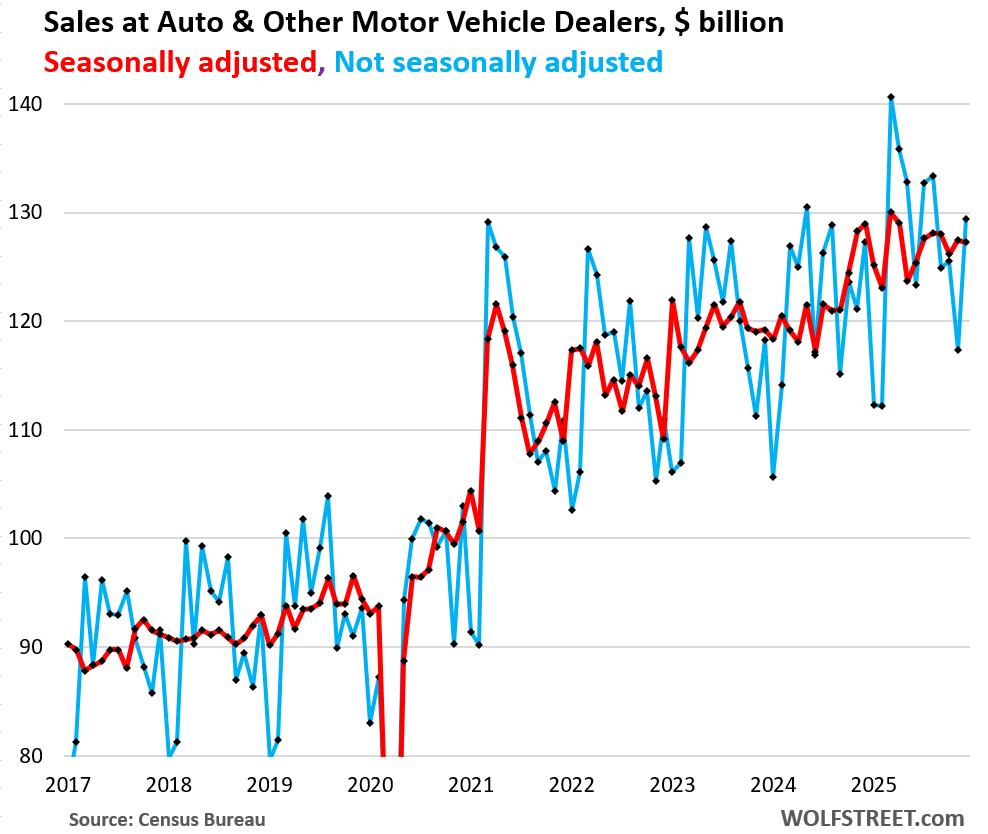
Auto & other motor vehicle dealers accounted for 15.9% of total retail sales, the second-largest category in December.
Not seasonally adjusted, sales jumped by 10.3% from November to $127 billion. But November and October had been weak as EV sales plunged when the federal incentives expired at the end of September, dragging down overall vehicle sales.
Seasonally adjusted, sales dipped by 0.2% in December from November.
We’ve already seen that the number of vehicles sold in Q4 fell, as EV sales dropped sharply, after the strong Q3, which had been pushed higher by frontrunning among EV buyers that had pushed EV sales to a big record in Q3. For the year 2025, unit sales rose 2.4% [see my report: Ugly Charts of US Auto Sales, 2025: Stellantis, Nissan Flirt with Catastrophe. GM, Ford, Honda Sales Rise but far below Peaks. Toyota & Hyundai-Kia Set Records].
Year-over-year, not seasonally adjusted, sales at auto & other motor vehicle dealers rose by 1.7% in December.
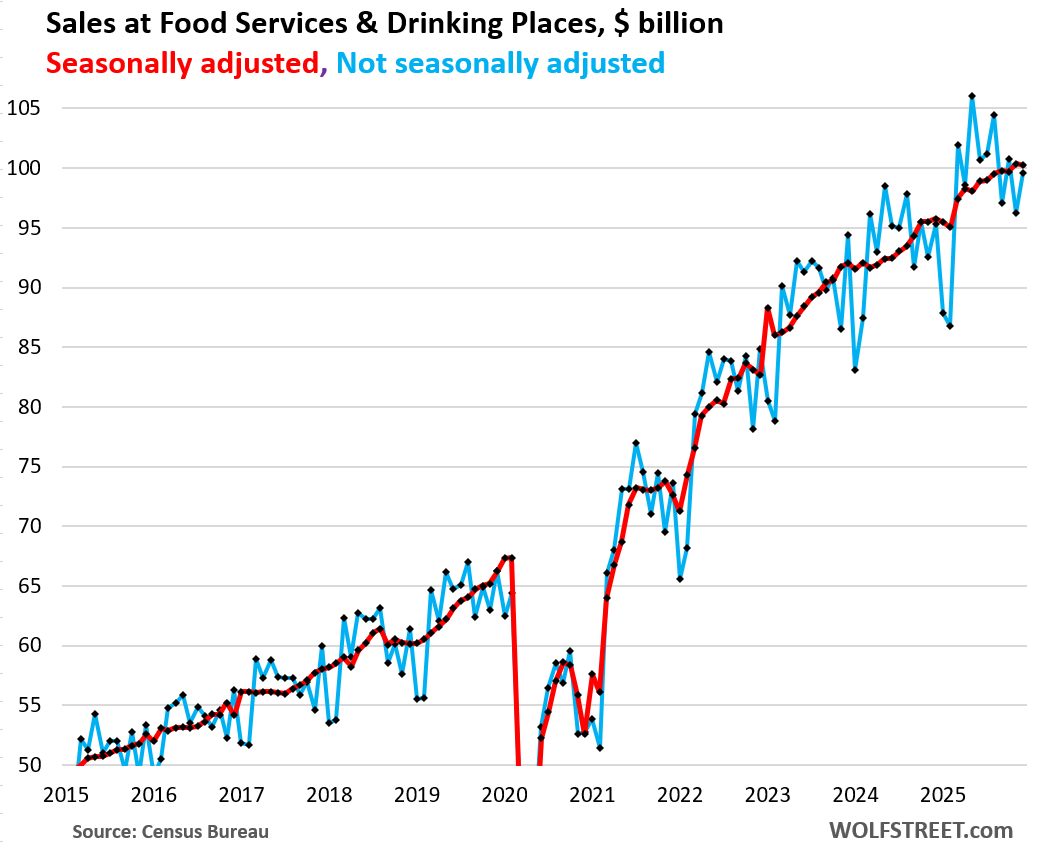
Food services & drinking places, such as restaurants and bars, accounted for 12.2% of total retail sales.
Not seasonally adjusted, sales rose by 3.5% in December from November, and by 4.5% year-over-year, to $100 billion.
Seasonally adjusted, sales dipped by 0.1% in December from November, to $100 billion.
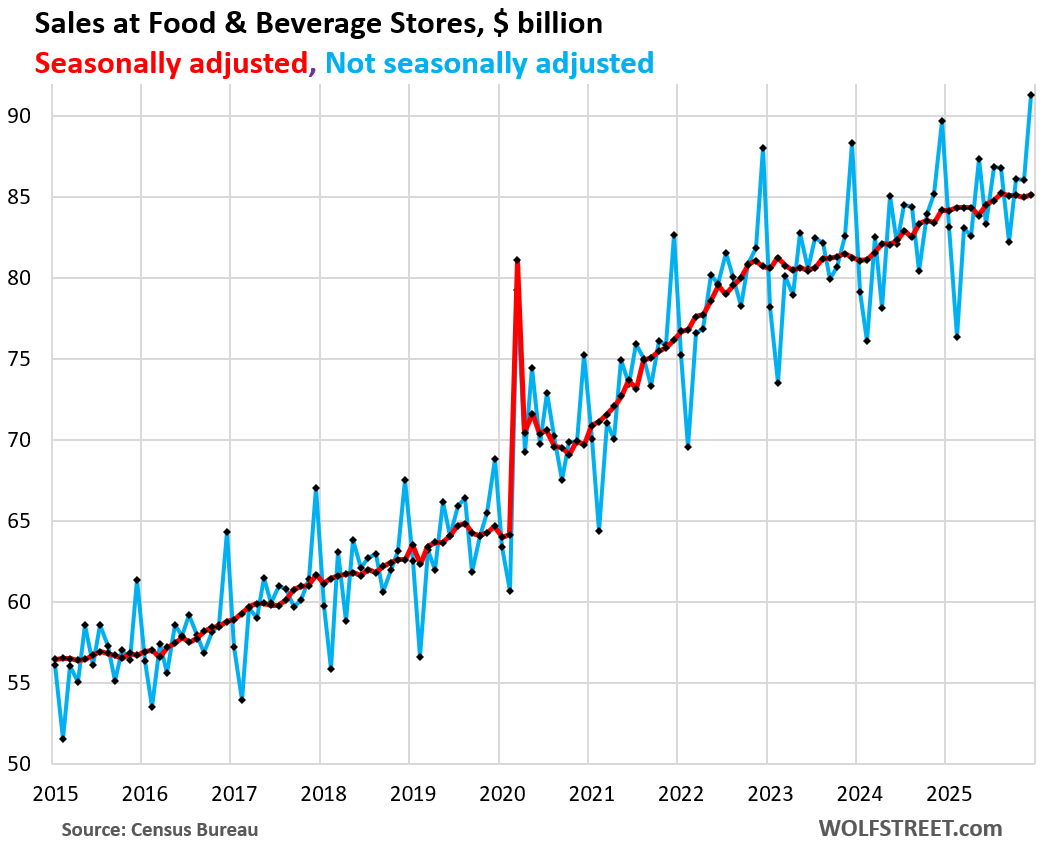
Food & Beverage stores accounted for 11.2% of total retail sales.
Not seasonally adjusted, sales spiked by 6.1% in December from November, to $91 billion. Year-over-year, sales were up by 1.8%.
Seasonally adjusted, sales rose by 0.2% in December from November, to $85 billion.
Enjoy reading WOLF STREET and want to support it? You can donate. I appreciate it immensely. Click on the mug to find out how:


based on the patterns of the chart, it appears the next monthly retail sales will be way low.
It will plunge by about 20-22% from December, typically. And then the huge seasonal adjustment will make it jump.
Why not calculate 12 month moving average as an alternative to the seasonal adjustment? You lose some month to month granularity but avoid any distortions from the seasonal adjustment formula.
I assume the government does not explain the changes in seasonal adjustments and why they made the changes?
Wow! Looks like the Drunken Sailors are still enjoying life!