
After biggest hiring binge ever in 2020-2021, it was clear there’d be a lot of sorting out & cleaning up afterwards.
By Wolf Richter for WOLF STREET.
Amazon and Alphabet – and other tech companies – keep announcing serial layoffs and buyout-encouraged departures. But they’re still hiring too.
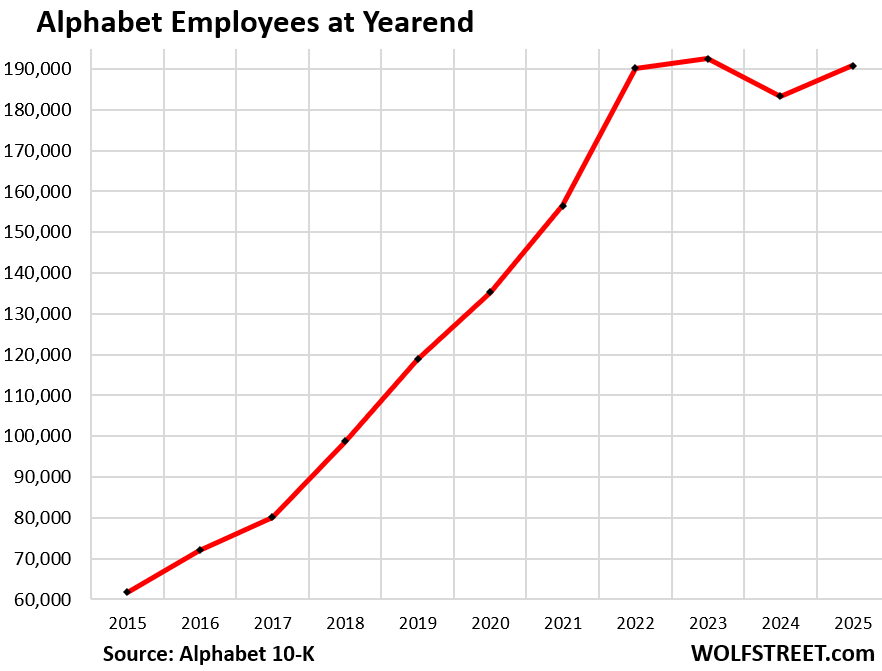
Alphabet’s global headcount on December 31, 2025, reported in its 10-K filing, rose by 7,497 year-over-year, was a hair above where it had been at the end of 2022, when these layoffs started, and only a hair below peak headcount at the end of 2023.
But in the two years 2020 and 2021, its headcount had surged by 60%, as it hired helter-skelter and in massive numbers people who worked remotely, amid stories that began circulating of people having two or three full-time remote jobs and pulling in huge amounts of money while skiing or whatever. Exaggerated or not, what was clear is that there would be a lot of sorting out and cleaning up to do afterwards.
The afterwards began in late 2022. Turns out, the cleanup included sweeping out 35% of its managers that were overseeing small teams, Brian Welle, VP of Analytics & Performance Management at Google, told employees in August last year. “So a lot of fast progress there,” he said.
Lots of people gone, and the headcount is up. So what is clear is that Google is swapping out workers, pushing lots of people out, and hiring lots of people, with the effect that the headcount had remained roughly unchanged for four years, after the biggest and wildest hiring binge ever in 2020 and 2021.
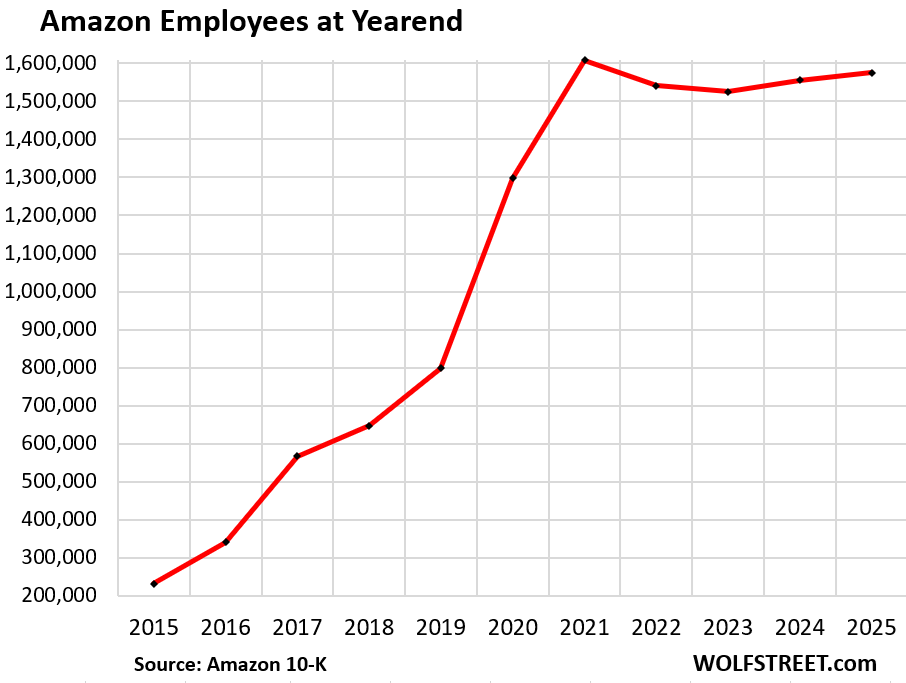
And Amazon’s gigantic headcount at the end of December 2025 rose by 20,000 year-over-year, to 1.576 million, according to its 10-K filing on Friday. In the prior year, it had risen by 31,000.
But in 2022 and 2023, headcount had dropped by 16,000 and 67,000.
Its headcount at the end of 2025 was down by 32,000, or by just 2.0%, from the peak year 2021.
But in the two years of 2020 and 2021, its headcount had shot up by 810,000 people, from 798,000 at the end of 2019 to 1.608 million at the end of 2021, having more than doubled (+102%) in two years.
In the seven years 2015 to 2021, its headcount exploded by 1.377 million, or by 600% (headcount had multiplied by 7).
In 2020 and 2021, Amazon overhired in one of the most amazing hiring binges ever seen, increasing its staff by 810,000 people in just two years. Many of its workers also quit during that time, so the hiring to replace the quits and add the 810,000 must have been gigantic and chaotic.
And since then, it has been trying to sort through who it really needs and who it doesn’t need, trying to get rid of the deadwood, the recalcitrant remote workers, the workers in projects that it shut down, the workers that it replaced with automation, etc., while hiring where it needed fresh blood.
So it’s not like there is no movement in employment at these companies. There is lots of movement, with big layoffs and buyouts, accompanied by lots of hiring.
Intuit was an explicit example of that in July 2024, when it announced 1,800 layoffs, about 10% of its workforce, including 1,000 for not meeting performance expectations, while it also announced plans to hire 1,800 people to accelerate its push into AI. Layoffs are quicker to pull off than hiring workers for AI-related roles. So one came first, and the other has been slower to materialize.
In case you missed it: AMZN, GOOG, MSFT, META, ORCL Plan $700 Billion in Largely AI-Related Capex in 2026. Here’s Where the Cash Will Come From
Enjoy reading WOLF STREET and want to support it? You can donate. I appreciate it immensely. Click on the mug to find out how:


I think your article correctly captures the tragedy
I was at Intel during the 90s when things were great there. Turnover of employees was about 2% when they wanted around 5% to be able to get new blood in. Didn’t want to show up at bottom in 360 review process as that usually meant corrective action plan and 6 months to turn it around. Doesn’t feel like that level of consideration is given today but you need turnover if you want fresh blood and ideas and stay flat with head count in technology areas imo.
Plus younger workers are cheaper.
I’ve thought this for a while, that the “mass layoffs” are just management’s way of keeping employees on their toes, and to not become the deadwood you mentioned.
I’m sorry, an employee not on their toes is not deadwood. They are highly effective capitalists. They are doing exactly what the corporations that employ them are trying to do. Extract as much value as possible for as little as possible. They are 100% shareholders, company of 1.
I’m not following this.
My point is that at any organization, you have awful employees that need to go at any cost, you have top performers that they try to keep, and you have a huge group in the middle.
A lot of people get complacent and start doing the bare minimum, becoming deadwood, especially if they’re unhappy about something there.
Doing regular layoffs keeps people from becoming the deadwood in the first place, as they mentally internalize that they could be next.
In my experience, rolling layoffs make people incredibly risk adverse and fully in CYA mode which decreases work velocity.
I think you’re describing a workplace from a bygone era.
Themsicles is correct, a lot of employees have adopted a “corporation of 1” mentality, and they’re more nimble than their employer. New methods of management and leadership are needed.
People with short attention spans love drawing conclusions from incomplete bits of information. Then we get this great narrative about tech layoffs and it’s such a horrible job market.
I wonder how many of the laid off people just immediately applied for a different role and got it.
Intuit and AI, so who they gonna send to the client IRS audit meeting.
17,000 Amazon managers have not immediately gotten new jobs, I promise you.
Paragraph 5: “…biggest and wilder…”, to “biggest and wildest”. And all handled without anyone yelling P(roof)RTGDFA. 😂
I’m grateful for my unpaid line editors 🤣
Amazon is a global company with significant international revenue $50B in Q4 compared to 127B in NA in the same quarter).
You hear/read about layoffs… but those are US ones. Tech giants are still hiring overseas (Actually Indian is an ongoing joke). My company is doing the same. Why hire one mid-level US engineer when you can hire a senior/principal Eastern European engineer for the same salary?
Sure, there is some of that. But the big majority of employees at Amazon are working in its fulfillment and distribution business. These are physical jobs you cannot do from India.
Amazon has established fulfillment and distribution networks in other countries too, and you can buy from Amazon in Europe, in Japan, in Australia… and these operations are all staffed locally.
It is even in India, operating fulfilment centers, building new ones, hiring to staff them, etc. It has hired a lot of people in India over the last few years to expand its retail operations in India, with local fulfilment centers, local drivers, etc. It has about 60 fulfilment centers there now. Many of the people it has been hiring in India do physical jobs in its retail division. So when you see that it hired thousands of people in India, they may be working in a highly automated fulfilment center or somewhere else in its distribution network.
I’m curious, do the US headcount charts look the same?
What I’ve seen repeatedly throughout the industry is laying off US workers to hire workers in India and other lower cost areas
Sure, there is some of that. But the big majority of employees at Amazon are working in its fulfillment and distribution business. These are physical jobs you cannot do from India.
Amazon has established fulfillment and distribution networks in other countries too, and you can buy from Amazon in Europe, in Japan, in Australia… and these operations are all staffed locally.
It is even in India, operating fulfilment centers, building new ones, hiring to staff them, etc. It has hired a lot of people in India over the last few years to expand its retail operations in India, with local fulfilment centers, local drivers, etc. It has about 60 fulfilment centers there now. Many of the people it has been hiring in India do physical jobs in its retail division. So when you see that it hired thousands of people in India, they may be working in a highly automated fulfilment center or somewhere else in its distribution network.
What about Alphabet?
Which is why it has so much publicity. Office workers, making TikToks, on how evil the system is. No one cares when 1,000 blue collar dudes get the ax. But a few colorful office hires with unique degrees…the sky is falling.
“And since then, it has been trying to sort through who it really needs and who it doesn’t need, trying to get rid of the deadwood, the recalcitrant remote workers, the workers in projects that it shut down,”
This is a tertiary issue, but look at the PISA math scores.
Our government schools generally do not provide the needed background in math, science, and reading for the number of students who would go into STEM careers.
It seems obvious that strong K-12 education is needed to ensure companies like Amazon can have a full pipeline of engineers in America.
AI is going to greatly reduce, if not eliminate, the need for STEM graduates in the US.
Unemployment rate among young STEM workers and graduates are very high.
i.e. There is no shortage of STEM grads.
Anecdotally, I know many Young STEM grads from top colleges with good GPA struggling to find jobs.
I work in STEM field and in AI.
The whole promise of AI is: it’d reduce headcounts in big companies which are one of the biggest expense.
AI is already eating lot of engineering jobs. A team which needed 10 engineers , now only need 6 engineers to deliver a project. It is possible that after a year or two, they may need only 2 engineers.
From my perspective, AI would greatly reduce number of STEM grads and I have been wrong many times in the past.
Companies clamoring for H1B visa workers is another way for companies to reduce personnel cost. H1B visa workers are not paid less but since they are indentured/bonded to their employer for 10 years or so before they get their green card, they are willing and forced to worked 60 plus hours.
I used to be on H1B and saw this very closely.
When will we see more hiring to fix AI mistakes?
AI is a pipe dream. A bubble like the dot.com error. As of now, AI is not very good at all. Most companies have just slapped the term AI to replace “App”.
As for it replacing engineers, outside of software/coding engineers, I don’t see it happening anytime soon. I spend more time fixing new hires mistakes from them trusting AI googling blindly than anything else right now. It’s at least a decade, if not more, away from being useful for hardcore engineering.
We currently do not have the energy infrastructure in place to keep powering rapid growth/learning of AI. That needs to happen first. We also don’t know when/if governments will step in and limit the AI due to collapsing the work economies.
Barring a revolution in the field of AI research, which I doubt is going to happen, the disruption does seem to be limited to software, but the end result there judging by current trends will be buggier software that is harder to maintain and which could ironically cost more (you need huuuuge token burn to get halfway decent outputs).
There’s good reasons to believe that it will be limited to software. For one, there’s ample training data for the software applications. Reams and reams of open source projects (much of which is of dubious quality) and the short “semantic distance” between plain language and code (and good commenting practices of course helps reduce that semantic distance – there are companies that make their money now just contracting SWEs out to write code for the training corpora). I think SWEs have been due for a reduction in salaries and headcount for a long time; software as a field is overhyped and has lost the futurist sheen of the 1990s to the 2010s. The world is awash in software of dubious quality and chronically unprofitable software companies, even before “AI” came onto the scene. The “AI” systems as they work now “approximate” reasoning but do not reason. They don’t “think” like a human being does. But that may not matter if you just want to probabilistically retrieve a CRUD app from the trillions of CRUD apps within the training corpora. It doesn’t matter at all to businesses that don’t use software, and which still rely on good old fashioned pen and paper (and they are legion – there are more mechanics in town using carbon copies than tablets, and they usually provide a better service than the companies that do all their paperwork on a screen). As the software gets shittier (see also the enshittification of the Windows OS), I honestly expect more small and medium sized businesses to go analog. A funny anecdote is when I was working for a software company in 2024, whose CEO demanded that we start to eschew Slack in favor of… actual phone calls and face-to-face collaboration.
Having lived/worked the biotech boom of the 90’s in the bay area, I can tell you it’s a different world. Back then, we actually had a business cycle. My company grew one year, and shrunk another. Regardless of the number of employees we remained profitable (~400 million per year). But back then, companies actually went bankrupt and had their assets sold off to the highest bidder. The people who actually lost their jobs and had to spend their savings while looking for a new position. That’s not the world we live in any more. The debasement trade is very much alive and well.
Companies still go bankrupt at a solid pace, no worries. Nothing has changed. Lots of small biotechs whose inventions didn’t pan out have shut down, or are shutting down. Happening in the Bay Area right now, for a couple of years. Mass extinction event going on right now at biotech startups, as VC money has swiveled to AI.
Maybe, but as you have documented, their real estate assets have NOT crashed…
…yet.
I still visit my friends in Moss Beach when the swell is big.
“VC money has swiveled to AI.”
The smart VC money is betting on the bird in hand. Companies making actual product discoveries. For example, antibody guided drug delivery. I still my hand in a few ventures. Mark my words, “AI” is the largest mis-allocation of capital and resources the world has ever seen. When even the Chinese recognize that there needs to be a bench scientist testing the big predictions you know it’s a bubble. It’s the equivalent of a stripper owning and renting 4-5 homes in 2008…
That’s what you get when you let HR do the hiring. Write your own ads, include your own specifications. You’ll get overqualified but good employees. They’ll be more productive.
Couldn’t agree more – and for a small fee you can post those ads here on Wolf Street. A lotta smart folks watching
In semi-related news, Alphabet (Google’s parent company) just rolled out a 100-year bond offering. Me thinks they are scraping the bottom of the investment barrel to fundraise for AI infrastructure and its related admin costs?
A 100 year corporate bond? This cannot be real. Got a link?
LOL. It’s a sign of the strength of the bond market, where investors are falling all over each other to chase yield. The order book ($100 billion) was about five times the size of the actual USD bond offering by Alphabet ($20 billion), which includes slices of several terms, from shorter terms to the 100-year slice. In addition, it is offering bonds in other currencies.
Weeeellll…
With Amazon, a lot of those workers are the same kind of worker that get treated so badly they would park ambulances outside of the distribution centers because it’s easier than actually providing decent working conditions.
A lot of their advanced layoffs have been corporate jobs, which are theoretically the kind of jobs that help maintain a middle class.‘Course a sizable chunk of those corporate jobs were overseas , so it gets pretty muddled.
But still, the way the corporate workforce exploded during Covid seems pretty crazy…
Trump’s senior trade counselor, Peter Navarro, pushed the message on Tuesday and emphasized the immigration angle during a Fox Business appearance.
“We have to revise our expectations down significantly for what a monthly job number should look like,” he said, suggesting that 50,000 jobs should be considered enough to keep up with population growth.
Wall Street will “have to adjust for the fact that we’re deporting millions of illegals out of the job market,” he added.
^^^^^^^^^^^^^^^^^^^^^^^^
What? Illegals people pay taxes? I don’t think so. They also don’t report their employment status. What kind of game we are playing now?
1. What Navarro said is true: If US population growth slows to a trickle due to “negative” net immigration, then the economy doesn’t need to create 200,000 jobs a month. If it did, there would be a labor shortage after a while.
Here is what he is talking about, and it is happening:
https://wolfstreet.com/2026/01/27/population-growth-slows-to-crawl-net-migration-may-turn-negative-census-bureaus-new-population-estimates/
2. These are the headcount numbers reported by Alphabet and Amazon in their annual reports. This has zero to do with the government. So get off your high horse.
3. In general: Illegal immigrants who are hired by bigger companies often have fake SS# so that they can get hired by these companies. Some companies have encouraged that, as we found out recently. And these people DO PAY taxes, because income taxes and payroll taxes are being withheld.
But Amazon and Google likely don’t fall in this category. And so it’s irrelevant here. Meatpackers etc. have been caught doing that.