
Hugely important for housing, employment, and consumer spending.
By Wolf Richter for WOLF STREET.
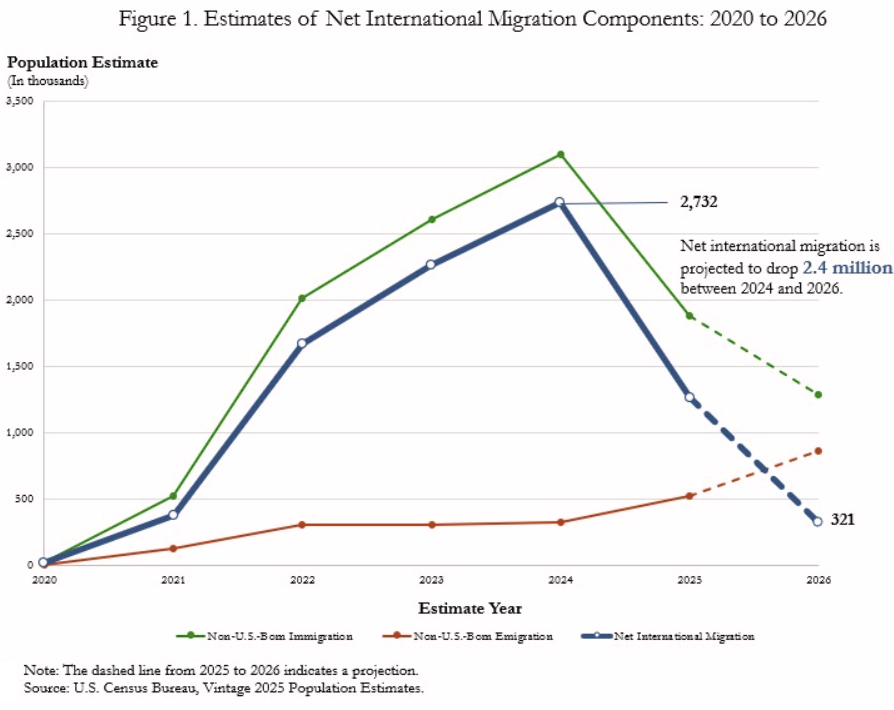
“Currently, the estimates of NIM [Net International Migration = immigration minus emigration] are trending toward negative net migration. If those trends continue, it would be the first time the United States has seen net negative migration in more than 50 years,” the Census Bureau said in a comment on its population estimates released today.
Net International Migration – immigrants minus emigrants – in the 12 months to July 1, 2025, plunged by over half to 1.26 million people, but that period is still a mix of six months of Biden’s immigration policies and six months of Trump’s immigration policies.
“If current trends continue,” the Census Bureau said today, NIM is “projected to further decline to approximately 321,000” in the 12 months to July 1, 2026. And it may turn negative the following year (green line = non-US-born immigrants; brown line = non-US-born emigrants; bold blue line = Net International Migration):
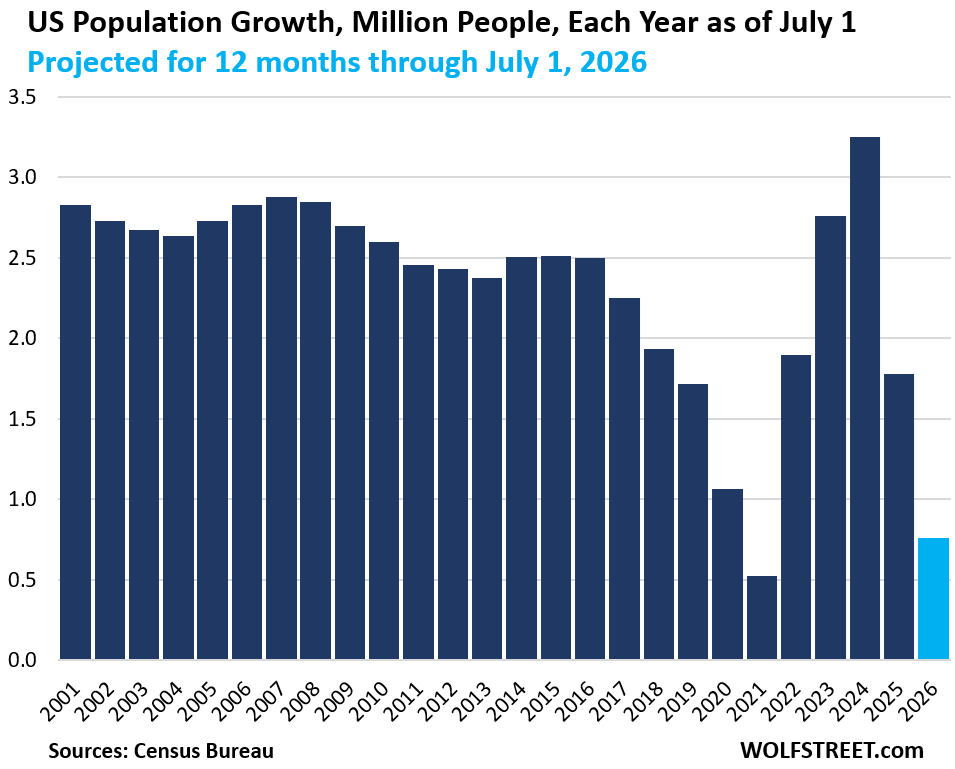
The total US population increased by 1.78 million people (+0.5%) to 341.78 million in the 12 months to July 1, 2025.
The increase was the result of 1.26 million people from net migration – the mix of six months of Biden’s immigration policies, and six months of Trump’s immigration policies – and 519,000 people from natural growth (births minus deaths).
For the 12-month period through July 2026, the total population would increase by only 756,600 (+0.2%), shown in light blue in the chart below, according to projections by the Census Bureau today.
But it cautioned that projections are always based on the prior 12-month trend, so the trend through July 1, 2025, which included six months of Biden’s immigration policies, and that a full 12 months of Trump’s policies could produce even lower population growth for the 12 months to July 1, 2026 (to be released in December 2026). Chart from the Census Bureau:
The Census Bureau had been struggling to account for the sudden and huge waves of immigration under the Biden administration that caused the Census Bureau to dramatically underreport population growth for those years. But in December 2024, using new data sources, including from ICE and the Department of State Bureau of Consular Affairs and Refugee Processing Center, it revised up its population estimate by a huge amount: Over the three years through December 2024, the US population had increased by nearly 9 million people, according to the further revised data released today.
Then came the 2025 crackdown on illegal immigration, the deportations, and the “voluntary deportations,” plus tightening up of legal immigration, that produced another sudden and huge change that even the prior year’s new data sources could not pick up – one of the issues being that the data sources could not track people who’d left and were no longer living in the US.
And so the Census Bureau had to find additional data sources to track the people who were no longer in the US:
“Measuring emigration presents unique challenges because this population is no longer in the United States to respond to a survey or census. Further, there are very few mechanisms to remove the records of these people from administrative data after they have emigrated.”
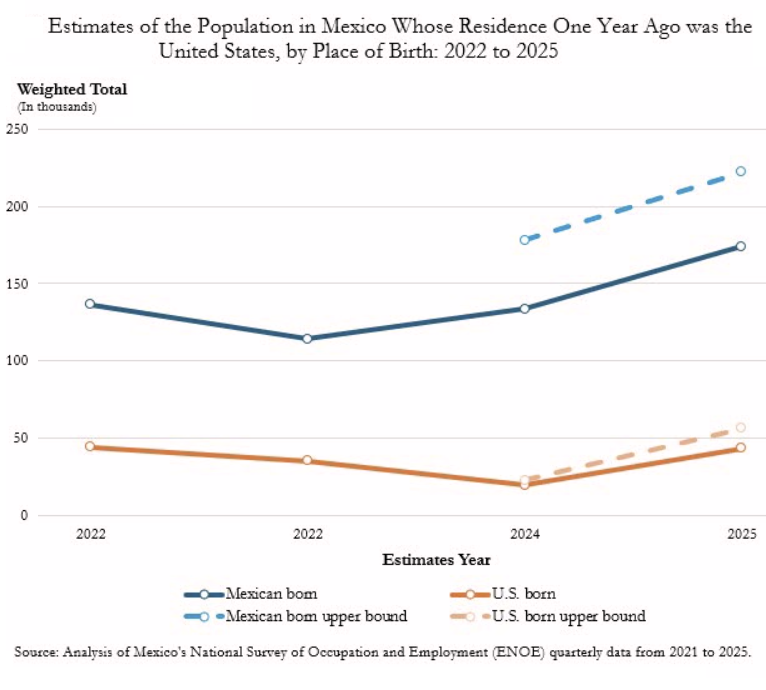
The new sources of the data for emigration include, among others, repatriations data from the Department of Homeland Security and data from Mexico’s National Survey of Occupation and Employment, which includes a question about a respondent’s Residence One Year Ago (ROYA), which produced an estimate of Mexican-born and US-born people whose ROYA was in the US but were now living in Mexico (emigrants).
The chart below by the Census Bureau shows the population now in Mexico whose residence one year ago was in the US (blue = Mexican-born; brown = US-born; dotted lines = upper bound of the Mexican survey data:
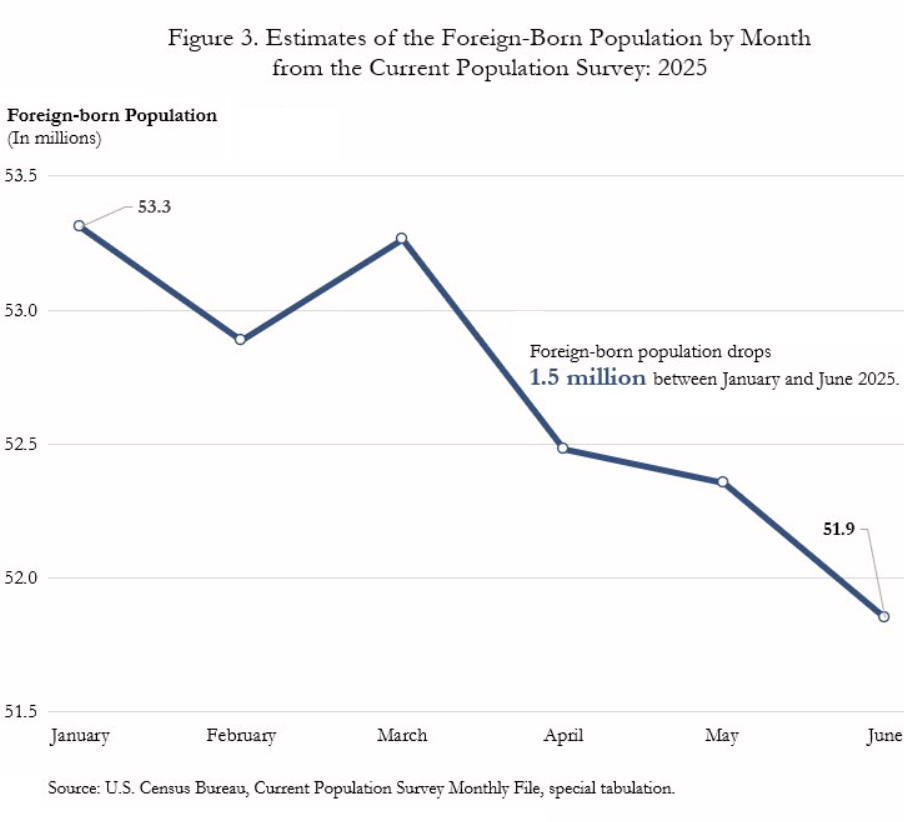
The Census Bureau also conducts a separate monthly survey for the Bureau of Labor Statistics, the “Current Population Survey” (CPS), which the BLS uses for its labor force data. This survey includes the data on the foreign-born population in the US.
Today, the Census Bureau showed the trends through July 1, 2025, accounting for the first six months of the Trump administration immigration policies.
The foreign-born population per the CPS declined by 1.4 million over these six months, from 53.3 million in January 2025 to 51.9 million in June 2025.
But the Census Bureau cautioned:
“While the change in the foreign-born population in a survey over time can imply emigration, it can also reflect survey non-response, coverage error or the impact of population controls.”
And it said that the CPS is based on a “relatively small sample size” compared to the American Community Survey (ACS), “especially for the foreign-born population.” The ACS is the Census Bureau’s huge population-survey data trove.
And it said:
“We have historically used ACS data instead of CPS data to estimate the size and geographic distribution of the foreign-born population. However, the CPS provides more current estimates with the monthly files, making it a valuable benchmark that informed the emigration research for Vintage 2025.”
Hugely important for Employment and Housing.
The Bureau of Labor Statistics will incorporate these new population data into its employment-related data, whose survey results it extrapolates to the overall US population. This affects total employment, the labor force, unemployment, participation rates, the employment-to-population ratio, etc.
We have seen in the second half of 2025 that growth in nonfarm payrolls in the private sector was weak, while the federal government and state governments shed jobs. But the unemployment rate has remained very low, and applications for unemployment insurance have remained very low, and average hourly wages have continued to rise at a solid clip.
Many observers, including us here, and including the Fed, have noted that one of the reasons for low growth of private sector payrolls combined with the low unemployment rate and the solid wage pressures must have been the dramatic slowdown in population growth in 2025, especially in the second half when the new immigration policies were being implemented.
And the housing market is going to feel it. The construction industry has been putting up on average 1.45 million new housing units per year, for-sale and rental units, single-family and multifamily all combined. Each housing unit on average is occupied by 2.5 people in the US overall. So very slow population growth, and even slower as projected, would further reduce demand in the housing market amid this surge in new supply. Bring on the new supply! Lots of new supply and slow population growth may solve a lot of problems in the housing market.
And consumer spending has been losing the engine of population growth. Yet, consumer spending, adjusted for inflation, has continued to grow at a solid pace, on rising incomes and big capital gains.
Enjoy reading WOLF STREET and want to support it? You can donate. I appreciate it immensely. Click on the mug to find out how:


Don’t know why all people in the US aren’t chipped. Numbers would be much more accurate and chip scanners could exist everywhere to find those not chipped or staying beyond visa, etc.
After you, Sir! You get chipped first. Me last.
Howdy Glen. Lots of folks are chipped. I still have a cell phone battery that is removable from the phone. They can find you if they want too….
We are being chipped. Just in slow motion. By facial recognition. That’s why the ICE agents are filming the individuals protesting. Others are being chipped by political party membership. Others in the checkout lane of the local grocery store as your loyalty card is being scanned. Others while getting gasoline. Others while they talk on their phones. So being ‘chipped’ is not the question. The question is what is and will our government do with this information and whether we the people will ever have access to what the government knows about us and how we are categorized. Think you’re not a ‘domestic terrorist’? Well, maybe not today but most assuredly you are in the database somewhere just waiting for a future poorly monitored Elon to change your designation. So the government has a good idea about you just as they have a good idea about your comings and goings and a good idea about what this means for the future housing market. Yeah, I know, Hollywood had this idea down years ago – probably where Palantir got the idea.
Some things you cannot put a price tag on.
As an Australian reading this I am mildly depressed.
Our “leaders” policies promote rampant immigration and ever increasing house prices to the detriment of everything else.
That revision is astonishing. In one year over 9 million people came to the country which is like importing the Dallas metropolitan area in one go. How could anyone have thought that was sustainable to an already inflationary economy?
That was 9 million total over 3 years. And I have seen figures suggesting the illegal border crossing figure was a bit higher.
Not to get political, but all the claims during the Biden years that Congress needed to modify the immigration laws in order to stop the huge influx of illegals has been shown to be malarky. As the data above shows, all it really took was the will of the President/Administration to crack down. From an economic standpoint, it is good that we have basically shut down the border. Yes, there will be some economic problems/issues caused by Trump going after illegal immigrants, especially in the agricultural and construction industries, but it will take years to undo what got built into the system by unfettered illegal immigration. And yes, some of the changes will likely increase both wages and inflation, but overall it should be a net positive.
Very good to see this. As Wolf has noted, it will keep (and has kept) wages up and unemployment very low (and labor participation rates high), and the increases in housing will put downward pressure on sales prices and rents. It will also help reduce inflation going forward.
What we need to do now is fix our legal immigration laws and policies, including getting rid of the fraud in the H1-B program. Harvard University sponsors over 125 new H1-B visa holders every year. I mean, really, how can a university like that not be able to find people to fill their positions? Don’t they graduate enough students (grad and undergrad) to meet all their needs? More likely, it is just a refusal to pay enough, and thus they want cheaper foreign labor, which is what the H1-B program is NOT supposed to provide?
I truly believe the semi-untold story of several countries is declining population base. China, Japan and most European counties. The implications will be significant. It doesn’t take long for low birthrates to significantly reduce a population. Grok-“China: Fertility fell sharply from the 1970s (pre-one-child policy) and below replacement by the 1990s. Population peaked around 2022 and is now declining, illustrating a ~30–50 year lag from rapid fertility drop.”
Just reproductive rates mind you. Legal immigration has been beneficial for the country and should be encouraged. We need educated innovators and we need service workers and people willing to do the jobs that we either do not choose to do or refuse to do. I worked in a kitchen during college cleaning dishes and that taught me I never wanted to do that job again.
I don’t agree that this is a good thing. Only 2 ways to grow an economy(GDP)-increase the number of people working, or increase how much each worker produces. Immigration has always been the secret sauce that helps America’s economy grow, so that Debt/GDP stays manageable, and the borderline Ponzi scheme programs like Social Security stay solvent. Low immigration/low birth rate countries like Japan and Italy have seen poor Economic growth the past few decades, and that will be our future as well if we choke off immigration and the younger generations don’t start having more kids.