
The five-month surge is a sign of strong business investment, partly driven by the AI infrastructure buildout.
By Wolf Richter for WOLF STREET.
Orders for durable goods reported by manufacturing plants in the US fired on all cylinders in November, rising by 5.3% from October and by 12.3% year-over-year, including huge orders for civilian aircraft, a very volatile component, according to data from the Census Bureau today.
Orders for core capital goods (“nondefense capital goods excluding transportation”) are particularly interesting because they reflect future investment expenditures by businesses and more broadly, domestic business conditions in the manufacturing sector.
Orders for core capital goods rose by 0.7% in November from October, by 3.7% over the past five months, and by 5.5% year-over-year, to a record of $78.4 billion.
Manufacturers of core capital goods include manufacturers of fabricated metals, machinery, computer and electronic products including semiconductors, electrical equipment, and others.
They’d shot out of the lockdown, amid shortages, distortions, and inflation from mid-2020 through August 2022, then declined for two years. But in mid-2024, they started rising again, and over the five months, they have surged and in November hit a new record, surpassing the old record of August 2022:
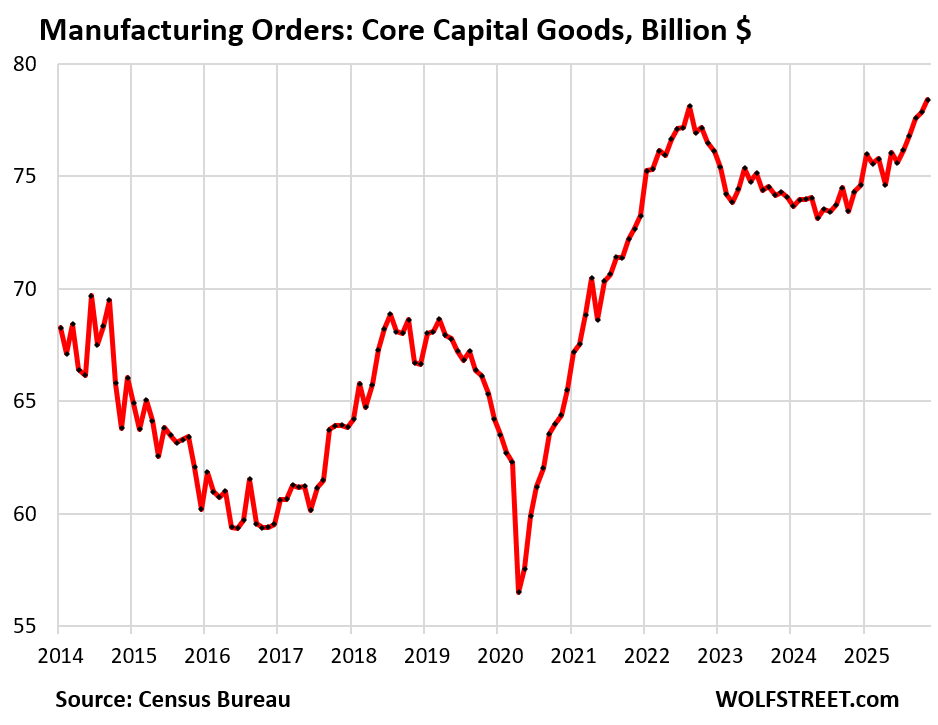
The surge in orders over the past five months is another signal of strong business investment fairly broadly, but also related to the buildout of AI infrastructure that has been going on for some time.
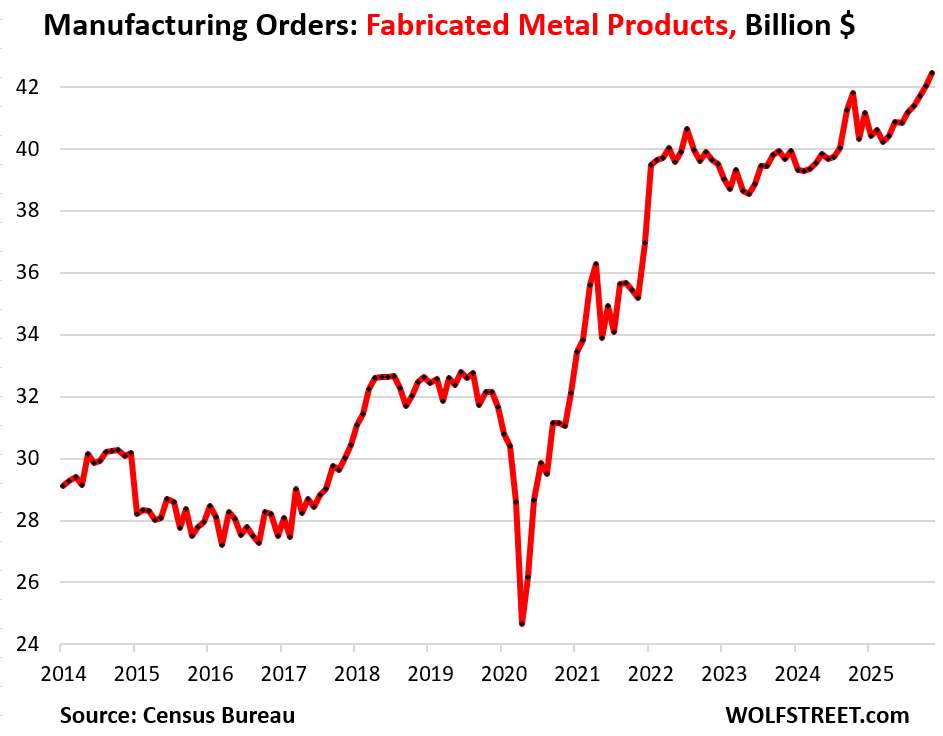
Orders for fabricated metal products rose by 1.0% in November from October, by 3.9% over the past five months, by 5.5% since March, and by 5.3% year-over-year, to a record $42.4 billion.
Industries in the Fabricated Metal Product Manufacturing category (North American Industry Classification System NAICS code 332) use processes such as forging, stamping, bending, forming, machining, welding, and assembling metals into intermediate or end products, other than machinery, computers and electronics, and metal furniture.
Also note the 8-month 5.5% surge since March:
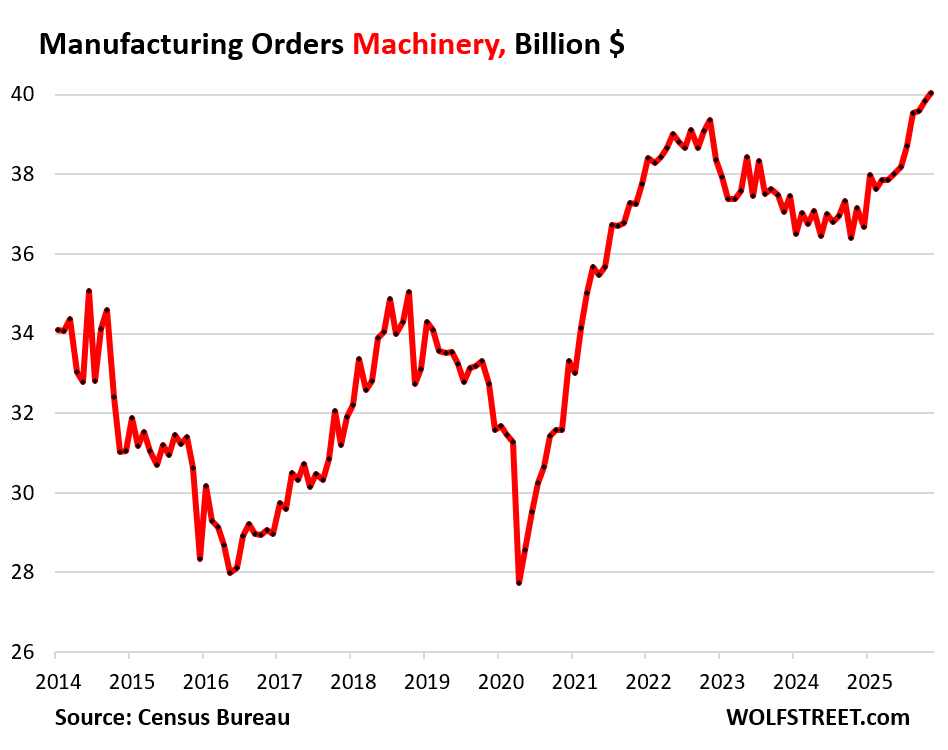
Orders for machinery rose by 0.5% for the month, by 4.8% for the past five months, by 5.8% since March, and by 7.7% year-over-year, to a record $40.0 billion in November.
Several of the subsectors below supply the AI infrastructure buildout.
Industries in Machinery Manufacturing (NAICS 333) consist of:
- Agriculture, Construction, and Mining Machinery Manufacturing
- Industrial Machinery Manufacturing
- Commercial and Service Industry Machinery Manufacturing
- Ventilation, Heating, Air-Conditioning, and Commercial Refrigeration Equipment Manufacturing
- Metalworking Machinery Manufacturing
- Engine, Turbine, and Power Transmission Equipment Manufacturing
- Other General Purpose Machinery Manufacturing
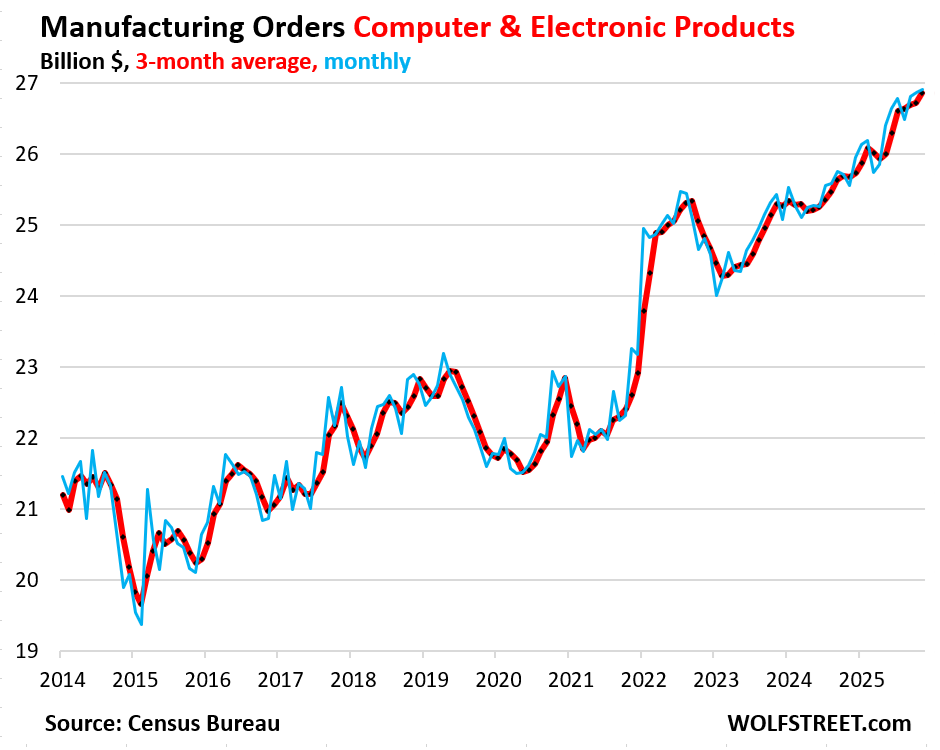
Orders for computer and electronic products rose by 0.2% for the month and by 5.3% year-over-year (blue in the chart below).
This is volatile data with big monthly up-and-down squiggles. So the chart below also shows the three-month average, which irons out the squiggles and shows the trend better (red).
The three-month average rose by 0.5% in November from October and by 4.6% year-over-year.
Industries in Computer and Electronic Product Manufacturing (NAICS 334) consist of:
- Computer and Peripheral Equipment Manufacturing
- Communications Equipment Manufacturing
- Audio and Video Equipment Manufacturing
- Semiconductor and Other Electronic Component Manufacturing
- Navigational, Measuring, Electromedical, and Control Instruments Manufacturing
- Manufacturing and Reproducing Magnetic and Optical Media
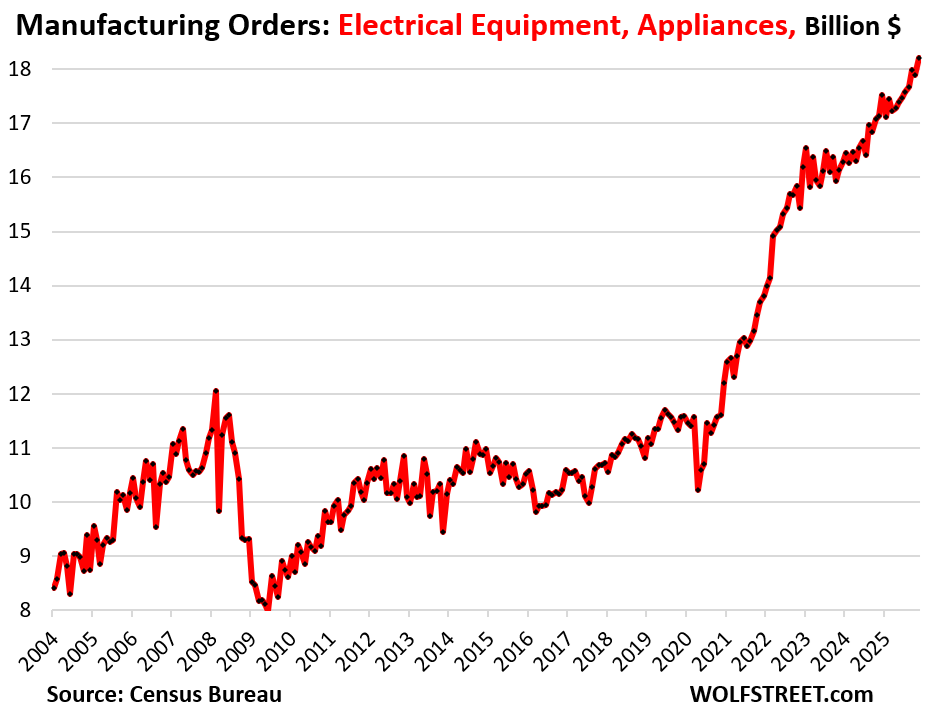
Orders for electrical equipment, appliances, and components jumped by 1.7% in November from October, by 4.2% over the past five months, and by 6.3% year-over-year to a record $18.2 billion.
From November 2020 through November 2025, orders have surged by 57%.
Industries in Electrical Equipment, Appliance, and Component Manufacturing (NAICS 335) consist of:
- Electric Lighting Equipment Manufacturing
- Household Appliance Manufacturing
- Electrical Equipment Manufacturing
- Other Electrical Equipment and Component Manufacturing
As we have seen in other data, part of this economic growth is fueled by strong business investment, in part driven by the AI infrastructure boom. It takes a while for the announced AI infrastructure projects to actually turn into orders for manufacturers, and that boom of announcements in 2025 – the portion of projects that will actually come to fruition – will turn into orders for US manufacturers over time.
It’s hard to imagine an economic slowdown until this business investment boom fizzles.
Enjoy reading WOLF STREET and want to support it? You can donate. I appreciate it immensely. Click on the mug to find out how:


I think it continues until something happens to make people realize that their “AI investment” is not actually turning into revenue, at which point investors start defaulting on capital calls, banks start tightening lending standards, and the wheel come off.
Or when Google / OpenAI / Tesla roll out general AI in the next two years that scares the crap out of everyone.
Heck, for all we know, they’ve already made it to general AI with it sitting around in the labs. Once AI can fully teach itself, it’s game over.
This isn’t about data centers or capital investments. It’s about how many & how quickly all sorts of white-collar jobs are put at risk & then hands on jobs due to robotics.
> roll out general AI in the next two years that scares the crap out of everyone.
Bubble will continue until these hypotheticals and such thinking are completely shattered.
> they’ve already made it to general AI with it sitting around in the labs
No one is sitting on AGI (artificial general intelligence), and no one is anywhere close to creating AGI.
> It’s about how many & how quickly all sorts of white-collar jobs are put at risk & then hands on jobs due to robotics.
Not quickly and not much. Mostly augmentation over time as models are adapted for specific use cases to be useful enough by relevant knowledge worker and workflows.
Current AI is to language what the calculator is to numbers. Really good at working and manipulating it for results, not actually intelligent. Anyone who works in complex knowledge fields knows how “stupid” these models are when the solution can’t just be regurgitated and how naive the reasoning of these models is.
“Current AI is to language what the calculator is to numbers. Really good at working and manipulating it for results, not actually intelligent.”
That’s actually the best I’ve ever heard it described. People need to realize the hype they read about online is exactly that, hype.
If you weren’t a software engineer and all you did was read Twitter, you would think “AI” is writing all the code. As a software engineer myself, AI writes very little code. Not only that, projects continue to get cancelled because AI can’t solve the problems it was hyped up to solve. And this is at a fortune 50 company I’m working at. Actually several I have worked at as a contractor. If you need any evidence when these AI companies say AI is writing all their code, visit their hiring section, it’s all software engineer jobs. I’m actually getting paid higher than I ever have as a software engineer and I receive more calls from recruiters than in the past two years.
“Current AI is to language what the calculator is to numbers. Really good at working and manipulating it for results, not actually intelligent.”
That’s a lot better than most humans.
^^This. Work in tech and I’m seeing jobs shipped to India, not coworkers replaced by AI. Outsourcing doesn’t generate clicks though and is politically unpopular.
Expand this logic to all the other business investment, which relies on the assumption debt-fueled consumers will be able to keep buying.
A lot of consumers have no debt. It’s as much about willingness to spend money as it is ability.
I read about a guy who used the Claude builder ($20-$200 a month) to design a way for him to identify his kids clothes. Apparently he was struggling to do laundry, glad AI could help him.
Hope the kangaroos don’t suffer too bad from his AI use. 🦘
Exactly.
Is it possible that the Administration’s boasts about growth are true? more inward investment leading to higher employment demand. run it hot is the goal, I believe, but we seem likely to see strong numbers, at least through the mid terms
“It’s hard to imagine an economic slowdown until this business investment boom fizzles.”
As you mentioned, there is a lag time before the funding for projects materializes into orders. What happens if PE investors begin to pull money at a faster clip or interest rates rise significantly? There’s already considerable worry that mark to market is hiding the true value of assets.
There have been bubble concerns for a while. And when this bubble implodes, it’s over. But that isn’t happening yet. The investments keep piling in.
I said this in Nov 2024:
https://wolfstreet.com/2024/11/10/we-might-not-get-our-recession-until-the-ai-spending-bubble-implodes/
And again in Oct 2025:
https://wolfstreet.com/2025/10/10/is-it-really-different-this-time/
It’s not over until the fat lady sings.
Agreed, though one note of concern is that this appears to be a lagging indicator (by about 6 months) compared to the stock market.
AI profits might already be largely captured in earnings. Companies have been using machine learning for years. For example, transportation logistics optimization (think Amazon, Delta, etc.), investment arbitrage, factory automation, satellite imaging, medical diagnosis, to name just a few. Any process that requires pattern recognition or optimization has already been enhanced.
The new part is the addition of large language models, and it’s not clear how much value that adds to the economy at large. Further profit gains seem somewhat speculative.
AI = Atrocious Idiocy
I’ll have to respectfully disagree. I’ve been an AI “power user” since my computer science major daughter introduced ChatGPT to me shortly after it was initially released to the public. I can’t even begin to tell you how many use cases i’ve applied it to, but it includes (1) large scale data analysis, (2) helped me negotiate a better severance for my job (served as a pseudo lawyer) (3) practically instantaneous analysis of multi page documents (4) massively decreased the amount of time spent on software development, (including the time spent developing my own app for a a new business venture, I would’ve never been able to do so quickly without AI).
I totally get how most people may not understand how to use it, but it’s been a game changer for me in my professional career as of late in a Director level role, as well as on the side, helping me to launch a new business I would’ve never been able to do as efficiently on my own.
Careful, psychologists and psychiatrists are seeing an uptick in ChatGPT induced psychosis.
Set a reminder so ChatGPT can check you for that.
Sounds like automated Cliff Notes. I used those to skip reading (a lot of) books in college.
I can see using AI to help in starting a business. Ask though: who—in the end—will buy your products or services? If people have been replaced by AI. Will you accept a portion of their UBI via CBDC? How will your business navigate the social unrest that will come when the have-nothings storm the castles of the haves?
Rest (or toss and turn) assured that things will come down to that.
Software Engineer (with a CS degree) here and yeah it’s like an amazing Google search. I equate it to when the PC came out. It makes life easier. However just like Google searches it’s accuracy is so-so. I hold a professional license from a previous degree and was doing continuing ed for it chatgpt got about 80% of the questions right. This wasn’t something complex or that required problem solving, it was what’s the codefication/statutes/law say for xx. So I’d be careful.
Also yes you can build an “app” with AI but it won’t scale. It also will likely have security issues. The thing is you could have also built a simple app by watching a YouTube video before AI. I built a pokemon card trading app in 50 minutes while people stared at me for my last job interview. That doesn’t mean it could have supported 100k+ user base, manage large data sets, get data from and send data to the backend quickly, and wouldn’t get all my customer info stolen and then me sued
> I totally get how most people may not understand how to use it
Bucketing all AI skeptics into “don’t know how to use it” is not sound reasoning.
Have experience with all the use cases you list using the frontier models and while its head and shoulders above the absolute hot garbage Google Search has become for knowledge based research it’s far from perfect.
For anything of significant complexity the models regularly confuse references, data points, make poor assumptions and arrive at the incorrect conclusions. If you don’t have sufficient depth in the domain / data it all looks reasonable, if you do you quickly see the errors and are constantly auditing the output and course correcting. Yes this is more time productive than reading everything yourself but it is also more error prone. Something for something, at least for now.
> massively decreased the amount of time spent on software development
Yes, agreed at least for greenfield work for small projects until complexity grows. Enterprise level results are mixed and the industry is as usual crap at measuring outcomes after a project is released, i.e. the real after cost to resolve bugs, performance issues and refactors to support the next stage of features. So anything that gets a project out the door faster (AI generator) is great, what happens after is not measured much if at all.
It’s definitely a useful assistant, just the usefulness varies based on domain, data and expertise.
Here’s my anecdote: Last summer I used chatgpt to assess a vase, Chinese, that was up for auction at a lower tier auction house. I started with the auction house page. Chatgpt pointed out an obvious issue: no picture of the bottom. Amateur time on behalf of the house. The mark, the rim, is critical. I provided a picture of the bottom (the rim is can tell a lot) and mark, that I took. Chatgpt took a while to crunch the old mark, the stylized characters, and provided an excellent report on that, and the history of that mark. It assessed basics, like the condition of the glaze, the manner in which it was painted, etc. It provided to me, a non-expert, who has a sense of things, with a very good analysis. Blew me away.
Me, too. I’m constantly using AI (mostly Gemini ATM) as a thought partner and pattern recognition specialist. It makes me think deeper, first about exactly what problem I’m solving and second about solutions that weren’t obvious.
Even though I’m a huge user, I don’t see it getting anywhere near the adoption rate or headcount reductions that investors are hoping for.
Here’s the callout to ask if some of this is related to factories that have moved into the US due to tariffs? Are they at a point where the building is far enough along that they are ordering the machinery to go inside?
I know Wolf always likes to point out that what is inside is worth much more than the building.
New factories take a very long time to plan and build. The changes brought about by the tariffs will lead to more factories being built, but it will be years before they install the equipment and start production. Ordering the equipment would take place before then, but still, they would have to have purchased the land and got permits before they order the equipment. Moving new production into an existing building is much faster, and that is happening too, and those orders could be happening now.
And big companies, such as GM, with plants in the US and around the world, can shift some production from their foreign plants to their US plants, and they’re doing that, and have already announced some of their plans. But even that takes a year or so.
So we have probably only seen a small portion of the impact of the shift in manufacturing.
The AI data centers are big deal. They require all kinds of equipment. And they’re trying to build them fast and furious out in the middle of nowhere, including some of the time, their own power generation equipment. That’s some big orders! But that’s unrelated to the effects of tariffs.
Wolf,
You allude to it here, but I would like to know how much of the spending in these numbers is from or tied to the magnificent 7/AI building. How will a potential popping of the AI bubble affect this?
Thanks!
Mike L
I wonder how much of this investment is being pulled forward in time. The counter-narrative, based on things like the business surveys and hiring rates, is that there’s too much chaos and uncertainty right now for businesses to do any real investing, but plenty of reason for them to do some stockpiling (see for example: 100% tariffs on Canada).
A couple of different people I read also think the AI bubble will blow this year; probably led by an OpenAI bankruptcy. Meanwhile, “Gold Storms Past $5,000” based on geopolitical chaos and the “debasement trade”, according to Bloomberg. Who needs entertainment media anymore when we have the news.
“Gold Storms Past $5,000”
As a in hand stacker of gold and silver this does not make me feel good.
>Who needs the entertainment media anymore when we have the news.
I have been thinking that too… just remember it’s designed to pull you in just like a good TV show
This is true. I notice that they both use the same strategy too: I’m sitting there watching it going “this is so f***king stupid,” and I can’t look away. Is that intentional?
Our president is a reality TV show host, so yes. I say this as someone who doesn’t regret voting for him. Each side thinks the other has lost their minds and ragebait is everywhere
Just read a NYT article about home bakeries. These little shops have you stop by their front porch to pickup your bread (highly inconvenient). At $17 a loaf this better be some dang good bread!
Anywho because of the price and morons spending tons of $, these people make over 100k a year.
I guess in a way it’s middle class charity.
Part of the problem is that there is little real bread in United States, creating enough demand for this. Costco and Walmart sell bakery bread that is a good alternative.
The shopping experience for me is what stops me from going to Costco more.
How is it that travelers demand more cushy 30 minute lodging at airports from the credit card companies, yet do not demand a better shopping environment from Costco?
I am a Costco member for a few trips a year for the massive savings over their competitors. Mostly I go to target, when combined with the red card 5% off and their app sales, it’s pretty low priced.
Costco needs to run a pilot where it’s a very upscale store and no heavy items looming over you threatening to crush the body. lol
Maybe a cushy lounge like the Amex or Chase ones or whomever installs these lounges in airports people love to brag about.
I think Costco is a great shopping experience, at least compared to Walmart. What part don’t you like?
Bread is fairly uncomplicated (and fun) to make at home. It’s not labor-intensive or time-consuming. All you need is a Dutch oven and a few practice runs to get “real bread.” The cost per loaf is 50 cents to $1.
I think they’re talking about actual bread with a crust that crunches when you bite into it and that keeps the bread fresh for a couple of days, or even weeks, depending on the thickness of the crust, as the bread sits on a shelf, until you cut into the crust — the kind of bread that is destroyed when put into a plastic bag. That kind of bread has to be baked in a real oven, and a wood-fired stone oven would be a special treat.
Business investment outrunning consumption growth is a classic recession story: “Oops, we built too much capacity”.
The part I can’t wrap my head around is inflation. All those nominal charts would need to go up and to the right even if there was no trend and it was just prices rising at 2% per year. Similarly, nominal consumption would look like a rising trend even if everyone bought the exact same things each year.
But yea, even the inflation adjusted metrics I look at show a rising trend of real consumption and business investment…. and debt. This can work as long as productivity increases, but spending can also outrun productivity.
Can you clarify something? The word “include” in your sentence:
“Manufacturers of core capital goods include manufacturers of fabricated metals, machinery, computer and electronic products including semiconductors, electrical equipment, and others.”
makes me think that the figures shown in the last four graphs must be components/subsectors of the figure ($78 Billion) that is shown in the first graph (core capital goods), but the $78 Billion for core capital goods orders is clearly less than the total of the $ amounts reflected in the last four graphs.
What am I missing?
Well no. Core capital goods have subtracted out all goods related to transportation and defense. There are separate industries for transportation equipment manufacturing, aircraft and components manufacturing, defense equipment manufacturing, etc. that I did not list. But a clean subtraction is not available for the industries I specifically listed — fabricated metal products manufacturing; machinery manufacturing; computer and electronic products manufacturing; electrical equipment; appliances, and components manufacturing — and there is some crossover, for example to transportation equipment manufacturing.
Transportation equipment manufacturing (NAICS 336) is a gigantic industry, with $119 billion in orders in November (+15% MoM, +29% YoY), far larger than core capital goods, consisting of the below industries, many of which are also related to business investment but are not included in core capital goods and are not included in my list either:
— Motor Vehicle Manufacturing
— Motor Vehicle Body and Trailer Manufacturing
— Motor Vehicle Parts Manufacturing
— Aerospace Product and Parts Manufacturing
— Railroad Rolling Stock Manufacturing
— Ship and Boat Building
— Other Transportation Equipment Manufacturing
By contrast, all defense capital goods orders, including defense aircraft, were only $20 billion in November, and roughly flat with a year ago.
OBBBA had created massive incentive to front load spending for AI, R&D, and automating factories.
“100% bonus depreciation, restored by One Big Beautiful Bill Act (OBBBA) in 2025, is projected to reduce federal tax receipts by $172 billion in 2025 alone, according to estimates by Joint Committee on Taxation”
Corps are borrowing $ Billions to get automatic 21% return & providing major cash flow from no estimated quarterly tax payments.
Good call.
No they don’t get a “21% return.” If they invest $1,000, that $1,000 is gone, out the door. They get a 21% reduction of that $1,000 cost. So they’re still out $790. So now they have to make that investment work so that they get an actual return on their investment ($790). If that investment leads to nothing, they will have a loss of $790 (minus taxes).
This country hasn’t had a traditional “business cycle” recession since the “deficits don’t matter” attitudes started over 40 years ago with Reagan. You can enjoy a lot of prosperity endlessly charging significant items to the national credit card.
This AI data center buildout is stock market bubble bullshit. This is all driven by a massive AI mania.
We are in the most grotesque speculative mania in the history of the world which is enriching the already obscenely wealthy even more. We have never needed a crash more than we do right now.
The amount of malinvestment and waste of natural resources that is occurring is disgusting beyond words.
AI will be bigger than Internet. So the bubble is bigger than Dot Com. The crash will be yuuuge.
Agreed.
What’s really grotesque is that ordinary people have to pay more in electricity so that big tech can build these useless data centers.
Wolf, another great article. i would be interested in seeing these charts in inflation adjusted cost. I would assume most of the industrial equipment and goods were a lot less expensive in 2018-2019. The increases would not appear as significant.
1. To adjust durable goods orders that manufacturers receive for consumer price inflation, which is dominated by consumer services (rent, insurance, etc.), would be inane BS.
2. No one has ever ordered at or paid inflation adjusted prices. Not ever in the history of mankind. Go order a diesel generator set from Caterpillar and tell them that you will only pay the inflation adjusted price, LOL.
The odds of an AI blowup I think are way off. Open AI has restructured and Microsoft has a 27% stake. Microsoft gets use of IP until AI reaches level 5, which has to be independently verified, but of which it will be unlikely to be in a hurry. I think most people think of Level 1, chatbots, but it is already solidly in level 2 and 3 and showing some limited use in level 4. Level 5 is entirely a different level so I don’t even bother to guess at that.
In short, I think the AI boom is going to go strong and possibly boost some other industries, perhaps in the energy sector as well. Not suggesting AI won’t be hugely disruptive to society but don’t sense anything resembling a crash.
Let’s assume that it doesn’t blow up. Outside of big tech, I’m not seeing who is actually making money on this stuff.
So here’s my question what happens if salaries stay relatively flat and the employment market stays as it is? Or gets worse because of AI? Does this spending matter if it doesn’t trickle down to most of population?
Obviously stock market goes up for a bit? But this just makes the K wider?
If you study the great revolutions of history, they provide a clue. AI will speed up the widening of the gap between the top 10% and every one else. Trump was the first wave of revolution to crest, when he fails to raise the living standards of the bottom 90%, the bonfires will become bigger. Meet the new boss, same as the old boss…
Looks like this bull market has more room to run….