
The beginning of the 4th year of demand destruction in the resale market after the price explosion from mid-2020 to mid-2022.
By Wolf Richter for WOLF STREET.
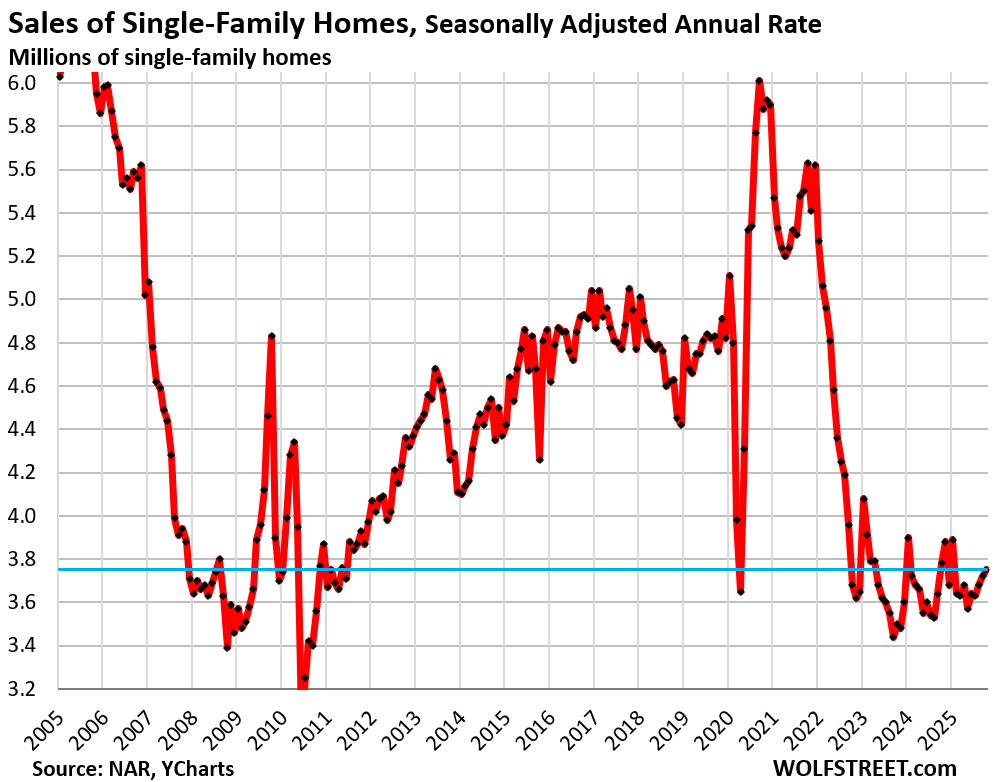
Sales of single-family homes that closed in November rose seasonally adjusted by 0.8% from October, but were down year-over-year by 0.8%, and by 22% from November 2019. At an annual rate of 3.75 million, sales were at Housing Bust levels.
Welcome to the beginning of the fourth year in a row that sales of existing single-family homes have wobbled along crushed levels (historical data from YCharts):
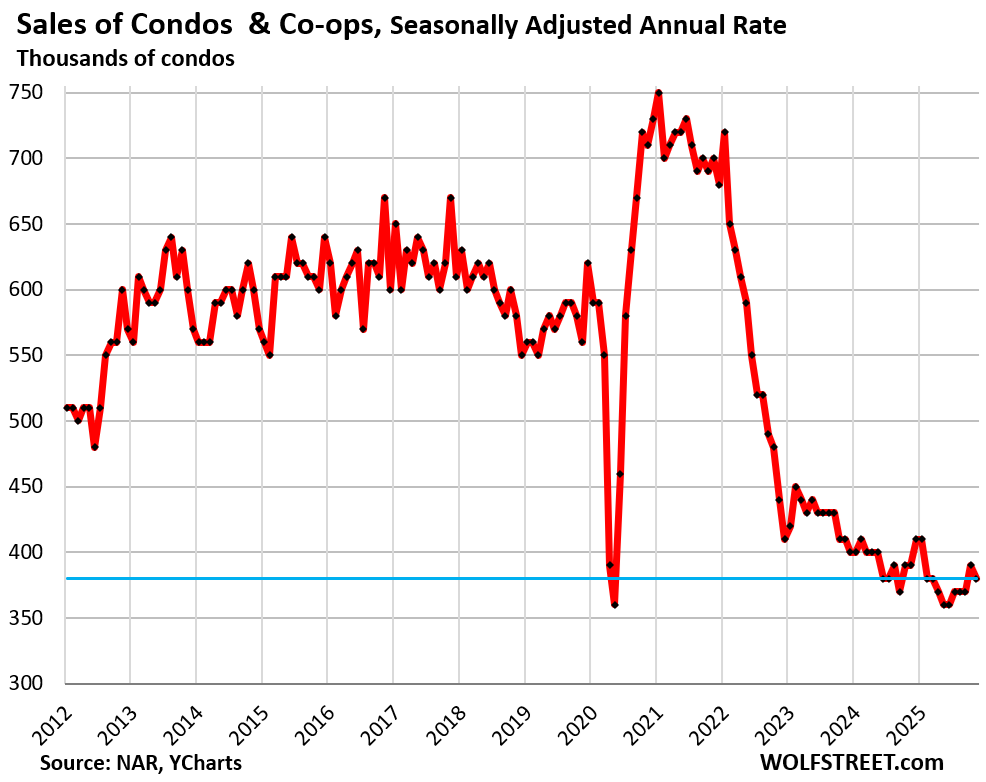
Sales of condos and co-ops fell seasonally adjusted, both, month-to-month (-2.6%) and year-over-year (-2.6%), to an annual rate of 380,000, according to the National Association of Realtors today.
Compared to November 2019, condo sales were down by 32%. NAR’s data on condos goes back only to October 2011, and within that time frame, sales have been wobbling along record lows for over three years (historical data from YCharts).
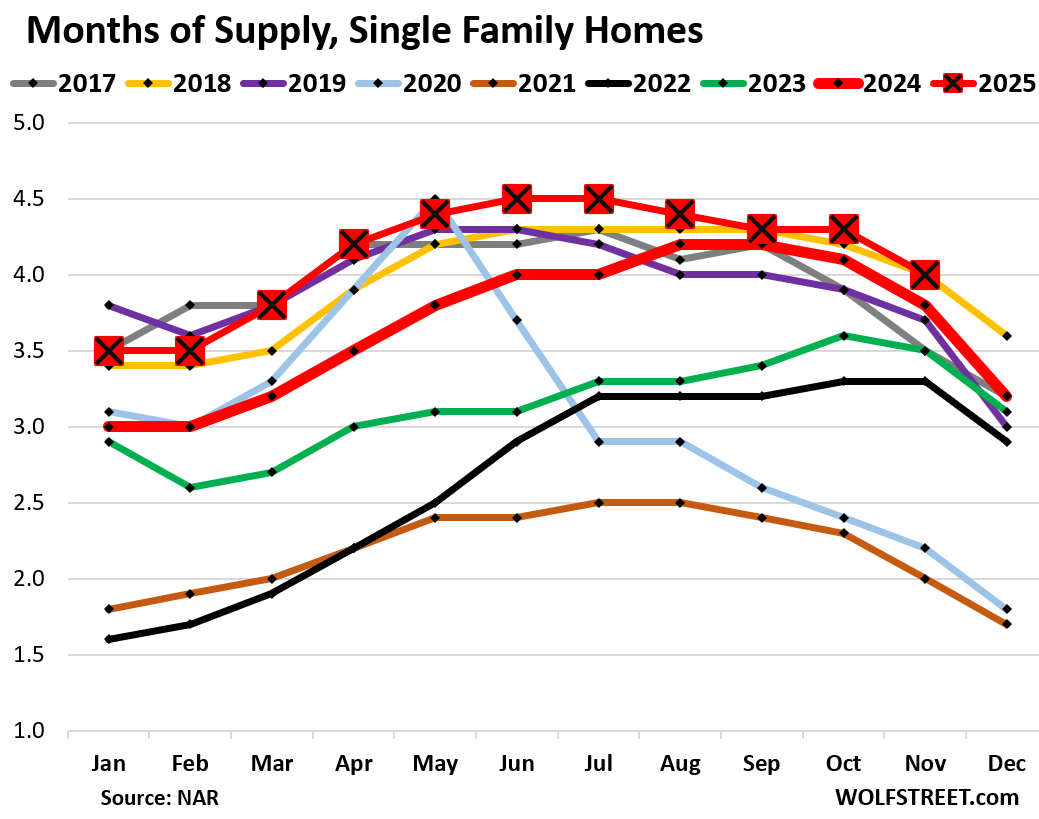
Most supply in years.
Supply of single-family homes dipped along seasonal patterns to 4.0 months (red line with big squares in the chart below), the highest for any November since 2018 (also 4.0 months, yellow line). Back in November 2018, mortgage rates had surged to 5% and were starting to shake up the housing market.
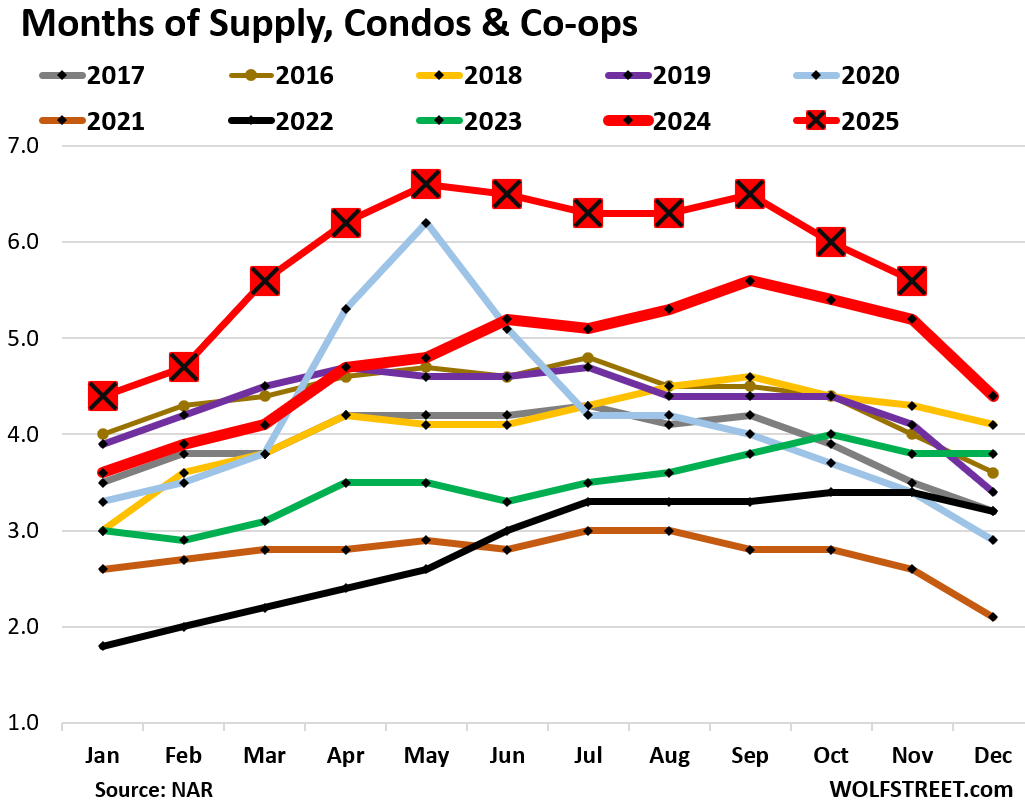
Supply of condos declined seasonally to 5.6 months, the highest for any November since November 2011 during the Housing Bust. Compared to November 2019, supply was up by 37%.
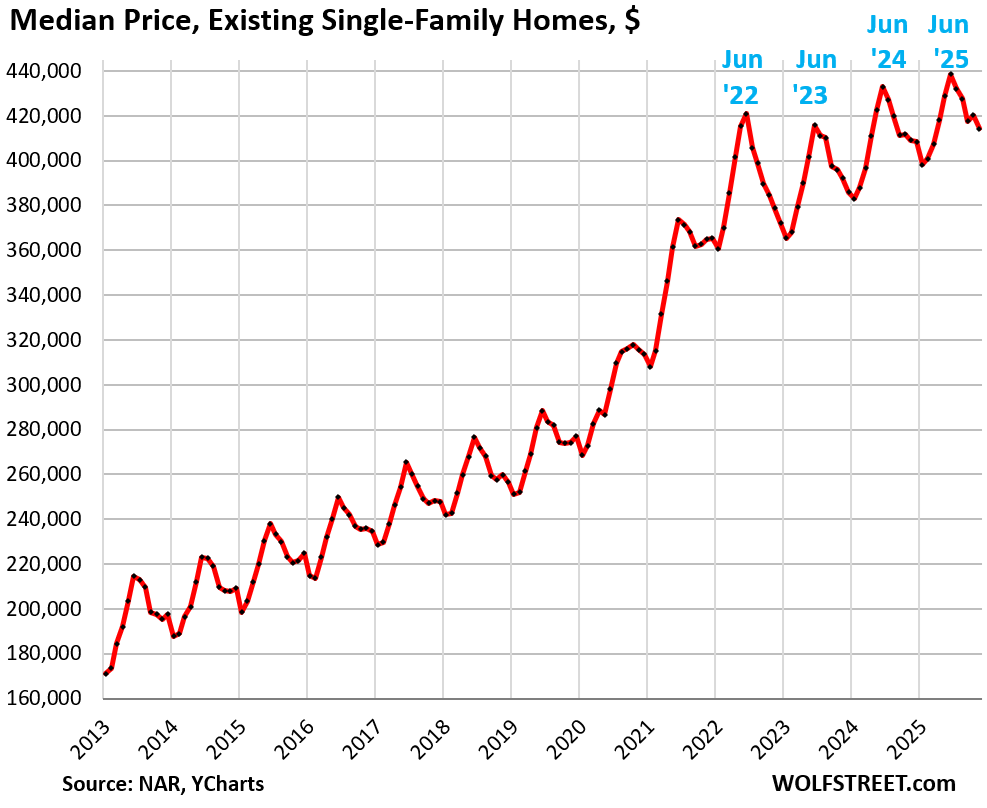
The national median price of single-family homes fell by 1.4% in November from October along seasonal patterns, to $414,300, reducing the year-over-year gain to 1.2%.
This national median price of single-family homes had exploded by 47% from June 2020 through June 2025, most of it during the two years of mid-2020 to mid-2022.
June marks the seasonal high each year. January or February marks the seasonal low each year. The index is not seasonally adjusted. The seasonal zigzag is a result of shifts in the mix of what is on the market and sells, which shifts the median price up or down.
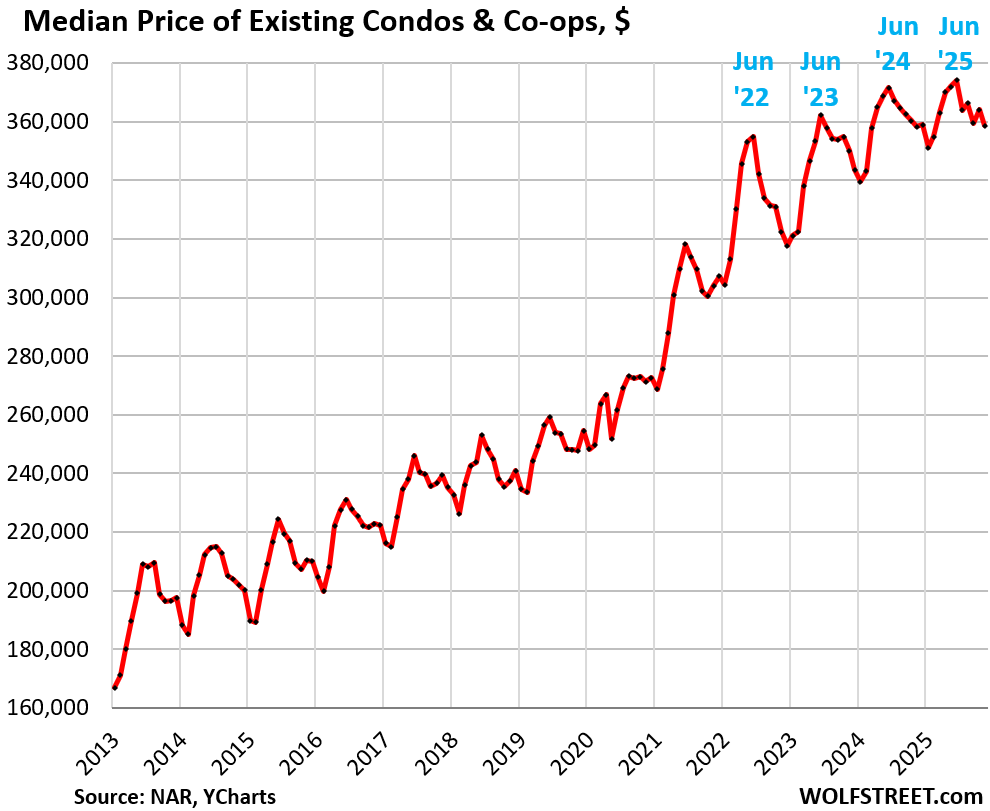
The national median price of condos and co-ops dropped 1.5% in November from October, and by 1.5% year-over-year, to $358,600.
This national median price of condos and co-ops had exploded by 43% from mid-2020 through mid-2025, most of it during the two years of mid-2020 to mid-2022.
But price dynamics differ in individual markets.
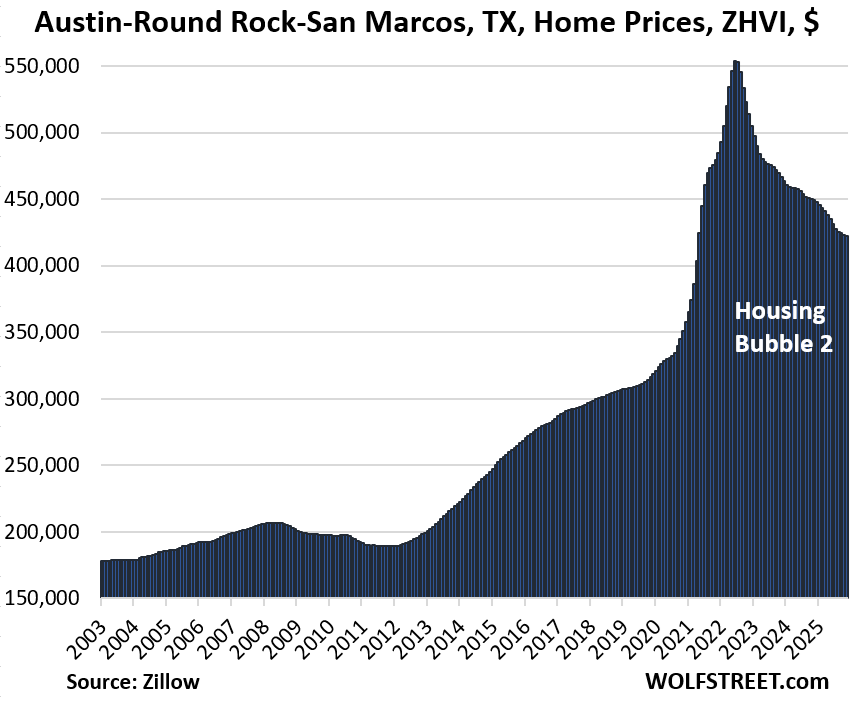
The national median price is meaningless for specific markets. In some markets, home prices have fallen substantially, including by 24% in the Austin-Round Rock-San Marcos metro, the biggest drop in our lineup of 33 large and expensive housing markets. The drop so far has backed out only about half of the 74% price explosion from January 2020 through June 2022:
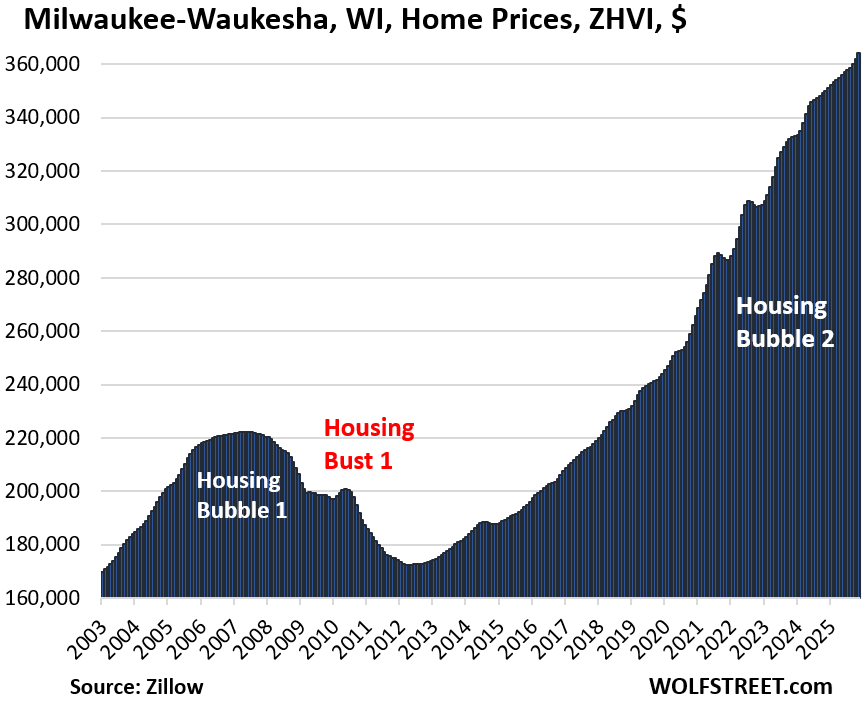
Conversely, the Milwaukee-Waukesha metro is the market with the biggest year-over-year gain (+4.1%) in our lineup of 33 large and expensive housing markets:
Demand destruction by region.
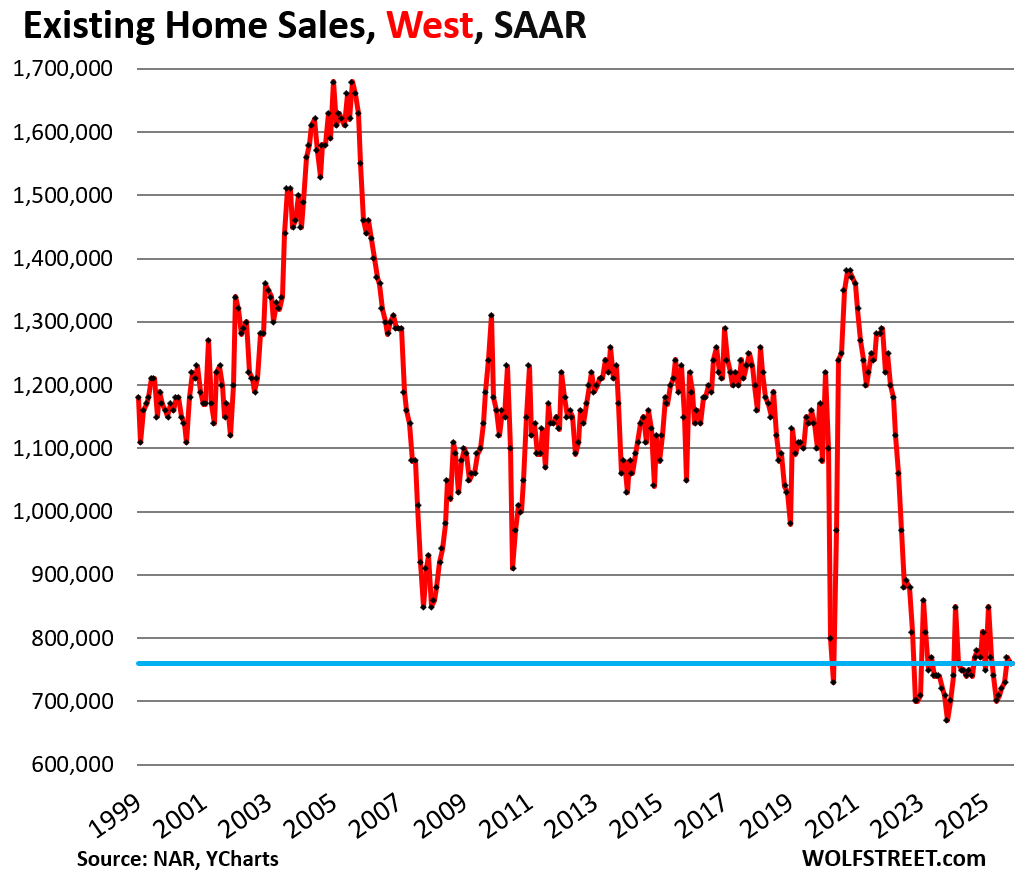
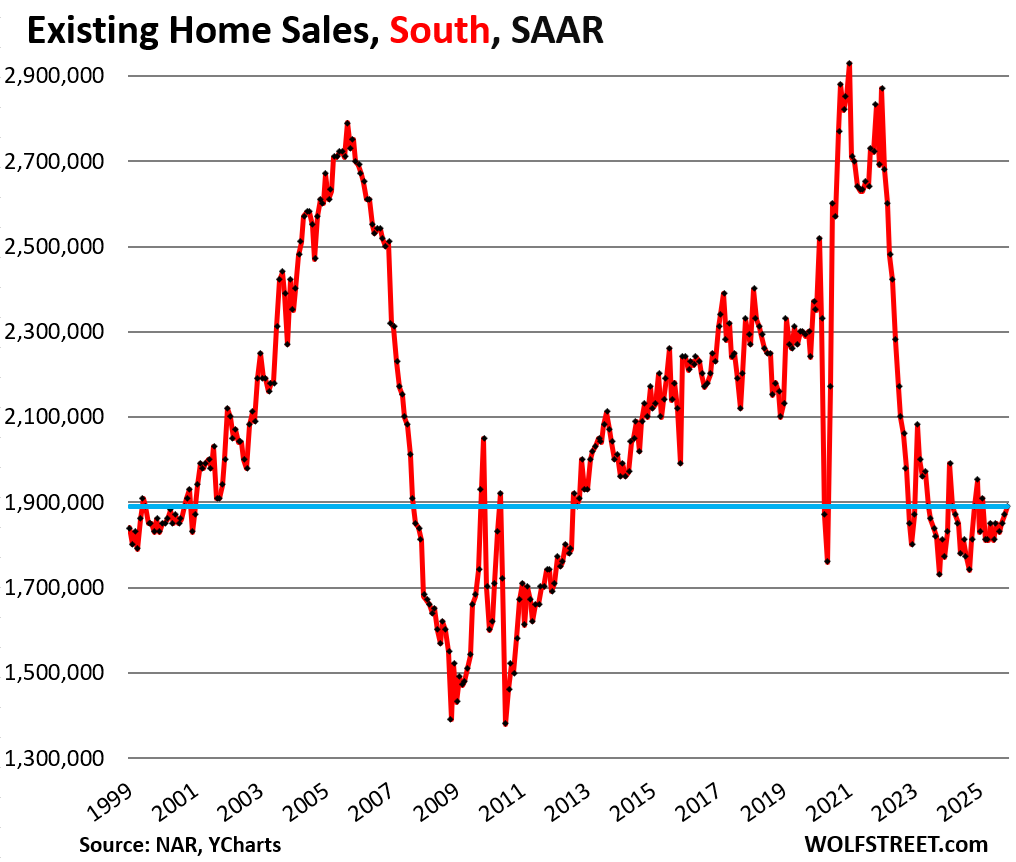
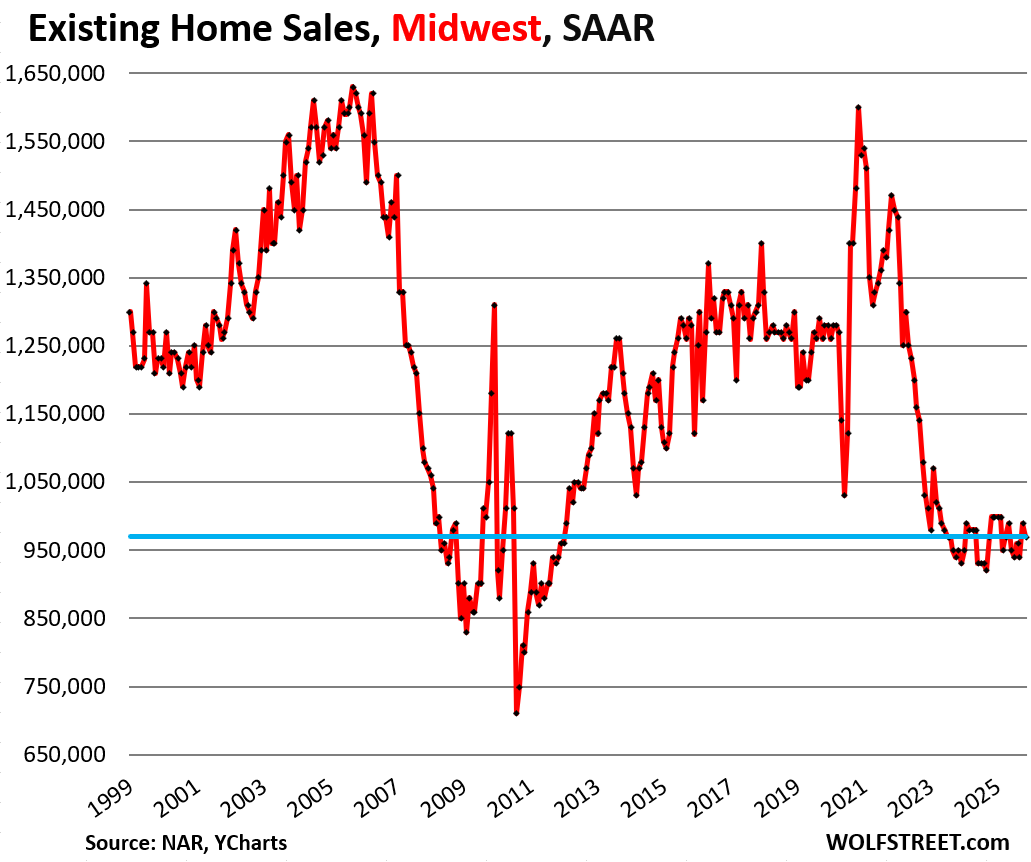
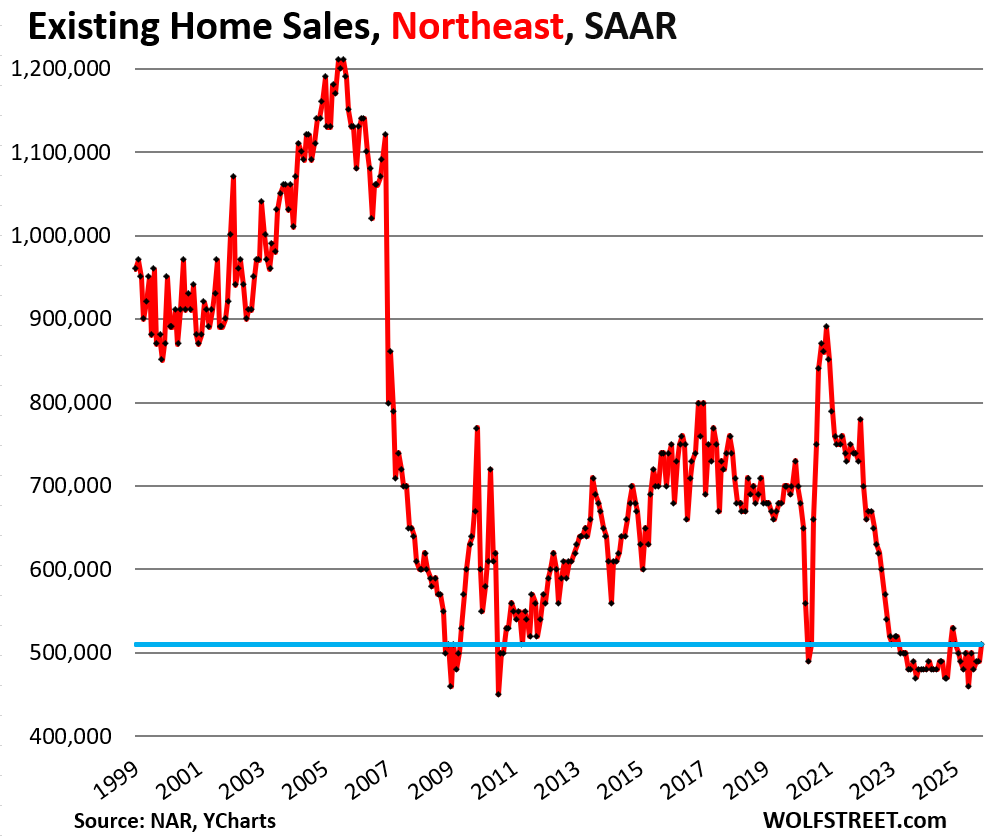
The charts below show the seasonally adjusted annual rate of sales (SAAR) in the four Census Regions of the US. A map of the four regions is at the top of the comments below.
In the West, the seasonally adjusted annual rate of sales remained at 760,000 homes in November compared to the prior month, and was down by 1.3% year-over-year, by 31% from November 2019, and by 27% from November 2018.
In the South, the seasonally adjusted annual rate of sales rose from the prior month to 1.89 million in November, but was unchanged from a year ago, and down by 16% from 2019 and by 13% from 2018.
In the Midwest, the seasonally adjusted annual rate of sales fell from the prior month to 970,000 in November, down by 3.0% year-over-year, by 24% from 2019, and by 23% from 2018:
In the Northeast, the seasonally adjusted annual rate of sales rose from the prior month to 510,000 homes in November, unchanged from a year ago, and down by 27% from 2019 and by 28% from 2018.
Enjoy reading WOLF STREET and want to support it? You can donate. I appreciate it immensely. Click on the mug to find out how:


Here is a map of the four Census regions of the US:
Why are prices still going up in some markets
Some markets are still relatively cheap. Prices there surged too, but from low levels and are still low compared to high-priced areas. I keep thinking about my former hometown Tulsa, which had been through three decades of a housing depression. Obviously, incomes are a lot lower too in those areas, with far fewer opportunities. Cities like Tulsa were so desperate that they paid working-from-home people to move there if they brought their jobs with them (with some success). But it seems from some sporadic reporting that not everyone who made that move is particularly happy with it. It goes something like this: “Sure, housing costs a lot less than in San Diego, but…”
Wisconsin’s economy is supposedly still in expansion. I guess that coupled with relatively low unemployment has allowed it to continue….for now. That said, I sure as hell am not buying. 😉
If only we lived in a free market-based economy the shrew and patient among us could benefit from what in a rational and non-manipulated market would be a good opportunity in a few years or so.
But since we live in a world in which all asset charts must always go up by any means necessary (see Wolf’s last article) we will see manipulations and schemes* to keep this economic flaming box of turds barreling down the road.
The result?
Inflation out the wazoo!!!
* free government downpayment assistance, FFR bullied down to 1% (or lower), stimulus checks, 50 year mortgages, etc.
The housing market in lock down is the end result of the Government and Federal Reserve policy manipulating the natural interest rates and money markets
There are two charts of SF Wolf, where one was supposed to be condos and coops.
Yes, thanks!
Just kick the television hard. This stuff tends to right itself eventually. And now, another episode of Keeping up with the CarCrashians.
Your very first phrase – “Single-Family Home Prices Barely up YoY” is all we need to know that there is MASSIVE manipulation going on.
Home prices should be falling like a rock, instead we have price levitation that would make a master magician jealous.
(And yes, I do read many of your articles. I’m aware that prices are falling by minor amounts in some areas).
The first chart that shows volume of sales, show we are at “bust levels” for 3 years now.
But the same chart show that in the Great Recession, after 3 years of low volume of sales, that the volume rebounded.
Based on the Great Recession, volume of sales should be rebounding soon. If consumers start to fear inflation, that could be a big motivator to jump in a buy sooner, rather than later.
IMHO, the USD dilution from the coming Debt Crisis (which will result in devaluation of the USD by at least 90%, of not 999%, will result in huge prices increases in everything.
Homeowners with below 4% mortgages are doing everything they can to not have to sell their home, so they won’t have to buy another one with a 6-7% mortgage. This keeps them off the market, both as sellers and as buyers, and they have been very slow to return to the market (“lock-in effect”), which is one of the reasons why demand/sales are so low. I document the progress of them returning to the market here quarterly:
https://wolfstreet.com/2025/09/29/the-lock-in-effect-and-mortgage-rates-update-on-unwinding-a-phenomenon-that-wrecked-the-housing-market/
Yeah, prices came down much more in 3 years during the housing bust than in the most recent episode. As many people have said, this is most likely going to be resolved by 7-10 years of slight price decreases than by 3 years of steep ones.
I live in the Northeast; and looking at the sales volume in the 1999-2005 years compared to now is incredible to see. Hard to believe there was that much volume of sales at one point.
The Federal Reserve didn’t “make a mistake” — it detonated a housing bomb. Near-zero interest rates were not some noble emergency tool; they were an open invitation to speculation, leverage, and greed. Anyone with a freshman-level understanding of economics knew that 2% money would blow a massive asset bubble. They did it anyway.
Then they poured gasoline on it by letting hedge funds and private equity storm the single-family housing market — crowding out real families with cheap institutional capital. That never should have been allowed. Single-family homes are not trading desks, and houses are not derivatives.
The result? Prices disconnected from reality, buyers panicking during COVID, and people overpaying for homes that weeks earlier couldn’t meet asking price. The Fed claims it couldn’t see this coming. That’s nonsense. This was the inevitable outcome of reckless policy and moral hazard.
Now, after inflating the bubble, they slam rates higher and pretend they’re firefighters instead of the arsonists. Regular people are left holding the bag while Wall Street walks away with the gains. That’s not bad luck. That’s policy failure — and accountability has been nowhere to be found.
Forgot to ad- END THE FED. If a central bank must exist at all, it should be limited to true emergencies — yet it usually creates the emergency. Artificially low rates aren’t stabilization; they’re market manipulation.
A free market would produce a real interest rate based on actual savings, risk, and time — not a committee guessing with broken models
Lol. Part of the reason major crises and crashes happen about every 80 years is that we eventually forget why we put in place certain fixes, and what happens when they go away.
I’m not eager to return to a world with financial panics every decade (as was the case in the 1860-1910 period).
There is NEVER any single interest rate in any economy, and the array of rates are based on DURATION and RISK and are established by the largest bond market in the world in the US, namely the US Treasuries market which is the epitome of free markets.
In the US about 40% of the population live in towns with less than 50K people and about 27% in rural areas with less than 5K. The rest live in large and small cities. In Italy and in Germany the situation is about the same. In France, Austria, Croatia, eastern Europe and Russia more people live in small towns and in rural areas. The situation is inversed in China, India and a few cities in South east Asia.
Existing Home Sales Bubble #2 existed in the south and the midwest. Both deflated. There was no Bubble #2 in the northeast and the west. Both decayed.