
Three-month average job creation dips into negative for the first time since 2020, per ADP data.
By Wolf Richter for WOLF STREET.
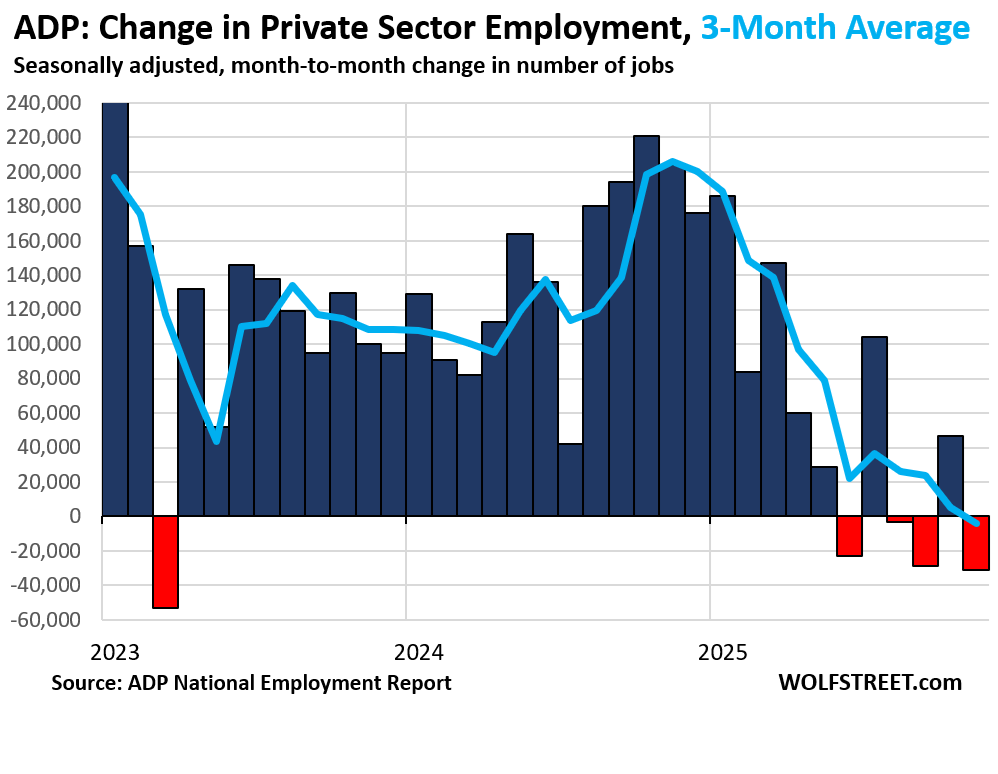
According to ADP today, based on data from companies whose payroll it processes, the private sector lost 31,000 jobs in November. But it revised up its October job-creation figure to 47,000 additional jobs, from 42,000 originally reported.
The declines in August and September were due to the annual adjustment for the 12-month period through March 2025, to benchmark ADP’s data to the Quarterly Census of Employment and Wages (QCEW) data released by the Bureau of Labor Statistics in September. These adjustments were not related to employment in August and September, but to employment through March 2025. The annual adjustment had turned the small growth in September (+11,000) into a job loss (-29,000). And it had turned the job growth in August (+54,000) into a job loss (-3,000).
Those adjustments would not be a big deal in a job market with lots of employment growth and would get lost in the month-to-month squiggles. But employment growth has been weak in recent months. And so these adjustments knocked those two months into the negative. The three-month average (blue line in the chart) turned negative for the first time since August 2020.
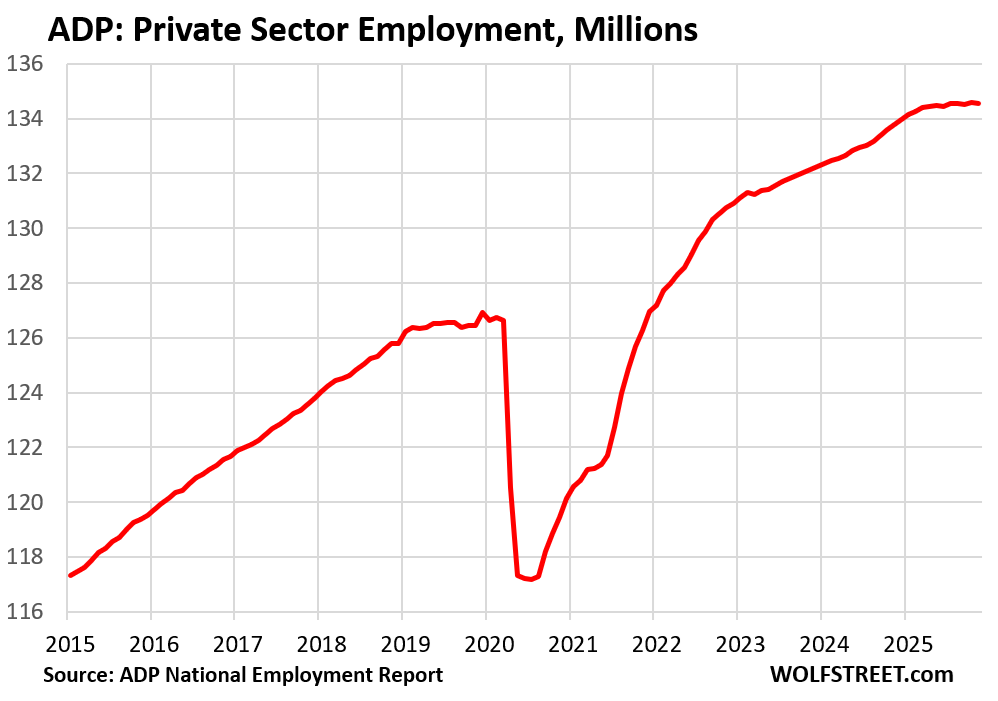
Total private-sector payrolls declined to 134.55 million in November, from the record in October. Compared to a year ago, total payrolls were up by 747,000.
The chart of private-sector employment shows the trend: Job growth continued in 2025, and the number of jobs rose to a record in October, but that growth was slower than in prior years.
- Year-to-date 2025, jobs added: 571,000
- Same period in 2024, jobs added: 1.46 million.
Median wages increased year-over-year for:
- “Job Stayers”: +4.4%, compared to +4.7% a year ago. Since April, year-over-year increases have been +4.4% or +4.5%.
- “Job Changers”: +6.3%, compared to +6.8% a year ago and down from +7.1% over the summer.
The wage data from ADP is based on a subset of 14.8 million workers employed for at least 12 months, whose paychecks ADP processed.
Employment by category:
Total payrolls by major industry in millions, month-to-month change (MoM) and year-over-year change (YoY).
Enjoy the month-to-month changes with a grain of salt. They’re just up-and-down squiggles in the data. Look at the charts to see the trend.
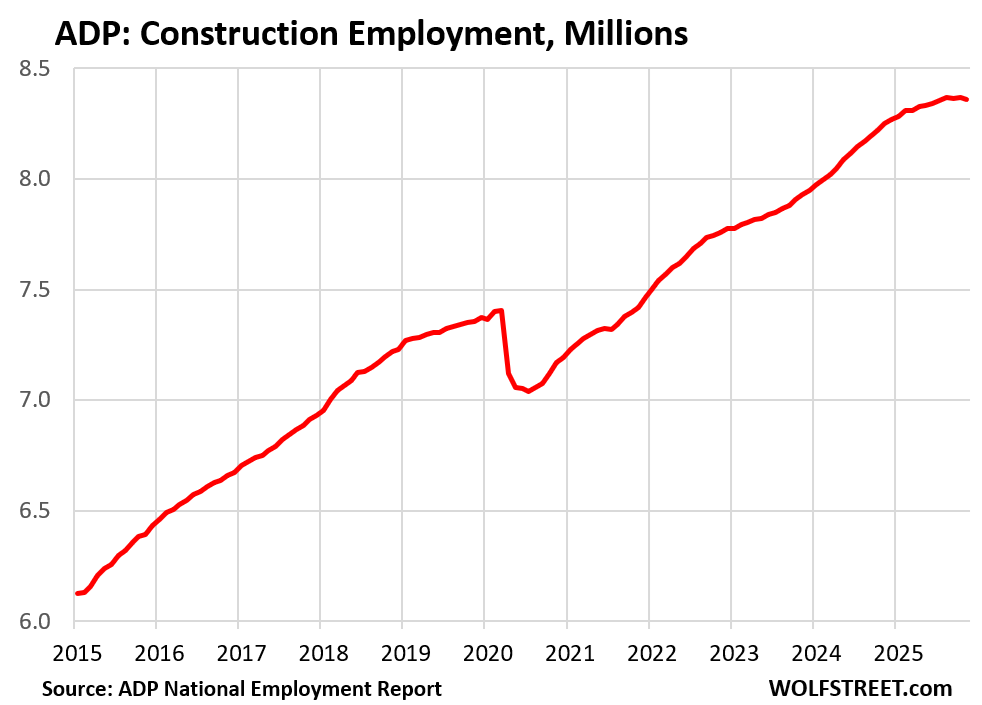
Construction:
- Total jobs: 8.36 million
- MoM: -9,000
- YoY: +109,000
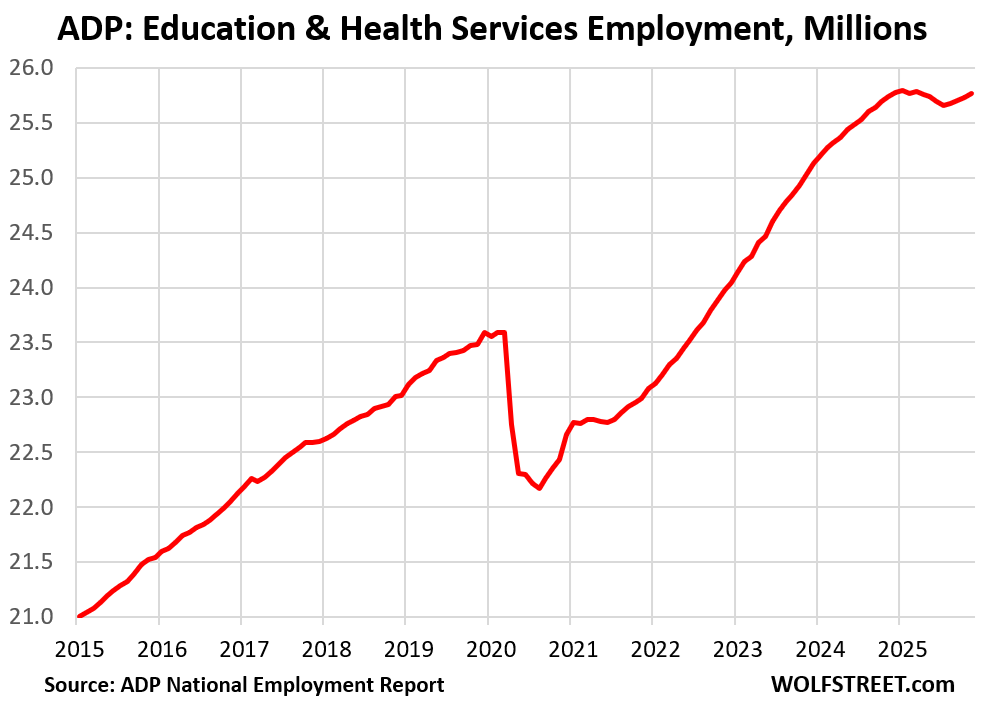
Education and health services:
- Total jobs: 25.76 million
- MoM: +33,000
- YoY: +20,000
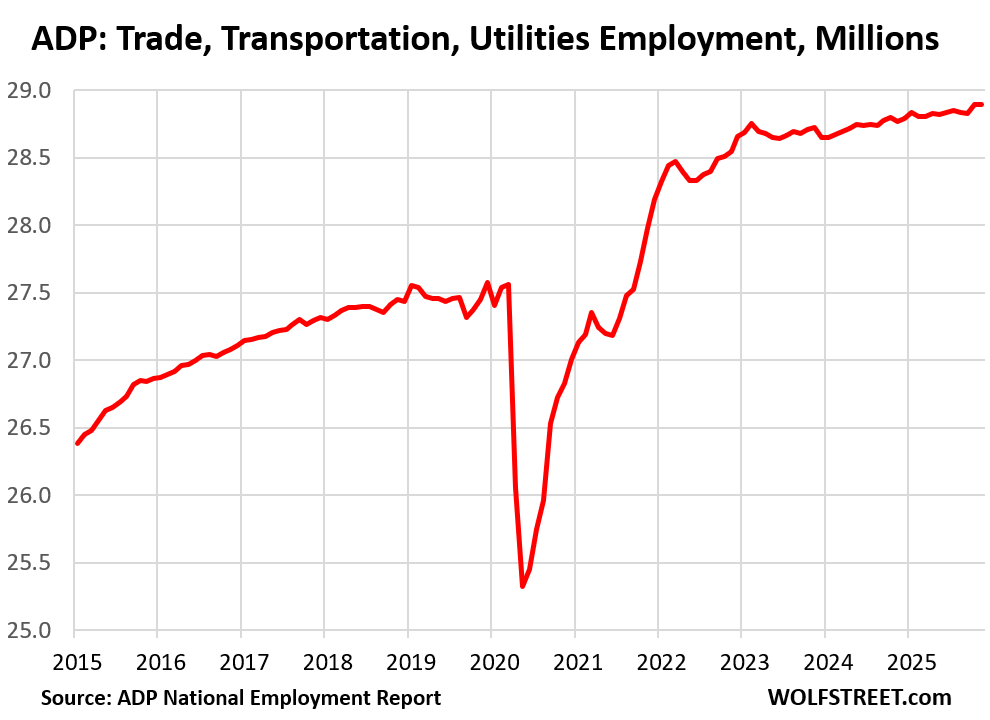
Trade, transportation, and utilities:
- Total jobs: 29.90 million
- MoM: +1,000
- YoY: +127,000
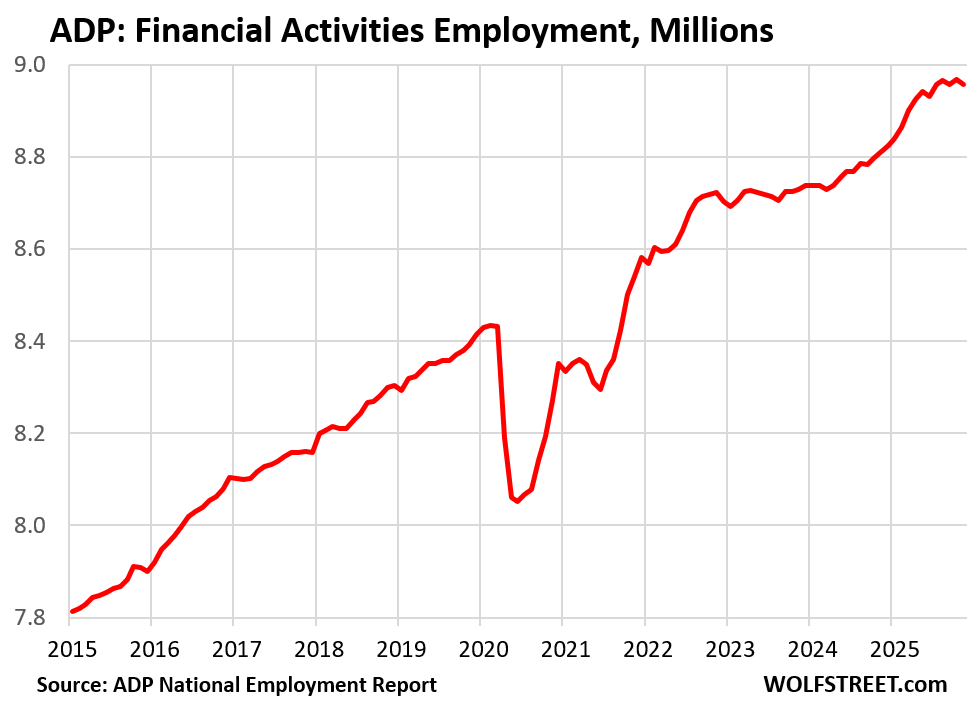
Financial activities:
- Total jobs: 8.96 million
- MoM: -9,000
- YoY: +146,000
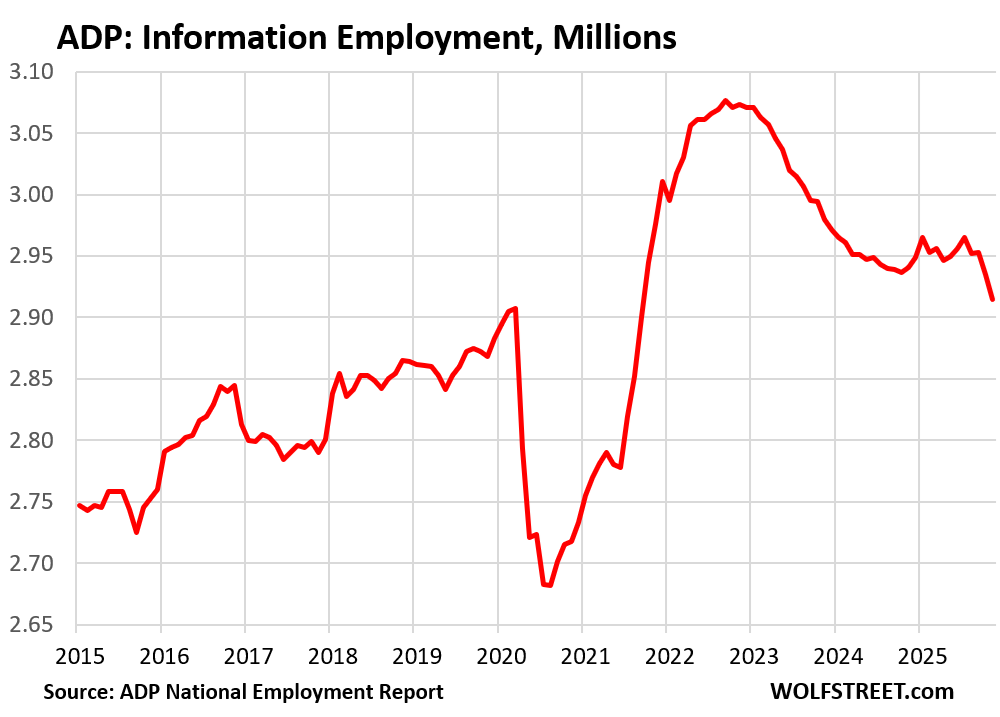
- Total jobs: 2.92 million
- MoM: -20,000
- YoY: -25,000
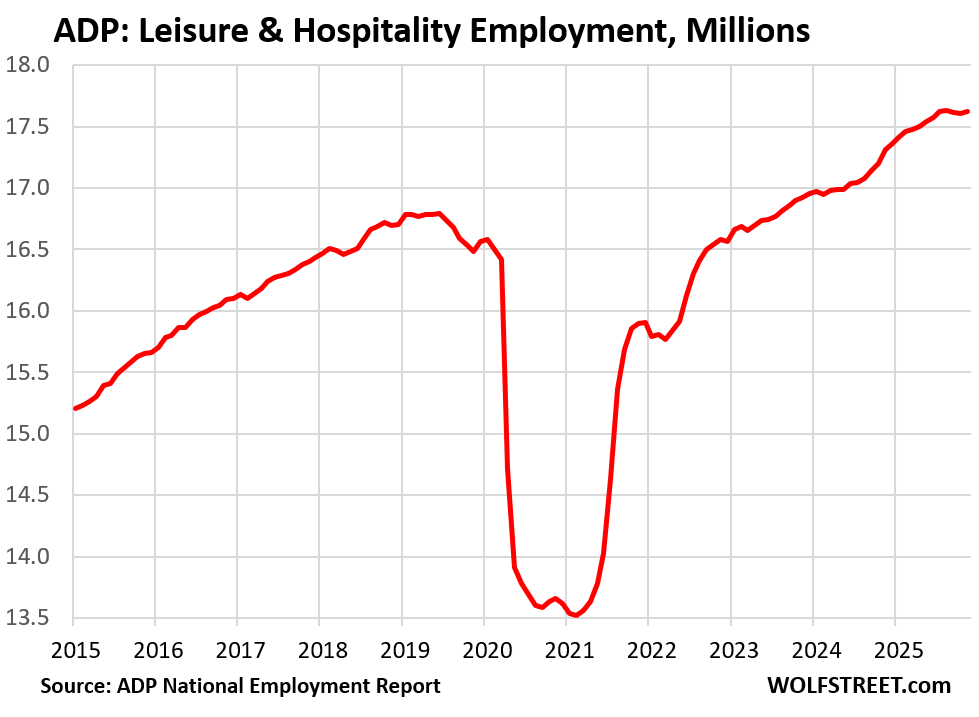
Leisure and hospitality:
- Total jobs: 17.62 million
- MoM: +13,000
- YoY: +305,000
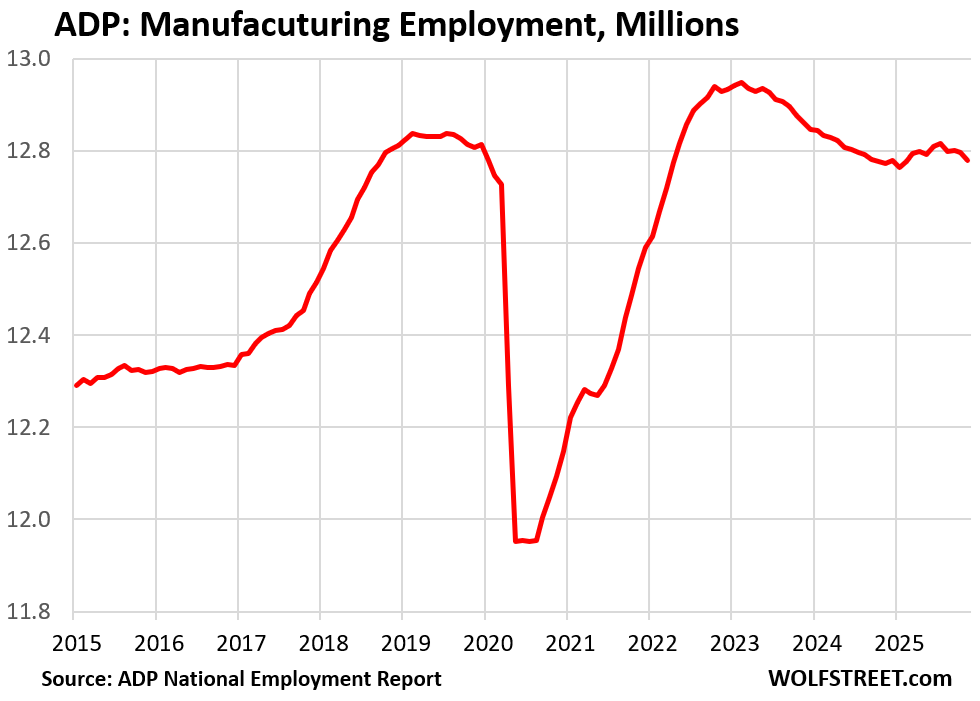
Manufacturing:
- Total jobs: 12.78 million
- MoM: -18,000
- YoY: +7,000
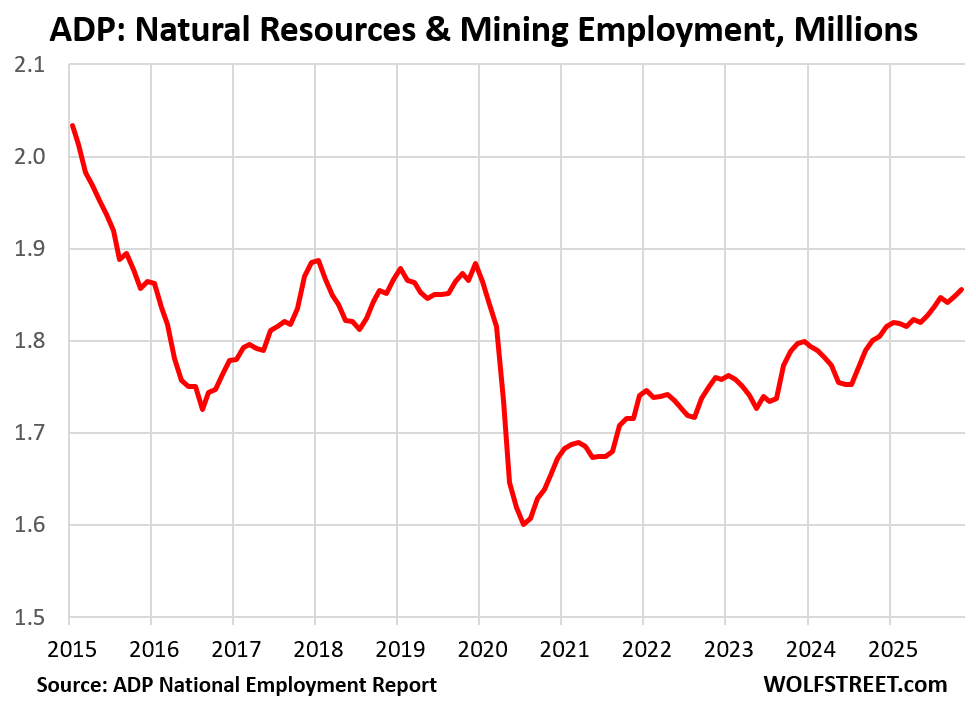
Natural resources and mining (incl. oil & gas):
- Total jobs: 1.86 million
- MoM: +8,000
- YoY: +51,000
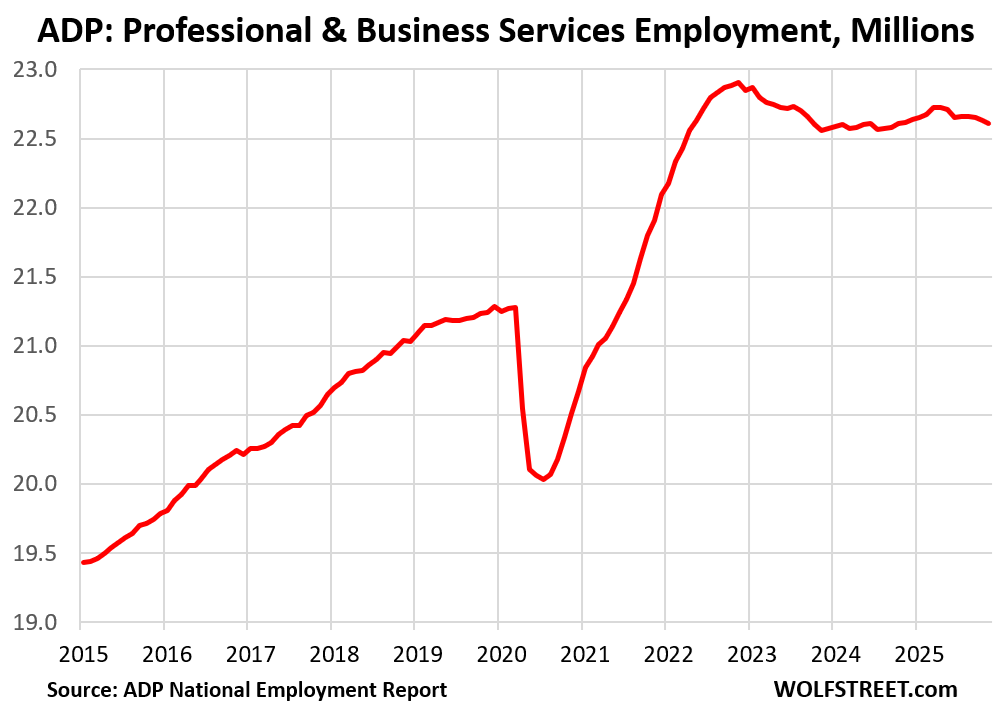
Professional and business services:
- Total jobs: 22.61 million
- MoM: -26,000
- YoY: +11,000
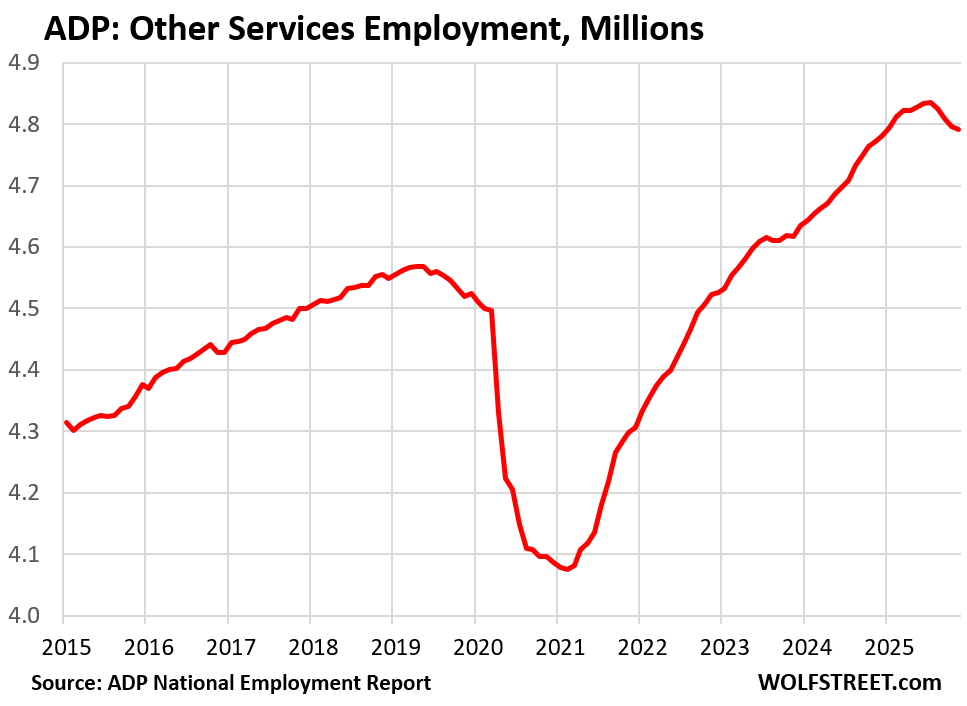
Other services:
- Total jobs: 4.79 million
- MoM: -4,000
- YoY: +20,000
Enjoy reading WOLF STREET and want to support it? You can donate. I appreciate it immensely. Click on the mug to find out how:


Interesting that median wage increases for both stayers and changers seem to be beating inflation.
I’m in a sector with rare raises, so seeing the median wage change for job stayers always hurts a bit.
They’ve been beating inflation for a couple of years. But during the big inflation spike (2021 through mid-2022), they both fell behind and it took a while of big wage increases for both to catch back up.
This is why people are so pissed off about inflation: they got big wage increases, which made them feel good for about two seconds, and then they realized that they’re just catching up with price increases, which pissed them off.
There is also the split between older workers late in their career who get smaller if any wage increases, and younger workers early in their careers who move from job to job and get bigger wage increases. Some of the older workers never got enough wage increases to catch back up, and other job opportunities are limited or non-existent for them (due to agism). It always plays out like that. Maybe it used to be even worse some decades ago.
Here, for what it is worth, is one data point about the old days. I started work for the IRS as a newly graduated lawyer at the beginning of September, 1968. My starting salary (as a GS-11) was $10,203. (I left for private practice after four years.)
Someone hired at the GS-11 grade in September 2025 got a starting salary of $84,601.
The August 1968 CPI was 35.0. For August 2025 (57 years later) the CPI was 323.976, which is 925.6% of the August 1968 CPI. If the increases in the GS-11 salary had exactly tracked the CPI it would have reached $94,444, 11.6% higher than the actual current GS-11 starting salary,
Also, as regards fringe benefits, the old Civil Service Retirement System that was in place in 1968 was much more generous to Federal employees (and more costly to the Federal Government) than the current FERS system that was implemented in 1987.
Also the CPI vastly understates the true cost of buying a home because it has changed to an owners equivalent of rent measure that is disconnected from home buying. If you were living in the DC area in 1968, I would hazard a guess that the home you bought in 1968 has appreciated at least 20 X. In Coastal CA, probably 50 X.
I retired from the open pit mining industry,
Our plant pumped out 700 tph.
Base rock, Sand, Crushed rock and Contrete aggregate.
Durying slow times We kept plugging along building up Our stockpiles.
Our customers were State, Federal and private sectors.
It was a pretty good recession proof industry.
The Minnesota Iron Range has had one of it’s longest runs in recent history without any major shutdowns. High paying jobs for the area, but the whole region is used to the boom and bust cycles that come with it.
Most iron mines are now sitting on several years worth of pellets however. It will be interesting to see if they can sustain this pace if there is a downturn. Locally it is felt hard when they do big lay-offs, but nationally it barely moves the needle.
In 2024 or 2025, how “elevated or suspended” are the job statistics, from government over spending? (deficit spending, that buys GDP from the future with IOUs and compound interest).
Interesting about manufacturing jobs, which is a ~$1.1T “goods” trade deficit issue. As even with tariffs, the jobs so far are not coming back. Automation? Tariffs still to small vs cost of operating in usa? Challenged to give up offshore tax haven benefits? No interest (from China, EU, USA)? Government deficit overhang?
All manufactures always every day try to reduce the cost of labor by improving processes, designs, automation, etc. They always strive to produce more with fewer workers. No successful manufacturer in the US does sweat-shop labor in the US. Some plants, such as semiconductor plants have relatively few employees, and those they have are largely tech people (there is a boom in semiconductor plant construction right now). There are not a lot of workers in a plant that manufactures chemicals, which is a huge industry in the US. Same with packaged foods, pharma products, etc. New steel plants have relatively few employees. There used to be 50,000 workers at an auto assembly plant way back; now there are 3,000, and those vehicles are a lot more complicated to build. People have to get used to that. The time of sweatshop labor in the US is long over. Manufacturing jobs today are mostly higher to high-skill jobs.
Wolf, to add to your reply, look at this Texas-based audio manufacturing company’s newest product. It is a headphone amplifier, and pre-amp, that can be combined (as an option when ordering) to include a built-in DAC and a Bluetooth interface for you to control and monitor its operation via an iPhone or iPad (soon to be usable with an Android device too, but that’s been a challenge).
From their website:
“November 12, 2025, San Antonio, TX. Today, Schiit Audio introduced Jotunheim 3.”
“Jotunheim 3 also has the distinction of being the first product made 100% on Schiit’s in-house SMD line in Corpus Christi. Schiit’s wholly-owned, captive robotic assembly line gives the company greater control of its production, higher quality and exceptional flexibility for the future.”
“Schiit designs and produces its products in the USA.”
Wolf, this is exactly like you say, “All manufactures always every day try to reduce the cost of labor by improving processes, designs, automation, etc.”
Schiit? Is that name serious? The ad campaigns should be hilarious.
Aaron,
Yes, that’s the name. They have been in business since 2010. The company was started by two audio engineers, one with digital expertise and one with an analog background.
I searched their website for employment, it said “Schiit jobs available”, and I thought to myself that I already have one of those!
Looking at the trends as you suggest, interesting that ADP shows Education and Health Services to be essentially flat YTD while the Sept BLS release shows Healthcare and Social Assistance and Local Government (Largely Education per your note) to continue a linear increase.
Overlaying your two plots, the total number of workers in ADP Education and Health Services category is about 3M more than BLS Healthcare & Social Assistance and both tracking very similarly up through 2023, then ADP slowed more in 2024 and is different as noted above in 2025.
ADP’s “education” is private-sector education and does NOT include employment in public schools and universities.
May matter somewhat less for ADP “education” (but whither state funding for approved private charter schools?) but the “private” health care sector sees approx 50% of its revenues come from government funding (medicare, medicaid, etc.).
G spending permeates well more than just the explicit Federal, State, and Local employment categories (Fed paid “private” contractors are another very large group that aren’t going to be officially listed as “government” employees…even though that is who actually funds their paychecks.)
Before the shutdown, ADP reports were often dismissed as not particularly important, especially when compared to the monthly BLS employment numbers. Now initial BLS data is also suspect, although the revisions are probably okay. The fact is we don’t really know WTF is going on in the labor force. Maybe after the first couple of BLS revisions, a couple of months from now, we can say something useful about it.
The only reason I’m posting the ADP reports is because there have been no BLS reports. Note the massive revisions in the ADP data in Aug and Sep. And more revisions every month since.
ADP process 15 million payroll checks. ISM rings recession alarm at 42.3%, not at 50%. Values > 42.3% indicate expansion !
Wait a minute. ISM says the OVERALL economy generally goes into a recession when the MANUFACTURING PMI drops below and stays below 42.3%. That’s because SERVICES are the biggest part of the economy, and they keep growing. So manufacturing has to go into a deep funk to pull the overall economy into a recession.
ISM manufacturing PMI signals contraction for MANUFACTURING when below 50 and expansion for MANUFACTURING when above 50.
News says ADP terminated it’s data sharing agreement with the Federal Reserve, so hopefully their gloom and doom won’t affect the Federal Reserve FOMC. President Trump is getting the BLS straightened out on their data reporting. Perhaps a call from President Trump to ADP like the one to Bezos of Amazon on the tariff cost website is appropriate. Doesn’t seem patriotic to have ADP reporting gloom and doom that may contradict the Government’s official data, since ADP’s job is to process payrolls.
The Fed still gets ADP data. What it doesn’t get anymore is the detailed weekly data that was not available to the public.
Patriotic?
What does patriotism have to do with reporting of the economic data.
The BLS is getting straighten out? Or is it getting patriotized lol
Just like inflation, you can not lie to people about the job market. They will see the prices they pay and they will see job expansion and opportunity or they will see no opportunity and people getting laid off.
It is what it is no matter how patriotic you want to feel…SMH
You are suggesting a company doesn’t get to say something (truthful or otherwise) that contradicts the narrative of party in power? First amendment much…
Since information employment is on its way down maybe we can shift all that H1B talent to mining. Surely there is just no talent in the USA and according to our politicians who have been speaking about this for decades there is no solution they possibly could have implemented over the decades
In the 1970’s we had: car, oil, nuke, aircraft, shipbuilding, underwear, shoes, men suits, jewelry industries… Today we produce more with less industries and less workers. The peak oil of the 70’s didn’t materialized. Within a few years we will add more industries with their satellites: small, mid and large businesses, producing higher output with less workers, with no oil import.
In a normal year, I would expect to see some seasonal hiring for the Xmas Holiday. I am also hearing truck drivers complaining about smaller loads. Even if everyone was buying online, someone would still have to get merchandise from the manufacturer to the location where the orders were processed.
The USA Gov. Bureau of Transportation Statistics reports:
“The September 2025 Freight Transportation Services Index (TSI) Fell 2.1% from August 2025 and Fell 1.2% from September 2024 while the Passenger Index also Declined”
Thursday, November 13, 2025
whatever. But retail sales over Thanksgiving were hot. Cyber Monday sales were up 7.1% from a year ago (Adobe Analytics).
“retail sales up?”
Were more widgets sold this holiday season or did the price of widgets just go up,thus higher dollars numbers in sales?
1. Many prices of goods actually FELL, including big-ticket items, gasoline, many others. So sales would have been higher if those prices hadn’t fallen.
2. Most of the inflation is in services, not goods. But retailers (“retail sales”) don’t sell services, they sell goods.
3. I have been discussing this endlessly in my articles.
4. overall consumer spending, adjusted for inflation, rose 2.1% yoy, as per today’s data… that’s AFTER inflation. Before inflation adjustments, consumer spending jumped by 5.0% yoy.
5. I understand that some people cannot wrap their brains around the concept that Americans make a lot of money and spend a lot of money, and that both are rising, and rising faster than inflation, and record employment and record high wages. This nonsense that American don’t have anything, and cannot afford anything, and are all living in cardboard boxes just refuses to die. Which is why people who’re hung up on this never really understand the economy and are always surprised by it.
One factor not yet fully appreciated is that warehouses are now more closely embedded into large metro and suburban areas, which reduces some of the delivery costs reported for same day/overnight deliveries. I ordered a set of pens the other day at 10AM and they were on my front steps at 1:00, delivered by an non-uniformed guy in a Toyota. I still get regular deliveries from the regular Amazon, UPS and Fedex guys, but these one-offs seems to be happening more and more.
Any way of knowing the manner in which employment is dropping? Is it forced layoffs from the company? Deportation of illegals (which must surely impact the construction trade)? Good old fashioned attrition?
1. ignore the month-to-month squiggles. That’s just data noise. Look at the trends.
2. Layoffs are historically low. We see that in the initial unemployment claims, which are low.
3. But hiring is slow too in many industries. So in industries that actually had a decline this year, most of that is from attrition and slow hiring.
4. Some industries, like construction, are impacted by the crackdown on illegal immigration, which is probably one of the reasons growth in construction jobs has flattened out over the past six months. There are labor shortages in part of the construction industry. That’s not a sign of weak demand but weak supply of labor.
Brad, as per https://layoffs.fyi/ – IT is particularly hit hard from layoffs in aggregate over the last 3 years (inclusive of 2025) and hiring has slowed a lot. I can’t say what’s the story about other industries.
Layoffs.fyi like Challengers doesn’t give you the number of people these companies with announced layoffs have hired.
They both count public layoff announcements of companies with global employment, and those layoff announcements are for for jobs around the globe, not just the US.
I go into this here:
https://wolfstreet.com/2025/12/04/low-fire-low-hire-job-market-after-massive-overhiring-by-big-tech-others-in-2021-2022/
Real Estate agents here in the Swamp are out of work. There are no properties going to settlement except distress sales, estate sales, foreclosures, divorces, fire sales etc. The government shutdown took the market down for 6 months or longer. We took off the month of December. The last property we appraised was an estate sale where the property was vacant for 4 years, except for squatters and looters who took everything in there that was not nailed done. We got sick from the mold. The original owner was an Air Force Officer who was killed in a head on collision by a drunk driver in 2021. Very sad.
I hope the PhD that I have got in
Burger Flip-ology won’t be made obsolete by AI.
Got my postgraduate from Harvard.
If your job doesn’t require physical presence, AI can do it.
That’s not really a factor, jobs requiring physical presence have if the anything been replaced at a much higher rate over years and years due to automation, which just another form of AI that’s been around longer. (There’s nothing new or special about AI, it’s been around for decades in some form or another) China has entire dark factories with physical work done by advanced robots, though surprisingly, employment and jobs have increased due to more technical tasks involving the robots with higher salaries. OTOH plenty of other “knowledge” jobs not associated with physical presence–despite all the hype with the AI bubble, the actual agents for AI don’t replace people, if the anything they cost more and make things even worse for companies that over-rely on.
And jobs are created to fix the mess the AI makes when it starts to hallucinates, and subtle errors start to build up and things start to break. We’ve been seeing the same pattern constantly in companies we work with, they start off excited about the AI agent, start to lay off staff thinking they save labor “costs”. Only realize to their horror in later months, they’ve spent thousands or even millions on fancy AI agents, only to realize later the AI has started to hallucinate or make tiny little errors that seem small but build up. Then when things break, they’ve laid off the people who know how things work, data and documents or coding base contaminated and it’s too late to fix. Several went belly-up from this. What’s unique about AI, it’s first tech in human history, it gets worse with new and more advanced forms of the tech, due to nature of the current form of AI getting all the VC and investment bubbles and now, circular deals between Nvidia, OpenAI, Oracle and other companies. Because as the AI grows bigger and more parameters for train and inference, it starts to take in less and less quality data, also more inaccurate data and “learns” on the wrong things.
Often even worse, training on previous AI outputting and pure synthetic slop, and just regurgitates it up even worse. And now the AI researchers are showing there’s no engineering fix, it’s basic to structure of the AI and even scarier, even a tiny amount of bad data, a fraction of a percent will basically contaminate the AI so the model breaks down, even worse for any kind of AGI. So the ugly conclusion is all these billions being shovelled into AI just ensure its doom, they’re running out of fresh good data to train the models, and the extra billions are actually making the new AI even worse and vulnerable to breakdown. The slop from AI is like the weeds of the Internet that choke off good content, unfortunately soon enough, they also choke off the model itself. AI works best for careful defined, limited applications where the AI has been special trained, that’s why the open-sourced AI with specialty applications work better. But Silicon Valley messed up by way over-promising on what the AI could do and obsess over generalizing the AI for things that don’t work for actual business, trying to use the AI to attack jobs and failing to focus on more limited, but productive tasks where the AI can work better. And that like so many other things, is result of the Fed and bad fiscal policy in the US pushing easy money, ZIRP and QE and speculative bubbles, that went way out of proportion with actual ROI that just isn’t there for the bubble valuations that took hold.
That makes sense. So I think of it as you can suddenly have dumb AI or chronic mental health problems AI or conspiracy theory believing AI or lying AI, etc.
Thank you, Miller , for your knowledge and opinions regarding this current buzz world, AI, LLM, etc., and others you have posted here !
I, for one, hope you will continue to post on what we (in this case the family we, call ”Wolf’s Wonder” possibly the most honest and clearly most helpful source for us old retired folx trying to keep up with the continuing degradation of our savings and income.
Glad for helping with what I can, I’m by not any means an expert and not anti-AI, like said I find a lot of the new tech useful and cool for limited and specialized uses. What I can’t stand is all the dumb hype of the AI bubble and the extreme malinvestment pushed by Silicon Valley tech bro’s with outrageous over-promises and expensive data centers that ruin whole communities and force up bills, all for the sake of just making more AI slop that eventually ruins even the AI models themselves. All on this fed, by results of the Fed’s stupid ZIRP and QE policies. It’s the very worst kind of corruption by speculation and billionaire arrogance with little care for the damage they’re doing or the society that that makes their wealth possible, to point of corrupting fiscal and monetary policy itself.
Miller-…addressing well what seems to me Kurzweil’s hubristic fallacy in predicting/desiring the advent of some sort of human/machine ‘singularity’ to cope with the (as far as I understand it) fact that inorganic/digital AI can’t possess or adequately address the necessity for the spacecraft’s broadbased organic-species’ DNA ‘institutional memory’-proven evolution in adapting to the vast, dynamic, and constantly-changing, analog universe it actually lives and travels through…
may we all find a better day.
Don’t be so sure about that.
“AI” is not true intelligence, and cannot be trusted. It’s more a super lookup engine. I find it does amazingly good translations of WWII Japanese-language historical documents, but makes brain-dead errors on some fairly simple math problems. And major errors on some historical matters, like putting the words of one personage into another’s mouth. Or giving as a reference a plausibly titled article that in fact does not exist. This follows quite naturally from the fact that the basis is LLMs — “Large Language Models” — enormous matrices of statistics of what is the most frequently encountered word following the sequence of some number of preceding words. It doesn’t really understand anything. It’s useful for churning out rough drafts, but you need to double check its work.
https://arstechnica.com/ai/2025/12/microsoft-slashes-ai-sales-growth-targets-as-customers-resist-unproven-agents
I think the win for AI will be when it is customized for each objective.
In specialized fields, it will be trained on a company’s own data, rules, and knowledge base, reducing the risk of hallucinations and ensuring domain and company-specific relevance.
Yeah that’s one of the things finding most unfortunate about the way the AI bubble got over-hyped, there actually are some cool things AI can do in specialized areas, both the newer AI and earlier research years ago. Like a more flexible tech tool for looking at design flaws in a building beam or in structure imaging. But the Silicon Valley tech bro’s ruined it because got so arrogant and greedy with the over-promises to sucker investors into 100’s of billions of dollars more, picked maybe the worst pitch-line in business history (you can use it to increase layoffs), applied it in places it doesn’t work and make things worse (all the AI slop weeds that ruin good Websites and anything with creative work or collections–dead Internet), over-focussed on the race to AGI hype (always a dumb idea because by design that would be uncontrollable and mess up any actual business use), then began pushing and forcing expensive data centers on communities that never wanted them with higher utilities bills and ruined water tables. A lot of them are smart guys but have no social sense or how to relate to people, or how they ruin their own ambitions by ignoring and insulting communities. So they’ve poisoned any real prospects of good AI tech catching on especially in the US.
Already throughout the United States now in just about any region, the surest way to anger your community and get kicked out of public office (and then ruin your career in anything else you used to do, since now you’re on record being clueless about reading the public room) is to support an AI data center. Those things are hated everywhere because the big companies and AI tech bro’s insisted on using NDA’s and often some shady and hidden deals and zoning, forcing the extra power costs on the locals to pay for the extra electric and water usage even though many are billionaires, running wells dry and often polluting the air and water. It didn’t have to be that way if the AI hypesters had instead, talked and listened more to communities concerns, prevented extra costs for local utilities and strain on their grid, focussed more on isolated areas and just in general be less arrogant. Not to mention like you said, the most useful AI’s are going to turn out to be the smaller and focussed ones that don’t need so much power at all, just trained to do specialized things without delusions of grandeur of AI tech bro’s. Instead we have the biggest bubble in American history, set to take down the whole US economy with it, even in 50 years with most ideal assumptions there’s not enough ROI for the costs. Better to do it sooner than postpone the inevitable.
Great comment. Aside from all the practical problems with AI, there is the fact that I think a lot of people are tired of “move fast and break things”, and all these billionaire tech bros running around like a bunch of jackasses hyping up every last halfway-novel thing you can do with an algorithm. I don’t use any of these chatbots partly because they always make stuff up, and partly out of principle for what these con men are doing to communities and the environment with their FOMO+debt-driven data center buildout. It’s like crypto all over again. The sooner it crashes the better.
Right on.
Just west of Ann Arbor, MI in the city of Saline a data center is proposed, the utility DTE is trying to ram rod the public service commission, utility regulator, to sign off on plans w/o a public hearing. Small protest last weekend, no resolution thus far.
Battery operated disc cutoff….,fiber optic cables,…..hmmmmm.
The “Great Rotation” of jobs in US will begin to take off. Low paying, BS type, little physical effort jobs will be replaced by low paying hard work jobs. If you want to eat, you’ll have to make the rotation.
There is no way the US can compete with the rest of the world without this. All the inflated cost (and salary) structures will have to decline….slowly at first as has been happening then all of a sudden.
AI is the biggest bunch of hype I have yet to see in my lifetime; and I lived through the .com nonsense. And if the US thinks they are going to compete with China in AI…good luck with that. We don’t have the electrical power and won’t for a number of years.
Perhaps its just as well. Contrary to the comment above about peak oil (NOT), the world is fast running out of cheap, easy to access oil. All of the upcoming international fist fights and takedowns will be about obtaining this diminishing resource for national consumption. If you don’t believe my statement, I suggest you do some solid digging into real reserves in the world. And remember that the world uses 100 x 10e6 barrels per day. So a 100 billion barrel reserve (which sounds like a whole lot) will last 3 years at world consumption rates, as an example.
This might not be politically incorrect, but jobs that can support a reasonable (own a home, have a family, rainy day savings, retirement fund…) lifestyle are becoming more difficult to obtain.
Already, there are about 140M taxpayers in the 0-50 percentile of the income bucket. Not as many in the higher income brackets to support the government spending.
With millions of new workers competing for resources (jobs, housing, government benefits, oil…), the “ideal” American lifestyle will become more difficult to obtain.
It’s not only cheap oil that is in play, but good jobs as well.
If what you say about oil was even remotely true the price per barrel would be magnitudes higher than it is.
What is it, $59.50 at last check.
MW: Jobless claims sink to 3-year low in no-hire, no-fire U.S. economy
“But today’s initial unemployment insurance claims were a doozie that’ll reverse next week.”
Low-Fire Low-Hire Job Market, after Massive Overhiring by Big Tech & Others in 2021 & 2022
A big chunk of people getting laid off are getting new jobs before their severance runs out. Right?
AI isn’t making any money now. 80% to 90% of entrepreneurs who are using the big AI companies code to start platform can’t make money. Meta is betting developers can make money from their lama because they can’t make much from AI. , the hype is high, profits are not! Over 50% of Y combinator grads have been AI enterprises recently, but where are the profits, that’s what we need the little old lady from Wendy’s saying Where is the profit sometimes it’s where are the sales from AI?
Dai – …some might still be posing the same 1990’s questions of the timing of the actual arrival of a general profitability-and-prosperity popularly-promised by the original ‘dot.com revolution’…
may we all find a better day.