
But today’s initial unemployment insurance claims were a doozie that’ll reverse next week.
By Wolf Richter for WOLF STREET.
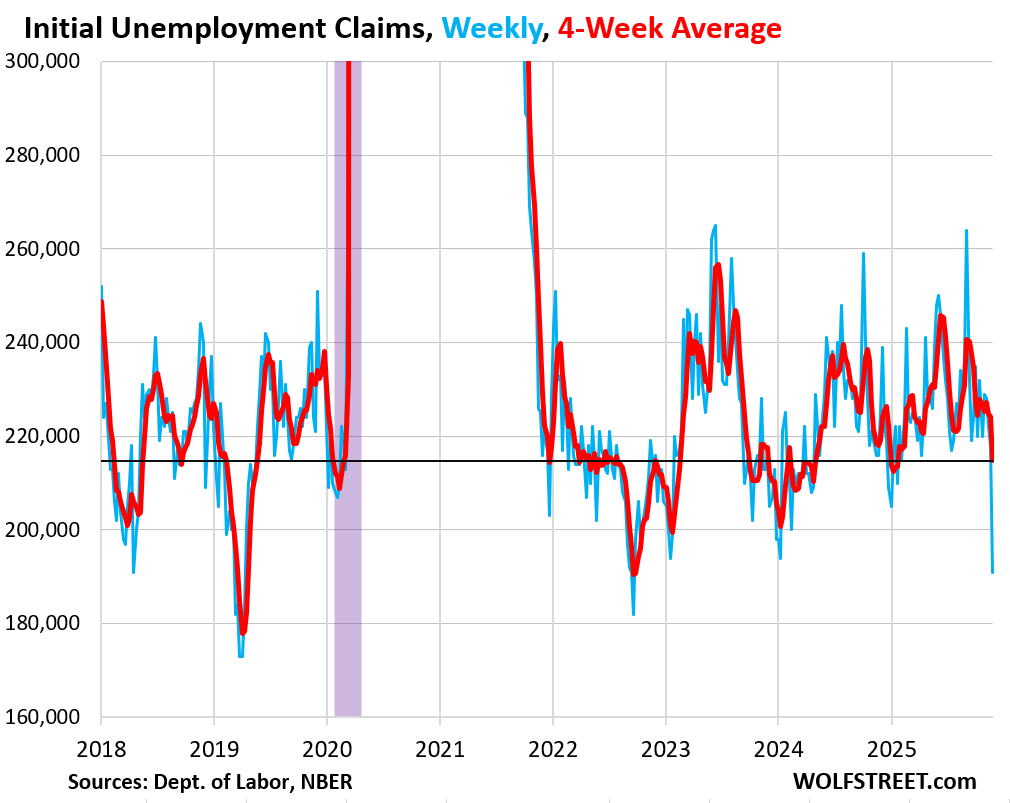
Initial applications for unemployment benefits (“initial claims”) in the week through Saturday plunged from already low levels, in an outlier move, by 27,000 from the prior week to 191,000, seasonally adjusted, the lowest since 2022 (blue line in the chart).
These are applications for unemployment insurance that freshly laid-off people filed at state unemployment agencies, which then reported them to the US Department of Labor by the weekly deadline, which then combined the data and published it today.
Obviously, one or more big states didn’t get their claims data filed before deadline, this having been the week of Thanksgiving, which is what caused this plunge in claims. But that data gets picked up in the next week, and so we’ll see a spike in claims, which will undo part or all of today’s plunge.
The four-week average fell to 214,750, seasonally adjusted, which is historically low, and in the same low range that it has been in for the past four years.
The four-week average irons out the week-to-week squiggles of weeks when deadlines were missed and weeks when the missed data was included (red line in the chart).
In a historic context going back to the 1970s, initial claims are very low, despite the growth of nonfarm payrolls over the decades. They were lower only during the tight labor market of 2018 and 2019 and during the labor shortages coming out of the pandemic.
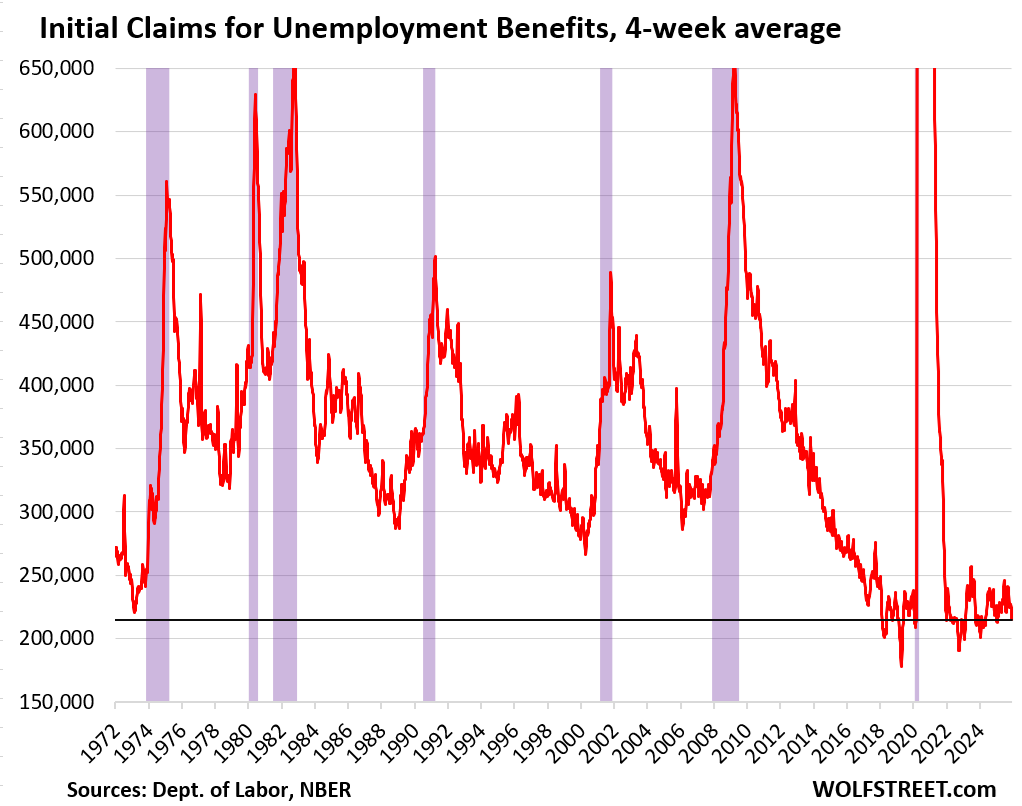
This shows that layoffs are really not a problem in this unusual labor market.
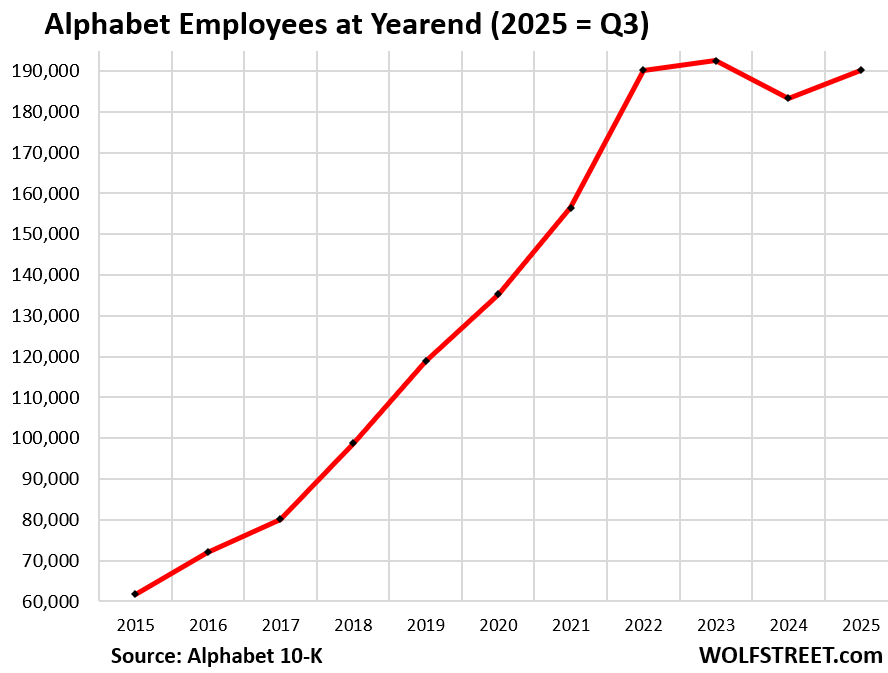
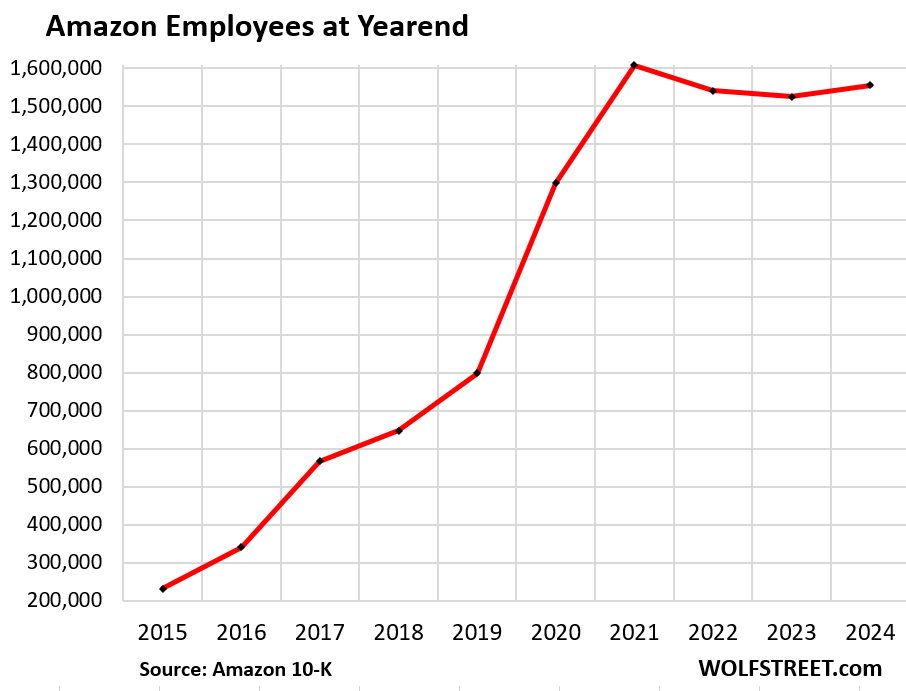
The labor market is showing the effects of overhiring during the pandemic by companies that have since then laid off people and hired people at the same time, which is what Amazon and Alphabet have done, with the net effect that their headcount, after exploding for a few years, has been roughly flat – more in a moment.
And the labor market may be showing the effects of the crackdown on illegal immigration and some tightening up of legal immigration, which reduce the supply of labor and slow hiring.
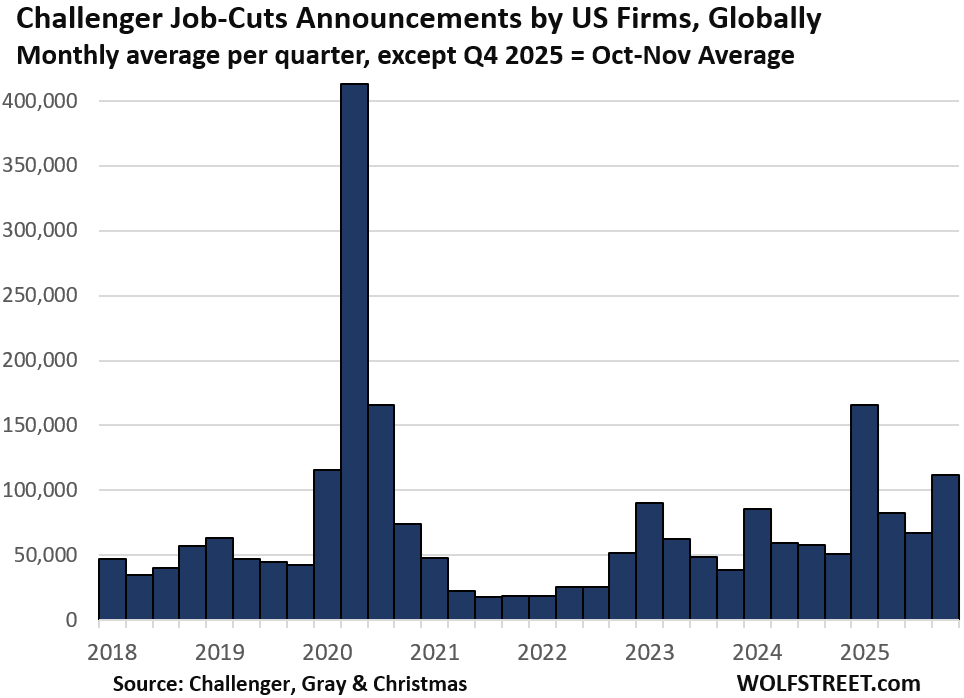
The Challenger Job Cuts Report, also out this morning by outplacement firm Challenger, Gray & Christmas, tracks layoff announcements by US companies of their global workforce. So these are not actual layoffs, but announcements of potential future layoffs globally.
In November, layoff announcements fell to 71,321. The layoff announcements this year were concentrated in February (172,017), March (275,240), and October (153,074).
When Amazon announced in late October that it would lay off 30,000 people of its global workforce – with an undisclosed portion to take place in the US, and the rest globally – it pumped up the Challenger Jobs Cut report to 153,000, even though those layoffs hadn’t happened yet, and not all might happen, and even though only some of the layoffs will take place in the US, and even though Amazon was hiring through the other door.
The chart shows the monthly average per quarter, except Q4 2025, which shows the monthly average of October and November.
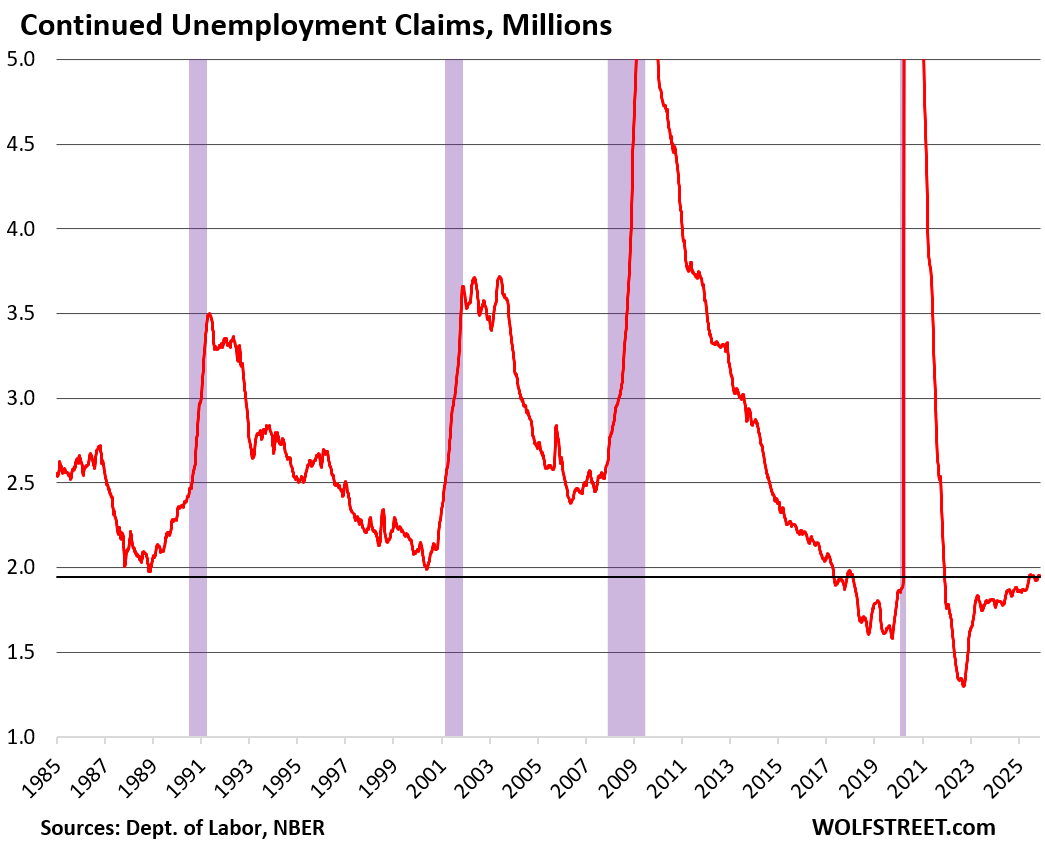
Continued unemployment insurance claims, also released today by the Labor Department, track people who applied for unemployment insurance at least a week earlier and are still claiming unemployment insurance because they still haven’t found a job.
These “continued unemployment claims” fell in the latest week to 1.939 million, the second week in a row of declines, and are down by 29,000 from the recent high at the end of July.
The four-week average dipped for the second week in a row to 1.945 million.

Over the past four decades, it’s only during the tight labor market in 2018 and 2019 and in the years since covid, particularly the period of the labor shortages in 2021 and 2022, that the level was lower – despite the much larger nonfarm payrolls.
It does mean that people remain on the unemployment insurance rolls a little longer than in 2022-2024 and in 2018-2019, but not nearly as long as they did in the decades before 2018.
So layoffs are very low, but once laid off, it takes people longer to find a job as companies have slowed their hiring.
Alphabet and Amazon, along with other tech giants, exemplify this low-fire low-hire labor market. After the massive overhiring during the pandemic, which was in part responsible for the labor shortages during that time, they started trimming some of the excess in some places, starting in 2022, while still adding in other places, and their global headcount has remained roughly stable since 2022, after exploding in prior years.
Alphabet, which discloses the headcount in its quarterly filings, reported 190,167 employees globally at the end of Q3, up from yearend 2024, and flat with yearend 2022.
Between 2016 and 2023, its headcount had tripled! During the overhiring binge in 2020-2023, its headcount had soared by 62%. These are huge increases for big mature companies.
Amazon, which discloses global yearend headcount in its annual reports, had 1.56 million employees at yearend 2024, slightly higher than in the prior two years but below the peak in 2021 (1.61 million).
Though a tech giant, a big portion of Amazon’s employees are in brick-and-mortar retail (including Whole Foods), ecommerce retail, warehousing, and transportation around the world.
Overhiring: In the two years of 2020 and 2021, its headcount had doubled. From yearend 2015 through yearend 2021, its headcount had multiplied by seven! These are gigantic increases.
Since 2021, it has laid off people and hired people simultaneously – though it’s the layoff announcements that get into the news, a time-honored corporate strategy, eagerly spread by the crisis-media, to cow restless employees.
The low-fire low-hire labor market also shows up in employment data where job creation has flattened out: Private-Sector Job Trends by Industry: From Job Destruction in “Information” to Job Creation in “Mining & Natural Resources”
Enjoy reading WOLF STREET and want to support it? You can donate. I appreciate it immensely. Click on the mug to find out how:


Catchy phrase coined to describe the labour market … “low hire low fire”
It’s like the 2019 to post COVID era create eventually massive distortions in the labour market and assets (housing, equities). Wonder if all of this is like Wylie Coyote a few meters from the cliff edge?
Why is foretelling catastrophe so enduringly appealing? For as long as the written word has existed, people have been predicting End of Days.
I have a photo of an Assyrian clay tablet from 2800 BCE. Part of it reads, “Our Earth is degenerate in these later days. There are signs the world is speedily coming to an end. Bribery and corruption are common. Children no longer obey their parents. Every man wants to write a book [which I interpret to mean everyone has an opinion] and the end of this world is steadily approaching.”
So, JamesN, be proud to continue this nearly 5,000-year-old tradition.
Bad dominates because it is psychologically stronger than good. As stated in the book “The Power of Bad”:
“It means the universal tendency for negative events and emotions to affect us more strongly than positive ones.”
The mainstream news media is an obvious example. Negative events are always headlined. Murders, car accidents, plane crashes, shootings etc. are always covered first and foremost.
The crisis media (to use Wolf’s correct term) figured out this negativity bias a long time ago. They also know how to “spin” a positive event into a negative one.
Equally obvious is the financial media’s content bias. They too emphasize the bad to generate ratings. If there is no real crisis, they create one using negatively biased coverage.
“the crisis media (to use Wolf’s correct term)…”
It’s not my term. I stole it from one of our commenters here.
Doom porn is good for the soul Ross
/LOL
Have a good weekend!
The catch phrase that made me want to barf every time I hear it was ‘green shoots’. The morons that come up with some of these phrases.
Also, ‘build back better’ is a good second place.
The propagandist only know irony, sarcasm, and blatant dishonesty.
Kinda like “big, beautiful bill”,
Sounds more like a bbb credit rating incoming.
K shaped econ is making another run as well, used to hear that back in 2010. Nothing k shaped about it.
“Wealth effect” and “trickle-down eCONomics” are my least favorite.
Like the term crypto “winter”. What’s happens after winter? How long does winter last? It’ll be over in no time! I wonder if they paid an advertising agency to come up with that one
There is no justification whatsoever for a rate cut at the next FED meeting.
Pretend to work from home is alive and well, still. Roads are jam-packed as usual. No sign of a recession.
The primary purpose of a rate cut would be to put many more houses on the market because many people now won’t move if they still have a mortgage and can’t or won’t afford higher interest rates, which will free up housing inventory and also make monthly payments more affordable.
But rate cuts may not lower mortgage rates. Mortgage rates are now higher than they had been before the Fed cut its rates at all. If the bond market gets spooked about inflation, long-term rates, including mortgage rates, will rise, regardless of what the Fed does with its short-term policy rates.
The best thing for long-term rates and mortgage rates is a hawkish Fed that keeps inflation low.
“But rate cuts may not lower mortgage rates. Mortgage rates are now higher than they had been before the Fed cut its rates at all.”
Exactly. This is my kind of comedy. When you cut rates when inflation is surging, the market sees right through your Weimar BS and calls it.
Well, average 30 year mortgage rates are now about 6.2%, which is lower than my 7.0% rate from Fall 2023, so it looks to me like the Fed lowering rates is lowering mortgage rates.
“so it looks to me like the Fed lowering rates is lowering mortgage rates.”
Nonsense. INFLATION has been ratcheting down from the 2022 high of 9% to 2.3% earlier this year. Long-term interest rates are driven by the bond market’s inflation expectations, among other factors. Inflation has been ticking up in recent months, and so has the average 30-year mortgage rate.
“Mortgage rates are now higher than they had been before the Fed cut its rates at all”
That’s because in Sept 2024, many people, including yourself (saying that “The Fed’s policy rates are high” back in Sept 6, 2024), were advocating for rate cuts due to the released jobs numbers at the time. The market was expecting the Feds to cut hard and fast based on the jobs numbers. When those jobs numbers got revised upwards, we saw a nearly 1% spike up in mortgage rates in Oct 2024 due to the market’s changing expectations.
In short, the only reason mortgage rates fell from July to early Sept 2024 was because the markets thought things were breaking bad. When Oct revision data came out, it turns out things weren’t bad.
Mortgage rates are ~1% lower now than they were in January due to cuts and the expectation of future cuts because of the deteriorating jobs market. Logically, if the job market continues deteriorating, the expectation of cuts will increase, and mortgage rates will continue to decrease.
As you’ve said before, “If inflation resurges, and refuses to go back down on its own, the Fed can always hike again. Rate cuts are not permanent.”
We seem to entering the early stages of the debt crisis, where investors are worried about dilution of the currency and interest rates not being enough to cover inflation; so the buyers of treasuries require a risk premium, and that drives up the cost of the debt, but the higher cost of the debt ends up costing more than we can afford, so investors get nervous, so interest rates go up; and we end up in a death spiral, and the only way out is to get rid of the debt by renouncing the debt ( deflationary), or inflate-way the debt (inflationary) or possibly if the value of the US gold is high enough, just swap the gold for the treasuries and give up our gold in exchange for eliminating the debt.
Promotes the labor market and stable prices.
Nothing to do with mortgage rates whatsoever.
Gotta take the chairman at his word.
Likely, will do the opposite. The debt to GDP is too high. But hey, we need those t bills for the next rollover of debt. Debt bazooka.
Are you extremely stoned? Cutting rates “promotes stable prices?” Sure, like a tanker of gasoline extinguishes fires.
Actually for DC:
Please at least consider the likely hood that the comment to which you refer failed to include the ”sarc” signal, eh?
We can hope, eh?
Pretend to work from home is the same as pretend to work from an office
Not even close. You can’t be out shopping, skiing and mountain biking while “pretending to work from an office.”
I assure you I can slack off plenty at my office.
This is disingenuous and outright stupid.
Good employees don’t do that shit. Employees that do that while working from home also waste time in the office. They are not employable.
Are you 80?
Uh… kind of like me reading this article right now? I better close this page and get back to work!
Yeah, the RTO crowd is a weird alliance.
One faction is composed of incompetent managers who are too clueless to know how to assess their workers’ true productivity. So instead they only meddle and bully in the hopes that does something, and they know it’s harder to meddle and bully remotely. But we all know it’s easy to waste time at work on both places, and we also know that you can be productive without looking productive and can look productive without being productive. So this is just managers who should be demoted or fired immediately because they don’t know their business and don’t know their reports.
The other faction is of government and business leaders who are losing money on the commercial real estate busy and have figured that the only way to fix that is force people to come to that office they already paid for.
Internet commenters are usually the first faction (or at least sympathetic to the first faction), being incapable of imagining that managing people requires anything more than babysitting and bullying them.
“This is disingenuous and outright stupid….Are you 80?”
Nah, I’m closer to your age than 80. You’re straight up projecting now. You know I’m right and you are a thin-skinned wfh guy who’s scared the gravy train is going to end.
Wolf:
Why would companies layoff employees on one side and hire on the other. What is the incentive. Lower wages for newer hires??Adding some places, cutting in others…am I missing something ?
Intuit was a great example: It laid off 1,000 people in various positions and hired 1,000 people for AI-related jobs. Headcount remained the same. That was in 2024.
They’re laying off low performers, remote workers who drag their heels coming to the office, people with skills that no longer fit the new trend, etc. And they’re hiring for their needs.
EXACTLY!!
And may we, in this case WE who want our wonderful experiment in at least close to democracy and individual capitalism to continue to mature,,, even if that concept and the practices following has been vastly eroded since the inception of the banksters dream, AKA Federal Reserve Bank, AKA ”CENTRAL PLANNING”…
WE, in this case the WE who have been individual operators of personal capitalism from very early ages selling newspapers on the streets and magazines door to door, etc., etc. can continue to at least HOPE that ALL the young folx who WANT to profit from their efforts will not accept any of the currently popular alternatives that will rob them of the profits of their hard work.
Exactly. Why *wouldn’t* a company be constantly hiring and firing at the same time: hiring to fill new roles or find new talent and firing to eliminate roles no longer needed or get rid of bad employees (or bad matches with your company to be more charitable).
“Ummm, I’m gonna need you to go ahead come in tomorrow. So if you could be here around 9 that would be great, mmmk… oh oh! and I almost forgot ahh, I’m also gonna need you to go ahead and come in on Sunday too, kay. We ahh lost some people this week and ah, we sorta need to play catch up…”
“Yeah, I just stare at my desk; but it looks like I’m working. I do that for probably another hour after lunch, too. I’d say in a given week I probably only do about fifteen minutes of real, actual, work.”
M-m-m-my stapler!
Low hire because corporations aren’t as profitable these days. Low fire because if they let anyone go, the people that replace them would be even less profitable. How do we get out of this funk?
Corporate profits have never been higher, have they?
So off base.
Business is more profitable than ever.
Wolf covers this issue elsewhere.
Corporate profits are as high as they’ve ever been.
Considering an erratic an unpredictable gov admin, it’s no surprise business is a bit gun shy on expansion.
Cost of capital plays a role too.
Recession. By trying to avoid recession which would have been over by now, we are now stuck at this place…
Yes, but what is this place? Has the term hyper-stagflation been coined yet?
Can I point out for the 100th time that the misery index (inflation plus unemployment) is very close to the long term average and about one third of its peak in 1980
AI will replace many of the placemats we now call staff.
Perhaps, but so far there is scant evidence of that, as Wolf points out it is a “low fire” environment so these CEO’s aren’t putting their $ where their mouths are.
I believe the 340,000 retirements a month, on average, explains everything “weird” about labor statistics in recent years. Personal opinion, not necessarily fact. Boomers are the pig in a python, and it is disruptive while it passes through.
Retirements are historically LOW. This year, they averaged 302,000 a month. There was a spike in 2021 and 2022. But there had been a bigger spike in 2015/2016, and an even bigger spike during the Great Recession (12-month average, JOLTS data):
Retirements down? That seemed counterintuitive to me, so I googled Social security stats: The total number of people who filed for social security this year is up about 15% YOY. There are close to 75 mio individuals claiming SS and related benefits this year. Perhaps the JOLTS number only catches those that retire from their job, but not those who didn’t have a job when the entered retirement. So no, retirements are actually way up.
1. I fact-checked your figures. They’re bogus. You claim a 15% increase year-to-date through November 2025 compared to the same period last year. That’s way wrong. I just downloaded the data from the SSA:
11 months through Nov 2024: 3,482,472
11 months through Nov 2025: 3,510,065
YoY increase: +0.8%… Not 15%
2. SS applications do NOT track retirements. They’re age-based. People can start claiming at 62 or delay till 70. The longer they wait, the higher the monthly payment. Many SS recipients are still working. So this is a nonsense comparison:
The number of people over 65 with fulltime jobs (not retired, LOL) has continued to rise and hit a record 5.86 million in Q3 2025, which proudly and happily includes me. Many of them also receive Social Security benefits. This does not even include those who are between 62 and 65, and are working, and may also have applied for SS benefits.
There’s an extensive NY Times article that extensively and explicitly explains that that number is not about the number of people retiring, but is about a whole bunch of people taking their benefits earlier than they were planning to because the current administration is making them believe that is they don’t they may not get anything at all.
My google search apparently came up with outdated projections. Earlier this year a 15% increase to 4 mio filings was projected. Perhaps there was a spike earlier in the year, perhaps more people decided to delay filing due to economic uncertainty, or perhaps the projections where outright wrong. Still, based on your newer data, it shows that it is difficult to gauge the number of people who are actually retiring and leaving the workforce.
Happy to say that I will be a microscopic contributor to the retirement curve in 2026, very much looking forward to disengaging from incredibly intense career and pursuing volunteer church work and grandkid visitation.
Working in HCIT and it is crazy busy yet people are getting laid off and can’t find another job for months and months and if they get an offer it is a low ball. The people not getting laid off are doing the jobs of what would be multiple FTEs. Some of the work is not as high quality as a result, but with decrease in reimbursements from payors, increased costs and the massive investments shifting to AI and security to avoid obsoletion/threats leaves no other options. Everyone I talk to says it is bonkers at work. AI is helping but there are so many edge cases/one off/spaghetti bowl/legacy tech debt workflows in HC that it can’t rationalize and requires manual intervention. And on top of that all projects need to be delivered in a quarter of the time and half the cost. Thanks to the Bobs 😛
I know anecdotally that Verizon just had a huge layoff. But undoubtedly, those folks got severance packages that will last into the new year.
Folks on severance cannot collect UE until their severance runs out. So, they may delay filing claims until that time. I know when I was laid off I did immediately file but was told it was not worth it by the state labor dept, it wouldbetter to wait.
IMO there may be many of these “delayed” filings next year, as AMZN and other companies’ layoff high-salaried white collar workers who then ride out severance before filing.
“I know anecdotally that Verizon just had a huge layoff.”
Verizon ANNOUNCED 13,000+ layoffs in November. They’re included in the Challenger data in the article – they’re not “hidden.”
Actual layoffs, when the people are shown the door, also began in November but proceed in smaller groups over time. And correct, while they receive severance pay, they’re not eligible to apply for unemployment compensation and are therefore not included in the “initial unemployment claims.”
But they are included in the jobs report and in the ADP data, where they DO count as job cuts and unemployed. They’re not hidden. They’re in the data all over the place.
Big announcements of layoffs have been going on since mid-2022, when the first big layoffs started. So it’s just a steady flow of a few heavily promoted layoff events. I discussed this in the article. Note the Amazon and Alphabet charts, which had had HUGE layoffs. Verizon’s 13,000 out of 160 million jobs is not even a rounding error. These kinds of layoffs happen in the best of times… an old company in a changing industry trying to cut its costs.
We need to bring back DOGE and re-hire Musk to administer the program. At least 85% of the workers in my last job in the government were either completely useless or performing functions that were no longer needed or duplicated. Most of the contractors were just as bad if not worse.
Lol. Same thing applies to the supposedly hyper efficient businesses too. There’s no meaningful difference in waste, fraud and abuse between public and private sectors.
“According to the Association of Certified Fraud Examiners (ACFE), the typical organization loses 5% of its annual revenue to fraud, and global losses are estimated at $4.7 trillion per year.”
I don’t know a single small business that has even a single person of excess capacity. If you are talking about large corporations, I don’t have experience in that environment, but can imagine they are less efficient. My friends in administrative government positions echo the words of swampy, large numbers of people doing a very small amount of work. But my firsthand experience is in small business.
Honestly, the biggest pubic vs private difference is customer service. The private sector has it, the public sector doesn’t.
Notice how easy it is to complain and get e.g. a retail employee written up or fired vs a DMV employee. The latter has more job security and therefore has no need to be nice to customers.
Another example: don’t forget your password for TreasuryDirect unless you have 4-6 hours of free time to wait on hold. Yes, that’s how long they’ll take to answer your call. I can’t imagine any private sector business forcing customers to wait on hold that long for any reason, letalone something as simple as a password reset.
ShortTLT
1. “…vs a DMV employee.”
I just went to the DMV in SF last week to get a new DL because after three automatic online renewals every five years, you have to go in personally, do a vision test, etc. Last time I had to do this was 20 years ago, when I changed from my TX DL to a CA DL. Lots of things have changed since then.
You, as CA resident, should know that in CA, most of the DMV stuff is done online, so I filled out the application online, which was intuitive and easy, and everything was ready when I got there. I was a walk-in, I was assigned a place in the queue, and could watch on my smartphone how I was advancing. I could have waited out in the car, but I was on foot, so I waited inside, maybe 30 min. The line was moving pretty fast, like about 1 place a minute.
There are other options. For example, you can check in online for the same day, and watch your place in the queue advance, and then when your number gets closer to the front, go to the DMV, and when you’re next, you just walk up to the correct number at the counter and do your business.
My guy was super-friendly and efficient. In addition, if you pay by credit card, they charge you an extra fee. So I paid cash and saved that money.
Vehicle registrations are done online or by mail, and if you buy from a dealer, you will never have to go to the DMV. If you get new plates, they come in the mail. The annual fees are paid by mail or online too.
I don’t know why people keep complaining about DMVs. Now let me tell you about the infernal run-around I keep getting when there is a problem in the private sector, such as when I suddenly found out that there was a Amazon Prime fee for several months on my business credit card, and Amazon wouldn’t cancel it and wouldn’t refund the fee, and I ended up having to cancel my credit card and reclaim the fee through my bank. I had to get a new credit card and transfer all automatic payments over to it. I wasted hours on this. Thanks to the efficiency of the private sector. The private sector is only efficient for its own profit motive, not its customers.
2. “Another example: don’t forget your password for TreasuryDirect unless you have 4-6 hours of free time to wait on hold.”
wait until you lose your Bitcoin password and your 12-word backup phrase. There isn’t even a phone number to call, you’re essentially SOL. Bye-bye bitcoin. Lots of people are in that boat. That’s the ultimate private sector efficiency 🤣
To answer Wolf’s questions about DMVs: IME the DMVs on the East Coast were terrible, inefficient, massive waste of time, employees who hated their customers. The DMVs on the West Coast were a joy. Efficient, quick, in and out with relatively little waiting, most stuff online.
And also, I nearly spewed my drink across the room when Short said (presumably with a straight face?) that private companies have better customer service. The worst customer service I get on a regular basis is from private sector pseudomonopolies: rental car companies, Internet providers, Amazon, CVS (the Comcast of drugstores), etc.
The idea that private sector does customer service better (or at all) is laughable.
And fraud is not the same as efficiency. I work in healthcare, and would be astounded if fraud in provision of services for private insurance is as high as it is for the government paid insurance programs, or in the ACA exchanges, which are the worst possible combination of unsupervised government money buying private insurance from brokers with a financial incentive to commit fraud.
On the one hand – my day job employer is a small biz (<200 employees) and wastes plenty of money on dumb stuff and some employees that are probably not needed.
On the other hand, I used to sell to state and municipal employees and saw all the ways they pissed away taxpayer funds on dumb stuff. They were the best customers tho because it was SO EASY to upsell them on things they didn'r really need. After all it wasn't their money so they didn't care.
Public, private, doesn't matter. When you're not spending your own money its a different psychology.