
Much lower margins, lower revenues per square foot, and lower construction costs. “We are adapting to market conditions as they are and not waiting for the market to bounce back”: CEO.
By Wolf Richter for WOLF STREET.
In its earnings report yesterday evening and in its conference call this morning, Lennar [LEN], one of the largest homebuilders in the US, laid out a laundry list of problems in the housing market that it dealt with in its own way: Revenues in Q1 plunged by 13% year-over-year. Operating earnings from homebuilding plunged by 54%, earnings before income taxes plunged by 57%, net earnings plunged by 56%, and its shares have plunged by 52% since the peak in September 2024.
The average price per home sold plunged by 8.3% year-over-year, and by 24%, or by $118,500, from the peak in Q3 2022, to $374,000 (red in the chart), where it had first been in 2017. The mid-range guidance for Q2 dropped to $372,500 (blue).
Lower prices are what it takes in this frozen overpriced market. Lennar’s deliveries have soared since 2021 and 2022: In Q1 2026, it delivered 16,863 homes, up by 37% from Q1 2021 (12,314), and up by 35% from Q1 2022 (12,538), in a market where sales of existing single-family homes have plunged by 32% from 2021, for the third year in a row, amid surging supply.
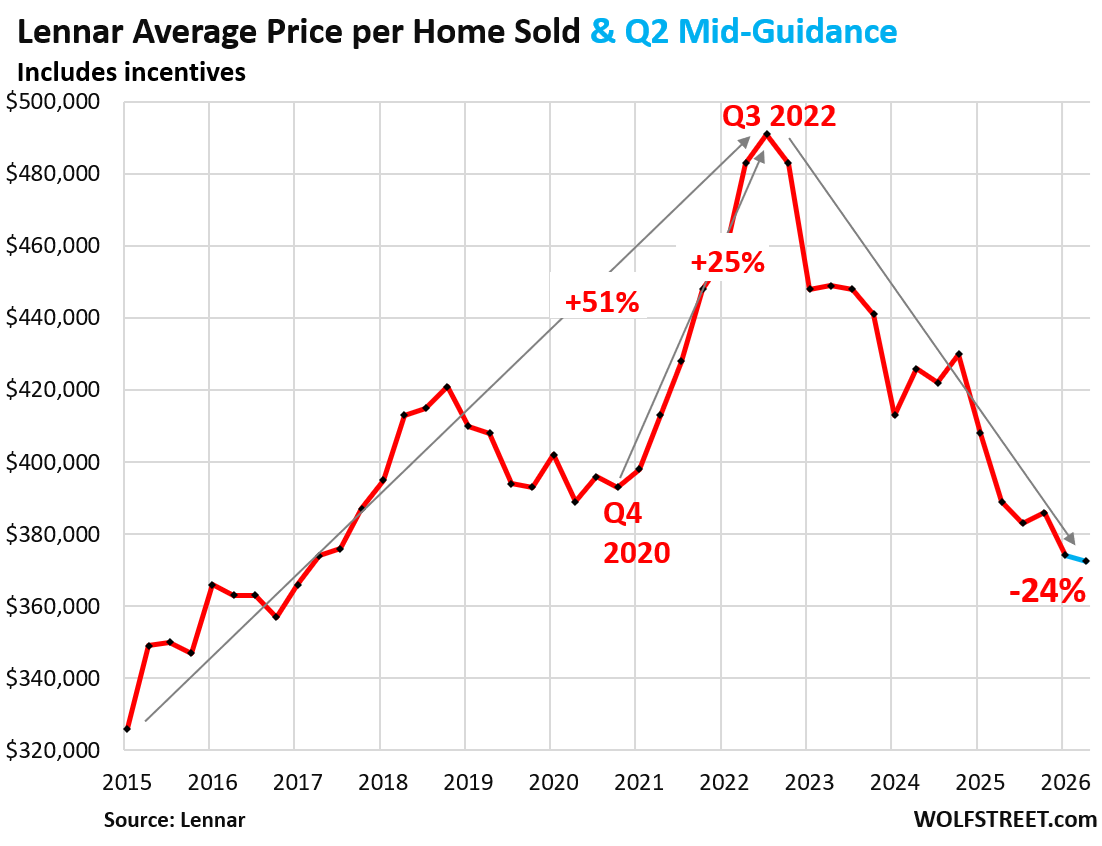
Part of it came out of profit margins: The average selling price was brought down by lower price points and by big incentives, including mortgage-rate buydowns. Incentives alone amounted to 14% of the average sales price.
Those incentives and lower prices slashed its gross margin on home sales to 15.2%, down from the obscene 26.9% in Q1 2022 when FOMO-besotted buyers were still willing to pay whatever during the final gasp of the golden days for homebuilders, and Lennar let them and cleaned them out, as did all homebuilders and sellers of existing homes.
Lennar targets the mass market. It doesn’t target the high end. It targets average families that want to buy a home. Its homes are mass-market products, designed and built to be more easily affordable – meaning lower priced. Lower-priced homes are exactly what this price-ravaged market needs.
What Lennar said:
“The decrease in average sales price [in Q1 year-over-year] was primarily due to continued weakness in the market and an increased use of sales incentives offered to homebuyers,” Lennar said.
“Gross margins decreased primarily due to lower revenue per square foot and higher land costs year over year, which were partially offset by a decrease in construction costs, reflecting the Company’s continued focus on cost-saving initiatives,” Lennar said.
“Our strategy has been to actively design around the affordability challenge rather than waiting it out,” Lennar said.
“We have focused on prioritizing volume to create durable scale advantages, delivering that volume at lower prices, and ultimately improving margins,” Lennar said.
“Additionally, our construction costs improved just over 2.5% in the first quarter and have decreased 12% over the last two years, even as labor remains constrained and materials face constant pricing pressure,” it said.
“We are, in fact, actually adapting to market conditions as they are and not waiting for the market to bounce back,” CEO Stuart Miller said during the conference call.
“Mortgage interest rates, which showed some early signs of easing towards the end of last year, have remained stubbornly over 6%, hovering around 6.2%-6.4% through most of our first quarter. With home prices plus interest rates at these levels, affordability remains the central challenge facing our buyers,” Miller said.
“The war in the Middle East is a wild card. It might end quickly and the world is a better and safer place, or it might trigger higher gas prices, higher inflation, and higher interest rates, and we’ll just have to wait and see,” he said.
“New leadership is taking a fresh look at efficiencies as well, together with new technologies. SG&A [selling, general, and administrative expenses] will continue to shrink, and the bottom line is that our overhead costs are coming down meaningfully throughout 2026,” he said.
In case you missed it: Supply of Existing Single-Family Homes Surges to Highest for February in 9 Years, Demand Stuck in the Deepfreeze.
Enjoy reading WOLF STREET and want to support it? You can donate. I appreciate it immensely. Click on the mug to find out how:


Right the price has dropped, but a buyer is probably getting 30-40% less of a house. Lennar’s lot and infrastructure costs cannot be reduced since their lot inventory is probably years old.
” designed and built to be more easily affordable – meaning lower priced” translate-cheap.
And what is the average size and price per ft.?
Need a bit more detail on this story.
Tariffs have caused huge price increases on their inputs for dimensional lumber, concrete, paint, fixtures and finishes.
there is a huge affordability crisis in this country, and you bitch about the homes being “cheap.” I’m so sick of this BS. you have no idea how tone-deaf this crap is.
You’re also ignorant about construction cost. RTGDFA and study what Lennar does. Note the word “manufacturing” in its description. This is modern methods of mass-production getting introduced to putting these products on the market for a lower price. That’s what ALL manufacturers do all the time. It’s a matter of survival.
I cannot believe that the first comment I get, posted within moments after the article got published, is this nonsense again. I get them on every article that deals with lower-priced homes offered by homebuilders to deal with this affordability crisis by introducing modern methods of building homes. But usually people at least wait a little while before posting this nonsense.
It’s like an automaker coming out with a nice well-performing has-everything-but-isn’t-gold-plated midsize car for $25,000, undercutting everyone in the market, and sales take off, and you goofballs diss it as “cheap” because it doesn’t have a V-8 with a carburetor (younger people might not even know what that is, lol).
Tell it, Wolf!
Just waiting for used homes to come down in price too.
Years ago I came up with a similar analogy that, coincidentally, aligns with the topic of this article.
I’ve actually used it against myself, the first time was with a coworker, and then a handful of times with my wife’s ideas. Oops.
Anyways, it goes a little something like this…
Basically, they go through the trouble of designing a whole house, all sorts of bells and whistles, get the layout just right, and then I come along and focus my commentary on the fact that I’m not a huge fan of the curtains. 😂
Anyways, thanks for these articles, really appreciate the insights.
Also to add Wolf that average house has increases in size by like 1000 feet since the 70s. It has started to drop which is good.
Also remember that the average household size is getting smaller as well. So we basically have huge homes with fewer individuals in them.
It is a huge part of the affordability crisis.
Until there is some national policy helping families with children this won’t change. I see the M mansions selling to multi family generational buyers…. Here in Ca largely immigrants.
America’s decadent super sized cultural-glutonoous affinity…… I learned how to live within means while living abroad.;-)
The older suburban housing “manufacturing” techniques appear in the song: “Little Boxes” by Malvina Reynolds, 1962. This song was covered by Pete Seeger in 1963. Written after seeing the tract houses of Daly City, California in that time period. Reference: Financial Times, Jan 17, 2022. Available for Audiovisual viewing on YouTube.
Still too damn high.
Fair to say this average price drop is driven by the ~40,000 drop in average price for the “Central” region?
Other region new order average price didn’t move much from 2025 Q1, and in some cases increased (West and East).
Unfortunately their definition of “Central” makes it a bit hard to understand where exactly the price drops are occuring.
Central includes theses states: Alabama, Georgia, Illinois, Indiana, Maryland, Minnesota, North Carolina, South Carolina and Tennessee.
In terms of new orders, it looks like the one region with strong year-on-year sales growth is “East”, with other regions static or declining (West).
East is Florida, New Jersey and Pennsylvania, so guessing most of those new order increases are in Florida?
Average price of new homes in South Central is $232,000!
Guessing that is driven by Texas? South Central is Arkansas, Kansas, Oklahoma and Texas.
“this average price drop is driven by the ~40,000 drop in average price for the “Central” region? Other region new order average price didn’t move much from 2025 Q1, and in some cases increased (West and East).”
That’s a lie. Average price dropped substantially in ALL four regions in Q1 yoy. The only place where it didn’t drop was in “other” where Lennar sold “5” (five) homes, so that doesn’t matter at all.
East: -5,000
Central: -33,000
South Central: -15,000
West: -41,000
Total: -34,000
I should have specified I was looking at the New Orders table.
The numbers you quoted are from the Deliveries table. As you say, average price of delivered homes did fall in all four regions.
OK. And yes, they pretty much reached the end of their price cutting, they said. They’re going to try to hold the line there. But they’re going after volume and efficiencies (mass production), and if mortgage rates head higher and slow things down, they might get even more aggressive on pricing.
It’s wonderful to see builders strive to make more affordable product and benefit from manufacturing and material advances. There are a lot of good ideas out there for cutting costs with little to no quality impact, and it’s great to see some big builders push in that direction.
Correct me if I’m wrong, but you’ve always stated incentives do not reduce the sales price. So 14% of $374K is $52K.
No wonder home sales are in the tank. That’s a lot of greasing of palms to get people to by your average home.
My dad lives in Cedartown, GA about 1.5 NW of Atlanta. A building is charging $245K for a 2 bedroom townhome that sits across the street from a county dump / recycling center & right next to train tracks. There’s probably 40 townhomes on what looks to be like 5 acres.
It’s ridiculous.
They don’t, in terms of the official sales price recorded by the town, used for the mortgage, etc.
But Lennar here (I believe) is reporting their internal accounting of their net sales price taking into account incentives, as part of their financial reporting to shareholders.
“New leadership is taking a fresh look at efficiencies as well, together with new technologies. SG&A [selling, general, and administrative expenses] will continue to shrink…”
There must be sales people with years of experience of judging just the right incentives to make a sale. Now AI is coming for their jobs.
The 30-year fixed-rate mortgage averaged 6.11% as of March 12, 2026, up from last week when it averaged 6.00%. A year ago at this time, the 30-year FRM averaged 6.65%. I can’t wait to see the results of the spring selling season here in Denver Metro.
It’s amazing to see builders starting new single family home developments as though the demand is still 2020-2022 on steroids. I bought my Lennar Home new in 2014 for $335K now valued at $600K. 2400sq/ft. I really admired and appreciated their products and programs to help the buyer along with selling a great product. Compared to Richmond and DH Horton builders foundations walls cracks and shifting to poor follow up on warranty repairs.
people get mad about “affordable” housing like it’s actually trash but many of us have owned or lived in hundred year old kit homes. The 1900-1930s bungalows, many of them were “cheap” kit homes back in the day and I think they’re beautiful. Even with the modernization I had to put in (asbestos gravity furnace anyone?). Who knows how domicile character will evolve over the years.
I looked at these Lennar homes in Portland a while back. They really are fairly nice. I do prefer older homes with larger lots but they do have lovely interiors. Glad to see they are getting smaller. As an environmentalist I hate to see houses much over 2500 sq ft. They are building a lot of townhomes here for about $300 to $400k, but also single family for around $500 to $650k which is right around the same as “used houses” in less desirable neighborhoods closer in. These new houses are mostly in former farm areas of course on the edge of the greater metro. I actually invested in this company for about a year recently but got out before it sank luckily.