
Dropping gasoline prices since mid-2022 papered over big price increases in electricity and natural gas. But that’s over.
By Wolf Richter for WOLF STREET.
What kept overall energy costs from blowing out for American households over the past couple of years was the long decline of gasoline prices from the top of the spike that ended in mid-2022. But electricity prices have shot up, and utility natural gas has shot up. And now in March, gasoline prices have started to shoot up too amid soaring oil prices.
In addition, as the Strait of Hormuz remains blocked, foreign demand for US LNG (the US is the largest exporter of LNG in the world), US crude oil, diesel, gasoline, and jet fuel (the US is a big exporter of those products) could further drive up domestic prices of gasoline and natural gas. So we have to keep an eye on energy inflation more broadly.
The average retail price of gasoline, all grades combined, at gas stations in the week through March 9 spiked by $0.49 from the prior week, and by $0.73 from early January, to $3.63 a gallon, the highest since June 2024, according to EIA data. Compared to a year ago, gasoline is now up by nearly 14%, having flipped from many months in a row of year-over-year declines.
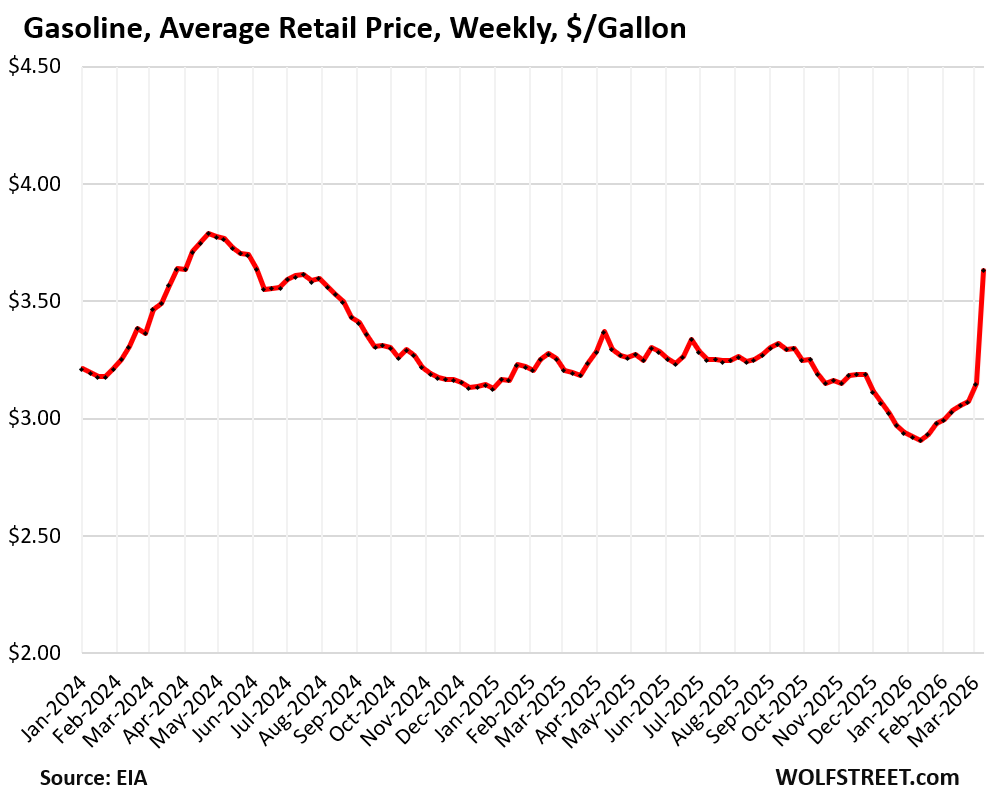
Gasoline prices started rising in mid-January, then leaped in early March, and spiked in the week ended on Monday. These price changes in March will be reflected in the inflation indices for March, to be released in April:
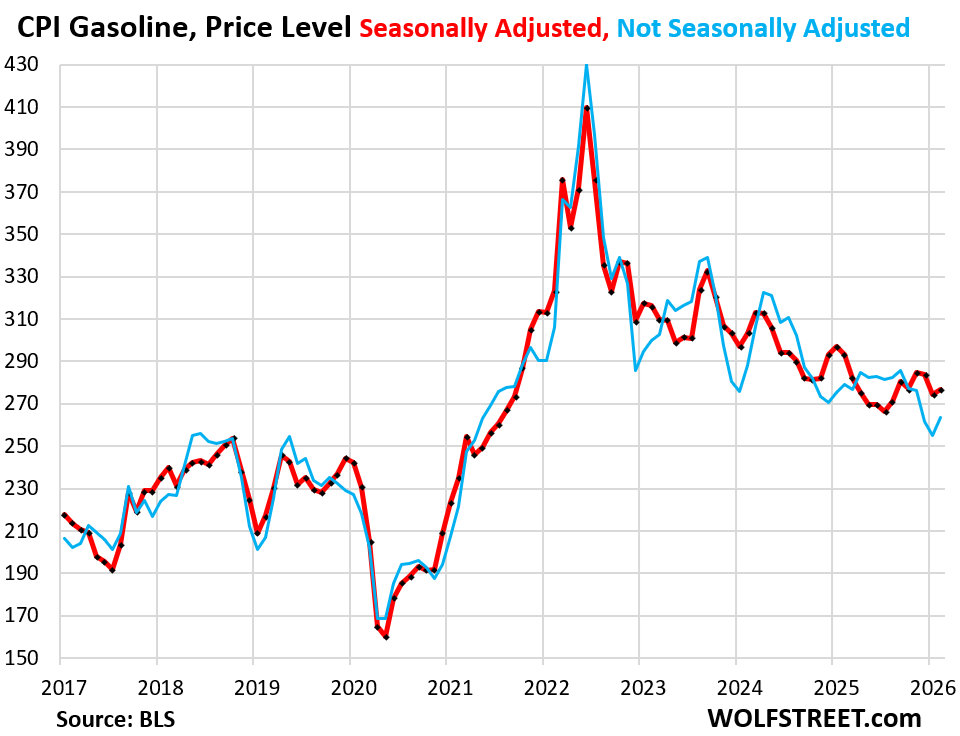
The increase in February of the price of gasoline has already entered into the CPI for gasoline, which jumped by 3.3% from January, not seasonally adjusted, and by 0.8% seasonally adjusted, according to the Bureau of Labor Statistics yesterday.
This increase in February reduced the year-over-year decline to -5.6% (from -7.5% in the prior month).
It is this long wobbly decline from mid-2022 through early January 2026 that contributed to cooling inflation and that papered over the surge in other energy costs. And that decline is now flipping into an increase.
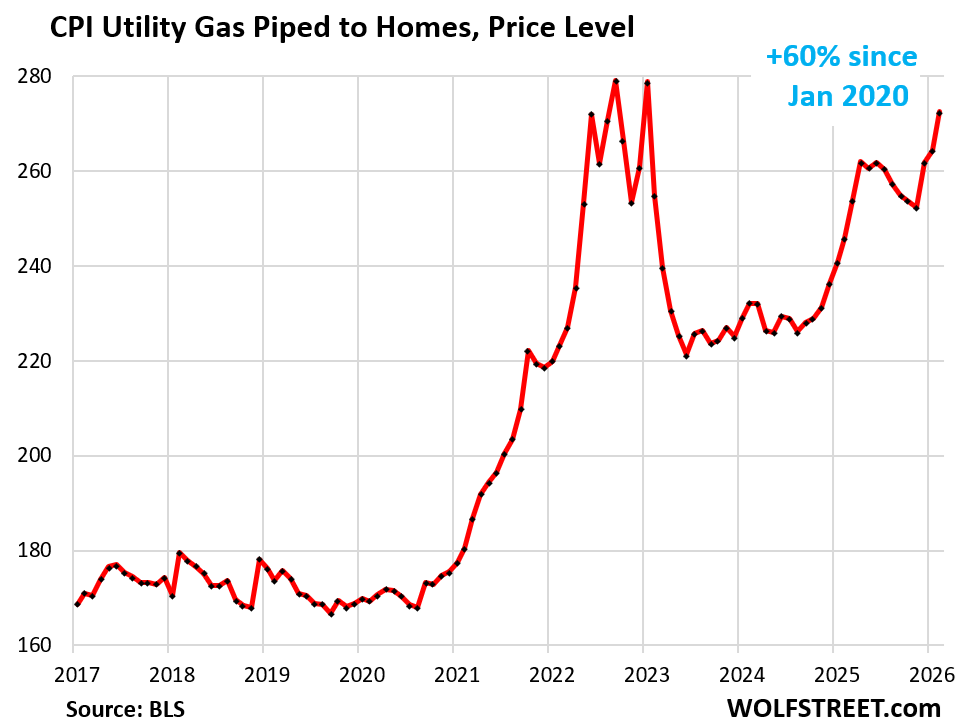
Utility natural gas: The CPI for utility natural gas piped to the home spiked by 3.1% in February from January and by 10.9% year-over-year. Since January 2020, it has surged by 60%.
A harsh winter in part of the country plays some role here, but the CPI for utility natural gas is seasonally adjusted and so it already accounts for roughly the average weather in February.
It wasn’t just the harsh weather in February: utility natural gas has been soaring year-over-year at double-digit rates since April 2025. On a month-to-month basis the price started taking off in late 2024.
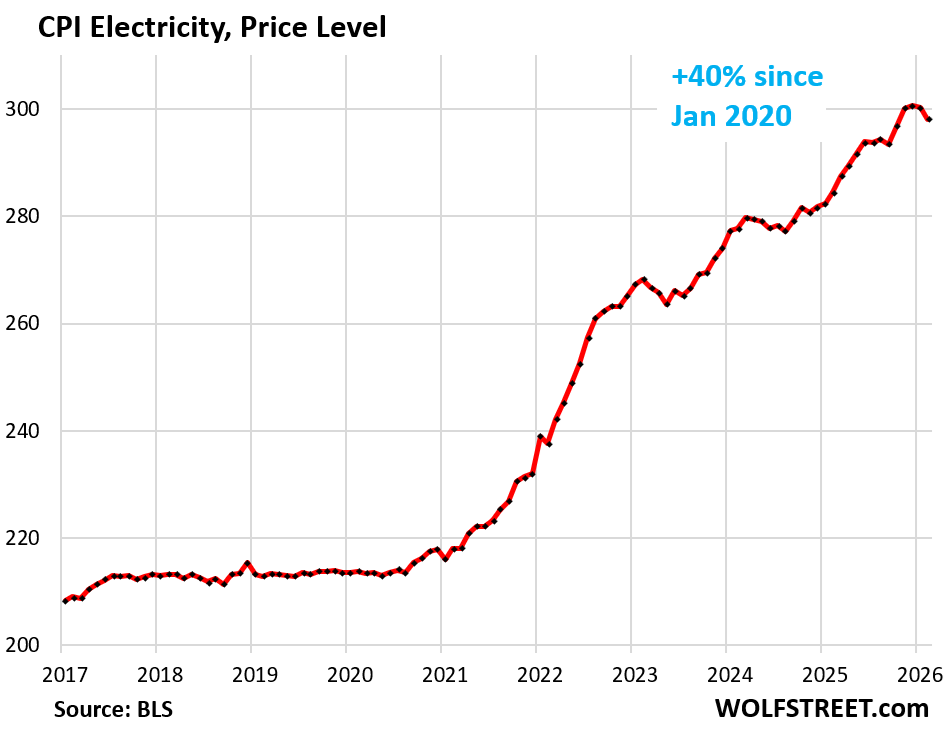
Electricity costs for households soared from record to record, starting in 2021. The CPI for electricity is up by 40% since January 2020.
In February, the CPI for electricity declined for the second month in a row from the record in December, but was still up by 4.8% year-over-year.
The price that households pay for electricity on their monthly bills – the fixed fees and charges and the price per kWh used – is largely set by utilities that are monopolies. Some of the utilities are owned by public entities, such as the municipality; some are owned by their ratepayers; others are investor-owned regulated monopolies, and investors come first. The only competition these electric utilities face is rooftop and plug-in solar.
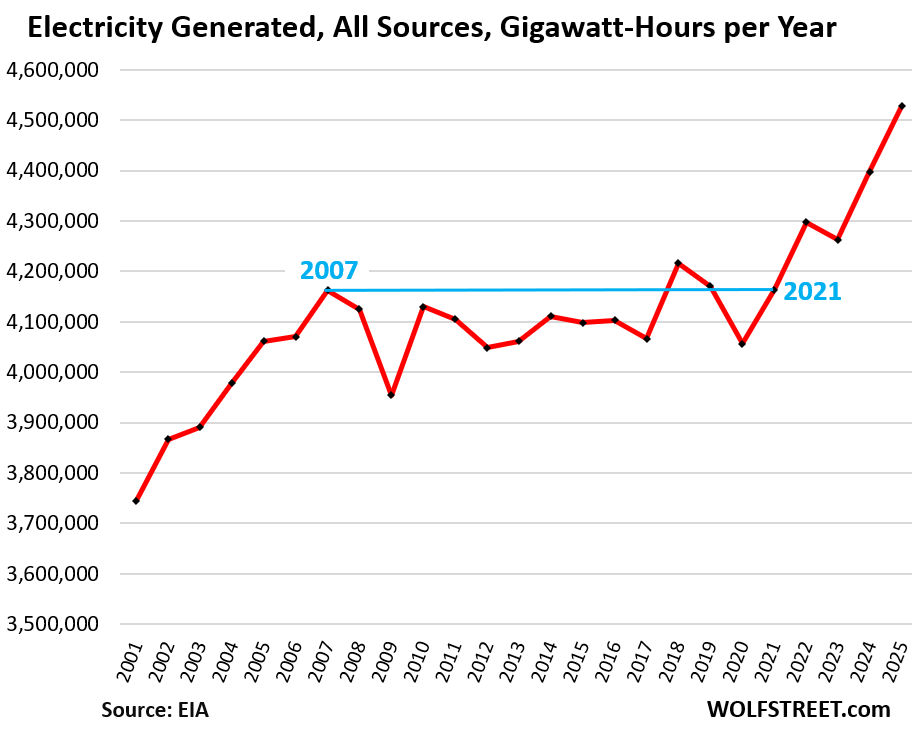
AI data centers are massive consumers of electricity, and US electricity consumption has started to surge. The quantity of electricity generated in the US by all sources rose by 3.0% in 2025 and by 6.2% over the past two years combined, after 15 years of stalling, according to data from the EIA. This additional demand on the grid has started to push up rates.
The AI-infrastructure buildout has accelerated. The size of each new data center is measured by their capacity to consume electricity, such as 500 megawatts, and even 1 gigawatt (about the capacity of a commercial nuclear reactor) or more for the big ones in the pipeline. This has unleashed a mad scramble to supply these data centers with power. Many data center projects are having to include on-site power generation.
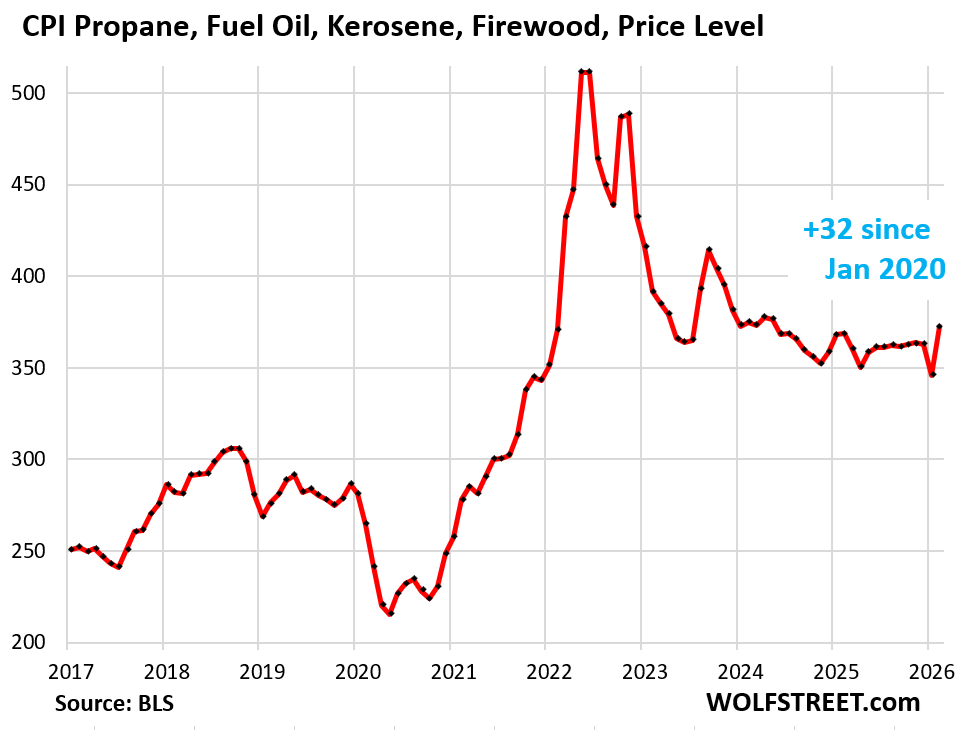
Propane, fuel oil, kerosene, and firewood: The CPI for “Other fuels” spiked by 1.1% in February and by 8.6% year-over-year. It too had plunged off the tip of the spike starting in mid-2022. And that plunge seems to have ended in late 2024.
Propane is widely used for heating by households that do not have access to utility natural gas, such as households in rural areas. In the US, most of the propane is a byproduct of processing natural gas from fracked wells. Some propane is also obtained as part of refining crude oil.
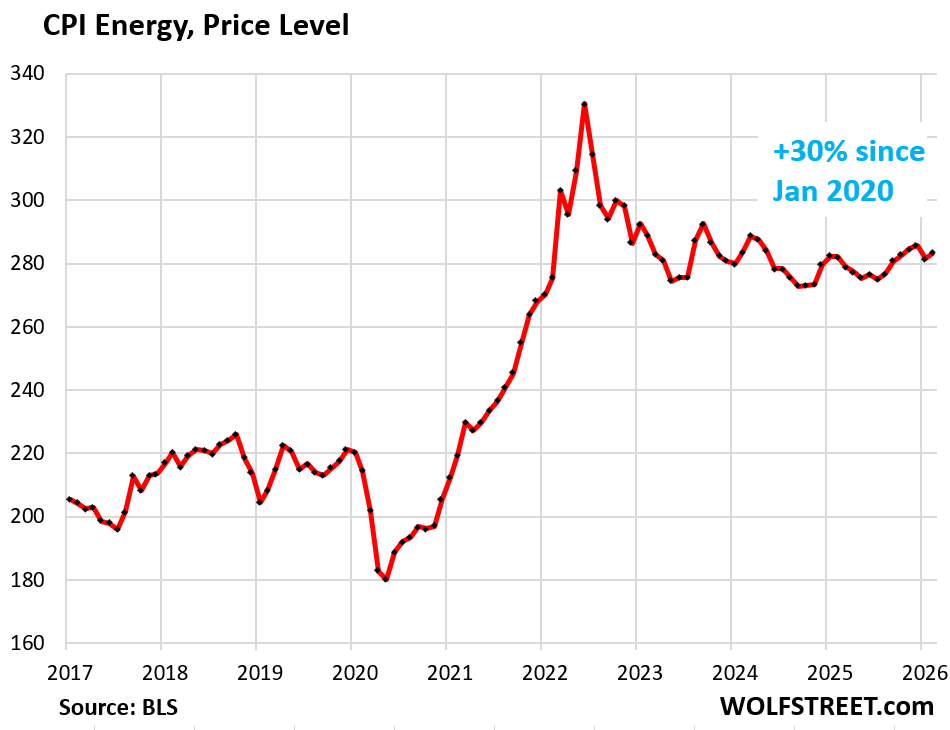
Energy costs combined. The energy CPI, which tracks the above categories, rose by 0.6% in February from January. Year-over-year it was up just a hair, pushed down by the decline in gasoline prices through February. Gasoline accounts for about half of the energy CPI. And the increase of the energy CPI in March will be a sight to behold.
Since January 2020, it has increased by 30%.
Energy inflation, like food inflation, hits the lower income households the hardest, as they spend a substantial part of their budget on food and energy.
In case you missed the other two components of this inflation series:
Enjoy reading WOLF STREET and want to support it? You can donate. I appreciate it immensely. Click on the mug to find out how:


Don’t worry people, I’ll get BLS to change formula to exclude gasoline till it starts falling again.
My inflation numbers will look pretty even as your behind hurts…
Don’t worry, when gas prices are high “we” make more money.
Idiots.
Can’t AI actually do something positive?
It makes cartoons (AI images), uses our power, takes jobs, Cliff notes all websites.
Yes won a Nobel prize from already common public data that no one took the time to put together. Guess that is something.
Perhaps it could invent cold fusion to power itself? Just saying
We gotta build more nuclear power plans
“plants” not “plans”.
But then the Fed only looks at prices excluding food and energy when deciding interest rates, doesn’t it? We can forget any rate cuts for the foreseeable future. On the other hand, it would be a brave economist that suggests increasing rates to control inflation in this political environment.
“But then the Fed only looks at prices excluding food and energy when deciding interest rates, doesn’t it?”
No it doesn’t. It looks at both the overall PCE price index, which includes food and energy; and at the core PCE price index which does not include food and energy.
You can look at its Projection materials, where it projects the trajectory of both “PCE inflation” (overall) and “core PCE inflation” (without food and energy):
https://www.federalreserve.gov/monetarypolicy/fomcprojtabl20251210.htm
The reason the Fed and everyone is also looking at core inflation (without food and energy) is because food and energy can have big positive and big negative % change results; energy plunged for a while with big negative values that pushed down overall PCE inflation. But to see the underlying inflation, not just volatility in commodities, everyone also looks at core inflation.
A couple of analysts Bloomberg interviewed on Odd Lots over the last two days have said the situation with Hormuz is a doomsday scenario from a commodities perspective. A lot of the world’s urea fertilizer flows through there, so we’re going to see a hit to crop yields that will show up in food prices throughout the year.
On the oil side, many refineries around the world are reducing production to buy themselves more time to bridge the big supply gap coming their way. Nobody wants to actually shut down a refinery because restarting it takes a lot of time and money. That’s much of what’s causing the massive price spikes in gas/diesel/jet fuel, etc.
One analyst said that, for perspective, the current reduction in oil supply is about the same as the reduction in oil demand during the peak of COVID, so if we were going to retain our current prices through demand destruction alone, we would need to get worldwide demand down to COVID lockdown levels.
He also said that if the US chooses to do export bans, that would help prices in the short run but would eventually cause critical oversupply of some oil products like diesel, which are currently exported. We would run out of storage in a way similar to what’s going on in the gulf right now and have to curtail refinery output, which would result in shortages of other products like gas. He thinks it’s possible but unlikely that this government could effectively manage that crisis.
Meanwhile, Senator Chris Murphy is reporting that, according to the briefings he’s had, nobody really has a plan on how to end the war. “What happens when we stop bombing and they restart production?” The answer appears to be more bombing and an endless war.
And a huge amount of helium also flows thru the straits of Hormuz. Helium that is used in the manufacture of computer chips.
I wouldn’t believe a word out of Chris Murphy’s mouth or any politician but the other guys sound smart
“Short-term pain leads to long-term gain” is what Team Trump tells us. I can’t see how energy shortages will eventually benefit us though. More and more, I am regretting that I voted for him.