
Not good.
By Wolf Richter for WOLF STREET.
Food prices have been very high since the massive inflation outburst in 2021 and 2022. Then in 2023 and for much of 2024, price increases (inflation) calmed down, and prices rose more slowly off this very high level. But little by little, food inflation has been accelerating.
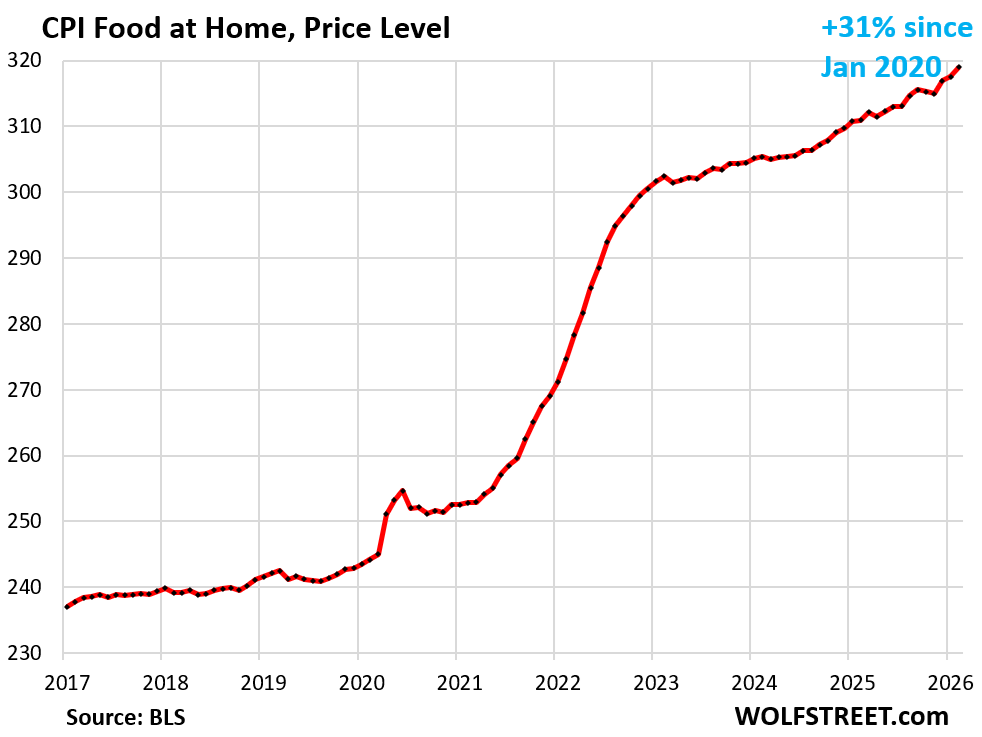
The chart shows the price level of the CPI for “Food at home” as index value. In a moment we’ll get to the rate of change of that price level expressed in percentages (inflation). What hurts is that these price increases now (inflation) come on top of these already very high prices (price level). The CPI for “food at home” covers food and beverages that people buy at stores, markets, or online and consume off premise. The price level in February was up by 31% from January 2020.
Note the dynamics: Price explosion in 2021 and 2022, followed by much slower price increases in 2023 through the first half of 2024, and then a steepening of the line, indicating that prices rose faster again off those already very high prices.
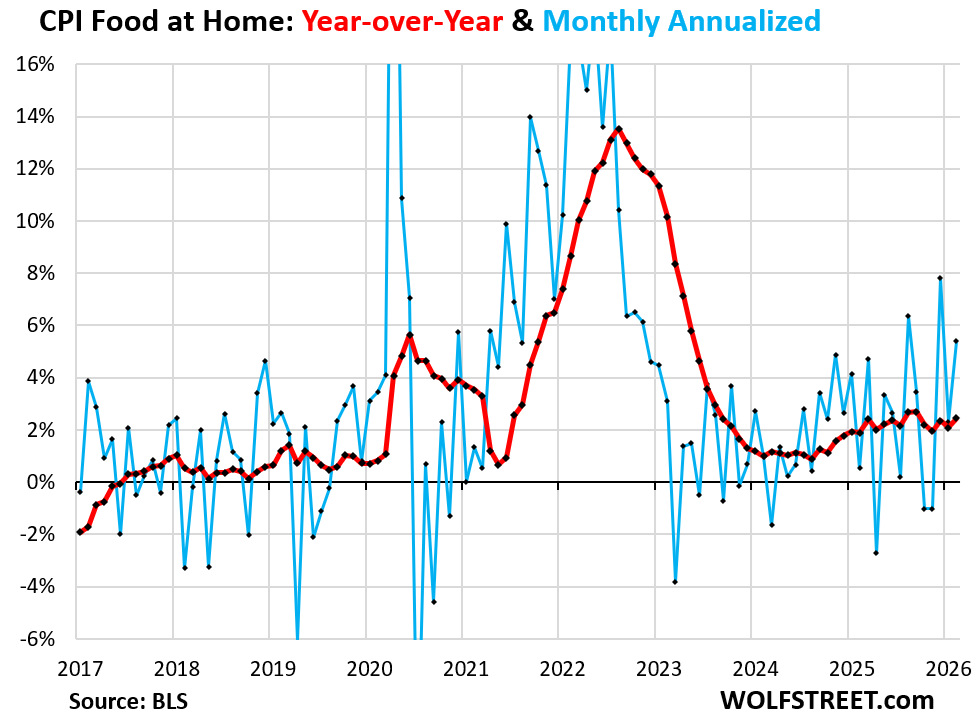
In February, the CPI for Food at home rose by 0.44% from January, seasonally adjusted (+5.4% annualized), after rising by 2.3% annualized in January and by 7.8% annualized in December, according to the Bureau of Labor Statistics today (blue line in the chart below).
Compared to a year ago, food prices have risen by 2.45%, the biggest year-over-year increase since September (red line).
Prices in some major food categories jumped in February – or continued to spike, such as beef and coffee. Prices in other categories fell – or continued to plunge, such as eggs. Other prices increased or decreased much more modestly. And we’ll get to some of the major ones.
Beef & veal prices spiked month-to-month by 1.5% (+19% annualized) in February from January, and by 14.4% year-over-year, according to BLS data.
Beef prices have been soaring since the beginning of 2021, as the US cattle herd has dropped to a multi-decade low for a laundry list of reasons, causing tight supply, and lots of profit opportunities for ranchers.
Despite the high prices, demand for beef has not yet collapsed. For prices to come down, one or both have to happen: supply has to surge or demand has to drop substantially. But neither has happened to the degree necessary to move prices back down.
Americans wail and gnash their teeth about high beef prices but keep buying it and keep paying those prices, though there are lots of delicious alternatives to beef, such as a great variety of fish, plus chicken and pork, plus vegetarian proteins.
The Bureau of Labor Statistics tracks tens of thousands of products and services by detailed items separately, which are then combined into categories and indices. So let’s look at ground beef and steak.
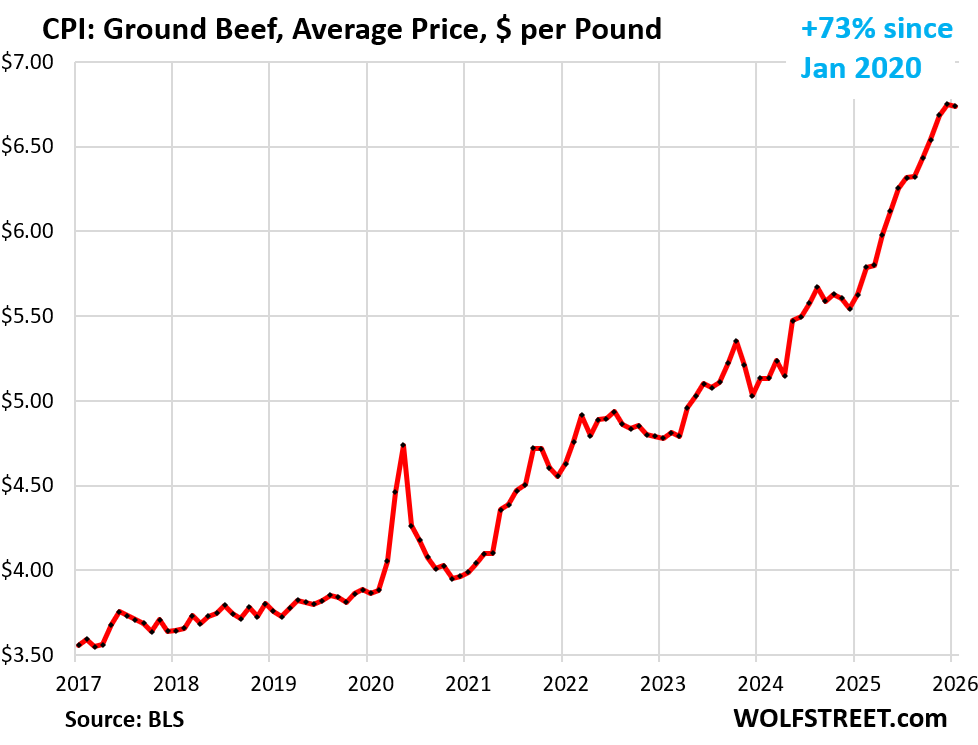
Ground beef: The average price of ground beef, 100% beef, excluding round, chuck, and sirloin, and excluding preformed patties, finally took a breather in February and barely budged, rising by just 0.2%, after spiking month after month almost uninterrupted for a whole year.
At $6.74 per pound, the average price is up by nearly 20% from a year ago and by 73% from January 2020.
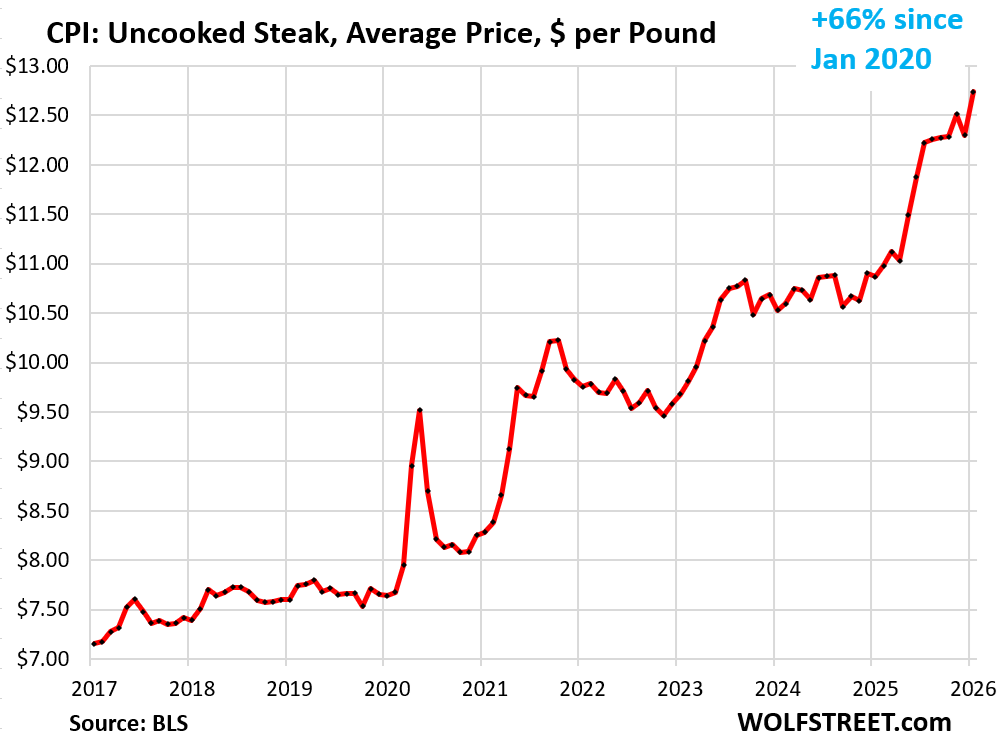
Steak… Other beef products spiked in February. For example, the average price of uncooked steak spiked by 3.6% in February from January (+52% annualized), to $12.74 per pound, after dropping in the prior month. Steak is up by 17% year-over-year and by 66% from January 2020.
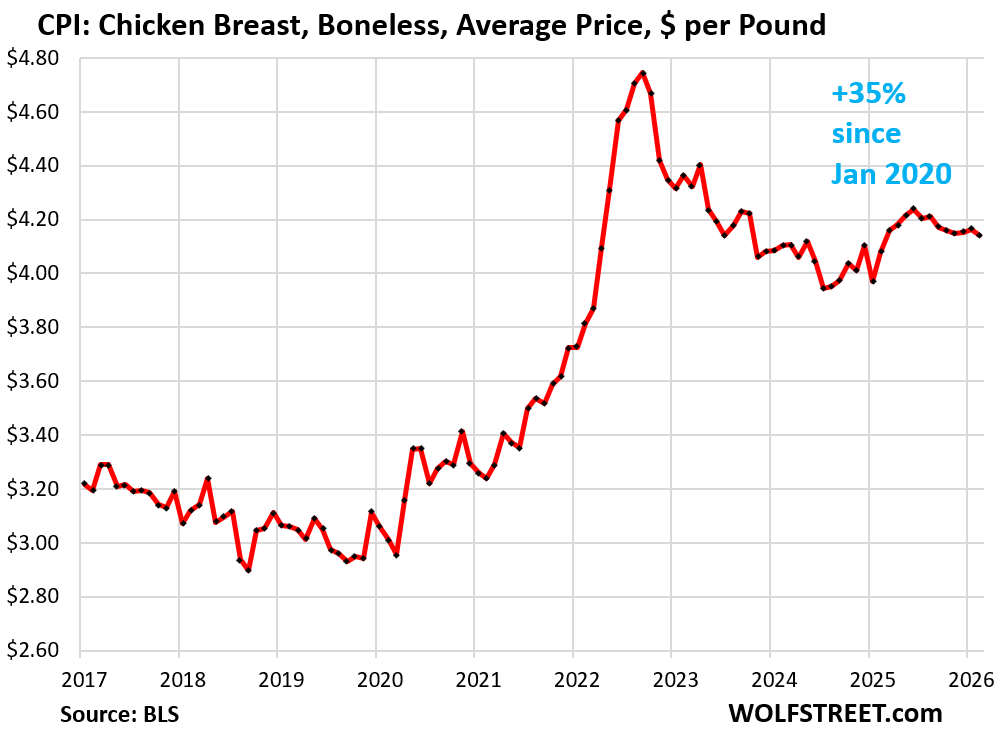
Chicken breast, boneless: The average price of boneless chicken breast fell by 0.6% in February from January, to $4.14 per pound. Year-over-year, it was up by 1.2%.
During the inflation shock from 2020 through September 2022, the price had exploded by 58%, then declined. But it is still up by 35% from January 2020.
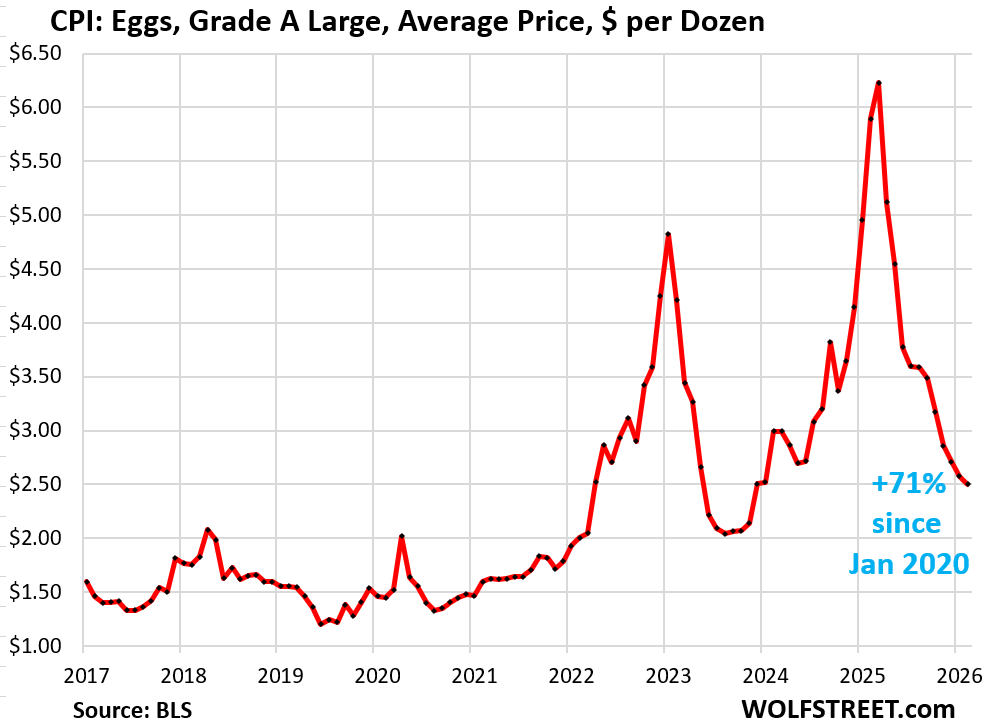
Eggs: The price spike imploded, but prices are still high. The avian flu came in two waves, the first in 2022 and the second in 2024, each triggering shortages of eggs and huge price spikes. The average price of “Grade A Large Eggs” soared by 368% from $1.33 per dozen in mid-2020 to $6.23 at the peak of the second wave in March 2025, according to CPI data by the BLS.
Then, the price spike began to implode. In February, the average price of Grade A Large Eggs fell another 3.0% from January, to $2.50 per dozen, the lowest since December 2023, having now plunged by 60% from the March peak.
But it’s still 71% higher than in mid-2020.
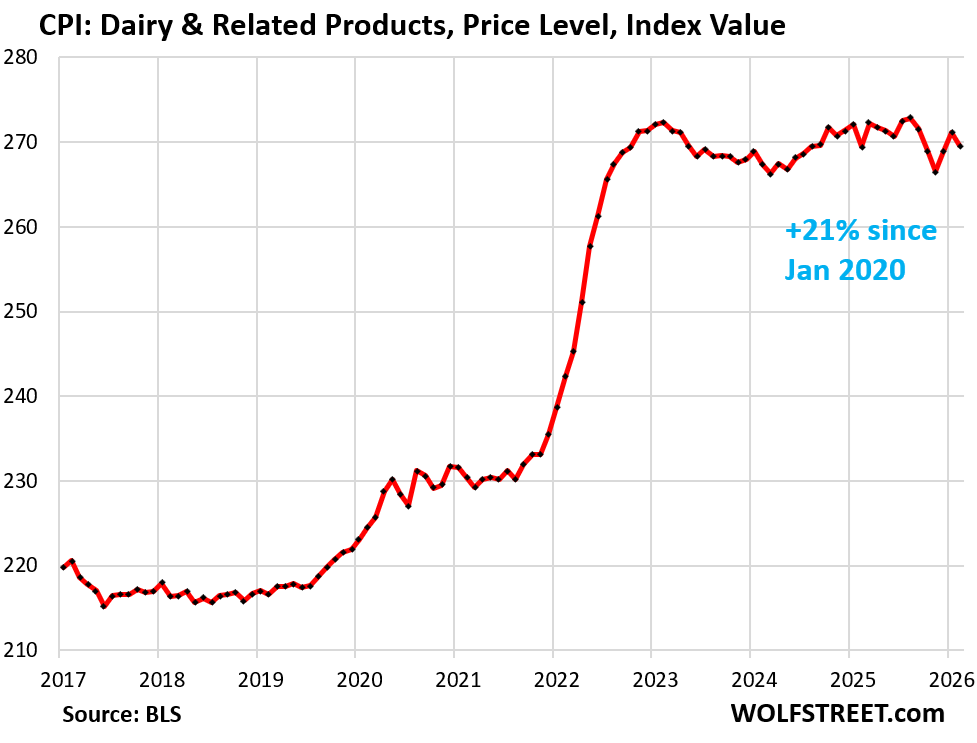
The CPI for dairy and related products fell by 0.6% in February from January and was unchanged year-over-year. Dairy prices are high (price level), but the annual rate of change (inflation) of dairy prices is now low.
Compared to January 2020, the index is 21% higher.
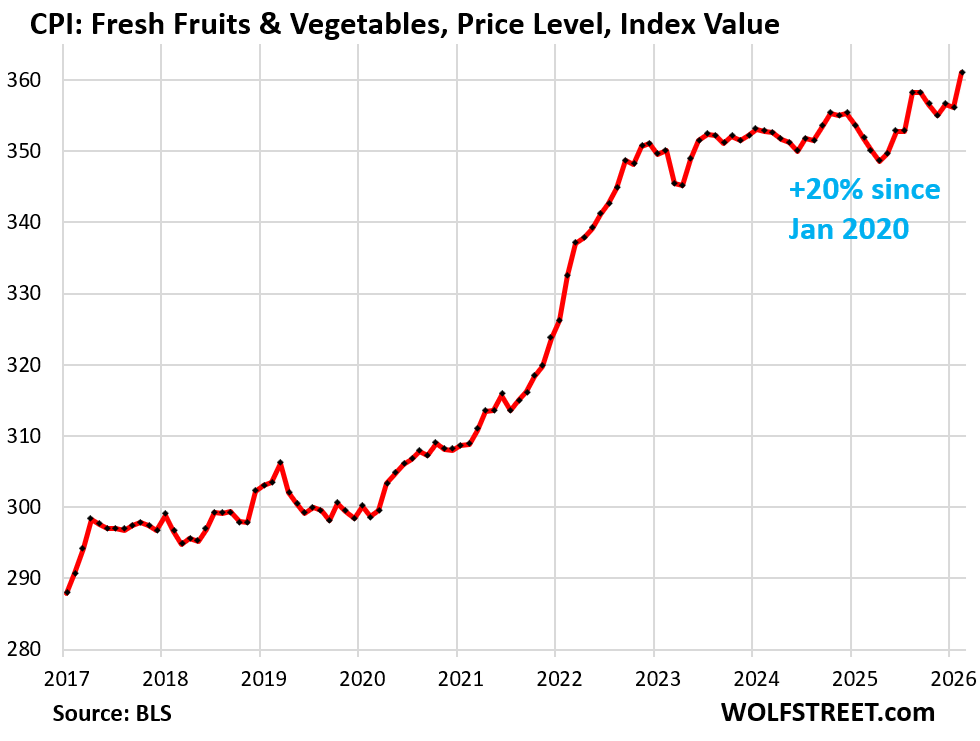
The CPI for Fresh fruit and vegetables spiked by 1.4% month-to-month (+17.8% annualized). This big move pushed the year-over-year price increase to 2.6%, after having been close to unchanged year-over-year for several months:
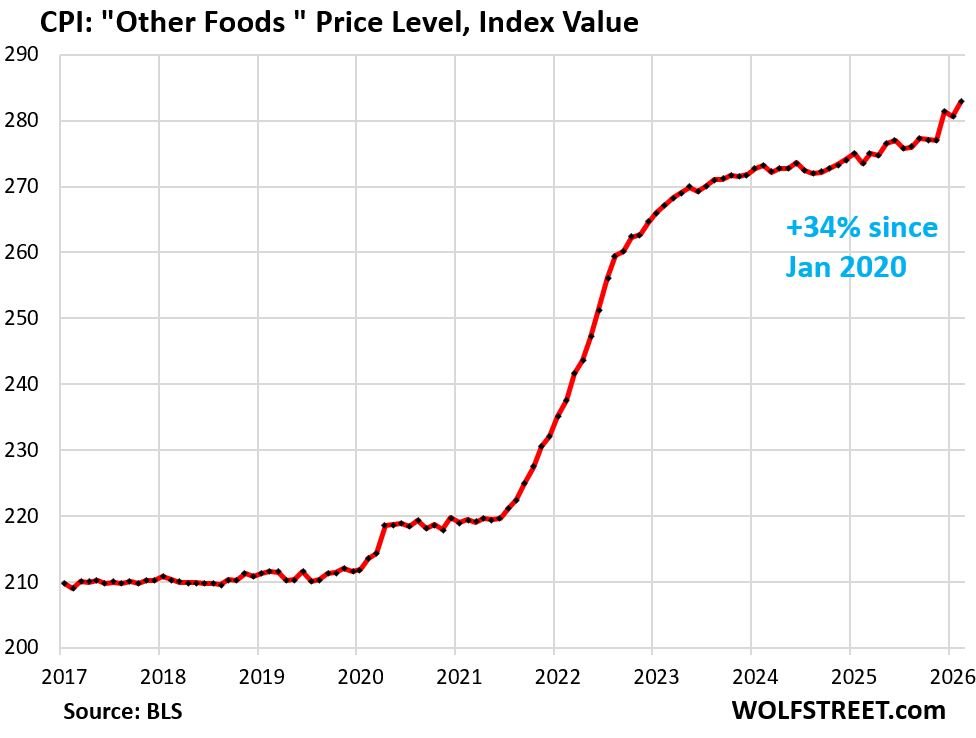
“Other foods” because we can’t post a chart of every type of food. The CPI for “Other foods” combines the sub-indices of many food items and categories that the BLS tracks separately. They include the categories for sugar, sweets, fats and oils, salad dressing, peanut butter, soups, frozen and prepared meals, snacks, spices, olives, pickles, baby food and formula, etc. So a substantial part of the middle of the grocery store.
These “Other foods” were a culprit in the acceleration of food inflation in February. The CPI for “other foods” jumped by 0.8% in February from January (+10% annualized), after a drop in January and a big spike in December.
Over those three months combined, the CPI other foods jumped by 2.1% (6.4% annualized). Year-over-year, it rose by 3.4%, the biggest year-over-year increase since November 2023.
Since January 2020, the index for other foods soared by 34%.
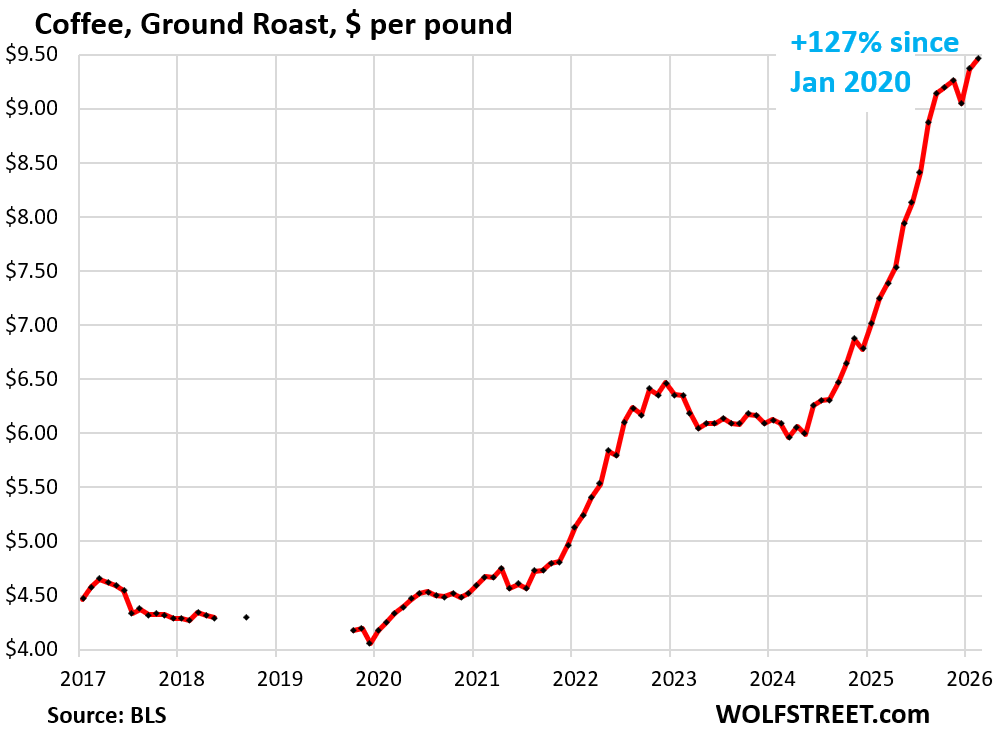
Coffee, oh dearie… The average retail price of Ground Roast 100% Coffee spiked by 1.0% in February and by 30.5% year-over-year, to $9.46 per pound, according to BLS data today.
Since January 2020, the price of this type of coffee has exploded by 127%.
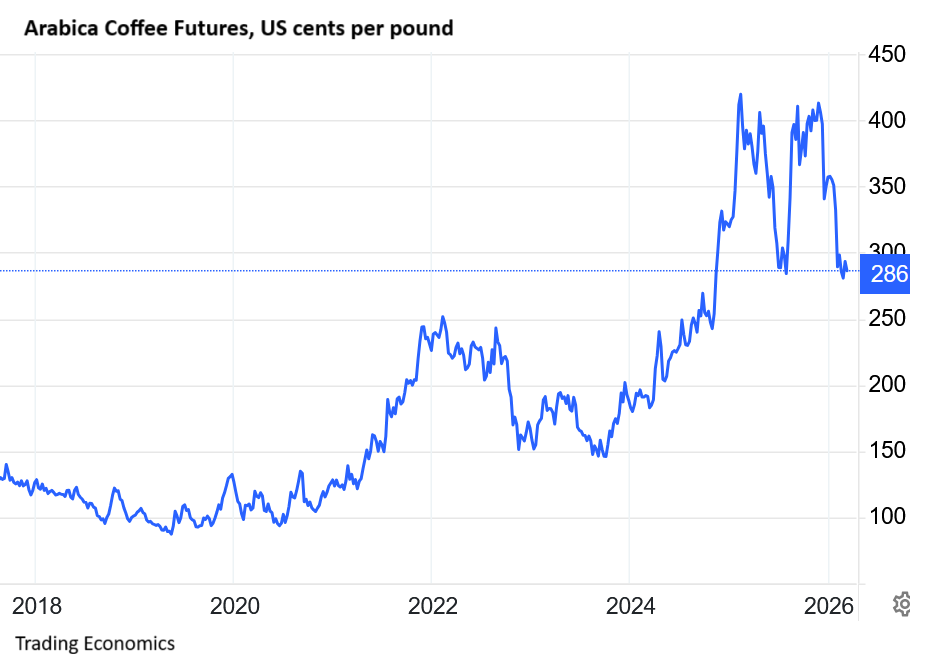
Coffee rocketed higher in two waves, roughly following with a lag the two waves in the coffee futures market: The first wave started in mid-2021, the second wave in September 2024.
But there is hope for coffee drinkers. Green coffee beans are a global commodity product, and prices can fluctuate wildly and instantly, driven by fears of droughts, bad harvests, market forces, tariffs, or whatever.
Futures prices for green beans of Arabica coffee have plunged to $2.86 per pound, from over $4.00 a pound in December.
But note, the cost of green coffee beans as a commodity is only a part of the retail price of ground roast coffee.
The current green-bean price of $2.86 per pound of Arabica compares to the average retail price of $9.46 per pound for ground roast coffee.
The difference between the two prices goes to the roaster, the retailer, the transportation companies, to wages and salaries and share buybacks, and rent, and everything in between, plus profits for everyone between the green beans and the coffee in your cup. So if the price of coffee futures drops by $1.00 per pound, as it just did, it may not reach your cup, or reach it only partially and slowly (chart below via Trading Economics):
And in case you missed it: CPI Inflation Rose on Food & Energy Prices, even before Gasoline Price Spike. YoY still Pushed Down by Bad-Joke OER
Enjoy reading WOLF STREET and want to support it? You can donate. I appreciate it immensely. Click on the mug to find out how:


I really don’t know the solution for any of this.
Just seems stuck
Besides a recession I mean
I mean… more supply? People doing the work that’s needed. People allowed to the do work needed. Efficient allocation of resources? No wars? Imagine the price of energy a couple of weeks ago.
I’m still finding my 2nd fav coffee on Amazon for 54 cents an ounce. Brand Name.
In the stores it’s $1-1.30 an ounce.
Still haven’t been forced to buy coffee from Costco but that may be coming.
Wolf – you should have titled this article “We’re screwed – oh no, not all of us – just those who eat!” 🤓 🍱
all I can say is that NOW we are in the exponential explosion of federal debt(along with states/cities/school districts)
the CONTINUAL devaluation(inflation) of fiat $dollar has made everything more ‘astronomical’
I had apartment owner ask me today if I thought we could finish for $500k of renovations
I didn’t answer given the 2-3 year timeline
learn to grow your own veggies and do community chickens
otherwise learn to eat soy products
Fortunately, alcoholic beverages are only 1.6% yoy, it’s time to substitute over from Coffee.
The Best part of waking up, is Jackie D in your cup!
I was in a hardware store the other day looking for a very specific light bulb and an older gentleman employee asked if I needed help. It was probably 1 in the afternoon. I was overwhelmed by the smell of alcohol on his breath. I’m positive he was drinking on the job. Years ago I would have been annoyed because it’s just really poor form. These days I don’t blame the guy. He is probably making minimum wage and I honestly don’t know how he is even surviving on it.