
Double-digit increases in employee health insurance costs hold down wage increases.
By Wolf Richter for WOLF STREET.
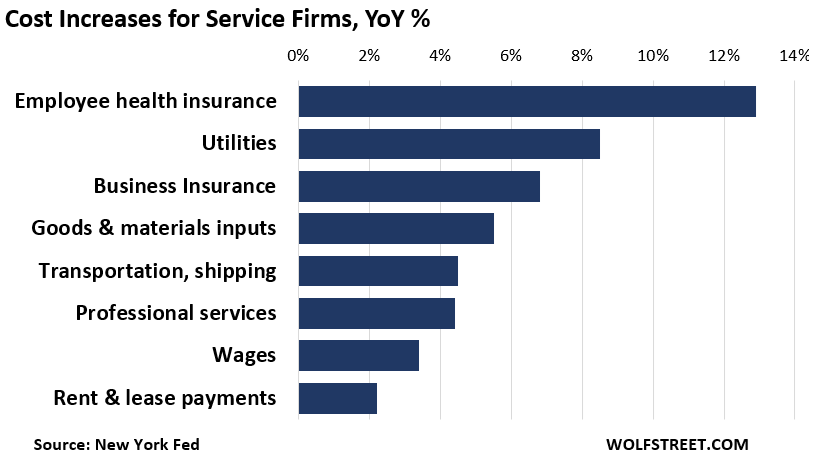
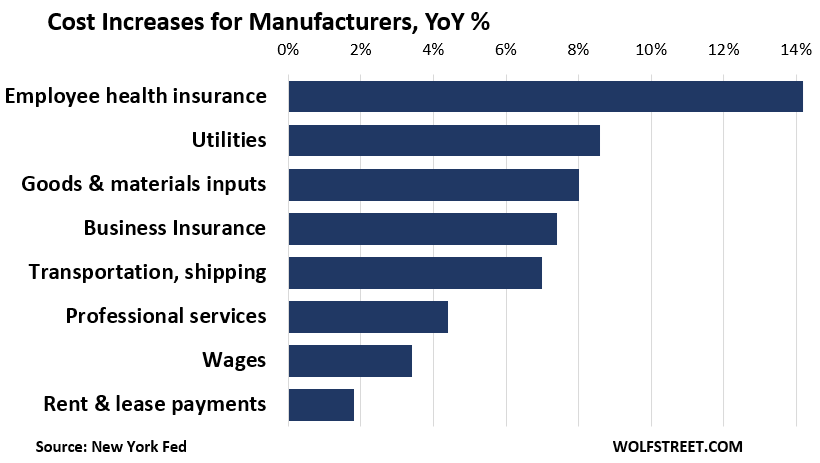
Manufacturers reported that the costs of health insurance for employees shot up by 14.2% on average; service firms reported an average increase of 12.9%, according to a report by the New York Fed based on a survey of companies in the New York-Northern New Jersey region.
These are averages, but “some firms reported increases of between 25% and 50% when they renewed their coverage,” the report said.
Manufacturers and service firms both reported that the costs of utilities jumped by about 8.5% on average. About one-fifth of the companies reported increases of 20% or more. “Indeed, sharply rising utilities costs in some areas have been tied to the explosive growth of AI-related data centers,” the report said.
For service firms, the third worst cost increases were in business insurance, which jumped by 6.8%. This includes liability, property, auto, and workers’ compensation insurance.
For manufacturers, business insurance increases were the fourth-worst, with an average increase of 7.4%.
Nearly one in ten of these companies reported massive spikes of 20% or more in business insurance costs.
For manufacturers, the third-worst increases were goods and material inputs, which jumped by 8.0%. They reported substantial increases in the costs of tariffed inputs, such as aluminum, steel, equipment, electrical supplies, auto parts, coffee, and cocoa, etc.
For service firms, cost increases of goods and material inputs averaged 5.5%.
“A greater exposure to tariffs may be part of the reason manufacturing firms faced a sharper increase in goods and materials costs” than service firms, the report said.
These are very serious cost increases.
The Producer Price Index (PPI), which track prices paid by companies, has also shown sharply accelerating cost increases across a wide range of industries, with big price increases for both services (which dominate the PPI) and goods. The price increases in goods were driven by companies shuffling the costs of the tariffs around to each other, but they’re having trouble passing them on to consumer-facing companies, which are having trouble passing them on to consumers without losing sales.
But wages increased by only 3.4% at both service firms and manufacturers, amid indications that soaring employee health insurance costs – average annual premium for employer-sponsored family health insurance rose to about $27,000, according to the NY Fed – were putting downward pressure on wage growth.
“Businesses providing insurance to their workers indicated that absent these cost increases, they would have raised wages by roughly an additional percentage point, on average, (so an overage by 4.4%), suggesting that rising health insurance costs resulted in a drag on wage growth for workers at these firms,” the report said.
But increases of rent & lease payments were relatively modest at 2.2% for service firms and 1.8% for manufacturers – thanks to the depression in Commercial Real Estate.
This chart shows the cost increases by category for service firms. Note, business insurance in third position (+6.8%):
This chart shows the cost increases by category for manufacturers. Note, goods & material inputs in third position (+8.0%), and business insurance in fourth position:
The report also pointed out that service firms and manufacturers were impacted differently by these cost increases:
“For example, utilities and materials inputs would represent a larger share of costs for manufacturers compared to, say, a consulting firm, where labor costs would have more of an impact. Thus, cost increases for any category could have more of an effect on some firms than others.”
Costs overall for service firms jumped by 7% in 2025, an acceleration from the 5% increase a year earlier.
Costs overall for manufacturers jumped by 8.5%, a hot acceleration from the 5% increase a year earlier.
These are just indications based on companies in the New York and Northern New Jersey region, and not national indications. Firms in other parts of the US may experience cost factors that are somewhat different, such as the average increase in the costs of utilities, which are the newest hot button in many places.
So inflation is raging beneath the consumer-level surface again. It has also shown up in the GDP inflation adjustments: The Price Index for Gross Domestic Purchases, which reflects inflation adjustments in GDP except for imports – so a measure of overall domestic inflation for consumers, businesses, and governments – jumped by 3.7% in Q4, the worst in three years.
Enjoy reading WOLF STREET and want to support it? You can donate. I appreciate it immensely. Click on the mug to find out how:


OK. I thought I had been hallucinating, because until this report, the majority of what I read kept telling me that inflation is low. However, my costs have continue to increase, with insurance increasing the most. Some of this, like supplemental health insurance (to cover the portion Medicare doesn’t pay) is expected as I get older. However, auto and home insurance have gone up 15% this year.
If you can resist… stop reading FRED.GOV
They are state run propaganda.
The reason why we have hyperinflation is because Arthur Burns is the Federal Reserve chairman.
Or the the ghost of Arthur Burns is in the Eccles building.
Its one or the other, I don’t know. I’m not an economist.