
And the price of US natural gas fell back to where it had been 30 years ago.
By Wolf Richter for WOLF STREET.
Marketed production of natural gas jumped by 4.5% in 2025, to a record 43.2 trillion cubic feet. Since 2006, production has soared by 123%; since 2016 by 52%, according to EIA data.
The fracking boom in the US generates enormous amounts of hydrocarbons across the spectrum, and a substantial part of natural gas – along with other hydrocarbon gases and liquids – is produced as a byproduct of fracked oil wells. Drill Baby Drill since the mid-2000s.
The US is also the largest producer of crude oil and petroleum products in the world, and a large exporter of them. This massive amount of reliable energy produced in the US has had a huge impact on the global energy landscape, on the US economy, and on how the US can conduct its foreign policy.
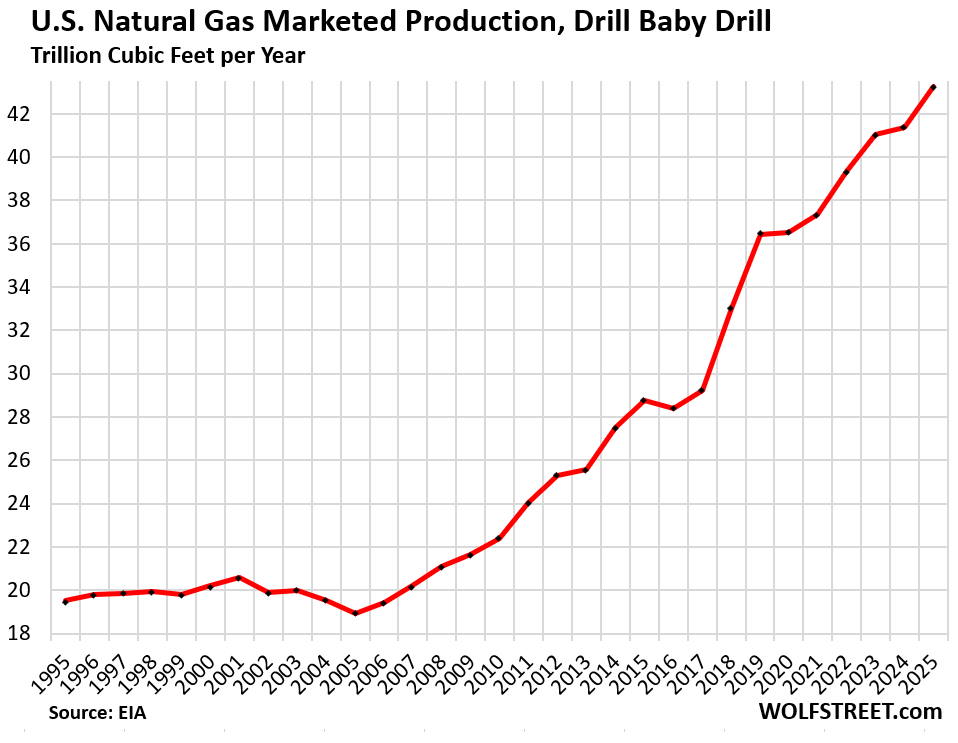
Drill Baby Drill milestones:
- In 2011, the US became the largest natural gas producer in the world.
- The price of US natural gas began collapsing in 2008 amid this new overproduction with no outlet at the time via liquefied natural gas (LNG) exports in the lower 48 states and only limited pipeline exports to Mexico and Canada (see last chart, price of natural gas).
- In 2016, natural gas passed coal as the dominant fuel for power generation in the US (my analysis: Power Generation by Source in 2025).
- In 2025, power generation from natural gas accounted for 40% of total power generation in the US, while coal accounted for 16%.
- The first LNG export terminal in the lower 48 states came on line in 2016, and large-scale LNG exports began. As more export terminals came online, LNG exports soared.
- In 2017, the US became a net exporter of natural gas, exporting more than importing.
- In 2023, the US became the largest exporter of LNG in the world and has since then further outdistanced Qatar and Australia.
US natural gas exports spiked to record.
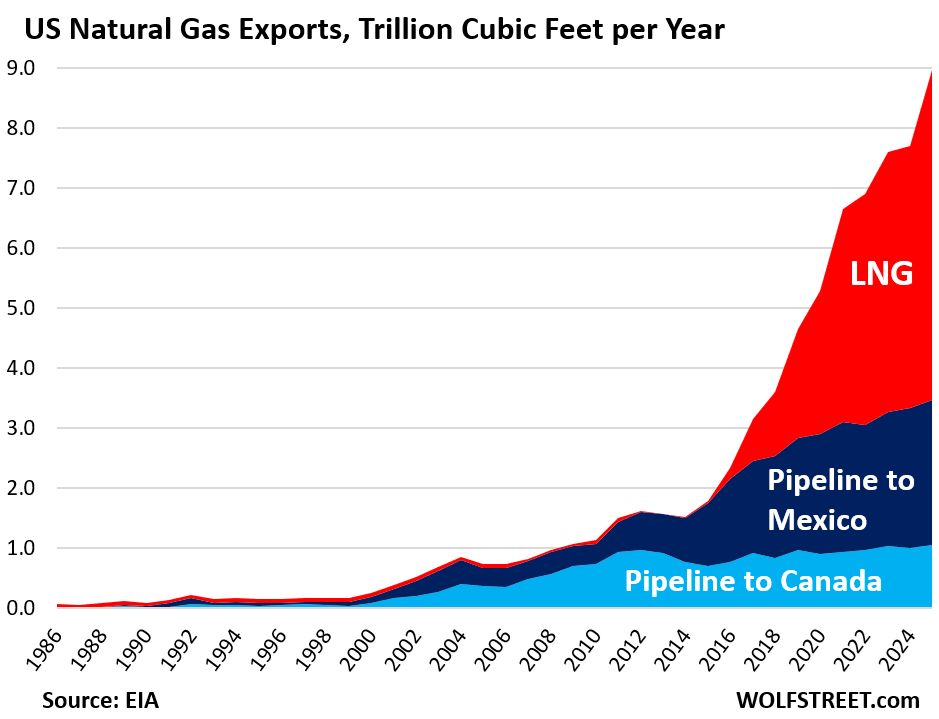
The US began exporting LNG in 2016 when the first LNG export terminal became operational. As more export terminals were built, LNG exports soared and turned the US into the largest LNG exporter in the world by 2023, surpassing Australia and Qatar. And the lead has widened.
The US also exports natural gas via pipelines to Mexico and Canada.
Total exports of natural gas via pipeline and LNG in 2025 spiked by 16.4% year-over-year to a record 9.0 trillion cubic feet, or about 21% of US marketed production.
LNG exports spiked by 26.1% to a record 5.5 trillion cubic feet.
Pipeline exports to Mexico rose by 3.4% to a record 2.42 trillion cubic feet; to Canada, exports rose by 4.6% to record 1.04 trillion cubic feet.
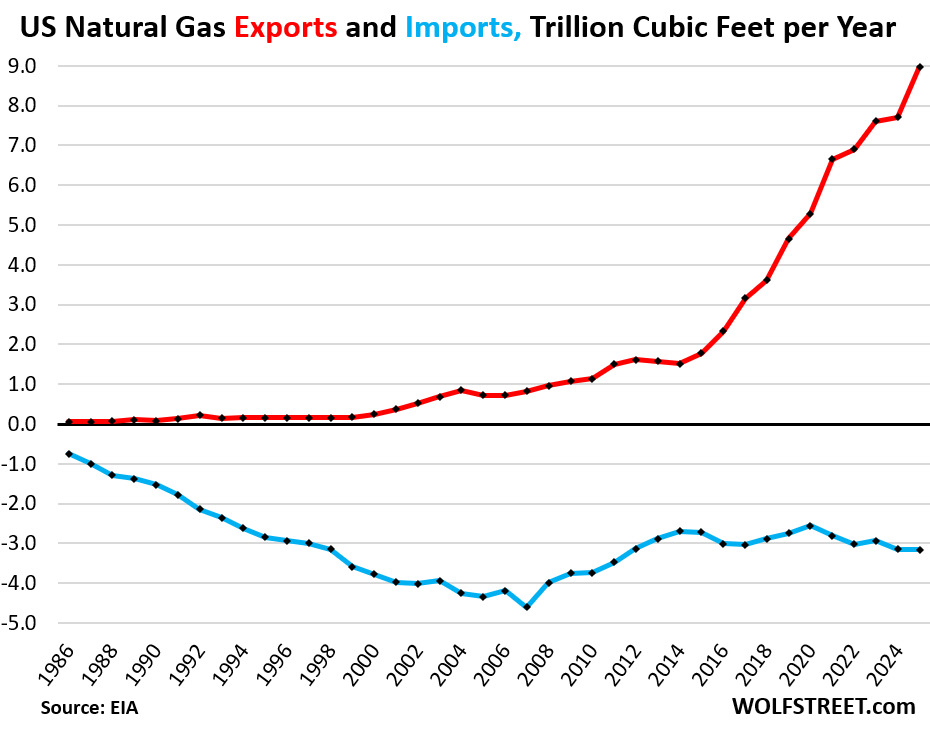
Imports remained roughly stable at 3.16 trillion cubic feet, essentially all of it via pipeline from Canada, and only minuscule amounts via LNG in the Boston area, which is still inadequately connected via pipeline to the producing areas in the US.
This chart shows imports (blue) as a negative figure and total exports as a positive figure (red). The import peak was in 2007.
“Net exports” of natural gas spike to new high.
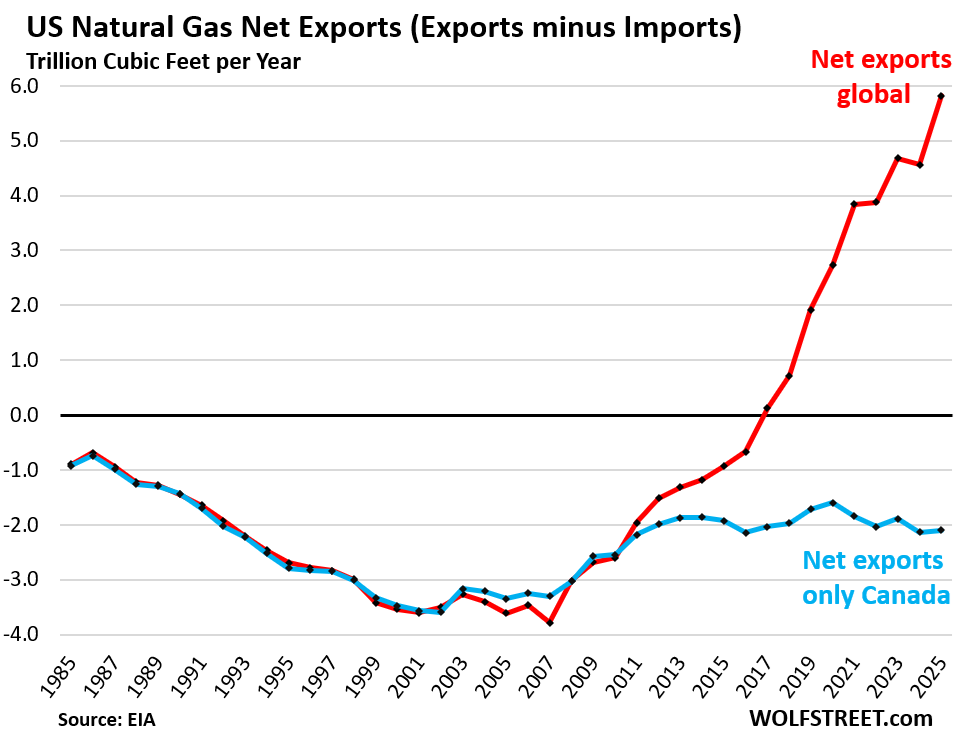
The US became a net exporter of natural gas in 2017, exporting more than importing. In 2025, net exports soared by 27.5% to a record 5.82 trillion cubic feet (red in the chart below).
Imports from and exports to Canada are a function of where producing areas, pipelines, and population centers in both countries are. The trade goes in both directions: The US exported 1.04 trillion cubic feet to Canada and imported 3.14 trillion cubic feet from Canada. On net, the US imported 2.1 trillion cubic feet more from Canada than it exported to Canada; net exports to Canada were therefore a negative 2.1 trillion cubic feet (blue line); this figure is included in global next exports.
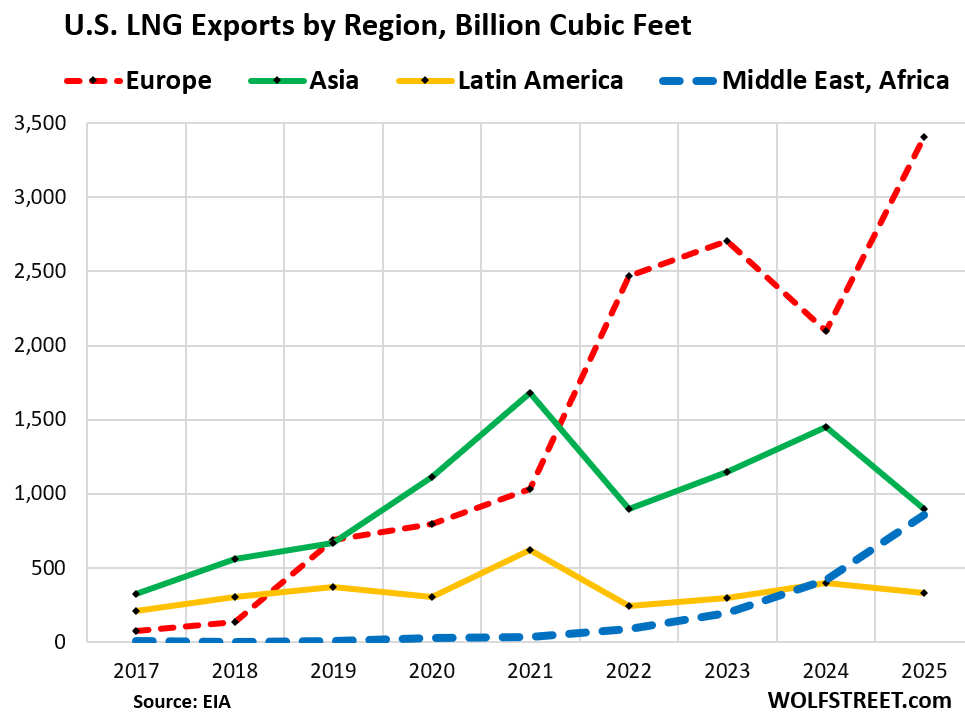
LNG exports by region.
In 2025, US exports to Europe (includes the UK) spiked by 62% to a record 3.4 trillion cubic feet, accounting for almost two-thirds of total LNG exports. Europe became the largest buyer of US LNG in 2022 (dotted red line in the chart below). The importing countries are those that have LNG import terminals that feed into the European system of pipelines, in that order in 2025: the Netherlands, France, Spain, the UK, Spain, Germany, and Italy.
LNG exports to Asia fell by 38% to 899 billion cubic feet in 2025 (green line). The biggest importers were South Korea, Japan, India, and Taiwan. LNG exports to China collapsed to near-nothing.
Exports to the Middle East and Africa spiked by 105% in 2025 to a record 857 million cubic feet, nearly equating Asia, on a massive increase by Egypt, which accounted for over half of the 2025 volume (dotted blue line).
Exports to Latin America fell by 18% to 330 million cubic feet (yellow).
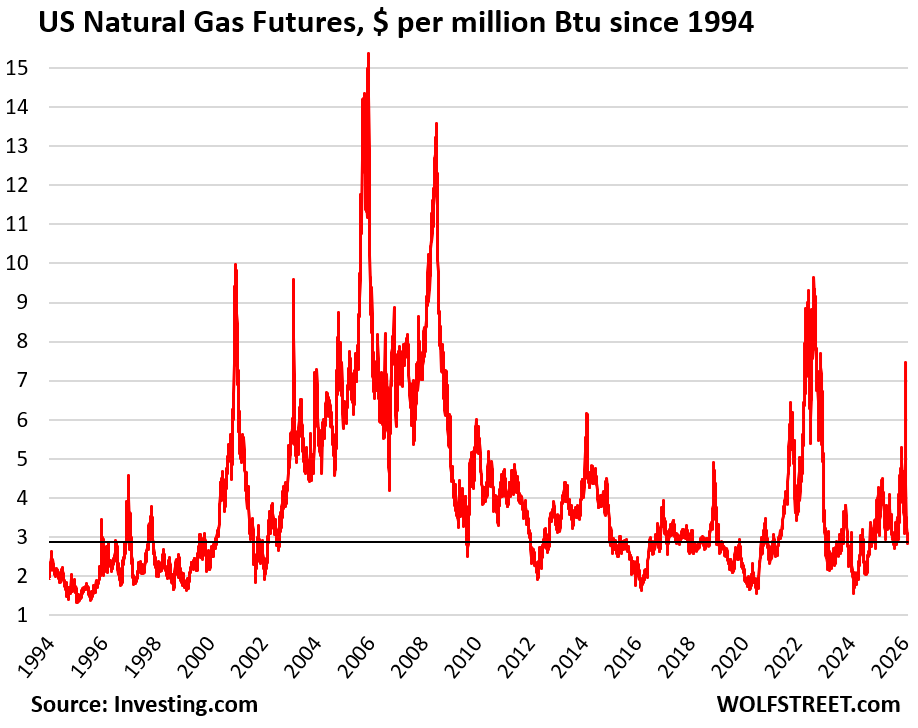
Production boom crushed the price of natural gas.
Currently, natural gas futures trade at $2.89 per million Btu. The brief spike in January to $7.50 due to weather conditions has been wrung out. The price of natural gas was already in this range 30 years ago, despite 30 years of inflation in other products and services.
The reason natural gas can be priced this low is that it’s a byproduct of oil production, and even wells that are primarily natural gas produce significant amounts of other hydrocarbons, including crude oil.
In 2008, a few years after US production from fracking took off, the price collapsed as overproduction set in with no LNG export terminals in the lower 48 states as an outlet.
This low price of natural gas in the US makes US LNG very competitive on the global market. It also transformed the US power-generation industry (see my analysis linked below the chart).
And in case you missed it last week: WHOOSH Goes Demand for Electricity. US Power Generation by Source in 2025: Natural Gas, Coal, Nuclear, Wind, Hydro, Solar, Biomass, Geothermal, Petroleum
Enjoy reading WOLF STREET and want to support it? You can donate. I appreciate it immensely. Click on the mug to find out how:


This might explain my unscientific observation that housing prices in middle income Texas neighborhoods have gone up in the last 2 years.
Ya mean with all the wi…wi…wind and solar, natural gas is roaring like a steam locomotive?
Yoo-hoo! What do ‘renewables’ provide..like 15%?
I just discussed this the other day and linked that analysis in the article above. This is the amount of power generated (not capacity) in 2025 in GWh:
https://wolfstreet.com/2026/02/24/whoosh-goes-demand-for-electricity-us-power-generation-by-source-in-2025-natural-gas-coal-nuclear-wind-hydro-solar-geothermal-biomass-petroleum/
New cheap renewables and highly efficient natural gas combined cycle power plants replace aging, inefficient, and highly environmentally damaging coal power plants that only have marginal utility at times of maximum demand because of their inflexibility.
I just discovered a stream I used to filter water out of when hiking now has prominent warnings not to drink out of it due to acid mine drainage from coal mines leaching heavy metals. You shouldn’t even eat the fish anymore.
Beyond the acid mine drainage there is the particle pollution, water usage, ash disposal and very low efficiency of conversion of heat into electricity power from old coal plants. They’re inflexible, inefficient old eyesores and their death due to new natural gas combined cycle plants is a small blessing to most people who live nearby.
Natural gas is not without its environmental costs, but its better it be used to make electricity than flared since many areas in the US can’t seem to ban the practice.
Buying TAN on the dip in early 2025 ended up being a very wise choice so far. Solar PV has been winning in both Texas and California because it’s cheap and the fuel is free. It would be doing even better if it weren’t for politics trying to stifle a nascent American energy industry to benefit entrenched interests.
Reuters [term: “fossil fuel”]: “However, John Howell, Professor of Virtual Geoscience at the School of Geosciences, University of Aberdeen, told Reuters the term was not coined by Rockefeller, but was conceived much earlier by German chemist Caspar Neumann.”
“The term “fossil fuel” is viewable in the index of a 1759 translation of ‘The Chemical Works of Caspar Neumann”
The high tech world of 1759 and it’s great knowledge of geology (sarcastic), they didn’t even know continental drift then.
“Natural gas (primarily methane) can remain stable and even form in the upper mantle at depths of roughly 100 to 300 kilometers (approx. 60 to 185 miles).” Oilprice.com; keyword search: “natural gas stability depth mantle miles”
There is no end of natural gas to drill out. Organisms will not be able to breath (CO2 of Apollo 13 movie) long before the O2 is depleted, of course the planet will be toasty before then.
What are your thoughts on depletion rates in the various basins in the US? I have read that there is a 5 -6 percent rollover according to IEA. When you have Harold Hamm pulling out of N Dakota because of econnomics and what could be underinvestment, NG may be poised to outperform for years. We all know of its’ reputation but long NG here.
As long as I have reported on fracking (since 2012), there has always been the “Yeah but look at the depletion rates.” But drillers kept pushing the technology forward, they’re refracking wells, they’re drilling new wells that are much more productive, closer together, etc. The process has been amazing, and production has keep soaring.
One thing for sure: I don’t want to live where they frack.
My brother can see a 100’ X 100’ fenced concrete pad with pipes and a green tank from his front porch. The fracking was finished several years ago but the royalties come in the mail every month. The pad is in a cow pasture about a 1/4 mile from his house. This is in southwestern Pa.
Production of gas and liquids from Fracking operations seems to be a simple mater of inject amount of capital A and produce quantity of Gas/Liquids B. The amount of energy produced will be a function of price + improving technique.
The safety of fracking is a function of of the quality of regulation. If the aim of the regulatory state is to mitigate risk and environmental damage, results are usually pretty good. If the regulatory state is completely hostile, then the results are usually pretty poor.
The main thing seems to be to ensure that wells are properly cased down to an appropriate depth safely below the surface water level which is usually a few hundred feet.
fun fact, cement has been known to debond from the well casing, the well bore or both during the frac op.
the casing itself has been known to fail long after the frac op.
many things have to go right. not just regulation.
US oil production has reached record highs also, allowing for the increase in nat gas. There has been a lot of speculation that lower prices would lead to lower output as shale formations dry up pretty quickly, but that doesn’t seem to be happening.
Hmm, I wonder what could be done, in order to raise prices, overnight?
The Russian war spike was unsustainable. Maybe if we… err, some enemy nation like Iran, closed down major shipping lanes?
Yes, US oil production has risen by about the same percentage sine the late 2000s.
Not quite. Between 2009 (when production started rising again) and 2025, production rose year-over-year in a range of -7.7% (2020) to +17.2% (2014), and everything in between. In that period there were 3 years of declines and 5 years of double-digit increases. There were two big US oil busts in that period with hundreds of oil & gas drillers filing for bankruptcy. Article coming.
It seems imprudent to export energy when you seek energy independence for now and the future.
AND, with the recent geopolitical events, the energy inputs into the inflation calculations which have lately tamped down the numbers now will likely have the inverse effect going forward in the short term.
Energy spikes will be explained away by the financial “experts” who defend the narrative, and their positions.
This data show how incredibly wrong the “peak oil” and “peak natural gas” and left wing enviro antifracking crowd has been since about 2008. If we had listened to that very vocal crowd, we would still be dependent on middle eastern oil and Europe would be under the heel of Russia for natural gas and oil. The fracking revolution is the best thing that has ever happened for US energy independence and the people who fought against it should be completely discredited.
Interestingly, total fossil fuel production worldwide has only grown about 1% per year since 2013.
Peak oil as a fundamental law of nature or economics was always really dumb. Peak oil as a result of improving technology (i.e. we eventually develop alternatives that are better so we don’t need it is much) is highly likely to occur.
…. ,and the effects of fracking are still to be determined. Like many say, ” not in my backyard”. The exporting of natural gas helped support the price to the supplier. Yes, the technology further advanced production, but without the so called liberal input and the opening to exporting, it would have been years later.
Exporting was accomplished by U.S. Government action starting in 2008 during a liberal Congress and President. Trump used his, drill baby drill stump rhetoric for his fans. The production and exporting were already here.
You’re kind of confusing some terms and concepts here. Peak oil isn’t really a concept invented by environmentalists. Rather, it’s a concept that dates back to the work of geologist M. King Hubbert in the 1950 which predicted that natural resources production and depletion follows a bell-shaped curve.
Hubbert Peak Theory with respect to oil production actually turned out to be remarkably prescient, up until new oil extraction technologies came into play.
Hubert’s curve is still considered a useful tool for predicting resource depletion, it’s just that it needs to be applied individually to specific oil producing regions and extraction methods, rather than lumping “all” oil production into one bucket.
Be very thankful that you have had governments that have succeeded in this, earning the country large sums of money. Norway has done similar and their sovereign wealth fund is now close to a trillion dollars. In consequence they own a large part of the biggest American companies. I am surprised that their voters tolerate this, because they are very heavily taxed.
So we still have not had a president who prioritized decarbonizing the energy infrastructure?
Obama’s all-of-the-above strategy was his typical everybodyism, and Biden was pedal to the floor on gas, continuing Trump 1. Yet those Dem presidents get portrayed as green crazies on energy.
The ferocity of arguments about green energy policy in the US is kind of funny, given how consistent actual policy has been across the two parties.
Even the substitution of coal with gas has been a bipartisan issue!
Yep, the renewable energy production has increased also. We can’t be fooled by political talking points. The energy industry has the last say, no profit=no production.
The fossil fuel execs were smart to rebrand their industry as energy and leave behind the fossil fuel name.
Glad they dropped the “freedom molecules” thing though.
I lived for many years in Texas and Oklahoma, through the oil boom in the 1970s when OPEC turned down production and the price of oil exploded and money was flowing knee-deep through the streets of the Oil Patch, and I lived through the terrible oil busts of the 1980s in Tulsa, the Oil Capital of the World, as it called itself until then, when all the oil companies moved their headquarters from Tulsa to Houston. And I don’t think I’ve ever heard the phrase, “drilling for fossil fuels.” It was always “drilling for oil.” And the industry was “oil and gas,” and people worked for an “oil” company, not a “fossil fuel” company. “Oil” was a word like “gold.” You got rich if you struck it, or you went bust trying. Those were the days. And “never ever drill with your own money,” was another piece of industry wisdom.
How long ago was he president? Aren’t there kids in college who were in diapers then?
Grow up like them sir.
…. ,and the effects of fracking are still to be determined. Like many say, ” not in my backyard”. The exporting of natural gas helped support the price to the supplier. Yes, the technology further advanced production, but without the so called liberal input and the opening to exporting, it would have been years later.
Exporting was accomplished by U.S. Government action starting in 2008 during a liberal Congress and President. Trump used his, drill baby drill stump rhetoric for his fans. The production and exporting were already here.
And the liberals, in Boston,( my hometown) have kept OUT pipelines of natural gas. They also restrained LNG tankers entering the harbor. This policy exists to this day. You are correct, our Governor said not in our back yard….but still wants cheap energy!
“peak” ment the prices, not the volumes. 2007 2008. why did we wait so long to blow up Nord stream 1 & 2 ?
Wolf!! I remember environmentalists mentioning around 2010 that earthquakes will happen. There is no out of ordinary earthquakes. Isn’t it so? Please advise. Thanks
There have been lots of earthquakes in Oklahoma and Texas, up to about 5.0 on the Richter Scale. Regulators have stepped in and curtailed injection wells (where the toxic waste fluids that came out of oil and gas wells, along with hydrocarbons, get injected back deep underground), which were thought to be the primary cause of the quakes. This is a really big issue.