
The sudden CEO switcheroo was just the latest spooky thing.
By Wolf Richter for WOLF STREET.
Shares of PayPal plunged 20% on Tuesday, to $41.70, after it reported earnings that missed expectations on a variety of metrics, offered Q1 guidance that disappointed, and did a CEO switcheroo out of the blue: It booted out CEO Alex Chriss “effective as of February 2, 2026,” the company announced in the SEC filing on February 3; and it hired a new CEO, HP CEO Enrique Lores, effective March 1. Criss “will remain an employee of the Company in a non-officer capacity through March 2, 2026 to assist with transition matters,” it said. And CFO Jamie Miller would serve as interim CEO until March 1. All this is kind of spooky. But PayPal has been a spooky stock for a while.
The stock [PYPL] has now collapsed by 86% from its goofball meme-stock all-time high of $308.53 on July 23, 2021, and thereby has made it into our pantheon of Imploded Stocks, for which the minimum requirement is a plunge of at least 70% from the more or less recent all-time high.
PayPal had two public listings: Its original IPO in 2002, six months after which it was acquired by eBay. Then in 2015, eBay spun off PayPal and it has been independent ever since. So it’s that second round as a public company that we’re looking at here. The stock market is full of these kinds of crazy charts documenting the meme-stock mentality:
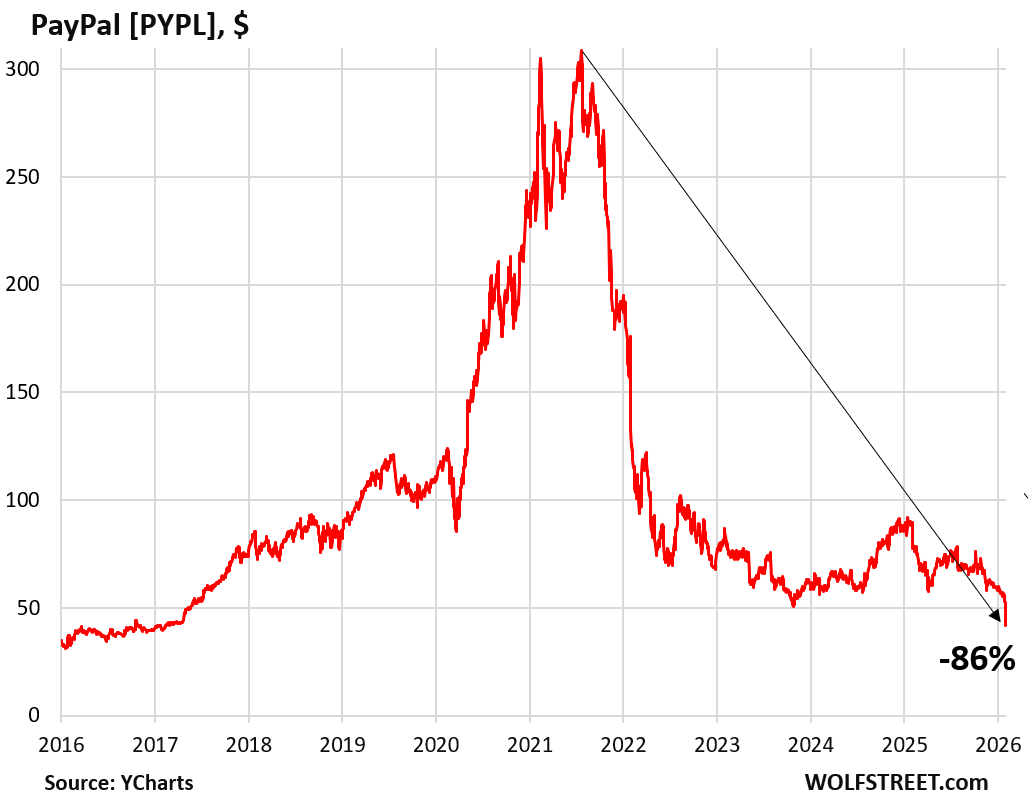
The company has had rising revenues year-after-year for years, and substantial profits that it extracted from each transaction via its substantial fees. It’s not like this company will suddenly keel over or anything. But it does have some challenges beyond the goofballs that drove up its shares to $308 by July 2021.
PayPal, the legacy digital payments service, has a lot of competition in the digital payments space these days, including Apple Pay, Google Pay, Amazon Pay, Shopify Payments (Shop Pay), Zelle, Stripe, Square, Wise, Payoneer, Skrill, Klarna, Buy-Now-Pay-Later (BNPL) providers that have invaded ecommerce checkouts, and others.
PayPal’s revenues are largely from fees deducted from the amounts the recipient receives ($4.0 billion in Q4), and from the interest it earns on its customer balances ($3.7 billion). The transaction fees are a mix of fixed fees and a percentage of the transaction amount. For small merchants, those fees add up.
Peer-to-peer payments system Zelle is an increasingly strong competitor. It charges no fees to either party. Zelle is owned by Early Warning Services, which is owned by a consortium of banks. The service is integrated into online bank accounts, and most bank customers in the US have access to it in their online bank accounts. Transfers are instant and free. But it cannot be used for international transactions. And ecommerce sites don’t offer Zelle at the checkout.
Zelle processed 3.6 billion transactions in 2024, totaling over $1 trillion, up by 27% from 2023. In the first half of 2025, it processed 2 billion transactions, totaling $600 billion, up by 23% year-over-year. Payments to small businesses – such as WOLF STREET for donations – increased by 31% to 180 million transactions in the first half of 2025.
Compared to Zelle’s growth rates, PayPal’s growth rate of “total payment volume” was a lame 7% in its just reported year 2025.
Zelle’s no-fee feature is hard to beat. And it has been eating into PayPal’s transactions.
So PayPal also expanded through acquisitions, including these major ones:
In 2013, it acquired peer-to-peer mobile payments app Venmo as part of the $800 million purchase of Braintree. In 2015, it acquired digital money transfer company Xoom for $1 billion. In 2018, it acquired iZettle, a Swedish payments processor, for $2.2 billion. In 2020, it acquired tech company Honey for $4 billion, which operates a browser extension that automatically applies online coupons on ecommerce websites, and that has gotten tangled up in all kinds of allegations and lawsuits. In 2021, PayPal acquired Japanese BNPL app Plaidy for $2.7 billion. If your competition eats your lunch, buy your competition.
Enjoy reading WOLF STREET and want to support it? You can donate. I appreciate it immensely. Click on the mug to find out how:


“If your competition eats your lunch, buy your competition”
That hasn’t worked too well for HP and INTC
They’re all doing it.
They became way too political starting in 2001.
They froze my account after I tried to buy a ticket to a Republican National Lawyers Association event in 2002.
It’s still frozen. They are still sitting on approx. $200 in my account.
Your state should have the funds in their unclaimed property fund. This would be the state you used when you signed up originally.
Thanks for the tip. I didn’t know that.
Their political posturing (“censorship is okay when we do it”) is why I stopped using them when they uncoupled from Ebay (they were required use on my occasional Ebay sale). Once they decoupled I set up a zero-balance-account for Ebay, turned off my PayPal account, and never looked back.
As noted Zelle then appeared for free at local banking, and what I use on the rare occasion I need this sort of service.
Zelle is definitely superior. Money is xferred in seconds; no fees for seller, no political suppression, no profits to support leftist manager and workers.
I thought I was the only persona nongrata at PayPal who they confiscated $200 and froze the account. Too small of an amount to litigate.
I suspect Paypal ‘stuck’ 100’s of thousand of customers, if not millions.
Oddly enough, no one at Republican National Lawyers Association ever did anything, or hardly responded to my inquiries. Because of that issue, and other situations, I have concluded that the brass at Republican National Lawyers Association are just a bunch of ladder climbers trying to improve their credentials for positions in the party or the administration, or as Congressional aids.
Don’t expect positive change to come from any political party. It’s only going to come from people. Real people – not “money’ed” interests (like Soros for the Dems) or corporations for the Repubs.
Worked amazingly well for Google.
Worked too well for whom?
Do most of the executives still have jobs despite these blunders?
The principal-agent problem seems to grow with the obsolescence of the product. Eventually the executives loot the last value out of the sinking ship.
Think about it. It spawned the rogue capitalists that the US population has to deal with. We have reached the end where the tax receipts are insufficient to pay for the basic humanistic alternative discussion about AI
Pay pal, an appropriate warning
PayPal been around a longtime (5 years to implode). Gave many people confidence in internet purchasing. Not a very sexy industry – paying bills etc. Ever since govworks? documentary trying to take a cut to pay a bill, I still pay old fashioned way. Bank t/f.
Which are all factual reasons of why it was successful especially your succinct description:
Gave many people confidence in internet purchasing.
> and it hired a new CEO
That’s often a positive
> So PayPal also expanded through acquisitions
Not a bad plan if the company generates strong free cash flows and has low debt, which it surprisingly does. On paper, the company appears healthy and stable financially. Good execution could stabilize it by using existing cash flows to secure new growth vehicles and mitigate cash-flow erosion.
Of the many imploded stocks, this one seems more hopeful. At least for investors who buy it when it’s in the dumps and not heights.
> That hasn’t worked too well for HP
Lows to highs during last 5 years shows reasonable returns. Don’t think a bargain investor would be disappointed with HP over this time frame. If you hold stocks till death do you part than sure, it’s a terrible pick.
Wouldn’t touch PP with 10 ft pole after they froze my account for 6 month for one misspell of my last name happened 20 years ago.
you don’t trust grifters like musk and thiel? why not ?
PayPal stole $5 from me maybe 10-15 years ago. Can’t remember how, but remember they stole it. Closed account and never trusted them again. Heard many stories like that.
The number of stories on this board alone is concerning enough. Shows a pattern of failure and an attitude of customer abuse.
Had two different credit card numbers stolen by PayPal workers to make fraudulent charges with and never used the service again.
That is exactly the citizen democratic exercise of rights that they forgot they had because they have been eroded rather than assaulted.
Tbh, I think PayPal will be fine.
Younger generations love it.
They increase their revenues by about 3 billion a year.
I thought PayPal was for boomers, it’s been around since the 1990s. Young people use Apple Pay or whatever.
When we do fundraisers for co-workers getting married or having first kid, I get looked at like a dinosaur when I say I have PayPal but not Venmo. (I also can do zelle but they dont know what that is either.)
sufferinsucatash,
We know different younger people. My sons generation(he’s 19) uses Zelle and sometimes Venmo. They are also completely against boomer platforms like FB.
Venmo is owned by PayPal.
Yep. Paypal owns about 30 different payment companies.
I bet they all use the same back-end from PayPal.
I trust PayPal over all the ones listed.
Those Swedish companies are just screwing everyone.
I can’t remember but I think Zelle gets hacked all the time?
If a random website I need something from, say rear view mirror mittens. If they have PayPal acceptance , then I’ll buy from them directly. If not, then I’m skipping the purchase.
All the payment platforms listed, I’m not even sure they are all competing with each other?
I think millieniels learned about PayPal from using eBay. And Gen X too of course.
At least PayPal doesn’t put you into debt and gurantees the purchase up to $100. Has your back a little bit. Although the credit card companies, your bank, has your back more.
We need to boot those Swedish companies to the curb tbh. Pay in 4 is bullshit
Zelle has never been hacked. It gets a bad reputation because naive people get scammed, use Zelle to pay the scammers, and then blame Zelle for it.
It is as dumb as blaming your wallet for making you lost $100 at 3 card monte in a new york subway station.
Gen Z has money?!
Haha
A 19 year has YOUR money
No, they’re broke, but they at least admit it, unlike we millennials did at that age. In those days we just went into CC debt. Well, most people I know did – I always avoided debt whenever I could.
No, younger people use Venmo (which to be fair, PayPal owns), Zelle and Apple Cash.
paypal is a scammer co. The online purchase guarantee money back is impossible to get. They keep you in email hell until the dreaded our refund time limit has expired. Sorry
Well if PayPal doesn’t fix it then go thru your credit card bank. They will.
I like PayPal, obviously. Never had an issue
Note to self: never use Venmo.
@sufferinsucatash
The kids use Zelle, or some app I’ve never heard of.
Give the kids a book to read and tell them to quit plagiarizing using AI.
Haha
Their buy now pay later just seems a little sketchy to my cynical self. Then again who knows? Also their ceo sudden change without a heads up could be good but didn’t the new ceo come from a stalled hp? That’s gotta inspire copious amounts of confidence does it not?😂
I got wacked on this one trying to bottom fish. There might be other shoes to drop here. Caveat emptor.
to lazy to switch. Have to much setup already in paypal. Though I absolutly despise the people behind the company.
And their scam with the browser extension (honey?) which was steeling hundreds of millions from sponsering deals from creators.
Just a matter of time before I dump it. Their bigger problem is that there is little reason for someone to start using paypal because now there are so many other options. They would need to start growing in emerging markets with a big young population. In the “west” there is little growth opportunity left for them.
I own Oracle and it has become an AI meme stock. I fear that it is on the way to imploded status.
Oracle licensing is super expensive. One project rewrote all their components to simply get away from it. Plenty of database and software services out there that do it for a fraction of the cost. Same could be said for much of IBM too where better solutions exist at 1/10th the cost. Although IBM has been buying up those better options like everyone else so won’t last long.
Agree. It’s hard to understand how Oracle remains viable. I can only guess it’s due to how sticky legacy is. For most applications it seemed like Postgresql worked well, had a mostly compatible language, is free but still well supported and a relatively inexperienced tool user could manage most of the DBA stuff. A even more than free, there was much less friction not having to deal with marketing and licensing. Maybe there is some sort of scaling advantage with Oracle…I don’t know.
No one ever got fired for buying IBM, or perhaps Oracle too .
Here in the UK I have found that the combination of eBay and PayPal is by far the best method of online purchases. Their dispute resolution process works extremely well, dodgy sellers are quickly punished and the money is back in my bank a/c within days. I would never consider allowing a direct withdrawal from my bank account under any circumstances from any seller. I avoid Amazon, they have no PayPal option, if I have to use them it is only by credit card, to limit my potential losses.
You touched on the only positive experience I ever had with PayPal, dispute resolution as a buyer
PAYPAL IS BOOMER STUFF. I’M A BOOMER. I THINK I USED IT ONCE OR TWICE. USED ZELLE FOR MY RUSSIAN MAIDS……….MORE IMPORTANTLY, THE TRUE MONEY THAT HAS ALWAYS WORKED ON ALL CONTINENTS IN ALL TIMES. In Germany’s Bundesbank, gold now represents roughly 80 percent of the entire balance sheet. There is thus motivation in many places to continue boosting the gold price. It is an elegant way to stabilize the monetary system while simultaneously repairing past damages across different institutional levels through a simple repricing.
States Strive for a Gold Monopoly
It is almost a historical irony. When U.S. President Richard Nixon terminated the dollar’s convertibility into gold in 1971 amid soaring debt and massive inflation of liabilities, the so-called fiat credit money system was set in motion. Debts exploded, and states could borrow nearly without limit.
Unbacked credit, combined with ever-lowering reserve requirements, created a perfect Ponzi system, which has now entered its crisis stage.
“Germany’s Bundesbank, gold now represents roughly 80 percent of the entire balance sheet.”
This is completely fabricated goldbuggery bullshit.
As of the end of January, the Bundesbank had:
€2,246 billion total assets
€348 billion in monetary gold plus SDRs (IMF Special Drawing Rights).
Gold plus SDRs = 15.5% of total balance sheet.
https://www.bundesbank.de/resource/blob/621440/58259979ae0749e140aa51cd4264c5bb/472B63F073F071307366337C94F8C870/finanzielle-vermoegensbilanzen-data.pdf
The Bundesbank has not bought ANY gold at all in a very long time.
@Wolf
“completely fabricated goldbuggery bullshit.”
Sir, I continue to be filled with admiration at you command of the language.
Please continue.
Thanks for the info there. Facts are helpful.
thanks for the link and insight. it’s so funny how gold makes people crazy to love and to hate. i don’t give a flying fuck either way. i’ve been collecting silver coins since LBJ took it out of our coins in 1965. cost basis 1 paper dollar for once ounce of silver. gold has been money too. accepted everywhere and anywhere as money for thousands of years. i lived in charleston SC for a decade. every single family there, that still owned their mansion downtown and their 1000 acres of plantation land up the rivers a few miles sold confederate us dollars for gold. same goes with countless other instances when gold is good to have hidden for those rainy days. not if, but when the USD is confetti. i keep my italian lira and zimbabwe billion dollar note in my wallet next to an ounce of gold and silver and 250 year old coin from the last year of the portuguese minting them as the earthquake in lisbon put the end on their empire. thanks again wolf. your little blog is wonderful. great insights you share with us.
Lol. Get caught in a blatant lie, pivot to “I don’t understand why everyone gets pissed when I lie to them” plus “I don’t care what you think, neener neener”
Where do you come up with such laughably delusional nonsense?
Like a lot of people I thought PayPal was a market leader with a big moat a few years ago. There is a lesson in here somewhere. What I thought was a moat was just a large puddle.
Economies based on debt, like the USA. are inherently prone too inflation.
If you get a chance, look up the PayPal Mafia. There are two underlying currents common to most of the members. Unnerving at best.
I know this article is focused on PP’s stock price but has anyone on this discussion ever just walked your ass down to the store to buy something? Maybe I’m just old.
If I want to get exercise outside — which I do all the time — it doesn’t include going shopping. There are a million better ways to exercise.
We still buy some things at stores, but that is shrinking every year, down to almost exclusively groceries now, with about 1/3 or our grocery purchases already having shifted to special online only regional grocery sellers (get the order in before deadline in the afternoon; they pick the next morning and deliver in the afternoon/evening). We can get all kinds of things that we cannot get in at the normal stores, and it’s usually a lot cheaper. But PayPal is not involved when we buy.
I’m not old, and I walk to the store whenever possible. It gives me a reason to get out of the house, as well as the instant gratification. A lot of the time I also find options in stores that I didn’t know existed – or wouldn’t have been able to find without routinely browsing through a hundred pages of thumbnails. Last week I took the light rail an hour and a half downtown to a local shop to get like 2 things because I’m not a vampire like my roommates are, who sit on the couch and send all their money to Jeff Bezos. These stores can ship things but it usually isn’t free, so you have to go there and interact with strangers, heaven forbid.
The day Paypal decidedly to “fine” their customers $2500 for wrongthink and wrongspeech is the day they destroyed their business.
Where does Shop fit in the payments scheme? It seems new and pervasive. Is is part of something else?
I’d never heard of Shop. Seems that every day another retail payment fintech company appears. That has to be an awfully crowded market and no one outfit is the head of the class. PayPal was able to make deep inroads early as it was a mandatory link to eBay and at the time eBay was truly unique. Now the sector looks like a free for all.
It’s a service by Shopify, and used Shopify Payments as payments processor, which I listed.
Thanks. I have a hard time opting out of Shop. I guess by design.
Pay pal account of mine lost me 60.00 dollars US when I did not use it for a few years. The state of NJ took the money because it was an inactive account.
States can do that to your bank account too. When there is no activity for a certain number of years, states can require the financial institution to send them the balance, and then you have to chase after it at the state. I have an unused bank account at my broker with a few bucks left in it for years. And one day, I get an email from the broker telling me to transfer the money out because the state wants to take it.
PayPal’s biggest problem for most of the past decade is that it has been a finance-driven rather than a product driven organization. As a result, PayPal has acquired multiple other companies apparently unguided by a coherent vision of the payments problems the company aspires to solve for consumers or merchant alike, and without a map to monetize some of them (poster child: the uber-successful Venmo). None of this bodes well.
I’ll play my tiny violin for PayPal. I remember when they used to pay you interest on money you left with them. They were just passing on the interest from the bank they held your money in minus their cut. Then they cut that and got aggressive locking people out of their accounts. Mostly because holding on to that money made PayPal money. I still occasionally use it (class action settlements and refunds and what not), but I take that money out immediately. P2P transactions I just use zelle.
As I mentioned in the article, nearly half of their revenues is from interest they make off their customers’ balances.
Hence they’ve applied for a bank licence. After all, charging 20% and only giving 2% is a easy business.
Have you ever tried to contact PayPal to resolve an issue – did a few years ago – it would be easier to descend and ascend Dante’s nine levels of hell than get support from this outfit.
Amen commented earlier about my experience with them. I hope they disappear
Which is the question that every dimwit American should instinctively be asking themselves is the cost of the dominant Financial sector worth it. I don’t think so
Given my radical opinions when I was young I would have been more forceful.
But I am old and subject to the various frailties that that entails.
Aware that love is the glue.
Reddit appears to be imploding now as well. Their valuation was stupid high 115 PE+. At one time last year, Reddit had a market cap higher than Ford. One measures their financials in millions, the other thousands. One makes and has actual cars, the other sells garbage data to Google for peanuts (they are like 40% of AI, which is sad and scary, but only got paid in the low $100M which just shows they suck at business). It’s just a giant data landfill with no account verification.
Is it just me or is the equity market getting a lot smarter recently?
Speaking of valuations – Palantir imploded from 400 P/E to 200 P/E. Practically a bargain. No one knows what they do, but they recently added AI to their description.
What does it do? It works 👍
Trust us bro!
I for one am glad all this garbage is finally getting offloaded. We will come out of the other side better for it.
The Reddit platform is cool but they have driven off large portions of their users by closing subreddits they don’t agree with. It’s such a one sided echo chamber now. So much for freedom of speech.
Their business problem is verification – they still run the old fashioned “check this box and you’re 18!”.
Unlike many social media accounts these days, they know nothing about their users. Demographics? Age? Nationality?
Which means it’s a lot of data, sure, but it’s filthy data. And everyone’s already gone dumpster digging and they don’t need anymore filler.
Days are numbered for this one – if they started requiring users to prove they’re not teenagers from North Korea the site will rebel.
Freedom of speech doesn’t apply on private property. It’s their house, their rules.
Sure but enough people will leave the site if they feel they can’t voice their opinions. As Kirk mentioned if they try to verify their users it will cause a big problem. Genuine users like myself will also leave in mass. I will never share my real information with them. I’m one subreddit away from closing my account.
Reddit shouldn’t be a stock.
It’s just a meme stock
The site is fun to read.
Speaking of imploded…it’s time to call it on Bitcoin, down over 1 year from 126 K to 73 K or approx 42%. To think that some zeros and ones (binary digits aka bits) have been treated as an asset alternative to gold…
I wonder how much longer CNBC is going to have a ‘Crypto’ heading at the top of their page along with Bonds, FX. OIL, Metals etc. My fave DOGE has been 10 cents for about a month now, so it’s more stable than BC. But is anyone breathlessly awaiting the next move in DOGE?
Does it rank with the South Sea Bubble where Isaac Newton lost a bundle. or the Dutch Tulip Bulb craze that almost wrecked their economy? Not quite. Some of the South Sea islands did produce a profit in real goods, just not enough to support the bloated expectations. (AI?)
Today Holland makes about a hundred million a year exporting tulip bulbs.
So there was SOMETHING there to hype.
The difference was that the Dutch Tulip Bubble and the South Sea Bubble fizzled out within months. The crypto bubble has been going on for years. Maybe people are getting dumber over the centuries?
But of course the price of crypto is manipulated in fake markets set up by the holders to attract fresh fiat money.
I don’t have a lot of faith in BTC, I definitely could care less about meme coins, but Ethereum … that’s actually different, because it happens to be the rails all these carts move along. I don’t think we’ve seen the end of crypto, the next leg of the venture will come in heavy with gamification, and all of that will sit on Ethereum. So if memecoins are tulips, that makes Ethereum the cargo ships (not a more different tulip).
Cargo ships are useful.
Just the way I see it – NFA.
The crypto vrs metal stackers wars on 4 chan business have been epic lately,have provided me with many smiles in a crazy economic world we find ourselves in.
Lemme guess: they’re bragging about pay-day leveraging their tax refund to buy Gold at $5,899?
ETH lost 90% of its value in 2018. And then 75% of its value in 2022. It’s just gambling
AI is definitely a bubble, but some winners are going to come out of it after the shakeout.
What I don’t get is even fidelity’s people and strategists were pushing Bitcoin.
One analyst I follow early 2025 said Bitcoin was a part of the new 60-40.
That was such bullshit
And everyone who bought into it is now poorer for their retirement.
Stripe is no alternative to Pay pal for repeated payments of things like monthly newsletter subscriptions, because it is impossible for the subscriber to cancel the subscription.
You as subscriber have to request the seller to terminate, but they can tell you to get lost. Then you would have go through the bank and credit card chargeback procedures.
Misread it the first time around as “WOLF STREET donations increased by 31% to 180 million” and though Wolf’s doing well until I re-read the paragraph :)
Classic value trap or a misunderstood buy?
Neither. Future meme stonk.
AI Turns From Tailwind to Threat as Software and Legal Stocks Collapse
AI was supposed to lift all boats. Instead, it’s suddenly exposing winners and losers. Investors are dumping software and legal tech names as automation fears turn into earnings pressure.
Pay Who?
Oh yeah, those losers. Almost forgot about them. Left them years ago due to questionable business practices.
MSTR might be a microcap soon if Bitcoin continues to collapse.
It’s now well within the Pantheon of Imploded Stocks. I really hope Wolf does a write-up on it!
Venmo, Paypal, Zalle, Cash App are all in bed with the IRS. All the income one receives through these payment networks gets reported just as though you got a 1099. I would never use these payment networks. I just got a notice from my sports betting site that they they are reporting any cumulative winnings over $600. I made well over $1,000.
Trying to commit tax fraud? If you make money, even betting or gambling, you need to add it to your taxable income.
Zelle has NEVER sent us a 1099, and we have both used Zelle for over a decade to pay and get paid. If you’re a merchant and get paid via PayPal, it will send you a 1099.
Paypal is doing such a great job, their stock has just joined Wolf’s list of imploded stocks. We just had a lender from California who wanted to pay us via Paypal or digital ACH payment, and we told them we would not accept payment in that form. They had to back off.
ACH payments are good and free for the recipient, unlike PayPal
It’s cuz they need help funding your social security and your Medicaid.
You don’t seem to be making smart decisions so Congress decided to make you invest in your own future.
Remember that when you are 88 and checking out with your beans and rice. 😆
*medicare
Seriously??? You are betting sports online and you just realized that winnings are reported to the IRS??? If so, you definitely should not be betting sports. You should not bet sports with the online sportsbooks anyway, they are set up so you can’t win. The spreads are so wide, the bettor has almost ZERO chance of winning. And if you do by any chance happen to have a winning year, winnings are taxed as ordinary income, not capital gains, so there is no tax loss carry forward. Let’s say you lose $5000 your first year, then your second year by some miracle you win $5000, well you’re even right? But since you can’t deduct the loss from the first year, you still owe taxes for the second year! They’ve got you coming and going.
Zelle, ShopPay, SofiPay, Google Pay, Apple Pay, Fed Now, Stripe, Square. I”m sure I’m missing some but their TAM is meaningfully shrinking.