
ICE vehicle sales dropped 28% from 2017 peak, while EV sales soared 648% over same period.
By Wolf Richter for WOLF STREET.
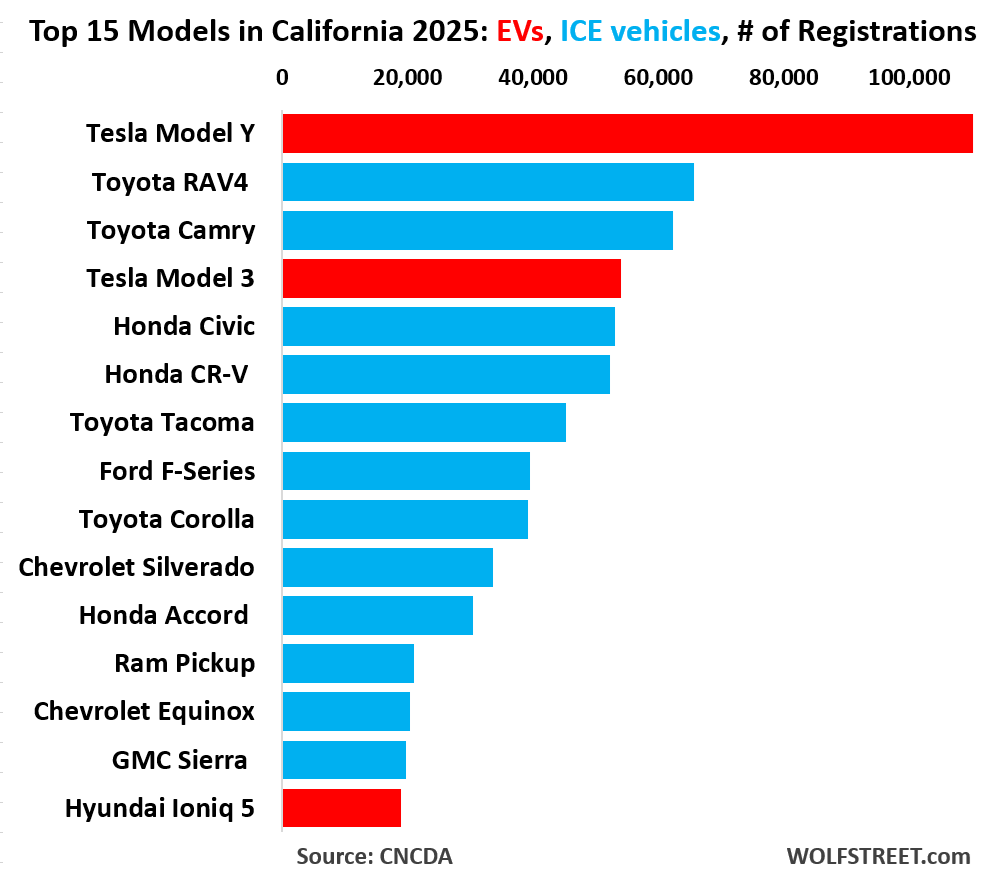
Tesla, California’s native son that once walked on water, and the only major automaker that manufactures in California, lost market share for the second year in a row in 2025 in California, but its Model Y was still the #1 bestselling model, with a share of 6.1% of all new vehicles sold, outselling by a huge margin the #2 bestseller, the Toyota RAV4 (share of 3.6%), according to registrations data released by the California New Car Dealer Association (CNCDA).
The pecking order of the top 6 bestsellers remained unchanged from last year. But further down the list, there was some elbowing for position: The national #1 bestseller, the Ford F-series pickup moved up two notches to #7 in California, pushing down the Toyota Corolla and the Chevrolet Silverado, each one notch. Thereby, the Silverado, national #2 bestseller, landed in the #9 slot in California.
The red bars are battery electric vehicles (EVs). The blue bars are ICE vehicles, including hybrids (if it has an ICE under the hood and the driver fills it up with gas, it’s an ICE vehicle, even if it has some electric components in its powertrain).
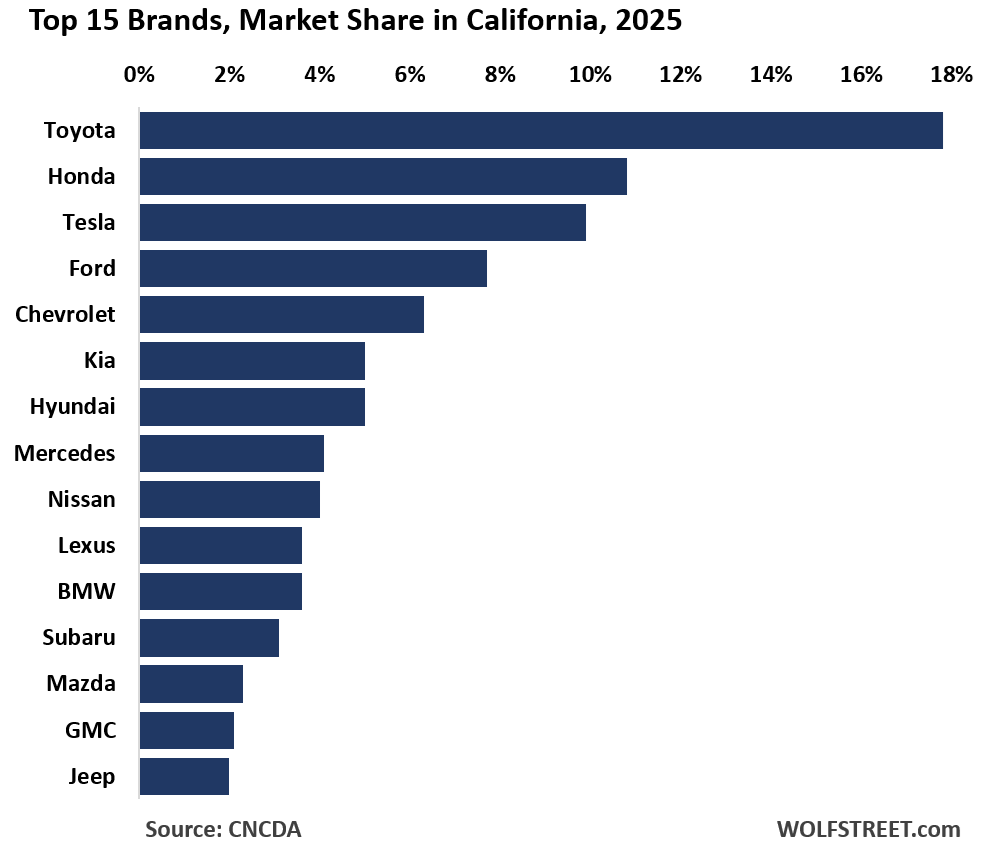
The most popular brand in California, Toyota, increased its share to 17.8%. Honda leapfrogged Tesla and reclaimed its classic hold on the #2 spot with a share of 10.8%.
Tesla lost lots of ground. Its share dropped to 9.9% of total new vehicle sales in 2025, from 11.6% in 2024 and from 13.0% in 2023. It had been #2 in those two years. In 2023, it was only 2.7 percentage points behind Toyota; now it is 7.9 percentage points behind.
California accounted for 11% of Tesla’s global sales.
But Tesla is still the #1 US brand on this list, ahead of Ford (7.7%) and Chevrolet (6.3%).
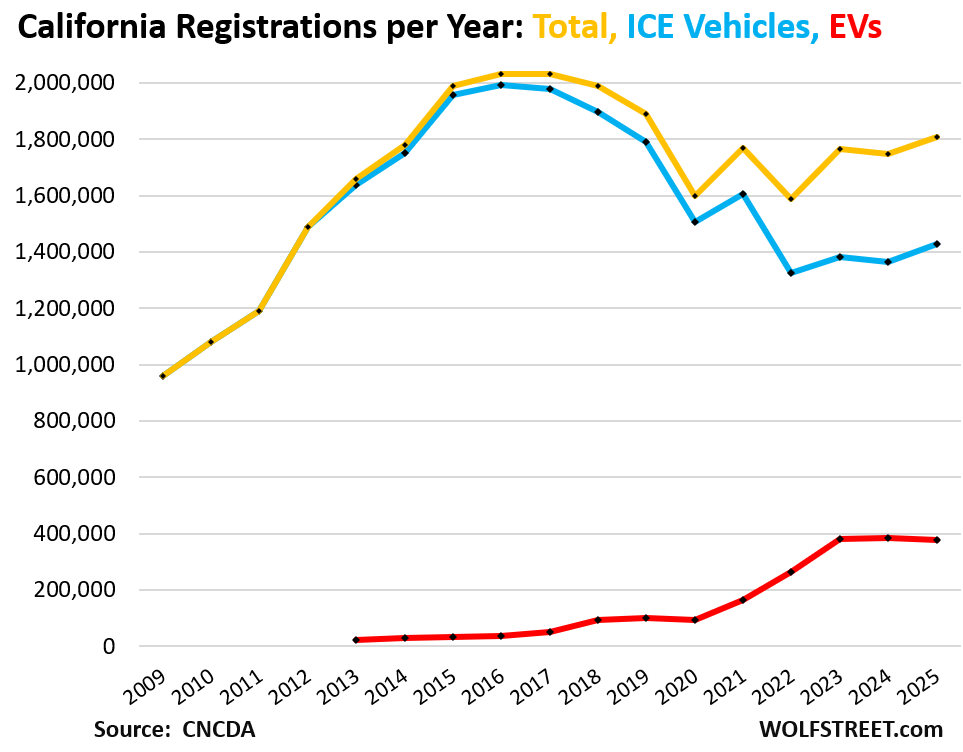
Overall vehicle sales in California (yellow in the chart below) rose by 3.3% in 2025 to 1.806 million vehicles, but were down by 11% from the peak in 2017.
ICE vehicle sales rose by 4.8% to 1.429 million vehicles in 2025, but were down by 28% from 2017.
EV sales dipped by 1.9% in 2025, but were up by 648% from 2017. And non-Tesla EV sales jumped in 2025:
- Non-Tesla EV sales: +8.7% to a record 198,560 vehicles.
- Tesla sales: -11.4% in 2025, and -22% over the past two years, to 179,656 vehicles.
- Cybertruck sales: -18% to 7,321 trucks, accounting for only 4.1% of Tesla’s total sales in California.
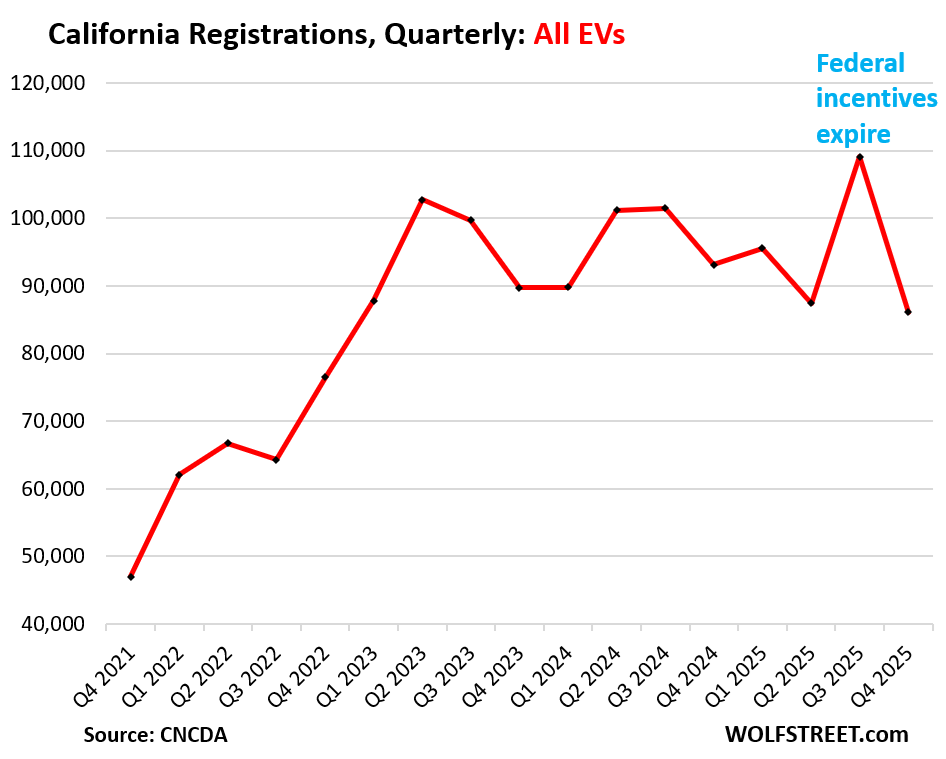
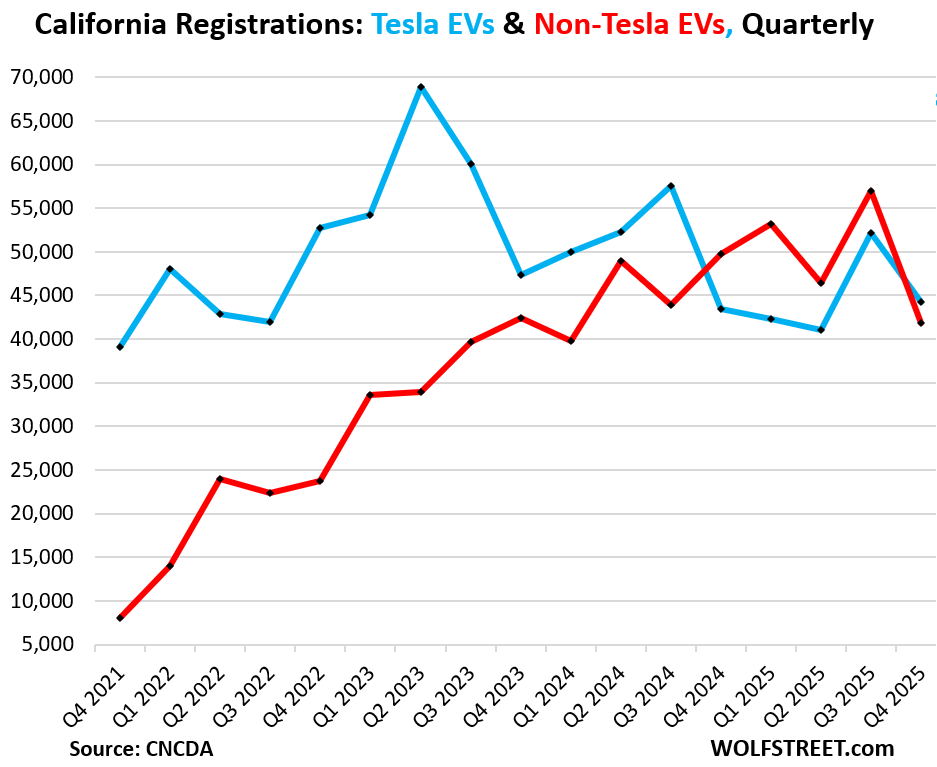
Quarterly EV sales were quite a spectacle. The federal EV incentives expired on September 30, which had triggered massive frontrunning by EV buyers, and sales exploded to a record 109,099 vehicles in Q3.
But then in Q4, the hangover set in, and EV sales replunged to 86,092, a hair below the sales volume in Q2.
The spike in Q3 was driven by record sales of non-Tesla EVs. Tesla’s sales also increased in Q3 but remained well below its Q3 sales in 2023 and 2024.
But then in Q4, non-Tesla EV sales plunged more than Tesla EV sales, and for the first time since Q3 2024, Tesla sold more EVs in California than all other EV makers combined.
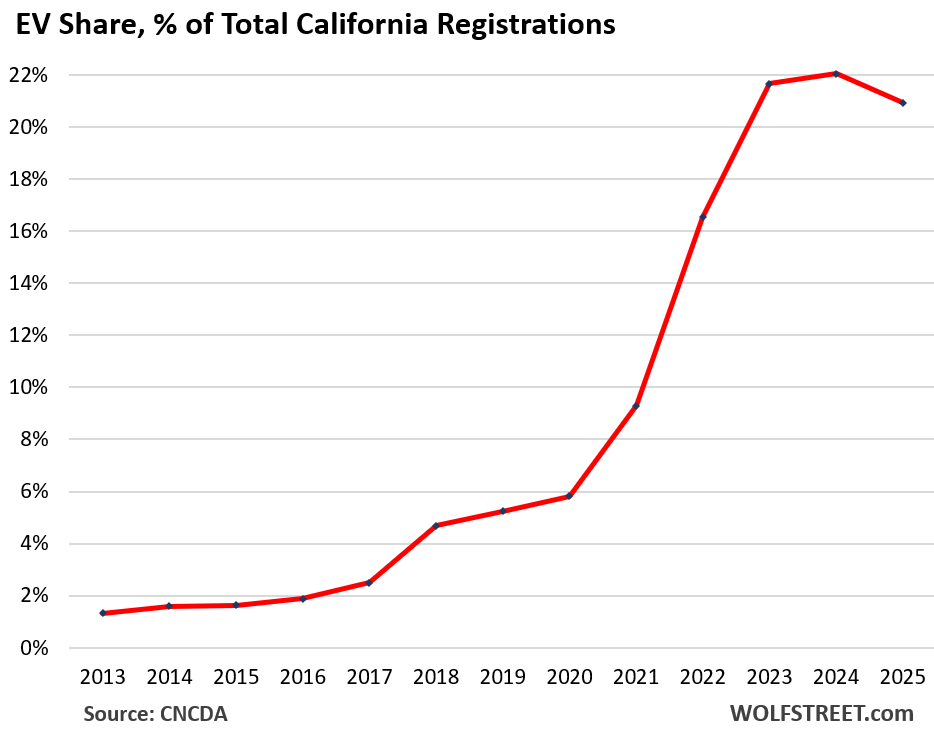
The annual share of EV sales fell to 20.9% of total sales, including fleet sales, in 2025 from the record share of 22.0% in 2024, as California’s native son that still totally dominates the industry, ran into rough waters.
In terms of retail sales (excluding fleet), the share of EV sales in Northern California was 24.6%; and in Southern California 21.8%, according to the CNCDA registrations data.
And in case you missed it: Ugly Charts of US Auto Sales, 2025: Stellantis, Nissan Flirt with Catastrophe. GM, Ford, Honda Sales Rise but far below Peaks. Toyota & Hyundai-Kia Set Records
Enjoy reading WOLF STREET and want to support it? You can donate. I appreciate it immensely. Click on the mug to find out how:


Nice data compilation. Thanks!
CA energy dept stats show a bit over 16% of all ZEV sales are PHEV (plug in hybrid).
Never understood why those had/have such a low take rate. They tend to be very reliable if Stellantis is avoided
That’s nonsense.
1. PHEVs are not ZEV (they have an ICE under the hood, duh)
2. The share of PHEVs has been flat at around 3-4% of total registrations since 2016. They’re just not a factor.
It’s not nonsense. It’s the data from CA energy board that groups phev with bev’s for zev sales counts (the do segregate them out)
2. Yes I agree they are not a big segment. That will change with California allowing them to meet their ZEV goals per ACC2 act and growing consumer acknowledgment/press that you can do 80+% of mile EV without roadtrip issues
I have a PHEV. I will try to share an unbiased opinion:
I get the best and the worst of both worlds. I enjoy the great fuel economy and the great range that comes with have 2 power units in my vehicle. However, I have to do the same or more maintenance because I have an engine, and the added weight of the battery tends to be harsher on consumables like tires.
All being said, I still think it’s the best for my case, seeing as electricity rates in my area are making it harder to fully justify a BEV.
Buying a car used to be fun and exciting, especially here in California, but with what’s available today I wouldn’t even want to go to a show or showroom to even look at cars as there is simply nothing of interest to see even if any choice was completely free.
They don’t build them like they used to. I have yet to find a compelling reason to get rid of my E39. Maybe an F30 340i? But then I would have to teach myself how to work on a newer engine….
Just when you think new cars can’t possibly get any uglier, they prove you wrong.
Can’t beat a Toyota!
Great Vehicles!
Still have my 2007 Toyota Tacoma. I aim to drive it till it falls apart.
Wolf here is helping me keep tabs on the EV market status. I like a lot about EVs, but the features vs cost aren’t quite there yet for my use case (I live a ways out of town). Hopefully the right car for me will come off the production line BEFORE my truck falls to bits!
Was at a dealership getting mine serviced, (which I admit that process could be a tiny bit less painful with better paid employees) and the amount of people who just “pop in” to buy a 60-80k car is kind of wild.
Toyota does offer the service customers nice digs to hang out in. Free coffee, Water and maybe pastries?
The upsells on services you probably could wait a year on, feels “commission based”, but just say no till you feel your car actually needs brakes, belts, plugs etc. The upsells aren’t unnecessary, more like you prob could milk more time out of certain things. $90 for wipers when mine seem fine, is a stretch. I can walk over to parts for wipers! lol and change my own filters supplied by Amazon.
Also a bit trashy the used car department calls me hours before my service to offer to buy my car. “Nah I’m good but would you pay for my tune up? Hello, hello? 😆 “
“Can’t beat a Toyota! Great Vehicles!”
Many new Toyota trucks are being recalled at similar rates to GM/Ford trucks, so be careful there.
I’ve been daily-driving a 2005 Tacoma PreRunner 4 cyl since I bought it new in 2005 and have enjoyed it for the most part. But I’m considering a Japanese-built Subaru for my next vehicle. Or a Japanese-built Toyota if there are any left in the USA.
Muff man,
Even if Toyota has recalls, they fix the problem for you. And you get to sit inside their nice facilities.
Most of the recalls are not even their fault, just poor manufacturing from one of their suppliers of parts that they install on their new vehicles.
I can attest that the “cabin air filter” charges on my “paid for” Toyota care got old quickly.
They would often just replace it and give me the bill, until I got sick of it and had them ask (I would usually wait an extra visit beyond the “recommendation.”)
I know the new Tacoma engine had an assembly line issue but am not aware of the recall rate increase across the board?
I would love to buy another Toyota (or a Lexus?) and every time I start to price it out, I see the value of NO car payment….
Struggler,
No car payment is the eighth wonder of the world!
Driving an 03 Tacoma and an 07 4Runner in our household in Colorado, reliable as the day is long, no major mechanical issues ever, routine maintenance and a few very minor wear and tear items, handy on trails and in the snow, we will drive them another 10 years God willing. I wish they still made these models without the extra electronic crap and with naturally aspirated engines…
There is nothing even slightly interesting about any Toyota or Lexus.
Eh….,I love the FJ-40,bit hard to find these days and pricey.
These are known as land crushers inside Toyota circles.
You shop for the most interesting car? That’s interesting.
LOL who wants interesting, give me reliable.
Rivian stock (RIVN) getting hammered of late. Great short-term trading “stock” due to its volatility. Very low PE: ZERO. Actually, negative but I digress. Mired in a years-long trading range. Looking to go long on one of two signals: 1. An overnight gap down, but preferably, 2. A beautiful big red daily candle with very little wick at either end of the body and closing damn near on the low, accompanied by significantly higher volume. I’ll buy on the close. Don’t do this at home unless you’re paper trading and keeping in mind that paper trading will never simulate trading with real money because your broker-DEALER never takes the other side of your paper trade.
“Tesla, California’s native son that once walked on water, and the only major automaker that manufactures in California.” I’d wager a week of roustabout wages that Tesla uses a massive amount of foreign parts and electronics in their apparatuses. 50 + percent? Who knows? Maybe they should be labeled ‘Assembled in the USA’. Mostly by robots, likely.
The National Highway Traffic Safety Administration (nhtsa.gov) tracks the percentage of US/Canadian content in motor vehicles.
Teslas are at the top:
Model RWD, AWD: 75%
Model Y: 70%
Cybertruck: 65%
Some other foreign brands, such as Honda and Toyota, that assemble their vehicles in the US, also have many of their models in the 60-75% range.
The US brands have a few models in the 50-70% range and a whole bunch of models in the 20-30% range. And a whole bunch in the near 0% range, such as GM’s China-made Buicks.
There are 9 pages of small-print tables of models where you can look that up, by the National Highway Traffic Safety Administration
https://www.nhtsa.gov/sites/nhtsa.gov/files/2025-10/MY2026-AALA-Alphabetical-10-8-25.pdf
Netflix stock cratered, Tesla’s can too!
I await the day with glee
That Tesla
Is delisted
From the S and P!
Hehe
Suffer,now in Haiku.
It should be in S and P, but near bottom, overvalued by about 20X
@sufferinsucatash- I await the day with glee
So odd…
Gleefully awaiting a US company’s downfall—workers & shareholders wrecked?
Jealousy?
Spite?
Political bubble?
Very Freudian.
What’s the real drive?
What’s YOUR real drive? Hype and hoopla stock manipulation?
I have toured both the Tesla factory in Fremont, CA and the BMW factory in Spartanburg, SC, and they are remarkably similar. Robots stamp panels and assemble the major components, body, doors, trunk, etc. And also paint. Then humans take over to decorate all the bits: interior, windshield, tires, etc. BMW made a big show of touting all the local suppliers it draws from.
I have also toured the Robinson Helicopter factory in Torrance, CA. One of the last remnants of the Socal aerospace industry. No robots there. Almost everything is manufactured, by hand, onsite. The only external components are the engine (from Lycoming in Pennsylvania) and flight instruments (various US mfrs). That is a big reason why a two-seat trainer helicopter (mechanically much simpler than the smallest automobile) will set you back $500K. In that sense, it’s very much like a Lamborghini, only slower, but with a better view.
Till Oct 2025, Tesla and few other EVs were subsidized ($7.5k to $10K).
Elon managed to get a loophole for few weeks where Delivery could happen in 2025 as long as Order was placed prior to Sep 30 2025.
Now Federal credits are gone. CA is still offering EV credit but not on mass scale like before. very targeted cases.
So I believe 2026 will be completely different story.
*EV credit = Tesla engineering the price to “suck up your oil” so you get zero discount and they keep it all.
allegedly*
I still don’t understand why people pay such a premium for software that should be included with the car for free. It’s like your dishwasher being installed and then “oh yeah you have to buy the software so it cleans in 4 hours instead of 8 hours”
people would return that dishwasher so fast!
In addition to the end of Federal EV subsidies, there must be some effect on Tesla sales since Progressives, the kind of people who have often bought Teslas, are not inclined to like Elon Musk since his association with the Trump administration.
Yes, and we discussed this year, and you can see it in the quarterly chart (2nd chart from the bottom). This started in mid-2023, when Musk was spreading all kinds of lies and BS on Twitter/X about California and San Francisco. That’s when sales in CA began to tank. The peak for Tesla in CA was Q2 2023.
Can you give an example of a lie that Musk made about California or San Francisco? Also explain why it’s a lie? Certainly Musk has made unrealistic predictions, but so have you at this site. Neither were lies; just predictions by people who don’t understand how the real world works.
Sure. For example when he blamed the stabbing of a tech executive, Bob Lee, in SF on street crime. “Violent crime in SF is horrific and even if attackers are caught, they are often released immediately. Is the city taking stronger action to incarcerate repeat violent offenders?”
When in fact it was another tech bro, Nima Momeni, that killed Lee over Momeni’s sister. The two were at Momeni’s sister’s beforehand, then they left together, and rode in a car together. Momeni stabbed him with a knife he’d taken from his sister’s apartment. He was convicted of second-degree murder and is in jail.
Musk’s lies about it turned off a lot of people here, and his lies got crushed by officials and in the local press.
And crime rates in SF are among the lowest of any big city in the US, and the number of homicides has dropped to the lowest since the 1960s when Sf was a much smaller city.
Musk is an asshole and liar. I give him full credit for having put EVs on the map and having shaken up the legacy automakers, I give him full credit for SpaceX and some of his other enterprises, but he is a flamboyant asshole and liar and he gets away with it because he is the richest man in the world.
Crime rates in San Francisco, by category, including homicides:
https://wolfstreet.com/san-francisco-homicides-rapes-robberies-aggravated-assaults-burglaries-larceny-thefts-auto-thefts-and-arson/
In late 1958 America let in the Japanese auto makers. That was a huge mistake. One the country probably won’t repeat with China.
“In late 1958 America let in the Japanese auto makers. That was a huge mistake.”
What you call a “mistake” for US manufacturers was actually a huge “boon” for middle-class first-time car buyers like myself looking for quality.
Free-market capitalism with largely free trade is what’s needed to improve the US economy right now.
It was terrible for shareholders in the Big 3. Absolutely wonderful for the average citizen.
Someone had to show the US how to make cars. Modern car manufacturing is known as the Toyota System, but was used in Japan by Honda. Includes ‘just in time’ inventory and ‘zero defects’ The latter means that a problem is not taken off the line for repair while the line keeps rolling, the line can be halted until the source of the problem is found.
In the Fall of 1987 Popular Mechanics magazine evaluated the Cadillac Brougham de Elegance (yucky name) and the Lincoln Town Car. Both were described as ‘wretched excess on wheels’. The Caddy was said to have the fit and finish of an econo-box. One door hinge had three shims making it fit. The Lincoln was described as having much better build quality…but one problem, and this is a quote: ‘Even our professional drivers could not keep the car travelling in a straight line’
I know this problem from its budget cousin the Grenada. A girl friend was car shopping so I took one for a drive and quickly thought there was something wrong with the steering. I pulled into a service station I knew and asked if any clues. The mechanic noted the rear tires were a bit low and with this corrected it went from having a mind of its own to just mediocre. But the worst power steering I’ve ever driven was an 80’s Jeep.
When you turned the steering wheel, after a noticeable lag, the vehicle would jump in that direction, like a video game of the same generation.
Then there was Cadillac Diesel, and the 4- 6- 8 (fuel economy idea with engine using different numbers of cylinders) The mechanics refused to work on them. GM gave big incentives on the owners’ next car.
But the domestics got better, faced with Japanese competition.
The ‘Japanese System’ (Just-In-Time) all arose from W. Edwards Demming of America with his work in Japan. BMW never needed any such remedial learning exercises and simply always built the best.
Toyota vehicles are far more reliable than BMW, at least historically, you confuse over engineering with reliability, they are not the same thing, I’ll take the 6 and 8 cylinder truck and 4Runner engines of 2000 to roughly 2020 over any engine ever made by BMW.
This is true almost every single time a country tries to protect their auto industry by banning foreign sales. Famous examples like the Trabi, Yugo, and whatever brands the Aussies used to make. Substandard products at inflated prices to protect against the fact that they aren’t willing to invest and innovate anymore.
Sad to see the US fall into that trap yet again. And when Europe decides that don’t want anything to do with US automakers, that will accelerate the process.
Many of us in the auto industry refer to those Cadillack engines as the 8-6-4-2-0 models. They were on par with their 350 cubic inch engines which they converted to 22:1 compression ratio versus the 11:1 ratio they were designed to operate with and within a few thousand miles they simply blew up!
American legacy car companies make absolute crap. Thank goodness we have an alternative. I would love to have the option for a high quality 10K Chinese EV, the entire country would be much better off with that option.
Happy1,
There is no such thing as “a high quality 10K Chinese EV.” They’re cheap in every sense and don’t comply with US safety regulations.
There are quality cars in China, but they cost a lot more than $10k.
You would gladly sell the US to the Chinese in no time, guaranteeing that the US becomes a vassal state of China, just so that you can drive their 10k junk? It is THAT attitude that has caused US manufacturing to collapse over the past four decades. YOU are at fault. You people have no idea what you’re talking about.
And the Japanese did what ever it took to make sure nobody would be able to buy a US made car
To say Tesla is 7.9% points behind Toyota it true but somewhat deceptive. 17.9% for Toyota versus 9.9% for Tesla means that Toyota actually sold ~80% more cars than Tesla or 9 cars for every 5. Much bigger gap when you look at it in those terms.
All you have to do is look at the first chart — number of vehicles sold. In one glace, you see the difference.
Now figure out how far ahead Toyota is of Ford and Chevrolet.
NB: “market share” is not “deceptive.” It’s a standard metric in the industry and everywhere, you goofball.
Musk didn’t go full crazy until a bit later in the year, the model Y had a refresh, and the Federal subsidies expired, leading to front-loading sales. These are all factors that worked in Tesla’s favor in 2025. However, they no longer apply and I shudder to think what Tesla sales in 2026 will look like.
Without those subsidies, Wolf, I think the model Y would be on the bottom of the list. But, it’s OK – I LOVE paying for other people’s cars.
The original federal subsidies ran out for Tesla in 2018 when the Model 3 sales exceeded the cap, and people thought sales would collapse. So there was some frontrunning and then a dip, and then sales took off again, and then the Model Y came along in 2020, and it took off without federal subsidies, and became the bestselling SUV in the US without federal subsidies.
Then in 2023, the new federal subsidies started (part of Biden’s Inflation Reduction Act, enacted in 2022). Tesla would have been fine without subsidies. But not Ford.
But Ford, which cannot manage itself out of a paper bag, could not produce EVs profitably without subsidies. And the Biden administration, being so pro-union, despised Tesla and coddled up to Ford and GM and came up with the subsidies to help them, and it actively promoted Ford, with Biden even visiting a Ford plant and driving a Ford Lightning.
Biden never once mentioned “Tesla.” This really galled Musk. So here is Biden trying to promote EVs, and he ignores the company and the man that put EVs on the map, and that are the dominant force in EVs, and he promotes Ford, which didn’t have hardly any EV sales, but were a union shop, and promotes THEM, though the Mustang Mach-E is made in Mexico and has near-zero US content, and the Lightning is assembled in the US, but only has 25% US content, the rest being imported. While Teslas are made in the US and have the most US content of any automaker.
Those federal subsidies from 2023 on were stupid policy, and were never needed and just distorted the market and allowed legacy automakers to be inefficient and offer inadequate models. I’m glad those federal subsidies are gone. And EV sales will be just fine, though Ford completely failed at it… handicapped by stupid executives and dealers and salespeople that refuse to sell EVs. GM is better off and actually has a real lineup of EVs across the spectrum, from a compact SUV for less than $30,000 to high-end huge 1,000 hp trucks, and everything in between.
In Feb 2023 the Treasury department revised how it classified the Model Y so that it would qualify for the subsidies.
Ford Electric F150 (discontinued), actually outsold the Cybertruck in 2025. Go figure.
Don’t forget the carbon credit scam that made Tesla billions and made Gore millions.
Honda and Toyota are paying attention to the 1.5% yen strengthening today. You don’t see that everyday. Shocked the algo hasn’t went wild based on yen input.
Who is buying the 10 year UST this afternoon ? $usd is down. Strange, maybe the us treasury used some of the TBill cash to buy 10 year bond to enhance market liquidity! LOL
Investors. As to the USD, it will be just fine in the months ahead.
I was just told about this. It was the US treasury buying this afternoon. 2B today and 4b yesterday, I had no idea they published this. Liquidity in the long bond needs support.
https://home.treasury.gov/system/files/221/Tentative-Buyback-Schedule.pdf
Treasury started the buybacks under Biden/Yellen. I have written about it a few times, starting under Biden. They borrow money and then use that money to buy back some minuscule amounts of older securities. Treasury sells between $500 billion and $700 billion in securities a week, and buys back between $0.5-8 billion a week. The buybacks go across the spectrum, not just long bonds.
Interesting, I hadn’t noticed this. The “news feed” is referring to a rate check by the Fed.
I’m not exactly sure what that entails? It seems like a result of the yields that Wolf reported on recently?
In general it is also translating into general “dollar weakness” as shown by a drop in the DXY.
The DXY is now touching a fairly critical support (at least for the $ milkshake theory?).
Interesting times indeed!
Also the 10-year yield seems to have some legs. Fighting the resistance, but I don’t see it dropping much (I also have no horse in these races).
MW: Why the dollar just had its worst week in 8 months despite Trump’s pivot on tariffs
The “rate checks”:
This is a USD/JPY exchange-rate issue.
“The New York Fed conducted “rate checks” on the dollar/yen pair around midday on Friday, a source familiar with the matter told Reuters. Analysts say the move may have triggered a sharp drop in the greenback and could signal that U.S. and Japanese monetary authorities may be preparing to act after weeks of sustained dollar strength against the yen.”
“A rate check, in which officials ask dealers what price they would get if they entered the market, is something monetary authorities can use to signal their readiness to do so.”
They’re trying to get the yen to stop collapsing against the USD.
I will share my 2 cents. Capital flight out of USD. The Greenland issue is not over when we had the drop earlier in the week USD went down, that’s the opposite of the milkshake theory, plus when you liquidate US assets as a function you are forced to buy USD. We saw the same issue back in April 25 liquidation of US equities and a falling dollar. Not a normal outcome. Countries are talking about “sanctions risks” and diversifying out of UST into safer, harder assets. The ultimate fear is that our government says do what we say to other governments or we won’t pay our debt to you and we know what bonds you own by Cusip #. Sounds crazy but it was talked about at Mar-a-Lago summit, selective defaults they called it
Thanks Wolf!
Delusional: I am not necessarily a champion of the milkshake theory, but it’s not invalid (yet?).
The monthly close will be telling, but the DXY has been looking like it is forming a bottom… for 6+ months.
If there’s any turmoil in financial markets, it’s usually good for the DXY, as many assets are denominated in USD, and selling of assets is a defacto “buying” of USDs.
Another interesting year.
i never heard of the expression “rate check” before today.
Interesting fun facts, spy “monthly close”
Oct~$680.05
Nov~$681.38
Dec~$681.92
Jan~ we will find out next week, but if spy closes below $680.05 to end Jan, that is quarterly loss on a 3 month look back. 1.26% drop next week and its red for the past 3 months. Monthly closes on SPY have hit some resistance, its running on fumes. Also, take a look at Aug 2024 when the $vix spiked above 60, it was all because of the Yen ripping higher and creating fear of the carry trade unwind. next week will be interesting!! i think the last time the yen ripped like today was back in Aug 2024
Cheers, have great weekend all!
I was in CA – driving through in December. Gasoline at home is 2.69/gallon. In Calif I paid between 4.89 and 5.89 – I could probably have paid less by getting off the main highways.
The news flow was telling me that as of Dec 15 3 big refineries were closing. The Martinez refinery complex. The Benitia complex and one in S. Calif I’m not familiar with – all representing 30% of CA gasoline production and about 1.5% of US refining capacity.
There was also news of a pipline operator caring 100k barrels of crude production out of Bakersfield area shutting down. I’m not sure if I can credit that reporting.
But if any or all of this is true, Gasoline prices in CA will continue to rise. By how much ? I don’t know, markets can be wonderful mechanisms for moderating these sorts of shocks.
However, I wouldn’t be surprised to see a surge in EV sales a year or 2 from now if gas rises to $6 or 7$.
I did see a lot of Tesla’s around, but also a lot of other EV’s especially ICONIQ’s.
We still need to see significant battery improvements before EV’s can really be general purpose transportation. But thats coming – although perhaps 3 years out for real commercial scale production.
A Rav4 Hybrid will deliver 45 miles per gallon, with good reliability and utility. But that will be a stop gap if CA continues it’s war on gasoline production.
Gasoline demand has been collapsing in CA for years, in part due to more efficient ICE vehicles, including lots of hybrids; and in part due to the surge in EVs. About 25% of all vehicle sold in Northern California were EVs in 2025. That makes a huge difference on demand for gasoline.
California’s refineries are ancient. They kept their business afloat by importing crude oil and exporting gasoline, jet fuel, and diesel to Mexico and other Latin American countries.
Can anybody tell me where my 2020 Mitzibushi Mirage is manufactured? I’m seeing a lot of them around here lately. It’s a no frills car, something that is hard to find nowadays. Ser no ML32A3HJ1LH008573. The dealer that sold it to me said it was made in the USA.
Your VIN starts with “ML” = country code for Thailand. Mitsubishi manufactures a lot of its vehicles there.
Mitsubishi assembles no vehicles at all in the US since 2016. Your dealer was a card-carrying goofball.
Wolf
Thanks very much for the info. I like the car. It’s great for urban driving.
MB EV’s sales are way down without the federal rebates. But they are also phasing out the EQ lineup. However, they are changing their approach with a new modular architecture starting with the new CLA. I think it will give consumers more choice at which powertrain they prefer and also help lower costs.
Daimler-Benz used to use the slogan ‘Das Beste Oder Nichts’ and it has been time for the ‘Nichs’ part to kick in going back to 1986.
Thanks for the data Wolf.
My crystal ball says Tesla sales in California in 2026 will be around 160,000. Total EV sales in California will be down low to mid-single digits, and drop to right around 20% of total California sales. Nationally, EV sales will drop a bit.
Without subsidies, and with electric rates rising and gasoline prices low, in 2026 it will be hard to find new EV customers, and liberal/progressive dislike of Elon hurts Tesla sales. So, most EV sales will be sales to repeat customers, with a few new customers mostly offsetting the Tesla owners who quit buying new Teslas (and don’t buy another EV brand, because most of why they bought an EV was to be part of the Tesla clique). Glad to see the market, not government subsidies, deciding what cars get bought.
Me thinks the next new Tesla model should be named the Tesla Wolfster, or Wolfmeister, or maybe even the Wolfman.
I probably will get canx here again; but I’m sure we’d like to see the Stats for the Nation as well since TSLA sell most of their Vehicles in California.
Looking at the Natl Figures from several industry sources (so I won’t get accused of click baiting),
we’ve TSLA at:
#10 – in overall Sale for 2025;
Tesla Model Y – #7; and
Tesla Model 3 – #21
One questions I have, are:
Q1)Since TSLA moved their USA_HQ to Texas, what have been TSLA Sales w/comparisons to others in the State of Texas on a yearly basis?
Q2)Do the State of Texas offer incentives to their residents who buy EVs and Hybrids; and if so, what are their terms?
Thank you
Texas is one of the states that doesn’t even allow Tesla to sell vehicles directly to consumers. Tesla has to jump through some hoops to sell to Texans.