
In between: Vancouver, Victoria, Hamilton-Burlington, Calgary, Ottawa, Halifax, Edmonton, Winnipeg.
By Wolf Richter for WOLF STREET.
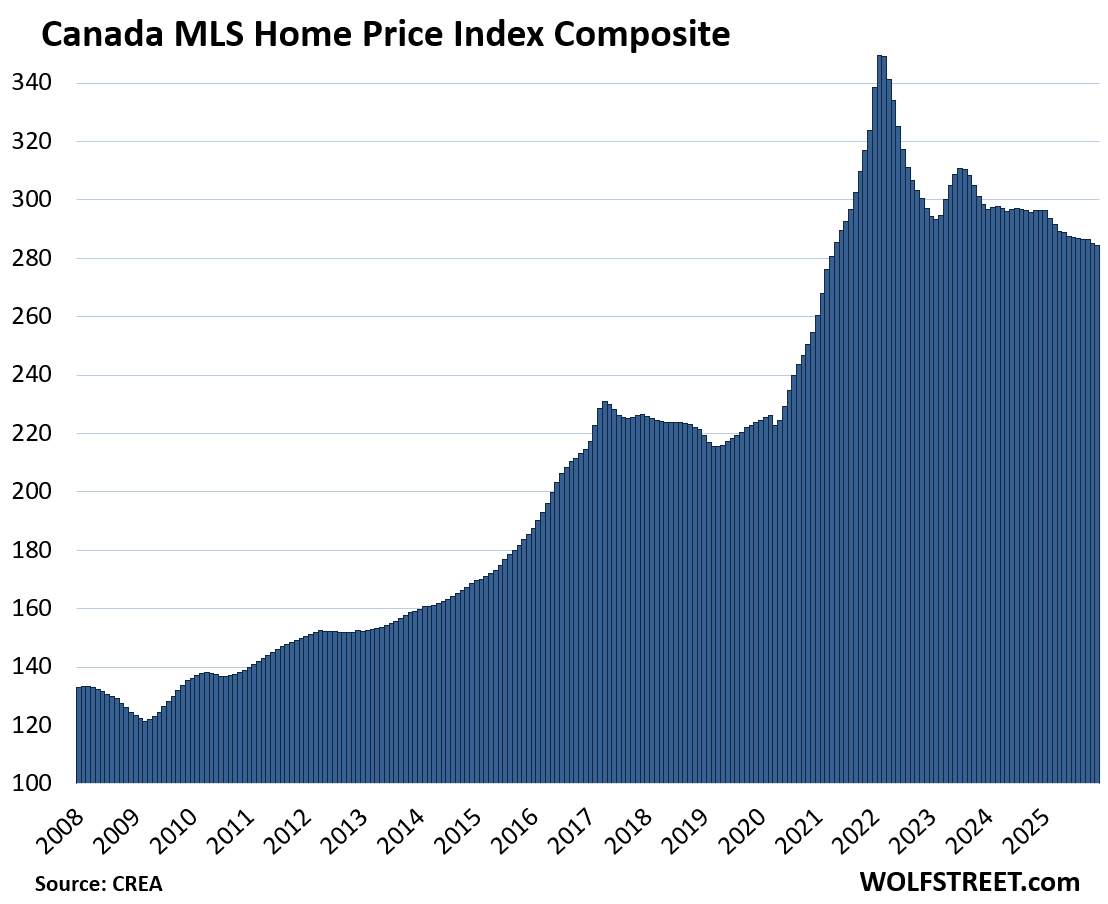
Prices of all types of homes in Canada fell by another 0.3% in December from November, seasonally adjusted, and by 4.0% year-over-year, to the lowest level since April 2021, according to the Canada MLS Home Price Index Composite released by the Canadian Real Estate Association (CREA) today.
Since the peak in February 2022, the overall index has dropped by 19%. But price movements in the major markets have diverged: At one end of the spectrum, in the vast Greater Toronto and Hamilton Area, prices have plunged. At the other end, there are a gaggle of markets where prices rose to all-time highs, such as in the metropolitan areas of Montreal, Quebec City, or Winnipeg. Then there are the markets in between where prices have dropped but not yet in the double-digits, such as Greater Vancouver and Calgary.
And in markets where prices declined over the past two years, condos got hit harder than single-family properties.
Home sales in Canada declined by 4.5% year-over-year in December. Inventory listed for sale at the end of December, at 133,495 homes, was up by 7.4% from a year ago. Supply was at 4.5 months. So now, all hopes rest once again on the spring selling season.
But markets diverged. The big story is the housing bust playing out in Canada’s biggest housing market, the vast Greater Toronto and Hamilton Area.
In the Greater Toronto Area (GTA), for year 2025, sales fell by 11.2% from the already low levels in the prior year, to 62,433, while listings rose by 10.1% to 186,753 homes, according to the Toronto Regional Real Estate Board (TREB).
These sales were the lowest since the year 2000, and down by nearly 50% from the peak year 2021.
Prices in the major Canadian markets.
Below are the prices and charts in Canadian dollars for single-family homes, and in some markets for condos, seasonally adjusted. Data via CREA.
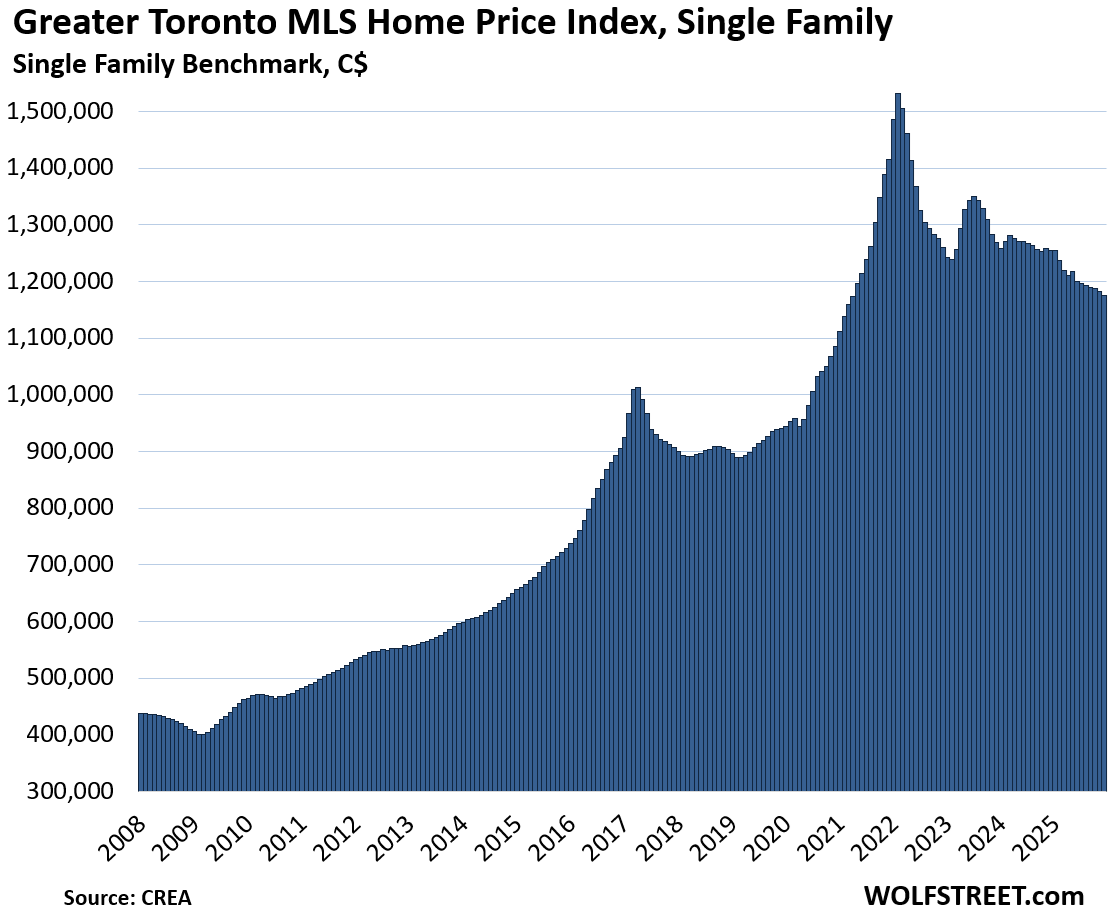
Greater Toronto Area, single-family MLS Home Price Benchmark Index:
- Month-to-month: -0.6%
- Year-over-year: -6.4%
- From peak in February 2022: -23.3%
- $1,174,800; lowest since March 2021
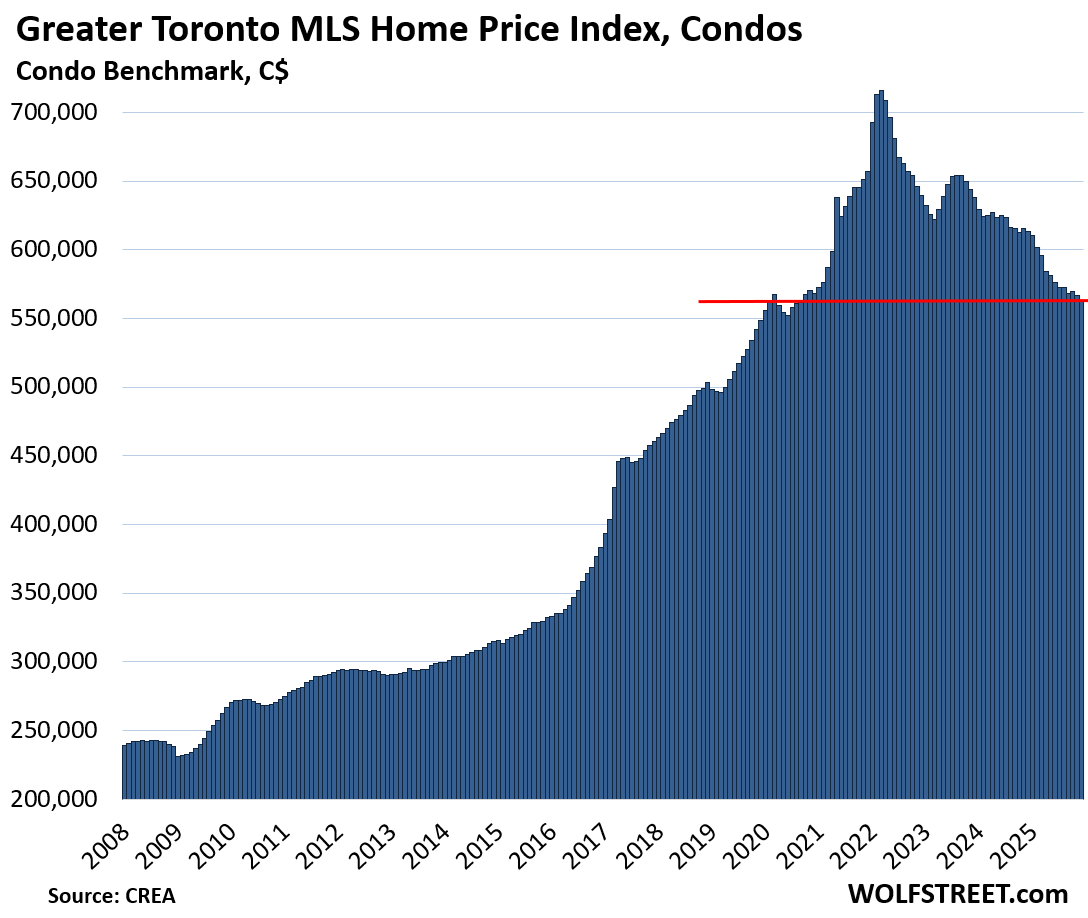
Greater Toronto Area, condo benchmark price:
- Month-to-month: -0.6%
- Year-over-year: -8.2%.
- From peak in April 2022: -21.4%
- $563,100, lowest since February 2020. Prices have worked off the entire pandemic-era price spike.
Despite the massive problems that the Toronto condo market currently is stewing in, prices haven’t dropped quite as much from the peak as prices of single-family homes (-23.3%). But they’re currently dropping at a faster rate and are catching up.
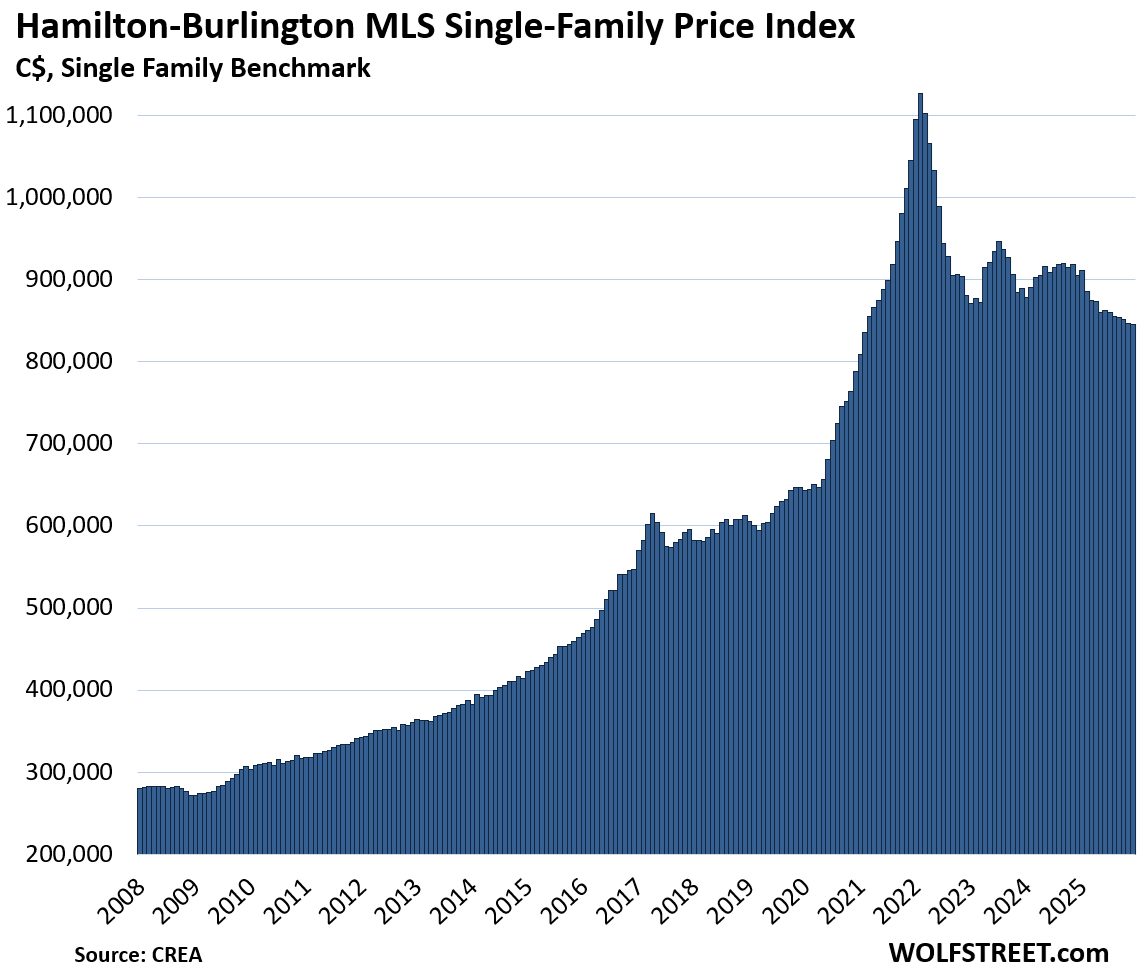
Hamilton-Burlington metro single family benchmark price (part of the “Greater Toronto and Hamilton Area”):
- Month-to-month: -0.2%
- Year-over-year: -6.6%
- From peak in February 2022: -25.0%
- $845,500, lowest since February 2021.
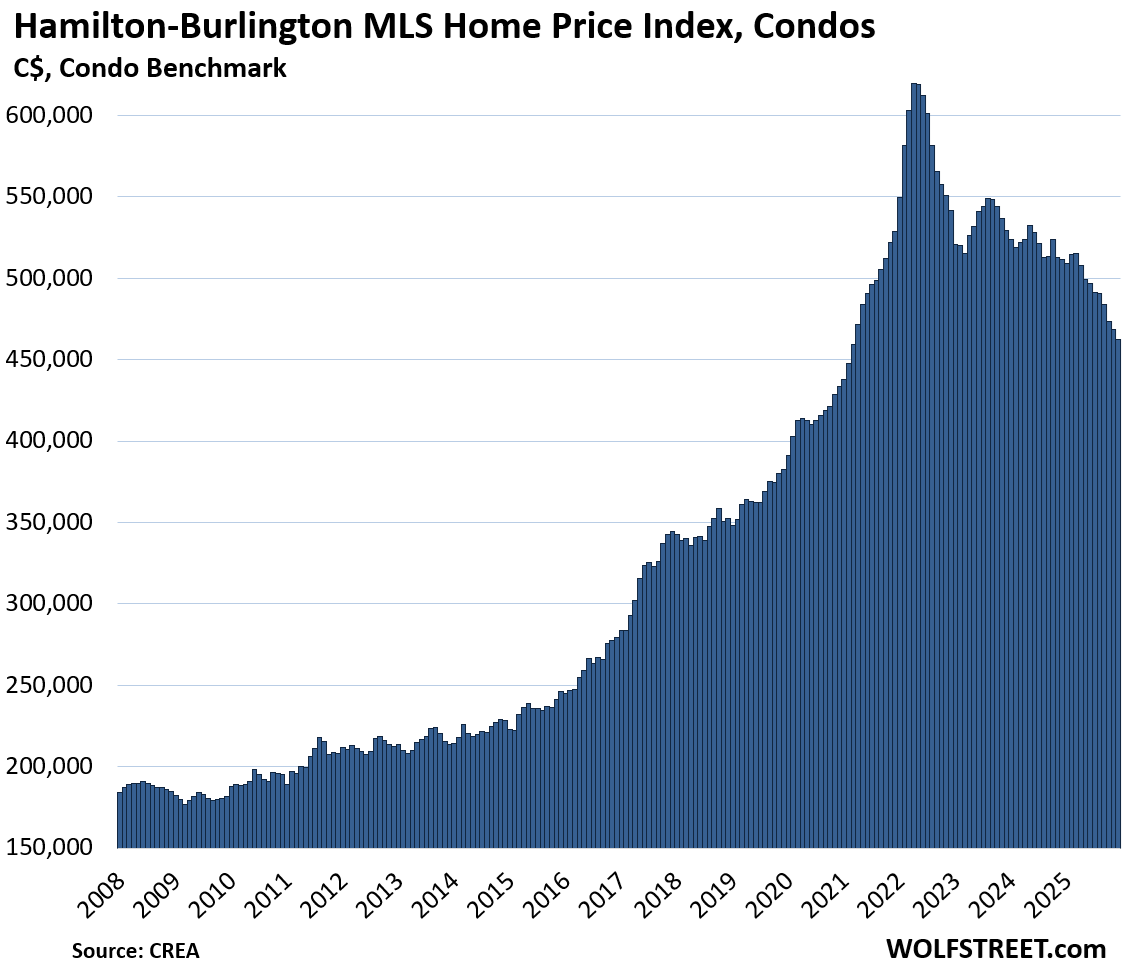
Hamilton-Burlington metro condo benchmark price:
- Month-to-month: -1.3%
- Year-over-year: -9.6%
- From peak in April 2022: -25.4%
- $462,400, lowest since March 2021.
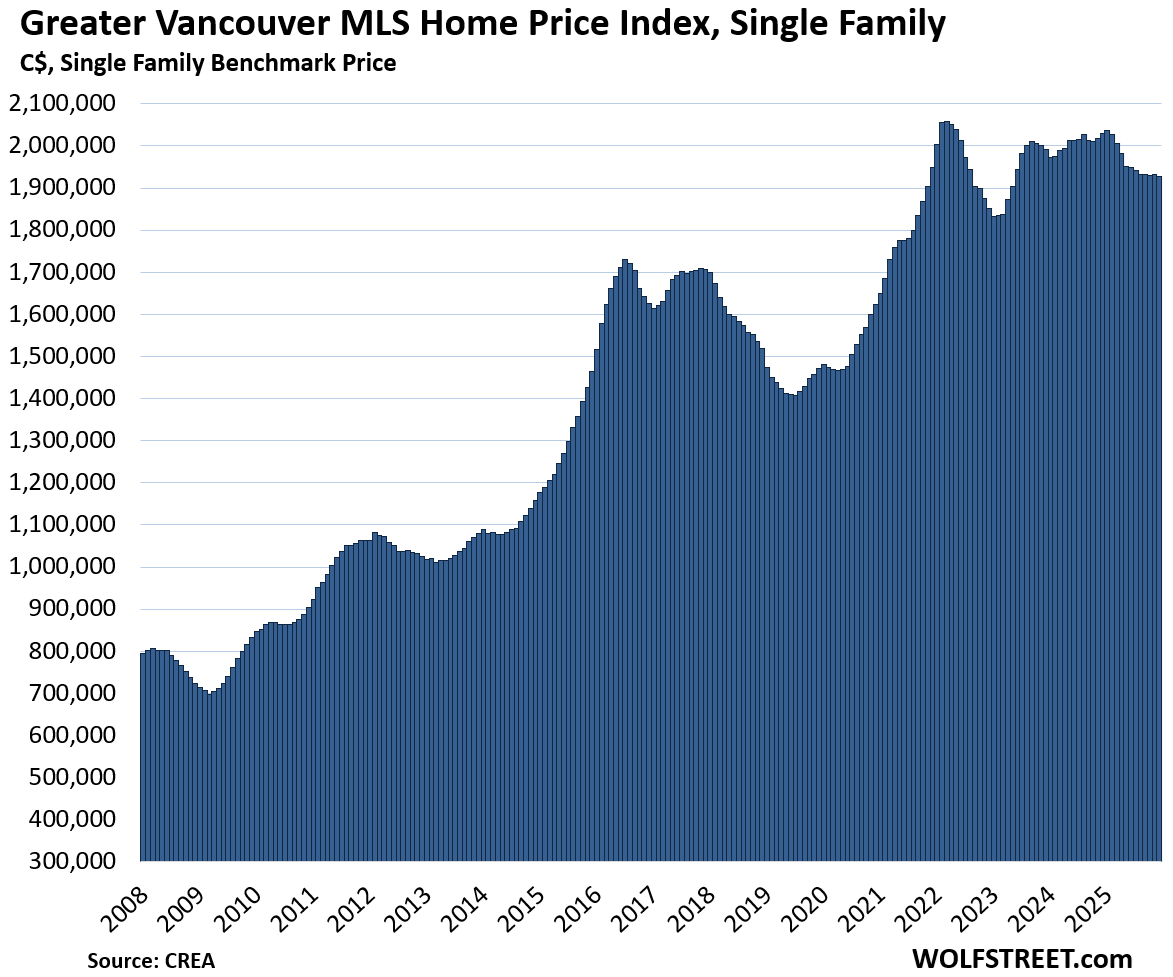
Greater Vancouver single-family benchmark price:
- Month-to-month: -0.2%
- Year-over-year: -5.0%.
- From peak in March 2022: -6.4%
- $1,928,000, back to December 2021.
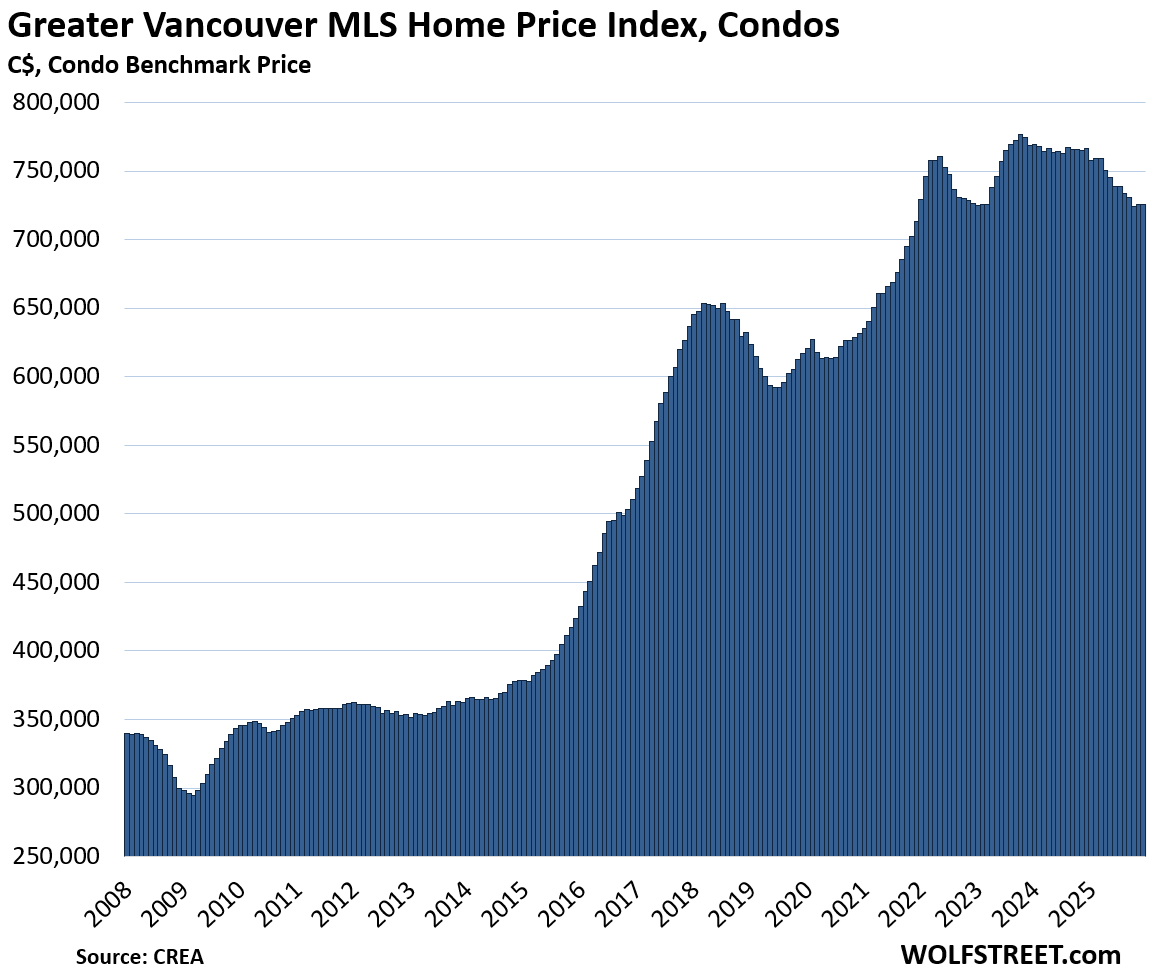
Greater Vancouver condo benchmark price:
- Month-to-month: unchanged
- Year-over-year: -5.4%
- From high in October 2023: -6.6%.
- $725,500, where they’d first been in January 2022.
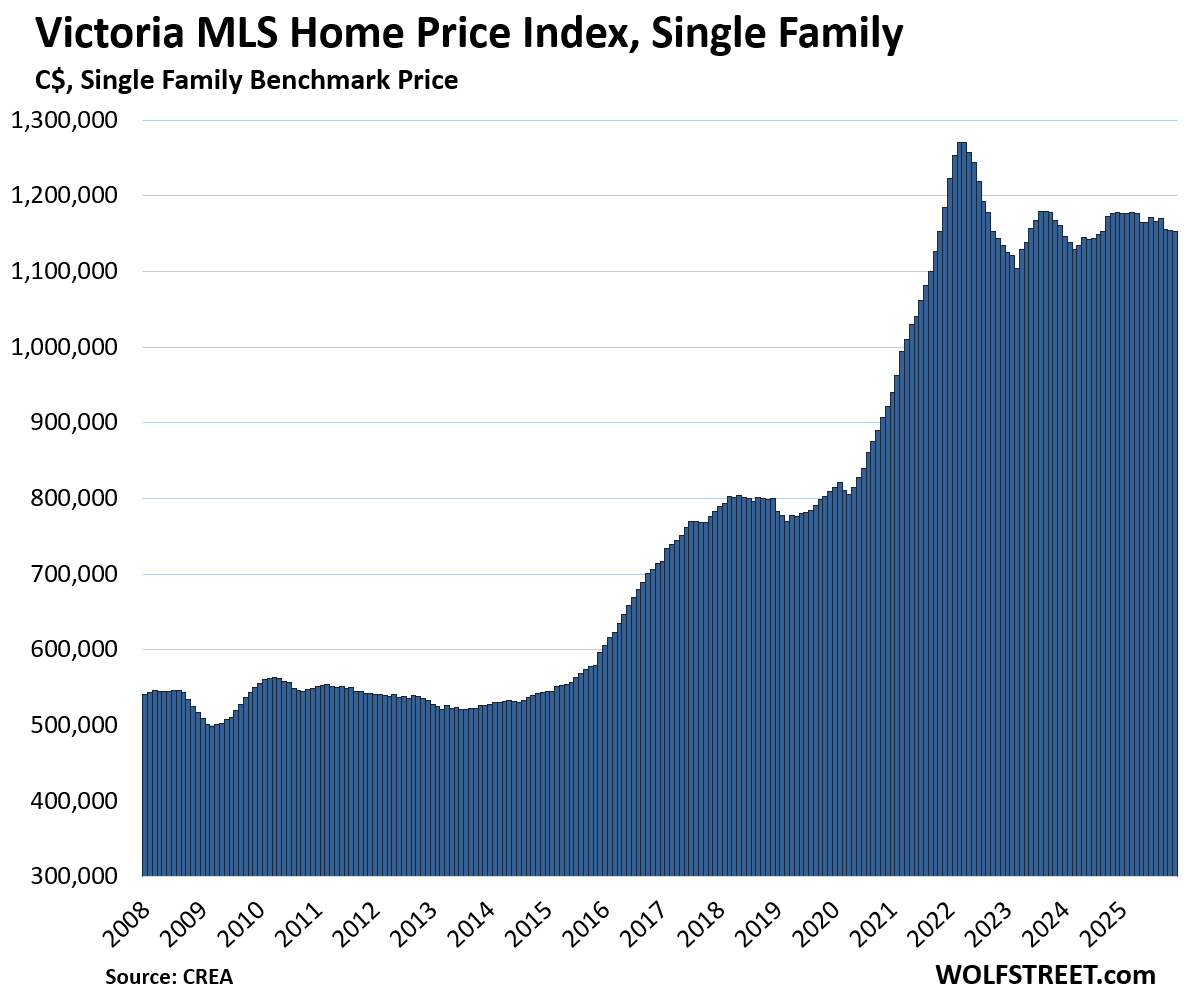
Victoria, single-family benchmark price:
- Month-to-month: -0.1%
- Year-over-year: -2.2%
- From peak in March 2022: -9.3%
- $1,152,400, where they’d first been in November 2021
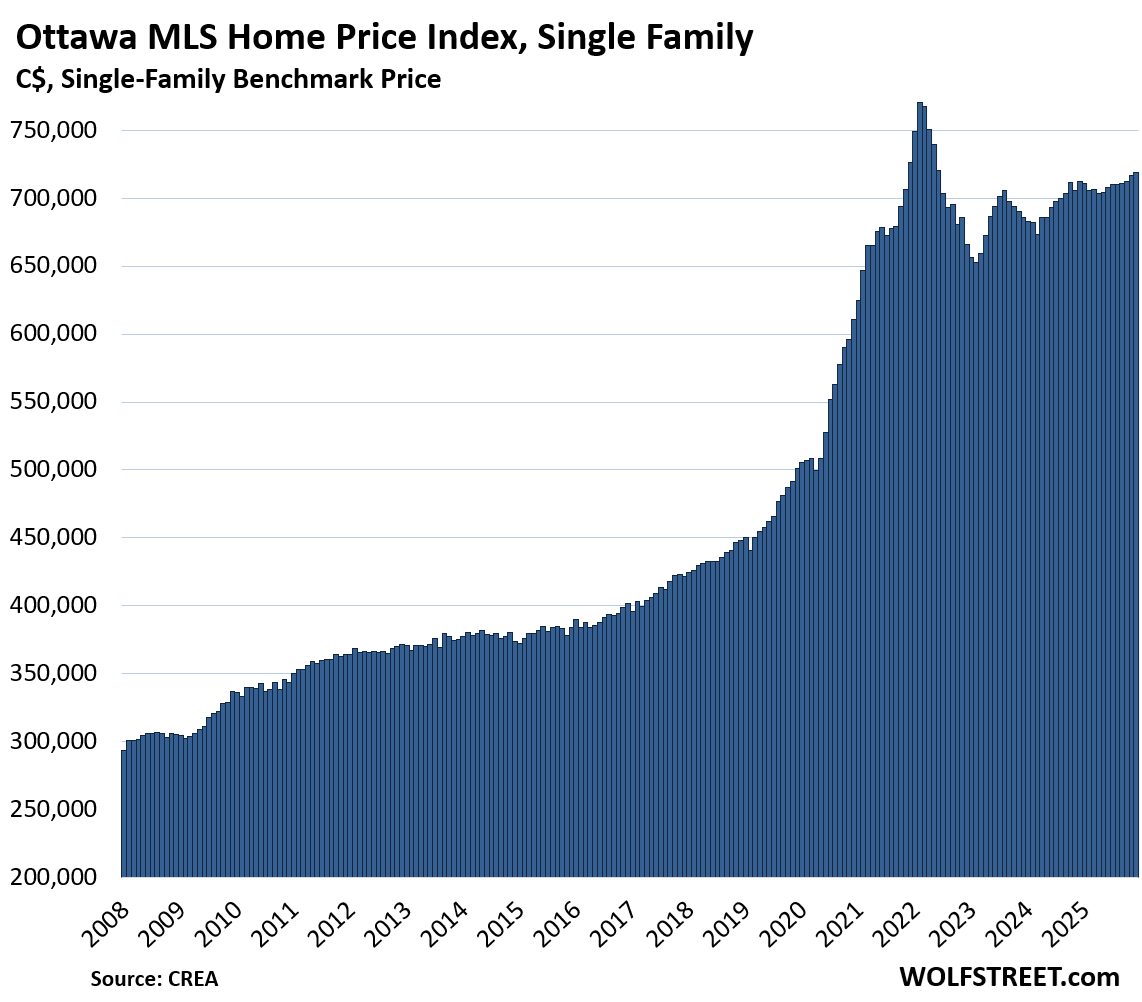
Ottawa, single family benchmark price:
- Month-to-month: +0.3%
- Year-over-year: +0.9%.
- From peak in March 2022: -6.4%
- $718,800 where it had first been in December 2021
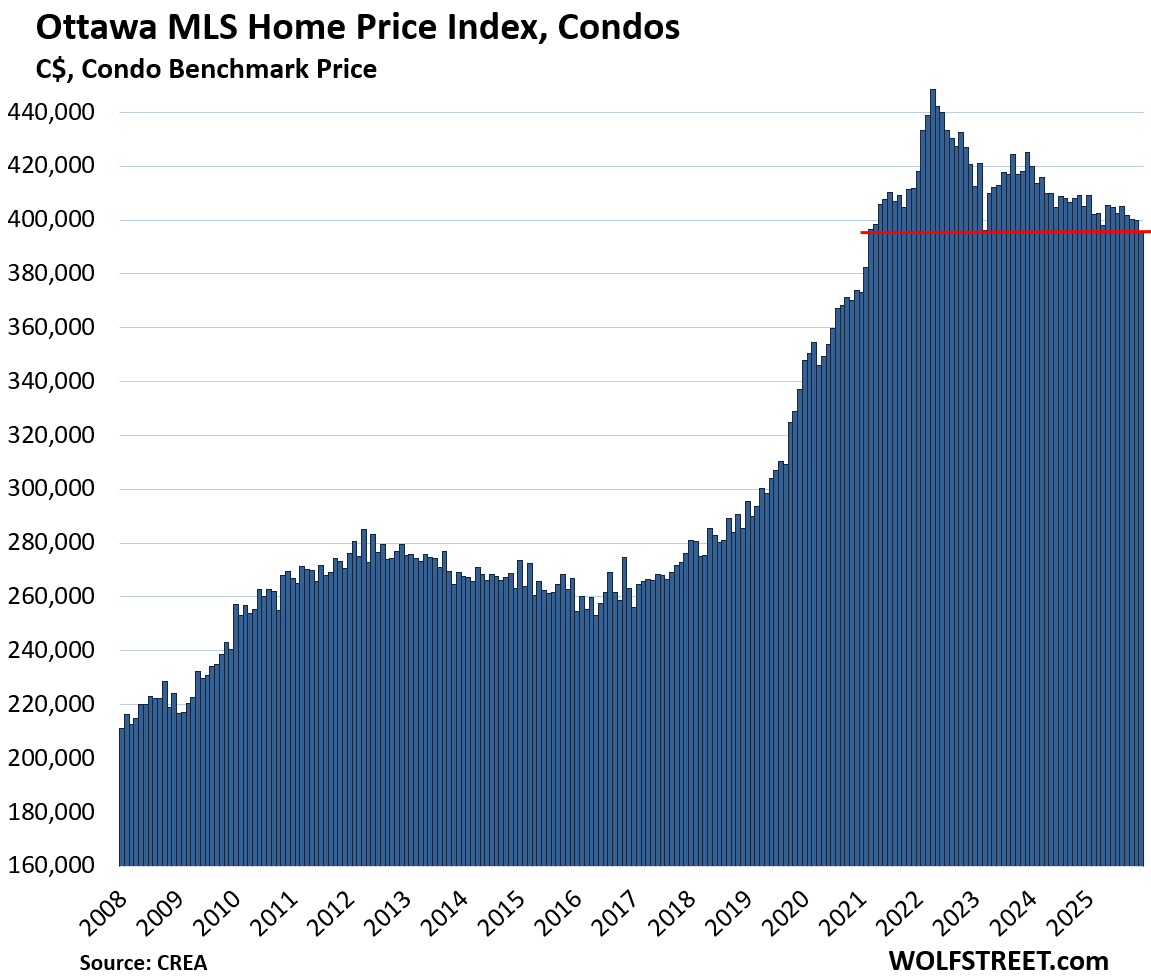
Ottawa, condo benchmark price:
- Month-to-month: -1.0%
- Year-over-year: -2.2%
- From peak in March 2022: -11.7%
- $395,900, lowest since March 2021
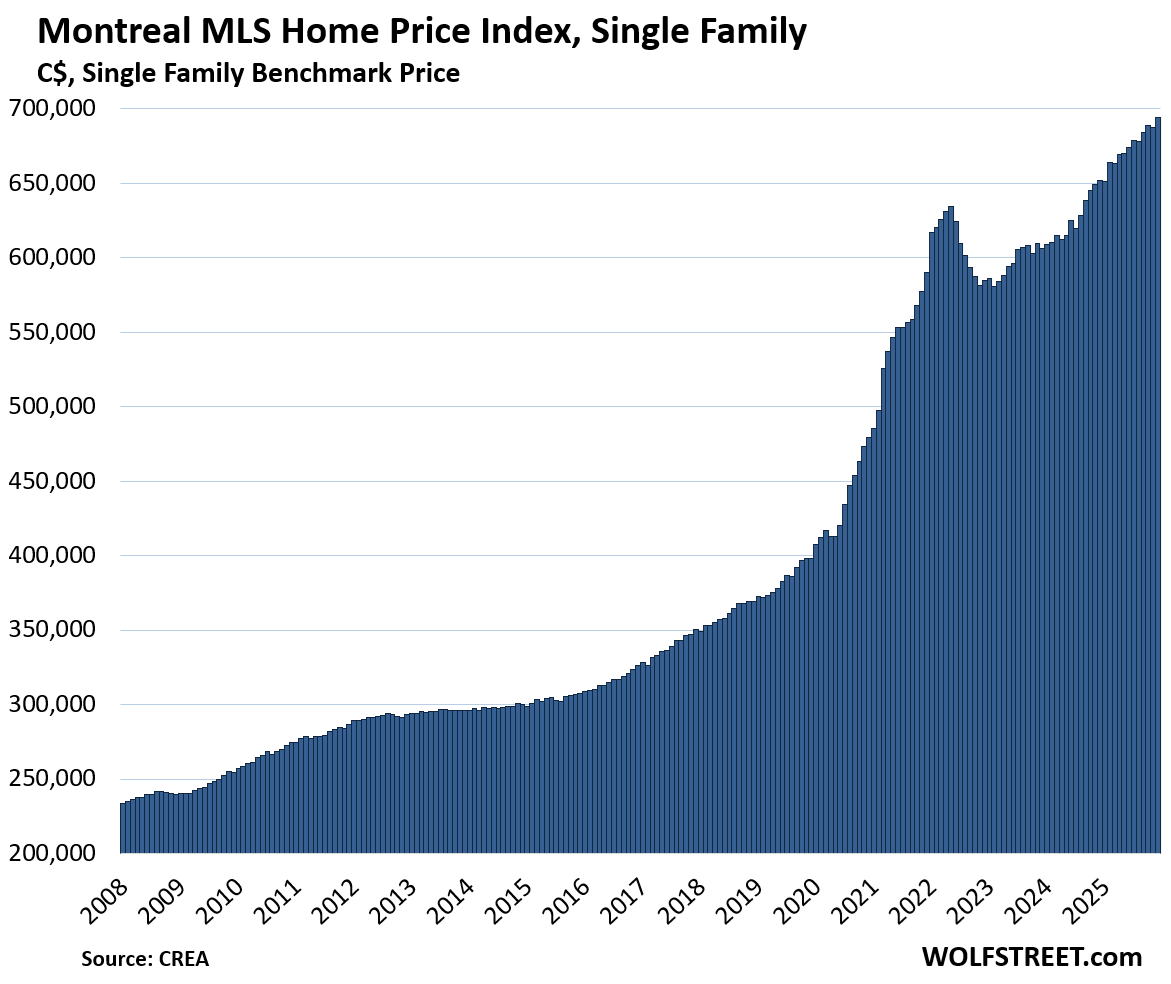
Montreal, single family benchmark price:
- Month-to-month: +1.0%,
- Year-over-year: +6.5%
- $693,900, a new high.
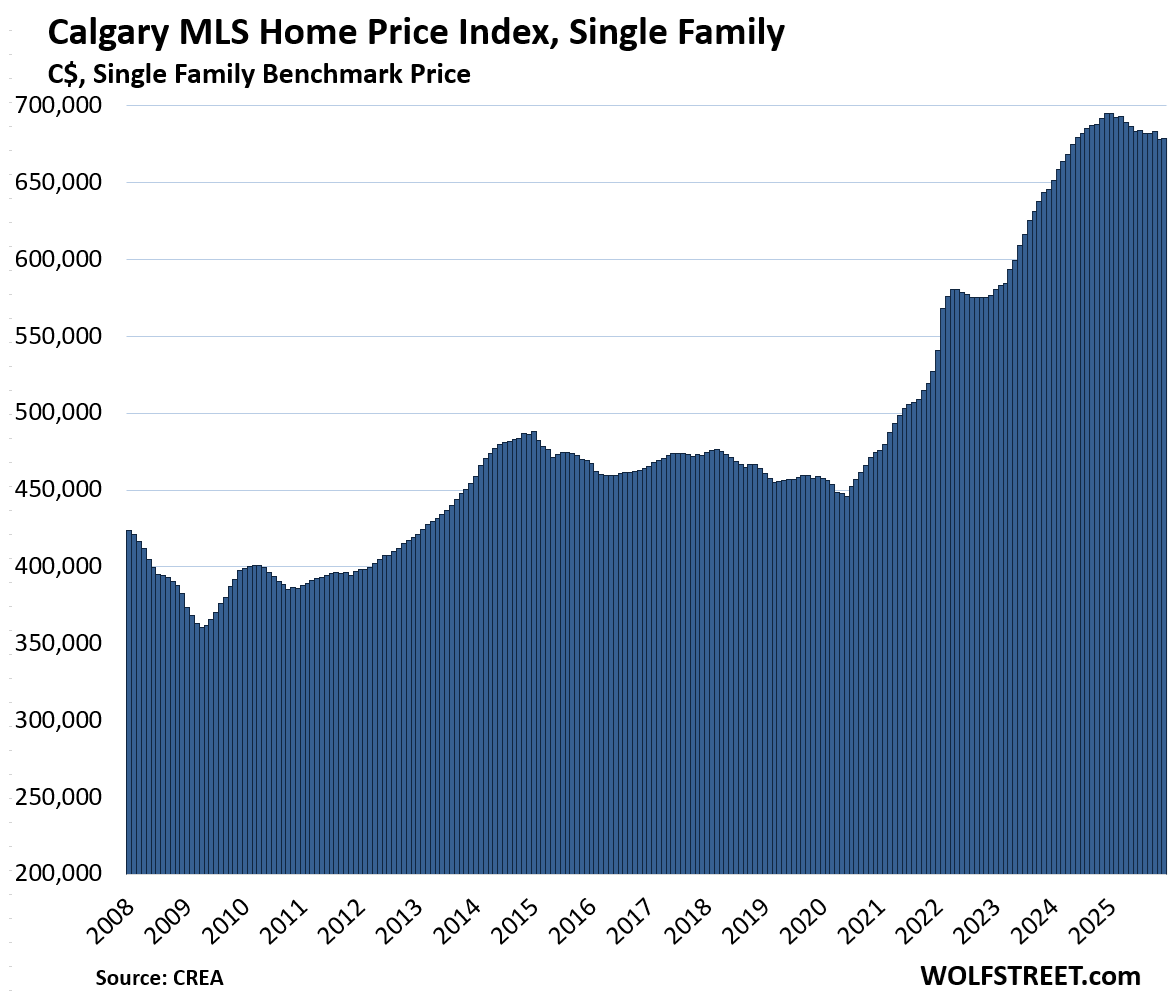
Calgary, single family benchmark price:
- Month-to-month: +0.1%
- Year-over-year: -2.3%
- From peak in January 2025: -2.3%
- $678,700, lowest since May 2024
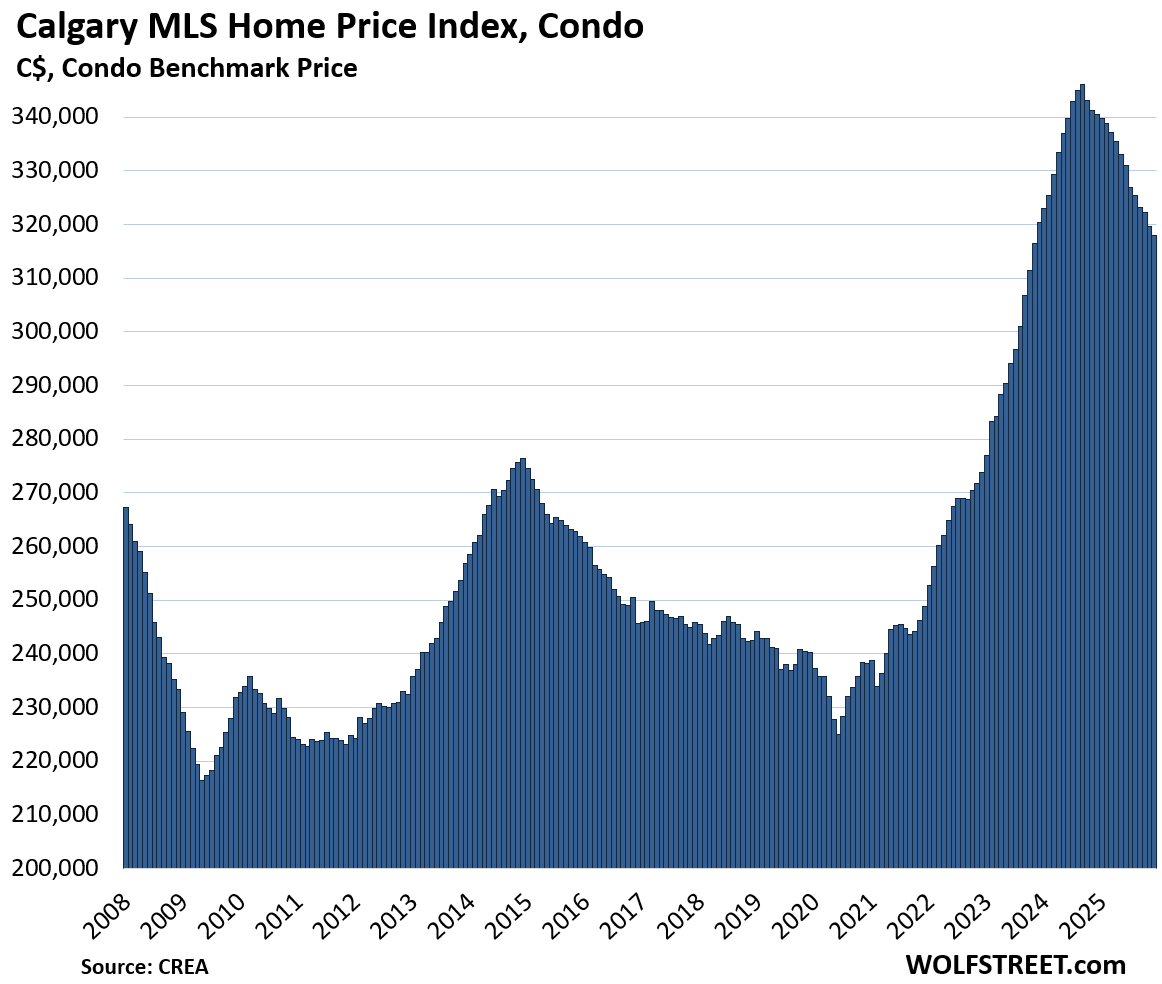
Calgary, condo benchmark price:
- Month-to-month: -0.5%
- Year-over-year: -6.6%
- From peak in September 2024: -8.1%
- $318,200, lowest since November 2023.
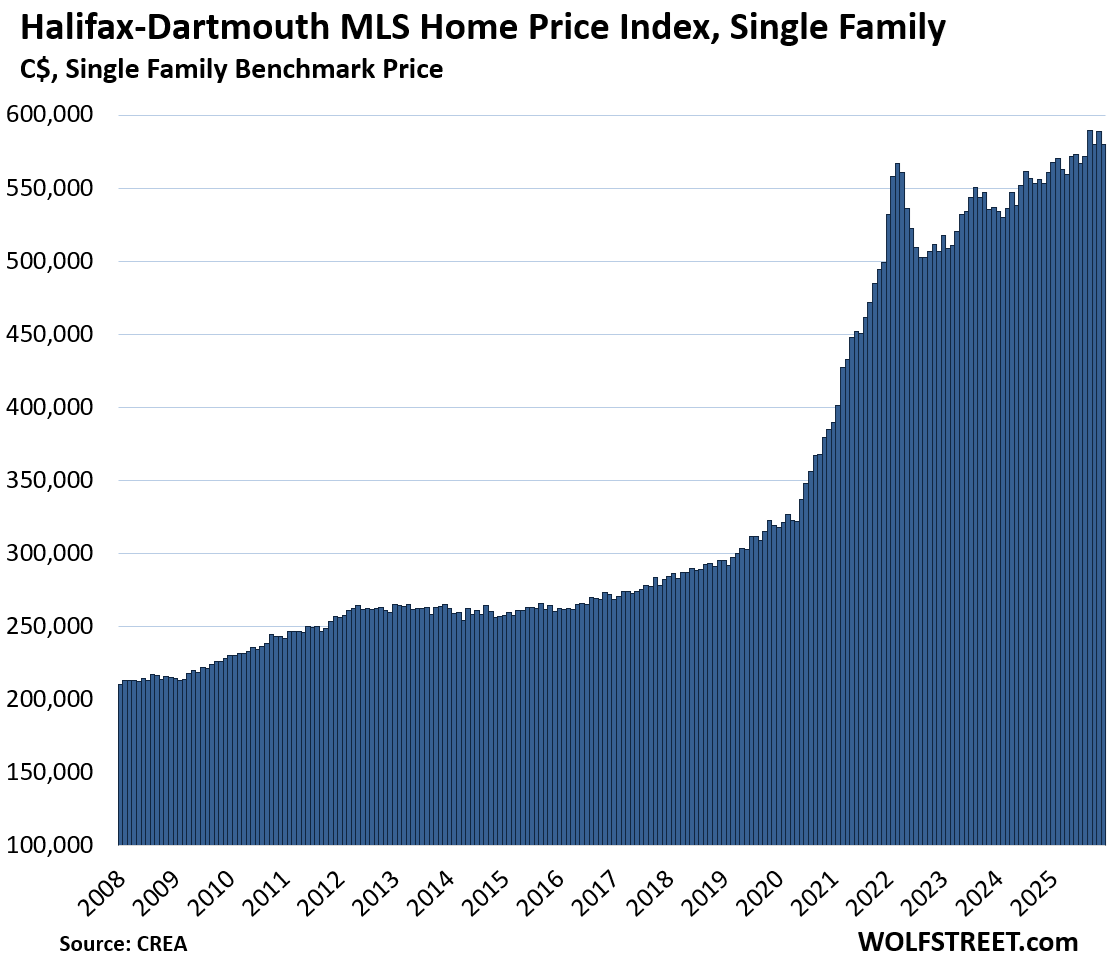
Halifax-Dartmouth, single family benchmark price:
- Month-to-month: -1.5%
- Year-over-year: +3.4%
- $579,700
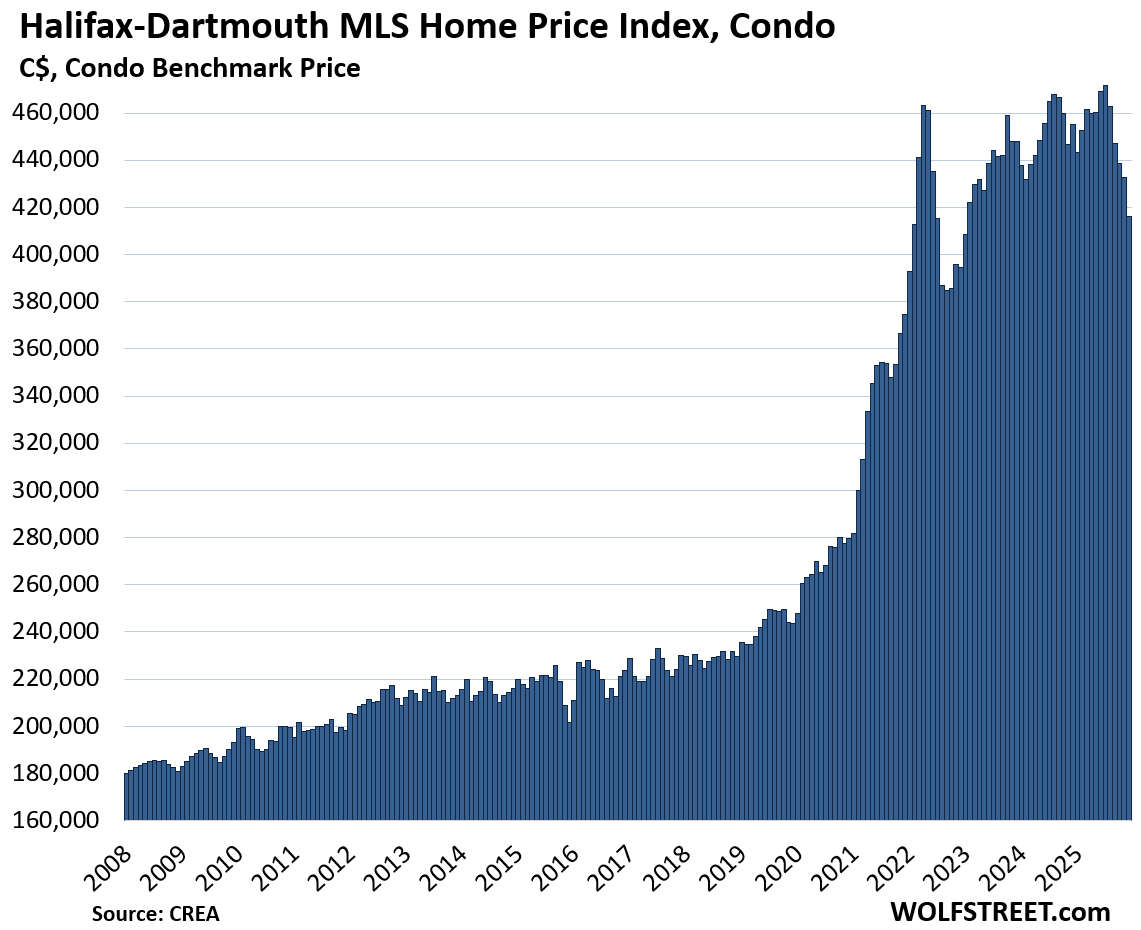
Halifax-Dartmouth, condo benchmark price. In this small-ish condo market, the price index, with relatively few transactions, can be all over the place.
- Month-to-month: -3.8%
- Year-over-year: -8.6%
- From peak in April 2024: -11.1%
- $416,000, back to February 2022.
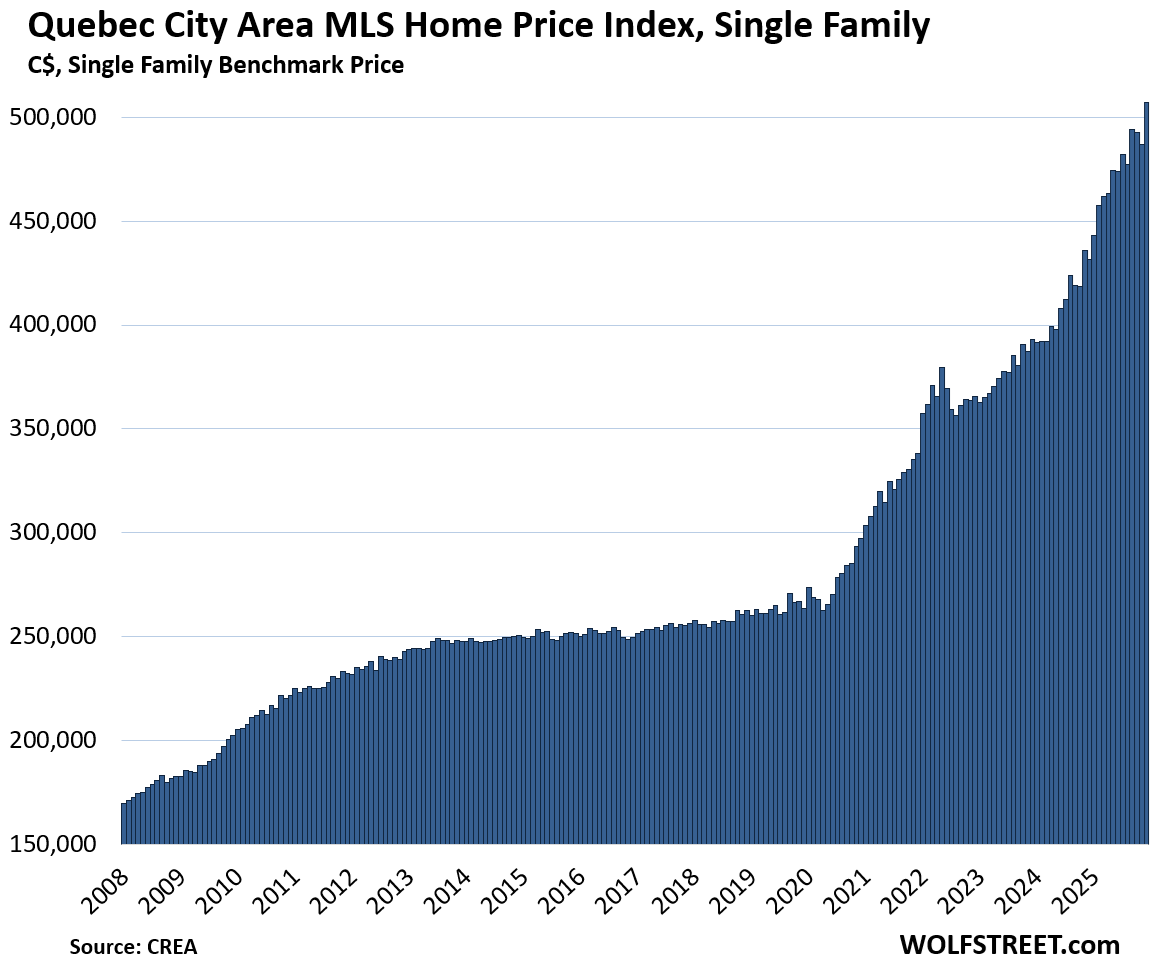
Quebec City Area, single-family benchmark price:
- Month-to-month: +4.2%
- Year-over-year: +17.5%
- Six-year price explosion: +93%, which is nuts
- $507,300, new high
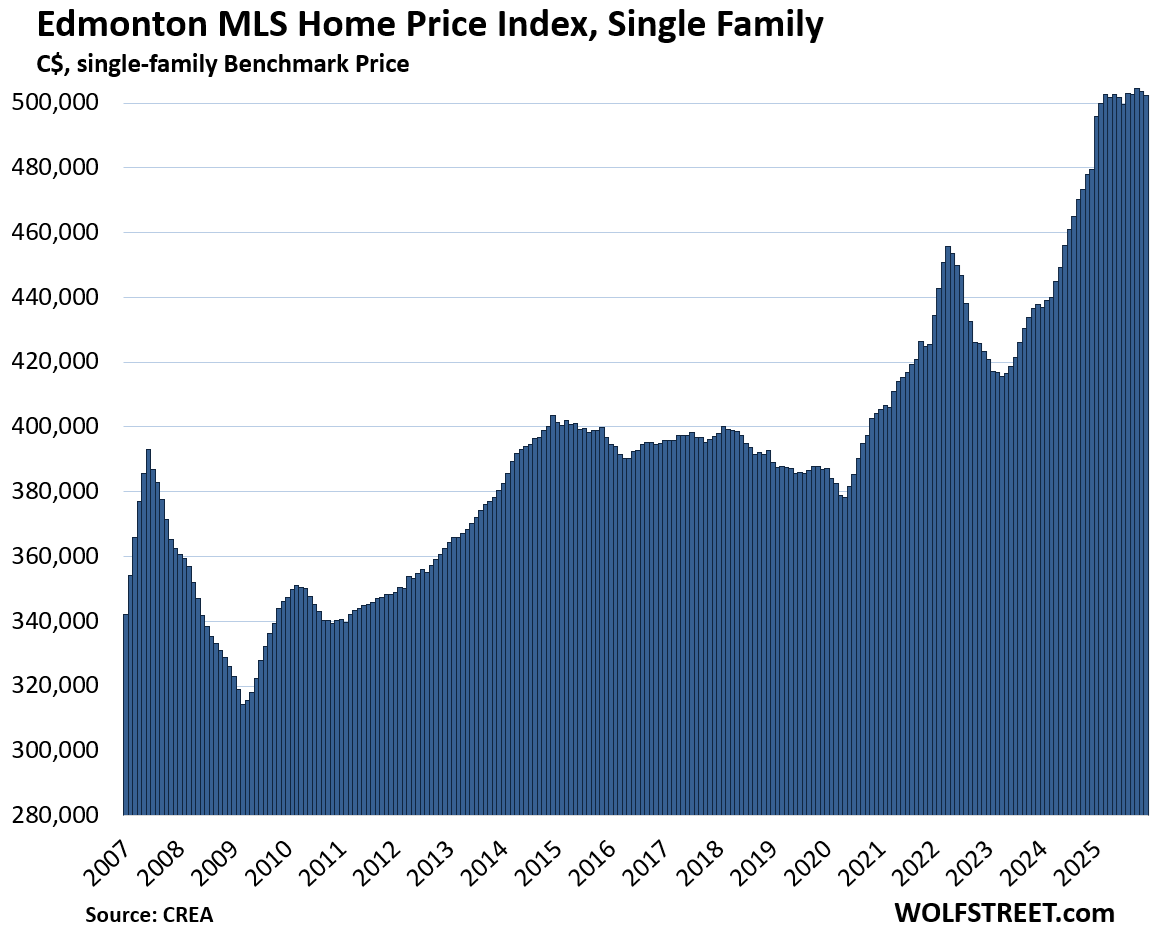
Edmonton, single-family benchmark price:
- Month-to-month: -0.3%
- Year-over-year: +4.7%
- $502,200, essentially unchanged since February 2025.
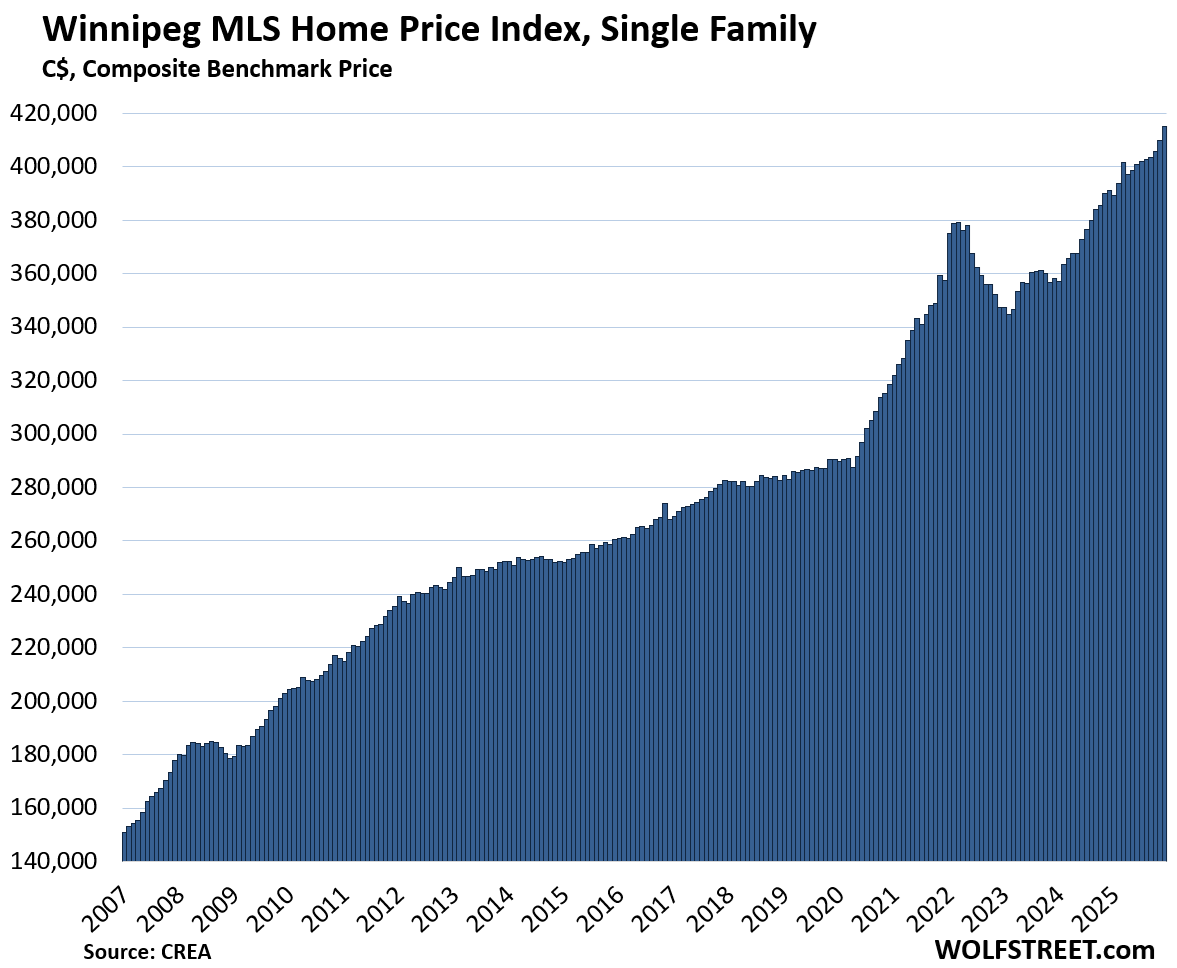
Winnipeg, single-family benchmark price:
- Month-to-month: +1.3%
- Year-over-year: +6.1%
- to $415,000, new high
And in case you missed it: The phenomenon that wrecked the housing market is slowly unwinding: “Locked-in” Homeowners Nevertheless Pay Off Below-4% Mortgages: their Share Drops to Lowest since Q4 2020
Enjoy reading WOLF STREET and want to support it? You can donate. I appreciate it immensely. Click on the mug to find out how:


Thanks for doing Canada, Wolf. We appreciate it. Wild times, seems like the condo construction is never ending in Calgary.
Hear, hear!
100% thanks Wolf!
GTA condo market is going to be exciting to watch over the next year or so and ~4.5M mortgages are set to renew in 2026. Bank of Canada cannot do much more rate wise … it’s time for the bond market to decide.
Thanks WR.
It’s amazing to see how the home prices are so detached from people’s income.
This was a really good analysis. Thanks for this. Toronto and Canada developed a disease where investors became more interested in buying condos to rent out and developers recognized this and built condos, not for the residents, but for investors. The condos got smaller and smaller until they became Dog Crate Condos, which were followed by Cat Crate Condos (250 sq ft). At the same time, the Fed govt realized the voters were pissed off at the millions of extra people and “students” brought into the county and reduced the numbers significantly which reduced the housing pressure. Investors tried to rent out the condos but could not get people to rent these tiny units at their break-even point, so many are renting at a loss. In addition, thousands of units that investors purchased years ago are now being completed so there will be a massive glut of Dog Crate Condos that people don’t want to rent, and they cannot break even. I recommend, should you wish to do more research on this, a foul-mouthed but brilliant mortgage broker at this Twitter site (Ron Butler).
/agree + Daniel Foch and Ron Butler’s podcast was excellent, everything you need to know about TO condo market.
Oh Canada. Completely mismanaged housing + immigration policies and mostly corrupt governments from Feds all the way down to local, who flamed the fire instead of putting in policies that helped affordability for all Canadians (not just the old ones). Young Canadians are so financially poo pooed but they don’t seem to be very financially literate and the lucky ones are using the bank of mom & dad who made $ on the whole affair.
As for the trends, disappointing to see the cheaper locations rising at an accelerated pace but not surprising. About time that condos overall are seriously falling, most of the newer ones were never built to be livable (comparing to Europe) and were a pure investment play by all.
Wish SFH homes had a stronger reversal, country is literally mostly empty land. Way too much greed though.
And Canadians are expecting the very institutions which caused this are going to solve it. “Government never found a problem so bad that it couldn’t make it worse.” I don’t recall who said that but it ever was and ever will be.
Builders and people respond to market forces (whether they realize it or not) and the government insists on distorting the market.
Prices in Montreal and Quebec City are rising, but transactions in both cities are declining after several quarters of growth.
Montreal home sales fell 11.3% year-over-year to 2,831 transactions in December 2025, while new listings fell 5% to 2,529 over the same period.
In November 2025, 875 residential transactions were concluded in the Quebec City area, representing a 4% decrease compared to November 2024
Montreal and Quebec City are in a highly nationalistic French speaking province, so why would English speakers flock there to cause housing bubbles there makes me curious.
The French language laws in Quebec are so strict that English speakers complained to media that hospital staff would only treat them if they spoke francais!