
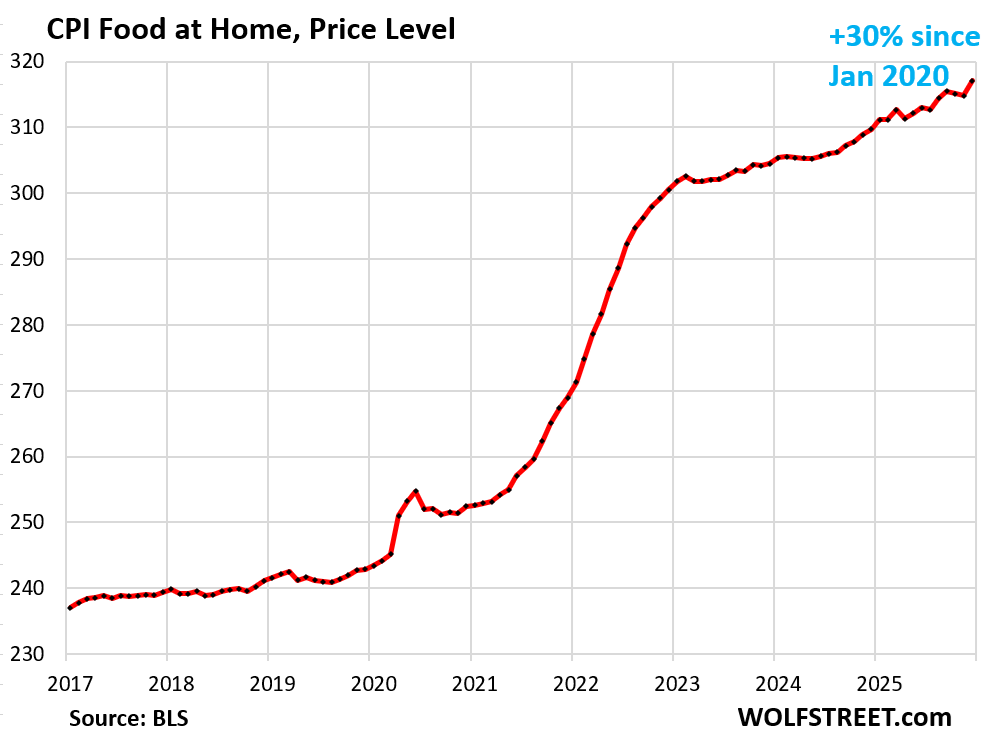
CPI for “Food at home” jumped in December and is up 30% since January 2020. The CPI for restaurant food is even hotter.
By Wolf Richter for WOLF STREET.
The CPI for “Food at home” – food that people buy at stores, markets, or online and consume off premise – jumped by 0.72% month-to-month (+9.0% annualized), the biggest jump since August 2022, after a slight decline in the prior month, according to the CPI data from the Bureau of Labor Statistics. This increase pushed the year-over-year increase to 2.4%.
Prices of many food and drink categories jumped in December, such as beef, coffee, dairy, and “other foods” which include items like sugar, sweets, fats and oils, salad dressing, peanut butter, soups, frozen and prepared meals, snacks, spices, olives, pickles, baby food and formula, etc. But prices of some foods fell, and fell hard, such as eggs whose avian-flu related price spikes have been imploding.
Since January 2020, the CPI for food at home has surged by 30%. The chart shows the price level. After the surge in 2021 through 2022, prices flattened out for a while, then rose slowly for a while. The spike in December was an outlier, and maybe just a blip. But the alternative could be that it’s an ominous sign of food inflation taking off again.
Beef prices spiked month-to-month by 1.0% (+12.7% annualized) in December and by 16.4% year-over-year.
Beef prices have been soaring for five years, as the US cattle herd has dropped to a 64-year low for a laundry list of reasons, causing tight supply. Despite the high prices, demand for beef has not yet collapsed. Americans gripe, moan, groan, wail, and gnash their teeth about high beef prices, but keep buying it and keep paying those prices. Prices would come down if demand collapses. But that hasn’t happened yet.
The BLS tracks tens of thousands of products and services by detailed items separately, which are then combined in categories and indices.
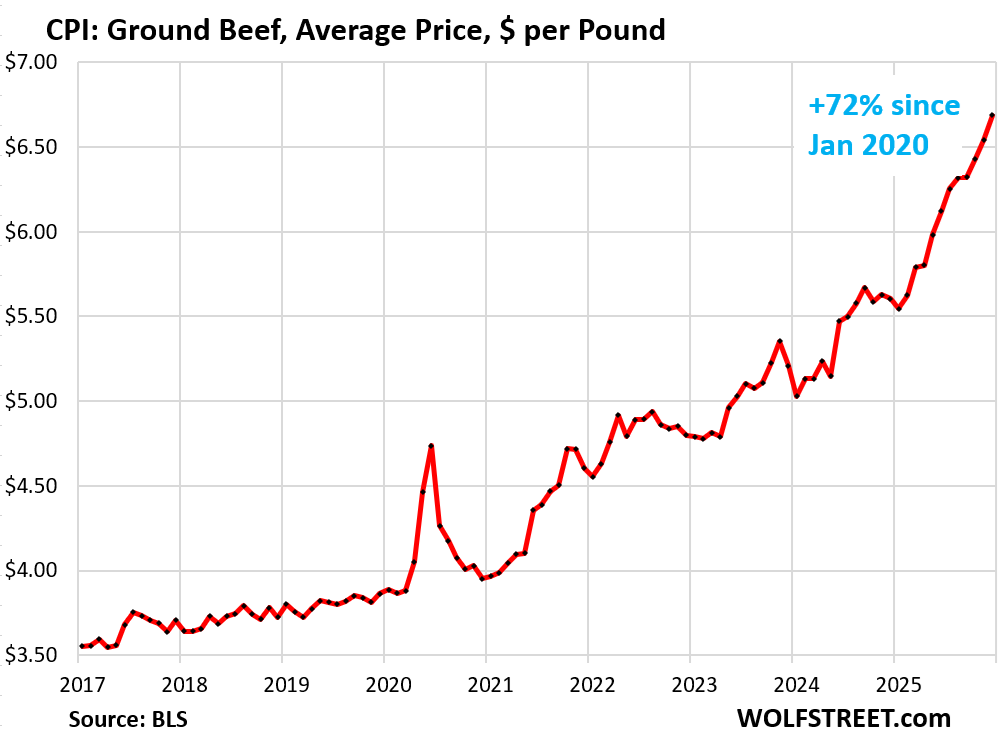
For example, the BLS tracks the price of ground beef, 100% beef, excluding round, chuck, and sirloin, and excluding preformed patties. The average price of this type of ground beef spiked by 2.2% (+30.6% annualized) in December from November, and by 19.3% year-over-year, to $6.69 per pound, according to the CPI data from the BLS.
The average price of this type of ground beef has exploded by 72% since the beginning of 2020.
Chicken breast, boneless – one of the tens of thousands of items that the BLS tracks – was unchanged in December, with an average price of $4.15 per pound, up by 1.2% year-over-year.
During the inflation shock from 2020 through September 2022, the price of this item had exploded by 58%, then skittered lower. But it is still up by 36% from early 2020, and very high.

The price spike of eggs is imploding, but prices are still higher than they had been before the two avian flu episodes.
The avian flu came in two waves, the first in 2022 and the second in 2024, each triggering shortages of eggs, empty shelves, purchase restrictions when eggs were available, and huge price spikes.
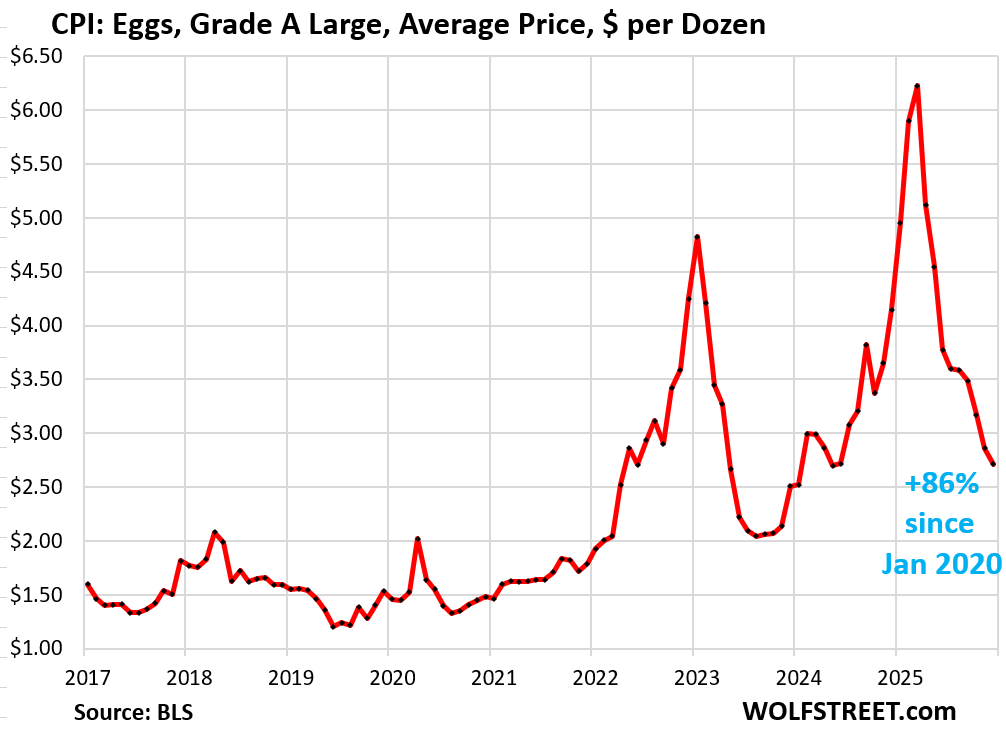
The average price of “Grade A Large Eggs” had soared by 368% from $1.33 per dozen in mid-2020 to $6.23 at the peak of the second wave in March 2025, according to CPI data by the BLS. Then, prices began to collapse.
In December, the average price of Grade A Large Eggs fell another 5.2% from November, to $2.71 per dozen. They have now plunged by 53% from the March peak, but are still 86% more expensive than they had been in mid-2020.
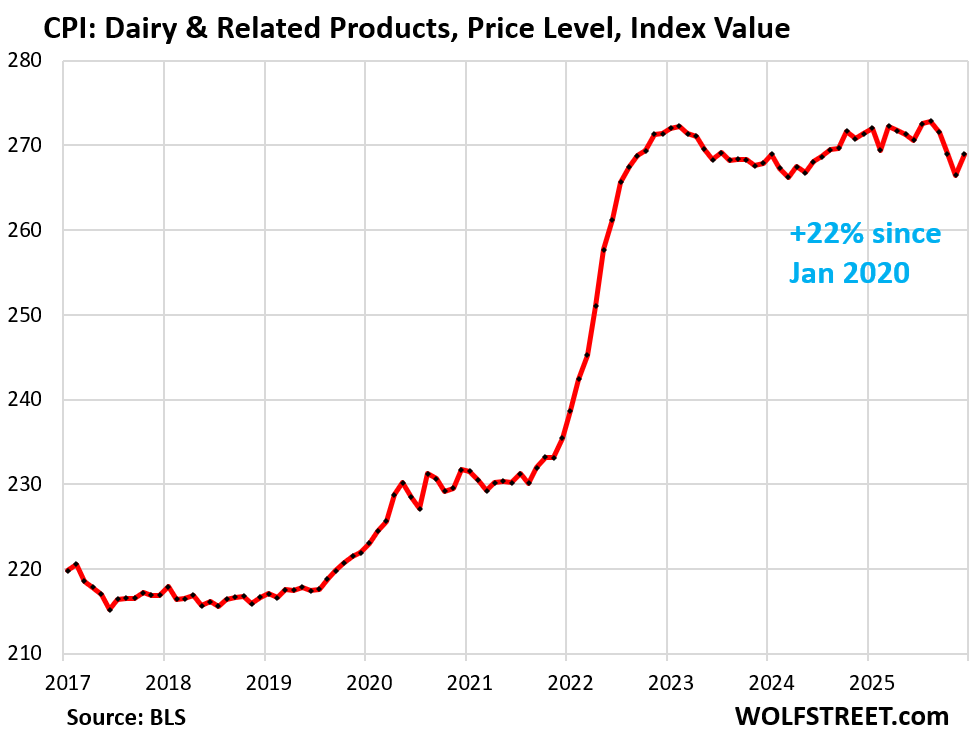
Dairy and related products contributed to the inflation shock in 2020 to 2022, when they spiked by 22%. Since then, prices have wobbled along at these high levels.
The CPI for dairy and related products spiked by 0.9% in December from November, after falling in prior months from the all-time high in August.
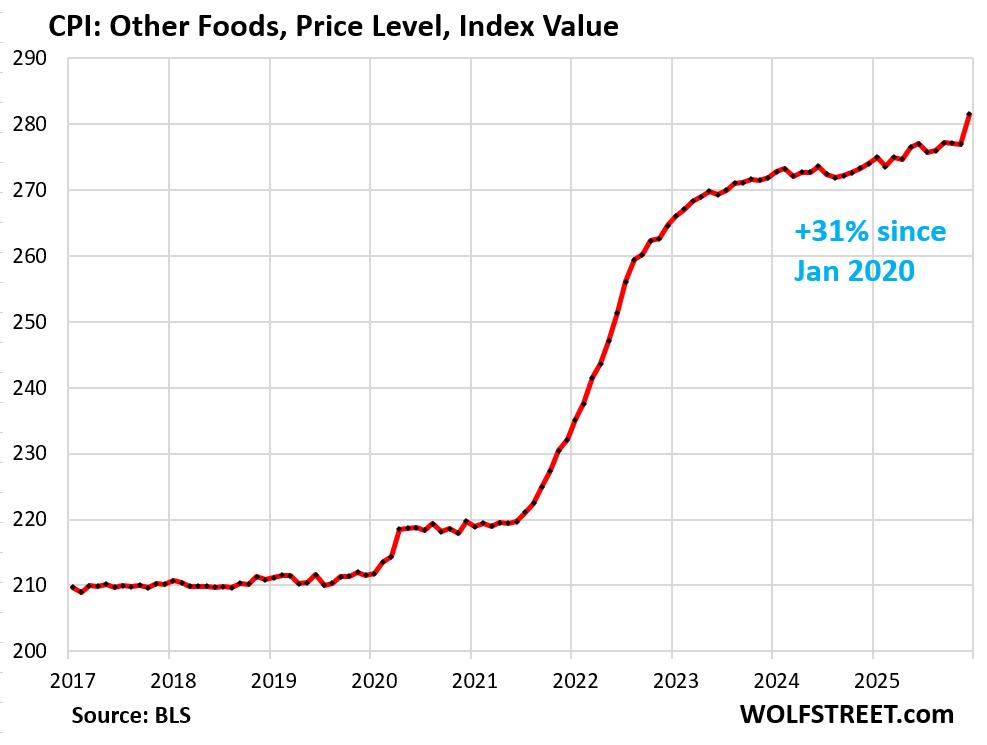
“Other foods,” is a CPI category that combines the indices of many specific food items that the BLS tracks separately. They include the categories for sugar, sweets, fats and oils, salad dressing, peanut butter, soups, frozen and prepared meals, snacks, spices, olives, pickles, baby food and formula, etc. So a substantial part of the grocery store. “Other foods” were a massive culprit in the inflation spike in December.
The CPI for “other foods” spiked by 1.6% in December from November (+21% annualized), after being relatively unchanged for seven months.
Year-over-year, they rose by 2.7%, the biggest year-over-year increase in two years. Since January 2020, prices for other foods soared by 31%.
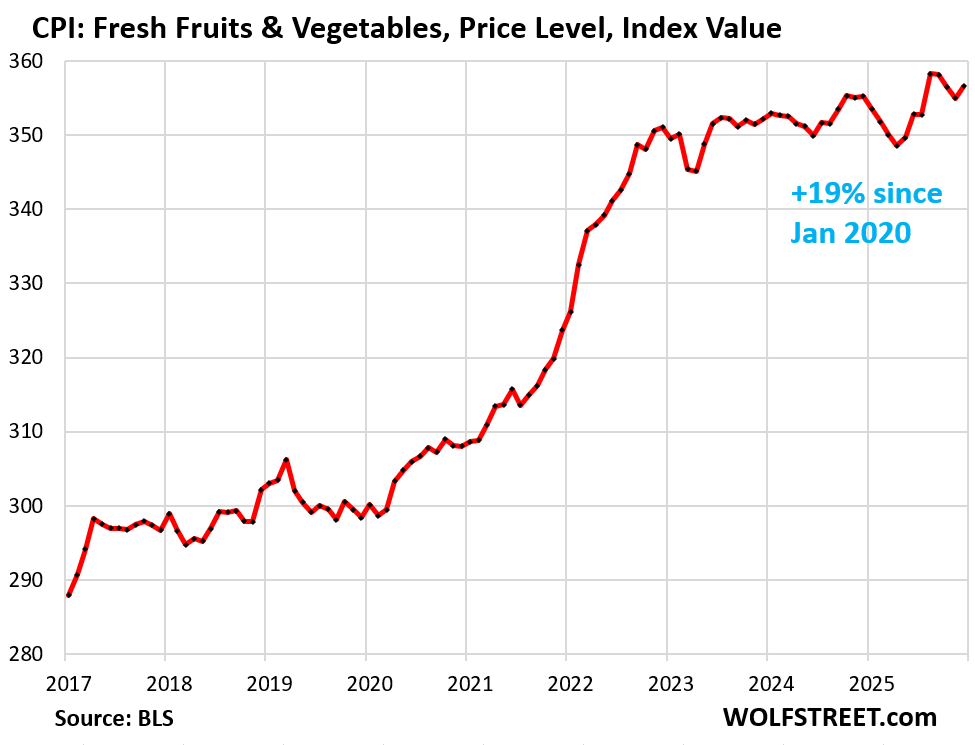
Fresh fruit and vegetables also surged during the era of the inflation shock. Since then, prices have wobbled higher, but more slowly, and are 19% higher than in January 2020.
In December, the CPI for fresh fruits and vegetables rose by 0.5% and was up a hair from a year ago:
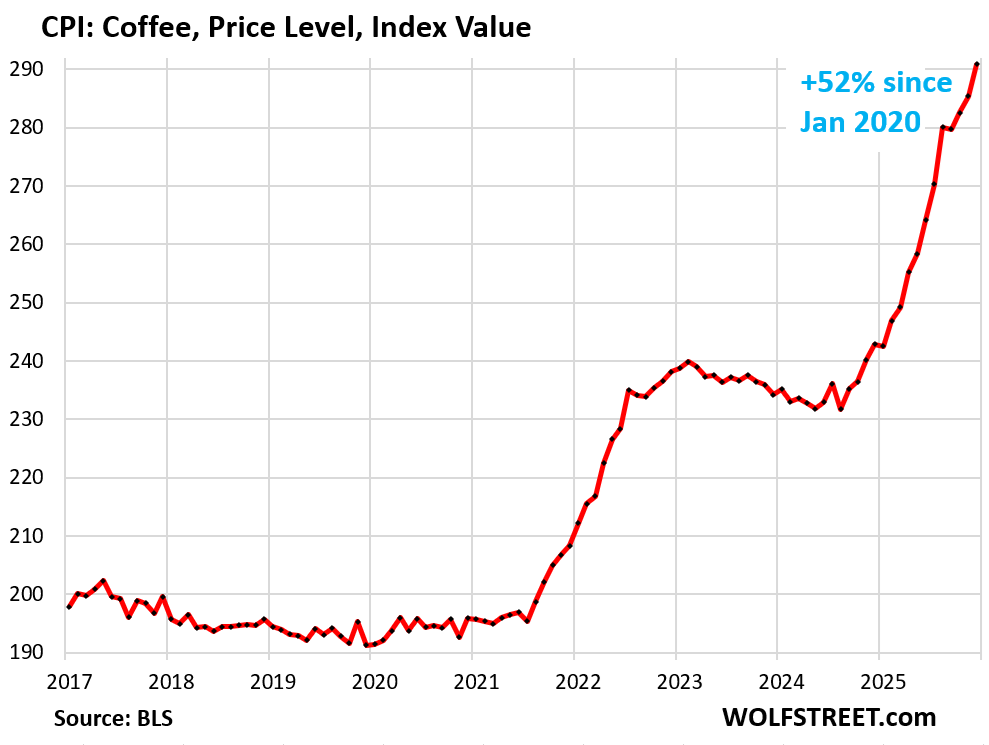
The CPI for roasted coffee – includes the indices for roasted whole bean, ground, and instant coffee – spiked by 1.9% in December from November (+26% annualized).
Coffee started rocketing higher in mid-2021. By February 2023, it had spiked by 23%. Then it tapered off a little.
In September 2024, it began spiking again and since then has spiked by another 25%.
These two surges roughly follow with some lag the two surges of global commodity prices of green coffee beans, plus some extra profit for US retailers and their coffee supply chains.
Since January 2020, the CPI for coffee spiked by 52%.
Various types of green coffee beans are traded as a global commodity product, and prices can be very volatile, often driven by fears of droughts, bad harvests, market forces, tariffs, and fears of tariffs.
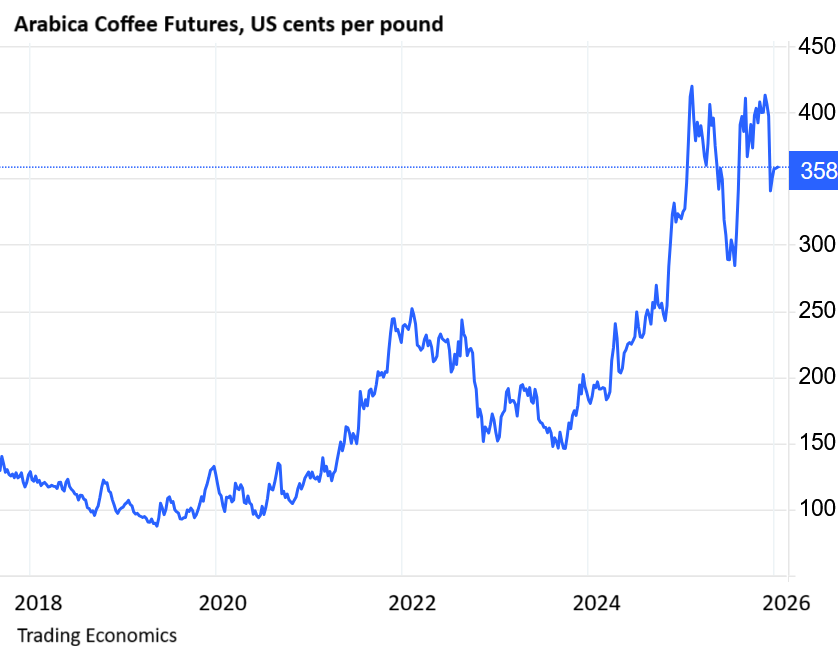
For example, futures prices for green beans of Arabica coffee are currently at $3.58 per pound (chart below via Trading Economics):
- From mid-2020 to early 2022: +150%
- Then skittered down some.
- From late 2023 to February 2025: +125%
- February 2025 was the peak. Since then, futures prices have zigzagged violently up and down and are currently down 14% from the February peak.
Food commodity prices can make crazy moves. But those moves don’t get passed on to retail prices in all their craziness for several reasons, including:
One, retailers and their supply chains work off long-term contracts.
And two, the cost of green coffee beans as a commodity is only a small-ish part of the retail price. The current green-bean cost of $3.58 per pound is close to one third of the $9.05 average price in the CPI for “Coffee, 100%, ground roast.” The difference goes to the roaster, the retailer, the transportation companies, and everything in between, plus profits galore for all of them.
Rising food prices (inflation), and even continued sky-high food prices that are no longer rising (high prices) cause a lot of hardship among consumers who aren’t rich and who have to make all kinds of trade-offs to put this food on the table. Food prices are critical, consumers face them every day, and yet politicians, central bankers, and billionaires can be tone-deaf on the subject.
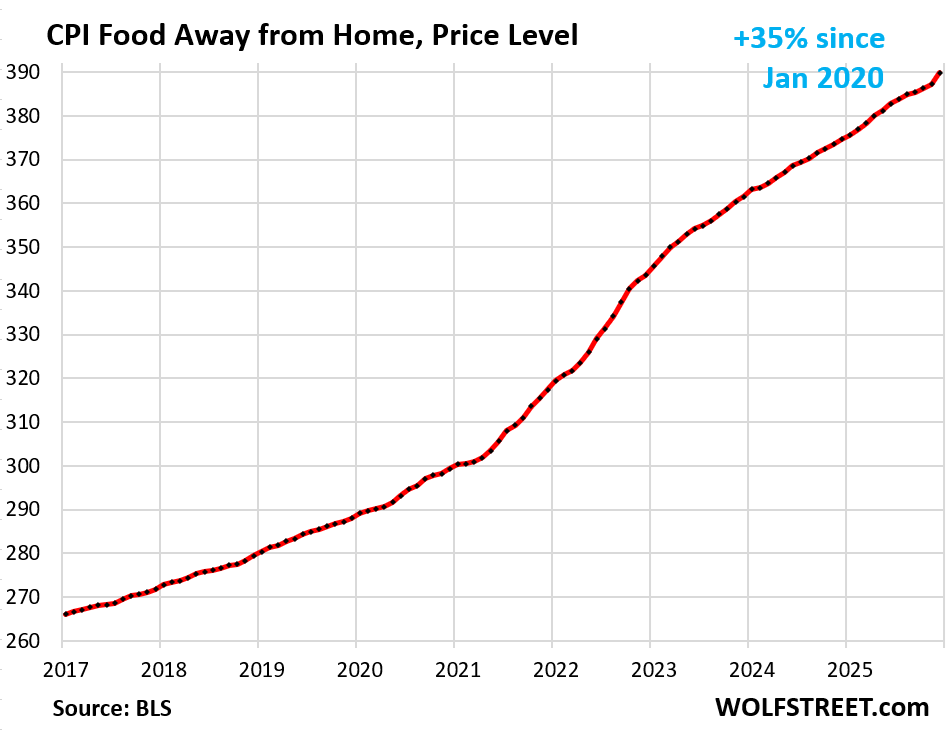
Inflation at restaurants – the CPI for “Food away from home” which is separate from the above CPI for “Food at home” – jumped by 0.7% in December from November.
Year-over-year, it rose by 4.1%, the biggest year-over-year increase since July 2024.
Since January 2020, the CPI for Food away from home has surged by 35%.
For restaurants, the biggest cost component is labor, not the cost of the ingredients. As the cost of labor rises, restaurants need to figure out how to pass that on to their menu prices. In addition, restaurants have to deal with rents, insurance, electricity, gas, supplies, equipment, repair and maintenance of the equipment, and all kinds of other costs.
And in case you missed it: Bad-Joke Housing CPIs, Absurd Health Insurance CPI Still Mar Today’s CPI Report, Repress Year-over-Year CPI Inflation
Enjoy reading WOLF STREET and want to support it? You can donate. I appreciate it immensely. Click on the mug to find out how:


Beef prices up with zero retracement, why? “Beef prices remain high because the U.S. cattle herd is at a historic low, driven by years of drought and high input costs (feed, fuel, financing), which makes rebuilding herds expensive, while strong consumer demand continues, meaning it will take several years for supply to catch up, with experts predicting little relief until late 2027 or 2028. ” Ok I’ll be watching next year.
Just but a chicken breast, broccoli, a corn tortilla, and some other thing. We’ve run thousands of simulations.
Brook Rollins for economic data – show your simulation sources and methods. Who are they targeting with this nonsense?
Part of the reason that cattle herds are low, and beef prices are high, is the “new world screwworm” infestation,or pandemic, if you will. The old tried and true remedy is being banned, and the veterinary pharma industry is pushing a new and very costly high-tech solution. Until congress (or Trump) wakes up and directs USDA to allow the old treatment, the problem of high beef prices will continue.
Could we import beef from Argentina, especially since we are on such good terms with their president, and we are extending a bailout for their economy?
I just bought a bottle of Malbec from Costco for 6.99 just to try it out, and to my disbelief it was better than some of the expensive French wines.
The funny thing is the US is still a big exporter of beef.
Biased Cattle Producer here but not a whiner. US government agricultural policy, known as the Farm Bill, for the last 50 years has skewed government support to the grain commodities. Just a way to reward the corporations of the world that provide seed, chemicals, fertilizers, machinery and even financial capital. The US independent cattle raiser, mostly through pride, has rejected government getting into bed with them. USDA is now in the process of extending grain commodity support to the former 30 million acres of grassland that has been converted (plowed out) in the last 20 years. The point being that cattle that used to graze those acres are now history. At the same time, we have surplus grain that the US and the world doesn’t need. It’s a supply and demand imbalance story that government has created to appease the lobbying of corporate America.
As far as the export of beef from the US. To begin with, Americans don’t care for tongues, lips, livers, stomach and intestinal linings, hearts, lungs, brain and yet every animal has them. Mexico, China, Korea, Egypt, etc call them delicacies. Further the US imports from Argentina and Brazil also contain these same cuts which are repackaged and sent out as exports, so much of the US exports of beef products weren’t even produced here.
My wife works for a beef exporter to Asia. So I hear the war stories. They buy all their beef from US packers, except when, for example, Japan blocks ALL US-beef imports because some BSE cow was discovered somewhere in the US, and the company then switches to non-US beef for exports. They export by container, either chilled or frozen. Packers need to produce the special cuts that are required in these Asian markets. Japanese importers will not accept US cuts. All of the beef they export is higher-end meat, mostly steaks, ribs, etc. They don’t export offal.
most US exporters are ‘speciality’ beef
$50 lb and UP UP AND AWAY
we get the oscar mayer beef -spit spit out my mouth
threatened wife with raising meat pullets again to freeze
she got cross eyed
but corn/grains cheap right now
and everyone of us have back yard
Wolf,
What do you think about the Truflation.com take on calculating inflation? Their estimate is currently running about 1.6%.
Thanks!
More blockchain BS. For example, anyone who counts rent inflation by scooping up “asking rents” from the internet — as Truflation” does — is demented.
I heard Argentina repaid the loan. Is this true?
It was a short term currency swap ($20B) and yes, its been reversed. It provided short term liquidity of USD to Argebtina in order to prevent their having to acquire those dollars on the open market, which would have resulted in a further decline in the peso and perhaps more contagion to their economy.
Once you travel the world. You really notice how affordable the food at the markets are We feel something is broken in the states with how expensive the food is. Apples for example taste better and are way more affordable in Europe like half price with a weaker USD.. I just bought chicken to grill in New Zealand for 4 people and it cost 9 New Zealand dollars that 5 USD, my wife tells me that would have cost 12 usd or more in the states. Eating out almost anywhere but the states is way more affordable because no taxes and no tipping on the restaurant tab. Food prices in the USA is just wrong.
Don’t you have to compare NZ prices with respect to NZ income and not US wages unless you happened to have retired there with US pension?
True that, Tucker Carson ran a show about how cheap it was in Russia to buy groceries but neglected how little income people made. But my point about no taxes and no tipping is huge, in my hometown in the states the sales tax at a restaurant is 9.5% and 20% for tipping that adds up!!. But the more I travel the more I believe food prices are broken in the states, it’s interesting that Porches all over the world sell for a premium than the USA post conversions. States are great for buying a Luxury car or luxury goods but poor for buying dinner out., Swiss prices at restaurant are expensive but they have a high minimum wage for the staff and free health insurance included. Most restaurant staff in the USA get zero health insurance with their job. Imagine how expensive a meal out would be if they were provided health insurance, it’s broken in my opinion.
I spent a lot of time in Russia in the 90’s. Interesting time for the Russian people to be sure. The propaganda at the time was that Americans had no money to purchase the items in American stores and that’s why the shelves were so full. Unfortunately, it looks like the American oligarchs are taking the U.S. to the same s destination, only coming at it from a different direction…
Yes. Stuff is cheap in Russia but nobody makes shit. A woman my parents knew refused to buy sucks here because the were twice as expensive but neglected her family was making 5x as much. That’s the problem with vibes.
Good point.
went to restaurant last weekend
$170 later(just water)
$20 burger(no fries )
$9 fries
so for wife and I – water only
$60+
and WHY DO WE HAVE TO TIP with these prices
1/2 time service ‘sucks’
For someone who “travels the world”, your observations are skewed.
First of all, “Europe” is not a country. Things are vastly different all over. I am dual EU citizen (parents are from Hungary) where they have the highest value-added tax (27% on goods and 5% on restaurants). The “service charge” (10%-20%) is added to almost every restaurant bill in Budapest for years now.
Inflation (including groceries) is up 40% since pre-covid and salaries haven’t budged. A decent net salary (for a professional) per month is around 5-600K HUF which is $1500-1800 a month.
Having traveled to London and Paris…I agree with your post vis restaurants. Headed to Italy so we shall see.
For those who have been there, individual EU countries are by far smaller than the US and have a long history of urban and local food markets – as opposed to grocery stores.
Kinda funny – EU is rather like China when it comes to import/export. They are net exporters of processed foods but net importers of raw materials and seasonal goods for their agriculture.
More analysis needed on what is happening on the supply side in my opinion – in the US.
Yes, in many European countries, a service charge is included in menu prices., its built in to the price, you order 59 euro meal and you leave 60 euro in Utah you order $100 meal and it cost $130 after tax and tip and most of the kitchen staff are non legal. The price would even be more if they used legal help. Its crazy Utah is getting stuff done with illegal immigration the state tried to past a law to prevent businesses from getting in trouble from hiring illegal help but it was deemed illegal a decade or two ago. Over a 100 hundred guys at Home Depot Salt Lake City looking for work daily. Our Red state gets a free pass and we as a state save money in labor inflation. Every residential building site has illegal help in the state, construction would come to a standstill still and get really expensive without our helpers. 21.6% voting margin in the right direction buys our state freedom.
A lot of these comments scream troll bot farm network
Regarding coffee, there’s also some substitution at work that makes consumer prices less volatile. For cheaper brands especially, if Arabica (KC Futures) get too expensive, the blend in the package you see in the supermarket gets weighted more towards cheaper Robusta (KD Futures). Some people might notice the difference if it goes from 60-40 to 40-60, but I certainly wouldn’t. With other brands, they might keep it 100% Arabica all the time, so prices would be more volatile.
I like coffee, but I don’t NEED coffee. It’s gotten so expensive that I might just go without in the near future. I took a 3 year hiatus from it about 15 years ago, and that looks to be a real possibility again. The prices are nothing short of ridiculous. And that 1 pound shrinkflation package is now down to 10.5 ounces, which really irritates me. Just charge me more but quit shrinking the package, f*ckwad, you’re not fooling anybody.
Than you Depth,as I NEED coffee,keeping demand down will save a few dollars,tis one of my main staples in long term pantry preps.
I do not know what a world will be like without coffee but hope I die before it happens!
This will lead to consumers buying less and less beef and resorting to alternatives like chicken, and even eating omelettes for dinner.
The inflation numbers should account for this as far as reducing beef’s inflation aggregate weighting and increasing that for chicken.
And this could be construed as a reduction in quality of life by consumers being forced to trade down to less quality or lower luxury items.
What you’re describing is called “substitution.” CPI does not incorporate substitution. But the PCE price index (the Fed’s favorite) incorporates it.
In terms of long-term shifts to different products, CPI does change weights. For example, when flat-panel TVs first came on the market and gained market share, their weight began rising from 0% to higher weights, while vacuum-tube TVs’ weight started falling and eventually hit 0%, and the product is no longer tracked because no one is buying it, all based on what people spent their money on over time. This process took many years. In this way, the huge CPI basket is constantly updated as new products are phased in, while old products that people aren’t buying anymore, are phased out of the basket.
We rarely eat beef nowadays. Fortunately we’re in an area with a lot of farmer’s markets where we can get game – venison, muntjac (open season), wild boar, wood pigeon, etc. It’s far better quality and, pound for pound, less expensive
What is remarkable is that we currently have dirt cheap corn and soybeans and wheat.
These crops have had demand issues due to political gyrations.
But $4 Corn and $10 Soybeans are prices from the 1980s.
This has tamped down inflation numbers.
If these prices ever catch up to today’s pricing, it will be DRAMATIC in food pricing. Very dramatic.
I can almost hear them assembling the guillotine down in Farragut Square.
Was it made in China, and did it come with instructions? It’s probably made of pot metal and will break in half on the first chop.
I watched a news show somewhere on television a couple of weeks ago regarding beef prices from the point of view of ranchers. The ranchers were blaming small herds on the meat packers paying too low a price. The concept being the meat packing industry has consolidated to the extent that they can control pricing. They felt betrayed by the administration importing beef from Argentina saying it just goes straight to the meat packers who still increase prices anyway because they can. Could just be whiners whining.
You might want to look at this post. One of the relevant points it makes is that the concentration of market share in the top four meat packers has not increased in the past 30 years.
https://www.americanactionforum.org/insight/unpacking-trumps-meat-packing-allegations/
The industry left themselves vulnerable to packers with hope that the federal government would break up the stronghold for them instead of take matters into their own hands and make an alternative packing supply chain. Now problems have been kicked all the way here.
The only independent vertical supplier that I’m aware of is Porter Road. It’s small, much better quality than Argentina (hand foot mouth going around), and because they can’t cut any costs by scale it’s expensive. I believe Cargill (big ag) was interested in investing which says a lot on how tight the grip is and how tough it will be to break it. They’ve waited too long, through easier times and multiple AG bailouts. Now it’s even more challenging with additional headwinds.
Oh my goodness the little guy/small business gets screwed. Been happening since the dawn of time. Getting worse due to consolidation. Gvt should be breaking up these larger companies and creating some competition. The oposite is true. Wish I had better news.
Try being a rancher sometime.
Been in the beef industry for over 40 years. Supply-demand still works, and as Wolf pointed out, the cattle herd is the lowest in decades. Right now the packer is losing $150-200 for every head they process, while the feedyard is making around $150/head as they have leverage with lower supplies. It will be this way through the end of this year into 2027. However, back during covid, when a lot of the economy was blunted, the packer made over $2,000/head but maybe last for a few months as the economy started recovering. Point is, each side uses leverage as much as they can when to their advantage. There are basically 3 large packers in the U.S. so concentration in the beef industry. Tyson is closing their Lexington, Neb processing plant down today in hopes that packers won’t fall over themselves trying to secure supplies, but will still have to go through 2026 dealing with lower cattle supplies. It takes 18 months for a mama cow once calved to get that beef to your table.
Charlie..if memory serves…wasn’t there a very large cattle death spike (disease related) sometime around Covid in KS or mid-west….something in the neighborhood of 10,000 cattle? I have no idea and am too lazy to research what percentage 10k is relative to the total US estimate. But that loss had to have an impact.
As an aside….any idea how much domestic agriculture sources to the reported growing ownership of US farmland to Chinese owners?
phillip – in 2022 there was a cold spring that went quick to high heat, humidity and no breeze for a short period of time in SW Kansas. Northern type cattle in this area still had their “winter coats” on and died from this abnormal weather condition. Farther south going into Tx, cattle there have “thinner coats” and can handle that type of weather. Numbers that died were estimated from 2,000 to over 10,000, probably closer to the top side. This is out of over 2.4 million head in the western 1/3 of Ks. Hope that helps.
Chinese farmland ownership in the U.S. is small but increasing. Canada actually owns much more U.S. farmland than China.
Foreign entities own somewhere around 4% farm ground in the U.S.
The nice thing about the foreign ownership of farm (or any other) land in the US is: the land is never exported.
I remember reading about Japanese investment in US real estate: everything from hi-rises to stadiums.
A lot of this was happening in the ’80s. Of course, that was near the economic zenith of Japan, and as the stock markets and other economic sectors were falling apart: the US still had the land and buildings, and the little green pieces of paper that were flying around everywhere were of less importance.
Humanity seems doomed to keep learning the same tough lessons over and over…
There’s reason why agriculture is heavily subsidized by governments. The ruling families learned long ago that a hungry man is an angry man. Having grown up on a dairy farm that also grew their own silage, you learn first-hand that there is no such thing as a free lunch. The laws of Nature (math, physics, chemistry) rule the day, despite what any politician or eCONomist says.
With over 8 billion souls competing for the real resources and energy required for a decent standard of living, I’d like to be optimistic but personally I am not predicting any deflation in food prices until there is a massive decrease in real demand (population).
Hedge accordingly.
The press often talks about “the inflation in beef prices” and I thank Wolf for avoiding this.
Inflation is defined as a general increase in prices. We can expect price changes in any single commodity due to supply and demand. The price of eggs provides a relevant recent example.
Inflation is always a monetary phenomenon where the provider of money, usually the government, expands the supply without a corresponding increase in the real production of goods and services. The government of Argentina provides another example.
Our modern money of course has no value, and scarcity should be an attribute. It is simply a convenient method for exchanging valuable goods and services. When too much is “printed” it increases the attraction of gold, silver and more recently bitcoin as alternative mediums of exchange.
Good report
This conforms to what I’m seeing here in the grocery stores and eating out. If you go on the Mediteranian diet, heavy on fish and fresh produce you will not see the gigantic food inflation that has hit many products on the shelves, especially red meat. Food inflation has not affected us hardly at all. My concern is more on the abundance of junk food sold, and poor quality of many of the items, and the necessity of going to multiple grocery stores to get everything you need to eat healthy. My food budget is lower than it was in 2022 at the height of the Biden Inflation.
We eat Mediterranean diet here and I think you’re “nuts” … Produce prices, fruit prices, fish prices are all out of control! I live in a coastal state and fish is priced like a luxury item!
Good summary of the variability in price moves. Inflation of the money supply always plays out in an uneven manner for prices as well as wage/salary changes. It’s a messy and often painful process for the public that has to absorb this change.
The 30% general rise in the price structure is supposed to translate to a similar rise in GDP (over time). Thus, if the deficit were reduced to zero, the Debt/GDP ratio, over time would be reduced 30%. However, the US government continues to overspend by around $2T each year, which for a $38T debt load is a 5% increase in debt. So a few more years of $2T in deficits will undo the inflation “benefit” to GDP.
Final comment on inflation. As the US inflates, the whole US cost structure increases against those countries who inflate less; essentially making us even less competitive. This is the dirty side of inflation that I rarely see discussed.
If beef had its externalities (environmental damage) priced in, it would be far more expensive than it is even now. I’ve always treated beef like a luxury and have saved a ton of money in the past few years with this approach. Being a little flexible at the grocery store is going to be a great skill in the coming decades, but I understand why people get anxious about groceries and food.
I mean, if you’re one of the millions of Americans who literally does not know how to cook, and your McDonald’s/etc. triples in price, that’s pressure on your ability to access food. With a culture that teaches consumer choice as the highest freedom, I can see why people are inflexible. However, I am really sick of hearing people complain bitterly every time some little thing in their lives changes because they refuse to consider alternatives.
I think that’s a great insight about the mighty consumer being brought low by a change in the dollar menu. I remember during COVID that eggs became ridiculously expensive, then unavailable, and beef and chicken and lamb and pork were unchanged or even went down in price. I wondered if people attempted to stock their refrigerator but didn’t know how to cook any proteins besides eggs.
A person should know how to make a tasty meal out of whatever leftovers they have around. Moreso, their palates need to evolve a little to be open to other foods and food combinations.
The restaurants in our area have large entree portions and and charge 3.75 to 4.25 for ice tea and sodas. My wife and I usually split an entree and order water with our meal. Wine at home is much more affordable.
Again, seems to me that a complete analysis needs to be done. How much traces to individual state minimum wage policies, how much to transport costs, how much to import costs, how much traces to the E2E chain of costs (e.g., fertilizers), how much to market power by big ag, how much to gov’t subsidies/regulation, how much to energy costs, how much to weather impacts, how much to Covid impacts, how much changes in the labor pool, etc., etc.
I like beef as much as the next person although usually just hamburger and such. And while everything comes with a cost, the amount of water and resources and impact on the environment is huge. Moderation in most things makes sense and beans and lentils provide solid protein with a fraction of the negative stuff from animals.
The average American consumes 227 pounds of meat per year while global average is about 75 pounds. Europe falls more or less at midpoint between the two. Australians and Argentinians are only two countries similar to US. Perhaps high prices will force more balance into the equation?
I went vegan a long time ago, mainly to try to avoid all the environmental impacts of meat. The statistics of it are impressive; I’ll quote from a 2006 UN report called “Livestock’s Long Shadow”:
– The sector is the largest anthropogenic user of land; 23% of ice-free land surface; 33% of total arable land for feedcrop; 70% of total agricultural land.
– 70% of deforested land in the Amazon is occupied by pasture.
– The sector is responsible for 18% of greenhouse gas emissions (in CO2eq), a higher share than transportation.
– Figures from the US have the sector responsible for 55% of topsoil erosion, 37% of pesticide use, 50% of antibiotic use, and a third of the nitrogen and phosphorus loads in freshwater.
– Additionally, as of 2025, 95% of the world’s biomass of mammals consists of humans and livestock; only 5% are wild mammals. Humans and cattle are both at about 37% of that.
And that’s setting aside the health issue. We would probably all benefit in the long run if prices forced people to chill out with the meat. Much of the reason the prices are low to begin with is that the sector is being subsidized on one hand, and the environmental damage isn’t being priced in at all on the other. Neither is resource depletion (i.e., aquifer depletion to grow alfalfa in the desert, topsoil loss to grow food for cattle with feed conversion rates in the single digits, etc.)
I’m in WI where milk cows and beef cows plus other livestock have been raised and grazing here for a couple centuries. In my 60 plus years the only “environmental “ degradation —if you want to call it that—has been caused by sprawling suburbs. The State’s land, rivers, lakes, rolling hills are doing fine in spite of all those goll dern pesky animals.
That CPI food at home went crazy from January 2020 to January 2023, up nearly 25%. Luckily since then it’s only up about 6% total from 1/23 to 1/26. People can handle 2% a year.
One more example of how the crazy money printing and “Stimulus” of the pandemic and early JB eras distorted everything. The pain in food, autos and housing will take a long time to work off. Ten to fifteen years of inflation in just three years.
Found a historical ground beef price chart that only went back to 1984. Between 1984 and 2000, 16 years, the average price was $1.50lb. I remember paying.99lb all the time. Prices started to move up in 2000 and last year was the winner up a buck a pound in 2025.
I think the burger chains will be crying soon. You can only hedge lower prices for so long.
There has to be some moms paying $300 at the checkout now.
Chick-fil-A has entered the chat.
Oh also, who can afford kids?!
Not in this economy.
I think part of the price changes are due to what is in fashion as “healthy” at the moment. Demand increases and shrinks accordingly. Americans are starting to eat red meat again after many, many years of not as much and now it is showing. Also high protein diets in general are in fashion even before the latest upside down pyramid came out from the government.
Beef. It’s what’s for dinner.
Up until a couple of months ago, my local ALDI was gradually lowering prices through most of last year. However, that changed which most prices going up about 5-10%.
My local Kroger is selling boneless chicken breasts for $2.49 a pound with a Kroger card.
That’s my local trends here in NW ATL.
Meanwhile, the ten year bond yield is looking quite angry today.
The big skyrocket in CPI for food at home took place in 2021, 2022, and 2023. Hmm, now who was president during that time? You guessed it, Joe Biden. Of course this is a bivariate evaluation, but it is suggestive. All sorts of things can impact food prices, even the political party in power.
Yes, we all know the executive branch is basically solely responsible for food costs AND economic performance.
Good thing the people in the comments are RTGDFA… and comprehending this.
I am writing my local congresspeople to congratulate them on their bipartisan successes in balancing the budget, once again. /s
Almost like we shouldn’t have killed 40 million bison in the 1800s.
Remember during Clinton administration when McDonalds was 2 for 2 and Burger King was $1 whopper, limit 5. I would get 2 for me, 1 for my wife and kid and one for my dog. And gas was a buck a gallon. Good times.
Well the dollars back then are now worth $1.83 to $2.24.
corporate greed is def greedier though
One thing that would be helpful is to have grocery stores put country of origin labels on all the products they sell. Right now many, don’t. Even the labels that are there are misleading. Example “distributed by company x in a city in New Jersey. The company distributes them but the product is made in China. Same with prescription and over the counter drugs.
I am grateful have eggs from friends chickens which taste a lot better then supermarket eggs/go in with others on 1/2 cow for beef/have a lot of local farms and try and support them.
That said,do shop in markets and the biggest increases I have seen by far was me coffee beans,last tow years up 2.50 or so for 24 ounce bag and decent bread,look for sales on what I need and if long term stock up beyond me basic long term preps.
I ever get me own lands again will among other things have a garden/a few goats for butter/cheese and chickens for eggs.
Move out of the city. Live in plentiful country. Plant your own garden. Have a root cellar. Eat Venison Keep a few cows and sheep, chickens. It is marvelous how this life changes your outlook. You stop worrying about food and inflation because you grow your own, and the back forty acres keep going up in price. Added benefit, I grow to much food each year and can give it away to my delighted neighbors.
You’re describing what would be the absolute worst nightmare for me 🤣
Just be happy everyone likes something different, and that lots of people like living in big dense cities, or else 20 million people would be packed into your idyllic spot, trying to have small gardens and keep two cows, and then it would be a big filthy city with cows.
“Brown Acres” ?
To me, food from the grocery store is very inexpensive. I don’t buy pricey things like beef, though. You can get a lot of healthy fruits and vegetables such as cabbage, carrots, papaya, grapefruit, apples, roma tomatoes, russet potatoes, for between $1-$1.50 per pound. 40oz. containers of oatmeal for less than $5. Dry beans and rice that you can cook a large amount of for very cheap. Peanuts in the shell are cheap. For meat you can get tuna, chicken, minced fish for low prices. Both cow’s milk and almond milk are cheap. Some people wouldn’t want it but instant coffee is still not that expensive. Save up, find a used compact car in good condition and buy it cash, and take care of it, don’t drive it hard and fast. Some people pay a lot of money to lease vehicles, way to much in my opinion. The vast majority of my monthly expenses goes to housing costs. I’m very surprised at how cheap gas is. Is that why the US govt. is selling the most advanced fighter jet to Saudi Arabia, so they will keep pumping lots of oil to keep the price down?
Though I’ve seen the reports of Americans spending a lot at food away from home, I still feel like the govt’s desperate attempts to keep housing prices high, by pushing down interest rates, is hurting discretionary sectors. Maybe that’s why there is so much deficit spending, to try and keep restaurants, auto dealers, retail shopping going. Maybe I’m wrong, just a hunch.
Restaurants are closing left and right in Austin, TX. The costs to go out is starting to pepper conversations with friends. People see restaurants closing due to increased operating costs which in turn makes them think about their own discretionary income. People start “locking up” and aren’t eating out as much. Restaurants saddle with increased costs and now fewer customers. The vicious circle begins.