
If the labor market is weakening, it’s on the job-creation side of the equation, maybe in part due to AI.
By Wolf Richter for WOLF STREET.
Initial applications for unemployment benefits (“initial claims”) in the week through Saturday bounced back to a still relatively low 236,000, from the outlier-plunge last week, seasonally adjusted, that had caused me to note, “initial unemployment insurance claims were a doozie that’ll reverse next week,” and they did today.
And I had said: “Obviously, one or more big states didn’t get their claims data filed before deadline, this having been the week of Thanksgiving, which is what caused this plunge in claims. But that data gets picked up in the next week, and so we’ll see a spike in claims, which will undo part or all of today’s plunge.” And they did today.
Which is why we look at the four-week average, which largely irons out the week-to-week squiggles, and which ticked up to 216,750, seasonally adjusted, which is historically low, and in the same low range that it has been in for the past four years.
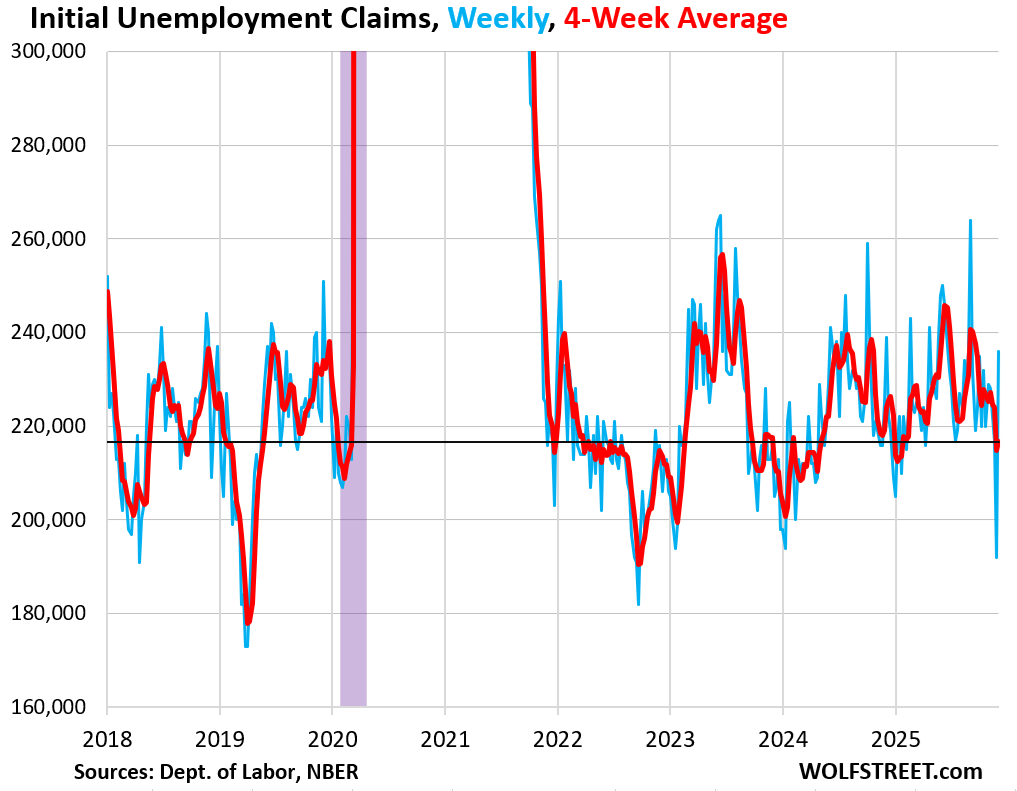
This is administrative data, not survey-based data. Freshly laid-off people filed these applications for unemployment insurance at state unemployment agencies, which then reported them to the US Department of Labor by the weekly deadline, which then combined the data and published it today.
In a longer timespan going back to the 1970s, initial claims are very low, despite the growth of nonfarm payrolls over the decades. They were lower only during the tight labor market of 2018 and 2019 and during the labor shortages coming out of the pandemic.
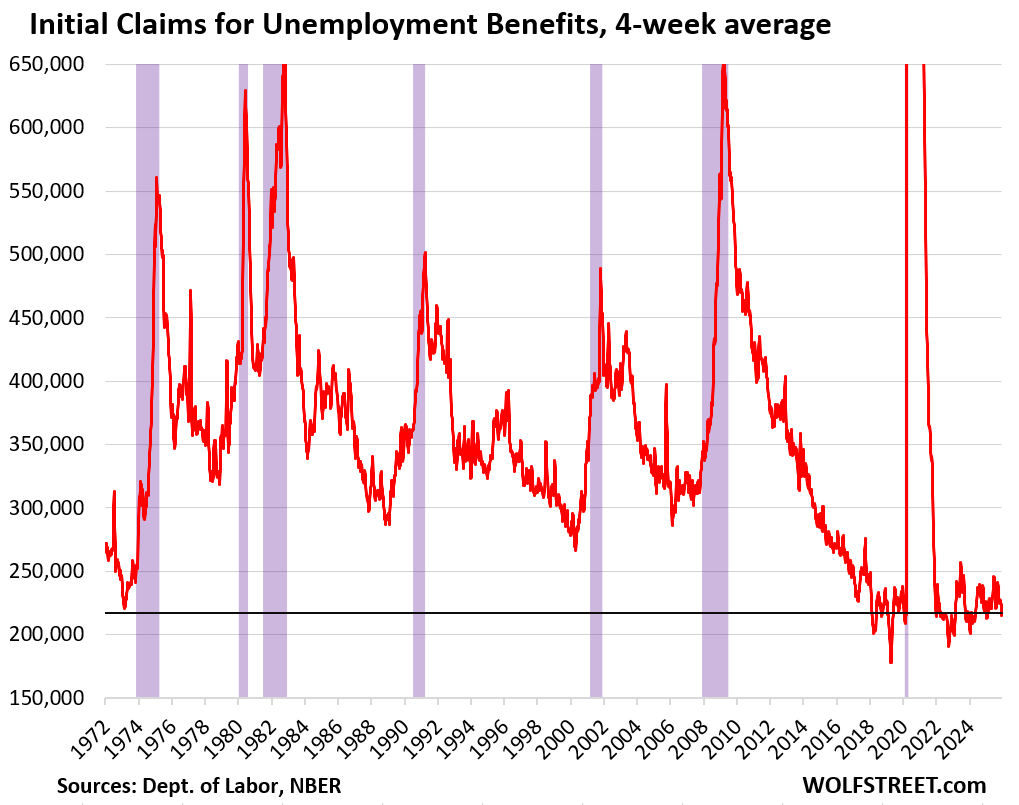
Layoffs show no signs of a weakening labor market. If the labor market is weakening, it’s on the job-creation side of the equation.
We have also consistently seen that churn in the labor market has calmed down dramatically from the pandemic spike, with relatively few people quitting, with retirements being down, with layoffs & discharges being relatively low. As fewer people are leaving their jobs, they leave fewer job openings behind, and fewer people need to be hired to fill those newly opened jobs. While job openings remain relatively high – they’re at the level of the peak before the pandemic – there is a lot less turnover in the labor market, so it’s harder for people who are out of job to find a job, all discussed here.
This greater difficulty for laid-off people to find a job, and to spend more time looking for a job, shows up in the continued claims for unemployment insurance – but even those have improved recently.
Continued claims for unemployment insurance, also released today by the Labor Department, track people who applied for unemployment insurance at least a week earlier and are still claiming unemployment insurance because they still haven’t found a job.
These “continued unemployment claims” plunged by 99,000 in the latest week – a huge outlier plunge that will at least partly reverse in a week or two – to 1.838 million, the third week in a row of declines, seasonally adjusted (blue in the chart below).
These continued claims are now down by 130,000 from the recent high at the end of July.
The four-week average fell for the third week in a row to 1.918 million (red).
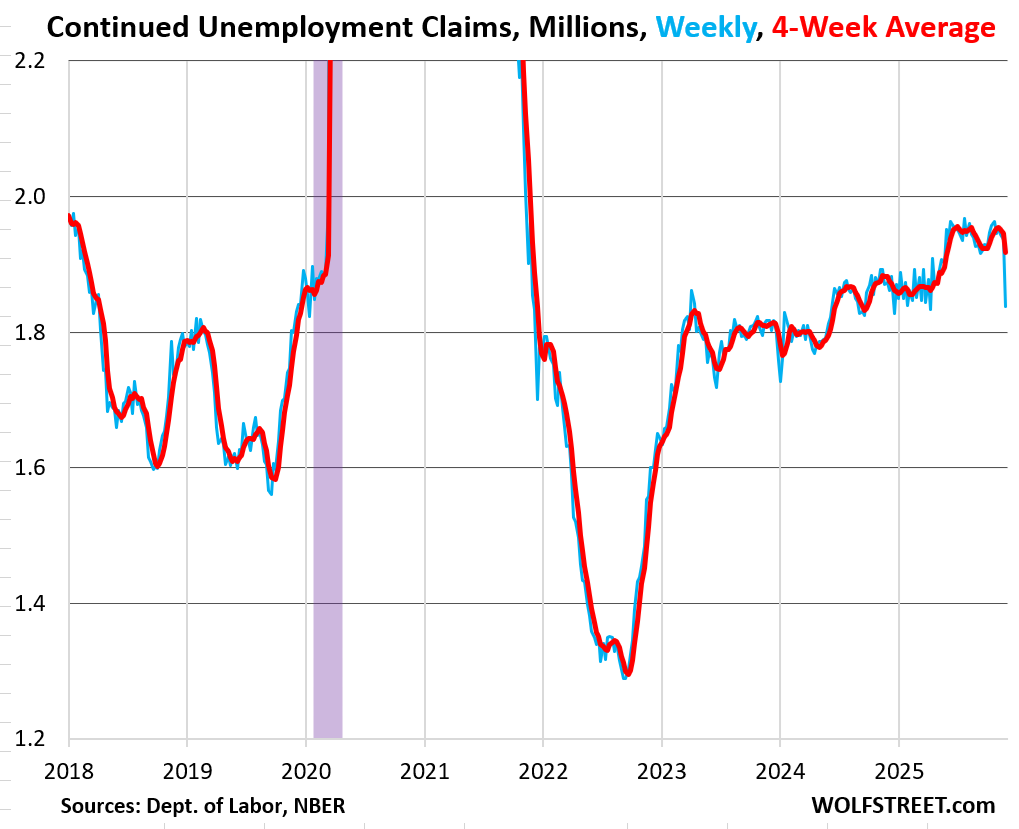
These continued claims are relatively low in a historic context. Over the past four decades, it’s only during the tight labor market in 2018 and 2019 and in the years of the labor shortages in 2021 and 2022, that the level was lower – despite the much larger nonfarm payrolls.
It indicates that people remain on unemployment insurance rolls somewhat longer than in 2022-2024 and in 2018-2019, but not as long as they did in the prior decades.
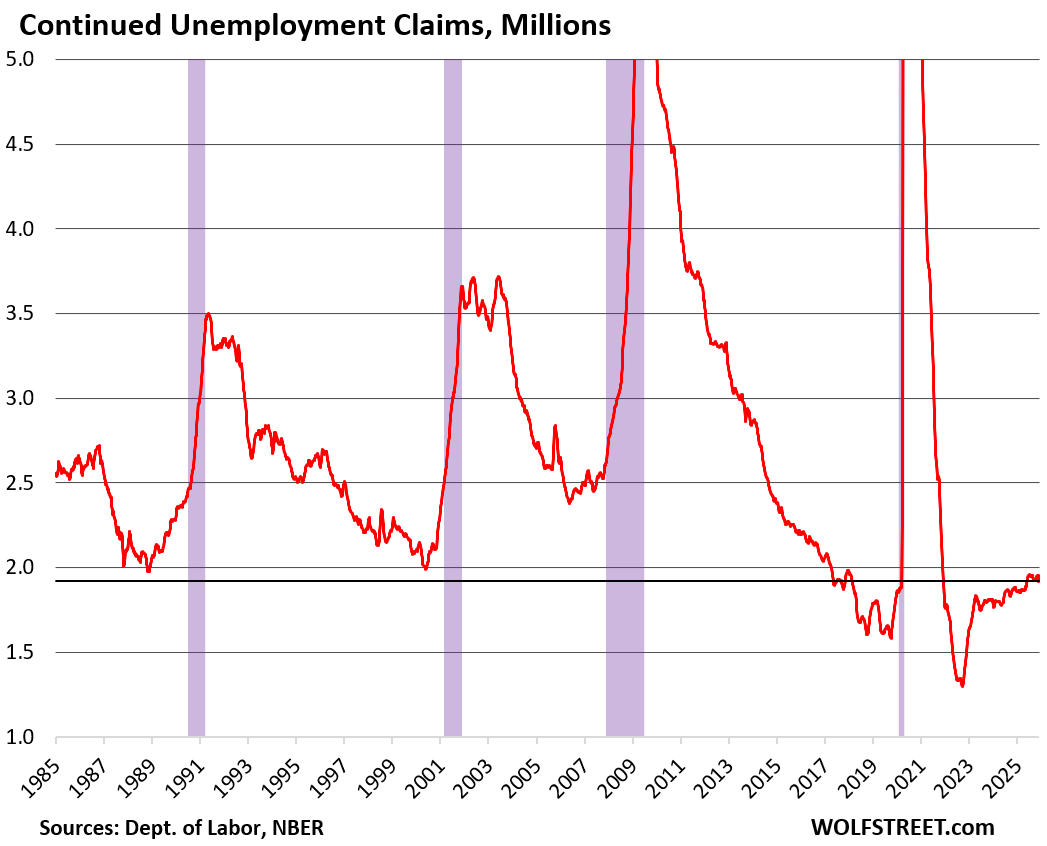
So layoffs are low, but once laid off, it takes people longer to find a job as companies have slowed their hiring, but even that has improved since the summer.
AI is turning out to be a further complication for people who’ve graduated from college and are trying to start their careers.
The CEO of Intercontinental Exchange (ICE), Jeffrey Sprecher talked about it in an interview. His company has rolled out AI tools for its staff years ago. He said the AI tools have made his people more efficient. The company hasn’t “necessarily eliminated any positions or what have you,” but the company slowed down hiring for “these kinds of entry-level jobs. They have been getting automated in many cases, where somebody might have had a junior person doing something,” he said.
“And so I have a lot of friends that have children that are graduated from college – good colleges with good degrees – that are having problems and their friends are having problems entering the workplace,” he said.
“I see that because I look at our own behavior, which is we’re kind of slow-walking some of that hiring now because we’re using these tools.”
College graduates having a hard time finding a job is now a wider issue, especially because AI tools have reduced somewhat the number of entry level jobs. But college graduates who have not worked the minimum amount of time are not eligible for unemployment insurance, and are not in the unemployment insurance data here. But they’re in the unemployment figures of the jobs report.
Enjoy reading WOLF STREET and want to support it? You can donate. I appreciate it immensely. Click on the mug to find out how:


So AI is propelling the stock market
but AI is also causing an issue in the job market that is portrayed as a problem
and the Fed cuts rates because of those issues in the job market from AI
and the stock market goes up because of those rate cuts that allegedly are directed at the employment problem caused by AI
So, there is an absurdity here.
Does the Fed really believe that rate cuts will cure an employment problem caused by AI? Better question, do they care? They have the hammer and everything is a nail.
When you realize the goal is to prop up the stock market so that a reduction in wealth effect spending doesn’t cause a recession, it all makes sense.
That’s the problem with the ”wealth effect.” Once you create it, you can’t unwind it.
Full employment used to be unemployment below 5%.
Now we get Fed hand wringing with 4.4% unemployment…..a veiled excuse to keep the punch bowl full, the party going, cut rates.
It is beyond reason to cut rates with the markets at all time highs, costs of living near or at all time highs, insurance, medical care….. you name it.
If this is a time to cut, when do you raise rates.
Greenspan and his “irrational exuberance” caution is missing in all of this.
Country Clubs with ten year waiting lists……on one end, and Socialists winning elections at the other end. The societal rubber band is stretched.
I work in Big Tech and in AI specifically. At this point in time, AI is not eating lots of jobs but it’d soon. Most companies over hired a lot in last 5 years and are now shedding the fat. Tech job market is pretty bad and difficult to find job because of AI to some extend, big scale outsourcing and Cos preferring workers on Visa as they work as indentured slave due to decade long process to come out of visa and get green card.
FED cutting rates won’t impact Tech job market directly.
I don’t think that AI is capable of doing anything it is not told to do. That’s how AI works. It is trained to minimize the variance, the sum of the squared error, between a political target based array of inputs which the model selects at the correct value too minimize the outcome as opposed to the target. Hopefully the array inputs doesn’t include thermonuclear war as an option.
Come on…There’s no business like the glow business! And electric bills will drop!!
AI will crash & burn, just like Crypto and electric cars. It will make the Dot com crash of summer 2000 look like a walk in the park.
What do you think about people who have long since exhausted their 6 months of unemployment. They do not count as unemployed. How are they counted?
They count as unemployed and they’re part of the unemployment rate. But that’s a different data set you’re referring to with that question.
It has always that way. There have always been job seekers who’ve reached the end of their benefits without finding a job. Nothing new. And they all count as in the unemployment rate as unemployed.
That is measured in the U6 Unemployment rate, which is up about a point since the low in 2022. It is still near historical lows.
These are the people who play PC games all day.
Powell coming out today saying they don’t trust the jobs data. Though I suppose with the moving average, things still look in line? What are the safeguards against data gaslighting, I wonder.
Right? That was a bold move saying we don’t trust the data it’s likely overstated by 60k jobs a month. I feel like if you know that, why don’t they then fix those models and data?
BS, both comments.
Powell did NOT talk about this data here. This is unemployment claims, based actual applications for unemployment insurance. RTGDFA
This data here is not revised. It’s administrative data of actual applications filed by actual people.
What Powell referred to the monthly nonfarm jobs report data, which is survey-based. The initial numbers that are reported monthly in the jobs report were overstated, and then the annual benchmark adjustment based on quarterly corporate payroll tax filings (estimate released in September, final figure applied early next year) substantially lowered those initial estimates. But that adjustment is once a year, and essentially a year behind. This has been the case for the past two years. Three years ago, the initial estimates were too low and were then adjusted upward.
So the nonfarm payroll jobs-created that are reported every month are very unreliable, but the benchmark adjustment comes too late for making policy decisions. So this is a quandary for the Fed.
In addition, the preliminary monthly nonfarm payroll figures are often revised down the following two months, based on more complete surveys, which adds to the issues. I use the three-month average in my charts, which irons out those revisions.
Powell’s 60,000 figure is based on the September estimate by the BLS for the annual benchmark revision, which I covered at the time. He just repeated it and carried it forward to today.
The final figure of that annual benchmark revision will be applied in early next year.
So Powell and many others think that these issues with the preliminary monthly estimates continue. The BLS needs to get a handle on this. At least, it should adjust its figures quarterly, not annually, to the corporate payroll tax filings, and I don’t understand why it hasn’t done that.
Boomers have plenty of room in their McMansions and second homes for their college graduate grandkids to move in — multigenerational living is hot after all
My God. Can you imagine the horror of my college graduate grandkids trying to move in. I would put my foot down and say no way.
“AI productivity” is code word for replacing American kids with H1Bs. They can quickly print those diplomas in India.
In fact Amazon has so much productivity gains they requested 10,000 H1Bs for 2026. They also just announced investing $35 Billion in India’s AI development. Just deleted my Amazon account.
You don’t need to “delete” your account. That doesn’t change anything. Amazon will keep all your data no matter what you do. Just don’t buy there, except my books 🤣
Amazon sucks! They are on my vendor boycott list except for books. I could list a dozen reasons. They hacked my Credit card is reason number 1. And I use a gift card for that. That’s It.
agree. screw amazon. bezos is a nihilist asshole. in other words, a great amerikan. use abe’s books. much cheaper too.
I’m all in on Amazon.
No going back now.
Lol
They “hacked” your credit card?
What do you mean?
“They “hacked” your credit card?”
“What do you mean?”
After I bought a zoom camera from them I got some additional charges for items I didn’t purchase. It was obvious Amazon leaked the credit card data. I had to cancel my card and get a new one. Wasted 3 to 4 hours of my time.
Amazon enrolled me in Prime w/o my permission. Amazon is a criminal organization. F$ck Amazon.
Andy – don’t let the daily headlines suck the brains out of your head. If you have an american kid that you are worried about, educate them and enjoy life.
OMG… Andy deleted the Amazon account.. What is going to happen to Amazon?
As usual blame everyone and everything else.
Sandeep,
How come we never get tall-Europen-blonde-type H1B scientists?
May be they dont exists.
May be they exists and they dont want to come USA . They are happy where they are.
Who knows?
Most US companies are not going to listen to your White supremacy crap. They will continue to seek and hire talent in all groups and colors.
I was shocked when the weekly spiked but the 99k drop in the continuing claims made me happy and to stick with the thesis. Job market is super solid and getting better(largeness of fiscal policy and deportations will drive the unemployment rate lower in the months ahead). I posted on here that the market topped in the end of October a day or two after the willshire 5000 hit 69t, willshire closed today at a hair(24b) away of 69trillion today, I can’t help but seeing a double top. I have a 3 day rule for new highs(like fish and guests), needs 3 days to trust it. Will find out soon, if the bull is intact for a Santa run to new highs or is coming to end. New liquidity announcement and we are back at a double top. algorithm is easy to follow, except Googl sold off today and Googl should determine the AI bubble direction, it’s the last momo race horse.
I suspect that you may have captured the essence of the whole mystery of it when you pointed out that ” Googl should determine the AI bubble direction, it’s the last momo race horse.”
Bitcoin just fell 2k in less than 10min! AVGO is down 10%, chips not hot. this could be it! Roller coaster drop next week?
My Blue Cross Blue shield customer service line has gone to AI for any calls from customers. I tried it the other day. I spent 15 minutes talking to “Betty”, a machine voice activated BOT. I got no answer to my simple question about a lost check that disappeared in my provider’s office. Finally, I demanded an “Operator” and got a human. She answered my question in 30 seconds and got the problem resolved. AI customer service will soon be extended to insurance claims, and other essential services. It will be hell on earth for everyone, and only the corporations that use it will be salivating with fat profits as they eliminate jobs. ENJOY!
The job market is… fine. Anecdotally I see some softness in my neck of the woods regarding tourism: Colorado’s primary export.
The numbers were soft for the summer, and my particular ski area is suffering from management stupidity, causing uncertainty. That and some churn regarding some of our help/ contractors in regards to some wage scandals.
On the other side: construction is at a full clip. The RE market has slowed to a crawl.
All these comparisons are made to ATH records after record times following the pandemic era weirdness.
The music is still playing, and nobody knows when it will stop: keep an eye on your chair!
Budweiser plant in Fairfield closing in ‘early’ 2026. Maybe as a severance package, they can give every employee 10 cases of Bud. 🍺
bud ain’t beer. flavored water. how do people drink that garbage.
“how do people drink that garbage.”,well,for me was red solo cups at the kegs!
Epic parties and and played many of which I was singer in the band,good times!
The Merrimack, NH, BUD plant is also closing.
Not an economic indicator, just a change in consumer tastes and preferences.
BUDLITE ( they still have a bunch of the Dylan Mulvaney leftovers ).
The official bud line is they are updating to new plants ect.,time will tell.
agree. screw amazon. bezos is a nihilist asshole. in other words, a great amerikan. use abe’s books. much cheaper too.
My experience in the job market is different than what the data shows. I’ve been unemployed since June and have applied to ten jobs per week, from $50k analyst jobs (I have a degree in economics), to jobs at Starbucks (I have experience at Panera and Starbucks), to Fedex (I have 4 years experience delivering packages and worked at a furniture store). I have received three grants for non-profits. I add value. 20 years life experience, degree, supervisory experience, etc.
I’m lucky to get 1 interview in 100 job applications. Employers are looking for perfection, not just someone who can do the job.
Back in 2005, looking for a job was more of confidence. Oh, you need a job right now? I’m hiring right now. Let’s go.
Now it’s like- let’s take two months and find the perfect person.
This isn’t showing up in the numbers I guess. But it will eventually I think. I don’t think in an outlier.
Sorry to hear about this trouble. If you’re not even getting interviews, I suspect your resume needs something fixed or you’re not targeting correctly. Have you spoken to recruiters? Most of them are useless, but some are decent.
It’s showing up in the numbers. That’s exactly what the numbers tell you. I actually explained that, and you would have seen it if had read it.
Thank you for all you do, but is there any regional data that could be included? Comments range from doom and gloom to all is well based on personal experiences. My son lives in AZ and my daughter in NYC. One place is booming the other sliding into recession.
I lived in Tulsa off and on, the most recent stint was from 1985 to 2000. During much of the time, Tulsa was in a depression and then stagnation, even during the dotcom bubble while the SF Bay Area was red-hot booming. Look at the Rust Belt cities that were in a depression for decades, in a massive way, lost a big part of their industries, population, and jobs, while other cities boomed. That’s just how it is. Some places are doing well, and some are not. It’s important for young people to go where the action is. And they usually do… which is why populations declined in cities like Tulsa. It’s not a national recession until the entire nation sees an economic decline. Which is why boots-on-the-ground impressions in one place mean zero for the overall economy.
You wrote “Initial applications for unemployment benefits … is historically low, and in the same low range that it has been in for the past four years” and “continued claims are relatively low in a historic context.”
What you said qualitatively makes sense: “once laid off, it takes people longer to find a job as companies have slowed their hiring, but even that has improved since the summer…AI is turning out to be a further complication for people who’ve graduated from college and are trying to start their careers.”
I’d be interested in further evaluation of numbers that show this qualitative experience.
ICE is in Atlanta. Even if he did start hiring them, where will they live? Million or two plus to raise a fam.
I know he and they are also caught in “this”, but the country has to figure out if we should build a large castle somewhere and put all the CEO’s and Politicians and so on, and then everyone else is down in the village. That’s what they’ve signaled. Federal Government is directly involved in the problem.