
Corporate guidance for capital expenditures keeps getting ratcheted higher and involves massive sums, largely focused on AI infrastructure.
By Wolf Richter for WOLF STREET.
The amount spent on the construction of data centers spiked by 7.0% month-over-month and by 46% year-over-year to a seasonally adjusted annual rate of $68 billion in June, according to construction data from the Census Bureau today. Since the beginning of 2022, monthly construction spending on data centers has spiked by over 500%.
But these amounts only reflect the construction costs of the building, the improvements around the building, and the equipment integrated into the building, such as HVAC systems. And this spending is growing on a near-exponential curve.
Once a data-center building is finished, the real spending commences in order to turn a concrete box into a functioning data center. The amounts here do not include the most expensive parts of a functioning data center: the immensely costly servers, the racks, the equipment to connect the servers to the internet, the electrical equipment to supply power to the servers, the power generators, the transmission lines, etc.
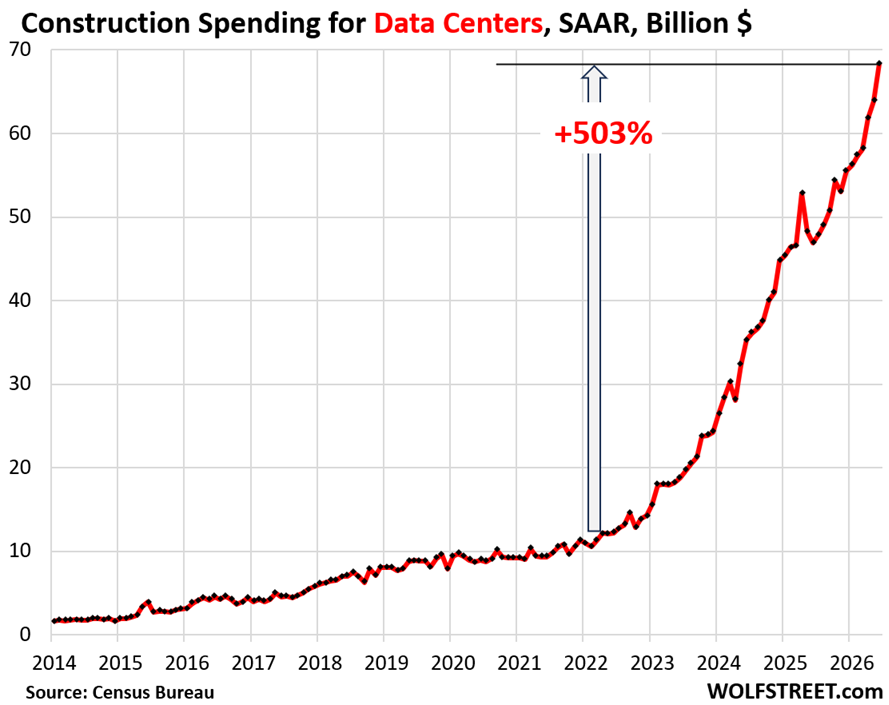
It is not often that corporate spending shoots up at this rate. Those kinds of the-sky-is-the-limit curves don’t last. They do hit a limit, and it’s a lot lower than the sky. But that moment hasn’t come yet.
The corporate announcements of capital expenditures keep getting ratcheted higher. In terms of the hyperscalers, the capital expenditures involve massive sums, largely focused on AI infrastructure.
For example, Alphabet increased its guidance for full-year 2026 capital expenditures to a range of $195-205 billion, up from $91 billion in 2025. Meta increased its guidance for full-year 2026 capital expenditures to a range of $130-145 billion. Microsoft increased its guidance for 2026 to a range of $175-190 billion.
Hundreds of billions of dollars of cash flow that would have gone into share buybacks or Treasury securities is now going into AI infrastructure. In addition, companies have issued new shares at near record high prices, they have borrowed massive amounts, they have “committed” even more massive amounts, a big part of it off-balance sheet, all in order to push the AI infrastructure buildout forward at a blistering speed, come hell or high water.
This massive boom in data center construction is causing shortages of all kinds, including shortages of specialized labor, such as electricians. The electronic equipment needed for those data centers is causing shortages of semiconductors, including memory chips, and prices have spiked. The electricity needed to power the new data centers is straining the grid and pushing up electricity prices. There are shortages of power generation equipment. The list is long and reaches across the economy.
Since money doesn’t seem to matter in AI-related spending, with the priority being to just get it done, the boom is drawing resources away from other activities – and costs are ratcheting higher, and some of those higher costs have started to filter into consumer prices.
Enjoy reading WOLF STREET and want to support it? You can donate. I appreciate it immensely. Click on the mug to find out how:


I hope this does not happen but is a lobbied Congress stupid enough to legislate and regulate AI to the extent that all the players get a regulated oligopoly and contracts with Dept of Defense, and militarily we must bail out these companies and too big to fail…..such that we do not let the market separate winners and losers and the losers sunk costs are eaten by shareholders, investors and bond holders; but instead taxpayers and consumers?
Yikes!
My son (GenZ) just explained to me yesterday morning, AI sunk cost and how the government will have to bail them out for “national security reasons” as justification to buy AI stock (according to ChatGPT). I think the craziness is exponentially too.
Now there’s a perpetual motion machine/self-licking ice cream cone for you: AI tells you to invest in AI because the government deems AI too important for “national security.”
Meanwhile, the rot in the Empire of Chaos intensifies…
Modern “progress” in America –
“Artificial Intelligence” being rigged to advise insider payoffs/too crooked to fail “insurance” instead of the “Genuine B*stards” (politicians) doing it the old fashioned way…
That was my flipping point for getting on the AI train. This snake is gonna eat itself unless people think for themselves enough to get off the ride.
So yea, full port DRAM.
This is what Dario is pushing for and this is what Palantir CEO are arguing against. Dario and Sam need their models to be “protected” so that they can charge companies up the wazoo vs. open source which are significantly cheaper. The bailout could come in the form of government regulation that prevents competition and ensures higher revenue for Anthropic and Open AI.
It’s mostly irrational. There is no evidence the demand exists for this amount of compute and highly unlikely the tech will be optimized to ever generate ROI. And by the time, of and when, the compute comes on line, all the server racks and chips will need to be replaced by newer generations. That said, it still is creating jobs, but guessing a significant amount of the “commitments” never get built out. You just can’t be the first company to do it but when OpenAI debt and lack of financing finally come to a head others will follow suit.
This mostly depends on on the next gen of edge computing evolves. The previous gen put the majority of the horsepower in our pockets/houses.
Will the next gen be able to have that kind of compute power truly reside on the edge or will it have to be the near edge, i.e., a datacenter within X number of km/person etc. At least initially and with this generation of hardware and “AI” tech, a large amount of the “edge” will remain distributed for some time to come.
In Minneapolis, a data center proposal was announced last week. This is from Hoodline.com:
“Minneapolis’ former newspaper factory is poised for a second life as an artificial-intelligence hub, with housing or retail potentially tagging along for the ride. The deal would turn one of the North Loop’s last major industrial properties into a test case for how downtown real estate gets reinvented.
“A Virginia-based developer has signed an agreement to buy the shuttered Minnesota Star Tribune printing plant, according to The Minnesota Star Tribune. Legacy Investing is pursuing a data center at the 13-acre Heritage Center site, while also envisioning a mixed-use project that could include homes or shops.
“…The company’s pitch for the North Loop is that revenue from computing infrastructure could help finance more conventional neighborhood uses that might otherwise be difficult to build on the property.
“…the site could support roughly 20 megawatts of data-center capacity over the next two to three years.
“The timing is notable because Minneapolis recently approved a temporary pause on most new data-center development while officials study energy use, environmental effects, public safety and other regulations. CBS Minnesota reported that downtown projects smaller than 350,000 square feet are exempt, although the exact size and permitting path for the Heritage redevelopment have not been announced.
“Data centers are attractive to developers because former printing facilities often have large electrical systems, expansive floor plates and loading infrastructure already in place…
How this plays out will be interesting.
Projects smaller than 350k sq ft. Being considered small. Existing facilities in the millions of sf
I the next meltdown leading to warehouse-a-geddon?
Unrelated, but due to a new demand charge in my local power COOP, my power bill has recently about doubled (over the previous all time high)
“come hell or high water”….so….no happy ending
Never have I seen the true potential of AI discussed; broadband was driven by leading edge porn industry technology and look at today’s resultant robust internet, half of which is proudly porn. AI promises an exponential advance in porn technology; especially when the promise of quantum computers in rendering 3d holographic projection is considered. AI and quantum computers will realize a porn cornucopia only dreamed about in far future science fiction writing. Data center electricity isn’t that expensive, and going from incandescent to led gives us the power to live forever in an AI powered porn universe.
You need to sell this idea to Altman as he is running short on ideas for selling his slop.
Hucksters like Altman are always 5 minutes away from “porn as a revenue source” anyways…Kinda surprised that WeWork in its death throes didn’t change its name to WeWorkIt and try the sublet brothel revenue model…
Literally just posted on Indeed…
“PR Specialist, AI Optimism and Industries
NVIDIA 4.2 4.2/5 rating
Santa Clara, CA
$84,000 – $166,750 a year”
Jensen Huang, you pop-collar Fonzie, you’re going to need a bigger boat…a couple of months ago you were offering bath-room attendant candidates half-a-mil…
What a wonderful contribution to society.
I would guess with AI Porn on the horizon, one could put an image of themselves into a porn flick as a participant!
I think perhaps somebody needs to revisit how exactly sex IRL works…and don’t query an AI!
(…AI ain’t a teleporter…or a holodeck…)
And most states, in particular Texas, whose governor has chased this virus,now have awaken to realize they do not have the water resources or electric power to support the centers.
ERCOT is currently tracking more than 1,800 projects in the queue, representing over 474 gigawatts of electricity, or more than five times the grid’s record for peak demand, according to ERCOT. Approximately 90% of the new power requests are data centers, Abbott said.
And guess who will foot the bill?
Good luck on air conditioning your house.
Another Republican grift.
The two Basic Rules of our increasingly fascist Techno-Feudal regime:
1. Because Markets
2. Go Di
The curve is not “near-exponential”. There are two linear segments, with a slope change around Jan-2023. The adjusted R^2 of the second linear segment is quite decent, at 0.97244
1. “at 0.97244” 🤣❤️
2. There is a nice exponential curve with a constantly steepening slope from about mid-2021 through about mid-2024. That part is not linear at all. Then there are some hiccups. But then in mid-2025, after the hiccups settle down, there is another segment of an exponential curve. So that’s close enough to “near-.”
Re: “But then in mid-2025, after the hiccups settle down, there is another segment of an exponential curve.” No, there isn’t. See https://ibb.co/TDSzksnG . The lines are least square regressions of an exponential (red) and linear (blue, magenta) models.
You might want to look into better plotting and data analysis tools. For this particular article, it changes the assumptions.
Nice chart, thanks, exactly proves my point. But now read what I wrote (don’t just look at the picture), namely that the exponential curve starts when the AI data center boom started, namely in 2021, and NOT in 2014. So now look at your chart again, with the AI boom and the exponential curve starting in 2021, and you’ll see how perfectly it fits through 2024. And then the hiccups in 2025 mess it up a little, as I said.
It is basically impossible to hear the term gigawatt thrown around with such abandon in these sorts of conversations/debates without immediately hearing the voice of Doc Brown in “Back to the Future” totally freaking out about just how much power “1.2 jigga-watts!” is.
Your chart literally & visually validates an exponential curve in complete alignment with Wolf’s commentary.
Wolf: 1
Karl: 0
The chart wouldn’t even open Karl.
Thanks for the awesome data and reporting Wolf.
Good times for contractors! AI is proven profits for someone!
That is a WOW! chart for sure. Even without the AI splurge we’d still need new data centers to hold all those pictures and videos we keep in the cloud and all those Gmails we never delete with big PDF files attched. You think that storage is free??? Think again when you’re bombarded with ads all day and night. Your personal low security data is all over the world. A little perspective on the expodential AI spend so far this year. It’s still only 13% of total construction spending (Commercial, Manufacturing [Data Ctr included] and Office) of $435.6B, YTD 2026. Full year 2025, total construction spending was $467.0B which included $41.1B of Data Center spend or 8.8%. That total YTD number is a WOW!! number and great news because it’s job creation, downstream buisness generation, and Yup further pricing pressure in a high growth economy. During the commercial real estate metldown of the late 1980’s an economist stated during the 90/91 recession, “we built a 10 year supply of real estate in 5 years so it will likely take 5 years to absorb. Fed Funds rate went from 6.75% to 3.00% and back up to 5.5% after 1995. Setting the stage for the Dot.com Boom/Bust and so on. These are not extraordinary times. It’s a growth wave so paddle your board out and ride that mofo all the way in. The sky is not falling. Embrace it! Be part of it! Dont fight it!
it’s the renowned “hockey stick graph”
usually only reserved for sales projections
“To the Metaverse and beyond!!”
The title rewritten as…
“AI Data Center Construction Spending Goes Piecewise Linear (But in Business, Piecewise Linear Curves Can’t Last)”
…just rolls off the tongue.
Because you think you see a better curve fit. For non-monotonic data points. Eyeballed off a graph.
Yes, “exponential” is misused all over the web. But pick your battles, dude. It works fine here as a concise human-processable description of trend. Find a better word or phrase in the OED than “piecewise linear” and I’ll retract that.
So a while back Wolf said AI spending was largely being covered by massive cash reserves tech companies had if I remember correctly.
Is this still the case or are companies starting to open themselves up to new liabilities to finance the build outs?
I discussed this back in February, so the numbers have gotten bigger since then, but the principle of where the money will come from is still the same. Cash flow is only one part:
https://wolfstreet.com/2026/02/07/amzn-goog-msft-meta-orcl-plan-700-billion-in-largely-ai-related-capex-in-2026-heres-where-the-cash-comes-from/
Here’s the list of where this cash will come from. The article gives you the details:
– Share buybacks get cut (already happening)
– Share issuance (already started)
– Debt issuance (oh-la-la)
– Their massive hoard of cash and short-term investments
– Their huge operating cash flows.
Cherry on top: There are the massive and accelerated tax cash-benefits for investments in 2026 that will provide some additional funding.
The more you understand what’s happening, you have to be thankful that the giants have the money to accelerate this AI buildout. Some of this innovation is and will be truly spectacular. Unfortunately I’ll be dead before it matures into the general economy. But it is happening at a pretty rapid pace.
From an old dude who appreciates the affect that technology has had on my life.
They have the money, yes, but in my opinion, they’ve legally stolen it from the rest of us, through a combination of government protectionism and failure to enforce antitrust laws.
Spectacular how? In that it will cause the rapid loss of jobs, farmland, and clean drinking water?
The problem, for my company at least, is that the benefits aren’t greater than the costs. They put us on an AI budget two months ago, because they weren’t going to send all our profits to the AI companies.
Unless the companies purchasing AI fire employees, it is too expensive. On the other hand, if they refuse to buy AI or cap spending on it, the AI build out is waste because there is no market. Unless this becomes more than a wealth transfer from company to company, I don’t know how this succeeds.
I mean, if companies decide to implement any new tool without a clear business case, well… that’s on them.
There’s two big questions literally every organization in the world should be asking themselves:
1) Are there parts of my organization for which over time all competitors in my industry will use AI to lower their operational costs? I.e. find out where AI will be used as a commodity to keep up with the curve in your industry. If that’s the case, don’t waste effort inventing anything, it’s not your core business and you can’t create a lasting edge in using a commodity. Just prepare your AI framework and get your data in order, then adopt a 3rd party AI tool once you are comfortable with the business case and the maturity of the provider of your choice. Ensure you continue to own your data and avoid vendor lock-in. Examples: AI service chatbots, AI legal aids, AI HR services, AI market research, AI translation, AI code assistants, AI research, etc etc.
2) Are there any parts of my organization that, when we invest in AI, could result in a moat that would differentiate us? I.e. does AI provide new opportunities to allocate capital and improve our ROI? In that case, you should already have a clear picture of current capital allocations. Map out where AI could either add value to existing offerings, add new offerings, or expand your market. If those prospects are better than your current allocations, invest in your teams to create in-house capability to realize those opportunities.
Companies just purchasing AI subscriptions and tokens for all employees, for those those employees to then use it for prompts like: “Hey make this e-mail sound more professional” deserve what’s coming.
Wow. Policies to promote dodgy investing then a tax cut to boot to help it along. And it’s affecting water supplies!!!!!! Grids!!! Lately have been hearing AI….the term AI, as a punchline. Just get AI to cut the grass, fix the gate, stuff like that. I am cheering for a dot com event with AI. Getting cynical with all these hoopla bandwagons. Reminds me of Bitcoin.
What ever happened to investing in a better idea or product? Solid management? Prospects? It just sounds crazy, and then so much is wrapped up in the ‘race against China’. China now selling AI products (blah blah ________back to US. A lot of upheaval out there.
Thank you for these fine articles.
This all reminds me of Paul Krugman’s “Space Alien” proposal from about fifteen years ago. Spend huge amounts of money building space defenses that weren’t actually needed and that would finally fix the economy from the GFC hangover.
This AI buildout – when’s it officially built out? They knew when the railroads were done because they were all connected and you could actually ride trains. When is this buildout done? When 80% of all electricity is used by data centers running 24/7.. doing what exactly?
In about a decade companies that specialize in deconstructing these warehouse quality builds and recovering the valuable metals from obsolete computer hardware might be booked solid.
““Space Alien” proposal”
In practice became the ZIRP Housing Stimulus – and that went well…
this looks a lot like the overcapacity build of fibre optic cable two decades ago ….though it eventually got contracted mainly by telecom companies , data centers are taking up more than a third of current production with a rising trend
worth noting that the first data center in the world was built in 1945 by the University of Pennsylvania to house the ANIAC
“the ANIAC”
Just imagine how advanced the US might be if the US had spent the equivalent of hundreds of billions on endless ANIACs.
ahem.
You would have thought that at this late stage of the US macro-economy, people would have figured out that throwing inconceivable fortunes into various “projects” ain’t necessarily equivalent to actually accomplishing something useful.
ENIAC?
another reason to be wary of overcapacity is that China while badly lagging the total count of data centers has a major advantage in the form of cheap electricity .
By 2030, China’s projected to have around 400 gigawatts of spare power capacity more than three times global data center power demand. The US has a gap in the form of electricity production that seems far more relevant than data center quantity
The models that run on Chinese centers are by a large multiple cheaper than the US, so it seems to be scale against efficiency
Yes. Important thought you bring up. I may be wrong but I am surprised to find that you were the only one to mention China in this discussion. I am no expert in this field but have been following the whole AI progression. How China approaches AI and integrated it into real world scenarios may affect the US hyperscalers overall world footprint. China isn’t laying down for this battle and there’s a big world outside of the US
The list of hyperscalers is a list of companies that have created more wealth than anyone else in human history. To think that these companies have somehow got a really bad case of STUPID isn’t a rational thought
I’ve said many times before: that these huge companies are plowing their huge piles of cash, borrowing power, equity-fund-raising power (share sales at huge valuations), and commitment power into the real economy is what is pushing economic growth, employment, and inflation right now. What they’re doing is switching from an asset-light model to a model like manufacturing companies with huge fixed assets and debts. This is the biggest factor why the economy is powering through all the issues in the world right now. But that spending will slow or stop at some point, and then we’ll have a recession.
It’s also fair to ask what happened when all the people who bought stock or bonds in asset-light, high-margin software and internet services companies selling unique IP realize that they are transforming themselves into asset-heavy, low-margin utilities selling commoditized computing power.
At some point railroads, automakers, and shipping companies have more attractive financials.
nonsense. They’re just people. Vain people, (most of the leaders) who believe that AGI/ASI is coming.
But here’s the thing. What’s the downside? Like, what is going to happen to these oligarchs, these fabulously wealthy and powerful people if AI falls apart, doesn’t deliver, is a failure on an epic overbuilt scale?
Nothing. Not only do these fabulously powerful and wealthy people stay powerful and wealthy but they’re in the same boat as every other company they are in competition with. So nothing happens.
The only danger is not being on board, if AGI comes and you sat on your hands you lose.
It’s easy to see the calculation. They’ve convinced themselves its inevitable and that they are the ones to capitalize and manage it, every one of them.
They won’t lose their jobs or their wealth or power if it all goes horribly wrong in any way you can imagine, because they’re all in it together.
Worse, what happens when AGI is a reality?
Created wealth? What does that even mean? If you’re talking about stock wealth, try selling it all at once and see what happens. Stock wealth without positive cash flow is perhaps just a appeal to the greater fool principle.
“To think that these companies have somehow got a really bad case of STUPID isn’t a rational thought”
Agreed.
Except.
It would be nice to see a business plan more detailed than…
Step 1) Steal underwear.
Step 2) ???
Step 3) Make fortune.
If the US construction industry only built data centers, this exponential curve would be awesome. But construction industry builds other stuff. The industry as a whole can’t support a 5X increase in spending over a few years… where is this AI building capacity coming from? A quick search suggests total construction spend is relatively flat to down in 2026. … Constrained supply? Wolf has previously covered overall construction spending and spend by type. Big AI has the cash to outbid others which is driving up cost and increasing inflation. Will total construction spending collapse when AI slows their build? I doubt it. I suspect there will be some shift back towards pre-AI allocation. Enjoy the ride…
“A quick search suggests total construction spend is relatively flat to down in 2026”
Telling if accurate.
Given the extinction level events in CRE, I don’t think the problem is “excess demand/constrained labor supply” – more like “almost no demand in anything that ain’t Metaverse, er AI…)”
“On a podcast in late 2025, Fleming had floated the possibility that AI might help the U.S. grow its way out from under the debt even as deficits climbed. But by the time he spoke with Rubenstein, that optimism had visibly narrowed into acknowledgment that AI is, at best, one variable among several—competing against an energy shock and unchecked deficit spending, not a silver bullet.
Recent research lends credence to that hedged view, as the St. Louis Fed analyzed nearly 490,000 corporate earnings calls to show a spike in mentions of AI-related productivity but almost no appearance in macroeconomic data.”
The 10-year treasury yield is now down 10 bps from last week. Apparently, the Fed doesn’t have to do anything to reduce inflation expectations after all! Trump just needs to spew some BS about an Iran deal, and all will be well in the world again!
It’s always kinds of fun to speculate on Why. I think this has more to do with the yen interventions; it soothed fears the Japanese might dump their Treasuries to buy yen with the dollars to prop up the yen. The shift to the FIMA SRF (part of the announcements) would address that.
I find the bond market fascinating in how it reacts. As someone who remembers the 80s when people were worried that Japan would take over, Japan’s relative decline is also fascinating to me. Remember that silly Styx song Mr. Roboto?
“Copilot, summarize the early railroad bubbles in the US”
The first U.S. railroads appeared in the 1830s. Investors quickly became convinced that railroads would transform commerce, settlement, and industry, which they ultimately did.
This led to:
– Heavy speculation in railroad company stocks and bonds.
– Construction of lines based more on optimistic forecasts than actual demand.
– Large amounts of borrowed money flowing into railroad projects.
– Investors buying railroad securities hoping to sell them at higher prices.
– Railroads were viewed as the future of the American economy.
– Tens of thousands of miles of track were built rapidly.
– Capital flowed into the industry far ahead of population growth and freight demand.
– Many projects were financed with debt and optimistic projections.
Economists call this a productive bubble:
– The technology itself was revolutionary and valuable.
– Many investors lost money.
– Too much capital was invested too quickly.
– The resulting infrastructure permanently transformed the economy.
[end of Copilot summary]
Sound familiar? Also see Internet Bubble.
So the evolution of AI industry will be messy and expensive, but ultimately beneficial.
Copilot does not know, or does not choose to state, when railroads began in the US.
https://en.wikipedia.org/wiki/Baltimore_and_Ohio_Railroad
They double as a sauna and warming center in winter.
AI/Tech bubble update:
S&P 500 market cap now $70.365 Trillion.
Top 8 tech stocks (Mag 7 + Broadcom) $26.81 Trillion, still almost 40% of the entire S&P 500.
SpaceX gave its first earnings report after the close. -$451,000,000 net Loss. NICE QUARTER!!!🤣
And of course, let’s not forget Palantir, which was up 30% today (!!!)
PLTR market cap $384 Billion, EBITDA 2.66 Billion.
For comparison, Berkshire Hathaway market cap $1.1 Trillion, EBITDA 118 Billion. Wal Mart market cap $891 Billion, EBITDA 45 Billion.
YOU CAN’T MAKE THIS STUFF UP!😁😁😁
All those huge buildings will make EXCELLENT indoor pickleball courts once the inevitable march of technology makes them obsolete. I wonder how much the money supply will be reduced by collateral selling for a fraction of the borrowings. Any attempted “bail out” by the government will result in soaring interest rates (not that they are not already on the way). Way back in the early ’80s I came up with this saying- as far as I know it is original, but then there is nothing new under the sun: “Every boom is followed by a bust- the bigger the boom, the bigger the bust.” And “A.I.” is one really, really big boom.
All Wolfstreet fans need to watch movie “Boom, Bust, Boom” (2015). It goes through a lot of the boom bust cycles of the past (tulip mania, railroads, etc.). It has a unique, often comedy view of some of the boom/bust cycles.
I could have done without the John Cusack commentaries. Why do Hollywood actors who never even finished college feel they are now experts in world matters?
Tons of money going into commodity infrastructure that depreciates very quickly. Am I wrong about that? Is there something defensible that makes my AI data centers superior to yours, long-term?
I will be interested to see how this all pans out.
“Depreciation” is an accounting fact of life, so things might get depreciated on a straight line to zero in 5 years, meaning that the company writes off the entire investment in equal increments down to $0 in 5 years.
In reality, depreciation is also a fact of life, but looks different. It doesn’t always mean that the investment is worthless after 5 years. For example, a company can purchase a delivery van for $50,000 and depreciate the price over 5 years ($10,000 a year expense on the financial statement) to $0. Then they operate the van for 10 years (with $0 depreciation expense for the last 5 years) and sell it after 10 years for $2,000.
In other words, just because a company “depreciated” a server to $0 doesn’t mean that that server can’t continue to do its job for 10+ years. At some point, when it becomes too expensive to operate the older server (uses too much power, produces too much heat compared to the latest and greatest), they will replace it.