
Even as miles driven rose to a record.
By Wolf Richter for WOLF STREET.
Gasoline consumption in the US, in terms of product supplied to gas stations, declined by about 1% in 2025, to 8.91 million barrels per day, according to EIA data, below where consumption had first been in 2003, even though the US population increased by 52 million people, or by 18%, over the same period.
Compared to the peak in 2018, gasoline consumption in 2025 fell by 4.5%. Compared to the prior peak in 2007, gasoline consumption is down 4.1%.
Gasoline consumption is increased by miles driven – which inched up to a record – and is slowed by the improving efficiency of gasoline-powered vehicles and the growing share of EVs.
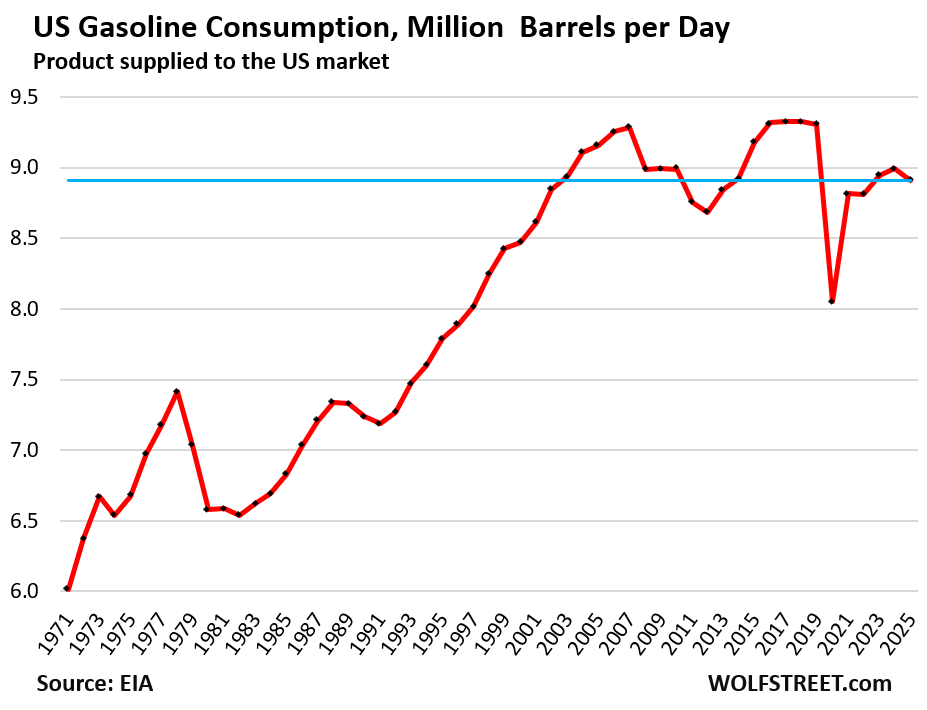
The effects of the two Oil Shocks in the 1970s on gasoline consumption was dramatic. High gasoline prices and a recession led to fewer miles driven, but it also unleashed efforts by US automakers to make and sell smaller, more fuel-efficient vehicles. And the small fuel-efficient Japanese models became immensely popular. This wave of smaller and more fuel-efficient vehicles held down gasoline consumption, and it didn’t surpass its 1978 high until 1993, though the population grew by 18% over those 16 years.
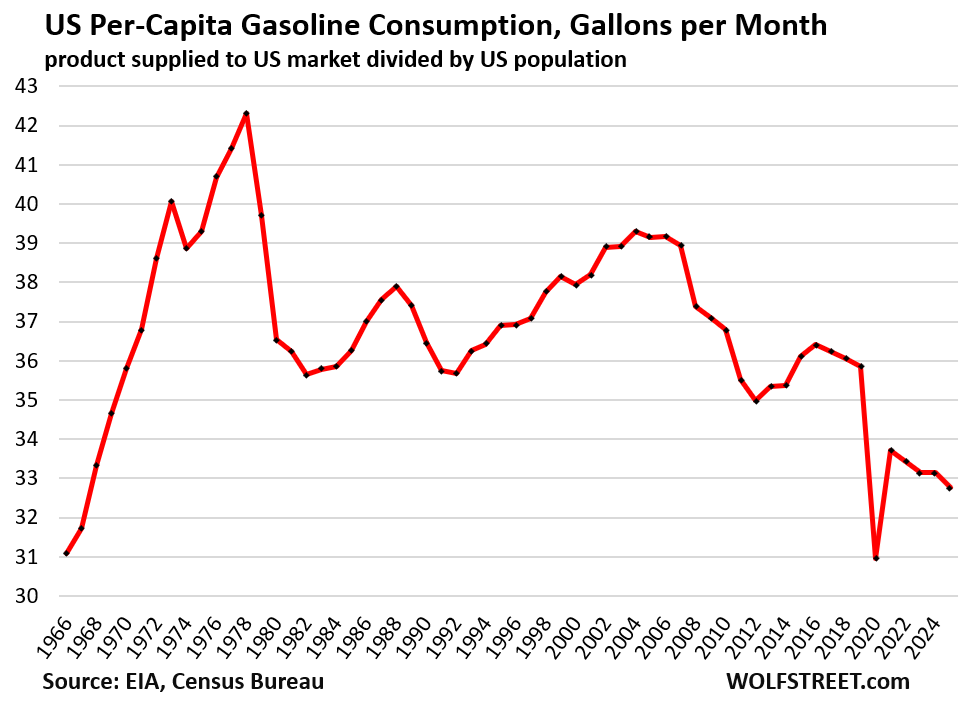
Per-capita gasoline consumption fell to 32.8 gallons per month in 2025, the lowest since 1967, except for the Covid year 2020, as a result of declining overall gasoline consumption amid a growing population.
This dynamic illustrates the structural decline in demand for gasoline.
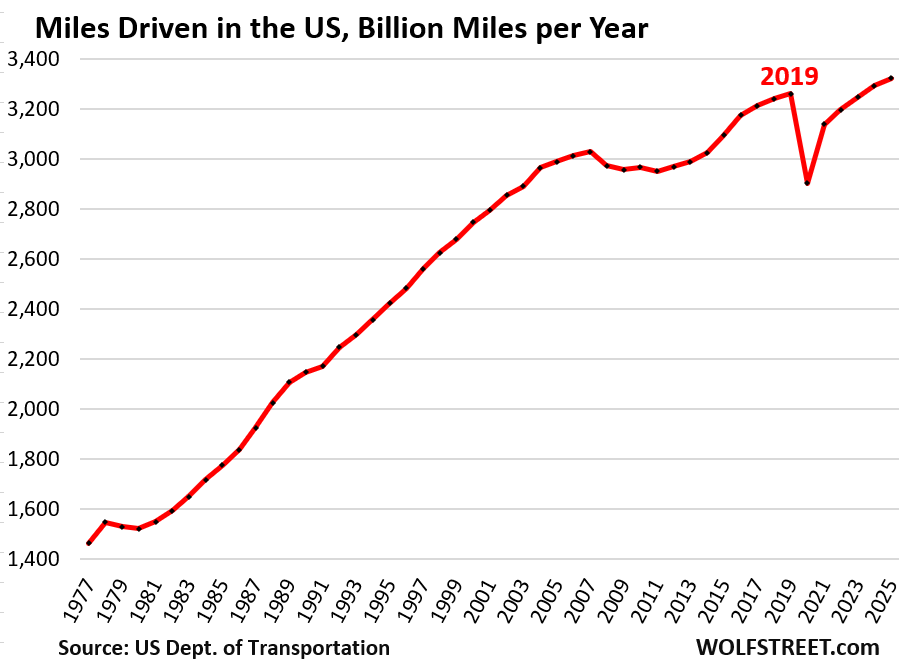
Miles driven edged up 0.9% in 2025, to a record of 3,324 billion miles, according to data from the Department of Transportation (includes miles driven by cars, light trucks, buses, motorcycles, delivery vans, and commercial trucks). But that’s only 9.7% higher than at the prior peak in 2007.
That gasoline consumption declines even as miles driven increases attests to the impact of more fuel-efficient ICE vehicles and more EVs in the vehicle mix.
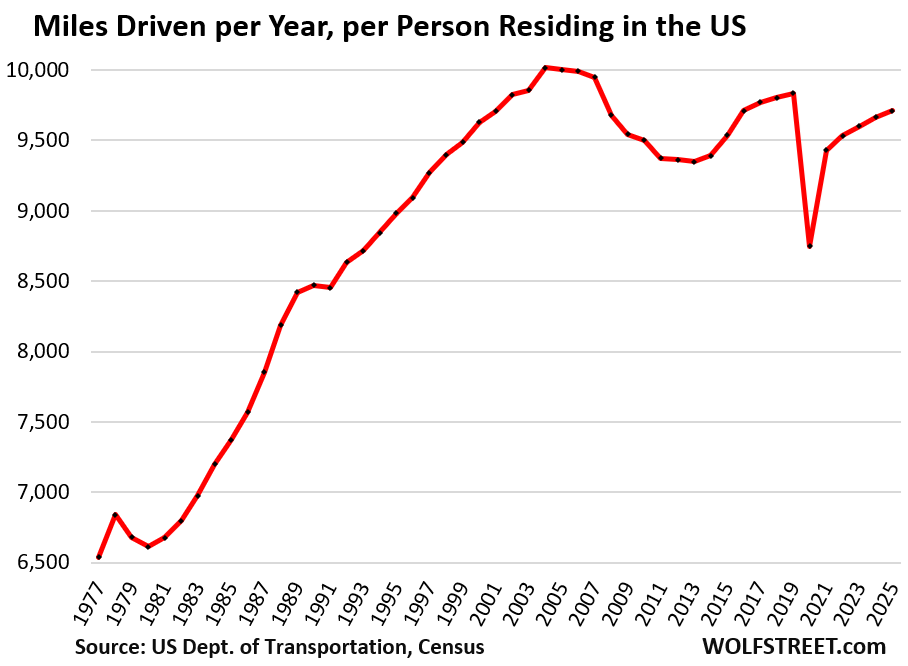
But people drive a little less: Miles driven per person residing in the US, at 9,710 miles in 2025, was 3.1% below the peak in 2004.
And average fuel economy keeps improving: that has been a big part of the long-term structural demand issue for gasoline.
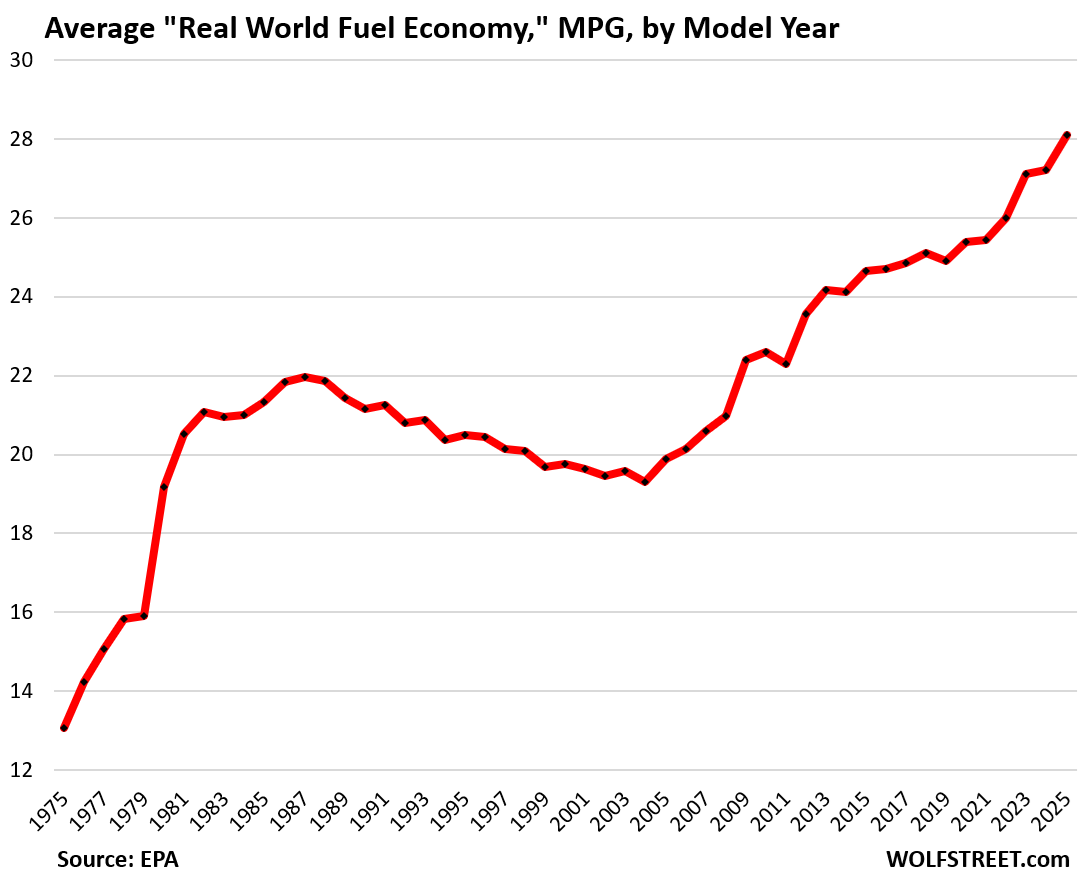
Over the past 25 years, the average fuel economy of all passenger vehicles sold in the US rose by 43%, to a record of 28.1 “real world” MPG for the 2025 model year, according to preliminary data from the EPA last month.
Note the spike in average fuel economy coming out of the Oil Shocks, as compact Japanese vehicles made huge inroads, and as US automakers began offering smaller vehicles with better mileage.
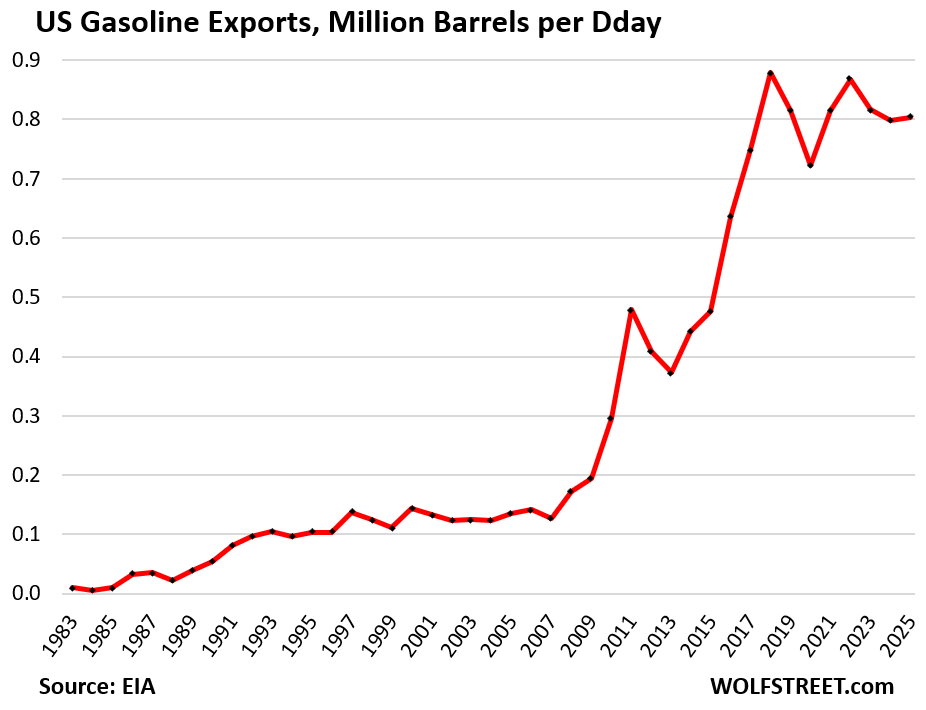
Exports of gasoline have become an outlet for refiners.
Crude oil production in the US has surged by 172% since 2008, to a record 13.6 million barrels per day (MMb/d) in 2025, according to EIA data. Over the years, exports of crude oil and petroleum products (diesel, gasoline, jet fuel, petroleum coke, and many others) have soared, and imports have fallen. In 2020, the US became a net exporter of crude oil and petroleum products, exporting more than importing. In 2025, net exports of crude oil and petroleum products rose to a record 2.8 MMb/d (detailed analysis and charts here).
Gasoline exports have become a big profitable trade for US refiners, and an outlet to replace falling demand at home. Many refiners import crude oil and export value-added products, such as gasoline, including refineries in California which face steeply dropping gasoline demand amid the rapidly growing prevalence of EVs and hybrids in the state.
For example, the US had a trade surplus of 590,000 barrels per day in crude oil and petroleum products with Mexico in 2025, importing 500,000 barrels a day of crude oil and exporting 1.1 MMb/d in value-added petroleum products, largely diesel and gasoline.
Gasoline exports started soaring in 2008, surpassed 700,000 barrels per day for the first time in 2017, hit 879,000 barrels per day in 2018, and have stayed in that range since then. In 2025, gasoline exports edged up to 804,000 barrels per day.
And in case you missed them:
Enjoy reading WOLF STREET and want to support it? You can donate. I appreciate it immensely. Click on the mug to find out how:


I live in Santa Clara, CA and Teslas are everywhere around here including in my garage.
We’re surrounded too, but not just by Teslas. There are lots of other EVs, but they’re harder to pick out than Teslas, and you have to look more closely, because they’re less distinctive looking and sort of blend in with the rest of the vehicles.
This is exactly why I went for the Blazer EV. It looks like an ICE Blazer unless you know the detail differences or parked side-by-side.
ICE is still too convienent for the great american road trip, but I love driving the EV for everyday use.
Interesting that the distribution of miles between Rural/Urban and Interstate/Arterial/Other has been pretty similar from 2017 through today. With office occupancy only in the ~54% range for the Top 10 markets, I would have guessed the distirubiton from commute to decrease but perhaps that is offset by ecommerce delivery.
Howdy Folks. Its good to be KING. OPEC never should have had control over US….
They NEVER did.
Howdy SoCal. Jimmy Carter believed it and so did I while in line waiting for my rationed 6 gallons of gas.
DBF
You do realize that fifty year old memory is irrelevant and just a tiny bit stupid ?
War in the Middle East just doesn’t hit the economy like it used to…
Especially since just about every country over there, muslim or not, hates Iran
I wonder how much hybrid vehicles have helped that number. I get like 45 mpg in a Rav4 hybrid
A lot. in the sedan segment, which Toyota dominates (along with Tesla), MPG spiked over the past 2 years model years, pushed higher by the hybrid-only Camry. So we can see the effect. But hybrids are in all categories, and lots of people are shifting to them from regular ICE power trains.
My main problem with the EV push by governments was the ignoring of hybrids.
You could gain 40-50% MPG, not worry about charging, it eliminates range anxiety (real or not).
Going from ICE to EV is great, but for many hybrids are the best of both worlds, especially plug ins
I’ve been living in Bali for 6 months and the array of Chinese EVs is definitely interesting. 15% of Indo sales are EVs BYD is the one that jumps out to me.. but just huge variety of brands, same as Chinese made TVs in American Best Buy. Not a lot charging stations that I notice, but somehow it works. EVs stand out silently in the roar of 90% scooter traffic’ … Indonesia’s workhorse. Cheap transport, a scooter is $2K USD, $1day for petrol, rideable year round in tropics, and can transport a family – and even the family dog ;) A few electric scooters here, but far more car EVs. You can swap your scooter battery easily at every mini mart which are everywhere. Indo is 280M population and a young country, .. cool to see how some of the developing world get around.
The World’s Hottest Market Just Crashed. Here’s What It Means for Investors
Panic swept through one of the best-performing stock markets in the world as investors rushed for the exits. Major companies plunged in the biggest one-day selloff on record, raising new concerns about how geopolitical tensions could ripple through global markets.
South Korea’s stock market suffered one of the most dramatic crashes in its history this week as escalating geopolitical tensions in the Middle East triggered widespread panic selling. The benchmark Kospi Index plunged roughly 12% in a single session, marking the biggest one day drop on record and forcing authorities to briefly halt trading to prevent further market instability.
That 2-day 20% crash still rolled back the gains of only 1 (one) month 🤣
I see UBER and Lyft cutting gas use (espically in places where you have to pay to park). I also know many people who will take an UBER or Lyft to an event when they can get a ride home from another family member coming to the event from another direction. Every year the number of my tenants that own cars keeps dropping since cars keep getting more and more expensive and less and less couples have two cars and more and more people are “car free” using just public transportation and UBER and Lyft (and Waymo more and more as it expends from just SF).
I lived 14 years car free. The three key things that allowed me to do that were a) a reasonable public transit system, b) a widespread and convenient to use short term car rental service (Zipcar and car2go), and c) Lyft/Uber.
Of these, Uber was the least important and critical because in my city, it’s actually cheaper to buy a car than take an Uber. Uber generally costs $5-6 a mile in my city, whereas you can own a car including all car related expenses for closer to $1-2 per mile.
My EV costs under 5 cents a mile for fuel, though of course parking, insurance, and tolls are about the same as for other cars, and upfront costs are slightly larger. I’ll probably end up paying about the same over the card lifetime for the EV as for the regular car.
i exchanged gasoline for electricity in 2004 when i started WFH.
I’m willing to bet the Average Real World Fuel Economy hit a brief nadir between 2003 and 2005 because of all the 10 MPG Hummers on the road, that all-American symbol of excess.
When was the last time you saw one of those on the road?
I’d love to know how many cybertruck owners had a hummer in the early 2000s.